SEBA Class 9 Class 10 Syllabus 2025 Dance
Finished viewing? Save it for later —
Download SEBA Class 9 Class 10 Syllabus 2025 Dance (PDF · 13 pages)About SEBA Class 9 Class 10 Syllabus 2025 Dance
SEBA Class 9 Class 10 Syllabus 2025 Dance is available here for free download. Published by Assam Board for Class 10, this syllabus can be viewed online or downloaded as a PDF (13 pages). Candidates preparing for Class 10 can use SEBA Class 9 Class 10 Syllabus 2025 Dance to understand the exam pattern, the type of questions asked, and the overall difficulty level.
Frequently Asked Questions
How can I download SEBA Class 9 Class 10 Syllabus 2025 Dance?
Open this page and click the Download button to save SEBA Class 9 Class 10 Syllabus 2025 Dance as a PDF. It is completely free on AglaSem Docs.
Is SEBA Class 9 Class 10 Syllabus 2025 Dance free to download?
Yes. SEBA Class 9 Class 10 Syllabus 2025 Dance can be viewed online and downloaded as a PDF free of cost on AglaSem Docs.
How many pages does SEBA Class 9 Class 10 Syllabus 2025 Dance have?
SEBA Class 9 Class 10 Syllabus 2025 Dance contains 13 pages, which you can read online or download together as a single PDF.
Where can I find more Class 10 study material?
You can find more Class 10 question papers, sample papers, syllabus, and answer keys on AglaSem Docs.
SEBA Class 9 Class 10 Syllabus 2025 Dance – Text
Read the full text of this syllabus below — useful to quickly search, copy and reference the content online without downloading the PDF.
📄 View text version (13 pages)
Page 1
Class-IX-X
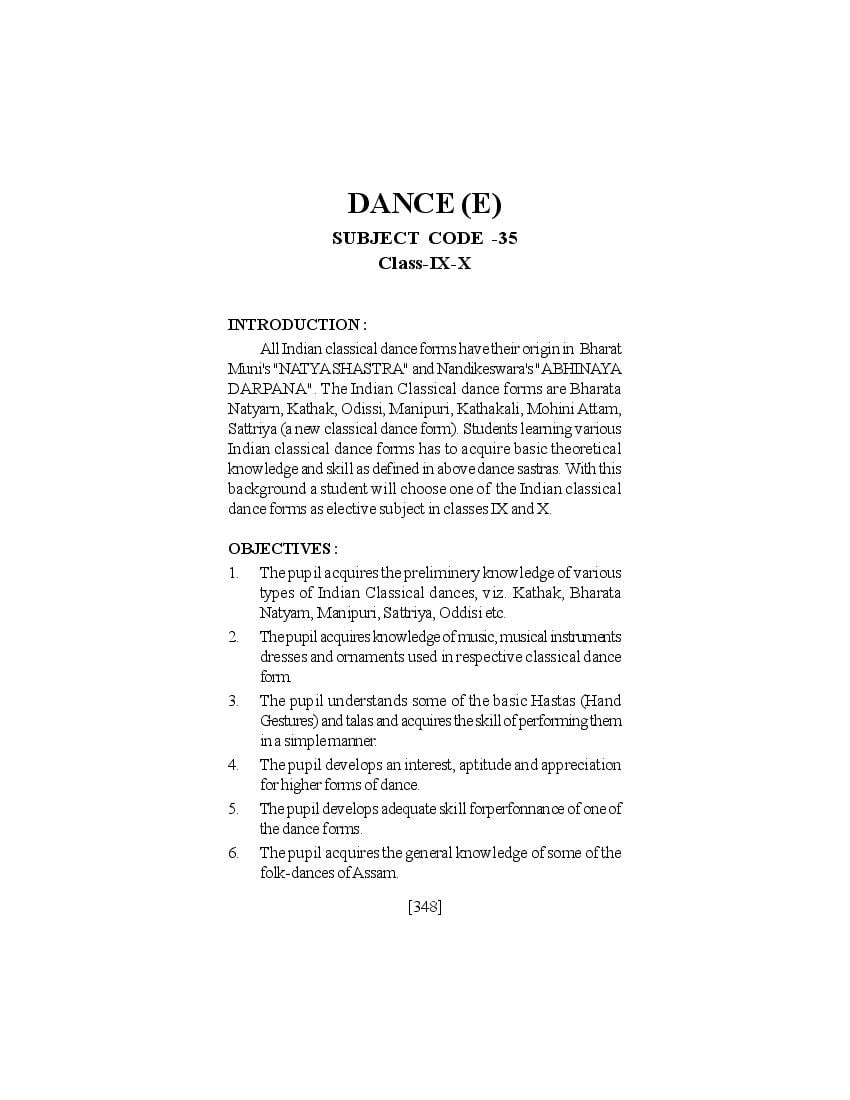
INTRODUCTION :
All Indian classical dance forms have their origin in Bharat
Muni's "NATYA SHASTRA" and Nandikeswara's "ABHINAYA
DARPANA". The Indian Classical dance forms are Bharata
Natyarn, Kathak, Odissi, Manipuri, Kathakali, Mohini Attam,
Sattriya (a new classical dance form). Students learning various
Indian classical dance forms has to acquire basic theoretical
knowledge and skill as defined in above dance sastras. With this
background a student will choose one of the Indian classical
dance forms as elective subject in classes IX and X.
OBJECTIVES :
1. The pupil acquires the preliminery knowledge of various
types of Indian Classical dances, viz. Kathak, Bharata
Natyam, Manipuri, Sattriya, Oddisi etc.
2. The pupil acquires knowledge of music, musical instruments
dresses and ornaments used in respective classical dance
form.
3. The pupil understands some of the basic Hastas (Hand
Gestures) and talas and acquires the skill of performing them
in a simple manner.
4. The pupil develops an interest, aptitude and appreciation
for higher forms of dance.
5. The pupil develops adequate skill forperfonnance of one of
the dance forms.
6. The pupil acquires the general knowledge of some of the
folk-dances of Assam.
[348]
Page 2
Muni's "NATYA SHASTRA" Nandikeswara's
"ABHINAYA DARPANA".
Subject Code : 35
Class : IX Pass Marks : 15
Theory Marks : 50 Time : 2 hours
Practical Marks : 50 Pass Marks : 15
Time : 2 hours
Part A - Theory common to all Indian Classical Dance
Forms-
Marks : 20
Marks
Contents Half
Yearly
}
1. Indian classical dances and their
origin.
2. Nritta, Nritya, Natya- knowledge of
Tandav and dasya.
3. Origin and evolution of Dance
4. Basic Postures of dances
5. Hasta or Hand gestures
6. Bhav, Rasa, Tal, Laya
* Questions from each Unit/Lesson will carry marks 2-10.
[349]
Page 3
Bharat Natyam
Part : B Theory Marks : 30
Contents Marks
1. Definition of terms - Jati, Adava, Half
Tirmanam, Solkaltu, Mandalam Yearly
2. Description of Alarippu, Jatisharam
sabdam and Barnam. (1,2,3)
3. Devahastas and Dasavatarahasta
4. Talas used in Bharata natyam
5. Various Instruments, dresses and
ornaments used in Bharat Natyam
* Questions from each Unit/Lesson will carry marks 2-10.
Bharat Natyam : Practical
Full Marks : 50
Contents Marks
Half
1. Repeatation of all dance exercises and advus. Annual
2. Knowledge of adavu, Mandalam,
Jati, Tirmanam and sollokatu (1,2,3)
3. Concert items Alarippu, Jatiswaram,
Sabdam and varnam.
4. Singing of above items
5. Demonstration of Devahastas and
Dasavatarhastas
* Questions from each Unit/Lesson will carry marks 2-10.
Sattriya Dance
Part : B Theory Full Marks : 30
Contents Marks
1. Elementary knowledge of sattriya dance. Half Annual
2. Description of Mati-Akhara, ora, chata, Yearly
Jalak, Pak, Muruka, Tewai, chitika.
Contd..
[350]
Page 4
Contents Marks
3. Knowledge of lawanuchuri Nritya. Half
4. Knowledge of Nadubhangi Nritya. Yearly
5. General knowledge of Jhumura Nach. (1,2,3,4,5)
6. Knowledge of Chali Nach.
7. Notation of tal - Chutatal, Ektal, Parital.
8. General knowledge of hasta.
9. Contribution of Sri Sri Madhavdeva.
Sattriya Dance : Practical
Full Marks : 50
Contents Marks
1. Practical Knowledge of Mati-Akhara Half
2. Knowledge of Lawanuchuri Nritya Yearly
and Nadubhangi Nritya.
3. Practical knowledge of Jhumura,
Ramdani, few ghats of geetar Nach
and few sachar of mela Nach. (1,2,3,4)
4. Practical knowledge of Chali Nach-
(1) Two parts of Ramdani
(2) Few ghats of geetar Nach (Ektal, Parital)
(3) Few Sachars of Mela Nach.
5. Demonstration of Sanjukta and Asanjukta
Hasta (according to Sri Hasta Muktawali)
6. Notation of tal - Chuta, Thukuni,
Parital, Jatital Ektal.
Odissi
Part : B Theory Marks : 30
Contents Marks
1. Odissi: its history and development. Half
2. The present repertoire for stage performance Yearly
3. Elementary knowledge of Talas and (1,2,3)
Ragas used in Odissi dance
Contd..
[351]
Page 5
Contents Marks
4. Elementary knowledge of Bhangis and Half
Pada-bhedas. Yearly
5. Elementary knowledge of Hastas used
in Odissi dance as described in Abhinaya
Darpana and Abhinaya Chandrika.
6. Instruments and Costumes.
Odissi : Practical
Contents Marks
Half
1. Practical knowledge of Talas and Ragas. Yearly
2. Practical knowledge of Pada-bheda
and Hasta. (1&2)
3. Practical knowledge of bhangis.
4. Dance items-
a) Batu, b) Pallavi on any raga, c) Muksha
Kathak
Part : B Theory Marks : 30
Contents Marks
Half
1. Origin and Development of Kathak Dance. Yearly
2. Concept of Tala, Sam, Tali, Khali,
Abartan, Matra, Pronami.
3. Introduction of Trital with Theka.
4. Knowledge of laya and its three kinds. (1,2,3)
5. General Knowledge of Anga,
pratyanga and upanga.
6. Knowledge of Asamyukta Hasta
according to Abhinaya Darpan.
7. Notaton of some bols of Trital and
Jhaptal used in Kathak Dance.
Contd..
[352]
Page 6
Contents Marks
1. Barabar, Dugun and chougum Tatkar Half
Yearly
in Jhaptal and choutal.
2. One Amadjuri Paran in Trital. (1, 2,
3, 4)
3. That, Pranami in Trital and Jhaptal.
4. Two simple tukra and two chakradar
Tukra in trital and jhaptal.
5. Advance Tatkar with palta in trital.
6. Gat Nikas of Basuri, Ghunghal and
Mukut.
7. One Kabit in Trital.
8. Practice of Padhant in Jhaptal and Trital.
Manipuri
Part : B Theory Marks : 30
Contents Marks
1. Importence of Maharaja Bhagya Half
Chandra in the development of Yearly
Manipuri Dance.
2. Note on Laiharaoba Festival. (1, 2, 3)
3. Festival Dance of Manipur.
4. Knowledge about few Manipuri
Dance Exponents.
5. Knowledge about Musical
instruments, dress and ornaments
used in Manipuri dance.
Contd..
[353]
Page 7
Marks
Contents Half
Yearly
1. NRITTABANDHA (PUNGLOL
JAGOI)- Dances on talas of rhythm
pattern.
a) Tal Tanchep in Hasya or tandava. (1 (a),
(b), (c))
b) Tal Menkup in hasya or Tandava.
c) Tal Chali in hasya or Tandava.
2. PRABANDHA NARTAN
(ISHEIJAGOI) - Dances on Songs
a) Krishna Nartan
b) Radha Nartan
3. Festivel Dance - Dance of priestess
(Mai bi Jagoi) in Laiharaoba Festival.
* Questions from each Unit/Lesson will carry marks 2-10.
[354]
Page 8
Class IX
Summary of Marks Distributions
Unit SUB-UNIT/LESSONS Marks
Theory : 50
Part -A
(Common to all India Classical
Dance forms)
Bhava, Raga, Tala, Laya
The origin of Dance Abhinaya and
its four varieties : ANAIKA,
VACHIKA, SATVIKA, AHARYA
General knowledge about regional
folk dances
Part - B
Bharat Natyam
Or
Satriya Nritya
Or
Odissi Dance
Or
Manipuri Dance
Or
Kathak Dance
Theory Total 50
Practical 50
Grand Total 100
Textbook : Bharatiya Shastriya Nrityar Ruprekha
Published by the ASTPPC.
* Questions from each Unit/Lesson will carry marks 2-10.
[355]
Page 9
Class : X Full Marks : 100
Theory Marks : 50 Pass Marks : 15
Time : 2 hours
Practical Marks : 50 Pass Marks : 15
Time : 2 hours
Part (A) Theory common to all Indian classical Dance Froms Marks : 20
Contents Marks
1. Meaning of Siras, Griva, Dristy Bhedas. Half
2. Nine Rasas and their meaning Yearly
3. Cosmic Dancer Shiva. Significance of
various parts of Shiva and Krishna. (1,2,3)
4. Brief knowledge about Bharat muni’s
‘‘Natya shastra’’ and Nandikeswara’s
‘‘Abhinaya Darpana’’
Manipuri Dance
Part : B Theory Marks : 30
Contents Marks
1. Different Rasleelas Performed in Manipur. Half Annual
2. Costumes of Lord Krishna and Radha Yearly
3. Knowledge of Notations of Talas like (1,2)
Tanchep, Menkup, Chali, Teoda, Chautal.
Manipuri Dance : Practical
Contents Marks
1. NRITTABANDHA (Punglol Jagoi) Half
Dances on Talas and Rhythm Patterns. Yearly
(a) Tal Teoda or tintal macha.
(b) Tal Chowtal or Tanjao.
2. PRABANDHANARTAN (ISHEJAGOI) (1,2)
Pure Dance on Song, Abhinaya on Song.
3. FESTIVAL DANCE
Mandila Nartan or khubakishei.
[356]
Page 10
Kathak Dance
Part : B Theory Marks : 30
Contents Marks
1. Definitions of that, Primalu, Kabit, Gat Half
Bhava, Paran and Tukra. Yearly
2. Brief life sketches of Birju Maharaj,
Uday Sankar, and Bindadin Maharaj. (1,2,3)
3. Name Various musical instruments,
costume and ornaments used in kathak.
4. knowledge of Jati and Yati.
5. Ability to write notation of the bol in
Dhamar, Choutal, Jhaptal and Trital.
Kathak Dance : Practical
Contents Marks
1. Revision of all Previous Course Half
Yearly
2. Trital
(a) One advance That with Kasak-Masak.
(b) One Tisra Jati Amad.
(c) One Chakradar paran
(d) Gat Bhava of Holi or Makhanchuri.
(1,2,3)
3. Chautal
(a) Two Simple and Chakradhar Tukra.
(b) One paran.
(c) One Tihai
4. Dhamar
(a) Barabar, Dugan, Chougun Tatkar.
(b) One Pranami
(c) One Chakradar Paran
[357]
Page 11
Bharat Natyam
Part : B Theory Theory Marks : 30
Contents Marks
1. Description of Astapadi, Padam and Tillana. Half Annual
2. Name of Various Ragas and Talas of Yearly
all the Bharat Natyam items which (1,2)
have been learnt in Practical Classes.
3. To Write notation of concert Items.
Bharat Natyam : Practical
Contents Marks
1. Repeatation of all Exercises and adavus. Half
2. Concert Items Yearly
Astapadi (1,2)
Padam
Tillana
3. Singing of above concert items.
Sattriya Nritya
Part : B Theory Theory Marks : 30
Contents Marks
1. Origin and Development of Sattriya dance. Half Annual
2. Traditionat Costumes and ornaments Yearly
of Sattriya Dance.
3. Knowledge of Anga, Pratyanga and upanga.
4. Simple Knowledge of Abhinaya
(Angika, Bachika, Aharya and
Satvika as applicable to Sattriya Dance. (1,2,3,4)
5. Knowledge about Subhankar kabi’s
Sri Hasta Muktavali.
6. General knowledge of folk dances of Assam.
7. Contribution of Sri Manta Sankar
Deva and Sri Sri Madhava Deva to
Sattriya Dance.
Contd..
[358]
Page 12
Sattriya Nritya : Practical
Contents Marks
1. Revision of the Previous Course. Half
2. Knowledge of the Raja Ghariya Yearly
chalinach (One Ramdani and geetar Nach)
3. Practical Knowledge of Nava Rasa.
4. Knowledge of the Demonstration of
Abhinaya.
5. Sutradhari Nritya (Geetar Nach,
Ragar Nach, Slokar Nach.)
6. Knowledge of the Bhaona Nritya-gopi (1,2,3,4,5)
pravesa, Ram-Lakshman or Krishna-
Boloram Pravesa, Patra Pravesha etc.
7. Abhinaya - Lawanuchuri, Kaliya
daman, Haradhanu Bhanga, Sita,
Satyabhama, Narada etc.
8. Knowledge of the acient dances
Devdashi or Deodhani.
9. Folk dances of Assam.
Oddissi Dance
Part : B Theory Theory Marks : 30
Contents Marks
1. Detailed Knowledge of Nritta, Nritya Half
and Natya. Yearly
2. Knowledge or Nine Rasas.
3. Knowledge about Mahakavi Jaydeva
and few renowned lyricists of Orissa. (1,2,3)
4. Knowledge of various Ragas and
Talas used in oddissi dance.
5. Comparative study between oddissi
and sattriya dance.
[359]
Page 13
Marks : 70
Contents Marks
1. Revision of the Previous Coursses. Half
Yearly
2. Demonstrations of few Ragas and
Talas used in oddissi dance.
3. Demonstrations of few songs used in (1,2)
oddissi dance.
4. Dance items
(a) One Astapadi.
(b) One Oriya Song With Abhinaya.
* Questions from each Unit/Lesson will carry marks 2-10.
[360]
Document Details
| Board / Org | Assam Board |
| Exam | Class 10 |
| Type | Syllabus |
| Pages | 13 |
| Updated | 30 Apr 2026 |