CBSE Class 11 Psychology Syllabus 2021-22
Finished viewing? Save it for later —
Download CBSE Class 11 Psychology Syllabus 2021-22 (PDF · 8 pages)About CBSE Class 11 Psychology Syllabus 2021-22
CBSE Class 11 Psychology Syllabus 2021-22 is available here for free download. Published by CBSE for Class 11, this syllabus can be viewed online or downloaded as a PDF (8 pages). Candidates preparing for Class 11 can use CBSE Class 11 Psychology Syllabus 2021-22 to understand the exam pattern, the type of questions asked, and the overall difficulty level.
Frequently Asked Questions
How can I download CBSE Class 11 Psychology Syllabus 2021-22?
Open this page and click the Download button to save CBSE Class 11 Psychology Syllabus 2021-22 as a PDF. It is completely free on AglaSem Docs.
Is CBSE Class 11 Psychology Syllabus 2021-22 free to download?
Yes. CBSE Class 11 Psychology Syllabus 2021-22 can be viewed online and downloaded as a PDF free of cost on AglaSem Docs.
How many pages does CBSE Class 11 Psychology Syllabus 2021-22 have?
CBSE Class 11 Psychology Syllabus 2021-22 contains 8 pages, which you can read online or download together as a single PDF.
Where can I find more Class 11 study material?
You can find more Class 11 question papers, sample papers, syllabus, and answer keys on AglaSem Docs.
CBSE Class 11 Psychology Syllabus 2021-22 – Text
Read the full text of this syllabus below — useful to quickly search, copy and reference the content online without downloading the PDF.
📄 View text version (8 pages)
Page 1
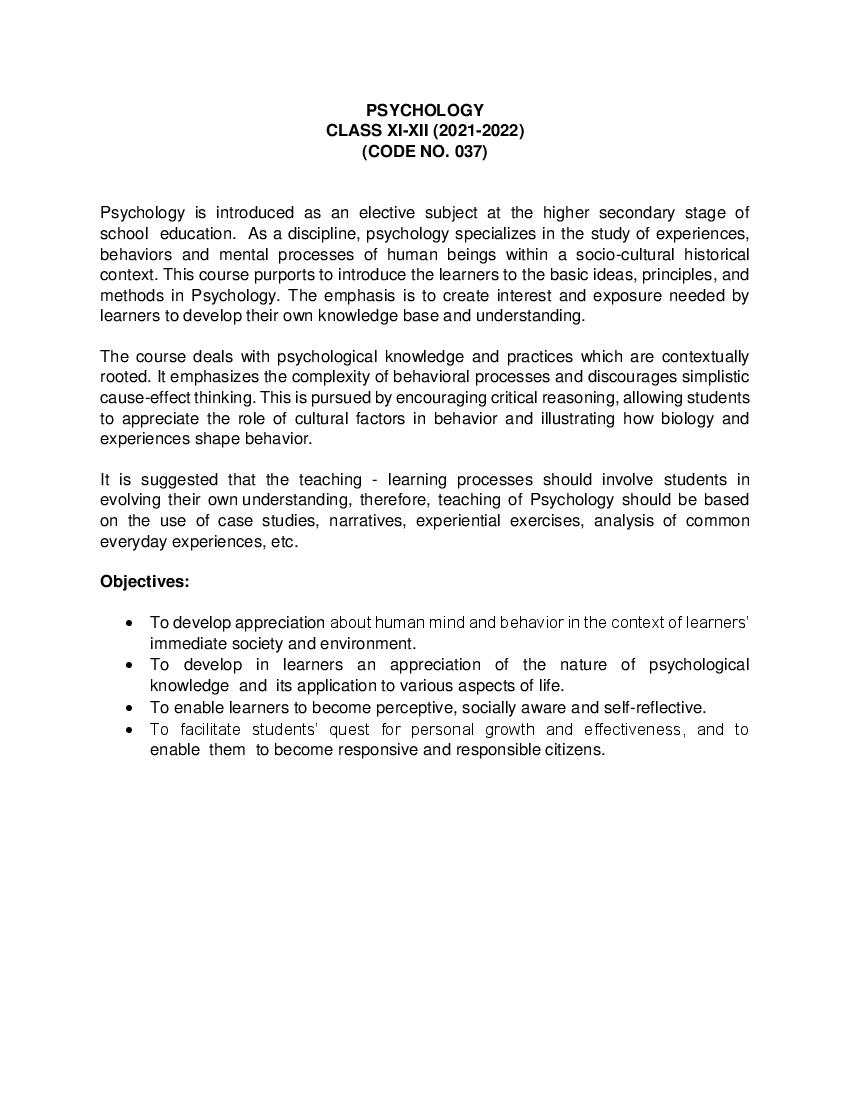
CLASS XI-XII (2021-2022)
(CODE NO. 037)
Psychology is introduced as an elective subject at the higher secondary stage of
school education. As a discipline, psychology specializes in the study of experiences,
behaviors and mental processes of human beings within a socio-cultural historical
context. This course purports to introduce the learners to the basic ideas, principles, and
methods in Psychology. The emphasis is to create interest and exposure needed by
learners to develop their own knowledge base and understanding.
The course deals with psychological knowledge and practices which are contextually
rooted. It emphasizes the complexity of behavioral processes and discourages simplistic
cause-effect thinking. This is pursued by encouraging critical reasoning, allowing students
to appreciate the role of cultural factors in behavior and illustrating how biology and
experiences shape behavior.
It is suggested that the teaching - learning processes should involve students in
evolving their own understanding, therefore, teaching of Psychology should be based
on the use of case studies, narratives, experiential exercises, analysis of common
everyday experiences, etc.
Objectives:
To develop appreciation about human mind and behavior in the context of learners’
immediate society and environment.
To develop in learners an appreciation of the nature of psychological
knowledge and its application to various aspects of life.
To enable learners to become perceptive, socially aware and self-reflective.
To facilitate students’ quest for personal growth and effectiveness, and to
enable them to become responsive and responsible citizens.
Page 2
CLASS XI (2021-2022)
One Theory Paper 3 Hours
Marks: 70
Units Topics No. of Marks
periods
I What is Psychology? 16 7
II Methods of Enquiry in Psychology 20 10
III The Bases of Human Behavior 20 8
IV Human Development 16 6
V Sensory, Attentional and Perceptual 20 8
Processes
VI Learning 22 9
VII Human Memory 20 8
VIII Thinking 18 7
IX Motivation and Emotion 18 7
Total 170 70
COURSE STRUCTURE
Unit I What is Psychology? 16 Periods
2. What is Psychology?
Psychology as a Discipline
Psychology as a Natural Science
Psychology as a Social Science
3. Understanding Mind and Behaviour
4. Popular Notions about the Discipline of Psychology
5. Evolution of Psychology
6. Development of Psychology in India
7. Branches of Psychology
8. Themes of Research and Applications
9. Psychology and Other Disciplines
10. Psychologists at Work
11. Psychology in Everyday Life
Unit II Methods of Enquiry in Psychology 20 Periods
Page 3
Steps in Conducting Scientific Research
Alternative Paradigms of Research
3. Nature of Psychological Data
4. Some Important Methods in Psychology
Observational Method
Experimental Method
Correlational Research
Survey Research
Psychological Testing
Case Study
5. Analysis of Data
Quantitative Method
Qualitative Method
6. Limitations of Psychological Enquiry
7. Ethical Issues
Unit III The Bases of Human Behaviour 20 Periods
2. Evolutionary Perspective
3. Biological and Cultural Roots
4. Biological Basis of Behaviour
Neurons
5. Structure and Functions of Nervous System and
Endocrine System and their Relationship with
Behaviour and Experience
The Nervous System
The Endocrine System
6. Heredity: Genes and Behaviour
7. Cultural Basis : Socio-Cultural Shaping of Behaviour
Concept of Culture
8. Enculturation
9. Socialization
10. Acculturation
Page 4
2. Meaning of Development
Life-Span Perspective on Development
3. Factors Influencing Development
4. Context of Development
5. Overview of Developmental Stages
Prenatal Stage
Infancy
Childhood
Challenges of Adolescence
Adulthood and Old Age
Unit V Sensory, Attentional and Perceptual Processes 20 Periods
2. Knowing the world
3. Nature and varieties of Stimulus
4. Sense Modalities
Visual Sensation
Auditory Sensation
5. Attentional Processes
Selective Attention
Sustained Attention
6. Perceptual Processes
Processing Approaches in Perception
7. The Perceiver
8. Principles of Perceptual Organisation
9. Perception of Space, Depth and Distance
Monocular Cues and Binocular Cues
10. Perceptual Constancies
11. Illusions
12. Socio-Cultural Influences on Perception
Unit VI Learning 22 Periods
Page 5
3. Paradigms of Learning
4. Classical Conditioning
Determinants of Classical Conditioning
5. Operant/Instrumental Conditioning
Determinants of Operant Conditioning
6. Key Learning Processes
7. Observational Learning
8. Cognitive Learning
9. Verbal Learning
10. Concept Learning
11. Skill Learning
12. Transfer of Learning
13. Factors Facilitating Learning
14. The Learner : Learning Styles
15. Learning Disabilities
16. Applications of Learning Principles
Unit VII Human Memory 20 Periods
2. Nature of Memory
3. Information Processing Approach : The Stage Model
4. Memory Systems : Sensory, Short-term and Long-
term Memories
5. Levels of Processing
6. Types of Long-term Memory
Declarative and Procedural; Episodic and
Semantic
7. Knowledge Representation and Organisation in
Memory
8. Memory as a Constructive Process
9. Nature and Causes of Forgetting
Forgetting due to Trace Decay, Interference and
Retrieval Failure
10. Enhancing Memory
Mnemonics using Images and Organisation
Page 6
2. Nature of Thinking
Building Blocks of Thought
3. The Processes of Thinking
4. Problem Solving
5. Reasoning
6. Decision-making
7. Nature and Process of Creative Thinking
Nature of Creative Thinking
Process of Creative Thinking
8. Developing Creative Thinking
Barriers to Creative Thinking
Strategies for Creative Thinking
9. Thought and Language
10. Development of Language and Language Use
Unit IX Motivation and Emotion 18 Periods
2. Nature of Motivation
3. Types of Motives
Biological Motives
Psychosocial Motives
4. Maslow’s Hierarchy of Needs
5. Nature of Emotions
6. Physiological Bases of Emotions
7. Cognitive Bases of Emotions
8. Cultural Bases of Emotions
9. Expression of Emotions
Culture and Emotional Expression
Culture and Emotional Labelling
10. Managing Negative Emotions
11. Enhancing Positive Emotions
Practical (Projects, experiments, small studies, etc.) 30 marks 60 Periods
Page 7
two experiments. The project would involve the use of different
methods of enquiry and related skills. Practical would involve
conducting experiments and undertaking small studies, exercises,
related to the topics covered in the course (e.g. Human development,
Learning, Memory, Motivation, Perception, Attention and Thinking).
Practical Examination
Practical (Experiments) file 05 Marks
Project file 05 Marks
Viva Voce (Project and experiments) 05 Marks
One experiment 15 Marks*
* (05 Marks for conduct of practical and 10 Marks for report writing)
Page 8
QUESTION PAPER DESIGN
CLASS – XI (2021 - 2022)
I. Theory
Time: 3 Hours Maximum Marks: 70
S. Competencies Total Marks %
No. Weightage
1 Remembering and Understanding: Exhibiting 25 35%
memory of previously learned material by
recalling facts, terms, basic concepts, and
answers; Demonstrating understanding of facts
and ideas by organizing, comparing, translating,
interpreting, giving descriptions and stating main
ideas
2 Applying: Solving problems to new situations 31 45%
by applying acquired knowledge, facts,
techniques and rules in a different way.
3 Formulating, Analysing, Evaluating and 14 20%
Creating: Examining and breaking information
into parts by identifying motives or causes;
Making inferences and finding evidence to
support generalizations; Presenting and
defending opinions by making judgments about
information, validity of ideas, or quality of work
based on a set of criteria; Compiling information
together in a different way by combining elements
in a new pattern or proposing alternative
solutions.
Total 70 100%
II. Practical: 30 Marks
Document Details
| Board / Org | CBSE |
| Exam | Class 11 |
| Type | Syllabus |
| Pages | 8 |
| Updated | 22 Jul 2026 |