Finished viewing? Save it for later —
Download CBSE Class 11 Spanish Syllabus 2021-22 (PDF · 5 pages)About CBSE Class 11 Spanish Syllabus 2021-22
CBSE Class 11 Spanish Syllabus 2021-22 is available here for free download. Published by CBSE for Class 11, this syllabus can be viewed online or downloaded as a PDF (5 pages). Candidates preparing for Class 11 can use CBSE Class 11 Spanish Syllabus 2021-22 to understand the exam pattern, the type of questions asked, and the overall difficulty level.
Frequently Asked Questions
How can I download CBSE Class 11 Spanish Syllabus 2021-22?
Open this page and click the Download button to save CBSE Class 11 Spanish Syllabus 2021-22 as a PDF. It is completely free on AglaSem Docs.
Is CBSE Class 11 Spanish Syllabus 2021-22 free to download?
Yes. CBSE Class 11 Spanish Syllabus 2021-22 can be viewed online and downloaded as a PDF free of cost on AglaSem Docs.
How many pages does CBSE Class 11 Spanish Syllabus 2021-22 have?
CBSE Class 11 Spanish Syllabus 2021-22 contains 5 pages, which you can read online or download together as a single PDF.
Where can I find more Class 11 study material?
You can find more Class 11 question papers, sample papers, syllabus, and answer keys on AglaSem Docs.
CBSE Class 11 Spanish Syllabus 2021-22 – Text
Read the full text of this syllabus below — useful to quickly search, copy and reference the content online without downloading the PDF.
📄 View text version (5 pages)
Page 1
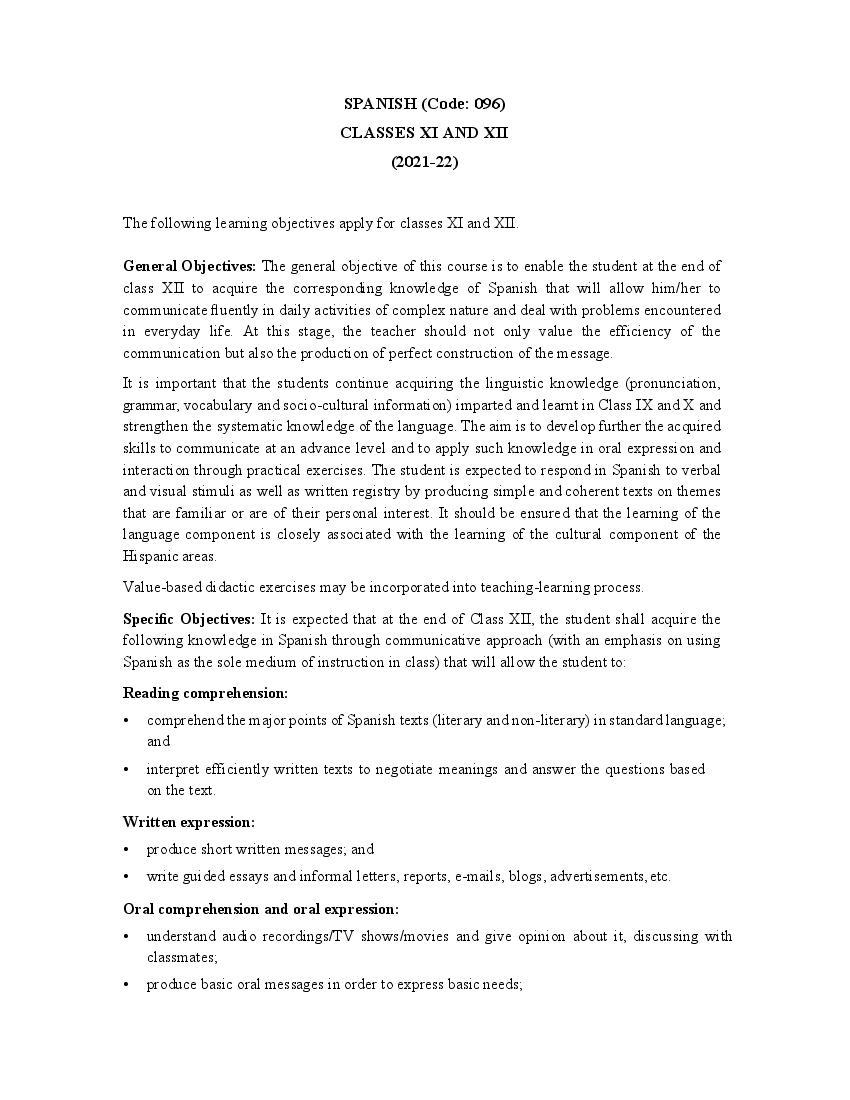
CLASSES XI AND XII
(2021-22)
The following learning objectives apply for classes XI and XII.
General Objectives: The general objective of this course is to enable the student at the end of
class XII to acquire the corresponding knowledge of Spanish that will allow him/her to
communicate fluently in daily activities of complex nature and deal with problems encountered
in everyday life. At this stage, the teacher should not only value the efficiency of the
communication but also the production of perfect construction of the message.
It is important that the students continue acquiring the linguistic knowledge (pronunciation,
grammar, vocabulary and socio-cultural information) imparted and learnt in Class IX and X and
strengthen the systematic knowledge of the language. The aim is to develop further the acquired
skills to communicate at an advance level and to apply such knowledge in oral expression and
interaction through practical exercises. The student is expected to respond in Spanish to verbal
and visual stimuli as well as written registry by producing simple and coherent texts on themes
that are familiar or are of their personal interest. It should be ensured that the learning of the
language component is closely associated with the learning of the cultural component of the
Hispanic areas.
Value-based didactic exercises may be incorporated into teaching-learning process.
Specific Objectives: It is expected that at the end of Class XII, the student shall acquire the
following knowledge in Spanish through communicative approach (with an emphasis on using
Spanish as the sole medium of instruction in class) that will allow the student to:
Reading comprehension:
• comprehend the major points of Spanish texts (literary and non-literary) in standard language;
and
• interpret efficiently written texts to negotiate meanings and answer the questions based
on the text.
Written expression:
• produce short written messages; and
• write guided essays and informal letters, reports, e-mails, blogs, advertisements, etc.
Oral comprehension and oral expression:
• understand audio recordings/TV shows/movies and give opinion about it, discussing with
classmates;
• produce basic oral messages in order to express basic needs;
Page 2
• argue superficially about a given topic and express reasons and discuss issues; and
• perform role-plays and dialogues with classmates.
Socio-cultural understanding:
• have better understanding of Hispanic cultures through shorter narrative texts/poems
selected from Spanish and Latin-American Literature; and
• acquire basic knowledge about some specific issues of Hispanic geography, history and art.
Class XI
Time: 3 hours Marks: 80
Marks
Section - A: Applied Grammar
(Based on the prescribed text books) 35
(i) Revision of elementary grammatical categories like articles, nouns, pronouns (personal,
demonstrative and interrogative), gender, number, adjectives, adverbs, conjunctions of
verbs, auxiliary verbs, possessive, prepositions etc.
(ii) Revision of uses of present tense: “Ser + adjetivo”, “Estar + adjetivo”, “Gustar /
Molestar + infinitivo”, Preferir.
(iii) Revision of uses of Se: Se + 3ª persona singular.
(iv) Verbs with prepositions: acostumbrarse a, interesarse por, pensar en, ir a, acordarse de,
etc.
(v) Verbal parafrasees: “Empezar a + infinitivo”, “Seguir + gerundio”, “Me parece/resulta
+ adjetivo + infinitivo”, “Creo que /pienso que + presente de indicativo”, “Me hace
falta/lo que necesito es /me gustaría + infinitivo”, “Hace falta /Es necesario /Es
importante /Se necesita /hay que /lo que hay que hacer + infinitivo”, “a lo mejor/quizá
(s) + infinitivo”, “Se puede + infinitivo”, “Es posible + infinitivo”.
(vi) Different forms of past tense (pretérito indefinido / imperfecto), including the perfect tense
with the auxiliary verb 'haber'.
(vii) Imperative verbal mood -command and entreaties: revision of affirmative and
negative commands.
(viii) Direct and Indirect speech
(ix) Use of idiomatic expressions
(x) Future (“Supongo que / creo que + futuro”, “seguro que + futuro”) and Conditional
Page 3
(xi) Difference between the indicative mood and the subjunctive mood.
(xii) Present Subjunctive mood
Section - B: Reading Comprehension 15
Students will be expected to read and answer simple questions from an unseen passage of about
150-200 words.
Section - C: Composition and Writing 15
A short composition of about 150 words in Spanish based on a topic related to the life around.
Section - D: Culture/Civilization/Literature 15
• Simple questions of famous works, authors, customs, festivals etc. related to the Spanish-
speaking Countries.
• The teacher is expected to make choices of texts from the prescribed textbook as per the
general competence of the class.
• Additional choice of author may be added by the teacher in addition to the ones
prescribed in Classes IX and X.
NOTE FOR THE TEACHER: (Some recommendations)
1. The above content should be presented and integrated in didactic materials and
communicative activities (related to school environment) inside the classroom in such a
way that the student develops the following competencies:
Functional competencies:
• describir algo o alguien • narrar en pasado
• hablar de acciones habituales • hablar del futuro
en el presente y el pasado
• hablar de hábitos y costumbres • hacer hipótesis sobre el presente
• comparar situaciones entre el pasado • expresar grados de certeza
y el presente respecto al futuro
• expresar acuerdo y desacuerdo • dar consejos y recomendaciones
de forma personal e impersonal
• expresar necesidad, deseo y finalidad • expresar buenos deseos a otras
personas
• contar experiencias • conceder permiso y denegarlo
2. The following suggested lexicon to be integrated into materials and communicative
Page 4
special emphasis on the aural comprehension and oral expression: saludos y
presentaciones, adjetivos de descripción física y de carácter, profesiones, actividades de
ocio, costumbres, informática, medios de prensa (la radio, la prensa y la tele), el deporte,
las dietas y la salud, restaurante, la medicina, enfermedades y remedios, expresiones de
deseo, recetas de cocina, alimentos, etc.
3. Efforts should be made to provide socio-cultural information of Spanish-speaking
countries: costumbres de los países hispánicos, el español en Internet, noticias de
periódico, revistas, radio, lugares públicos e importantes y famosos en los países
hispánicos, comidas típicas del mundo hispánico (ingredientes típicos), autores
importantes de los países hispánicos, etc.
4. The above-mentioned examples are suggestive in nature and the teacher depending on the
needs of the students may improvise the same within the framework of the prescribed
syllabus to facilitate the teaching and learning process.
Prescribed textbook:
Relevant chapters may be referred to for use as per the prescribed syllabus.
• Aula international 3 (CD+ workbook), by Jaime Corpas et.al, Difusión.
Reference textbook:
• Collins Gem Spanish School Dictionary, Collins.
• en acción Curso de español 2, (CD +workbook) by Elena Verdia, Marisa González, et. al.,
enclave ELE
• Compañeros 3 (CD+workbook) by Francísca Castro, et. al., SGEL.
e-Resources:
• “Mi mundo en palabras”: https://cvc.cervantes.es/ensenanza/mimundo/default.htm
• “Lecturas paso a paso” (lecturas adaptadas con actividades interactivas):
https://cvc.cervantes.es/aula/lecturas/
• “Pasatiempos de Rayuela” (actividades interactivas):
https://cvc.cervantes.es/ensenanza/pasatiempos/default.php
• “En sintonía con el español” (podcast en español):
https://cvc.cervantes.es/ensenanza/ese/default.htm
Page 5
In consonance with the template suggested in classes IX – X, the following model is suggested.
The weightage of internal assessment is 20 Marks and is divided into the following components:
A. Periodic Tests (2 best out of 3 to be counted) – Total weightage 10 out of 20.
- Test to be based on grammar and reading comprehensions being taught. The effort should be to
monitor the progress of the learner towards meeting the course aims and objectives.
B. Notebook submission –Total weightage 05 out of 20.
- Students are expected to maintain notebook for class work and other home-based enrichment
exercises.
- Assessment may be done on the basis of regularity on:
• assignment completion
• neatness and upkeep of notebook
- Teacher is expected to provide regular feedback to the students and identify student’s strengths
and weakness.
C. Subject enrichment activity – Total weightage 05 out of 20.
- The teacher should assess students on the skills of language learning namely, listening and
speaking. The assessment should be done on 20 marks, 10 marks each for listening and speaking.
- Two out of three tests shall be counted. The teacher should assess the student’s ability to
communicate and use the basic structure of the language with appropriate vocabulary. The teacher
should also ensure that the interactive skills are assessed at each stage.
Comprehension and Weightage Suggested activities
Listening to narrations and handling exercises such
Listening as True/False, MCQ, gap-filling and SAQ.
Conversation and dialogues, presentation on an
Speaking unseen visual/verbal stimulus (within the prescribed
syllabus and relevant to Spanish–speaking
countries), spontaneous question answers.
Document Details
| Board / Org | CBSE |
| Exam | Class 11 |
| Type | Syllabus |
| Pages | 5 |
| Updated | 15 Jul 2026 |