SEBA Class 9 Class 10 Syllabus 2025 English
Finished viewing? Save it for later —
Download SEBA Class 9 Class 10 Syllabus 2025 English (PDF · 11 pages)About SEBA Class 9 Class 10 Syllabus 2025 English
SEBA Class 9 Class 10 Syllabus 2025 English is available here for free download. Published by Assam Board for Class 10, this syllabus can be viewed online or downloaded as a PDF (11 pages). Candidates preparing for Class 10 can use SEBA Class 9 Class 10 Syllabus 2025 English to understand the exam pattern, the type of questions asked, and the overall difficulty level.
Frequently Asked Questions
How can I download SEBA Class 9 Class 10 Syllabus 2025 English?
Open this page and click the Download button to save SEBA Class 9 Class 10 Syllabus 2025 English as a PDF. It is completely free on AglaSem Docs.
Is SEBA Class 9 Class 10 Syllabus 2025 English free to download?
Yes. SEBA Class 9 Class 10 Syllabus 2025 English can be viewed online and downloaded as a PDF free of cost on AglaSem Docs.
How many pages does SEBA Class 9 Class 10 Syllabus 2025 English have?
SEBA Class 9 Class 10 Syllabus 2025 English contains 11 pages, which you can read online or download together as a single PDF.
Where can I find more Class 10 study material?
You can find more Class 10 question papers, sample papers, syllabus, and answer keys on AglaSem Docs.
SEBA Class 9 Class 10 Syllabus 2025 English – Text
Read the full text of this syllabus below — useful to quickly search, copy and reference the content online without downloading the PDF.
📄 View text version (11 pages)
Page 1
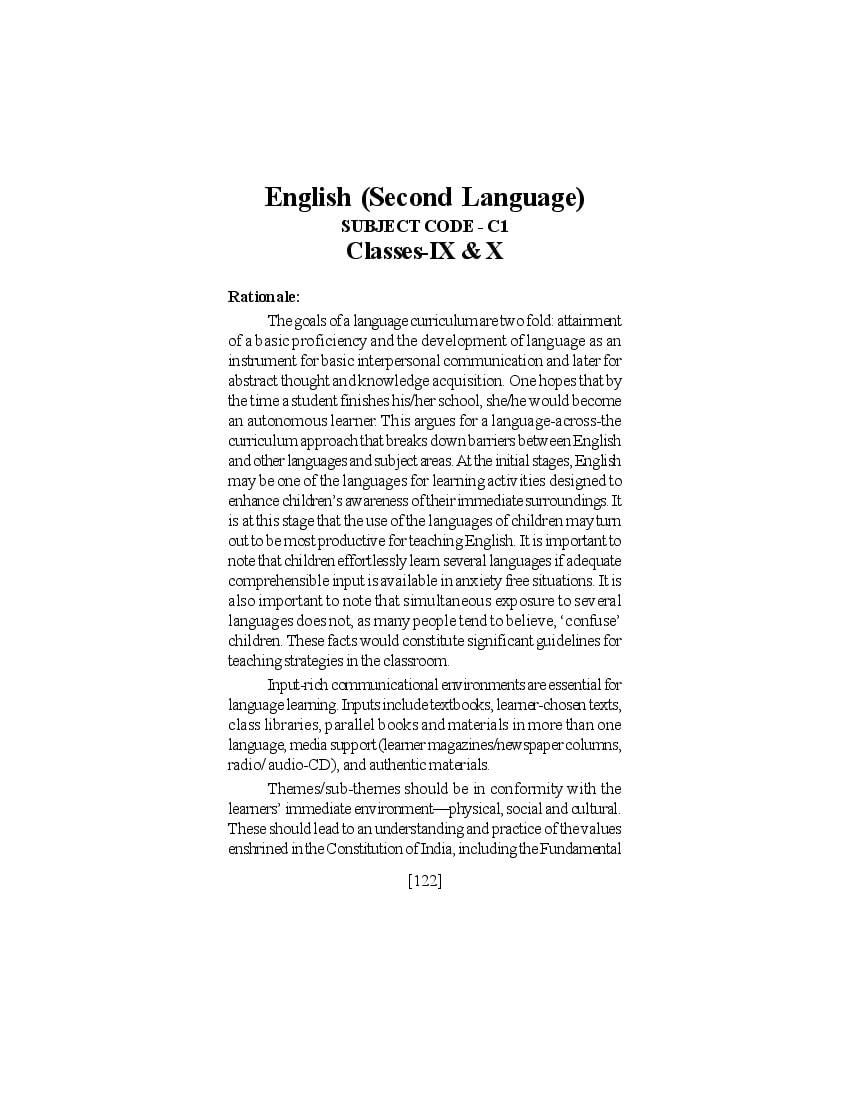
SUBJECT CODE - C1
Classes-IX & X
Rationale:
The goals of a language curriculum are two fold: attainment
of a basic proficiency and the development of language as an
instrument for basic interpersonal communication and later for
abstract thought and knowledge acquisition. One hopes that by
the time a student finishes his/her school, she/he would become
an autonomous learner. This argues for a language-across-the
curriculum approach that breaks down barriers between English
and other languages and subject areas. At the initial stages, English
may be one of the languages for learning activities designed to
enhance children’s awareness of their immediate surroundings. It
is at this stage that the use of the languages of children may turn
out to be most productive for teaching English. It is important to
note that children effortlessly learn several languages if adequate
comprehensible input is available in anxiety free situations. It is
also important to note that simultaneous exposure to several
languages does not, as many people tend to believe, ‘confuse’
children. These facts would constitute significant guidelines for
teaching strategies in the classroom.
Input-rich communicational environments are essential for
language learning. Inputs include textbooks, learner-chosen texts,
class libraries, parallel books and materials in more than one
language, media support (learner magazines/newspaper columns,
radio/ audio-CD), and authentic materials.
Themes/sub-themes should be in conformity with the
learners’ immediate environment––physical, social and cultural.
These should lead to an understanding and practice of the values
enshrined in the Constitution of India, including the Fundamental
[122]
Page 2
personal relationships, the neighbourhood, the larger community,
the nation, the world, etc. In addition to textual materials, various
other inputs can be brought into the language classroom, which
include cards, charts, advertisements, texts produced by children,
brochures, pamphlets, T.V. news, etc.
Background :
Traditionally, language-learning materials beyond the initial
stages have been sourced from literature: prose, fiction and poetry.
While there is a trend for inclusion of a wider range of
contemporary and authentic texts, accessible and culturally
appropriate pieces of literature should play a pivotal role at the
secondary stage of education. The English class should not be
seen as a place merely to read poems and stories in, but an area
of activities to develop the learner’s imagination as a major aim
of language study and to equip the learner with communicative
skills to perform various language functions through speech and
writing.
Objectives :
The general objectives at this stage are:
to build greater confidence and proficiency in oral and
written communication.
to develop the ability and knowledge required in order
to engage in independent reflection and inquiry.
to use appropriate English to communicate in various
social settings.
to equip learners with essential language skills to
question and to articulate their point of view.
to build competence in the different registers of English.
to develop sensitivity to, and appreciation of, other
varieties of English.
to enable the learner to access knowledge and
[123]
Page 3
dictionary/ thesaurus, library, internet etc.)
to develop curiosity and creativity through extensive
reading.
to facilitate self-learning to enable them to become
independent learners.
to review, organise and edit their own work and work
done by the peers.
At the end of this stage learners will be able to do the
following:
give a brief oral description of events/incidents of topical
interest.
retell the contents of authentic audio texts (weather
reports, public announcements, simple advertisements,
short interviews, etc.)
participate in conversation, discussions, etc, on topics
of mutual interest in non-classroom situations.
narrate the story depicted pictorially or in any other
non-verbal mode
respond in writing to business letters, official
communications
read and identify the main points/significant details of
texts like scripts to audio-video interviews, discussions,
debates, etc.
write without prior preparation on a given topic and be
able to defend or explain the position taken/views
expressed
write a summary of short lectures on familiar topics by
making/taking notes
write an assessment of different points of view
expressed in discussion /debate
[124]
Page 4
intonation)
grasp the theme of the poem and appreciate the creative
uses of language
transcode information from a graph / chart to a
description/ report
write reports on books read or festivals/important days
attended.
Content:
The ten core components identified in the National Policy
of Education must be suitably integrated in school curriculum.
These components, which will cut across all subject areas, should
be reinforced in the whole range of inputs (print and non-print,
formal and informal) for teaching/learning at various stages of
school education.
Since all contemporary concerns and issues cannot be
included in the curriculum as separate subjects of study, some
emerging concerns like environmental issues, conservation of
resources, population concerns, disaster management, forestry,
animals and plants, human rights, safety norms and sustainable
development should be suitably incorporated in the course content.
Course materials should also draw upon following concerns in
an integrated manner :
1. Self, Family, Home, Friends and Pets
2. Neighbourhood and Community at large
3. The Nation––diversity (socio-cultural, religious and
ethnic, as well as linguistic), heritage (myths/legends/
folktales)
4. The World––India’s neighbours and other countries
(their cultures, literature and customs)
5. Adventure and Imagination
[125]
Page 5
7. Issues relating to Adolescence
8. Science and Technology
9. Peace and Harmony
10. Travel and Tourism
11. Mass Media
12. Art and Culture
13. Health and Reproductive health
The thematic package given above is suggestive and at
each stage should be in line with learners’ cognitive level, interest
and experience.
Language Items:
In addition to consolidating the grammatical items practised
earlier, the courses in Classes-IX and X will seek to reinforce
the following explicitly:
sequence of tenses.
reported speech.
use of passive voice
degrees of comparison
question patterns
word order
preposition
determiners
vocabulary (phrases/idioms,etc)
synthesis of sentences
clauses, modals, etc.
Curricular Package:
It is recommended that the package for each class (IX-X) will
consist of a textbook and a supplementary reader. The textbook
should contain about 10 comprehensive units (lessons, exercises
[126]
Page 6
Besides, it may include an oral/Spoken English component. The
supplementary reader will have about eight pieces meant
essentially for self-study promoting reading for information and
pleasure. In the case of textbooks, it is imperative that layout and
illustration etc are treated as integral to the text rather than as
mere cosmetic add-ons.
Methods and Techniques:
The methodology will be based on multi-skill, activity
based, learner centred approach. Care would be taken to fulfil
the functional (communicative), literary (aesthetic) and cultural
(sociological) needs of the learner. In this situation the teacher is
the facilitator of learning, she/he presents language items, contrives
situations which motivate the child to use English for the purposes
of communication and expression. Aural-oral teaching and testing
is an intergral feature of the teaching learning process. The
electronic and print media could be used extensively. A few
suggested activites are:
Role playing
Simulating real-to-life situations
Dramatising and miming
Problem solving and decision making
Interpreting information given in tabular form and
schedule
Using newspaper clippings
Borrowing situations from the world around the
learners, from books and from other disciplines
Debating and discussing
Narrating and discussing stories, anecdotes, etc.
Reciting poems
Working in pairs and groups
Using media inputs–computer, television, video
[127]
Page 7
Time Available:
There are about 259 working days available for teaching/
learning etc. amounting to one period per day allotted to the
teaching of English. The actual number of teaching days available,
however, may be about 239 . The size of the curricular package
should be such as can be conveniently covered in the given time.
Evaluation:
Evaluation in language should be continuous and periodic.
It should be both oral and written.
Results of tests and examinations should be treated basically
as feedback to teachers. They should guide them in programming
their teaching and in organising remedial work. Evaluation should
be linked to assessment of general proficiency rather than to
specific achievements. The evaluation procedure should be
continuous and comprehensive in combination with summative
evaluation.
[128]
Page 8
SUBJECT CODE - C1
Class -IX
Theory : 90 Marks Time : 3 hours
Internal Assessment : 10 Marks Pass Marks : 30
Pass Marks in Written examination : 27
Marks
Section LESSON/UNITS Half
Annual
Yearly
A Reading Comprehension (two prose
passages––one seen, another
unseen)
B Writing (translation / amplification,
article / story, notice writing /
report writing)
C Grammar (tense, use of passive
voice, word order, narration,
preposition, degrees of comparison,
question patterns)
D Literature/Textbooks : (Beehive)
Prose :
1. The Fun they Had, 2. The
Sound of Music, 3. My Childhood
4. The Bond of Love, 5. A Visit to
Kaziranaga and Sivasagar
Poetry :
1. The Road Not Taken, 2. The
Lake Isle of Innisfree, 3. A
Legend of the Northland, 4. No
Men are Foreign, 5. A Slumber
did my Spirit Seal.
E Supplementary Reader : (Moments)
1. The Adventures of Toto, 2. The
Happy Prince, 3. Weathering
the Storm in Ersama, 4. A House
is Not a Home
Total 90 90
F Internal Assessment : 10 10
Grand Total 100 100
N.B. : Underlined lessons/items are for Half-Yearly Examination.
* Questions from each Unit/Lesson will carry marks 2-10.
[129]
Page 9
Sopken English - 10 Marks
to be evaluated through Spoken English App
Text Books : (1) Beehive
(2) Moments
(3) An Approach to English Grammar (ix-x)
[130]
Page 10
SUBJECT CODE - C1
Class - X
Theory : 90 Marks Time : 3 hours
Internal Assessment : 10 Marks Pass Marks : 30
Pass Marks in Written examination : 27
Marks
Section LESSON/UNITS Half
Final
Yearly
A Reading Comprehension (two prose
passages–one seen, another unseen
B Writing (translation/substance
writing (prose),essay/story writing,
letter writing/ report writing
C Grammar : All the grammar portion
of class IX and determiners, tense
forms, voice, narration, preposition,
vocabulary, synthesis of sentences,
verb phrases, sentence correction
(clauses, modals, etc.)
Literature/Textbook (First Flight)
D Prose :
1. A Letter to God, 2. Nelson
Mandela : Long Walk to Freedom
3. Glimpses of India (Coorg & Tea
from Assam), 4. Madam Rides the Bus
Poetry :
1. A Tiger in the Zoo, 2. Amanda!,
3. Animals, 4. The Ball Poem,
5. The Tale of Custard the Dragon
E Supplimentary Reader : (Footprints
without Feet)
1. The Midnight Visitor,
2. A Question of Trust,
3. Footprints without Feet,
4. The Hack Driver
Total 90 90
F Internal Assessment : 10 10
Grand Total 100 100
N.B. : Underlined lessons/items are for Half-Yearly Examination
* Questions from each Unit/Lesson will carry marks 2-10.
[131]
Page 11
Sopken English - 10 Marks
to be evaluated through Spoken English App
Text books : (1) First Flight
(2) Footprints without Feet
(3) An Approach to English Grammar (IX-X)
***
[132]
Document Details
| Board / Org | Assam Board |
| Exam | Class 10 |
| Type | Syllabus |
| Pages | 11 |
| Updated | 30 Apr 2026 |