PU CET PG 2019 Question Paper MSc_HS 2Yr__Chemistry_
Finished viewing? Save it for later —
Download PU CET PG 2019 Question Paper MSc_HS 2Yr__Chemistry_ (PDF · 8 pages)About PU CET PG 2019 Question Paper MSc_HS 2Yr__Chemistry_
PU CET PG 2019 Question Paper MSc_HS 2Yr__Chemistry_ is available here for free download. Published by Panjab University for PU CET PG, this question paper can be viewed online or downloaded as a PDF (8 pages). Candidates preparing for PU CET PG can use PU CET PG 2019 Question Paper MSc_HS 2Yr__Chemistry_ to understand the exam pattern, the type of questions asked, and the overall difficulty level.
Frequently Asked Questions
How can I download PU CET PG 2019 Question Paper MSc_HS 2Yr__Chemistry_?
Open this page and click the Download button to save PU CET PG 2019 Question Paper MSc_HS 2Yr__Chemistry_ as a PDF. It is completely free on AglaSem Docs.
Is PU CET PG 2019 Question Paper MSc_HS 2Yr__Chemistry_ free to download?
Yes. PU CET PG 2019 Question Paper MSc_HS 2Yr__Chemistry_ can be viewed online and downloaded as a PDF free of cost on AglaSem Docs.
How many pages does PU CET PG 2019 Question Paper MSc_HS 2Yr__Chemistry_ have?
PU CET PG 2019 Question Paper MSc_HS 2Yr__Chemistry_ contains 8 pages, which you can read online or download together as a single PDF.
Where can I find more PU CET PG study material?
You can find more PU CET PG question papers, sample papers, syllabus, and answer keys on AglaSem Docs.
PU CET PG 2019 Question Paper MSc_HS 2Yr__Chemistry_ – Text
Read the full text of this question paper below — useful to quickly search, copy and reference the content online without downloading the PDF.
📄 View text version (8 pages)
Page 1
1. Which of the following is most stable carbocation?
(A) (C6H5)3C+ (B) C6H5CH2+ (C) (CH3)2CH+ (D) CH3CH2+
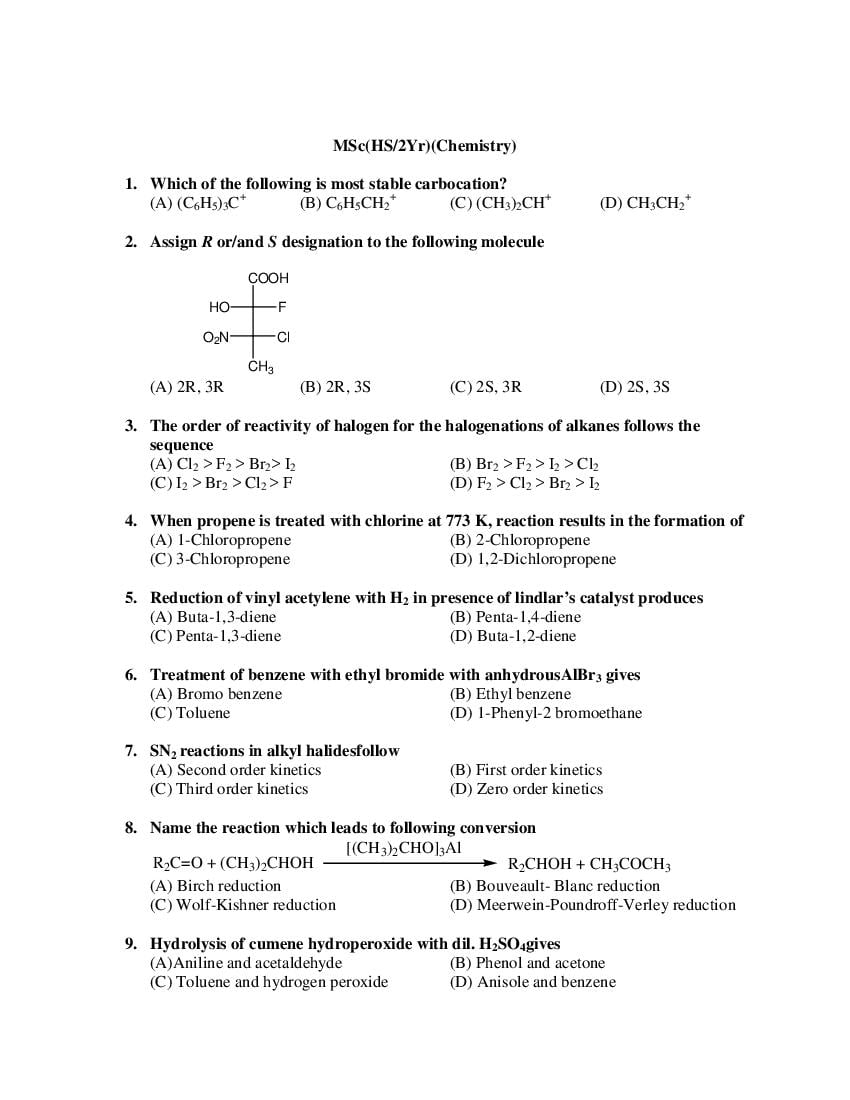
2. Assign R or/and S designation to the following molecule
COOH
HO F
O2N Cl
CH3
(A) 2R, 3R (B) 2R, 3S (C) 2S, 3R (D) 2S, 3S
3. The order of reactivity of halogen for the halogenations of alkanes follows the
sequence
(A) Cl2 ˃ F2 ˃ Br2˃ I2 (B) Br2 ˃ F2 ˃ I2 ˃ Cl2
(C) I2 ˃ Br2 ˃ Cl2 ˃ F (D) F2 ˃ Cl2 ˃ Br2 ˃ I2
4. When propene is treated with chlorine at 773 K, reaction results in the formation of
(A) 1-Chloropropene (B) 2-Chloropropene
(C) 3-Chloropropene (D) 1,2-Dichloropropene
5. Reduction of vinyl acetylene with H2 in presence of lindlar’s catalyst produces
(A) Buta-1,3-diene (B) Penta-1,4-diene
(C) Penta-1,3-diene (D) Buta-1,2-diene
6. Treatment of benzene with ethyl bromide with anhydrousAlBr3 gives
(A) Bromo benzene (B) Ethyl benzene
(C) Toluene (D) 1-Phenyl-2 bromoethane
7. SN2 reactions in alkyl halidesfollow
(A) Second order kinetics (B) First order kinetics
(C) Third order kinetics (D) Zero order kinetics
8. Name the reaction which leads to following conversion
[(CH3)2CHO]3Al
R2C=O + (CH3)2CHOH R2CHOH + CH3COCH3
(A) Birch reduction (B) Bouveault- Blanc reduction
(C) Wolf-Kishner reduction (D) Meerwein-Poundroff-Verley reduction
9. Hydrolysis of cumene hydroperoxide with dil. H2SO4gives
(A)Aniline and acetaldehyde (B) Phenol and acetone
(C) Toluene and hydrogen peroxide (D) Anisole and benzene
Page 2
of base can be termed as
(A) Aldol condensation (B) Benzoin condensation
(C) Perkin condensation (D) Knoevenagal condensation
11. CH3CH2CONH2 can be transformed to CH3CH2NH2 using reagent
(A) Br2/ KOH (B) Br2/P (C) Br2/CCl4 (D) PBr3
12. 2-Bromo propionic acid reacts with alc. KOH and followed by hydrolysis to produce
(A) 2-Hydoxy propionic acid (B) Acrylic acid
(C) Bromoacetyl bromide (D) Acetic acid
13. How many NMR signals are expected in the NMR spectrum of n-propyl bromide?
(A) Four (B) Three (C)Two (D) Five
14. The C=O stretching absorption band in the infra-red spectra of acetophenone
appears at
(A) 2200 cm-1 (B) 2860 cm-1 (C) 3100 cm-1 (D) 1705 cm-1
15. Which of the following is cationic detergent?
(A) Cetyl trimethyl ammonium chloride (B) Sodium laury sulphate
(C) Polyethylene glycol (D) Lauryl alcohol ethoxylate
16. Oxidation of naphthalene with CrO3/CH3COOH at 298K affords
(A) Phthalic anhydride (B) Phthalic acid
(C) 1,4-Naphthaquinone (D) 1,4-Dihydronaphthalene
17. Glucose reacts with the following reagent to form the osazone
(A) HCN (B) C6H5NHNH2 (C) HNO3 (D) (CH3CO)2O
18. The transfer of excess energy from one molecule to another in environment all at
once is called as
(A) Photo dissociation (B) Photo sensitisation
(C) Photo reduction (D) Photo isomerisation
19. Shifting of the absorption maximum towards shorter wavelength in Ultra-Violet
(UV) spectroscopy is known as
(A) Hypsochromic shift (B) Hypochromic shift
(C) Bathochromic shift (D) Hyperchromic shift
20. Pyrrole under catalytic reduction with Pd produces
(A) 2-Phenyl azopyrrole (B) Piperidine
(C) Pyrrolidine (D) Quinoline
Page 3
(A) 313 nm (B) 273nm (C) 253nm (D) 242nm
22. Degradation of alkaloids can be done by following method
(A) Zerewitnoff method (B) Kohn-Roth oxidation method
(C) Friedlander’s method (D) Emde’s method
23. When iodoform is heated with silver powder the product formed is
(A) Ethane (B) Ethene (C) Ethyne (D) Ethanol
24. Ethyl chloroformate on treatment with CH3MgBr form an addition product which
is unstable and gives
(A) CH3CH2OH (B) CH3COOC2H5 (C) ClCH2COOH (D) CH3COCl
25. For N-terminal residue analysis using Sanger’s method, the peptide is initially
treated with
(A) C6H5COCl (B) C6H5N=C=S (C) (NO2)2C6H3F (D) NH2NH2
26. For which one of the following ions, the colour is not due to d-d transitions:
(A) CrO42- (B) Cu(NH3)42+ (C) Ti(H2O)63+ (D) CoF63-
27. CO2 has
(A) 3 vibrational modes (B) 4 vibrational modes, 2 of which are degenerate
(C) Stretching modes only (D) An IR active symmetric stretch
28. Which of the following molecules and ions have S4 axis?
(A) SO42- (B) BF3 (C) C2H2 (D) CO2
29. Crown ether and cryptate –
(A) Both have N and O donor atoms
(B) Both are polycyclic
(C) Have O and N donor atoms respectively
(D) Cryptate is a weaker complexing agent than crown ether
30. Which of the followings are isoelectronic and isostructural?
NO3-, CO32-, ClO3-, SO3
(A) NO3 , CO32-
-
(B) NO3-, SO3 (C) CO32-, ClO3- (D) CO32-, SO3
31. In a non-polar AX2, the bond moment of AX is 0.56 D. The bond angle is
(A) 30o (B) 45o (C) 90o (D) 180o
32. Which one of these orders of acidic strength of hydrated cations is false?
Page 4
(C) [Ba(H2O)n]2+> [Be(H2O)n]2+ (D) [Cu(H2O)n]2+> [Ca(H2O)n]2+
33. The highest magnetic moment will be shown by
(A) Sc (B) Fe (C) Co (D) Ni
34. The orange colour of Cr2O72- is due to
(A) Metal to ligand charge transfer transition
(B) Ligand to metal charge transfer transition
(C) Crystal field transition
(D) Charge transfer complex formation
35. Which one of the following has tetrahedral geometry:
(A) [Co(NH3)6]3+ (B) [Ni(CN)4]2- (C) [Fe(CO)6] (D) [NiCl4]2-
36. Which of the following does not obey EAN rule ?
(A) [Cu(CN)4]3- (B) [Pt(NH3)4]2+ (C) [Pd(NH3)6]4+ (D) [Cr(CO)6]
37. In a solid “AB” having NaCl structure “A” atoms occupy the corners of the cubic
unit cell. If all the face-centred atoms along one of the axes are removed, then the
resultant stoichiometry of the solid is
(A) AB2 (B) A2B (C) A4B3 (D) A3B4
38. The van der Waal’s forces in halogen decreases in the order:
(A) F2> Cl2> Br2> I2 (B) I2> Br2> Cl2> F2
(C) Br2> Cl2> F2> I2 (D) Cl2> Br2> I2> F2
39. Dinitrogen tetroxide , N2O4, is a mixed anhydride because it:
(A) Is a mixture of N2O3 and N2O5
(B) Decomposes into two oxides of nitrogen
(C) React with water to form nitric acid
(D) React with water to form two acids
40. A magnetic moment of 1.73 B.M. will be shown by one among the following
compounds:
(A) [Ni(CN)4]2- (B) [TiCl4] (C) [CoCl6]4- (D) [Cu(NH3)4]2+
41. Alumina on heating with carbon in nitrogen atmosphere gives:
(A) Al + CO (B) Al + CO2 (C) AlN + CO (D) Al + CO + N2
42. P4O10 has short and long P-O bonds. The number of short P-O bonds in this
compound is:
(A) 1 (B) 2 (C) 3 (D) 4
43. CO2 and N2 are non- supporter of combustion. However, for putting out fires CO2 is
preferred over N2 and CO2:
Page 5
(B) Forms non-combustible
combustible products with burning substances
(C) Is denser than nitrogen
(D) Is a more reactive
44. Newly shaped glass articles when cooled suddenly become brittle, therefore these
are cooled
led slowly, this process is known as:
(A) Tempering (B) Annealing (C) Quenching (D) Galvanising
45. Al2O3 formation involves large quantity of heat evolution which makes its use in:
(A) Deoxidiser (B) Confectionary
(C) Indoor photography (D) Thermite welding
46. Optical isomerism is shown by
(A) [Ni(CO)4] (B) [Ni(CN)4]2- (C) [Pt(NH3)4]2+ (D) [Co(en)3]3+
47. BrO3- is isostructural with a noble gas species
(A) XeO3 (B) XeF3 (C) XeF4 (D) XeO2
48. Which of the following is non
non-linear according to VSEPR theory?
(A) CO2 (B) [N3]- (C) [I3]- (D) [ClF2]+
49. The styx code for diborane is
(A) 2020 (B) 2200 (C) 2002 (D) 0220
50. d-p mixing occurs in
(A) Tetrahedral complexes only (B) Octahedral
ctahedral complexes only
(C) Complexes
omplexes with no centre of symmetry (D) Complexes
omplexes with centre of symmetry
51. For any operator A and its adjoint A†, the incorrect statement is:
(A) A A† is Hermitian (B) A A† + A A† is hermitian
(C) A+A† is hermitian (D) A - A† is Hermitian
52.
At constant temperature, identify the correct match of speed distribution functions
w.r.t Ne, Ar, and Kr with the curves in the figure above
(A) Ne-a, Ar-b, Kr-c (B) Ne-b, Ar-c, Kr-aa
(C) Ne-c, Ar-b, Kr-a (D) Ne-c, Ar-a, Kr-b
b
Page 6
immersed in 2.0 M Fe2+ and 0.02 M Fe3+.
Given EºFe3+/Fe2+ = 0.771 V
(A) 0.798 V (B) 0.889 V (C) 2.771 V (D) 0.652 V
, √, š™
˜™ ˜
54. Which of the following is not linear operators?
˜š™ ˜š
(C) √
" "
" "
(A) (B) (D)
55. The number of carbon atoms per unit cell of diamond unit cell is:
(A) 8 (B) 6 (C) 1 (D) 4
56. At 25oC the molar conductances at infinite dilution of CH3COONa, HCl and NaCl
are 91.0 x 10⁻⁴, 426.16 x 10⁻⁴ and 126.45 x 10⁻⁴ S m2 mol-1, respectively. The Λom for
CH3COOH is
(A) 109.11 x 10⁻⁴ S m2 mol-1 (B) 286.45 x 10⁻⁴ S m2 mol-1
-4 2 -1
(C) 191.74 x 10 S m mol (D) 390.71 x 10⁻⁴ S m2 mol-1
57. Match the type of colloidal systems given in column I and column II
Column – I Column – II
(i) Solid in liquid (a) Foam
(ii) Liquid in solid (b) Sol
(iii) Liquid in liquid (c) Gel
(iv) Gas in liquid (d) Emulsion
(A)(i)-(b), (ii)-(c), (iii)-(d), (iv)-(a) (B) (i) -(c), (ii)- (b), (iii)-(a), (iv) -(d)
(C)(i)-(b), (ii)- (c), (iii)- (a), (iv) -(d) (D) (i)- (c), (ii)- (b), (iii)- (d), (iv)- (a)
58. Potential of hydrogen electrode at pH = 10 is :
(A) +0.59 V (B) 0.00 V (C) -0.59 V (D) -0.059 V
59. For an ideal solution which combination is correct (where ∆Vmix is volume change
on mixing and ∆Hmix is enthalpy change on mixing)
(A) ∆Vmix> 0, ∆Hmix> 0 (B) ∆Vmix< 0, ∆Hmix< 0
(C) ∆Vmix = 0, ∆Hmix= 0 (D) ∆Vmix> 0, ∆Hmix< 0
60. Rust is a mixture of:
(A) FeO and Fe(OH)2 (B) FeO and Fe(OH)3
(C) Fe3O4 and Fe(OH)3 (D)Fe2O3 and Fe(OH)3
61. The heat capacity of 10 mol of an ideal gas at a certain temperature is 300 JK-1 at
constant pressure. The heat capacity of the same gas at the same temperature and at
constant volume would be (in JK-1)
Page 7
62. The van der Waal’s equation reduces itself to the ideal gas equation at:
(A) High pressure and low temperature
(B) Low pressure and high temperature
(C) Low pressure and low temperature
(D) Critical pressure and critical temperature
›œ• › ž Ÿ
63. The Stark-Einstein law of photochemical equilibrium is defined as:
ž žœ• œ• ž
(A) ∆E = (B) = ∆E (C) = ∆E (D) = Nhc
64. A first order reaction takes 40 min for 30% decomposition.
Calculate t1/2 (Given log 3 = 0.477, log 5 = 0.699 , log 7 = 0.845 )
(A) 77.7 (B) 8.9 (C) 133.7 (D) 80.5
⇌ 2NH3 (g)
65. For the reaction at 527 oC
N2 (g) + 3 H2 (g)
The ratio of KP and KC is (R = 0.082 L atm mol-1 K-1)
(A) 3.23 x 10⁻⁶ (B) 2.32 x 10⁻⁴ (C) 2.32 x 10⁴ (D) 3.23 x 10 6
66. P.Q.R branches of spectral lines are observed in
(A) Vibrational spectrum of diatomic molecule
(B) Rotational spectrum of diatomic molecule
(C) Vibrational rotational spectrum of diatomic molecule
(D) Raman spectrum of diatomic molecule
67. What is the log γ ± value of aqueous solution of Na2SO4 of 0.001 molality at 250C?
where γ ± is mean ionic activity coefficient and for water at 250C, the value of Debye-
Huckel constant is 0.509.
(A) 0.879 (B) -0.055 (C) - 0.003 (D) -0.905
68. The relation of free energy change with temperature and pressure is
(A) dG = VdP (B) dG = SdT (C) dG = VdP - SdT (D) dG = VdP + SdT
69. For a reversible reaction
Ist order in both the directions, the rate of reaction is given by:
(A) K1[A] (B) -K2[B] (C) K1[A]+ K2[B] (D) K1[A]-K2[B]
.
(A) - •¢w ∇ + v (B) •¢w ∇ + v (C) - •¢w ∇ - v (D) - •¢w ∇ – v2
œ œ œ œ
70. The expression for Hamiltonian operator is
71. The pH of a 0.005 molar aqueous solution of sulphuric acid is approximately
Page 8
72. The rate constant, the activation energy and the Arrhenius parameter of a chemical
value of rate constant as T → ∞ is;
reaction at 25ºC are 3.0 x 10⁻⁴ s-1, 104.4 KJ mol-1 and 6.0 x 10¹⁴s-1, respectively. The
(A) 6.0 x 10¹⁴s-1 (B) 3.6 x 1030 (C) Zero (D) infinite
73. Freundlich isotherms is not applicable at
(A) Low pressure (B) Room temperature
(C) High pressure (D) 273 K
HI (g) ⇌ ™ H2 (g) + ™ I2 (g)
£ £
74. What will be the equilibrium constant at 717 K for the reaction:
H2 (g) + I2 (g) ⇌ 2HI (g) at 717 K is 64 ?
If its value for the reaction
(A) 64 (B) 8 (C) 1/64 (D) 1/8
75. The figure below describes a carnot engine work. Which path show adiabatic expansion.
(A) 3 to 4 (B) 2 to 3 (C) 1 to 2 (D) 4 to 1
x-x-x
Document Details
| Board / Org | Panjab University |
| Exam | PU CET PG |
| Type | Question Paper |
| Pages | 8 |
| Updated | 22 Jul 2026 |