Odisha HSC Paper 2014 Maths Part I
Finished viewing? Save it for later —
Download Odisha HSC Paper 2014 Maths Part I (PDF · 16 pages)About Odisha HSC Paper 2014 Maths Part I
Odisha HSC Paper 2014 Maths Part I is available here for free download. Published by Odisha Board for Class 10, this question paper can be viewed online or downloaded as a PDF (16 pages). Candidates preparing for Class 10 can use Odisha HSC Paper 2014 Maths Part I to understand the exam pattern, the type of questions asked, and the overall difficulty level.
Frequently Asked Questions
How can I download Odisha HSC Paper 2014 Maths Part I?
Open this page and click the Download button to save Odisha HSC Paper 2014 Maths Part I as a PDF. It is completely free on AglaSem Docs.
Is Odisha HSC Paper 2014 Maths Part I free to download?
Yes. Odisha HSC Paper 2014 Maths Part I can be viewed online and downloaded as a PDF free of cost on AglaSem Docs.
How many pages does Odisha HSC Paper 2014 Maths Part I have?
Odisha HSC Paper 2014 Maths Part I contains 16 pages, which you can read online or download together as a single PDF.
Where can I find more Class 10 study material?
You can find more Class 10 question papers, sample papers, syllabus, and answer keys on AglaSem Docs.
Odisha HSC Paper 2014 Maths Part I – Text
Read the full text of this question paper below — useful to quickly search, copy and reference the content online without downloading the PDF.
📄 View text version (16 pages)
Page 1
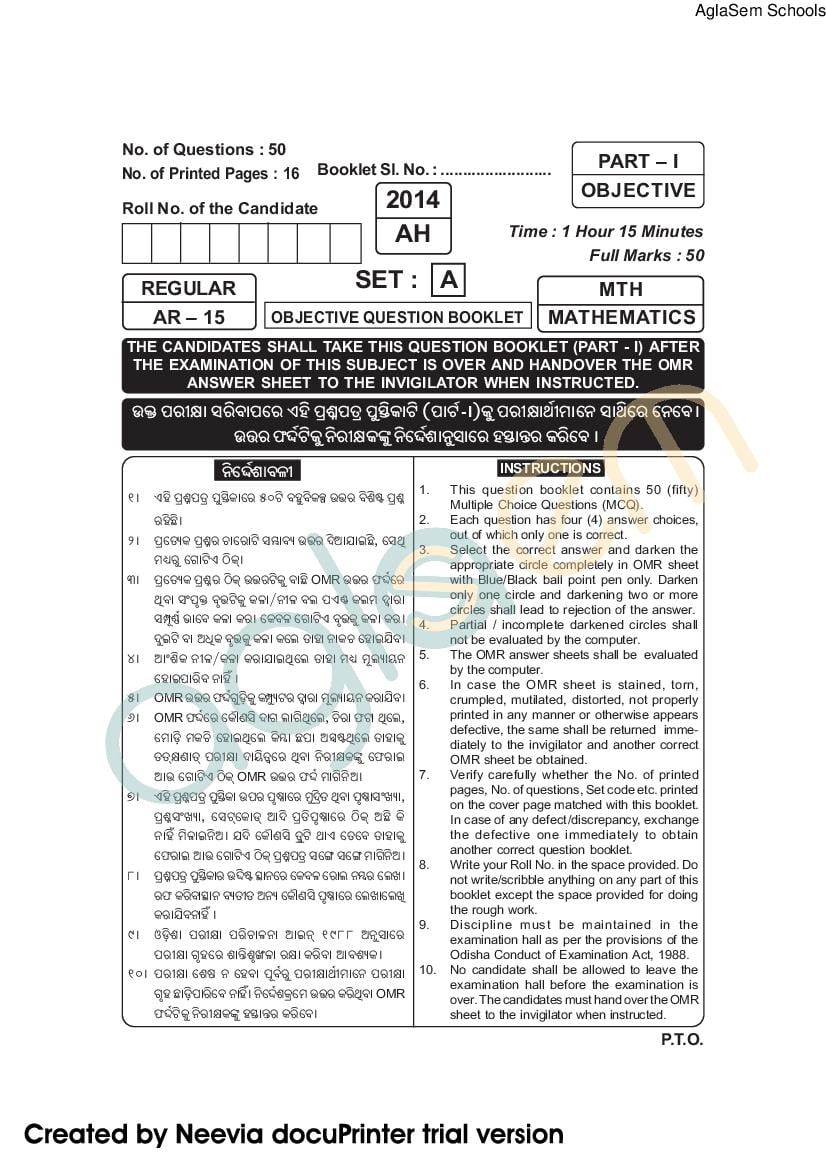
Booklet Sl. No. : ......................... PART I
No. of Printed Pages : 16
OBJECTIVE
Roll No. of the Candidate 2014
AH Time : 1 Hour 15 Minutes
Full Marks : 50
REGULAR SET : A MTH
AR 15 OBJECTIVE QUESTION BOOKLET MATHEMATICS
THE CANDIDATES SHALL TAKE THIS QUESTION BOOKLET (PART - I) AFTER
THE EXAMINATION OF THIS SUBJECT IS OVER AND HANDOVER THE OMR
ANSWER SHEET TO THE INVIGILATOR WHEN INSTRUCTED.
DNÿ ¨Àÿêäæ ÓÀÿç¯ÿæ¨{Àÿ FÜÿç ¨÷ɨ § ÿ÷ ¨ëÖLç ÿæsç (¨æsö - I)Lÿë ¨Àÿêäæ$öêþæ{ÿ Óæ$ç{Àÿ {ÿ{¯ÿ >
DÿÀÿ üÿösLç ÿë ÿçÀÿêäLÿZÿë ÿç{öÉæÿëÓæ{Àÿ ÜÿÖæ;ÿÀÿ LÿÀÿç{¯ÿ >
ÿç{öÉæ¯ÿÁÿê INSTRUCTIONS
1. This question booklet contains 50 (fifty)
1> FÜÿç ¨÷ɧ¨ÿ÷ ¨ëÖçLÿæ{Àÿ 50sç ¯ÿÜÿë¯ÿçLÿÅÿ DÿÀÿ ¯ÿçÉçÎ ¨÷ɧ Multiple Choice Questions (MCQ).
ÀÿÜÿçd>ç 2. Each question has four (4) answer choices,
2> ¨÷{ÿ¿Lÿ ¨÷ÉÀ§ ÿ `ÿæ{Àÿæsç Ó»æ¯ÿ¿ DÿÀÿ ÿçAæ¾æBdç, {Ó$# out of which only one is correct.
3. Select the correct answer and darken the
þÀÿë {SæsçF vÿçLÿú> appropriate circle completely in OMR sheet
3> ¨÷{ÿ¿Lÿ ¨÷ɧÀÿ vÿçLÿú DÿÀÿsçLÿë ¯ÿædç OMR DÿÀÿ üÿö{Àÿ with Blue/Black ball point pen only. Darken
$#¯ÿæ Óó¨õNÿ ¯ÿõÿsçLÿë LÿÁÿæ/ÿêÁÿ ¯ÿàÿ ¨F+ Lÿàÿþ ÿ´æÀÿæ only one circle and darkening two or more
circles shall lead to rejection of the answer.
Ó¸íÿö µÿæ{¯ÿ LÿÁÿæ LÿÀÿ> {Lÿ¯ÿÁÿ {SæsçF ¯ÿõÿLÿë LÿÁÿæ LÿÀÿ> 4. Partial / incomplete darkened circles shall
ÿëBsç ¯ÿæ A#Lÿ ¯ÿõÿLÿë LÿÁÿæ Lÿ{àÿ ÿæÜÿæ ÿæLÿ`ÿ {ÜÿæB¾ç¯ÿ> not be evaluated by the computer.
4> AæóÉçLÿ ÿêÁÿ/LÿÁÿæ LÿÀÿæ¾æB$#{àÿ ÿæÜÿæ þ þíàÿ¿æßÿ 5. The OMR answer sheets shall be evaluated
by the computer.
{ÜÿæB¨æÀÿç¯ÿ ÿæÜÿ] > 6. In case the OMR sheet is stained, torn,
5> OMR DÿÀÿ üÿöSÝë Lç ÿë Lÿ¸ë¿sÀÿ ÿ´æÀÿæ þíàÿ¿æßÿ LÿÀÿæ¾ç¯ÿ> crumpled, mutilated, distorted, not properly
6> OMR üÿö{Àÿ {Lÿò~Óç ÿæS àÿæSç${# àÿ, `ÿçÀÿæ üÿsæ $#{àÿ, printed in any manner or otherwise appears
defective, the same shall be returned imme-
{þæÝç þLÿ`ÿç {ÜÿæB$#{àÿ Lÿçºæ d¨æ AØÎ$#{àÿ ÿæÜÿæLÿë diately to the invigilator and another correct
ÿÿúä~æÿú ¨Àÿêäæ ÿæßçÿ´{Àÿ $#¯ÿæ ÿçÀÿêäLÿZÿë {üÿÀÿæB OMR sheet be obtained.
AæD {SæsçF vÿçLÿú OMR DÿÀÿ üÿö þæSçÿçA> 7. Verify carefully whether the No. of printed
pages, No. of questions, Set code etc. printed
7> FÜÿç ¨÷ɨ § ÿ÷ ¨ëÖLç ÿæ D¨Àÿ ¨õÏæ{Àÿ þëÿ÷ç ÿ $#¯ÿæ ¨õÏæÓóQ¿æ, on the cover page matched with this booklet.
¨÷ɧÓóQ¿æ, {Ósú{Lÿæxÿú Aæÿç ¨÷ÿç¨õÏæ{Àÿ vÿçLÿú Adç Lÿç In case of any defect/discrepancy, exchange
ÿæÜÿ] þçÁÿæBÿçA> ¾ÿç {Lÿò~Óç ÿ÷ësç $æF {ÿ{¯ÿ ÿæÜÿæLÿë the defective one immediately to obtain
{üÿÀÿæB AæD {SæsçF vÿçLÿú ¨÷ɨ § ÿ÷ Ó{èÿ Ó{èÿ þæSçÿçA> another correct question booklet.
8. Write your Roll No. in the space provided. Do
8> ¨÷ɨ § ÿ÷ ¨ëÖLç ÿæÀÿ DçÎ ×æÿ{Àÿ {Lÿ¯ÿÁÿ {Àÿæàÿ ÿºÀÿ {àÿQ> not write/scribble anything on any part of this
Àÿüÿ LÿÀÿç¯ÿæ×æÿ ¯ÿ¿ÿêÿ Aÿ¿ {Lÿò~Óç ¨õÏæ{Àÿ {àÿQæ{àÿQ# booklet except the space provided for doing
LÿÀÿæ¾ç¯ÿÿæÜÿ] > the rough work.
9. Discipline must be maintained in the
9> HÝçÉæ ¨Àÿêäæ ¨Àÿç`ÿæÁÿÿæ AæBÿú 1988 AÿëÓæ{Àÿ examination hall as per the provisions of the
¨Àÿêäæ SõÜÿ{Àÿ Éæ;ÿçÉõ\ÿÁÿæ Àÿäæ LÿÀÿç¯ÿæ Aæ¯ÿÉ¿Lÿ> Odisha Conduct of Examination Act, 1988.
10> ¨Àÿêäæ {ÉÌ ÿ {Üÿ¯ÿæ ¨í¯ÿöÀÿë ¨Àÿêäæ$öêþæ{ÿ ¨Àÿêäæ 10. No candidate shall be allowed to leave the
examination hall before the examination is
SõÜÿ dæÝç¨æÀÿç{¯ÿ ÿæÜÿ]> ÿç{öÉLÿ÷{þ DÿÀÿ LÿÀÿç$¯# ÿæ OMR over. The candidates must hand over the OMR
üÿösçLÿë ÿçÀÿêäLÿZÿë ÜÿÖæ;ÿÀÿ LÿÀÿç{¯ÿ> sheet to the invigilator when instructed.
P.T.O.
Page 2
22 22
π Àÿ þíàÿ¿ ÿçA (Take π = )
7 7
FÜÿç ¯ÿçµÿæS{Àÿ 50sç ¨÷ɧ ÿçAæ¾æBdç > ¨÷{ÿ¿Lÿ ¨÷ɧ ¨æBô `ÿæ{Àÿæsç ¯ÿçLÿÅÿ DÿÀÿ ÿçAæ¾æBdç >
{Ó$# þÀÿë vÿçLÿú DÿÀÿsç ¯ÿædç OMRDÿÀÿ üÿö{Àÿ $#¯ÿæ Ó¸õNÿ ¯ÿõÿsçLÿë
LÿÁÿæ/ÿêÁÿ ¯ÿàÿ ¨F+ Lÿàÿþ ÿ´æÀÿæ Ó¸íÿöµÿæ{¯ÿ LÿÁÿæ LÿÀÿ>
In this Part 50 questions are given. Each question has four alternative
answers. Choose the correct answer from them and darken the
appropriate circle completely in the OMR Sheet with
the Blue/Black ball point pen.
¨÷{ÿ¿Lÿ ¨÷ÉÀ§ ÿ þíàÿ¿ 1 A{s >
Each question carries 1 mark.
ÓþÖ ¨÷ÉÀ§ ÿ DÿÀÿ ÿçA >
Answer all questions.
1. 9x + y + 12 = 0 F¯ÿó 18x + ky + 24 = 0 ÓÜÿ ÓþêLÿÀÿ~ ÿ´ß Óèÿÿ H ÿçµÿöÀÿÉêÁÿ
{Üÿ{àÿ k Àÿ þæÿ {Lÿ{ÿ ?
If the simultaneous equations 9x + y + 12 = 0 and 18x + ky + 24 = 0 are
consistent and dependent, then what is the value of k ?
(A) 1 (B) +1
(C) +2 (D) 2
2. ÿçþק xÿçsÀÿþçÿæ+Àÿ þíàÿ¿ {Lÿ{ÿ ?
What is the value of the following determinant ?
2 −1
3 2
(A) 7 (B) 7
(C) 4 (D) 4
AR -15 / P - I / MTH 2 Contd.
Page 3
¨æBô Lÿ'~ LÿÀÿç¯ÿ ?
What is to be done for solving the simultaneous equations 3x + 4y = 10
and 2x 2y = 3 by the method of substitution ?
(A) ¨÷$þ ÓþêLÿÀÿ~Lÿë 2 ÿ´æÀÿæ H ÿ´ç ÿêßLÿë 3 ÿ´æÀÿæ Së~ÿ LÿÀÿç¯ÿ
Multiply the first equation by 2 and the second one by 3
(B) ¨÷$þsçÀÿë x Àÿ þíàÿ¿ ÿçÿöß LÿÀÿç ÿ´ç ÿêßsç{Àÿ {àÿQ#¯ÿ
Determine the value of x from the first one and write it in the second
one
(C) ÿ´ç ÿêß ÓþêLÿÀÿ~Lÿë ¨÷$þÀÿë ¯ÿç{ßæS LÿÀÿç¯ÿ
Subtract the second one from the first one
(D) Dµÿß ÓþêLÿÀÿ~Lÿë þçÉæB¯ÿ
Add both the equations together
4. x + y = 0 H x y = 0 ÓÜÿ ÓþêLÿÀÿ~ ÿ´ßÀÿ S÷æüÿú AZÿÿ Lÿ{àÿ {LÿDô ¯ÿç¢ÿë{Àÿ ¨ÀÿØÀÿLÿë {bÿÿ
LÿÀÿç{¯ÿ ?
What is the point of intersection of the simultaneous equations x + y = 0
and x y = 0 on a graph paper ?
(A) (0, 1) (B) (1, 0)
(C) (1, 1) (D) (0, 0)
5
5. ç æÿ ÓþêLÿÀÿ~Àÿ þíÁÿÿ´ßÀÿ ÓþÎç H Së~üÿÁÿ ¾$æLÿ÷{þ 4 H æ ÓþêLÿÀÿ~sç
{SæsçF ÿ´W
2
{Lÿ{ÿ ?
5
The sum and product of the roots of a quadratic equation are 4 and
2
respectively. What is the equation ?
(A) 2x2 + 8x + 5 = 0 (B) 2x2 8x + 5 = 0
(C) 2x2 + 8x 5 = 0 (D) 2x2 8x 5 = 0
AR -15 / P - I / MTH 3 P.T.O.
Page 4
ç æÿ ÓþêLÿÀÿ~{Àÿ ¨÷LÿæÉ Lÿ{àÿ {Lÿ{ÿ {Üÿ¯ÿ ?
What is x + x = 6 when expressed as a quadratic equation ?
(A) x2 13x + 36 = 0 (B) x2 + 13x + 36 = 0
(C) x2 + 12x + 36 = 0 (D) x2 12x + 36 = 0
7. 2x2 + kx + 3 = 0 ÓþêLÿÀÿ~{Àÿ k Àÿ þæÿ {Lÿ{ÿ {Üÿ{àÿ þíÁÿ ÿëBsç ¯ÿæÖ¯ÿ H Óþæÿ
{Üÿ{¯ÿ ?
What should be the value of k show that the roots of the equation 2x2 + kx
+ 3 = 0 are real and equal ?
(A) 4 6 (B) 2 6
6
(C) 6 (D)
2
8. {SæsçF Aæßÿ `ÿçÿ÷Àÿ {ÿðW¿ö ¨÷×vÿæÀÿë 8 {Ó.þç. ¯ÿÝ H FÜÿæÀÿ {äÿ÷üÿÁÿ 240 ¯ÿSö {Ó.þç.>
Aæßÿ `ÿçÿ÷Àÿ {ÿðW¿ö H ¨÷× ÿçÿöß LÿÀÿç¯ÿæ ¨æBô ÿç{þ§æNÿ ÓþêLÿÀÿ~ þÀÿë {LÿDôsç ¨÷¾fë ¿ ?
The length of a rectangle is greater than its breadth by 8 cm and its area
is 240 sq. cm. Which of the following equations is applicable to find its
sides ?
(A) x2 + 16x = 240 (B) 2x2 8x = 240
(C) 2x2 + 16x = 480 (D) 2x2 + 8x = 480
9. ÿçþৠÿçQ# ÿ AÿëLÿ÷þ þÀÿë {LÿDôsç Óþæ;ÿÀÿ ¨÷Sÿç{Àÿ ÿæÜÿ] ?
Which one of the following series is not in Arithmetic progression ?
1 2 3 4
(A) 1, 2, 3, 4, 5, ... (B) , , , , ...
3 3 3 3
(C) 1.1, 2.3, 3.5, 4.7, ... (D) 3, 1, 0, 2, 4, ...
AR -15 / P - I / MTH 4 Contd.
Page 5
¨ÿÀÿ ÓþÎç {Lÿ{ÿ ?
The first term of an arithmetic progression is 3 and common
difference is 2. What is the sum of its first 11 terms ?
(A) 154 (B) 77
(C) 44 (D) 20
11. (a + b), x H (a b) A.P.{Àÿ $#{àÿ x Àÿ þæÿ {Lÿ{ÿ ?
If (a + b), x and (a b) are in A.P. What is the value of x ?
(A) 2a (B) a
(C) b (D) 2b
12. Óþæ;ÿÀÿ ¨÷Sÿç{Àÿ $#¯ÿæ {SæsçF AÿëLÿ÷þÀÿ ¨÷$þ ¨ÿ 4 H {ÉÌ ¨ÿ 76 > F$#{Àÿ ÿç{ÿæsç
þLÿ $#{àÿ, ÿ´ç ÿêß þLÿsç {Lÿ{ÿ ?
The first term of a series in arithmetic progression is 4 and last term is
76. In between them there are three arithmetic means. What is the
second arithmetic mean ?
(A) 18 (B) 22
(C) 36 (D) 40
13. {SæsçF þëÿ÷æLÿë 30 $Àÿ sÓú LÿÀÿç¯ÿæÀÿë H {¾{ÿ $Àÿ AæÓçàÿæ T ÿæÀÿ ÿëBSë~ $Àÿ AæÓçàÿæ>
P (T) Àÿ þíàÿ¿ {Lÿ{ÿ ?
A coin was tossed 30 times. The number of times T appeared was twice
the number of times H appeared. What is the value of P (T) ?
(A) 20 (B) 10
2 1
(C) (D)
3 3
AR -15 / P - I / MTH 5 P.T.O.
Page 6
{SæsçF þëÿ÷æ DvÿæS{àÿ {SæsçF ¨`ÿæÉ ¨BÓç ¨æB¯ÿæÀÿ Ó»æ¯ÿ¿ÿææ {Lÿ{ÿ ?
There are 5, 10 paise coins, 3, 25 paise coins and 4, 50 paise coins in a
box. If one of these coins is lifted at random, then what is the probability
of getting a 50 paise coin ?
1 1
(A) (B)
12 6
1 1
(C) (D)
4 3
15. {SæsçF àÿëxÿë{SæsçLÿë ${Àÿ SÝæ Sàÿæ > ¾ÿç E Ws~æsç ""üÿÁÿ FLÿ ¾ëS½ ÓóQ¿æ''Lÿë ¯ÿëlæF,
{ÿ{¯ÿ E Ws~æsç Wsç¯ÿæÀÿ Ó»æ¯ÿ¿ÿæ {Lÿ{ÿ ?
A ludo die was thrown once. If the event E indicates result is an even
number then what is the probability of occurrence of the event E ?
1 1
(A) (B)
6 3
1 2
(C) (D)
2 3
16. {SæsçF àÿëxÿë{SæsçLÿë ÿëB$Àÿ SÝæBÿçAæSàÿæ > FÜÿæ ÿ´æÀÿæ ÓóQ¿æ ÿëBsçÀÿ {¾æSüÿÁÿ 6 ¨æB¯ÿæÀÿ
Ó»æ¯ÿ¿ÿæ Lÿ{{ÿ ?
A ludo die was thrown twice. What is the probability of getting the sum of
the numbers as 6 ?
5 2
(A) (B)
6 3
1 5
(C) (D)
9 36
AR -15 / P - I / MTH 6 Contd.
Page 7
If the mean of the scores 8, 5, 6, 7, x and 4 is 6.5, then what is the value
of x ?
(A) 9 (B) 10
(C) 11 (D) 12
18. ¨÷$þ 10sç S~ÿ ÓóQ¿æÀÿ þþæ, ¨÷$þ 9sç S~ÿ ÓóQ¿æÀÿ þþævÿæÀÿë {Lÿ{ÿ {¯ÿÉê ?
By how much the median of the first 10 counting numbers is greater than
the median of the first 9 counting numbers ?
(A) 0 (B) 0.5
(C) 1 (D) 1.5
19. ÿçþק þÀÿë {LÿDôsç SÀÿçÏLÿ ÿçÿöß LÿÀÿç¯ÿæ ¨æBô vÿçLÿú Óíÿ÷ ?
Which one of the following is the correct formula for finding mode ?
þæþæÿ + þþæ
(A) SÀÿÏ
ç Lÿ =
2
Mean + Median
Mode =
2
(B) SÀÿçÏLÿ = 2 þþæ 3 þæþæÿ
Mode = 2 Median 3 Mean
(C) SÀÿçÏLÿ = 3 þþæ 2 þæþæÿ
Mode = 3 Median 2 Mean
(D) SÀÿçÏLÿ = 2 (þþæ þæþæÿ)
Mode = 2 (Median Mean)
AR -15 / P - I / MTH 7 P.T.O.
Page 8
What is the mode of the following scores ?
5, 6, 7, 7, 8, 9, 9, 9, 10, 10, 11, 12, 12, 12
(A) SÀÿçÏLÿ ÿæÜÿ] (No mode)
(B) 9
(C) 12
(D) Dµÿß 9 H 12 (Both 9 and 12)
n n
21. x1, x2, x3, ..., xn Àÿ þæþæÿ M A{s > ∑ ( xi − 5 ) = 60 F¯ÿó ∑ ( xi − 8 ) = 24 {Üÿ{àÿ,
i =1 i =1
n Àÿ þæÿ {Lÿ{ÿ ?
n
The mean of the scores x1, x2, x3, ..., xn is M. If ∑ ( xi − 5 ) = 60 and
i =1
n
∑ ( xi − 8 ) = 24, then what is the value of n ?
i 1
=
(A) 5 (B) 8
(C) 10 (D) 12
22. ÿëBsç ¯ÿç¢ÿë A H BÀÿ ×æÿæZÿ ¾$æLÿ÷{þ (1, 2) H (5, 2) > {ÓþæÿZÿ þ{Àÿ ÿíÀÿÿæ
{Lÿ{ÿ ?
The co-ordinates of two points A and B are (1, 2) and (5, 2)
respectively. What is the distance between them ?
(A) 6 (B) 4 2
(C) 4 (D) 3 2
AR -15 / P - I / MTH 8 Contd.
Page 9
þþæ {Üÿ{àÿ D ¯ÿç¢ÿëÀÿ ×æÿæZÿ {Lÿ{ÿ ?
The co-ordinates of the points A, B, C of the ∆ ABC are (1, 2), (2, 4) and
(3, 5) respectively. If AD is a median then what is the co-ordinates of the
point D ?
(A) (5, 9) (B) (2.5, 4.5)
(C) (1.5, 3) (D) (2, 3.5)
24. {SæsçF {ÀÿQæQÀÿ þ¯ÿç¢ÿëÀÿ ×æÿæZÿ (0, 0) > FÜÿæÀÿ FLÿ ¨÷æ;ÿ¯ÿç¢ÿëÀÿ ×æÿæZÿ (2, 3) > Aÿ¿
¨÷æ;ÿ¯ÿç¢ÿëÀÿ ×æÿæZÿ {Lÿ{ÿ ?
The co-ordinates of the mid-point of a line-segment is (0, 0). The co-
ordinates of one of the end-point is (2, 3). What is the co-ordinates of the
other end-point ?
(A) ( 3, 2) (B) ( 2, 3)
(C) (2, 3) (D) (3, 2)
25. (2, 10), (2, 5) H (a, 2) ¯ÿç¢ÿëÿ÷ß FLÿ ÓÀÿÁÿ{ÀÿQæ{Àÿ A¯ÿ×çÿ > a Àÿ þæÿ {Lÿ{ÿ ?
The three points (2, 10), (2, 5) and (a, 2) are in one straight line. What
is the value of a ?
(A) 0 (B) 2
(C) 3 (D) 2
4
26. ÿÿ `ÿçÿ÷{Àÿ P Q || BC > AP = AB, QC = 1.8 cm >
A 7
AC Àÿ {ÿðW¿ö {Lÿ{ÿ {Ó.þç. ?
P Q 4
In the given figure P Q || BC . AP =AB, QC = 1.8
7
B C
cm. What is the length of AC in cm ?
(A) 2.4 (B) 3.6
(C) 4.2 (D) 5.4
AR -15 / P - I / MTH 9 P.T.O.
Page 10
{äÿ÷üÿÁÿÀÿ Aÿë¨æÿ LÿæÜÿæ Ó{èÿ Óþæÿ ?
(
( In the given figure m ∠ BAD = m ∠ CAD. Ratio of the
areas of the ∆ ABD and ∆ ACD is equal to which
B D C one of the following ?
(A) AC : AB (B) AB : DC
(C) BD : AC (D) AB : AC
28. P ÿÿ `ÿçÿ÷{Àÿ ∆ PQR ~ ∆ QRS > m ∠ PQR = 50°, m ∠ QSR
= 100° > m ∠ PRS = {Lÿ{ÿ ?
S
In the given figure ∆ PQR ~ ∆ QRS. m ∠ PQR = 50°,
(
(
Q R m ∠ QSR = 100°. What is the measure of ∠ PRS ?
(A) 70° (B) 80°
(C) 90° (D) 100°
29. A ÿÿ `ÿçÿ÷{Àÿ XY || BC H AX : XB = 2 : 3 > ∆ AXY H
ç þú XYCB Àÿ {äÿ÷üÿÁÿÀÿ Aÿë¨æÿ {Lÿ{ÿ ?
s÷æ¨çfß
X Y
In the given figure XY || BC and AX : XB = 2 : 3.
What is the ratio of the areas of ∆ AXY and trape-
B C
zium XYCB ?
4 4
(A) (B)
25 21
4 2
(C) (D)
9 3
AR -15 / P - I / MTH 10 Contd.
Page 11
{Üÿ{àÿ, AB = {Lÿ{ÿ {Ó.þç. ?
In ∆ ABC, m ∠ A = 90° and AD ⊥ BC . If BD = 2 cm and BC = 8 cm,
then what is the length of AB in cm ?
(A) 2 3 (B) 3 2
(C) 4 (D) 4 3
31. {SæsçF {ÀÿQæQ Ó¯ÿöæ#Lÿ {Lÿ{ÿsç ¯ÿõÿÀÿ ¯ÿ¿æÓæö {ÜÿæB¨æÀÿç¯ÿ ?
A line segment can be a radius of how many circles in the maxium ?
(A) 1 (B) 2
(C) 3 (D) 4
32. A
H ÿÿ `ÿçÿ÷{Àÿ O ¯ÿõÿÀÿ {Lÿ¢ÿ÷ H m AEB
¼ = 100° > m ∠ BDC =
E
D {Lÿ{ÿ ?
B O
G In the given figure O is the centre and m AEB
¼ =
F
C 100°. What is the measure of ∠ BDC ?
(A) 40° (B) 50°
(C) 60° (D) 80°
33. {SæsçF ÓëÌþ ÌݵÿëfÀÿ ¨÷{ÿ¿Lÿ ¯ÿæÜÿë FÜÿæÀÿ ¨Àÿç¯ÿõÿÀÿ ¨Àÿçv# ÿæ{Àÿ AZÿÿ LÿÀÿë$¯# ÿæ {Lÿæ~Àÿ
¨Àÿçþæ~ {Lÿ{ÿ ?
What is the measure of the angle subtended by each side of a regular
hexagon at the circumference of its circum-circle ?
(A) 120° (B) 90°
(C) 60° (D) 30°
AR -15 / P - I / MTH 11 P.T.O.
Page 12
{ÿðW¿ö Àÿ Aÿë¨æÿ {Lÿ{ÿ ?
A chord of a circle subtends a right angle at its centre. What is the ratio
of the lengths of the radius of the circle and the chord ?
(A) 2 : 1 (B) 1 : 2
(C) 2 :1 (D) 1 : 2
35. ÿëBsç ¯ÿÜÿç ØÉöê ¯ÿõÿ ¨÷ÿç Ó¯ÿöæ#Lÿ {Lÿ{ÿæsç ÓææÀÿ~ ØÉöLÿ AZÿÿ LÿÀÿæ¾æB¨æÀÿç¯ÿ ?
In the maximum how many common tangents can be drawn to two
externally tangent circles ?
(A) 1 (B) 2
(C) 3 (D) 4
36. ÿÿ `ÿçÿ÷{Àÿ O ¯ÿõÿÀÿ {Lÿ¢ÿ÷ F¯ÿó BA ØÉöLÿ Q > m ∠ ACB =
O
110° {Üÿ{àÿ, m ∠ CAB = {Lÿ{ÿ ?
C
B
In the given figure O is the centre of the circle and
A
BA is a tangent-segment. If m ∠ ACB = 110°, what
is the measure of ∠ CAB ?
(A) 20° (B) 30°
(C) 55° (D) 70°
37. C ÿÿ `ÿçÿ÷{Àÿ O ¯ÿõÿÀÿ {Lÿ¢ÿ÷ > OA || BC F¯ÿó OC || AB
{Üÿ{àÿ, m ∠ C = {Lÿ{ÿ ?
B
O In the given figure O is the centre of the circle. If
A OA || BC and OC || AB , then what is the measure
of ∠ C ?
(A) 30° (B) 40°
(C) 50° (D) 60°
AR -15 / P - I / MTH 12 Contd.
Page 13
A {Üÿ{àÿ, P ¯ÿç¢ÿëÀÿë ¯ÿõÿ ¨÷ÿç AZÿçÿ ØÉöLÿ QÀÿ {ÿðW¿ö {Lÿ{ÿ
{Ó.þç. ?
O P
In the given figure OA = 8 cm, OP = 17 cm. If O is
the centre of the circle then what is the length of the
tangent segment drawn from P to the circle in cm ?
(A) 8 (B) 15
(C) 17 (D) 25
39. A ÿÿ `ÿçÿ÷{Àÿ PA H PB ØÉöLÿ Q > m ∠ PAB = {Lÿ{ÿ ?
50° (
P In the given figure PA and PB are tangent-
B
segments. What is the measure of ∠ PAB ?
(A) 40° (B) 50°
(C) 65° (D) 75°
40. ÿëBsç ¯ÿõÿÀÿ ¨ÀÿçÀ# ÿ A;ÿÀÿ 88 {Ó.þç. H {ÓþæÿZÿÀÿ ¯ÿ¿æÓæö ÿ´ßÀÿ ÓþÎç 78 {Ó.þç. >
¯ÿõÜÿÿÀÿ ¯ÿõÿÀÿ ¯ÿ¿æÓæö {Lÿ{ÿ {Ó.þç. ?
The difference of the circumferences of two circles is 88 cm and the sum
of their radii is 78 cm. What is the radius of the bigger circle in cm ?
(A) 92 (B) 83
(C) 46 (D) 32
41. ÿëBsç FLÿ-{Lÿ¢ÿ÷Lç ÿ ¯ÿõÿÀÿ ¯ÿ¿æÓ ¾$æLÿ÷{þ 32 {Ó.þç. H 18 {Ó.þç. > DµÿßÀÿ ¨Àÿç# A;ÿSöÿ
×æÿÀÿ {äÿ÷üÿÁÿ {Lÿ{ÿ ¯ÿSö {Ó.þç. ?
The diameters of two concentric circles are 32 cm and 18 cm. What is
the area of the space included by their circumferences in sq. cm ?
(A) 550 (B) 1100
(C) 1650 (D) 2200
AR -15 / P - I / MTH 13 P.T.O.
Page 14
¨÷fç þúÀÿ Daÿÿæ 10 {Ó.þç. {Üÿ{àÿ, FÜÿæÀÿ Aæßÿÿ {Lÿ{ÿ Wÿ {Ó.þç. ?
The base of a prism is a right angled isosceles triangle whose
hypotenuse is 8 2 cm. If the height of the prism is 10 cm, what is the
volume in cubic cm ?
(A) 1280 (B) 640 2
(C) 640 (D) 320
43. {SæsçF {LÿæÿúÀÿ Daÿÿæ {SæsçF ÓçàÿçÀÿÀÿ Daÿÿæ Ó{èÿ Óþæÿ F¯ÿó {ÓþæÿZÿÀÿ Aæßÿÿ
Óþæÿ > {LÿæÿúÀÿ ¯ÿ¿æÓ H ÓçàÿçÀÿÀÿ ¯ÿ¿æÓÀÿ Aÿë¨æÿ {Lÿ{ÿ ?
The height of a cone is equal to the height of a cylinder and their volumes
are equal. What is the ratio of the diameters of the cone and cylinder ?
(A) 2 3 : 1 (B) 3 :1
(C) 1 : 3 (D) 1 : 2 3
44. ÿëBsç ÓþWÿÀÿ ÓþS÷ ¨õÏÿÁÿÀÿ {äÿ÷üÿÁÿÀÿ A;ÿÀÿ 1050 ¯ÿSö {Ó.þç. > {ÓþæÿZÿÀÿ ¯ÿæÜÿëÀÿ
{ÿðW¿ö Àÿ Aÿë¨æÿ 4 : 3 {Üÿ{àÿ, ¯ÿõÜÿÿÀÿ ÓþWÿÀÿ ¯ÿæÜÿëÀÿ {ÿðW¿ö {Lÿ{ÿ {Ó.þç. ?
The difference of the total surface areas of two cubes is 1050 sq. cm.
The ratio of the lengths of their sides is 4 : 3. What is the length of the
side of the bigger cube in cm ?
(A) 15 (B) 20
(C) 10 (D) 7.5
45. {SæsçF {SæàÿLÿÀÿ Aæßÿÿ {¾ÿçLÿç Wÿ {Ó.þç. ÿæÜÿæÀÿ ¨õÏÿÁÿÀÿ {äÿ÷üÿÁÿ {ÓÿçLÿç ¯ÿSö {Ó.þç.
{Üÿ{àÿ, {SæàÿLÿÀÿ ¯ÿ¿æÓ {Lÿ{ÿ {Ó.þç. ?
The volume of a sphere in cubic cm is equal to its surface area in square
cm. What is the diameter of the sphere in cm ?
(A) 8 (B) 6
(C) 4 (D) 3
AR -15 / P - I / MTH 14 Contd.
Page 15
46. sinA = {Üÿ{àÿ, cotA Àÿ þæÿ {Lÿ{ÿ ?
13
12
If sinA = , what is the value of cot A ?
13
5 12
(A) (B)
12 5
5 17
(C) (D)
13 13
47. sin120° + tan 150° . cos135° Àÿ þæÿ {Lÿ{ÿ ?
What is the value of sin120° + tan 150° . cos135° ?
2 3 2 3
(A) (B)
3+ 2 3− 2
3− 2 3+ 2
(C) (D)
2 3 2 3
48. sec (90° + θ ) cot (180° θ ) Àÿ þæÿ {Lÿ{ÿ ?
2 2
What is the value of sec2 (90° + θ ) cot2 (180° θ ) ?
(A) 0 (B) 1
1
(C) 1 (D)
2
1
49. tan A = H cot B = 3 {Üÿ{àÿ, A + B Àÿ þæÿ {Lÿ{ÿ ?
2
1
If tan A = and cot B = 3, what is the value of A + B ?
2
(A) 120° (B) 60°
(C) 45° (D) 30°
50. tan1° × tan2° × tan3° × ... × tan88° × tan89° = {Lÿ{ÿ ?
tan1° × tan2° × tan3° × ... × tan88° × tan89° = How much ?
1
(A) (B) 1
3
(C) 3 (D) 1
AR -15 / P - I / MTH 15 P.T.O.
Page 16
ADDITIONAL PAGE FOR ROUGH
AR -15 / P - I / MTH 16 Contd.
Document Details
| Board / Org | Odisha Board |
| Exam | Class 10 |
| Type | Question Paper |
| Pages | 16 |
| Updated | 15 Jul 2026 |