PU CET PG 2019 Question Paper MSc_HS2Yr__Botany_
Finished viewing? Save it for later —
Download PU CET PG 2019 Question Paper MSc_HS2Yr__Botany_ (PDF · 6 pages)About PU CET PG 2019 Question Paper MSc_HS2Yr__Botany_
PU CET PG 2019 Question Paper MSc_HS2Yr__Botany_ is available here for free download. Published by Punjab University for PU CET PG, this question paper can be viewed online or downloaded as a PDF (6 pages). Candidates preparing for PU CET PG can use PU CET PG 2019 Question Paper MSc_HS2Yr__Botany_ to understand the exam pattern, the type of questions asked, and the overall difficulty level.
Frequently Asked Questions
How can I download PU CET PG 2019 Question Paper MSc_HS2Yr__Botany_?
Open this page and click the Download button to save PU CET PG 2019 Question Paper MSc_HS2Yr__Botany_ as a PDF. It is completely free on AglaSem Docs.
Is PU CET PG 2019 Question Paper MSc_HS2Yr__Botany_ free to download?
Yes. PU CET PG 2019 Question Paper MSc_HS2Yr__Botany_ can be viewed online and downloaded as a PDF free of cost on AglaSem Docs.
How many pages does PU CET PG 2019 Question Paper MSc_HS2Yr__Botany_ have?
PU CET PG 2019 Question Paper MSc_HS2Yr__Botany_ contains 6 pages, which you can read online or download together as a single PDF.
Where can I find more PU CET PG study material?
You can find more PU CET PG question papers, sample papers, syllabus, and answer keys on AglaSem Docs.
PU CET PG 2019 Question Paper MSc_HS2Yr__Botany_ – Text
Read the full text of this question paper below — useful to quickly search, copy and reference the content online without downloading the PDF.
📄 View text version (6 pages)
Page 1
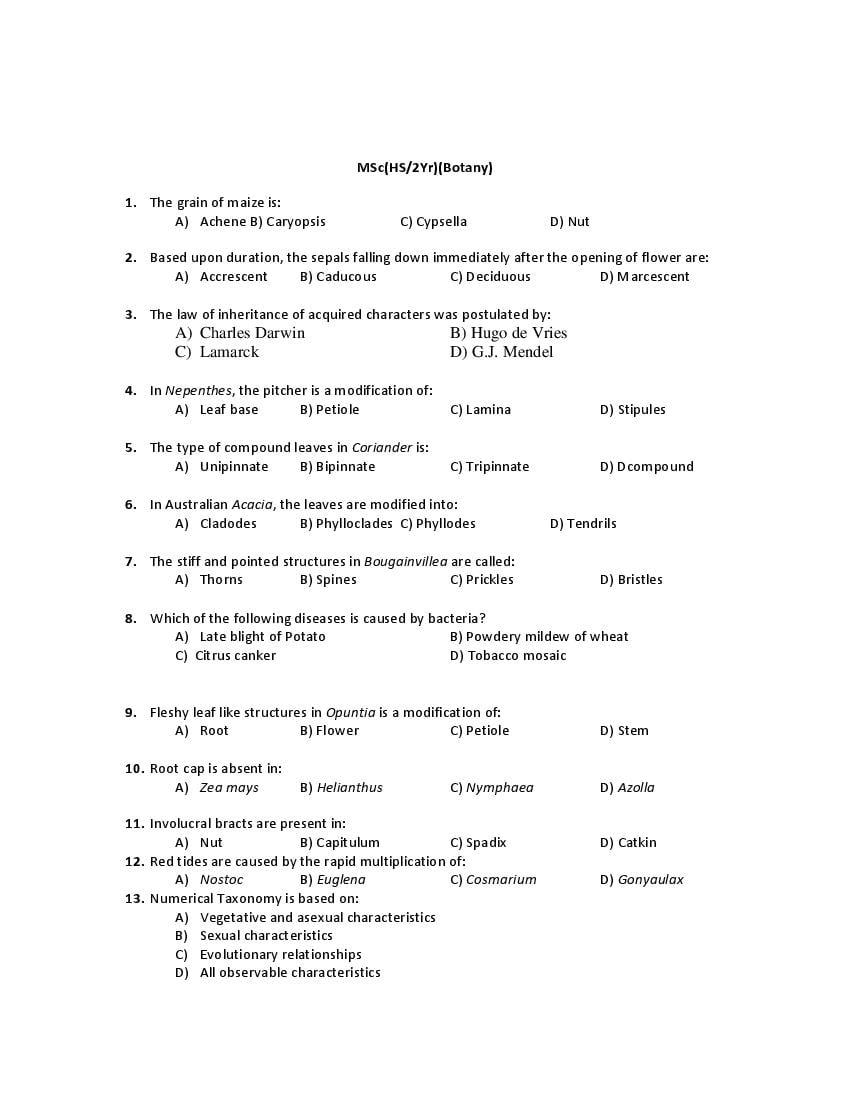
1. The grain of maize is:
A) Achene B) Caryopsis C) Cypsella D) Nut
2. Based upon duration, the sepals falling down immediately after the opening of flower are:
A) Accrescent B) Caducous C) Deciduous D) Marcescent
3. The law of inheritance of acquired characters was postulated by:
A) Charles Darwin B) Hugo de Vries
C) Lamarck D) G.J. Mendel
4. In Nepenthes, the pitcher is a modification of:
A) Leaf base B) Petiole C) Lamina D) Stipules
5. The type of compound leaves in Coriander is:
A) Unipinnate B) Bipinnate C) Tripinnate D) Dcompound
6. In Australian Acacia, the leaves are modified into:
A) Cladodes B) Phylloclades C) Phyllodes D) Tendrils
7. The stiff and pointed structures in Bougainvillea are called:
A) Thorns B) Spines C) Prickles D) Bristles
8. Which of the following diseases is caused by bacteria?
A) Late blight of Potato B) Powdery mildew of wheat
C) Citrus canker D) Tobacco mosaic
9. Fleshy leaf like structures in Opuntia is a modification of:
A) Root B) Flower C) Petiole D) Stem
10. Root cap is absent in:
A) Zea mays B) Helianthus C) Nymphaea D) Azolla
11. Involucral bracts are present in:
A) Nut B) Capitulum C) Spadix D) Catkin
12. Red tides are caused by the rapid multiplication of:
A) Nostoc B) Euglena C) Cosmarium D) Gonyaulax
13. Numerical Taxonomy is based on:
A) Vegetative and asexual characteristics
B) Sexual characteristics
C) Evolutionary relationships
D) All observable characteristics
Page 2
A) Colour Principles B) Aromatic principles
C) Moisture principles D) Weight principles
15. The permanent taste in ginger is due to:
A) Oil B) Minerals C) Resins D) Starch
16. The quality of coffee mainly depends upon:
A) Harvesting B) Processing
C) Physiological maturity D) Ripening
17. The literal meaning of word ‘Locust’ is:
A) Location B) Area C) Pests D) Plague
18. Companion cells are derived from:
A) Parenchyma B) Fibres C) Sclerotic cellsD) Sieve elements
19. A dew drop at the tip of tomato leaves on cool night is formed due to:
A) Atmospheric water B) Evaporation of water from stomata
C) Secretion of water from hydathodes D) Excessive water absorption at the root tips
20. Stone cells are also known as:
A) Brachysclereids B) Osteosclereids
C) Macroschereids D) Trichoblasts
21. Cells entirely lacking turgor pressure are referred to as:
A) Dead B) Inactive C) Flaccid D) Immotile
22. In plant physiology, radioactive isotopes are used as:
A) Tracers B) Activators C) Catalysts D) Initiators
23. The tendency of colloidal particles to attract and retain other particles at their surface is:
A) Adsorption B) Absorption C) Gelation D) Solation
24. Ammonia poisoning occurs in temperature sensitive plants at:
A) Low temperature B) High temperature
C) Moderate temperature D) Low light intensity
25. Which of the following is more resistant to high temperature stress:
A) Low hydrated tissues B) Moderate hydrated tissues
C) High hydrated tissues D) Very high hydrated tissues
26. Opening and closing of flowers represents a kind of:
A) Autonomic movement B) Nutation
C) Tropic movement D) Nastic movement
27. The scutellum of grass embryo is:
A) Photosynthetic organ B) Absorption organ
C) Reserve food storage organ D) Vestigeal organ
Page 3
A) Seed coat B) Aleurone layer
C) Coleorhizae D) Coleoptiles
29. In the respiratory chain of electron transport, which one of the following is the terminal
cytochrome that reacts with oxygen?
A) Cytochrome b B) Cytochrome b6 C) Cytochrome c D) Cytochrome a3
30. Which of the following enzyme has a dual role?
A) PEP carboxylase B) RuBisCo
C) Phosphorylase D) Aldolase
31. Which of the following does not require carrier molecules during transport through cell
membranes?
A) Simple diffusion B) Facilitated diffusion
C) Na+- K+ transport D) Active transport of sugars and amino acids
32. Which one of the following features is NOT found in meristematic cells?
A) Dense cytoplasm B) Isodiametric shape
C) Large prominent nucleus D) Thick cell-wall due to lignification
33. Zymogens are:
A) Enzyme inhibitors B) Enzyme solvents
C) Chemical precursors of enzymes D) Active enzymes
34. Which of the following are important for nitrogen fixation?
A) Calcium and potassium B) Sodium and phosphorus
C) Magnesium and boron D) Iron and molybdenum
35. Statocysts are:
A) Air-cells B) Chlorophyll cells
C) Fibre-cells D) Sensory cells
36. Movement induced by internal stimulus is known as:
A) Autonomic B) Paratonic C) Mechanical D) Independent
37. DNA replication in cell cycle occurs in which of the following phases?
A) Metaphase B) G1 Phase C) S Phase D) G2 Phase
38. Photorespiration is stimulated in:
A) Light B) Dark
C) A chamber devoid of CO2 D) A chamber filled with CO2
Page 4
A) Shortens the cycle period B) Extends the cycle period
C) Has no effect on the process D) Cause polyploidy
40. Reactive oxygen species are NOT found in:
A) Mitochondria B) Peroxisome C) Chloroplast D) Ribosomes
41. When Hydrilla is removed from aquatic habitat to be planted in soil:
A) The plant will dry up and die
B) The plant would grow though with a stunted growth
C) The number of lacunae reduce and a thick cuticle is developed
D) It start producing collenchyma and sclerenchyma cells for mechanical support
42. Dissociation constant (Kw) of water increases with:
A) Atmospheric pressure B) Temperature
C) Dilution D) Acid
43. Red Data Book gives information on:
A) Plants and animals found in Red sea B) Plants possessing red pigments
C) Plants threatened with extinction D) Effects of red light on photosynthesis
44. In gene banks, genetic material is in the form of:
A) Leaves B) Shoots C) Seeds D) Flowers
45. Which one of the following is the correct sequence of energy in an ecosystem?
A) Herbivore > Carnivore >Producer B) Producer > Herbivore > Carnivore
C) Producer > Carnivore > Herbivore D) Decomposer > Carnivore > Herbivore
46. Eutrophication is maximum in:
A) Upper layers of deep lakes B) Upper layers of shallow lakes
C) Bottom layers of shallow lakes D) Bottom layers of deep lakes
47. The gene which suppresses the action of a gene at other locus is called:
A) Lethal B) Penetrance C) Pleiotropic D) Epistatic
48. The chemical widely used for inducing polyploidy is:
A) Putrescine B) Spermidine C) Spermine D) Colchicine
49. Which of the following is not a type of direct gene transfer method:
A) Biolistic method B) Viral mediated
Page 5
50. The enzymes present in the lysosomes are optimally active at the:
A) Basic pH B) Acidic pH C) Neutral pH D) All the pH ranges
51. Ramachandran plot deals with the conformational studies of:
A) Carbohydrates B) Proteins
C) Lipids D) Nucleic acids
52. Association of fungi with the roots of higher plants is known as:
A) Lichen B) Mycoplasma C) Mycorrhiza D) Corallorhiza
53. Which of the following is a heterosporous genus?
A) Equisetum B) Salvinia C) Funaria D) Lycopodium
54. Agar, a commercial product used in ice-creams, is obtained from:
A) Gelidium B) Laminaria C) Porphyra D) Chlorella
55. Adventitious buds arise from the notches present at the margins of leaves in:
A) Ginger B) Agave C) Bryophyllum D) Water hyacinth
56. Loss of water from the leaves of plants in liquid phase is known as:
A) Transpiration B) Guttation C) Evaporation D) Diffusion
57. The inheritance of flower colour in dog flower is an example of:
A) True dominance B) Co-dominance
C) Incomplete dominance D) Maternal inheritance
58. The historic Convention on Biological Diversity (CBD) was held in:
A) Johannesburg B) New York C) Rio de Janeiro D) Kyoto
59. Chemical substances like nicotine, caffeine, quinine, strychnine and opium are produced
by plants as a:
A) Defence B) Medicine C) Commercial item D) Food item
60. The detritus food chain begins with:
A) Producers B) Carnivores C) Herbivores D) Dead organic matter
61. A toxic insecticidal component produced by Bacillus thuringiensis is a:
A) Glycoside B) Lipid C) Protein D) Alkaloid
62. In the ribose moiety of a ribonucleoside, phosphorylation is possible only at ________________
in the furanose ring formation.
A) C5’ (one) position B) C1’, C4’ (two) positions
C) C2’, C3’ C5’ (three) positions D) C1’, C2’, C3’, C4’, C5’ (five) positions
63. In Isoelectric focusing, proteins are separated on the basis of:
Page 6
B) Relative content of positively charged residue
C) Relative content of negatively charged residue
D) Relative content of positively and negatively charged residue
64. ____________________type of vascular bundles is characterized by the occurrence of xylem
and phloem at the same radius.
A) Conjoint B) Conjuctive C) Collateral D) Closed
65. Presence of vessels is a characteristic feature of:
A) Bryophytes B) Pteridophytes C) Gymnosperms D) Angiosperms
66. In most of the angiosperms, pollen grains are shed at:
A) 2-celled stage B) 3-celled stage C) 4-celled stage D) 5-celled stage
67. In which of the following plants, dioecy occurs?
A) Maize B) Banana C) Papaya D) Mango
68. There is net gain of ________ molecules of ATP during fermentation of one molecule of glucose.
A) 1 B) 2 C) 3 D) 4
69. _____________ promote bolting in beet, cabbages and many plants with rosette habit.
A) Auxins B) Gibberellins C) Cytokinins D) Abscisic acid
70. Vertical distribution of different species occupying different levels in a biotic community is:
A) Alfa diversity B) Stratification C) Beta diversity D) Gamma diversity
71. ______________ are the smallest living cells known that can survive without oxygen.
A) Archaebacteria B) Viruses
C) Cyanobacteria D) Mycoplasma
72. The network of hyphae is:
A) Sclerotium B) Mycelium C) Apothecium D) Acervulus
73. Which of the following is one of the tallest tree species in the world?
A) Pinus B) Sequoia C) Cedrus D) Eucalyptus
74. Bulliform cells are present only in:
A) Orchids B) Grasses C) Flowers D) Fruits
75. The oils and fats are stored in which of the following plastid types?
A) Amyloplsts B) Aleuroplasts C) Elaioplasts D) Chromoplasts
x-x-x
Document Details
| Board / Org | Panjab University |
| Exam | PU CET PG |
| Type | Question Paper |
| Pages | 6 |
| Updated | 22 Jul 2026 |