MBOSE Class 12 Question Paper 2022 for Education
Finished viewing? Save it for later —
Download MBOSE Class 12 Question Paper 2022 for Education (PDF · 8 pages)About MBOSE Class 12 Question Paper 2022 for Education
MBOSE Class 12 Question Paper 2022 for Education is available here for free download. Published by Meghalaya Board for Class 12, this question paper can be viewed online or downloaded as a PDF (8 pages). Candidates preparing for Class 12 can use MBOSE Class 12 Question Paper 2022 for Education to understand the exam pattern, the type of questions asked, and the overall difficulty level.
Frequently Asked Questions
How can I download MBOSE Class 12 Question Paper 2022 for Education?
Open this page and click the Download button to save MBOSE Class 12 Question Paper 2022 for Education as a PDF. It is completely free on AglaSem Docs.
Is MBOSE Class 12 Question Paper 2022 for Education free to download?
Yes. MBOSE Class 12 Question Paper 2022 for Education can be viewed online and downloaded as a PDF free of cost on AglaSem Docs.
How many pages does MBOSE Class 12 Question Paper 2022 for Education have?
MBOSE Class 12 Question Paper 2022 for Education contains 8 pages, which you can read online or download together as a single PDF.
Where can I find more Class 12 study material?
You can find more Class 12 question papers, sample papers, syllabus, and answer keys on AglaSem Docs.
MBOSE Class 12 Question Paper 2022 for Education – Text
Read the full text of this question paper below — useful to quickly search, copy and reference the content online without downloading the PDF.
📄 View text version (8 pages)
Page 1
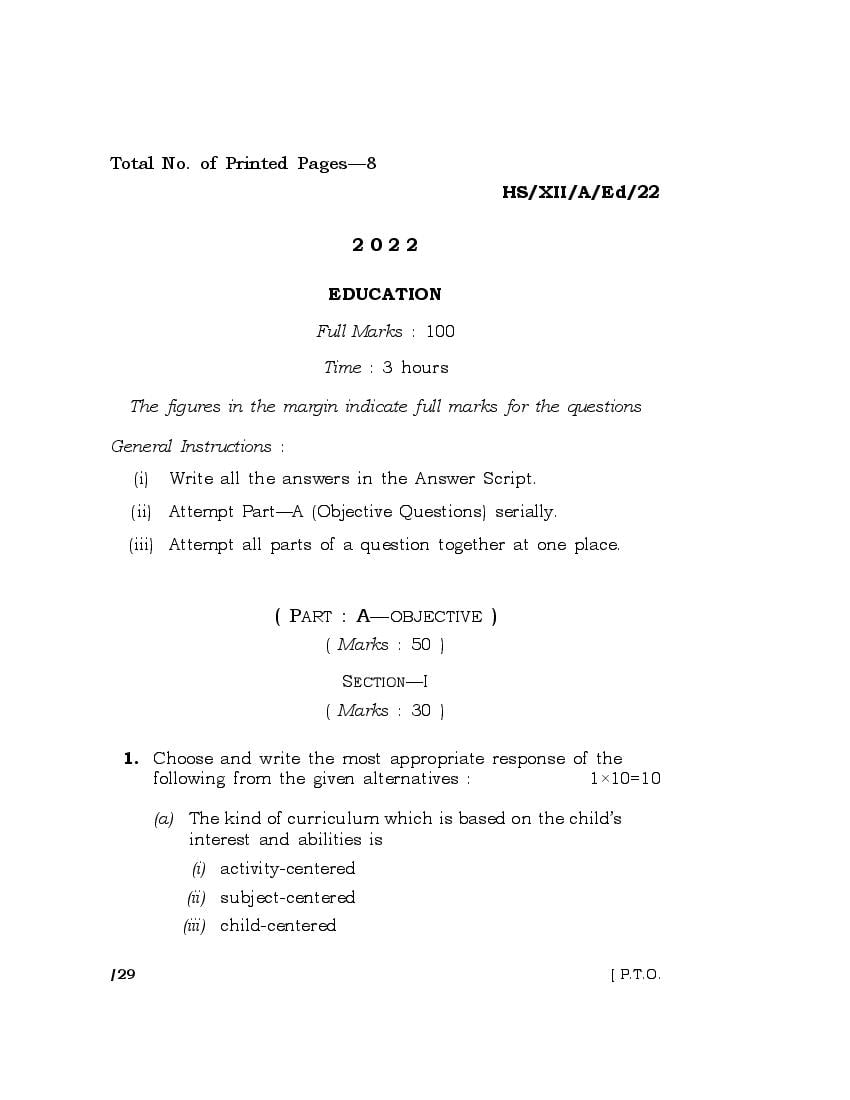
HS/XII/A/Ed/22
2022
EDUCATION
Full Marks : 100
Time : 3 hours
The figures in the margin indicate full marks for the questions
General Instructions :
(i) Write all the answers in the Answer Script.
(ii) Attempt Part—A (Objective Questions) serially.
(iii) Attempt all parts of a question together at one place.
( PART : A—OBJECTIVE )
( Marks : 50 )
SECTION—I
( Marks : 30 )
1. Choose and write the most appropriate response of the
following from the given alternatives : 1×10=10
(a) The kind of curriculum which is based on the child’s
interest and abilities is
(i) activity-centered
(ii) subject-centered
(iii) child-centered
/29 [ P.T.O.
Page 2
(b) The evaluation that determines the students’
performance at the beginning of instruction is
(i) placement evaluation
(ii) formative evaluation
(iii) summative evaluation
(c) Gifted children have
(i) low intellectual ability
(ii) normal intellectual ability
(iii) high intellectual ability
(d) Who supports integration of craft, art, health and
education into one scheme called ‘Nai Talim’ ?
(i) Tagore
(ii) Gandhi
(iii) Plato
(e) Inclusion is an opportunity for developing the child
with
(i) special needs
(ii) regular needs
(iii) Both (i) and (ii)
HS/XII/A/Ed/22/29 [ Contd.
Page 3
(f) Aptitude is one’s innate ability to
(i) behave properly
(ii) think reasonably
(iii) do certain types of work
(g) Educational technology is the mechanization of
(i) teaching process
(ii) educational process
(iii) various tools and products
(h) The theory of multiple intelligence was propounded
by
(i) Spearman
(ii) Howard Gardner
(iii) Louis Leon Thurstone
(i) The first stage of memory is
(i) registration
(ii) storage
(iii) recall
HS/XII/A/Ed/22/29 [ P.T.O.
Page 4
(j) Our ability to understand and interact with people
around us is referred to as
(i) personal intelligence
(ii) artificial intelligence
(iii) interpersonal intelligence
2. Write whether the following statements are True
or False : 1×5=5
(a) Most people equate syllabus with curriculum.
(b) Dyscalculia refers to a disorder with reference to
written expression.
(c) The superego is the final aspect of personality that
is concerned with morality.
(d) Focussed attention is the ability to maintain a
consistent behavioural response during continuous
and repetitive activity.
(e) Stimuli from the environment are registered in our
sensory memory.
3. Match the word(s) in Column—A relating to the
appropriate word(s) in Column—B : 1×5=5
Column—A Column—B
(a) Logic (i) Sigmund Freud
(b) Flynn effect (ii) Subject-centered curriculum
(c) Schemas (iii) IQ points
(d) Psychoanalysis (iv) Thinking
(e) Essentialism (v) Cognitive frameworks
HS/XII/A/Ed/22/29 [ Contd.
Page 5
4. Who stated the following? 1×5=5
(a) “The curriculum of the school did not neglect India’s
cultural, analytical and scientific heritage, but was
very involved with the rest of the world.”
(b) “It is through art, and through art only, that we can
realize our perfection; through art, and art only, that
we can shield ourselves from the sordid perils of
actual existence.”
(c) “The greatest gift you can give another is the purity
of your attention”.
(d) “When the mind is thinking, it is talking to itself.”
(e) “When all think alike, no one is thinking very much.”
5. Fill in the blanks : 1×5=5
(a) The process or the method of teaching, including
strategies or the style of instruction is referred to as
_____.
(b) A/An _____ classroom is a means to bring children
with varied needs together.
(c) _____, a form of language art, arouses stillness and
calm and deepens human emotions.
(d) _____ are systematic procedures for improving
memories.
(e) Aristotle, the Greek philosopher, introduced a
system of reasoning called _____.
HS/XII/A/Ed/22/29 [ P.T.O.
Page 6
SECTION—II
( Marks : 20 )
6. Answer briefly the following questions in 2 or 3
sentences each (any ten): 2×10=20
(a) What is Spiral Curriculum?
(b) What is the difference between Handicap and
Disability?
(c) What are the different forms of Art? Give examples.
(d) What is Autism?
(e) What are cognitive styles?
(f) Mention four objectives of educational technology.
(g) Mention the basic steps used in reasoning.
(h) What is creative thinking?
(i) Mention the different kinds of attention.
(j) Differentiate between Maintenance rehearsal and
Elaborative rehearsal.
(k) Name the fundamental characteristics of personality.
(l) What is interest?
HS/XII/A/Ed/22/29 [ Contd.
Page 7
(m) What is M-learning?
(n) Differentiate between Evaluation and Assessment.
(o) What is Emotional Quotient (EQ)?
( PART : B—DESCRIPTIVE )
( Marks : 50 )
Answer question no. 7 and any three from the rest :
7. Write short notes on any four of the following : 5×4=20
(a) Child-centered curriculum
(b) Various kinds of disabilities as given by the Persons
with Disabilities Act, 1995
(c) Three elements of personality mentioned by
Sigmund Freud
(d) Main steps in problem solving
(e) Art Education Curriculum as prescribed by NCERT
for secondary stage
(f) Selective attention
(g) Concept of curriculum
(h) Meaning of educational technology
HS/XII/A/Ed/22/29 [ P.T.O.
Page 8
8. Explain briefly the principles of curriculum construction. 10
9. What is Art Education? Write briefly on the importance
of Art Education. 2+8=10
10. Explain the aspects of educational technology. 10
11. Define personality. Explain briefly the theory of
personality given by Allport. 2+8=10
12. What is reasoning? Explain the various ways for
developing thinking and reasoning abilities. 2+8=10
13. Why do individuals differ and in what areas? What are
the educational implications of individual differences for
classroom teaching? 2+8=10
14. What is memory? Write briefly on the ways to enhance
memory. 2+8=10
15. What is inclusion? How are special children
discriminated against and segregated from other
children? 3+7=10
HS/XII/A/Ed/22/29 22K—23360
Document Details
| Board / Org | Meghalaya Board |
| Exam | Class 12 |
| Type | Question Paper |
| Pages | 8 |
| Updated | 22 Jul 2026 |