GATE 2023 Syllabus for Instrumentation Engineering (IN)
Finished viewing? Save it for later —
Download GATE 2023 Syllabus for Instrumentation Engineering (IN) (PDF · 3 pages)About GATE 2023 Syllabus for Instrumentation Engineering (IN)
GATE 2023 Syllabus for Instrumentation Engineering (IN) is available here for free download. Published by IIT for Graduate Aptitude Test in Engineering, this syllabus can be viewed online or downloaded as a PDF (3 pages). Candidates preparing for Graduate Aptitude Test in Engineering can use GATE 2023 Syllabus for Instrumentation Engineering (IN) to understand the exam pattern, the type of questions asked, and the overall difficulty level.
Frequently Asked Questions
How can I download GATE 2023 Syllabus for Instrumentation Engineering (IN)?
Open this page and click the Download button to save GATE 2023 Syllabus for Instrumentation Engineering (IN) as a PDF. It is completely free on AglaSem Docs.
Is GATE 2023 Syllabus for Instrumentation Engineering (IN) free to download?
Yes. GATE 2023 Syllabus for Instrumentation Engineering (IN) can be viewed online and downloaded as a PDF free of cost on AglaSem Docs.
How many pages does GATE 2023 Syllabus for Instrumentation Engineering (IN) have?
GATE 2023 Syllabus for Instrumentation Engineering (IN) contains 3 pages, which you can read online or download together as a single PDF.
Where can I find more Graduate Aptitude Test in Engineering study material?
You can find more Graduate Aptitude Test in Engineering question papers, sample papers, syllabus, and answer keys on AglaSem Docs.
GATE 2023 Syllabus for Instrumentation Engineering (IN) – Text
Read the full text of this syllabus below — useful to quickly search, copy and reference the content online without downloading the PDF.
📄 View text version (3 pages)
Page 1
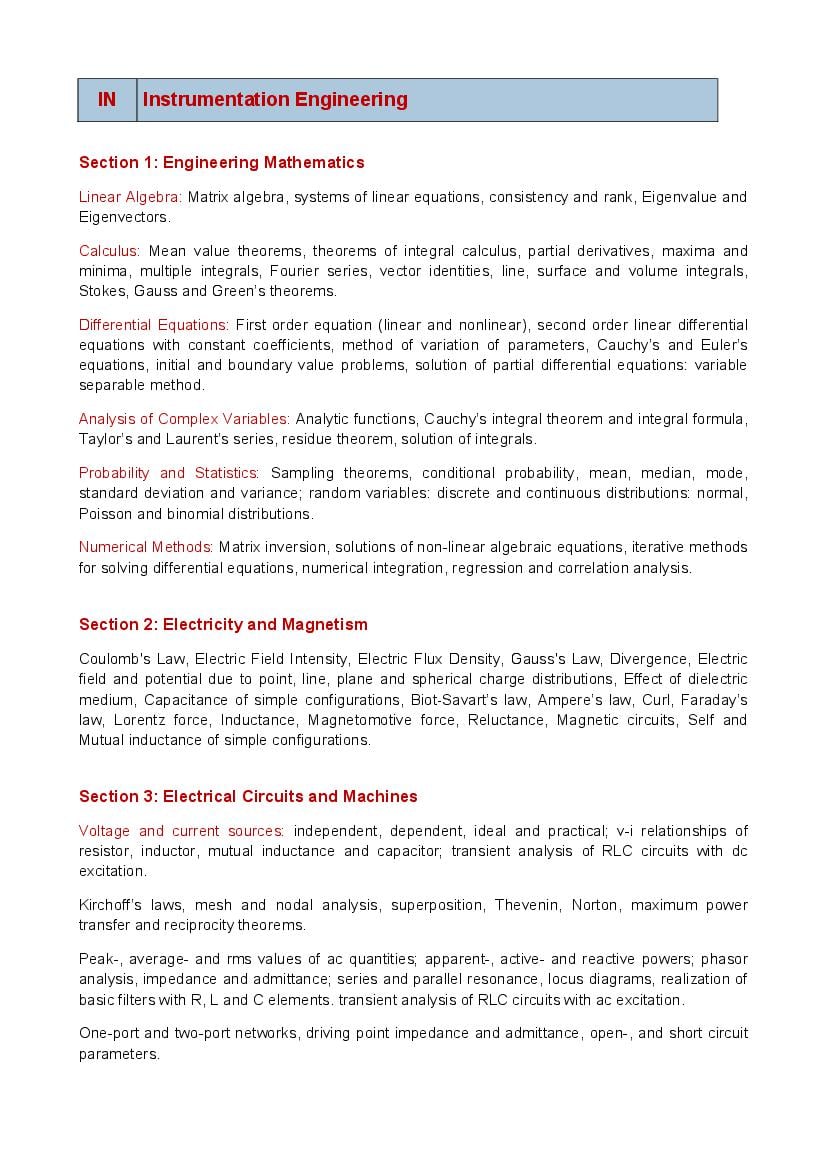
Section 1: Engineering Mathematics
Linear Algebra: Matrix algebra, systems of linear equations, consistency and rank, Eigenvalue and
Eigenvectors.
Calculus: Mean value theorems, theorems of integral calculus, partial derivatives, maxima and
minima, multiple integrals, Fourier series, vector identities, line, surface and volume integrals,
Stokes, Gauss and Green’s theorems.
Differential Equations: First order equation (linear and nonlinear), second order linear differential
equations with constant coefficients, method of variation of parameters, Cauchy’s and Euler’s
equations, initial and boundary value problems, solution of partial differential equations: variable
separable method.
Analysis of Complex Variables: Analytic functions, Cauchy’s integral theorem and integral formula,
Taylor’s and Laurent’s series, residue theorem, solution of integrals.
Probability and Statistics: Sampling theorems, conditional probability, mean, median, mode,
standard deviation and variance; random variables: discrete and continuous distributions: normal,
Poisson and binomial distributions.
Numerical Methods: Matrix inversion, solutions of non-linear algebraic equations, iterative methods
for solving differential equations, numerical integration, regression and correlation analysis.
Section 2: Electricity and Magnetism
Coulomb's Law, Electric Field Intensity, Electric Flux Density, Gauss's Law, Divergence, Electric
field and potential due to point, line, plane and spherical charge distributions, Effect of dielectric
medium, Capacitance of simple configurations, Biot‐Savart’s law, Ampere’s law, Curl, Faraday’s
law, Lorentz force, Inductance, Magnetomotive force, Reluctance, Magnetic circuits, Self and
Mutual inductance of simple configurations.
Section 3: Electrical Circuits and Machines
Voltage and current sources: independent, dependent, ideal and practical; v-i relationships of
resistor, inductor, mutual inductance and capacitor; transient analysis of RLC circuits with dc
excitation.
Kirchoff’s laws, mesh and nodal analysis, superposition, Thevenin, Norton, maximum power
transfer and reciprocity theorems.
Peak-, average- and rms values of ac quantities; apparent-, active- and reactive powers; phasor
analysis, impedance and admittance; series and parallel resonance, locus diagrams, realization of
basic filters with R, L and C elements. transient analysis of RLC circuits with ac excitation.
One-port and two-port networks, driving point impedance and admittance, open-, and short circuit
parameters.
Page 2
regulation and efficiency; Three phase induction motors: principle of operation, types, performance,
torque-speed characteristics, no-load and blocked rotor tests, equivalent circuit, starting and speed
control; Types of losses and efficiency calculations of electric machines.
Section 4: Signals and Systems
Periodic, aperiodic and impulse signals; Laplace, Fourier and z-transforms; transfer function,
frequency response of first and second order linear time invariant systems, impulse response of
systems; convolution, correlation. Discrete time system: impulse response, frequency response,
pulse transfer function; DFT and FFT; basics of IIR and FIR filters.
Section 5: Control Systems
Feedback principles, signal flow graphs, transient response, steady-state-errors, Bode plot, phase
and gain margins, Routh and Nyquist criteria, root loci, design of lead, lag and lead-lag
compensators, state-space representation of systems; time-delay systems; mechanical, hydraulic
and pneumatic system components, synchro pair, servo and stepper motors, servo valves; on-off,
P, PI, PID, cascade, feedforward, and ratio controllers, tuning of PID controllers and sizing of
control valves.
Section 6: Analog Electronics
Characteristics and applications of diode, Zener diode, BJT and MOSFET; small signal analysis of
transistor circuits, feedback amplifiers. Characteristics of ideal and practical operational amplifiers;
applications of opamps: adder, subtractor, integrator, differentiator, difference amplifier,
instrumentation amplifier, precision rectifier, active filters, oscillators, signal generators, voltage
controlled oscillators and phase locked loop, sources and effects of noise and interference in
electronic circuits.
Section 7: Digital Electronics
Combinational logic circuits, minimization of Boolean functions. IC families: TTL and CMOS.
Arithmetic circuits, comparators, Schmitt trigger, multi-vibrators, sequential circuits, flipflops, shift
registers, timers and counters; sample-and-hold circuit, multiplexer, analog-to-digital (successive
approximation, integrating, flash and sigma-delta) and digital-to-analog converters (weighted R, R-
2R ladder and current steering logic). Characteristics of ADC and DAC (resolution, quantization,
significant bits, conversion/settling time); basics of number systems, Embedded Systems:
Microprocessor and microcontroller applications, memory and input-output interfacing; basics of
data acquisition systems, basics of distributed control systems (DCS) and programmable logic
controllers.
Section 8: Measurements
SI units, standards (R,L,C, voltage, current and frequency), systematic and random errors in
measurement, expression of uncertainty - accuracy and precision, propagation of errors, linear and
weighted regression. Bridges: Wheatstone, Kelvin, Megohm, Maxwell, Anderson, Schering and
Wien for measurement of R, L, C and frequency, Q-meter. Measurement of voltage, current and
power in single and three phase circuits; ac and dc current probes; true rms meters, voltage and
current scaling, instrument transformers, timer/counter, time, phase and frequency measurements,
digital voltmeter, digital multimeter; oscilloscope, shielding and grounding.
Page 3
Resistive-, capacitive-, inductive-, piezoelectric-, Hall effect sensors and associated signal
conditioning circuits; transducers for industrial instrumentation: displacement (linear and angular),
velocity, acceleration, force, torque, vibration, shock, pressure (including low pressure), flow
(variable head, variable area, electromagnetic, ultrasonic, turbine and open channel flow meters)
temperature (thermocouple, bolometer, RTD (3/4 wire), thermistor, pyrometer and semiconductor);
liquid level, pH, conductivity and viscosity measurement. 4-20 mA two-wire transmitter.
Section 10: Communication and Optical Instrumentation
Amplitude- and frequency modulation and demodulation; Shannon's sampling theorem, pulse code
modulation; frequency and time division multiplexing, amplitude-, phase-, frequency-, quadrature
amplitude, pulse shift keying for digital modulation; optical sources and detectors: LED, laser,
photo-diode, light dependent resistor, square law detectors and their characteristics;
interferometer: applications in metrology; basics of fiber optic sensing. UV-VIS
Spectrophotometers, Mass spectrometer.
Document Details
| Board / Org | IIT |
| Exam | Graduate Aptitude Test in Engineering |
| Type | Syllabus |
| Pages | 3 |
| Updated | 22 Jul 2026 |