PU CET PG 2019 Question PaperM.E. Biotechnology
Finished viewing? Save it for later —
Download PU CET PG 2019 Question PaperM.E. Biotechnology (PDF · 11 pages)About PU CET PG 2019 Question PaperM.E. Biotechnology
PU CET PG 2019 Question PaperM.E. Biotechnology is available here for free download. Published by Punjab University for PU CET PG, this question paper can be viewed online or downloaded as a PDF (11 pages). Candidates preparing for PU CET PG can use PU CET PG 2019 Question PaperM.E. Biotechnology to understand the exam pattern, the type of questions asked, and the overall difficulty level.
Frequently Asked Questions
How can I download PU CET PG 2019 Question PaperM.E. Biotechnology?
Open this page and click the Download button to save PU CET PG 2019 Question PaperM.E. Biotechnology as a PDF. It is completely free on AglaSem Docs.
Is PU CET PG 2019 Question PaperM.E. Biotechnology free to download?
Yes. PU CET PG 2019 Question PaperM.E. Biotechnology can be viewed online and downloaded as a PDF free of cost on AglaSem Docs.
How many pages does PU CET PG 2019 Question PaperM.E. Biotechnology have?
PU CET PG 2019 Question PaperM.E. Biotechnology contains 11 pages, which you can read online or download together as a single PDF.
Where can I find more PU CET PG study material?
You can find more PU CET PG question papers, sample papers, syllabus, and answer keys on AglaSem Docs.
PU CET PG 2019 Question PaperM.E. Biotechnology – Text
Read the full text of this question paper below — useful to quickly search, copy and reference the content online without downloading the PDF.
📄 View text version (11 pages)
Page 1
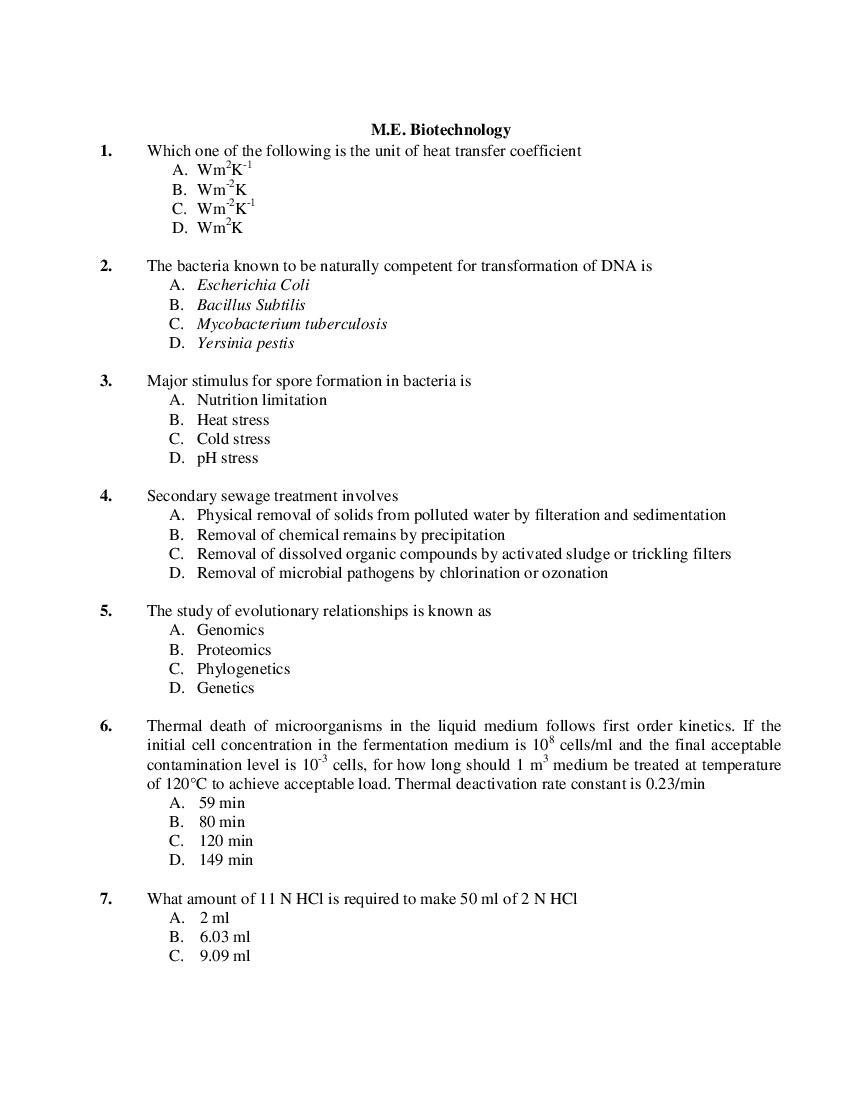
1. Which one of the following is the unit of heat transfer coefficient
A. Wm2K-1
B. Wm-2K
C. Wm-2K-1
D. Wm2K
2. The bacteria known to be naturally competent for transformation of DNA is
A. Escherichia Coli
B. Bacillus Subtilis
C. Mycobacterium tuberculosis
D. Yersinia pestis
3. Major stimulus for spore formation in bacteria is
A. Nutrition limitation
B. Heat stress
C. Cold stress
D. pH stress
4. Secondary sewage treatment involves
A. Physical removal of solids from polluted water by filteration and sedimentation
B. Removal of chemical remains by precipitation
C. Removal of dissolved organic compounds by activated sludge or trickling filters
D. Removal of microbial pathogens by chlorination or ozonation
5. The study of evolutionary relationships is known as
A. Genomics
B. Proteomics
C. Phylogenetics
D. Genetics
6. Thermal death of microorganisms in the liquid medium follows first order kinetics. If the
initial cell concentration in the fermentation medium is 108 cells/ml and the final acceptable
contamination level is 10-3 cells, for how long should 1 m3 medium be treated at temperature
of 120°C to achieve acceptable load. Thermal deactivation rate constant is 0.23/min
A. 59 min
B. 80 min
C. 120 min
D. 149 min
7. What amount of 11 N HCl is required to make 50 ml of 2 N HCl
A. 2 ml
B. 6.03 ml
C. 9.09 ml
Page 2
8. An enzyme that hydrolyses starch to maltose is
A. Alpha amylase
B. Beta amylase
C. Glucoamylase
D. Cyclodextrin glcanotransferase
9. How many fold would the g number of a centrifuge increase by doubling both the spinning
speed and the bowl diameter
A. 2
B. 4
C. 8
D. 10
10. Which of the following is not a plant hormone
A. Corticosterone
B. Ethylene
C. Jasmonic acid
D. Abscisic acid
11. An equimolar mixture of species 1 and 2 is in equilibrium with its vapour at 300 K. At this
temperature, the vapour pressures of the species are : 4•3 = 150 kPa and : 4•3 = 110 kPa.
Assuming that Raoult’s law is valid, the value of y1 is
A. 0.33
B. 0.45
C. 0.50
D. 0.57
12. Bacteria used in biogas plant
A. Methanogens
B. Nitrifying bacteria
C. Denitrifying bacteria
D. Ammonifying bacteria
13. 12 moles of O2 is added to 12 moles of H2. How many moles of H2O will it produce?
A. 6
B. 12
C. 18
D. 24
14. The dimensionless group in mass transfer that is equivalent to Prandlt number in heat transfer
is
Page 3
B. Sherwood number
C. Schmidt number
D. Stanton number
15. Which amongst the following is not a polymer
A. Vinyl alcohol
B. Rubber
C. Polystyrene
D. Polyethylene
16. In an experimental population the birth rate is 16 per 1000 and death rate is 10 per 1000. If the
size of the population is 10,000 at time, t, what will be the size of the population at time, t+1
A. 10,000
B. 10,060
C. 10,600
D. 11,600
17. Which part of a fermenter is used for thorough mixing of medium and inoculum
A. Sparger
B. Shaft
C. Headspace
D. Impeller
18. Flow cytometer is used to measure the number of
A. Cells
B. RNA
C. DNA
D. Proteins
19. What amongst the following does not affect the KLa value in fermentation vessel
A. Rheological properties of the medium
B. Presence of chelating agents
C. Air flow rate
D. Degree of agitation
20. Hydrolysis of a peptide involves cleavage of the bond between the atoms
A. N and Cα
B. C and O
C. Cα and C
D. N and C
21. An air lift fermenter uses ____________________ for mixing
A. Impeller
B. Air bubbles
C. Differential density
Page 4
22. Mass spectrometer separates ions on the basis of which of the following?
A. Mass
B. Mass to charge ratio
C. Molecular weight
D. Charge
23. Before freezing, the blanching of vegetables is done to
A. Denature enzymes
B. Maintain colour
C. Improve texture
D. Prevent microbial activity
24. Which property of polymeric sutures helps them keep the wound closed?
A. Low melting point
B. High thermoplasticity
C. High tensile strength
D. Low coefficient of friction
25. Lineweaver-Burk plot is a plot between
A. ¬ §„` [³]
²
B. Ž] §„` [´]
C. Ž] §„` [³]
D. ¬ §„` [´]
²
26. The ability of the immune system to recognize self antigens versus nonself antigen is an
example of:
A. Specific immunity
B. Tolerance
C. Cell mediated immunity
D. Antigenic immunity
27. Nitrogenase reduces N2 to NH3. Metal co-factors required for this activity are __________
A. Fe & Cu
B. Mo & Fe
C. Mo & Mn
D. Cu & Mn
28. In gas chromatography, the separation of components is based on the difference in
A. Molarity
B. Molecular weight
C. Partition coefficient
Page 5
29. Organic solvent used for yeast cell lysis
A. Toluene
B. Acetonitrile
C. Methanol
D. Dichloromethane
30. A Fab fragment
A. Is produced by pepsin treatment
B. Has no inter chain disulfide bond
C. Is produced by separation of heavy and light chains
D. Binds antigen
31. The process useful in harvesting microbial cells from fermentation broth is
A. Dialysis
B. Ultra filtration
C. Microfiltration
D. Reverse osmosis
32. For a chemical reaction the ratio of the rate constant at 600 K and 500 K is 3. The value of
activation energy is
A. 10.5 kJ mol-1
B. 12 kJ mol-1
C. 20.2 kJ mol-1
D. 27.4 kJ mol-1
33. Teflon is used as coating on mechanical heart valves as it
A. Increases strength
B. Enhances rigidity
C. Lowers friction
D. Prevent wear resistance
34. The primary structure of proteins is maintained by
A. Peptide bonds
B. Hydrogen bonds
C. Ionic bonds
D. Disulphide bonds
35. Tear drops are rich in
A. Amylase
B. Lysozyme
C. Phosphates
Page 6
36. In order to allow for bone ingrowth, the surface of the implants should be
A. Abrasive
B. Smooth
C. Porous
D. Adhesive
37. The antibody molecule is held together by ______________ bonds
A. Sodium
B. Hydrogen
C. Amino acid
D. Disulfide
38. In a contnous ferementer if input supply is decreased, what would be effect on standing
biomass and rate of production?
A. Standing biomass decrease and productivity increase
B. Standing biomass increase and productivity increase
C. Both decreases
D. Both increases
39. Gene mapping provides useful information about chance of
A. Inheritance of disorders
B. Inheritance of genes
C. Inheritance of recessive gene
D. Inheritance of dominant gene
40. Recombinant proteins are
A. Proteins synthesized in animals
B. Proteins synthesized by transgene in host cell by rDNA technology
C. Protein synthesized in cells that are produced by protoplast fusion
D. Proteins synthesised in mutated cell lines
41. What material coating helps the body to accept titanium implants?
A. Hydrogenated fat
B. Hydroxyapatite
C. Hydrangea
D. Hydrochloric acid
42. B and T cells are produced by stem cells that are formed in_____________
A. Bone marrow
B. Liver
C. Spleen
D. lymph nodes
43. IgE:
Page 7
B. Binds strongly to mast cells
C. Cannot bind to macrophages
D. Activates the complement cascade
44. Biofilm produced by bacteria is detected by
A. Saffranin
B. Malachite green
C. Basic fuchsin
D. Congo red
45. The dilution rate, D is defined as
A. Volumetric flow rate/ total volume of culture in the reactor
B. Total volume of culture in the reactor/ volumetric flow rate
C. Specific growth rate/ volumetric flow rate
D. Volumetric flow rate/ specific growth rate
46. A culture of Rhizobium is grown in a chemostat (100 m3 bioreactor). The feed contains 12 gL- 1
sucrose, Ks for the organism is 0.2 gL-1 and µm=0.3 h-1. Flow rate required for steady state
sucrose concentration of 1.5 gL-1 in the reactor will be
A. 2.6 m3h-1
B. 15 m3 h-1
C. 26 m3 h-1
D. 150 m3 h-1
47. Which device is used to measure the flow rate of a fluid
A. Orifice meter
B. Venture meter
C. Rotameter
D. Weir
48. Which of the following valves is used in an autoclave
A. Gate valve
B. Diaphragm valve
C. Safety valve
D. Globe valve
49. B cells that produce and release large amounts of antibody are called______________
A. Plasma cells
B. Memory cells
C. Basophils
D. Neutrophils
Page 8
A. Adenine and Guanine
B. Adenine and Thymine
C. Adenine and Uracil
D. Adenine and Cytosine
51. The complementary strand of 5’-ATCGAG-3’ is
A. 5’-TAGCTC-3’
B. 5’-CTCGAT-3’
C. 5’-ATCGAG-3’
D. 5’-GAGCTA-3’
52. Carbohydrates binding proteins are called
A. Lectins
B. Alexins
C. Polysacch-proteins
D. Glycoproteins
53. Which of the following substances will not stimulate an immune response unless they are
bound to a larger molecule?
A. Antigen
B. Hapten
C. Antibody
D. Virus
54. Wash out condition in seady state fermentation occurs when
A. Cell concentration reaches maximum
B. Substrate concentration is maximum
C. Specific growth rate is maximum
D. All of these
55. The homologue of β-catenin in Drosophila is
A. Fushi Tarazu
B. Engrailed
C. Armadillo
D. Cubitus Interruptus
56. How many overlapping trinucleotide units can be obtained for a DNA sequence of length 15
nucleotides
A. 12
B. 13
C. 14
D. 15
57. For moist heat sterilization, steam is used in the range of temperatures
A. 100-120 °C
Page 9
C. 141-160 °C
D. 161-180 °C
58. First developed database from protein sequences is
A. SWISS-PROT
B. TrEMBL
C. UniProt
D. PIR
59. E.Coli proliferates faster on GLUCOSE that it does on LACTOSE because lactose is
A. Taken up slowly as compared to glucose
B. Not hydrolyzed by E.Coli
C. Taken up faster as compared to glucose
D. Toxic to the cells
60. A chromosome aberration leads to change in the order of genes in a genetic map but does not
alter its linkage group due to
A. Inversion
B. Transposition
C. Recombination
D. Translocation
61. What amongst the following is not favourable for protein folding?
A. Hydrophobic interaction
B. Hydrogen bonding
C. Van der Waals interaction
D. Conformational entropy
62. Mycobacterium Tuberculosis is an intra-cellular bacterium. It prefers to infect
A. B cells
B. T cells
C. Neutrophils
D. Macrophages
63. B lymphocytes develop immune competence in the
A. Thymus
B. Spleen
C. Lymph nodes
D. Bone marrow
64. The protein in eukaryotes subjected to degradation undergoes
A. Phosphorylation
B. Ubiquitation
C. Carboxylation
D. Methylation
Page 10
gL-1 (DCW), the specific growth rate(µ ) is 0.2 h-1and substrate uptake rate (ν) is 15 gL-1h -1 .
The cell yield coefficient Yx/s will be
A. 0.20
B. 0.35
C. 0.45
D. 0.50
66. The standard enthalpies of formation of H2O (g) , CH4 (g), CO2 (g) are -241.8 kJ/mol, -74.52
kJ/mol, -393.5 kJ/mol respectively. Determine the heat of reaction for the following
reaction
•7 (µ) + 2• ¶(µ) → ¶ (µ) + 4 • (µ)
-1
A. 164.62 kJ mol
B. -77.18 kJ mol-1
C. -164.62 kJ mol-1
D. +77.18 kJ mol-1
67. Which of the following is employed for the repeated use of enzymes in bioprocesses?
A. Polymerization
B. Ligation
C. Isomerisation
D. Immobilization
68. In a batch culture of Penicillium chrysogenum, maximum penicillin synthesis occurs during
the
A. Exponential phase
B. Stationary phase
C. Lag phase
D. Death phase
69. The unit of reaction rate constant for a second order reaction is
A. Conc-1 time-1
B. Time-1
C. Concentration time-1
D. Concentration-1
70. Under steady state conditions ________________________ is zero
A. Rate of disappearance of substrate
B. Rate of output of substrate
C. Rate of accumulation of substrate
D. All of these
71. The yield coefficient ›· ‰• `)9‰„)` §•
¸
A. Grams of biomass produced per gram of substrate added
B. Grams of biomass produced per gram of substrate consumed
Page 11
D. None of these
72. A continuous reactor has a dilution rate of 0.5 per hour. The hydraulic retention time would be
A. 0.5 h B. 1 h C. 1.5 h D. 2 h
73. At constant temperature and pressure, the molar density of a binary mixture is given by V =
1+x2, where x2 is the mole fraction of component 2. The partial molar volume at infinite
dilution for component 1, Ž¹ ∞ is
A. 0.5 B. 1.0 C. 1.5 D. 2.0
74. The most effective method for air sterilization for the fermenter is
A. Heat
B. UV rays
C. Filtration
D. Chemical spray
75. The following is not a product of anaerobic digestion process
A. Antibiotics
B. Biogas
C. Hydrogen sulphide
D. Biofertilizer
x-x-x
Document Details
| Board / Org | Panjab University |
| Exam | PU CET PG |
| Type | Question Paper |
| Pages | 11 |
| Updated | 22 Jul 2026 |