CBSE Class 11 Legal Studies Syllabus 2021-22
Finished viewing? Save it for later —
Download CBSE Class 11 Legal Studies Syllabus 2021-22 (PDF · 4 pages)About CBSE Class 11 Legal Studies Syllabus 2021-22
CBSE Class 11 Legal Studies Syllabus 2021-22 is available here for free download. Published by CBSE for Class 11, this syllabus can be viewed online or downloaded as a PDF (4 pages). Candidates preparing for Class 11 can use CBSE Class 11 Legal Studies Syllabus 2021-22 to understand the exam pattern, the type of questions asked, and the overall difficulty level.
Frequently Asked Questions
How can I download CBSE Class 11 Legal Studies Syllabus 2021-22?
Open this page and click the Download button to save CBSE Class 11 Legal Studies Syllabus 2021-22 as a PDF. It is completely free on AglaSem Docs.
Is CBSE Class 11 Legal Studies Syllabus 2021-22 free to download?
Yes. CBSE Class 11 Legal Studies Syllabus 2021-22 can be viewed online and downloaded as a PDF free of cost on AglaSem Docs.
How many pages does CBSE Class 11 Legal Studies Syllabus 2021-22 have?
CBSE Class 11 Legal Studies Syllabus 2021-22 contains 4 pages, which you can read online or download together as a single PDF.
Where can I find more Class 11 study material?
You can find more Class 11 question papers, sample papers, syllabus, and answer keys on AglaSem Docs.
CBSE Class 11 Legal Studies Syllabus 2021-22 – Text
Read the full text of this syllabus below — useful to quickly search, copy and reference the content online without downloading the PDF.
📄 View text version (4 pages)
Page 1
LEGAL STUDIES Class XI-XII (2019-20)
(Code No. 074)
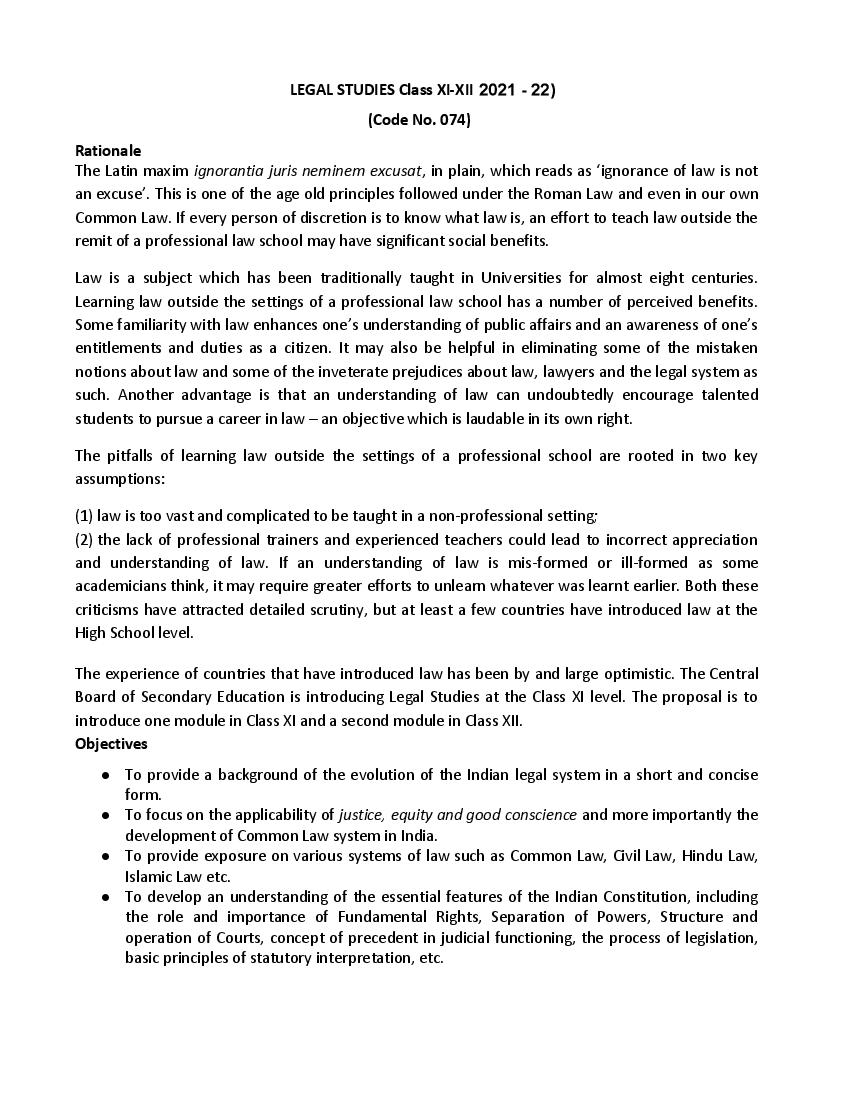
Rationale
The Latin maxim ignorantia juris neminem excusat, in plain, which reads as ‘ignorance of law is not
an excuse’. This is one of the age old principles followed under the Roman Law and even in our own
Common Law. If every person of discretion is to know what law is, an effort to teach law outside the
remit of a professional law school may have significant social benefits.
Law is a subject which has been traditionally taught in Universities for almost eight centuries.
Learning law outside the settings of a professional law school has a number of perceived benefits.
Some familiarity with law enhances one’s understanding of public affairs and an awareness of one’s
entitlements and duties as a citizen. It may also be helpful in eliminating some of the mistaken
notions about law and some of the inveterate prejudices about law, lawyers and the legal system as
such. Another advantage is that an understanding of law can undoubtedly encourage talented
students to pursue a career in law – an objective which is laudable in its own right.
The pitfalls of learning law outside the settings of a professional school are rooted in two key
assumptions:
(1) law is too vast and complicated to be taught in a non-professional setting;
(2) the lack of professional trainers and experienced teachers could lead to incorrect appreciation
and understanding of law. If an understanding of law is mis-formed or ill-formed as some
academicians think, it may require greater efforts to unlearn whatever was learnt earlier. Both these
criticisms have attracted detailed scrutiny, but at least a few countries have introduced law at the
High School level.
The experience of countries that have introduced law has been by and large optimistic. The Central
Board of Secondary Education is introducing Legal Studies at the Class XI level. The proposal is to
introduce one module in Class XI and a second module in Class XII.
Objectives
● To provide a background of the evolution of the Indian legal system in a short and concise
form.
● To focus on the applicability of justice, equity and good conscience and more importantly the
development of Common Law system in India.
● To provide exposure on various systems of law such as Common Law, Civil Law, Hindu Law,
Islamic Law etc.
● To develop an understanding of the essential features of the Indian Constitution, including
the role and importance of Fundamental Rights, Separation of Powers, Structure and
operation of Courts, concept of precedent in judicial functioning, the process of legislation,
basic principles of statutory interpretation, etc.
Page 2
justice, differences between criminal and civil cases, the concept of crime and the
fundamental theories of punishment, rights available to the accused at various stages of the
criminal investigative process, or the key components of Human Rights, etc.
● To understand the fundamental concept and subject matter of property, contract and tort.
● To understand the rudimentary aspects of contract law such as formation of contract, terms
and conditions, discharge, etc.
● To enables students to form an understanding of rights and duties and various categories of
liability principles which form the bedrock for an understanding of Law.
Competencies expected after this course
Students will be able to
i. acquire knowledge of legal theory, laws, legal procedure, drafting, interpretation and
application of laws;
ii. identify legal issues from facts, differentiate between ratio decidendi and obiter dicta;
iii. ask relevant, detailed, and probing questions to understand the differences among
facts, opinions, analyse judgments and recognize and meaningfully respond to legal
fallacies;
iv. apply the law, and draw conclusions by applying analytical reasoning;
v. apply knowledge and understanding of law, legal theory and procedure to solve legal
problems;
vi. evaluate, seek feedback and modify solutions to legal problems;
vii. carry out low scale legal research;
viii. acquire values such as justice, fairness, openness, honesty, integrity, respect for
diversity, and respect for the rule of law; and
ix. prepare themselves for pursuing higher education in the field of Law
Page 3
(2020–21)
One Paper Time: 3hrs. Marks: 100
S Units Periods Marks
1 Theory and Nature of Political Institutions 40 15
2 Nature and Sources of Law 45 15
3 Historical Evolution of the Indian Legal System 45 10
4 Judiciary: Constitutional, Civil and Criminal Courts and 45 20
Processes
5 Family Justice System 45 20
6 Project 20 20
Total 240 100
Contents:
S No Unit Topics
1 Theory and Nature of Political i. Concept of State and Nation
Institutions ii. Organs of Government
iii. Separation of Powers
iv. Basic features of the Constitution of India
2 Nature and Sources of Law i. Nature and meaning of law
ii. Classification of Law
iii. Sources of Law
iv. Law Reform
3 Historical Evolution of the Indian i. Ancient Indian Law
Legal System ii. Administration of Justice in British India
iii. Making of the Indian Constitution
4 Judiciary: Constitutional, Civil and i. Constitution: Roles and Impartiality
Criminal Courts and Processes ii. Hierarchy of Courts
iii. The Civil Court Structure
iv. Structure and functioning of Criminal Courts in
India
v. Other Courts in India
5 Family Justice System i. Introduction
ii. Institutional Framework
iii. Marriage and Divorce
iv. Children
v. Domestic Violence
vi. Property, Succession & Inheritance
6 Project on Unit 2
Page 4
(2021 - 22)
DESIGN OF THE QUESTION PAPER -CLASS XI and XII (2020-21)
Time : 3 Hours Max. Marks: 80
S. Competencies Total %
No. Marks Weightage
Remembering and Understanding
Exhibit memory of previously learned material by recalling facts, terms,
1 basic concepts, and answers. Demonstrate understanding of facts and ideas 30 37.5
by organizing, comparing, translating, interpreting, giving descriptions, and
stating main ideas
Applying
Solve problems to new situations by applying acquired knowledge, facts,
2 24 30
techniques and rules in a different way.
Analysing, Evaluating and Creating:
Examine and break information into parts by identifying motives or causes.
Make inferences and find evidence to support, generalizations, Present and
3 defend opinions by making judgments about information, validity of ideas, 26 32.5
or quality of work based on a set of criteria. Compile information together
in a different way by combining elements in a new pattern or proposing
alternative solutions
Total 80 100
1. No chapter wise weightage. Care to be taken to cover all the chapters
2. Suitable internal variations may be made for generating various templates.
Choice(s):
There will be no overall choice in the question paper. However, 33% internal choices will be given in all the
sections
Internal Assessment
A Project based internal assessment of twenty marks will be done as indicated above
Document Details
| Board / Org | CBSE |
| Exam | Class 11 |
| Type | Syllabus |
| Pages | 4 |
| Updated | 22 Jul 2026 |