PUMEET 2027 Sample Paper
Finished viewing? Save it for later —
Download PUMEET 2027 Sample Paper (PDF · 14 pages)About PUMEET 2027 Sample Paper
PUMEET 2027 Sample Paper is available here for free download. Published by Panjab University for PUMEET, this sample paper can be viewed online or downloaded as a PDF (14 pages). Candidates preparing for PUMEET can use PUMEET 2027 Sample Paper to understand the exam pattern, the type of questions asked, and the overall difficulty level.
Frequently Asked Questions
How can I download PUMEET 2027 Sample Paper?
Open this page and click the Download button to save PUMEET 2027 Sample Paper as a PDF. It is completely free on AglaSem Docs.
Is PUMEET 2027 Sample Paper free to download?
Yes. PUMEET 2027 Sample Paper can be viewed online and downloaded as a PDF free of cost on AglaSem Docs.
How many pages does PUMEET 2027 Sample Paper have?
PUMEET 2027 Sample Paper contains 14 pages, which you can read online or download together as a single PDF.
Where can I find more PUMEET study material?
You can find more PUMEET question papers, sample papers, syllabus, and answer keys on AglaSem Docs.
PUMEET 2027 Sample Paper – Text
Read the full text of this sample paper below — useful to quickly search, copy and reference the content online without downloading the PDF.
📄 View text version (14 pages)
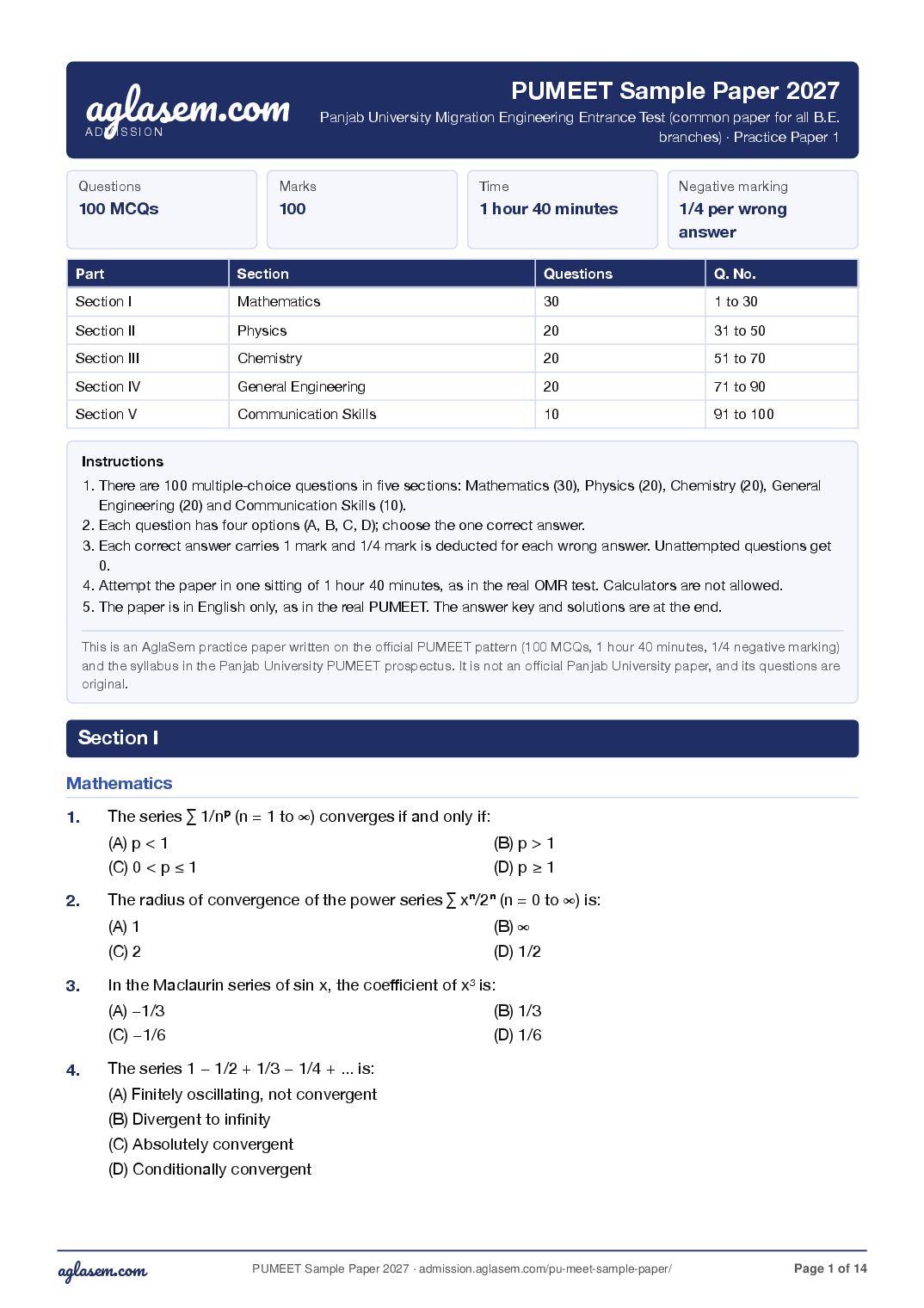
Page 1
Panjab University Migration Engineering Entrance Test (common paper for all B.E.
ADMISSION
branches) · Practice Paper 1
Questions Marks Time Negative marking
100 MCQs 100 1 hour 40 minutes 1/4 per wrong
answer
Part Section Questions Q. No.
Section I Mathematics 30 1 to 30
Section II Physics 20 31 to 50
Section III Chemistry 20 51 to 70
Section IV General Engineering 20 71 to 90
Section V Communication Skills 10 91 to 100
Instructions
1. There are 100 multiple-choice questions in five sections: Mathematics (30), Physics (20), Chemistry (20), General
Engineering (20) and Communication Skills (10).
2. Each question has four options (A, B, C, D); choose the one correct answer.
3. Each correct answer carries 1 mark and 1/4 mark is deducted for each wrong answer. Unattempted questions get
0.
4. Attempt the paper in one sitting of 1 hour 40 minutes, as in the real OMR test. Calculators are not allowed.
5. The paper is in English only, as in the real PUMEET. The answer key and solutions are at the end.
This is an AglaSem practice paper written on the official PUMEET pattern (100 MCQs, 1 hour 40 minutes, 1/4 negative marking)
and the syllabus in the Panjab University PUMEET prospectus. It is not an official Panjab University paper, and its questions are
original.
Section I
Mathematics
1. The series ∑ 1/nᵖ (n = 1 to ∞) converges if and only if:
(A) p < 1 (B) p > 1
(C) 0 < p ≤ 1 (D) p ≥ 1
2. The radius of convergence of the power series ∑ xⁿ/2ⁿ (n = 0 to ∞) is:
(A) 1 (B) ∞
(C) 2 (D) 1/2
3. In the Maclaurin series of sin x, the coefficient of x³ is:
(A) −1/3 (B) 1/3
(C) −1/6 (D) 1/6
4. The series 1 − 1/2 + 1/3 − 1/4 + ... is:
(A) Finitely oscillating, not convergent
(B) Divergent to infinity
(C) Absolutely convergent
(D) Conditionally convergent
PUMEET Sample Paper 2027 · admission./pu-meet-sample-paper/ Page 1 of 14
Page 2
(A) 2u (B) u
(C) 6u (D) 3u
6. If u = x²y + y³, then ∂²u/∂x∂y is:
(A) 6y (B) 2y
(C) 2x (D) x²
7. The function f(x, y) = x² + y² − 4x + 6y has its stationary point at:
(A) (2, −3) (B) (−2, −3)
(C) (−2, 3) (D) (2, 3)
8. For f(x, y) = x² − y², the origin is:
(A) Not stationary (B) A local maximum
(C) A saddle point (D) A local minimum
9. Using Lagrange's method of multipliers, the maximum value of xy subject to x + y = 10 is:
(A) 20 (B) 25
(C) 100 (D) 50
10. The gradient of φ = x²y + yz at the point (1, 1, 1) is:
(A) 2i + 2j + k (B) i + 2j + k
(C) 2i + j + k (D) 2i + 2j + 2k
11. The curl of the vector field F = −y i + x j is:
(A) −2k (B) 2k
(C) k (D) 0
12. Gauss's divergence theorem converts the surface integral of F over a closed surface into:
(A) A volume integral
(B) A line integral
(C) A single definite integral
(D) A contour integral in the complex plane
13. The area of the region bounded by y = x² and y = x is:
(A) 1/3 (B) 2/3
(C) 1/2 (D) 1/6
14. The volume generated when the area under y = √x from x = 0 to x = 4 is rotated about the x-axis is:
(A) 8π (B) 4π
(C) 32π/3 (D) 16π
15. The length of the curve y = (2/3) x^(3/2) from x = 0 to x = 3 is:
(A) 16/3 (B) 2
(C) 14/3 (D) 7/3
16. Changing to polar coordinates, ∬ (x² + y²) dx dy over the disc x² + y² ≤ 1 equals:
(A) π (B) π/2
(C) 2π (D) π/4
17. The value of ∫₀¹ ∫₀¹ ∫₀¹ (x + y + z) dx dy dz is:
(A) 3/2 (B) 1
(C) 3 (D) 1/2
PUMEET Sample Paper 2027 · admission./pu-meet-sample-paper/ Page 2 of 14
Page 3
(A) ∂M/∂y = ∂N/∂x (B) ∂M/∂x = −∂N/∂y
(C) M · N = 1 (D) ∂M/∂x = ∂N/∂y
19. The integrating factor of the equation dy/dx + y/x = x² is:
(A) x² (B) 1/x
(C) e^(1/x) (D) x
20. The general solution of y″ − 5y′ + 6y = 0 is:
(A) y = c₁e^x + c₂e^(6x) (B) y = c₁e^(−2x) + c₂e^(−3x)
(C) y = c₁e^(2x) + c₂e^(3x) (D) y = (c₁ + c₂x) e^(3x)
21. The general solution of y″ + 4y = 0 is:
(A) y = c₁ cos 4x + c₂ sin 4x (B) y = (c₁ + c₂x) e^(2x)
(C) y = c₁e^(2x) + c₂e^(−2x) (D) y = c₁ cos 2x + c₂ sin 2x
22. The Wronskian of the functions eˣ and e²ˣ is:
(A) e^(3x) (B) e^(2x)
(C) 3e^(3x) (D) 2e^(3x)
23. The general solution of the Euler–Cauchy equation x²y″ − 2y = 0 is:
(A) y = c₁x² + c₂/x (B) y = (c₁ + c₂ log x) x
(C) y = c₁x + c₂/x² (D) y = c₁x² + c₂x
24. The Fourier series of an odd function defined on (−π, π) contains:
(A) Only cosine terms (B) Only sine terms
(C) A constant only (D) Both sine and cosine
25. For f(x) = x² on (−π, π), with a₀ = (1/π) ∫ f(x) dx taken from −π to π, the value of a₀ is:
(A) π² (B) 2π²/3
(C) π²/3 (D) 4π²/3
26. The one-dimensional heat equation ∂u/∂t = c² ∂²u/∂x² is a partial differential equation of the type:
(A) Hyperbolic (B) Elliptic
(C) Non-linear (D) Parabolic
27. Eliminating the arbitrary constants a and b from z = (x + a)(y + b) gives (p = ∂z/∂x, q = ∂z/∂y):
(A) p + q = z (B) pq = z
(C) p = q (D) pz = q
28. The Laplace transform of t² is:
(A) 2/s² (B) 1/s²
(C) 2/s³ (D) 1/s³
29. The inverse Laplace transform of 1/(s² + 9) is:
(A) (1/3) cos 3t (B) sin 3t
(C) cos 3t (D) (1/3) sin 3t
30. The Laplace transform of the unit step function u(t − a), where a > 0, is:
(A) e^(−as) (B) e^(as)/s
(C) 1/s (D) e^(−as)/s
PUMEET Sample Paper 2027 · admission./pu-meet-sample-paper/ Page 3 of 14
Page 4
Physics
31. A lightly damped forced oscillator has a resonant frequency of 1000 Hz and a bandwidth (full width at
half power) of 20 Hz. Its quality factor is:
(A) 500 (B) 100
(C) 20 (D) 50
32. The equation of a damped oscillator is x″ + 2b x′ + ω₀² x = 0. The motion is critically damped when:
(A) b < ω₀ (B) b = 2ω₀
(C) b > ω₀ (D) b = ω₀
33. In a forced oscillator at velocity resonance (driving frequency equal to the natural frequency), the
velocity is:
(A) Behind the force by 90° (B) In phase with the force
(C) Ahead of the force by 90° (D) Opposite in phase to the force
34. In Newton's rings experiment, the diameter of the nth dark ring is proportional to:
(A) √n (B) n
(C) n² (D) 1/n
35. In a Michelson interferometer using light of wavelength 500 nm, how many fringes cross the field of
view when the movable mirror is moved by 0.1 mm?
(A) 200 (B) 400
(C) 100 (D) 800
36. A plane transmission grating has 6000 lines per cm. For light of wavelength 600 nm, the highest order of
spectrum that can be seen is:
(A) 1 (B) 2
(C) 3 (D) 4
37. Light is reflected from glass of refractive index √3. The angle of incidence at which the reflected light is
completely plane polarised is:
(A) 45° (B) 60°
(C) 30° (D) 90°
38. Unpolarised light of intensity I₀ passes through a polariser and then an analyser whose axis is at 60° to
that of the polariser. The intensity of the light that emerges is:
(A) I₀/4 (B) I₀/2
(C) I₀/8 (D) 3I₀/8
39. In a helium–neon laser, the laser transitions take place in:
(A) Neon ions (B) Neon atoms
(C) Helium ions (D) Helium atoms
40. The null result of the Michelson–Morley experiment showed that:
(A) The ether drift could not be detected
(B) The earth is at absolute rest in space
(C) Light slows down in a moving frame
(D) Light needs a material medium to travel
PUMEET Sample Paper 2027 · admission./pu-meet-sample-paper/ Page 4 of 14
Page 5
0.8c is:
(A) 5 μs (B) 3 μs
(C) 3.75 μs (D) 1.8 μs
42. A rod of proper length 1 m moves along its length at 0.6c. Its length measured by a stationary observer
is:
(A) 1.25 m (B) 0.8 m
(C) 0.6 m (D) 0.4 m
43. Two spaceships move towards each other, each at 0.5c relative to the earth. The speed of one as
measured from the other is:
(A) 0.75c (B) 0.5c
(C) 0.8c (D) c
44. X-rays are Compton scattered by free electrons through 180°. Taking h/m₀c = 2.43 pm, the increase in
wavelength is:
(A) Zero (B) 2.43 pm
(C) 1.22 pm (D) 4.86 pm
45. Light with a photon energy of 5 eV falls on a metal surface of work function 2 eV. The stopping potential
is:
(A) 2 V (B) 3 V
(C) 7 V (D) 5 V
46. X-rays are diffracted by crystal planes 2 Å apart. If the first-order Bragg reflection occurs at a glancing
angle of 30°, the wavelength of the X-rays is:
(A) 2 Å (B) √3 Å
(C) 4 Å (D) 1 Å
47. For a particle in a one-dimensional infinite potential well, the ratio E₃/E₁ of the energy of the third level to
that of the ground level is:
(A) 27 (B) 3
(C) 9 (D) 6
48. According to the Heisenberg uncertainty principle, the product Δx · Δp is:
(A) ≤ h/4π (B) = 0
(C) ≥ 2πh (D) ≥ h/4π
49. The packing fraction of a face-centred cubic (FCC) structure is about:
(A) 0.34 (B) 0.74
(C) 0.52 (D) 0.68
50. A crystal plane makes intercepts of 2a, 3b and ∞ (it is parallel to the c-axis) on the three axes. Its Miller
indices are:
(A) (3 2 0) (B) (2 3 0)
(C) (1 1 0) (D) (2 3 ∞)
PUMEET Sample Paper 2027 · admission./pu-meet-sample-paper/ Page 5 of 14
Page 6
Chemistry
51. According to molecular orbital theory, the bond order of O₂⁺ is:
(A) 1.5 (B) 3
(C) 2 (D) 2.5
52. Which of the following molecules is paramagnetic according to molecular orbital theory?
(A) H₂ (B) O₂
(C) N₂ (D) F₂
53. Which of the following has a bond order of zero and therefore does not exist as a stable molecule?
(A) Li₂ (B) H₂
(C) H₂⁺ (D) He₂
54. In the sodium chloride (rock salt) structure, the coordination number of each ion is:
(A) 6 (B) 12
(C) 8 (D) 4
55. In a cubic close-packed arrangement of N atoms, the numbers of octahedral and tetrahedral voids are
respectively:
(A) N and N (B) 2N and 2N
(C) 2N and N (D) N and 2N
56. Bakelite is a condensation polymer of:
(A) Melamine and formaldehyde (B) Urea and formaldehyde
(C) Phenol and formaldehyde (D) Phenol and acetaldehyde
57. In diamond, each carbon atom is:
(A) sp³d hybridised and bonded to five carbon atoms
(B) sp hybridised and bonded to two carbon atoms
(C) sp² hybridised and bonded to three carbon atoms
(D) sp³ hybridised and bonded to four carbon atoms
58. The crystal field stabilisation energy (CFSE) of a d³ ion in an octahedral field is:
(A) −0.4 Δo (B) −0.8 Δo
(C) −1.2 Δo (D) −1.6 Δo
59. For the same metal ion, ligands and metal–ligand distance, the tetrahedral splitting Δt is related to the
octahedral splitting Δo by:
(A) Δt = Δo (B) Δt ≈ (1/2) Δo
(C) Δt ≈ (9/4) Δo (D) Δt ≈ (4/9) Δo
60. In an octahedral crystal field, the d orbitals that are raised to the higher energy level (the eg set) are:
(A) dxy and dyz (B) dx²−y² and dz²
(C) dxz and dz² (D) dxy, dyz and dxz
61. The square planar complex [Ni(CN)₄]²⁻ is:
(A) Paramagnetic, 4 unpaired electrons
(B) Paramagnetic, 1 unpaired electron
(C) Paramagnetic, 2 unpaired electrons
(D) Diamagnetic, all d electrons paired
PUMEET Sample Paper 2027 · admission./pu-meet-sample-paper/ Page 6 of 14
Page 7
(A) Methane from paddy fields
(B) Carbon dioxide from burning fuels
(C) Sulphur dioxide from power plants
(D) Chlorine atoms released from CFCs
63. Itai-itai disease, a well-known case of heavy-metal poisoning, was caused by:
(A) Mercury (B) Cadmium
(C) Arsenic (D) Lead
64. For protecting buried iron pipelines by the sacrificial anode method, the metal commonly used as the
anode is:
(A) Palladium (B) Copper
(C) Magnesium (D) Silver
65. In waterline corrosion of a steel tank partly filled with water, the maximum corrosion occurs:
(A) Just below the waterline (B) Just above the waterline
(C) Uniformly over the whole tank (D) At the bottom of the tank
66. One mole of an ideal gas expands isothermally and reversibly at 300 K from 10 L to 100 L. The work
done on the gas is about (R = 8.314 J mol⁻¹ K⁻¹):
(A) −0.57 kJ (B) −5.74 kJ
(C) −2.49 kJ (D) +5.74 kJ
67. A reversible heat engine works between 500 K and 300 K. Its efficiency is:
(A) 40% (B) 25%
(C) 67% (D) 60%
68. A process is spontaneous at all temperatures when:
(A) ΔH > 0 and ΔS < 0 (B) ΔH < 0 and ΔS > 0
(C) ΔH < 0 and ΔS < 0 (D) ΔH > 0 and ΔS > 0
69. Pure benzene has a vapour pressure of 100 mm Hg at a certain temperature. A non-volatile solute is
dissolved so that the mole fraction of benzene is 0.9. The vapour pressure of the solution is:
(A) 100 mm Hg (B) 10 mm Hg
(C) 90 mm Hg (D) 111 mm Hg
70. Nylon-6,6 is a polyamide made by the condensation of:
(A) Caprolactam alone
(B) Phenol and formaldehyde
(C) Hexamethylenediamine and adipic acid
(D) Ethylene glycol and terephthalic acid
Section IV
General Engineering
71. A 12 V source with an internal (series) resistance of 4 Ω feeds a 4 Ω resistor connected across terminals
A and B. The Thevenin equivalent seen at A–B is:
(A) 12 V in series with 2 Ω (B) 12 V in series with 4 Ω
(C) 6 V in series with 2 Ω (D) 6 V in series with 8 Ω
PUMEET Sample Paper 2027 · admission./pu-meet-sample-paper/ Page 7 of 14
Page 8
(A) 5 W (B) 20 W
(C) 2.5 W (D) 10 W
73. The resonant frequency of a series RLC circuit with L = 10 mH and C = 1 μF is about:
(A) 10 kHz (B) 159 Hz
(C) 1.59 kHz (D) 15.9 kHz
74. In a balanced star-connected three-phase system the line voltage is 400 V. The phase voltage is about:
(A) 693 V (B) 400 V
(C) 133 V (D) 231 V
75. The RMS EMF induced in a 200-turn transformer winding at 50 Hz, when the maximum core flux is 0.01
Wb, is:
(A) 314 V (B) 100 V
(C) 444 V (D) 222 V
76. A transformer works at maximum efficiency when:
(A) Copper loss equals iron loss
(B) Copper loss is twice the iron loss
(C) The load is purely inductive
(D) Iron loss is zero
77. A 4-pole, 50 Hz three-phase induction motor runs with a slip of 4%. Its rotor speed is:
(A) 1500 rpm (B) 1200 rpm
(C) 1560 rpm (D) 1440 rpm
78. For a transistor with common-base current gain α = 0.98, the common-emitter current gain β is:
(A) 49 (B) 50
(C) 0.98 (D) 98
79. The hexadecimal number 2F is equal to the decimal number:
(A) 215 (B) 32
(C) 47 (D) 45
80. A JK flip-flop with J = K = 1, on every clock pulse:
(A) Sets its output to 1 (B) Complements its output
(C) Holds its previous state (D) Resets its output to 0
81. A block just begins to slide down a rough plane inclined at 30° to the horizontal. The coefficient of
friction between the block and the plane is:
(A) √3 (B) 1/2
(C) √3/2 (D) 1/√3
82. For a material with Young's modulus E = 200 GPa and Poisson's ratio 0.25, the modulus of rigidity G is:
(A) 80 GPa (B) 50 GPa
(C) 160 GPa (D) 100 GPa
83. The lathe operation that produces a diamond-shaped or straight-line pattern on a cylindrical surface to
give a better grip is:
(A) Facing (B) Taper turning
(C) Knurling (D) Chamfering
PUMEET Sample Paper 2027 · admission./pu-meet-sample-paper/ Page 8 of 14
Page 9
(A) Below the front view (B) Above the front view
(C) To the left of the front view (D) To the right of the front view
85. For a perfectly elastic collision, the coefficient of restitution is:
(A) 1 (B) 0.5
(C) Infinity (D) 0
86. A temperature difference of 10 °C is equal to a temperature difference of:
(A) 18 °F (B) 42 °F
(C) 10 °F (D) 50 °F
87. Hydrogen and oxygen react as 2H₂ + O₂ → 2H₂O. If 4 mol of H₂ is fed with 3 mol of O₂, the percentage
excess of oxygen is:
(A) 50% (B) 25%
(C) 100% (D) 33.3%
88. In a process with a recycle stream, a purge stream is taken out mainly to:
(A) Reduce the fresh feed to zero
(B) Prevent build-up of inerts in the loop
(C) Increase the conversion in each pass of the reactor
(D) Return all the unreacted feed to the reactor
89. Air at 30 °C has a partial pressure of water vapour of 2.1 kPa. If the saturation vapour pressure of water
at 30 °C is 4.2 kPa, the relative humidity is:
(A) 100% (B) 200%
(C) 25% (D) 50%
90. The number of moles in 44.8 L of an ideal gas at 0 °C and 1 atm is:
(A) 4 (B) 2
(C) 0.5 (D) 1
Section V
Communication Skills
91. Choose the past continuous form of: 'She writes a report.'
(A) She has been writing a report. (B) She wrote a report.
(C) She was writing a report. (D) She had written a report.
92. Choose the passive voice of: 'The engineer tested the circuit.'
(A) The circuit is tested by the engineer.
(B) The engineer was tested by the circuit.
(C) The circuit has been tested by the engineer.
(D) The circuit was tested by the engineer.
93. Fill in the blank with the correct article: He is ___ honest engineer.
(A) a (B) no article
(C) the (D) an
94. Arrange the parts to form a correct sentence:
P: the report Q: submitted R: has S: the manager
(A) S Q R P (B) P R Q S
(C) S R Q P (D) R S Q P
PUMEET Sample Paper 2027 · admission./pu-meet-sample-paper/ Page 9 of 14
Page 10
(A) A noun (B) An adjective
(C) An adverb (D) A verb
96. Choose the correct verb: The quality of these components ___ improved.
(A) have (B) were
(C) has (D) are
97. Proxemics, a component of non-verbal communication, deals with:
(A) Gestures and body movements
(B) Use of personal space and distance
(C) The tone and pitch of the voice
(D) Facial expressions and eye contact
98. Which of the following is NOT a form of non-verbal communication?
(A) A hand gesture (B) A facial expression
(C) A written memo (D) Eye contact
99. The informal channel of communication in an organisation is often called the:
(A) Chain of command (B) Grapevine
(C) Hierarchy (D) Wheel
100. In a 'wheel' communication network:
(A) All messages pass through one central person
(B) Members form a closed circle
(C) Messages pass along a single line of members
(D) Every member talks freely to every other member
PUMEET Sample Paper 2027 · admission./pu-meet-sample-paper/ Page 10 of 14
Page 11
1 B 2 C 3 C 4 D 5 D 6 C 7 A 8 C 9 B 10 A
11 B 12 A 13 D 14 A 15 C 16 B 17 A 18 A 19 D 20 C
21 D 22 A 23 A 24 B 25 B 26 D 27 B 28 C 29 D 30 D
31 D 32 D 33 B 34 A 35 B 36 B 37 B 38 C 39 B 40 A
41 A 42 B 43 C 44 D 45 B 46 A 47 C 48 D 49 B 50 A
51 D 52 B 53 D 54 A 55 D 56 C 57 D 58 C 59 D 60 B
61 D 62 D 63 B 64 C 65 A 66 B 67 A 68 B 69 C 70 C
71 C 72 A 73 C 74 D 75 C 76 A 77 D 78 A 79 C 80 B
81 D 82 A 83 C 84 A 85 A 86 A 87 A 88 B 89 D 90 B
91 C 92 D 93 D 94 C 95 C 96 C 97 B 98 C 99 B 100 A
Solutions
Mathematics
1. (B) This is the p-series test: the series converges for p > 1 and diverges for p ≤ 1 (p = 1 gives the divergent harmonic
series).
ₙ ₙ
2. (C) Ratio test: |a ₊₁/a | = |x|/2 < 1 gives |x| < 2, so R = 2.
3. (C) sin x = x − x³/3! + x⁵/5! − ..., so the coefficient of x³ is −1/6.
4. (D) The terms decrease to 0, so the series converges by Leibniz's test, but the series of absolute values ∑ 1/n
diverges. Hence it is conditionally convergent.
5. (D) u is homogeneous of degree 3, so by Euler's theorem x uₓ + y u_y = 3u.
6. (C) ∂u/∂x = 2xy; differentiating with respect to y gives 2x.
7. (A) fₓ = 2x − 4 = 0 gives x = 2 and f_y = 2y + 6 = 0 gives y = −3. (It is a minimum, since r = t = 2 and s = 0.)
8. (C) fₓ = 2x and f_y = −2y vanish at the origin, so it is stationary. rt − s² = (2)(−2) − 0 = −4 < 0, so it is a saddle point.
9. (B) With F = xy + λ(10 − x − y): y = λ and x = λ, so x = y = 5 and the maximum of xy is 25.
10. (A) ∇φ = (2xy) i + (x² + z) j + (y) k = 2i + 2j + k at (1, 1, 1).
11. (B) curl F = (∂F₂/∂x − ∂F₁/∂y) k = (1 − (−1)) k = 2k; the i and j components are zero.
12. (A) ∯ F·n dS = ∭ div F dV over the volume enclosed by the surface. Stokes's theorem is the one that links a
surface integral to a line integral.
13. (D) The curves meet at x = 0 and x = 1. Area = ∫₀¹ (x − x²) dx = 1/2 − 1/3 = 1/6.
14. (A) V = π ∫₀⁴ y² dx = π ∫₀⁴ x dx = π × 16/2 = 8π.
15. (C) y′ = √x, so length = ∫₀³ √(1 + x) dx = (2/3)[(1 + x)^(3/2)]₀³ = (2/3)(8 − 1) = 14/3.
16. (B) ∫₀^2π ∫₀¹ r² · r dr dθ = 2π × 1/4 = π/2.
17. (A) Each of x, y and z integrates to 1/2 over the unit cube, so the total is 3 × 1/2 = 3/2.
18. (A) The test for exactness is ∂M/∂y = ∂N/∂x.
19. (D) For dy/dx + P y = Q, IF = e^(∫P dx) = e^(∫dx/x) = e^(log x) = x.
20. (C) The auxiliary equation m² − 5m + 6 = 0 has roots m = 2, 3, so y = c₁e^(2x) + c₂e^(3x).
21. (D) m² + 4 = 0 gives m = ±2i, so y = c₁ cos 2x + c₂ sin 2x.
22. (A) W = eˣ · 2e²ˣ − e²ˣ · eˣ = 2e³ˣ − e³ˣ = e³ˣ.
23. (A) Putting y = xᵐ: m(m − 1) − 2 = 0, i.e. m² − m − 2 = 0, so m = 2 or −1. Hence y = c₁x² + c₂x⁻¹.
ₙ ₙ
24. (B) For an odd function a₀ = a = 0, because f(x) cos nx is odd. Only the b (sine) terms remain.
25. (B) a₀ = (1/π) × [x³/3] from −π to π = (1/π) × 2π³/3 = 2π²/3.
PUMEET Sample Paper 2027 · admission./pu-meet-sample-paper/ Page 11 of 14
Page 12
equation is hyperbolic and Laplace's equation elliptic.
27. (B) p = y + b and q = x + a, so pq = (x + a)(y + b) = z.
28. (C) L{tⁿ} = n!/sⁿ⁺¹, so L{t²} = 2/s³.
29. (D) L{sin at} = a/(s² + a²). With a = 3, 1/(s² + 9) = (1/3) × 3/(s² + 9), whose inverse is (1/3) sin 3t.
30. (D) L{u(t − a)} = ∫ from a to ∞ of e^(−st) dt = e^(−as)/s. (e^(−as) alone is the transform of the delta function δ(t − a).)
Physics
31. (D) Q = resonant frequency ÷ bandwidth = 1000/20 = 50.
32. (D) The roots are −b ± √(b² − ω₀²). Critical damping is the boundary case b = ω₀; b > ω₀ is overdamped and b < ω₀
underdamped (oscillatory).
33. (B) At ω = ω₀ the mechanical impedance is purely resistive, so the velocity is in phase with the driving force and
power absorption is maximum. The displacement then lags the force by 90°.
ₙ ₙ
34. (A) For the nth dark ring D ² = 4nλR, so D ∝ √n.
35. (B) N = 2d/λ = 2 × 0.1 × 10⁻³ / (500 × 10⁻⁹) = 400. The path changes by twice the mirror movement.
36. (B) Grating element d = 1/6000 cm = 1.67 × 10⁻⁶ m. n_max < d/λ = 1.67 × 10⁻⁶ / 6 × 10⁻⁷ ≈ 2.8, so the highest order
is 2.
37. (B) Brewster's law: tan θ_p = μ = √3, so θ_p = 60°.
38. (C) The polariser passes I₀/2. By Malus's law the analyser passes (I₀/2) cos² 60° = (I₀/2)(1/4) = I₀/8.
39. (B) Helium atoms are excited by the discharge and transfer energy to neon atoms by collision. The lasing
transitions (such as 632.8 nm) are between levels of neutral neon atoms.
40. (A) No shift of fringes was seen, so no motion of the earth relative to an ether could be detected. This supported
the postulate that the speed of light is the same in all inertial frames.
41. (A) γ = 1/√(1 − 0.64) = 1/0.6 = 5/3. Dilated life = γ × 3 μs = 5 μs.
42. (B) L = L₀ √(1 − v²/c²) = 1 × √(1 − 0.36) = 0.8 m.
43. (C) Relativistic addition: u = (0.5c + 0.5c)/(1 + 0.25) = c/1.25 = 0.8c.
44. (D) Δλ = (h/m₀c)(1 − cos θ) = 2.43 × (1 − (−1)) = 4.86 pm.
45. (B) K_max = hν − φ = 5 − 2 = 3 eV, so the stopping potential is 3 V.
46. (A) Bragg's law: nλ = 2d sin θ, so λ = 2 × 2 × sin 30° = 2 Å.
ₙ
47. (C) E = n²h²/(8mL²), so E₃/E₁ = 3² = 9.
48. (D) Δx · Δp ≥ ħ/2 = h/4π.
49. (B) FCC has 4 atoms per cell and a = 2√2 r, giving π/(3√2) ≈ 0.74. BCC is 0.68, simple cubic 0.52 and diamond
0.34.
50. (A) Intercepts in units of a, b, c: 2, 3, ∞. Reciprocals: 1/2, 1/3, 0. Multiplying by 6 gives (3 2 0).
Chemistry
51. (D) O₂ (16 electrons) has bond order (10 − 6)/2 = 2. Removing one antibonding π* electron gives O₂⁺ a bond order
of (10 − 5)/2 = 2.5.
52. (B) O₂ has two unpaired electrons in the degenerate π*2p orbitals. N₂, F₂ and H₂ have all electrons paired.
53. (D) He₂ has 2 bonding and 2 antibonding electrons, so its bond order is 0. H₂ has 1, Li₂ has 1 and H₂⁺ has 0.5.
54. (A) In NaCl each Na⁺ is surrounded octahedrally by 6 Cl⁻ ions and vice versa (6:6 coordination).
55. (D) A close-packed array has one octahedral void and two tetrahedral voids per atom.
56. (C) Bakelite is a phenol-formaldehyde resin. Urea and melamine with formaldehyde give other thermosetting resins.
57. (D) Diamond is a 3-D network in which every carbon is sp³ hybridised and bonded tetrahedrally to four others.
Graphite carbons are sp² hybridised.
58. (C) d³ = t₂g³. Each t₂g electron is stabilised by 0.4 Δo, so CFSE = 3 × (−0.4 Δo) = −1.2 Δo.
59. (D) Crystal field theory gives Δt = (4/9) Δo, which is why tetrahedral complexes are almost always high spin.
PUMEET Sample Paper 2027 · admission./pu-meet-sample-paper/ Page 12 of 14
Page 13
form the lower t₂g set.
61. (D) Ni²⁺ is d⁸. In the strong square planar field of CN⁻ all eight electrons pair up in the four lower orbitals, leaving the
dx²−y² orbital empty, so the complex is diamagnetic.
62. (D) UV light breaks CFCs to release Cl atoms, which destroy ozone in a chain reaction: Cl + O₃ → ClO + O₂ and
ClO + O → Cl + O₂.
63. (B) Itai-itai disease in Japan was caused by cadmium in river water used for rice fields. Minamata disease was
caused by mercury.
64. (C) The sacrificial anode must be more active (more negative electrode potential) than iron. Magnesium (or zinc)
corrodes in place of iron; copper, silver and palladium are nobler than iron.
65. (A) This is differential aeration corrosion. The metal just below the waterline gets less oxygen than the metal at the
surface, so it becomes the anode and corrodes most.
66. (B) w = −nRT ln(V₂/V₁) = −1 × 8.314 × 300 × 2.303 log 10 = −5744 J ≈ −5.74 kJ (the gas does work on the
surroundings).
67. (A) η = 1 − T₂/T₁ = 1 − 300/500 = 0.4 = 40%.
68. (B) ΔG = ΔH − TΔS. With ΔH negative and ΔS positive, ΔG is negative at every temperature.
69. (C) Raoult's law: p = x(benzene) × p° = 0.9 × 100 = 90 mm Hg.
70. (C) Nylon-6,6 is made from hexamethylenediamine and adipic acid (6 carbons each). Ethylene glycol and
terephthalic acid give polyester (terylene); caprolactam gives nylon-6.
General Engineering
71. (C) Open-circuit voltage = 12 × 4/(4 + 4) = 6 V. With the source shorted, R_th = 4 Ω ∥ 4 Ω = 2 Ω.
72. (A) Maximum power transfer occurs at R_L = 5 Ω: P_max = V²/(4R) = 100/20 = 5 W.
73. (C) f₀ = 1/(2π√(LC)) = 1/(2π√(10⁻² × 10⁻⁶)) = 1/(2π × 10⁻⁴) ≈ 1592 Hz ≈ 1.59 kHz.
74. (D) In star connection V_line = √3 V_phase, so V_phase = 400/1.732 ≈ 231 V.
75. (C) E = 4.44 f N Φm = 4.44 × 50 × 200 × 0.01 = 444 V.
76. (A) Efficiency is maximum when the variable (copper) loss equals the constant (iron) loss.
ₛ ₛ
77. (D) N = 120f/P = 120 × 50/4 = 1500 rpm. N = N (1 − s) = 1500 × 0.96 = 1440 rpm.
78. (A) β = α/(1 − α) = 0.98/0.02 = 49.
79. (C) (2F)₁₆ = 2 × 16 + 15 = 47.
80. (B) J = K = 1 is the toggle mode: the output changes to its complement on each clock pulse. J = K = 0 holds the
state.
81. (D) At the point of sliding the angle of inclination equals the angle of repose, so μ = tan 30° = 1/√3 ≈ 0.577.
82. (A) E = 2G(1 + ν), so G = 200/(2 × 1.25) = 80 GPa.
83. (C) Knurling presses a pattern into the surface (as on tool handles). Facing makes a flat end, chamfering bevels an
edge and taper turning produces a cone.
84. (A) In first-angle projection the object lies in the first quadrant; when the HP is rotated, the plan comes below the
elevation. In third-angle projection it is above.
85. (A) e = (velocity of separation)/(velocity of approach) = 1 for a perfectly elastic collision and 0 for a perfectly plastic
one.
86. (A) A Celsius degree is 1.8 Fahrenheit degrees, so Δ = 10 × 1.8 = 18 °F. (50 °F is the temperature reading equal to
10 °C, not a difference.)
87. (A) 4 mol H₂ needs 2 mol O₂, so H₂ is limiting. Excess O₂ = (3 − 2)/2 × 100 = 50%.
88. (B) Inerts or impurities entering with the fresh feed would keep accumulating in the recycle loop; a small purge
removes them so their level stays steady.
89. (D) Relative humidity = p(water)/p(sat) × 100 = 2.1/4.2 × 100 = 50%.
90. (B) One mole of an ideal gas occupies 22.4 L at 0 °C and 1 atm, so n = 44.8/22.4 = 2.
PUMEET Sample Paper 2027 · admission./pu-meet-sample-paper/ Page 13 of 14
Page 14
91. (C) The past continuous is was/were + verb-ing: 'She was writing a report.'
92. (D) Simple past active becomes was/were + past participle: 'The circuit was tested by the engineer.'
93. (D) 'Honest' begins with a vowel sound (the h is silent), so it takes 'an'.
94. (C) 'The manager has submitted the report' = S R Q P (subject, auxiliary, main verb, object).
95. (C) 'Smoothly' tells how the machine runs, so it modifies the verb and is an adverb.
96. (C) The subject is 'the quality' (singular); 'of these components' does not change it. So the verb is 'has'.
97. (B) Proxemics is the study of how people use space and distance when they communicate. Body movements are
kinesics and voice qualities are paralanguage.
98. (C) A written memo uses words, so it is verbal (written) communication. The other three are non-verbal.
99. (B) The grapevine is the informal network through which news and rumours spread. The chain of command and
hierarchy are formal channels.
100. (A) The wheel is a centralised network: one person at the hub links all others. The all-channel network lets
everyone talk to everyone; the chain is a single line; the circle is closed.
PUMEET Sample Paper 2027 · admission./pu-meet-sample-paper/ Page 14 of 14
Document Details
| Board / Org | Panjab University |
| Exam | PUMEET |
| Type | Sample Paper |
| Pages | 14 |
| Language | english |
| Updated | 27 Oct 2026 |