NCERT Book Class 10 Science Chapter 8 Heredity and Evolution
Finished viewing? Save it for later —
Download NCERT Book Class 10 Science Chapter 8 Heredity and Evolution (PDF · 6 pages)About NCERT Book Class 10 Science Chapter 8 Heredity and Evolution
NCERT Book Class 10 Science Chapter 8 Heredity and Evolution is available here for free download. Published by NCERT for Class 10, this books can be viewed online or downloaded as a PDF (6 pages). Candidates preparing for Class 10 can use NCERT Book Class 10 Science Chapter 8 Heredity and Evolution to understand the exam pattern, the type of questions asked, and the overall difficulty level.
Frequently Asked Questions
How can I download NCERT Book Class 10 Science Chapter 8 Heredity and Evolution?
Open this page and click the Download button to save NCERT Book Class 10 Science Chapter 8 Heredity and Evolution as a PDF. It is completely free on AglaSem Docs.
Is NCERT Book Class 10 Science Chapter 8 Heredity and Evolution free to download?
Yes. NCERT Book Class 10 Science Chapter 8 Heredity and Evolution can be viewed online and downloaded as a PDF free of cost on AglaSem Docs.
How many pages does NCERT Book Class 10 Science Chapter 8 Heredity and Evolution have?
NCERT Book Class 10 Science Chapter 8 Heredity and Evolution contains 6 pages, which you can read online or download together as a single PDF.
Where can I find more Class 10 study material?
You can find more Class 10 question papers, sample papers, syllabus, and answer keys on AglaSem Docs.
NCERT Book Class 10 Science Chapter 8 Heredity and Evolution – Text
Read the full text of this books below — useful to quickly search, copy and reference the content online without downloading the PDF.
📄 View text version (1 page)
Page 1
Heredity
W e have seen that reproductive processes give rise to new individuals
that are similar, but subtly different. We have discussed how some
amount of variation is produced even during asexual reproduction. And
the number of successful variations are maximised by the process of
sexual reproduction. If we observe a field of sugarcane we find very little
variations among the individual plants. But in a number of animals
including human beings, which reproduce sexually, quite distinct
variations are visible among different individuals. In this chapter, we
shall be studying the mechanism by which variations are created and
inherited.
8 . 1 A CCUMUL ATION OF V ARIA
VARIA TION
ARIATION
DURING REPRODUCTION
Inheritance from the previous generation provides
both a common basic body design, and subtle
changes in it, for the next generation. Now think
about what would happen when this new generation,
in its turn, reproduces. The second generation will
have differences that they inherit from the first
generation, as well as newly created differences
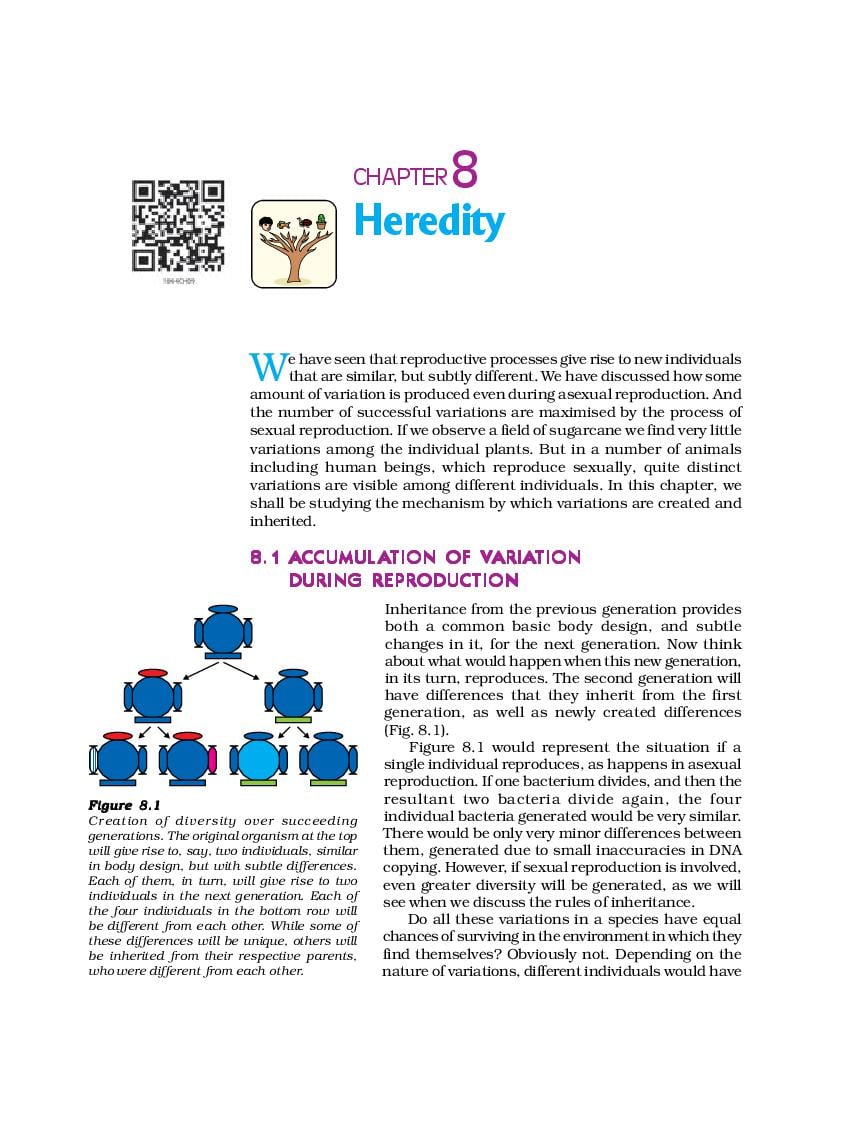
(Fig. 8.1).
Figure 8.1 would represent the situation if a
single individual reproduces, as happens in asexual
reproduction. If one bacterium divides, and then the
Figure 8.1 resultant two bacteria divide again, the four
Creation of diversity over succeeding individual bacteria generated would be very similar.
generations. The original organism at the top There would be only very minor differences between
will give rise to, say, two individuals, similar them, generated due to small inaccuracies in DNA
in body design, but with subtle differences. copying. However, if sexual reproduction is involved,
Each of them, in turn, will give rise to two even greater diversity will be generated, as we will
individuals in the next generation. Each of
see when we discuss the rules of inheritance.
the four individuals in the bottom row will
be different from each other. While some of Do all these variations in a species have equal
these differences will be unique, others will chances of surviving in the environment in which they
be inherited from their respective parents, find themselves? Obviously not. Depending on the
who were different from each other. nature of variations, different individuals would have
128 Science
Showing the first page only. Download the PDF above for the complete document.
Document Details
| Board / Org | NCERT |
| Exam | Class 10 |
| Type | Books |
| Pages | 6 |
| Language | english |
| Updated | 29 Aug 2026 |