HBSE Class 12 Question Paper 2025 English Elective
Finished viewing? Save it for later —
Download HBSE Class 12 Question Paper 2025 English Elective (PDF · 16 pages)About HBSE Class 12 Question Paper 2025 English Elective
HBSE Class 12 Question Paper 2025 English Elective is available here for free download. Published by Haryana Board for Class 12, this question paper can be viewed online or downloaded as a PDF (16 pages). Candidates preparing for Class 12 can use HBSE Class 12 Question Paper 2025 English Elective to understand the exam pattern, the type of questions asked, and the overall difficulty level.
Frequently Asked Questions
How can I download HBSE Class 12 Question Paper 2025 English Elective?
Open this page and click the Download button to save HBSE Class 12 Question Paper 2025 English Elective as a PDF. It is completely free on AglaSem Docs.
Is HBSE Class 12 Question Paper 2025 English Elective free to download?
Yes. HBSE Class 12 Question Paper 2025 English Elective can be viewed online and downloaded as a PDF free of cost on AglaSem Docs.
How many pages does HBSE Class 12 Question Paper 2025 English Elective have?
HBSE Class 12 Question Paper 2025 English Elective contains 16 pages, which you can read online or download together as a single PDF.
Where can I find more Class 12 study material?
You can find more Class 12 question papers, sample papers, syllabus, and answer keys on AglaSem Docs.
HBSE Class 12 Question Paper 2025 English Elective – Text
Read the full text of this question paper below — useful to quickly search, copy and reference the content online without downloading the PDF.
📄 View text version (16 pages)
Page 1
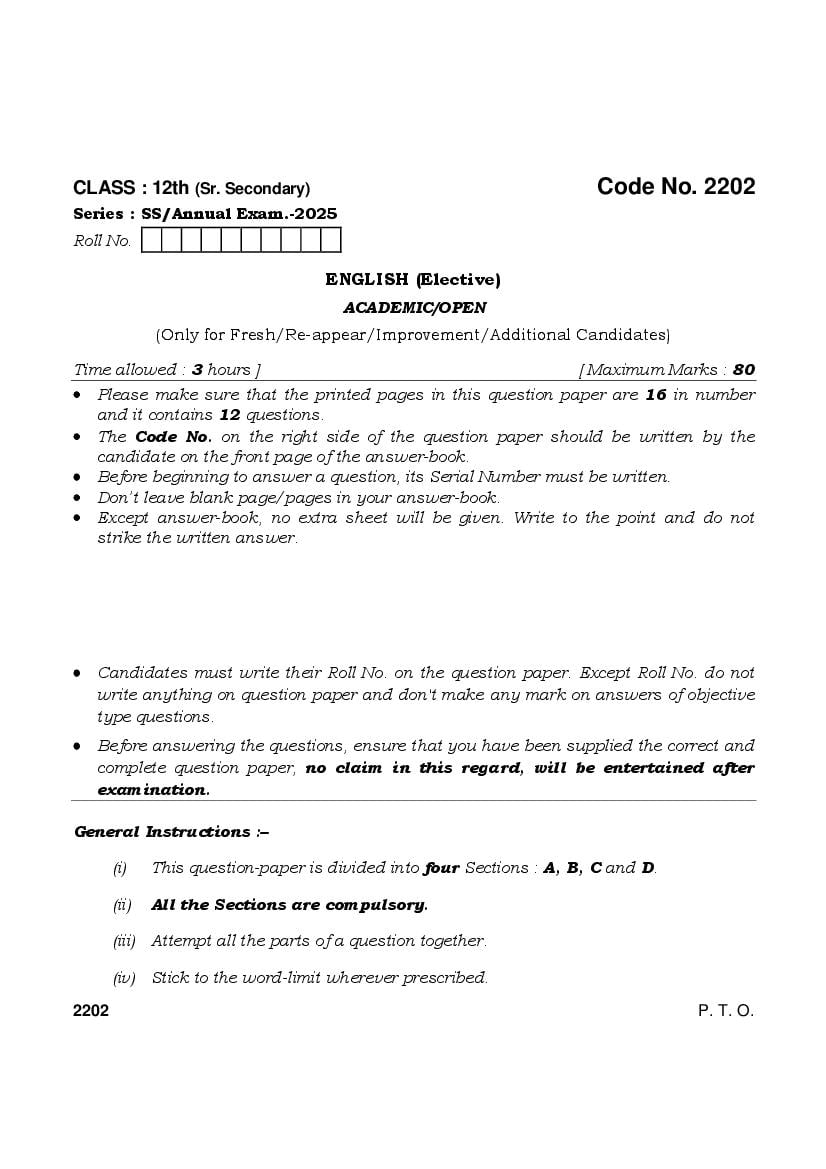
Series : SS/Annual Exam.-2025
Roll No.
ENGLISH (Elective)
ACADEMIC/OPEN
(Only for Fresh/Re-appear/Improvement/Additional Candidates)
Time allowed : 3 hours ] [ Maximum Marks : 80
• Please make sure that the printed pages in this question paper are 16 in number
and it contains 12 questions.
• The Code No. on the right side of the question paper should be written by the
candidate on the front page of the answer-book.
• Before beginning to answer a question, its Serial Number must be written.
• Don’t leave blank page/pages in your answer-book.
• Except answer-book, no extra sheet will be given. Write to the point and do not
strike the written answer.
• Candidates must write their Roll No. on the question paper. Except Roll No. do not
write anything on question paper and don't make any mark on answers of objective
type questions.
• Before answering the questions, ensure that you have been supplied the correct and
complete question paper, no claim in this regard, will be entertained after
examination.
General Instructions :–
(i) This question-paper is divided into four Sections : A, B, C and D.
(ii) All the Sections are compulsory.
(iii) Attempt all the parts of a question together.
(iv) Stick to the word-limit wherever prescribed.
2202 P. T. O.
Page 2
SECTION – A [ M. M. : 12
(Reading Comprehension)
1. Read the passage given below and answer any six questions that follow :
1×6=6
The Khirki branch of Delhi's Community Library Project is filled with books
for people of all ages, provides computers with internet for those who lack access
at home, offers story time and literacy programmes for children, and offers
evening hour operations to working people who need a quite place to read and
work when homes are loud and crowded. Like many public libraries in the
United States (US), Khirki also responds to materials needs beyond the book,
offering clean drinking water, washrooms and even food – bananas in the
morning, biscuits in the afternoon − to address the gap in access to basic
human necessities produced by systematic and longstanding disinvestment in
the people by the governments we elect.
All this good work is underpinned by a singular structural commitment −
the library is free. It is free to use and free to join. Book borrowing is free.
Computer use is free. Water and food are free. Anyone can walk through the
gates into the vibrant courtyard and use the library. The Khirki community
library serves the public. That public must include everyone if it is to live up to
its purpose. When libraries charge fees, their use becomes restricted to the
subset of people who can afford to pay. When libraries limit use by gender, race,
class, religion or caste, they cannot, in any meaningful sense, be called public.
When libraries are impossible to access due to distance or disrepair, only
the people who live nearby, and who can afford transit fares, are served. In each
case, a public good − the library − is privatised, limiting its use only to those who
can afford it.
2202
Page 3
When we call a library public, we mean that the library belongs to the
people, all of the people. If it is to belong to all of the people, particularly and
especially in the context of economic inequality and other forms of
discrimination, the public library must be free. Any imposed cost is an
exclusionary barrier.
Appeals to charge fees take two forms. First, some argue that libraries are
expensive, and therefore, users must contribute to the funding of these
institutions. It is true that libraries have costs, from the buildings and land they
occupy to the book and journal collections that only get costlier as publishers
consolidate across the United States (US) and Europe, extracting increasing
profits from institutional and individual buyers. The question is who should pay
these costs. Public goods are paid for with public money. We don't ask
individuals to cover the costs of parks or public schools. These are understood
as things that benefit everyone; so, we pay for them through the public purse.
Libraries should be no different.
Others argue that charging fees promotes personal responsibility. When we
ask users to pay for library service, some say that they will take greater care of
the books they borrow. Such an argument imagines that monetary exchange is
what produces a sense of commitment to us and each other, when it is the
opposite that is true. We value and care for what belongs to us, what we
understand to be our own. Our children receive our best attention not because
of what we pay for their food and clothing but because we see them as a part of
who we are. The public library belongs to those who are invited and welcomed
through their doors. If such libraries are to be valued by everyone, they must be
open to everyone. This requires abolishing exclusionary measures, including fees
for service.
2202 P. T. O.
Page 4
Questions :
(i) What does Khirki branch of Delhi community library project provide ?
(A) Computer with internet
(B) Offers storytime
(C) Literacy programme for children
(D) All of the above
(ii) What material needs are offered beyond the books ?
(A) Clean drinking water (B) Washrooms
(C) Food (D) All of the above
(iii) What is a singular structural commitment of this library ?
(A) Free (B) Paid
(C) Limited to some people (D) Open for VIPs
(iv) What is the rationale given for charging fees in the library ?
(A) Building and land costs
(B) Costly books and Journal collection
(C) Both (A) & (B)
(D) Neither (A) nor (B)
(v) How do we pay for the cost of public parks and public schools ?
(vi) What does charging fees contribute according to some people ?
(vii) To whom does the public library belong ?
(viii) What does library open to all mean ?
2202
Page 5
2. Read the extract given below and answer any six questions that follow : 1 × 6 = 6
The night is darkening round me,
The wild winds coldly blow;
But a tyrant spell has bound me,
And I cannot, cannot go.
The giant trees are bending
Their bare boughs weighed with snow;
The storm is fast descending,
And yet I cannot go.
Clouds beyond clouds above me,
Wastes beyond wastes below;
But nothing drear can move me :
I will not, cannot go.
Questions :
(i) What description does the poet give of the darkening night ?
(A) wild winds
(B) cold winds blowing
(C) tyrant spell of cold
(D) All of the above
2202 P. T. O.
Page 6
(ii) What are bending and with what ?
(A) giant trees
(B) snow
(C) giant trees bending with snow
(D) straight trees
(iii) What scenario is it being projected to descend ?
(A) rain (B) hail
(C) storm (D) snow
(iv) Where are the clouds ?
(A) beyond the poet
(B) above the poet
(C) both beyond and above the poet
(D) nowhere
(v) Does the whole climatic changes affect the poet ?
(vi) What does the line "I will not, cannot go" ?
(vii) What imagery "the tyrant spell" and "giant trees bending" convey ?
(viii) What is the central focus of speaker despite bleak and desolate setting ?
2202
Page 7
SECTION – B [ M. M. : 20
(Creative Writing Skills and Grammar)
3. Attempt any two out of the following three questions in about 120-150 words
each : 5 × 2 = 10
(a) You are Kanwal/Asha. Write a letter to the Editor about the deteriorating
condition of roads giving suggestions to improve it.
(b) Write a paragraph on the topic "Climatic Changes in India".
(c) You are Cultural Secretary of School Magazine and wants to present a
report on the "Deepawali Mela − A Mega Event" organized in your school to
the students.
4. Do as directed : 1 × 10 = 10
(i) Please give me a glass of water. (Change the Voice)
(ii) You …………. walk fast if you are to board the Vande Bharat train.
(must/could/might/shall)
(iii) If you had presented your idea in the seminar, you …………. .
(Complete the conditional sentence)
(iv) Both Ram …………… (or/and/if/because) are best friends.
(Appropriate Conjunctions)
2202 P. T. O.
Page 8
(v) The sun ………….. (rises/will rise/is rising/has risen) in the east daily and
sets in the west. (Use correct form)
(vi) (A/An/The/×) ………….. honesty is the best policy. (Use correct article)
(vii) He objected ………….. (to/for/on/with) our proposal.
(Use correct preposition)
(viii) He was too drunk ………….. (to drive/driving/drive) the car.
(Use correct non-finite)
(ix) He said, "Prosperity is a must in life". (Narration)
(x) Punctuate the sentence :
you said alas my house has been burnt to ashes
SECTION – C [ M. M. : 28
(Literature : Short Stories, Poetry & Non-fiction)
5. Choose any one extract and give the answer to the questions that follow : 1 × 5 = 5
During this morning nobody worried about the car encrusted in the wall,
for people assumed it was one of those that had been parked on the pavement.
But when the crane lifted it out of its setting, the body of a woman was found
secured behind the steering wheel by a seat belt. The blow had been so brutal
that not a single one of her bones was left whole. Her face was destroyed, her
boots had been ripped apart, and her clothes were in shreds. She wore a gold
ring shaped like a serpent, with emerald eyes. The police established that she
was the housekeeper for the new Portuguese ambassador and his wife. She had
2202
Page 9
come to Havana with them two weeks before and had left that morning for the
market, driving a new car. Her name meant nothing to me when I read it in the
newspaper, but I was intrigued by the snake ring and its emerald eyes. I could
not find out, however, on which finger she wore it.
Questions :
(i) Name the story and storyteller.
(ii) What was found in the car encrusted in the well ?
(iii) How fierce and brutal was the blow in the car accident ?
(A) face destroyed (B) boots ripped apart
(C) no single bone left whole (D) All of the three
(iv) What identity did the police establish of the woman ?
(v) What were the two things the author was intrigued of the woman ?
OR
Usually after breakfast on Sunday, he and his wife took a walk in Central
Park, or, when the weather was mild, went to the Palisades. But today Solomon
Margolin lingered in bed. During the years, he had stopped attending functions
of the Senciminer Society; meanwhile the town of Sencimin had been destroyed.
His family there had been tortured, burned, gassed. Many Senciminers had
survived, and later come to America from the camps, but most of them were
2202 P. T. O.
Page 10
younger people whom he, Solomon, had not known in the old country. Tonight
everyone would be there; the Senciminers belonging to the bride's family and the
Tereshpolers belonging to the groom's. He knew how they would pester him,
reproach him for growing aloof, drop hints that he was a snob. They would
address him familiarly, slap him on the back, drag him off to dance.
Questions :
(i) Name the story and its writer.
(ii) What two spots were visited by Solomon and his wife after breakfast ?
(iii) What happened to the family of Solomon in Sencimin ?
(A) tortured (B) burned
(C) gassed (D) All of the three
(iv) What sort of a treatment did Solomon expect in the wedding by
Senciminers ?
(v) How would they address him, slap him and drag him to dance ?
6. Read the extract below and give the answer to the question that follow :
1×5=5
Pity would be no more
If we did not make somebody Poor;
And Mercy no more could be
If all were as happy as we.
2202
Page 11
And mutual fear brings peace,
Till the selfish loves increase,
Then Cruelty knits a snare,
And spreads his baits with care.
He sits down with holy fears,
And waters the ground with tears,
Then Humility takes its root
Underneath his foot.
Soon spreads the dismal shade
Of Mystery over his head;
And the Caterpillar and Fly
Feed on the Mystery.
And it bears the fruit of Deceit,
Ruddy and sweet to eat;
And the Raven his nest has made
In its thickest shade.
2202 P. T. O.
Page 12
Questions :
(i) Name the poem and the poet.
(ii) Why would there be no pity ?
(iii) When there would be no mercy ?
(iv) What brings peace ?
(v) Who knits a snare and spread his baits with care ?
(A) cruelty (B) selfishness
(C) pride (D) ego
OR
But oh ! that deep romantic chasm which slanted
Down the green hill athwart a cedarn cover !
A savage place ! as holy and enchanted
As e'er beneath a waning moon was haunted
By woman wailing for her demon-lover !
And from this chasm, with ceaseless turmoil seething.
As if this earth in fast thick pants were breathing,
A mighty fountain momently was forced;
2202
Page 13
Amid whose swift half-intermitted burst
Huge fragments vaulted like rebounding hail,
Or chaffy grain beneath the thresher's flail :
And 'mid these dancing rocks at once and ever
It flung up momently the sacred river.
Questions :
(i) Name the poem and the poet.
(ii) What peculiarities are highlighted of the place ?
(iii) What was the woman waiting for ?
(iv) What was forcibly coming out of the place ?
(v) Where was the sacred river flinging ?
(A) half-intermitted burst
(B) huge fragments
(C) chaffy grain and dancing rocks
(D) All of the three
2202 P. T. O.
Page 14
7. Answer any two out of the following three questions in about 120-150 words
each : 5 × 2 = 10
(a) Where was Eveline planning to go ? (Eveline)
(b) Critically appreciate Emily Dickinson's poem "Trees".
(c) What is the nature of the first impressions that form the basis of a film ?
(Film Making)
8. Answer any four out of the following five questions in about 30-40 words each :
2×4 =8
(a) Why was her final vindication important to Tao Ying ? (One Centimetre)
(b) What contributes to the beauty and mystery of the Swans' lives ?
(The Wild Swans at Coole)
(c) How does the poem "Time and Time Again" justify the complex distillation of
a lifetime of unusual thought and feeling ?
2202
Page 15
(d) What is the simple truth that eludes the philosopher or the scientist ?
(Why the Novel Matters)
(e) Why is Prolixity not alien to us in India, according to Amartya Sen ?
(The Argumentative Indian)
SECTION – D [ M. M. : 20
(Drama)
9. Answer any one out of the following two questions in about 120-150 words : 5
(a) What is the role of the mother in Prakriti's self-realization ? What are the
hopes and fears for her daughter ?
(b) Why is the girl named Prakriti in the play "Chandalika" ?
10. Answer any one out of the following two questions in about 120-150 words : 5
(a) Justify the title "Broken Images".
(b) The play "Broken Images" can be looked at from multiple levels − the focus
on values, both personal and academic, and the issue of bilingualism in
today's world ?
2202 P. T. O.
Page 16
11. Answer any four out of the following six questions in about 30-40 words each :
2×4=8
(a) What did Chandalika tell her mother regarding the Buddhist Monk ?
(b) What is Prakriti's idea of religion ?
(c) What final warning does mother give to Prakriti before she starts her spell ?
(d) Who is Malini ?
(e) How advance money given for writing helped her ?
(f) What do you know about Pramod ?
12. Explain the following terms (any two) : 1×2=2
ode, sonnet, lyric, elegy
S
2202
Document Details
| Board / Org | Haryana Board |
| Exam | Class 12 |
| Type | Question Paper |
| Pages | 16 |
| Updated | 24 Sep 2026 |