GATE 2022 Question Paper ST Statistics
Finished viewing? Save it for later —
Download GATE 2022 Question Paper ST Statistics (PDF · 40 pages)About GATE 2022 Question Paper ST Statistics
GATE 2022 Question Paper ST Statistics is available here for free download. Published by IIT for Graduate Aptitude Test in Engineering, this question paper can be viewed online or downloaded as a PDF (40 pages). Candidates preparing for Graduate Aptitude Test in Engineering can use GATE 2022 Question Paper ST Statistics to understand the exam pattern, the type of questions asked, and the overall difficulty level.
Frequently Asked Questions
How can I download GATE 2022 Question Paper ST Statistics?
Open this page and click the Download button to save GATE 2022 Question Paper ST Statistics as a PDF. It is completely free on AglaSem Docs.
Is GATE 2022 Question Paper ST Statistics free to download?
Yes. GATE 2022 Question Paper ST Statistics can be viewed online and downloaded as a PDF free of cost on AglaSem Docs.
How many pages does GATE 2022 Question Paper ST Statistics have?
GATE 2022 Question Paper ST Statistics contains 40 pages, which you can read online or download together as a single PDF.
Where can I find more Graduate Aptitude Test in Engineering study material?
You can find more Graduate Aptitude Test in Engineering question papers, sample papers, syllabus, and answer keys on AglaSem Docs.
GATE 2022 Question Paper ST Statistics – Text
Read the full text of this question paper below — useful to quickly search, copy and reference the content online without downloading the PDF.
📄 View text version (40 pages)
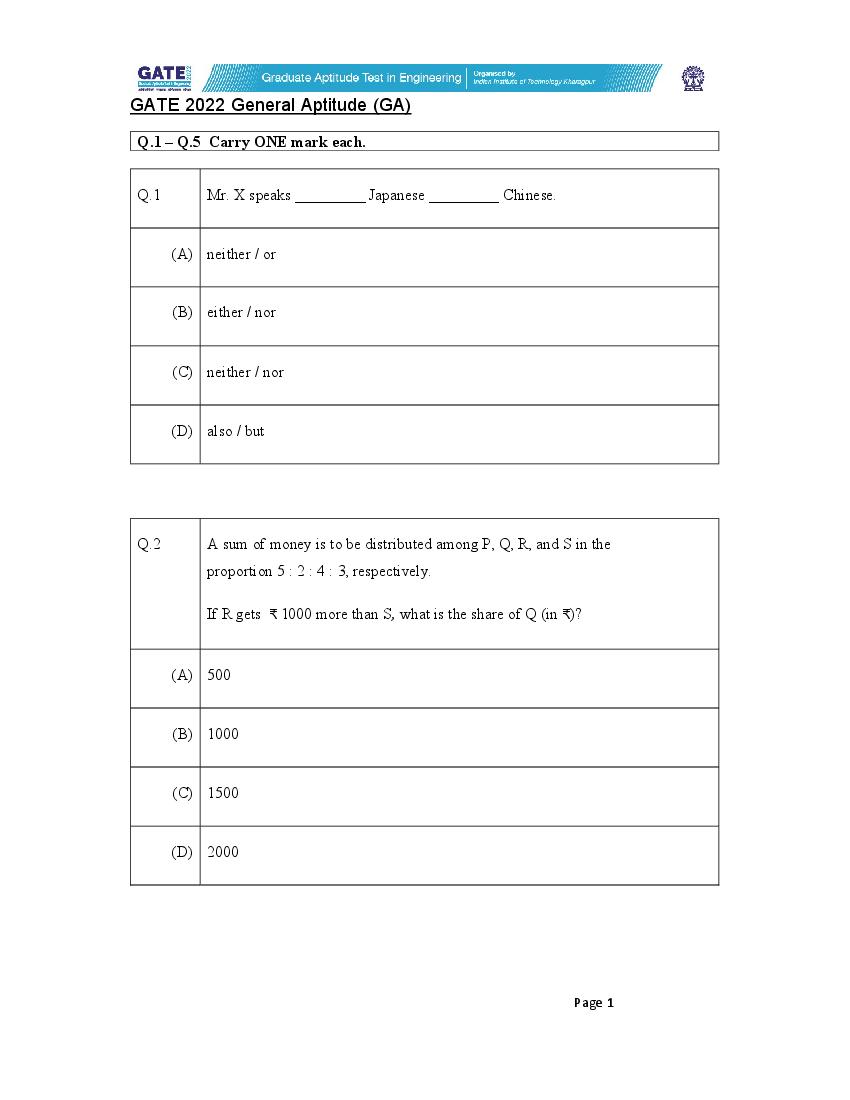
Page 1
Q.1 – Q.5 Carry ONE mark each.
Q.1 Mr. X speaks _________ Japanese _________ Chinese.
(A) neither / or
(B) either / nor
(C) neither / nor
(D) also / but
Q.2 A sum of money is to be distributed among P, Q, R, and S in the
proportion 5 : 2 : 4 : 3, respectively.
If R gets ₹ 1000 more than S, what is the share of Q (in ₹)?
(A) 500
(B) 1000
(C) 1500
(D) 2000
Page 1
Page 2
The side PQ is parallel to side SR.
Further, it is given that, PQ = 11 cm, QR = 4 cm, RS = 6 cm and SP = 3 cm.
What is the shortest distance between PQ and SR (in cm)?
(A) 1.80
(B) 2.40
(C) 4.20
(D) 5.76
Page 2
Page 3
unit square in the grid represents a hole.
What is the maximum number of squares without a “hole in the interior” that
can be formed within the 4 × 4 grid using the unit squares as building blocks?
(A) 15
(B) 20
(C) 21
(D) 26
Page 3
Page 4
protected. The diagram below represents the plan of the gallery where the
boundary walls are opaque. The location the security guard posted is identified
such that all the inner space (shaded region in the plan) of the gallery is within
the line of sight of the security guard.
If the security guard does not move around the posted location and has a 360o
view, which one of the following correctly represents the set of ALL possible
locations among the locations P, Q, R and S, where the security guard can be
posted to watch over the entire inner space of the gallery.
(A) P and Q
(B) Q
(C) Q and S
(D) R and S
Page 4
Page 5
Q.6 Mosquitoes pose a threat to human health. Controlling mosquitoes using
chemicals may have undesired consequences. In Florida, authorities have used
genetically modified mosquitoes to control the overall mosquito population. It
remains to be seen if this novel approach has unforeseen consequences.
Which one of the following is the correct logical inference based on the
information in the above passage?
(A) Using chemicals to kill mosquitoes is better than using genetically modified
mosquitoes because genetic engineering is dangerous
(B) Using genetically modified mosquitoes is better than using chemicals to kill
mosquitoes because they do not have any side effects
(C) Both using genetically modified mosquitoes and chemicals have undesired
consequences and can be dangerous
(D) Using chemicals to kill mosquitoes may have undesired consequences but it is
not clear if using genetically modified mosquitoes has any negative
consequence
Page 5
Page 6
Q.7
(i) 2𝑥 − 1 > 7
(ii) 2𝑥 − 9 < 1
Which one of the following expressions below satisfies the above two
inequalities?
(A) 𝑥 ≤ −4
(B) −4 < 𝑥 ≤ 4
(C) 4 < 𝑥 < 5
(D) 𝑥 ≥ 5
Four points P(0, 1), Q(0, −3), R(−2, −1), and S(2, −1) represent the vertices
Q.8
of a quadrilateral.
What is the area enclosed by the quadrilateral?
(A) 4
(B) 4 2
(C) 8
(D) 8√2
Page 6
Page 7
copied in the exam. The disciplinary committee has investigated the situation
and recorded the statements from the students as given below.
Statement of P: R has copied in the exam.
Statement of Q: S has copied in the exam.
Statement of R: P did not copy in the exam.
Statement of S: Only one of us is telling the truth.
Statement of T: R is telling the truth.
The investigating team had authentic information that S never lies.
Based on the information given above, the person who has copied in the exam is
(A) R
(B) P
(C) Q
(D) T
Page 7
Page 8
center marked as P, Q, R, S and T respectively.
Let X, Y and Z represent the following operations:
X: rotation of the square by 180 degree with respect to the
S-Q axis.
Y: rotation of the square by 180 degree with respect to the P-R axis.
Z: rotation of the square by 90 degree clockwise with respect to the axis
perpendicular, going into the screen and passing through the point T.
Consider the following three distinct sequences of operation (which are applied
in the left to right order).
(1) XYZZ
(2) XY
(3) ZZZZ
Which one of the following statements is correct as per the information
provided above?
(A) The sequence of operations (1) and (2) are equivalent
(B) The sequence of operations (1) and (3) are equivalent
(C) The sequence of operations (2) and (3) are equivalent
(D) The sequence of operations (1), (2) and (3) are equivalent
Page 8
Page 9
Q.11 Let 𝑴 be a 2 × 2 real matrix such that (𝑰 + 𝑴) = 𝑰 − 𝛼𝑴, where 𝛼 is a non-zero
real number and 𝑰 is the 2 × 2 identity matrix. If the trace of the matrix 𝑴 is 3, then
the value of 𝛼 is
(A) 3
4
(B) 1
3
(C) 1
2
(D) 1
4
Page 9
Page 10
𝜇 = 5𝑖, 𝑖 = 0, 1, … , 𝑁, 𝑁 ≥ 1 . Suppose that 𝑝 (𝑡) = 𝑃(𝑋(𝑡) = 𝑖). Then the
system of forward Kolmogorov’s equations is
(A) 𝑑𝑝 (𝑡) 𝑑𝑝 (𝑡)
= 5(𝑖 + 1)𝑝 (𝑡) + 5𝑖 𝑝 (𝑡) and = 5𝑁𝑝 (𝑡)
𝑑𝑡 𝑑𝑡
for 𝑖 = 0, 1, 2, … , 𝑁 − 1 with initial conditions 𝑝 (0) = 0 for 𝑖 ≠ 𝑁, and 𝑝 (0) = 1
(B) 𝑑𝑝 (𝑡) 𝑑𝑝 (𝑡)
= 5(𝑖 + 1)𝑝 (𝑡) − 5𝑖 𝑝 (𝑡) and = −5𝑁𝑝 (𝑡)
𝑑𝑡 𝑑𝑡
for 𝑖 = 0, 1, 2, … , 𝑁 − 1 with initial conditions 𝑝 (0) = 0 for 𝑖 ≠ 𝑁, and 𝑝 (0) = 1
(C) 𝑑𝑝 (𝑡) 𝑑𝑝 (𝑡)
= 5(𝑖 + 1)𝑝 (𝑡) + 5𝑖 𝑝 (𝑡) and = 5𝑁𝑝 (𝑡)
𝑑𝑡 𝑑𝑡
for 𝑖 = 0, 1, 2, … , 𝑁 − 1 with initial conditions 𝑝 (0) = 1 for 𝑖 ≠ 𝑁, and 𝑝 (0) = 0
(D) 𝑑𝑝 (𝑡) 𝑑𝑝 (𝑡)
= 5(𝑖 + 1)𝑝 (𝑡) − 5𝑖 𝑝 (𝑡) and = −5𝑁𝑝 (𝑡)
𝑑𝑡 𝑑𝑡
for 𝑖 = 0, 1, 2, … , 𝑁 − 1 with initial conditions 𝑝 (0) = 1 for 𝑖 ≠ 𝑁, and 𝑝 (0) = 0
Page 10
Page 11
with an unknown mean 𝜇 and an unknown finite variance 𝜎 > 0. Consider the
following statements:
(I) 𝑆 is an unbiased estimator of 𝜎 , and 𝑆 is an unbiased estimator of 𝜎.
(II) 𝑆 is a maximum likelihood estimator of 𝜎 , and 𝑆 is a
maximum likelihood estimator of 𝜎.
Which of the above statements is/are true?
(A) (I) only
(B) (II) only
(C) Both (I) and (II)
(D) Neither (I) nor (II)
Page 11
Page 12
𝑥 𝑦
, (𝑥, 𝑦) ≠ (0,0),
𝑓 (𝑥, 𝑦) = 𝑥 +𝑦
0, (𝑥, 𝑦) = (0,0).
Then which one of the following statements is true?
(A) 𝑓 is bounded and is unbounded on ℝ
(B) 𝑓 is unbounded and is bounded on ℝ
(C) Both 𝑓 and are unbounded on ℝ
(D) Both 𝑓 and are bounded on ℝ
Page 12
Page 13
distribution function 𝐹 (𝑥 ). Let the empirical distribution function of the sample be
𝐹 (𝑥 ). The classical Kolmogorov-Smirnov goodness of fit test statistic is given by
𝑇 = √𝑛 𝐷 = √𝑛 sup |𝐹 (𝑥) − 𝐹(𝑥)|.
Consider the following statements:
(I) The distribution of 𝑇 is the same for all continuous underlying
distribution functions 𝐹(𝑥).
(II) 𝐷 converges to 0 almost surely, as 𝑛 → ∞.
Which of the above statements is/are true?
(A) (I) only
(B) (II) only
(C) Both (I) and (II)
(D) Neither (I) nor (II)
Page 13
Page 14
1 0 0 1/6 1/3 1/2
𝑷𝟏 = 1/3 1/2 1/6 and 𝑷𝟐 = 1/4 0 3/4 .
0 0 1 0 1 0
Then which one of the following statements is true?
(A) Both 𝑷𝟏 and 𝑷𝟐 have unique stationary distributions
(B) 𝑷𝟏 has a unique stationary distribution, but 𝑷𝟐 has infinitely many stationary
distributions
(C) 𝑷𝟏 has infinitely many stationary distributions, but 𝑷𝟐 has a unique stationary
distribution
(D) Neither 𝑷𝟏 nor 𝑷𝟐 has unique stationary distribution
Page 14
Page 15
det(𝚺) ≠ 0, and suppose both 𝝁 and 𝚺 are unknown. Let
1 1
𝑿= 𝑿 and 𝑺= (𝑿 − 𝑿) (𝑿 − 𝑿) .
20 19
Consider the following two statements:
(I) The distribution of 19 𝑺 is 𝑊 (19, 𝚺) (Wishart distribution of order 6
with 19 degrees of freedom).
(II) The distribution of (𝑿𝟑 − 𝝁) 𝑺 (𝑿𝟑 − 𝝁) is 𝜒 (Chi-square
distribution with 6 degrees of freedom).
Then which of the above statements is/are true?
(A) (I) only
(B) (II) only
(C) Both (I) and (II)
(D) Neither (I) nor (II)
Page 15
Page 16
2𝑥 /
𝑒 , 𝑥 > 0,
𝑓(𝑥; 𝜃) = 𝜃
0, 𝑥 ≤ 0.
Let 𝜒 , denote the value of a Chi-square random variable 𝑌 with 𝑛 degrees of
freedom such that 𝑃 𝑌 > 𝜒 , = 𝛼. If 𝑥 , 𝑥 , … , 𝑥 is a realization of this random
sample, then, based on the sufficient statistic ∑ 𝑋 , which one of the following
is a 98% confidence interval for 𝜃?
(A) 2∑ 𝑥 2∑ 𝑥
,
𝜒 . , 𝜒. ,
(B) 2∑ 𝑥 2∑ 𝑥
,
𝜒 . , 𝜒. ,
(C) ∑ 𝑥 ∑ 𝑥
,
𝜒. , 𝜒. ,
(D) ∑ 𝑥 ∑ 𝑥
,
𝜒. , 𝜒. ,
Page 16
Page 17
parameter. Then which one of the following statements is NOT true?
(A) ∑ 𝑋 is a complete and sufficient statistic for 𝜃, if
𝑒 𝜃
𝑓 (𝑥; 𝜃 ) = , 𝑥 = 0, 1, 2, … , and 𝜃 > 0
𝑥!
(B) (∑ 𝑋 , ∑ 𝑋 ) is a complete and sufficient statistic for 𝜃, if
1 ( )
𝑓(𝑥; 𝜃) = 𝑒 , −∞ < 𝑥 < ∞, 𝜃 > 0
√2𝜋 𝜃
(C) 𝑓 (𝑥; 𝜃 ) = 𝜃𝑥 , 0 < 𝑥 < 1, 𝜃 > 0 has monotone likelihood ratio property in
∏ 𝑋
(D) 𝑋( ) − 𝑋( ) is ancillary statistic for 𝜃 if 𝑓(𝑥; 𝜃) = 1, 0 < 𝜃 < 𝑥 < 𝜃 + 1, where
𝑋( ) = min{𝑋 , 𝑋 , … , 𝑋 } and 𝑋( ) = max{𝑋 , 𝑋 , … , 𝑋 }
Page 17
Page 18
the parameter 𝜃. The null hypothesis 𝐻 : 𝜃 = is to be tested against the alternative
hypothesis 𝐻 : 𝜃 > , based on the statistic 𝑌 = ∑ 𝑋 . If the value of 𝑌
corresponding to the observed sample values is 4, then the 𝑝-value of the test
statistic is
(A) 21
32
(B) 9
64
(C) 11
32
(D) 7
64
Page 18
Page 19
8 7 𝑎
= + , 𝑛≥1
𝑎 𝑎 343
with 𝑎 = 3 and 𝑎 < 7 for all 𝑛 ≥ 2.
Consider the following statements:
(I) {𝑎 } is monotonically increasing.
(II) {𝑎 } converges to a value in the interval [3, 7].
Then which of the above statements is/are true?
(A) (I) only
(B) (II) only
(C) Both (I) and (II)
(D) Neither (I) nor (II)
Q.22 Let 𝑴 be any square matrix of arbitrary order 𝑛 such that 𝑴 = 𝟎 and the nullity
of 𝑴 is 6. Then the maximum possible value of 𝑛 (in integer) is ______
Page 19
Page 20
the subspace
𝑆 = {(𝑥 , 𝑥 , 𝑥 , 𝑥 ) ∈ ℝ | 𝑥 + 𝑥 + 𝑥 + 𝑥 = 0}.
If 𝒗 = (1, −2, 1, 1) , and the vectors 𝒖 and 𝒗 − 𝛼𝒖, 𝛼 ∈ ℝ, are orthogonal, then the
value of 𝛼 (rounded off to two decimal places) is equal to ______
Q.24 Let {𝐵(𝑡)} be a standard Brownian motion and let Φ(⋅) be the cumulative
distribution function of the standard normal distribution. If
1
𝑃 𝐵(2) + 2𝐵(3) > 1 = 1 − Φ , 𝛼 > 0,
√𝛼
then the value of 𝛼 (in integer) is equal to ______
Q.25 Let 𝑋 and 𝑌 be two independent exponential random variables with 𝐸(𝑋 ) = and
𝐸(𝑌 ) = . Then 𝑃(𝑋 < 2𝑌) (rounded off to two decimal places) is equal
to ______
Q.26
Let 𝑋 be a random variable with the probability mass function 𝑝 (𝑥 ) = ,
𝑥 = 1, 2, 3, … . Then the value of
𝑃(𝑛 < 𝑋 ≤ 𝑛 + 3)
(rounded off to two decimal places) is equal to _______
Page 20
Page 21
mean 1 and variance 4. Let 𝑆 = 𝑋 + 𝑋 + ⋯ + 𝑋 . If 𝑉𝑎𝑟(𝑆 ) denotes the
variance of 𝑆 , then the value of
𝑉𝑎𝑟(𝑆 ) 𝐸(𝑆 )
lim −
→ 𝑛 𝑛
(in integer) is equal to _______
Q.28 At a telephone exchange, telephone calls arrive independently at an average rate of
1 call per minute, and the number of telephone calls follows a Poisson distribution.
Five time intervals, each of duration 2 minutes, are chosen at random. Let 𝑝 denote
the probability that in each of the five time intervals at most 1 call arrives at the
telephone exchange. Then 𝑒 𝑝 (in integer) is equal to _______
Q.29 Let 𝑋 be a random variable with the probability density function
𝑐(𝑥 − [𝑥]), 0 < 𝑥 < 3,
𝑓(𝑥 ) =
0, elsewhere,
where 𝑐 is a constant and [𝑥] denotes the greatest integer less than or equal to 𝑥. If
𝐴 = , 2 , then 𝑃(𝑋 ∈ 𝐴) (rounded off to two decimal places) is equal to ______
Page 21
Page 22
𝑋 is 𝑀(𝑡 ) and the moment generating function of 𝑌 is
3 1
𝐻(𝑡 ) = 𝑒 + 𝑀(𝑡 ),
4 4
where 𝑡 ∈ (−ℎ, ℎ), ℎ > 0. If the mean and the variance of 𝑋 are and ,
respectively, then the variance of 𝑌 (in integer) is equal to _______
Q.31 Let 𝑋 , 𝑖 = 1, 2, … 𝑛, be 𝑖. 𝑖. 𝑑. random variables with the probability density
function
/ /
𝑥 𝑒 , 0 < 𝑥 < ∞,
√
𝑓 (𝑥 ) =
0, elsewhere,
where Γ(⋅) denotes the gamma function. Also, let 𝑋 = (𝑋 + 𝑋 + ⋯ + 𝑋 ). If
√ 𝑛 𝑋 (3 − 𝑋 ) − converges to Ν(0, 𝜎 ) in distribution, then 𝜎 (rounded
off to two decimal places) is equal to _______
Q.32 Consider a Poisson process {𝑋(𝑡), 𝑡 ≥ 0}. The probability mass function of 𝑋(𝑡) is
given by
𝑒 (4𝑡)
𝑓 (𝑡) = , 𝑛 = 0, 1, 2, …
𝑛!
If 𝐶 (𝑡 , 𝑡 ) is the covariance function of the Poisson process, then the value of
𝐶(5, 3) (in integer) is equal to ______
Page 22
Page 23
function
2(𝜃 − 𝑥)
𝑓(𝑥; 𝜃) = , 0 < 𝑥 < 𝜃,
𝜃
0, elsewhere.
If the observed sample values are 6, 5, 3, 6, then the method of moments estimate
(in integer) of the parameter 𝜃, based on these observations, is ______
Q.34 A company sometimes stops payments of quarterly dividends. If the company pays
the quarterly dividend, the probability that the next one will be paid is 0.7. If the
company stops the quarterly dividend, the probability that the next quarterly
dividend will not be paid is 0.5. Then the probability (rounded off to three
decimal places) that the company will not pay quarterly dividend in the long run
is ______
Q.35 Let 𝑋 , 𝑋 , … , 𝑋 be a random sample taken from a distribution with the probability
density function
𝑥
, 0 < 𝑥 < 4,
𝑓 (𝑥) = 8
0, elsewhere.
Let 𝐹 (𝑥 ) be the empirical distribution function of the sample. If 𝛼 is the variance
of 𝐹 (2), then 128𝛼 (in integer) is equal to ______
Page 23
Page 24
Q.36 Let 𝑴 be a 3 × 3 real symmetric matrix with eigenvalues −1, 1, 2 and the
corresponding unit eigenvectors 𝒖, 𝒗, 𝒘, respectively. Let 𝒙 and 𝒚 be two vectors in
ℝ such that
𝑴𝒙 = 𝒖 + 2(𝒗 + 𝒘) and 𝑴 𝒚 = 𝒖 − (𝒗 + 2𝒘).
Considering the usual inner product in ℝ , the value of |𝒙 + 𝒚| , where |𝒙 + 𝒚| is
the length of the vector 𝒙 + 𝒚, is
(A) 1.25
(B) 0.25
(C) 0.75
(D) 1
Page 24
Page 25
𝑛
𝑆 := (−1) and 𝑆 := (−1) 𝑛 +1 −𝑛 .
𝑛 +4
Which of the above series is/are conditionally convergent?
(A) 𝑆 only
(B) 𝑆 only
(C) Both 𝑆 and 𝑆
(D) Neither 𝑆 nor 𝑆
Q.38 Let (3, 6) , (4, 4) , (5, 7) and (4, 7) be four independent observations from a
bivariate normal distribution with the mean vector 𝝁 and the covariance matrix 𝚺. Let
𝝁 and 𝚺 be the maximum likelihood estimates of 𝝁 and 𝚺, respectively, based on
these observations. Then 𝚺𝝁 is equal to
(A) 3.5
10
(B) 7.5
4
(C) 4
13.5
(D) 10
3.5
Page 25
Page 26
Let 𝑿 = 𝑋 follow Ν (𝝁, 𝚺) with 𝝁 = −3 and 𝚺 = −1 2 𝑎 , where
𝑋 2 1 𝑎 2
𝑎 ∈ ℝ. Suppose that the partial correlation coefficient between 𝑋 and 𝑋 , keeping
𝑋 fixed, is . Then 𝑎 is equal to
(A) 1
(B) 3
2
(C) 2
(D) 1
2
Page 26
Page 27
𝑅: = {(𝑥, 𝑦) ∈ ℝ | 0 ≤ 𝑥 ≤ 𝑦 , 0 ≤ 𝑦 ≤ 2}
into two equal parts, then the value of 𝛼 is equal to
(A) 3
√2
(B) 2√2
(C) √2
(D) 5
2√2
Page 27
Page 28
1
(2𝑥 + 3𝑦 + 𝑧), 0 < 𝑥 < 1, 0 < 𝑦 < 1, 0 < 𝑧 < 1,
𝑓 , , (𝑥, 𝑦, 𝑧) = 3
0, elsewhere.
Then which one of the following points is on the regression surface of 𝑋 on (𝑌, 𝑍) ?
(A) 4 1 1
, ,
7 3 3
(B) 6 2 2
, ,
7 3 3
(C) 1 1 2
, ,
2 3 3
(D) 1 2 1
, ,
2 3 3
Page 28
Page 29
density function
2𝑥
, 0 < 𝑥 < 𝜃,
𝑓(𝑥; 𝜃) = 𝜃
0, elsewhere.
If is used as a pivot for obtaining the confidence interval for 𝜃, then which one of
the following is an 80% confidence interval (confidence limits rounded off to three
decimal places) for 𝜃 based on the observed sample value 𝑥 = 10 ?
(A) (10.541, 31.623)
(B) (10.987, 31.126)
(C) (11.345, 30.524)
(D) (11.267, 30.542)
Page 29
Page 30
variance 𝜃 > 0. Let
𝑋 +𝑋
𝐾= .
𝑋 +𝑋 +⋯+𝑋
Consider the following statements:
(I) The statistics 𝐾 and 𝑋 + 𝑋 + ⋯ + 𝑋 are independent.
(II) has an 𝐹-distribution with 2 and 7 degrees of freedom.
(III) 𝐸 (𝐾 ) = .
Then which of the above statements is/are true?
(A) (I) and (II) only
(B) (I) and (III) only
(C) (II) and (III) only
(D) (I) only
Page 30
Page 31
(I) Let a random variable 𝑋 have the probability density function
1 | |
𝑓 (𝑥) = 𝑒 , −∞ < 𝑥 < ∞.
2
Then there exist 𝑖. 𝑖. 𝑑. random variables 𝑋 and 𝑋 such that 𝑋 and
𝑋 − 𝑋 have the same distribution.
(II) Let a random variable 𝑌 have the probability density function
1
, − 2 < 𝑦 < 2,
𝑓 (𝑦) = 4
0, elsewhere.
Then there exist 𝑖. 𝑖. 𝑑. random variables 𝑌 and 𝑌 such that 𝑌 and
𝑌 − 𝑌 have the same distribution.
Then which of the above statements is/are true?
(A) (I) only
(B) (II) only
(C) Both (I) and (II)
(D) Neither (I) nor (II)
Page 31
Page 32
mean . Let the notation 𝑖. 𝑜. denote ‘infinitely often’. Then which of the following
is/are true?
(A) 𝑃 𝑋 > log 𝑛 𝑖. 𝑜. = 1 for 0 < 𝜖 ≤ 1
(B) 𝑃 𝑋 < log 𝑛 𝑖. 𝑜. = 1 for 0 < 𝜖 ≤ 1
(C) 𝑃 𝑋 > log 𝑛 𝑖. 𝑜. = 1 for ϵ > 1
(D) 𝑃 𝑋 < log 𝑛 𝑖. 𝑜. = 1 for ϵ > 1
Page 32
Page 33
functions
𝑛
⎧𝑛 + 1 , 𝑥 = 0,
⎪
𝑝 (𝑥) = 1
⎨𝑛 + 1 , 𝑥 = 𝑛,
⎪
⎩ 0, elsewhere.
Let 𝑋 be a random variable with 𝑃(𝑋 = 0) = 1. Then which of the following
statements is/are true?
(A) 𝑋 converges to 𝑋 in distribution
(B) 𝑋 converges to 𝑋 in probability
(C) 𝐸(𝑋 ) ⎯ 𝐸(𝑋)
(D) There exists a subsequence {𝑋 } of {𝑋 } such that 𝑋 converges to 𝑋 almost
surely
Page 33
Page 34
3 × 3 matrix with real eigenvalues such that 𝑴𝑵 + 𝑵 𝑴 = 3𝑰, where 𝑰 is the
3 × 3 identity matrix. Then which of the following cannot be eigenvalue(s) of the
matrix 𝑵 ?
(A) 1
4
3
(B)
4
1
(C)
2
7
(D)
4
Q.38 Let 𝑴 be a 3 × 2 real matrix having a singular value decomposition as 𝑴 = 𝑼𝑺𝑽 ,
where the matrix 𝑺 = √3 0 0 , 𝑼 is a 3 × 3 orthogonal matrix, and 𝑽 is a
0 1 0
2 × 2 orthogonal matrix. Then which of the following statements is/are true?
(A) The rank of the matrix 𝑴 is 1
(B) The trace of the matrix 𝑴 𝑴 is 4
(C) The largest singular value of the matrix (𝑴 𝑴) 𝑴 is 1
(D) The nullity of the matrix 𝑴 is 1
Page 34
Page 35
𝑎
𝑃 𝑋 ∈ ℤ = 1, 𝑎 > 0,
2𝜋
where ℤ denotes the set of all integers. If 𝜙 (𝑡), 𝑡 ∈ ℝ, denotes the characteristic
function of 𝑋, then which of the following is/are true?
(A) 𝜙 (𝑎) = 1
(B) 𝜙 (⋅) is periodic with period 𝑎
(C) |𝜙 (𝑡)| < 1 for all 𝑡 ≠ 𝑎
(D) ∫ 𝑒 𝜙 (𝑡)𝑑𝑡 = 𝜋 𝑃 𝑋 = , 𝑛 ∈ ℤ, 𝑖 = √−1
Q.50 Which of the following real valued functions is/are uniformly continuous on
[0, ∞)?
(A) sin 𝑥
(B) 𝑥 sin 𝑥
(C) sin(sin 𝑥)
(D) sin(𝑥 sin 𝑥)
Page 35
Page 36
following values:
Population 1 18 20 16 20 17 18 14
Population 2 17 18 14 20 14 13 16
If Mann-Whitney 𝑈 test is performed at 5% level of significance to test the null
hypothesis 𝐻 : Distributions of the populations are same, against the alternative
hypothesis 𝐻 : Distributions of the populations are not same, then the value of the
test statistic 𝑈 (in integer) for the given data, is ______
Q.52 Consider the multiple regression model
𝑌 = 𝛽 + 𝛽 𝑋 + 𝛽 𝑋 + 𝛽 𝑋 + 𝜖,
where 𝜖 is normally distributed with mean 0 and variance 𝜎 > 0, and
𝛽 , 𝛽 , 𝛽 , 𝛽 are unknown parameters. Suppose 52 observations of (𝑌, 𝑋 , 𝑋 , 𝑋 )
yield sum of squares due to regression as 18.6 and total sum of squares as 79.23.
Then, for testing the null hypothesis 𝐻 : 𝛽 = 𝛽 = 𝛽 = 0 against the alternative
hypothesis 𝐻 : 𝛽 ≠ 0 for some 𝑖 = 1, 2, 3, the value of the test statistic (rounded
off to three decimal places), based on one way analysis of variance, is _______
Page 36
Page 37
density function
2𝑥, 0 < 𝑥 < 1,
𝑓(𝑥 ) =
0, elsewhere.
If 𝑝 is the probability that the largest sample observation is at least twice the smallest
sample observation, then the value of 𝑝 (rounded off to three decimal places)
is ______
Q.54 Let a linear model 𝑌 = 𝛽 + 𝛽 𝑋 + 𝜖 be fitted to the following data, where 𝜖 is
normally distributed with mean 0 and unknown variance 𝜎 > 0.
𝑥 0 1 2 3 4
𝑦 3 4 5 6 7
Let 𝑌 denote the ordinary least-square estimator of 𝑌 at 𝑋 = 6, and the variance of
of 𝑌 = 𝑐𝜎 . Then the value of the real constant 𝑐 (rounded off to one decimal
place) is equal to ______
Q.55 Let 0, 1, 1, 2, 0 be five observations of a random variable 𝑋 which follows a Poisson
distribution with the parameter 𝜃 > 0. Let the minimum variance unbiased estimate
of 𝑃(𝑋 ≤ 1), based on this data, be 𝛼. Then 5 𝛼 (in integer) is equal to ______
Page 37
Page 38
{(𝑥 , 𝑦 ), 𝑖 = 1,2, … , 𝑛} from a paired data, it is found that 𝑥 are distinct for all
𝑖 ≥ 2, 𝑥 = 𝑥 , and ∑ 𝑑 = 19.5, where 𝑑 = rank(𝑥 ) − rank(𝑦 ). Then the
minimum possible value of 𝑛 − 𝑛 (in integer) is ______
Q.57 In a laboratory experiment, the behavior of cats are studied for a particular food
preference between two foods A and B. For an experiment, 70% of the cats that
had food A will prefer food A, and 50% of the cats that had food B will prefer food
A. The experiment is repeated under identical conditions. If 40% of the cats had
food A in the first experiment, then the percentage (rounded off to one decimal
place) of cats those will prefer food A in the third experiment, is ______
Q.58 A random sample of size 5 is taken from a distribution with the probability density
function
3𝑥
, 0 < 𝑥 < 𝜃,
𝑓 (𝑥; 𝜃 ) = 𝜃
0, elsewhere,
where 𝜃 is an unknown parameter. If the observed values of the random sample are
3, 6, 4, 7, 5, then the maximum likelihood estimate of the th quantile of the
distribution (rounded off to one decimal place) is ______
Page 38
Page 39
1 /
𝑥 𝑒 , 𝑥 > 0,
𝑓(𝑥; 𝛽) = 24 𝛽
0, elsewhere,
with 𝛽 > 0. Then, for 𝛽 = 2, the value of the Cramer-Rao lower bound (rounded
off to one decimal place) for the variance of any unbiased estimator of 𝛽 , based
on a random sample of size 8 from this distribution, is ______
Q.60 Let 𝑋 , 𝑋 , 𝑋 , 𝑋 be a random sample of size four from a Bernoulli distribution
with the parameter 𝜃, 0 < 𝜃 < 1. Consider the null hypothesis 𝐻 : 𝜃 = against
the alternative hypothesis 𝐻 : 𝜃 > . Suppose 𝐻 is rejected if and only if
𝑋 + 𝑋 + 𝑋 + 𝑋 > 2. If 𝛼 is the probability of Type I error for the test and 𝛾(𝜃)
is the power function of the test, then the value of 16𝛼 + 7 𝛾 (in integer) is
equal to ______
Q.61 Given that Φ(1.645) = 0.95 and Φ(2.33) = 0.99, where Φ(⋅) denotes the
cumulative distribution function of a standard normal random variable. For a
random sample 𝑋 , 𝑋 , … , 𝑋 from a normal population Ν(𝜇, 2 ), where 𝜇 is
unknown, the null hypothesis 𝐻 : 𝜇 = 10 is to be tested against the alternative
hypothesis 𝐻 : 𝜇 = 12. Suppose that a test that rejects 𝐻 if the sample mean 𝑋 is
large, is used. Then the smallest value of 𝑛 (in integer) such that Type I error is
0.05 and Type II error is at most 0.01, is ______
Page 39
Page 40
a continuous distribution, which is symmetric about its mean 𝜇. Then the smallest
value of 𝑛 (in integer) such that 𝑃(𝑌 < 𝜇 < 𝑌 ) ≥ 0.99, is ______
Q.63 If 𝑃(𝑥, 𝑦, 𝑧) is a point which is nearest to the origin and lies on the intersection of
the surfaces 𝑧 = 𝑥𝑦 + 5 and 𝑥 + 𝑦 + 𝑧 = 1. Then the distance (in integer)
between the origin and the point 𝑃 is ______
Q.64 Let 𝑋 and 𝑌 be random variables such that 𝑋 is uniformly distributed over (0, 4),
and the conditional distribution of 𝑌 given 𝑋 = 𝑥 is uniformly distributed over
0, . Then 𝐸(𝑌 ) (rounded off to three decimal places) is equal to _____
Q.65 Let 𝑿 = (𝑋 , 𝑋 , 𝑋 ) be a random vector with the distribution Ν (𝝁, 𝚺), where
3 4 2 1
𝝁= 2 and 𝚺= 2 3 0 .
4 1 0 2
Then 𝐸(𝑋 |(𝑋 = 4, 𝑋 = 7)) (in integer) is equal to ______
Page 40
Document Details
| Board / Org | IIT |
| Exam | Graduate Aptitude Test in Engineering |
| Type | Question Paper |
| Pages | 40 |
| Language | english |
| Updated | 22 Jul 2026 |