MBOSE Class 12 Question Paper 2022 for Geology
Finished viewing? Save it for later —
Download MBOSE Class 12 Question Paper 2022 for Geology (PDF · 8 pages)About MBOSE Class 12 Question Paper 2022 for Geology
MBOSE Class 12 Question Paper 2022 for Geology is available here for free download. Published by Meghalaya Board for Class 12, this question paper can be viewed online or downloaded as a PDF (8 pages). Candidates preparing for Class 12 can use MBOSE Class 12 Question Paper 2022 for Geology to understand the exam pattern, the type of questions asked, and the overall difficulty level.
Frequently Asked Questions
How can I download MBOSE Class 12 Question Paper 2022 for Geology?
Open this page and click the Download button to save MBOSE Class 12 Question Paper 2022 for Geology as a PDF. It is completely free on AglaSem Docs.
Is MBOSE Class 12 Question Paper 2022 for Geology free to download?
Yes. MBOSE Class 12 Question Paper 2022 for Geology can be viewed online and downloaded as a PDF free of cost on AglaSem Docs.
How many pages does MBOSE Class 12 Question Paper 2022 for Geology have?
MBOSE Class 12 Question Paper 2022 for Geology contains 8 pages, which you can read online or download together as a single PDF.
Where can I find more Class 12 study material?
You can find more Class 12 question papers, sample papers, syllabus, and answer keys on AglaSem Docs.
MBOSE Class 12 Question Paper 2022 for Geology – Text
Read the full text of this question paper below — useful to quickly search, copy and reference the content online without downloading the PDF.
📄 View text version (8 pages)
Page 1
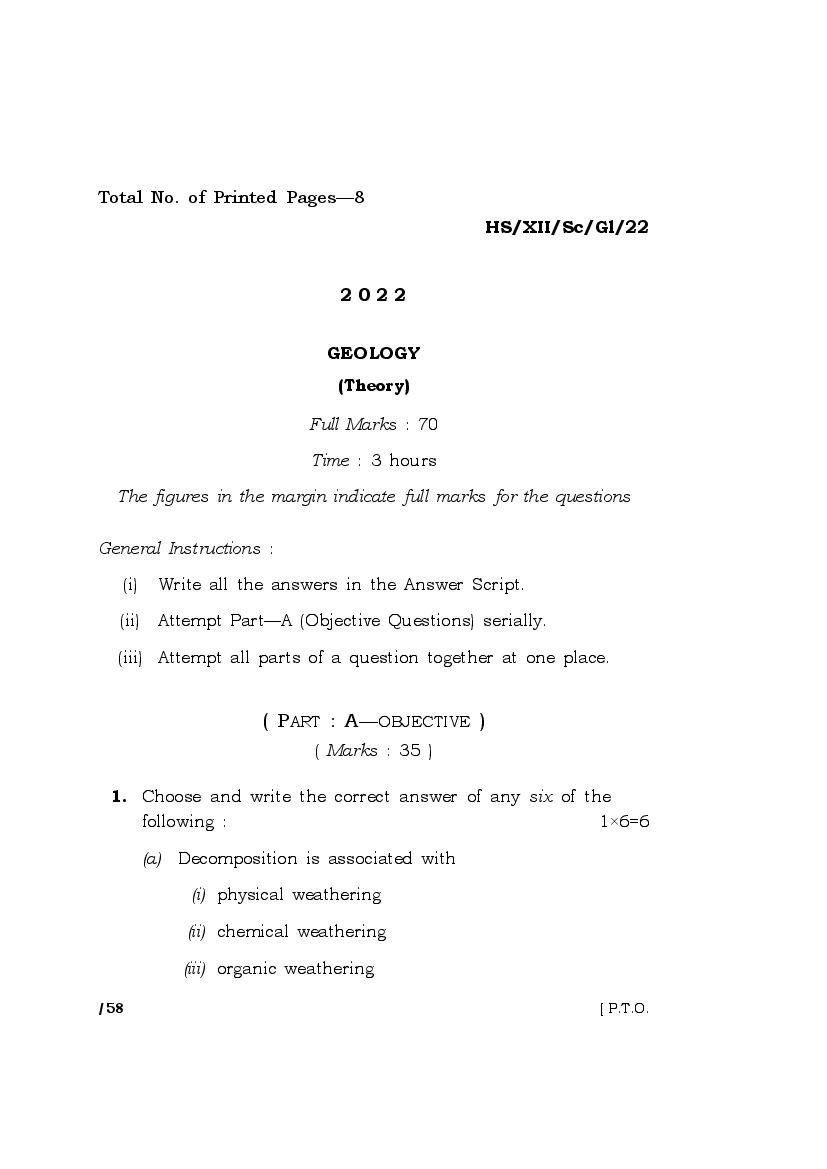
HS/XII/Sc/Gl/22
2022
GEOLOGY
(Theory)
Full Marks : 70
Time : 3 hours
The figures in the margin indicate full marks for the questions
General Instructions :
(i) Write all the answers in the Answer Script.
(ii) Attempt Part—A (Objective Questions) serially.
(iii) Attempt all parts of a question together at one place.
( PART : A—OBJECTIVE )
( Marks : 35 )
1. Choose and write the correct answer of any six of the
following : 1×6=6
(a) Decomposition is associated with
(i) physical weathering
(ii) chemical weathering
(iii) organic weathering
/58 [ P.T.O.
Page 2
(b) Organisms that swim about in ocean water are said
to be
(i) planktonic
(ii) nektonic
(iii) benthonic
(c) The Disang group is observed in the stratigraphy of
(i) Assam
(ii) Meghalaya
(iii) Spiti
(d) Galena is the ore of
(i) iron
(ii) lead
(iii) zinc
(e) Marine organic animals give rise to
(i) coal
(ii) water
(iii) petroleum
(f) Ore deposits formed at the same time as the
enclosing rocks are said to be
(i) syngenetic
(ii) epigenetic
(iii) metamorphic
HS/XII/Sc/Gl/22/58 [ Contd.
Page 3
(g) Which of the following is an ore of aluminium?
(i) Bauxite
(ii) Hematite
(iii) Coal
(h) Diamond bearing conglomerates were reported in the
(i) Dharwar supergroup
(ii) Vindhyan supergroup
(iii) Paleozoic of Spiti
(i) Acid rain is associated with
(i) overground coal mining
(ii) underground coal mining
(iii) overground Pb-Zn mining
2. State whether the following statements are ‘ True’
or ‘False’ (any six) : 1×6=6
(a) Dihing Group is younger than the Disang Group in
Upper Assam.
(b) Ores from which several metals can be extracted are
called complex ores.
(c) Sands range in size from 4 mm to 1/16 mm.
(d) Muds are argillaceous materials.
(e) Pallial line is seen in lamellibranchs.
HS/XII/Sc/Gl/22/58 [ P.T.O.
Page 4
(f) The brachiopods evolved earlier than the gastropods.
(g) Closepet granite is associated with the stratigraphy
of Meghalaya.
(h) The hot residual fluid containing minerals after the
main minerals have crystallized out is called
hydrothermal fluid.
(i) To mitigate the effect of earthquakes, buildings are
to be constructed on soil.
3. Fill in the blanks (any six) : 1×6=6
(a) Water bearing formations in the earth are called _____.
(b) Wavy features on the top of sedimentary layers are
called _____.
(c) Rocks of Archean age over which all other rocks are
laid down/formed later is called the _____.
(d) The ‘angle of rest’ for a safe hill slope should
not exceed ______°.
(e) Lung diseases in miners are associated with _____
mining.
(f) _____ coal is with over 90% carbon.
(g) The ease with which water moves through a medium
is called _____.
(h) Petroleum is of _____ origin.
(i) The Barail Group is followed immediately upwards
by the _____ Group.
HS/XII/Sc/Gl/22/58 [ Contd.
Page 5
4. Express each of the following in 1 (one) word (any five) :
1×5=5
(a) Rocks where oil accumulates
(b) Lessening of the hazards of natural earth processes
(c) Level below which actual groundwater occurs and
the pores completely saturated with water
(d) Place where organism, past or present, live
(e) Transformation of loose sediments into hard lithified
rock
(f) Natural earth process that brings loss of life and
property
(g) Useless minerals
5. Match Column—A with Column—B and write the
corresponding numbers : 1×6=6
Column—A Column—B
(a) Bed load (i) Gondwana
(b) Glossopteris (ii) Spiti
(c) Placer (iii) Assam
(d) Otoceras (iv) Deposition
(e) Landslides (v) Wet soil
(f) Conglomerate (vi) Mechanical concentration
(vii) Rudaceous
(viii) Transportation
HS/XII/Sc/Gl/22/58 [ P.T.O.
Page 6
6. Write on the following in 1 (one) or 2 (two) line(s)
(any six) : 1×6=6
(a) Dorsal side
(b) Mud crack
(c) Non-clastic sediments
(d) Ore
(e) Mould
(f) Vertebraria
(g) Nodule
(h) Definition of groundwater
( PART : B—DESCRIPTIVE )
( Marks : 35 )
Answer five questions, selecting one from each Group
GROUP—A
( Sedimentology )
7. Write a brief note on the common sedimentary structures
with neat sketches. 7
8. Write on any two of the following : 3½×2=7
(a) Diagenesis
(b) Grain size and the size scale
(c) Clastic and non-clastic sedimentary rocks
9. Give a classification of the environments of deposition
with very brief explanation on each of them. 7
HS/XII/Sc/Gl/22/58 [ Contd.
Page 7
GROUP—B
( Paleontology )
10. Outline the morphology of a typical brachiopod shell
with suitable sketches. 7
11. Write on any two of the following : 3½×2=7
(a) Index fossil
(b) Fossils and correlation
(c) Suture and types of suture in cephalopods
12. Write a note on the coiling of gastropods and the
different coiling patterns observed in gastropods. 7
GROUP—C
( Stratigraphy )
13. Write the lithostratigraphy of Meghalaya in tabular form
with very brief petrographic note of each unit. 7
14. Write on any two of the following : 3½×2=7
(a) Barail group
(b) Correlation
(c) Intrusives into the Dharwar Supergroup
15. Write a petrographic description of the Lower Triassic
rocks of Spiti. 7
HS/XII/Sc/Gl/22/58 [ P.T.O.
Page 8
GROUP—D
( Mineral and Energy Resources )
16. Outline the formation of coal. 7
17. Write on any two of the following : 3½×2=7
(a) Classification of magmatic ore deposits
(b) Lead deposits in India
(c) Distribution of radioactive minerals in India
18. Write an account on the origin and distribution of
chromite in India. 7
GROUP—E
( Engineering Geology, Groundwater, Environment
and Disaster Studies )
19. Write on the various causes of landslides. 7
20. Write on any two of the following : 3½×2=7
(a) Environmental impact of open-cast mining
(b) Porosity and permeability
(c) Mitigation of earthquakes
21. Explain how sedimentary rock structures have an
influence on dam stability with sketches. 7
HS/XII/Sc/Gl/22/58 22K—60
Document Details
| Board / Org | Meghalaya Board |
| Exam | Class 12 |
| Type | Question Paper |
| Pages | 8 |
| Updated | 22 Jul 2026 |