MAHA SET 2025 Paper II Mathematical Sciences Set A Question Paper
Finished viewing? Save it for later —
Download MAHA SET 2025 Paper II Mathematical Sciences Set A Question Paper (PDF · 48 pages)About MAHA SET 2025 Paper II Mathematical Sciences Set A Question Paper
MAHA SET 2025 Paper II Mathematical Sciences Set A Question Paper is available here for free download. Published by Maharashtra Exams for MAHA SET, this question paper can be viewed online or downloaded as a PDF (48 pages). Candidates preparing for MAHA SET can use MAHA SET 2025 Paper II Mathematical Sciences Set A Question Paper to understand the exam pattern, the type of questions asked, and the overall difficulty level.
Frequently Asked Questions
How can I download MAHA SET 2025 Paper II Mathematical Sciences Set A Question Paper?
Open this page and click the Download button to save MAHA SET 2025 Paper II Mathematical Sciences Set A Question Paper as a PDF. It is completely free on AglaSem Docs.
Is MAHA SET 2025 Paper II Mathematical Sciences Set A Question Paper free to download?
Yes. MAHA SET 2025 Paper II Mathematical Sciences Set A Question Paper can be viewed online and downloaded as a PDF free of cost on AglaSem Docs.
How many pages does MAHA SET 2025 Paper II Mathematical Sciences Set A Question Paper have?
MAHA SET 2025 Paper II Mathematical Sciences Set A Question Paper contains 48 pages, which you can read online or download together as a single PDF.
Where can I find more MAHA SET study material?
You can find more MAHA SET question papers, sample papers, syllabus, and answer keys on AglaSem Docs.
MAHA SET 2025 Paper II Mathematical Sciences Set A Question Paper – Text
Read the full text of this question paper below — useful to quickly search, copy and reference the content online without downloading the PDF.
📄 View text version (49 pages)
Page 1
MAHA SET 2025
Paper II Mathematical
Sciences Set A
Question Paper
EXAM YEAR TYPE
MAHA SET 2025 Question Paper
Notes · Sample Papers · Previous Year Papers · Mock Tests
Page 2
m. s e
l a
a g
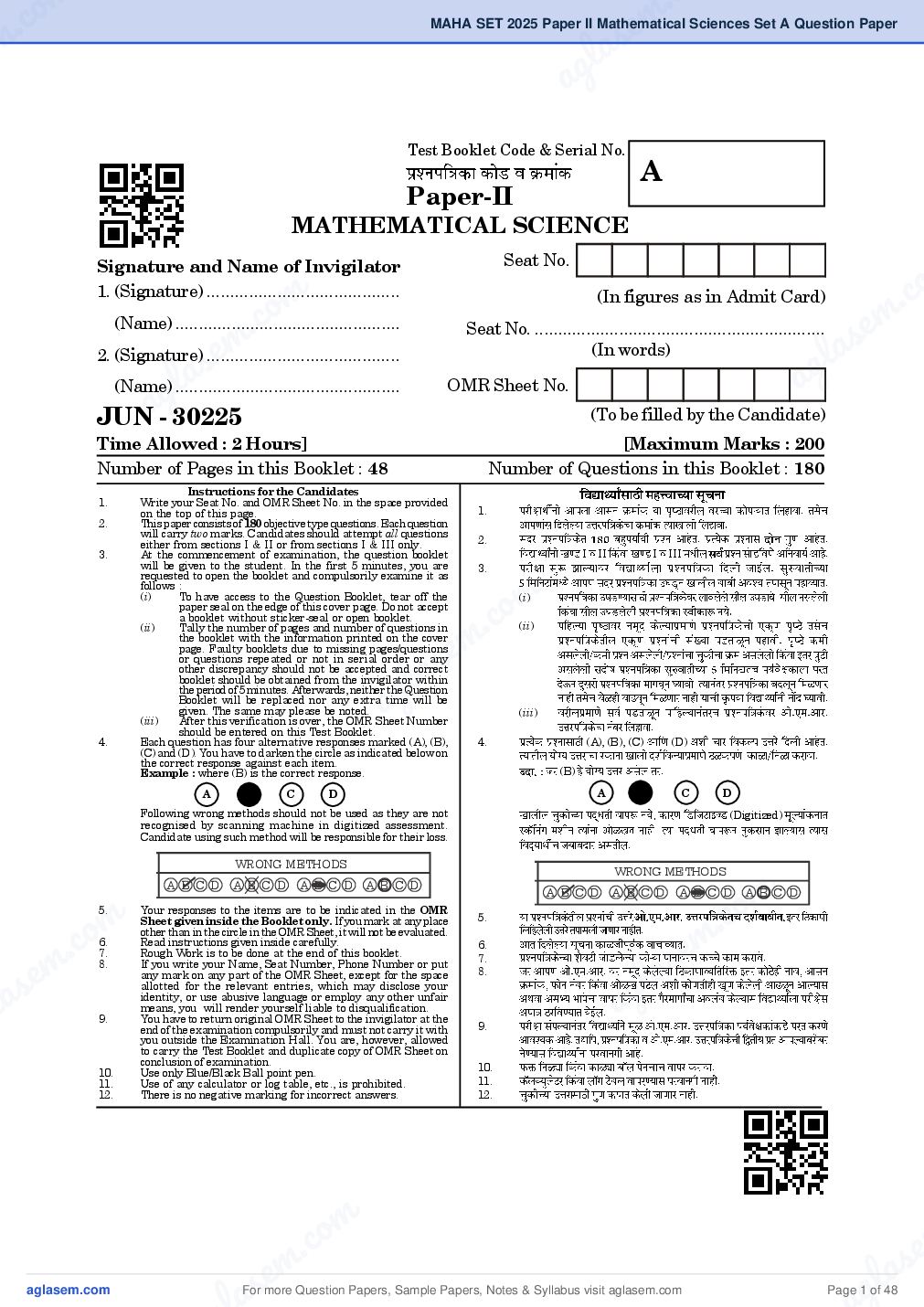
Test Booklet Code & Serial No.
A
Paper-II
MATHEMATICAL SCIENCE
co
Signature and Name of Invigilator Seat No.
m .
c. o m
1. (Signature) ......................................... (In figures as in Admit Card)
s e
em a
(Name) ................................................
l
Seat No. ..............................................................
la s
2. (Signature) ......................................... (In words)
ag
g
JUNa- 30225
(Name) ................................................ OMR Sheet No.
(To be filled by the Candidate)
Time Allowed : 2 Hours] [Maximum Marks : 200
Number of Pages in this Booklet : 48 Number of Questions in this Booklet : 180
Instructions for the Candidates
1. Write your Seat No. and OMR Sheet No. in the space provided
on the top of this page. 1.
2. This paper consists of 180 objective type questions. Each question
will carry two marks. Candidates should attempt all questions
either from sections I & II or from sections I & III only. 2.
3. At the commencement of examination, the question booklet I II I III
m
will be given to the student. In the first 5 minutes, you are 3.
c. o
requested to open the booklet and compulsorily examine it as
follows :
(i) To have access to the Question Booklet, tear off the (i)
paper seal on the edge of this cover page. Do not accept
em
a booklet without sticker-seal or open booklet.
(ii) Tally the number of pages and number of questions in (ii)
s
the booklet with the information printed on the cover
l a
page. Faulty booklets due to missing pages/questions
or questions repeated or not in serial order or any
g
other discrepancy should not be accepted and correct
a
booklet should be obtained from the invigilator within
the period of 5 minutes. Afterwards, neither the Question
Booklet will be replaced nor any extra time will be
given. The same may please be noted. (iii)
(iii) After this verification is over, the OMR Sheet Number
should be entered on this Test Booklet.
4. Each question has four alternative responses marked (A), (B), 4. (A), (B), (C) (D)
(C) and (D). You have to darken the circle as indicated below on
the correct response against each item.
Example : where (B) is the correct response. (B)
A C D A C D
Following wrong methods should not be used as they are not (Digitized)
recognised by scanning machine in digitized assessment.
Candidate using such method will be responsible for their loss.
CORRECT METHOD
m
WRONG METHODS
CORRECT METHOD WRONG METHODS
co
C D A B C D A B C D A B C D A B C D
m .
C D A B C D A B C D A B C D A B C D
c. o m
5. Your responses to the items are to be indicated in the OMR
se
Sheet given inside the Booklet only. If you mark at any place 5.
other than in the circle in the OMR Sheet, it will not be evaluated.
em la
6. Read instructions given inside carefully. 6.
7. Rough Work is to be done at the end of this booklet.
s
7.
g
8. If you write your Name, Seat Number, Phone Number or put
la a
any mark on any part of the OMR Sheet, except for the space 8.
allotted for the relevant entries, which may disclose your
identity, or use abusive language or employ any other unfair
means, you will render yourself liable to disqualification.
9. You have to return original OMR Sheet to the invigilator at the
end of the examination compulsorily and must not carry it with 9.
you outside the Examination Hall. You are, however, allowed
to carry the Test Booklet and duplicate copy of OMR Sheet on
conclusion of examination. 10.
10. Use only Blue/Black Ball point pen.
11. Use of any calculator or log table, etc., is prohibited. 11.
12. There is no negative marking for incorrect answers. 12.
m
.co s e
m a
se
For more Question Papers, Sample Papers, Notes & Syllabus visit
gl
Page 1 of 48
Page 3
For more Question Papers, Sample Papers, Notes & Syllabus visit Page 2 of 48
Page 4
m. s e
l a
a g
Mathematical Science
Paper II
om . co
Time Allowed : 120 Minutes] [Maximum Marks : 200
.c e m
Note : This paper contains One Hundred Eighty (180) multiple choice questions
m
in THREE (3) sections, each question carrying TWO (2) marks. Attempt
e l a s
a s g
all questions either from Sections I & II only or from Sections I & III
l a
ag
only. The OMR sheets with questions attempted from both the Sections viz.
II & III, will not be assessed.
Number of questions, sectionwise :
Section I : Q. Nos. 1 to 20, Section II : Q. Nos. 21 to 100,
Section III : Q. Nos. 101 to 180.
SECTION I 3. Which of the following statements
is not true in any metric space ?
1. Let X be a connected metric space.
m
(A) Every open set is closed
c. o(B) Every subset is bounded
Then which of the following is
em (C) There is a finite set which is not
true ?
(A) X is finite
l a s
(B) X is infinite
a g closed
(D) There is a countable set which
(C) |X| 10 is not compact
(D) X is uncountable
4. The series :
2. Let X, Y be metric spaces. Suppose
2 3 4 n1
f, g : X Y are continuous ...... 2 ......
1 4 9 n
functions and D { x| f ( x) g( x)} .
o m
m .c
(A) Converges to an irrational
c. o (A) Dense in X m
Then f g if D is :
e
number
(B) Convergesasto a positive
s em l
la (B) Unbounded ag number
transcendental
(C) Compact (C) Converges to a rational number
(D) Closed (D) Diverges
3
m
.co s e
m a
se
For more Question Papers, Sample Papers, Notes & Syllabus visit
gl
Page 3 of 48
Page 5
it is known that, functions defined by :
lim xn lim yn lim ( xn yn ) xn
fn ( x) , 0 x 1.
1 xn
lim ( xn yn ) lim xn lim yn (*)
Then, which of the following
0 if n is even statements is true ?
Suppose that xn
1 if n is odd S1 : fn f 0 uniformly on [0, 1]
and yn 1 xn , for all n 1. S2 : sup fn ( x) F( x) 0 on [0, ½]
0 x ½
Then, which of the following
S3 : fn f 0 uniformly on [0, ½]
statements is/are true for {x n } (A) Only S1 and S2 are true
and {yn} ? (B) Only S1 and S3 are true
(C) Only S2 and S3 are true
S1 : strict inequalities hold in (*)
(D) All the three are true
above.
7. Suppose that f is a function defined
by :
S2 : {xn + yn} converges, while {xn}
x
and {yn} do not. f ( x) ,
3 2x 0 x 1
2
(A) Neither S1 nor S2 is true If g( x) f "( x) f '( x) [ f '( x)] , then
g(1) is equal to :
(B) Both S1 and S2 are true
(A) 9
(C) Only S1 is true (B) 2
(C) 6
(D) Only S2 is true (D) 4
4
For more Question Papers, Sample Papers, Notes & Syllabus visit Page 4 of 48
Page 6
m. s e
l a
a g
8. Suppose that f is a function on R2 10. The number of non-empty proper
co
defined by :
xy o
m .
subsets of X = {1, 2, 3, 4, 5} is :
c
x . y , e m
f ( x, y) m
e
( x, y) (0, 0) (A) 16
l a s
s
2 2
a
l 0, ag
a g
( x, y) (0, 0) (B) 31
Then, which of the following (C) 32
statements is/are true ?
(D) 30
S1 : f is continuous at (0, 0).
S2 : Both partial derivatives exist 11. Which of the following statements
at (0, 0).
is true ?
m
c. o(A) C is a vector space over R of
(A) Both S1 and S2 are true
em
(B) Only S1 is true
(C) Only S2 is true
l a s dimension
1
ag
(D) Neither S nor S is true 2
(B) R is a vector space over Q of
9. Consider the function f defined
dimension
by :
(C) The vector space consisting
cos( x)
, x /2
f ( x) / 2 x of all polynomials with real
m
1, x /2
c o
coefficients of degree upto n has
m .
c. o f would be continuous at x / 2 ?
What should be the value of so that
em
s
dimension n
s em g lavectors in a vector
la a
(A) 1 (D) Every set of
(B) –1
space V can be extended to a
(C) 2
basis of V
(D) –2
5
m
.co s e
m a
se
For more Question Papers, Sample Papers, Notes & Syllabus visit
gl
Page 5 of 48
Page 7
such that : be I + X + X2 + ...... + Xn–1 ?
(A) (I – X)n (X – I)–1
1 0
1 0 (B) (I – Xn) (X – I)–1
T 0 , T 1 and
0 1 (C) (Xn – I) (X – I)–1
0 0
(D) (X – I)–1 (X – I)n
0 14. Suppose A, B and C are 3×3
1
T 1 matrices with |A| 3 and |B| 3 .
1 .
1 Then, |2 C A 2 BT (CA)–1 B| is :
(A) 54
1 (B) 216
Then T 1
(C) 27
1
(D) 172
15. The following system of equations :
2
(A) x + z = 3
1
x – y – z = 1
1 –x + y = 1
(B)
1 (A) is consistent with infinitely
many solutions
1
(C) (B) is consistent with a unique
2
solution
2 (C) is not consistent
(D)
2 (D) has exactly three solutions
6
For more Question Papers, Sample Papers, Notes & Syllabus visit Page 6 of 48
Page 8
m. s e
l a
a g
1 0 0 19. Let A be a 5 × 5 real matrix and
co
o1m .
16. Let A 2 2 0 . Then, the
c m
let B be the adjoint of A. Then :
.
1
m
4
s e
s e of the matrix g l a
a
(A) A and B have same rank
A g–l 3A + 2I are : a
eigenvalues
a
2
(B) A and B have same determinant
(A) 0, 0, 6
(B) –1, 1, 0 (C) A is invertible if and only if B
(C) –2, 4, 18 is invertible
(D) 0, 3, 12
17. Suppose A is a non-zero real (D) AB = 5 I5
m
c. o
nilpotent matrix. Then :
20. The quadratic form corresponding
e m to the matrix
(A) A is not triangulable
l a
(B) A has at least two eigenvalues s
ag
(C) The transpose of A is nilpotent
(D) The minimal polynomial of A
2 1 0
1 2 1
is same as its characteristic
polynomial 0 1 1
18. Let A be an n × n matrix with all
entries equal to 1. Then : is :
m
co
(A) All eigenvalues of A are positive
m .
(A) Positive definite
c. o em
(B) 0 is an eigenvalue of A with
em multiplicity 1
la s
(B) Negative definite
as g
l (C) Positivea semidefinite
(C) A has at least three distinct
eigenvalues
(D) A has exactly one non-zero
(D) Negative semidefinite
eigenvalue
7
m
.co s e
m a
se
For more Question Papers, Sample Papers, Notes & Syllabus visit
gl
Page 7 of 48
Page 9
(A) There exists an analytic function
21. For a complex number z, | e iz
| 1 f such that Re f ( z) y2 2 x
holds if : (B) There exists an analytic function
f such that Im f ( z) x2 y
(A) Re z > 0 (C) If f is analytic on the unit disk
, then the function f ( z ) is
(B) Re z < 0 analytic on
(D) There exists a real-valued non-
(C) Im z > 0 constant function which is
analytic on a domain D
(D) Im z < 0
sin z
24. The function f ( z) has :
1 ez
22. Under the stereographic projection
(A) a removable singularity at z = 0
between S2 and C, the point 1 + i
(B) a simple pole at z = 0
of C corresponds to the following (C) a pole of order two at z = 0
point of S2. (D) an essential singularity at z = 0
25. Let denote the unit disk and
2 –2 1 f : be analytic with f(0) = 0.
(A) , ,
3 3 3
Then :
2 2 1 1 1
(B) , , (A) If f , then f ( z) z for
3 3 3 2 2
all z
1 1
(C) , , 0 (B) | f '(0)| 1 , then f ( z) z for all
2 2
z
1 1 1 (C) | f ( z)| | z| for all z
(D) , ,
3 3 3
(D) If f '(0) 0 , then f is constant
8
For more Question Papers, Sample Papers, Notes & Syllabus visit Page 8 of 48
Page 10
m. se
l a
a g
28. Which of the following power
26. If { z C / | z | 1}1}
, then the
co
2
om .
series does not have radius of
c m
sin z dz
value of
m . convergence 1 ?
s e
a
is :
e l
z z
s
a g
2 (A) 1 – z z2 z3 ......
l a
ag0
(A) (B) z
z2 z3 z4
2
3
4
......
(B) 2i (C) 2 2.3 z 3.4 z2 4.5 z3 ........
1 z z2
(D) .........
(C) 4i 2 22 23
29. An analytic function f on unit disk
mis constant on if :
(D) –2i
. c o
27. Which of the following Möbius
m
e (A) f is bounded
la
transformations maps the unit s
a g
disk onto the right half plane (B) f is analytic 2
{w / Re w 0}0}?
(C) f f is analytic
zi 1
(A) f ( z) (D) is analytic
zi f
30. Which of the following functions is
m
z1
co
(B) f ( z)
m .
z1 conformal on the unit disk ?
c. o (A) z5 + 1
se
m
em z 1
la
s g
(C) f ( z)
l a 2z 1 (B) cos z
a
z1 (C) ze z3 1
(D) f ( z)
1 z
(D) zez
9
m
.co s e
m a
se
For more Question Papers, Sample Papers, Notes & Syllabus visit
gl
Page 9 of 48
Page 11
33. Let f ( z) sin and
statements : z1
A z / 0 | z 1| 1 Then :
(i) An entire function with
infinitely many zeros is (A) f(A) is a bounded set
identically zero.
(B) f(A) is contained in a half-plane
(ii) There exists an analytic
(C) f (A) C
function f on the unit disk such
that : (D) f is not analytic on A
1 1 1 34. One of the values of 1 i , where
f f
2n n 2n 1
i 1 , is :
for n 1, 2, 3 .....
1
(A) log 2 i
Then : 4 2
e
(A) Only (i) is true 1
(B) log 2 i
4 4
(B) Only (ii) is true e
1
(C) Both (i) and (ii) are true (C) log 2 i
e4
(D) Both (i) and (ii) are false
1
(D) log 2 i
32. Suppose f is analytic in a disk D and 2 2
e
f ( z) 0 for all z D . Then : 35. What is the minimal polynomial of
(A) f is a one-one map 2 3 over Q ?
(B) f is bounded
(A) x3 – 5x2 + 1
(C) f ' need not be analytic
(B) x4 – 6x2 + 1
(D) there is an analytic function
(C) x4 – 10x2 + 1
g:DC such that
f ( z) e g( z) (D) x2 + 6x + 1
10
For more Question Papers, Sample Papers, Notes & Syllabus visit Page 10 of 48
Page 12
m. s e
l a
a g
36. What is the Galois group of 39. For which of the following n, the
polynomial x3 – 9 is irreducible in
co
f ( x) x3 3 x2 15 x 3 over Q ?
om .
Zn [x] ?
.c (A) 11
e m
s
(A) (Z3, +)
s em (B) 31
g l a
a alternating group A
(B) Z , +)
(C) l a
4
g
(C) 9
a
the 4 (D) 10
(D) the permutation group S 3 40. Consider the following statements :
37. There is no subfield with k elements I : A subring of a unique
factorization domain is a unique
to the field with 64 elements if factorization domain.
k is : II : Let R be a unique factorization
domain and d gcd ( a, b) for
m
(A) 16
c. oWhich is correct ?
a, b R . Then ( d) ( a) (b) .
em (A) Only I is true
(B) 4
(C) 8
l a s
(D) 2
a g (B) Only II is true
(C) Both I and II are true
38. Let F q be a finite field with q (D) Neither I nor II is true
elements. Then which of the 41. Consider the following statements :
following need not be true ? I : Any finite non-commutative
ring must have at least 16
(A) q is a power of a prime
elements.
m
c. o
(B) For every positive integer n, II : Let R be a ring with unity
m
c. o
such that |R| = 9. Then R is
em is true ?
there is an irreducible polynomial
s
commutative.
em a
(A) Only I isgltrue
of degree n in F [x].
s
q Which of the following
la (C) The multiplicative group
(Fq \{0}, X) is cyclic
a
(B) Only II is true
(C) Both I and II are true
(D) Fq is algebraically closed
(D) Neither I nor II is true
11
m
.co s e
m a
se
For more Question Papers, Sample Papers, Notes & Syllabus visit
gl
Page 11 of 48
Page 13
of 2 × 2 matrices over Z/2Z : (A) A4 has a subgroup of order 6
(A) has cardinality 8 (B) A4 has only one proper non-
trivial normal subgroup
(B) has cardinality 16
(C) A4 is simple
(C) is isomorphic to S3
(D) Two elements of An that are
(D) is isomorphic to A4 conjugates in Sn are always
conjugates in An also
43. Consider the following statements :
45. Let G be a group of order p 2 ,
I : If G is a group such that every
(p-prime). Then which of the
cyclic group of G is a normal
following is correct ?
subgroup of G, then every
(A) G has exactly 3 subgroups
subgroup of G is a normal
(B) G has exactly 2 subgroups
subgroup of G.
(C) G has exactly 2 non-trivial,
II : If H is a subgroup of a group proper subgroups
G such that the index of H in
(D) G has more than 4 subgroups
G is 2, then H is a normal
46. Suppose given a positive integer k
subgroup of G.
has the property that for any integer
Which of the following statement(s) n k can be written as a sum of
is/are true ? 3’s and/or 8’s. Then which of the
following is the value of k ?
(A) Only I is true
(A) 6
(B) Only II is true
(B) 8
(C) Both I and II are true
(C) 9
(D) Neither I nor II is true (D) 15
12
For more Question Papers, Sample Papers, Notes & Syllabus visit Page 12 of 48
Page 14
m. s e
l a
a g
47. How many units are there in Z12 ? 50. The interval (–1, 1) is homeomorphic
om co
to :
.
(A) 3
.c (A) The parabola y = x2
e m
m s
(B) 4
s e g l a
a
x 2 y2
l a
(C) 5 1
ag2
(B) The ellipse
4 9
(D)
(C) The circle x2 + y2 = 1
48. The permutation (12) (13) in S4 is
(D) The interval [–1, 1]
similar to :
51. Let C[0, 1] denote the space of
(A) (2 3 4) continuous functions on [0, 1] with
(B) (2 3) sup norm . The set
m
(C) (1 2 3 4)
c. o M { f C{0, 1} / f 12 0} is :
s em
a
(D) (1 2) (3 4)
l
ag
(A) Bounded subset of C[0, 1]
49. Let B be the collection of bounded
(B) Open subset of C[0, 1]
real sequences with sup norm .
(C) Closed subset of C[0, 1]
Let
(D) Compact subset of C[0, 1]
A 0 xn / xn 0 n 10 and 52. Let f : X {1, 1} be a non-
B0 xn / xn 1 . constant map defined on a
o m
c
topological space X. Then :
m .
c. o (A) A is compact
Then :
m
e iff X is
(A) f is never continuous
em la s
s
0
g
(B) f is continuous
la (B) B is compact
0
a
disconnected
(C) A0 is not closed (C) f is continuous iff X is connected
(D) A 0 B0 is compact (D) f is continuous iff X is compact
13
m
.co s e
m a
se
For more Question Papers, Sample Papers, Notes & Syllabus visit
gl
Page 13 of 48
Page 15
is false for a space X with discrete (A) X is T2
topology ? (B) X is regular and T2
(A) Every open set in X is closed (C) for given x X and a neigh-
bourhood u of x there exists an
(B) Every closed set is compact
open set v such that x V u
in X
(D) for a given closed set A X and
(C) Every closed set is open in X an open set u containing A,
(D) Every singleton set is open there is an open set V such that
in X AVu
54. Let C be a closed subset of R such 57. Let X {( x, y) R 2 : x2 y2 1} .
that C I for any open interval Then :
I of R. Then : (A) X is compact and connected
(A) C is compact (B) X is compact, but not connected
(C) X is connected, but not compact
(B) C is bounded
(D) X is neither compact nor
(C) C = R
connected
(D) C is countable 58. Let 1 and 2 be the topologies
55. Let S' denote the unit circle with induced by the metrics d1 and d2
centre origin which of the following on a set X such that d1 d2. For
space is not connected ? x X and r 0 , the open balls in
(X, d1) and (X, d2) are denoted by
(A) S' × [0, 1]
B1(x, r) and B2(x, r) respectively.
(B) S' \ {P} × [0, 1] where P is a
Then :
given fixed point on S'
(A) B1 ( x, r) B2 ( x, r) and 1 2
(C) S' \ {P1, P2} × [0, 1] where (B) B1 ( x, r) B2 ( x, r) and 2 1
P1 , P2 S' are distinct points (C) B2 ( x, r) B1 ( x, r) and 1 2
(D) S' × {0} (D) B2 ( x, r) B1 ( x, r) and 2 1
14
For more Question Papers, Sample Papers, Notes & Syllabus visit Page 14 of 48
Page 16
m. s e
l a
a g
59. Let be the topology generated by 61. The differential equation corres-
ponding to the family of curves :
co
{( a, b]| a, b R, a b},} on R. Let
and bco
m1 y c( x c)2 ,
m .
. n e
1
m s
a for all n N .
a
where c is an arbitrary constant,
e sequences) :
n n
l
n
la s
Then (the
is :
ag
(A)
g
a (a ) and (b ) converges in
(A) ( y ')2 2 y ( x2 y ' 3 y)
(B) ( y ')3 4 y ( xy ' 2 y)
n n
(C) ( y ')4 3 x ( x3 y ' 4 y)
(B) (an) converges and (bn) does not (D) ( y ')2 3 y ( xy ' 2 y)
converge in 62. Let and be solution of
y ' 2 xy ' (sin x2 ) y 0 ,
(C) (an) does not converge and (bn)
such that :
converges in
o m (0) 1 , '(0) 1
m.c
e Then W (, ) at x = 1 is :
(0) 1 , ' (0) 2
s
(D) neither (a ) nor (b ) converges
a
n n
in
g l
a
(A) e – 1
(B) e2 + 1
60. Let X In , where (C) 1/e
n 1
(D) e ½
I1 I2 I3 ...... In ....... and
63. For the differential equation :
every In is a non-empty closed and y ' x sin y y cos x
m
bounded interval in R. Then : defined on rectangle
m (A) X = c o
which of the following .is Lipschitz
| x | 5 , | y| 2 ,
c. o s em
s em constant ?
g la
la a
(B) |X| = 1
(A) 4
(C) |X| (B) 6
(C) 1
(D) |X| 0 (D) 3
15
m
.co s e
m a
se
For more Question Papers, Sample Papers, Notes & Syllabus visit
gl
Page 15 of 48
Page 17
for any solution of the differential dy
2 xy 2e x
2
dx
equation with constant coefficient :
is :
y " a1 y ' a2 y 0 ,
(A) y (2 x c) e x
2
where a1, a2 are constants.
(B) y 2ce x
2
(I) 0 as x , if the real parts x2
(C) y ce 2
of the roots of the characteristic
(D) y (2 x2 c) e x
2
polynomial are negative.
(II) 0 as x , if the real parts 67. The solutions of the differential
equations
of the roots of the characteristic
dy dz
polynomial are positive. 2 y z and 3y
dx dx
Then :
satisfy the relation :
(A) Only I is true (A) y z c e3x
(B) Only II is true (B) y z c e x
(C) Both I and II are true (C) 3 y z c e3 x
(D) Both I and II are false (D) 3 y z c e x
65. Consider the differential equation 68. The normals to the surfaces
represented by the partial differential
dy
y y2 0 . equations :
dx
yzdx xzdy xydz 0 and
Then lim y( x) equals.
x yzp xzq xy
(A) 0 (A) are parallel
(B) 1 (B) intersect
(C) –1 (C) intersect orthogonally
(D) (D) are coincide
16
For more Question Papers, Sample Papers, Notes & Syllabus visit Page 16 of 48
Page 18
m. s e
l a
a g
69. The partial differential equation 71. Consider the following two
co
statements :
om .
yp xq 0
.c e m
s
has : (I) The characteristic curve of a one
(A) uniquem a
s e integral surface containing g l
lthea circle x y 4 , z 2
parameter family of surfaces
g a
a finitely many integral surfaces
2 2
f ( x, y, z, a) 0 is a locus of the
(B) common points of intersection
containing the circle x2 y2 4 , of :
z2 f ( x, y, z, a) 0 and
(C) infinitely many surfaces
f ( x, y, z, a)
containing the circle x2 y2 4 , 0.
a
o m The envelope of the one
. c
z2
(II)
e m
the circle x y 4 , z 2 as
(D) no integral surface containing
parameter family of surfaces
g l
2 2
a can
f ( x, y, z, a) 0 is obtained by
70. A partial differential equation
eliminating the parameter ‘a’
have :
from the equations :
(I) unique general integral
f ( x, y, z, a) 0 and
(II) unique complete integral
f ( x, y, z, a)
(III) unique integral surface 0.
a
m
c. o
containing the given curve.
m
c. o Then :
Then :
(A) (I) is true andem
em s
laand (II) is true
(II) is false
las g
(A) (I), (II) and (III) are true
(B) (I), (II) and (III) are false a
(B) (I) is false
(C) (II) and (III) are true (C) (I) and (II) both are false
(D) (I) and (II) are true (D) (I) and (II) both are true
17
m
.co s e
m a
se
For more Question Papers, Sample Papers, Notes & Syllabus visit
gl
Page 17 of 48
Page 19
R(x, y, z) dz = 0 be a Pfaffian differential equation,
differential equation. yuxx 2 xyuxy xuyy ux uy
is hyperbolic if :
Consider the following three
statements. (A) xy 1
(B) xy 0
(I) Every Pfaffian differential
(C) xy 0
equation is integrable.
(D) xy 1
(II) A Pfaffian differential equation
74. The envelope of the one parameter
is integrable if and only if
family of planes through (0, 0, 0) to
X . curl X = 0, where the integral surface of the partial
X = (P, Q, R) . differential equation p2 q2 1 is :
(III) A Pfaffian differential equation (A) x2 – y2 = 4
is integrable if and only if : (B) x2 + y2 = 4
(C) x2 + y2 = z2
Q R R P
P Q (D) x2 – z2 = y2
z y x z
75. Consider the following statements :
P Q (I) Wave equation is of parabolic
R 0
y x
type.
Then : (II) Heat equation is of elliptic type.
(A) (I) and (II) are true Then :
(A) Only (I) is true
(B) (I) and (III) are true
(B) Only (II) is true
(C) (II) and (III) are true
(C) Both (I) and (II) are true
(D) (I), (II) and (III) are true (D) Both (I) and (II) are false
18
For more Question Papers, Sample Papers, Notes & Syllabus visit Page 18 of 48
Page 20
m. s e
l a
a g
76. Let be the forward difference
79. Let f(x) be a function which takes
co
operator, be the backward
m .
c. o operator. Then :
difference operator and be the the values y0, y1, ......., yn for x = x0,
e m
(A) =m s
central difference
e l a
x1, ......., xn respectively and [a, b]
s be an interval divided into g
–
(B) a
g l –
2
an
a
(C) 2
subintervals of width h such that :
(D) –
77. Let f(x) be a polynomial of degree x0 = a, x1 = x0 + n, ......, xn = x0 +
n. Then the nth forward difference
nh = b.
of f(x), that is, n [ f ( x)] is :
(A) always 0 Then the error in the trapezoidal
o m for integration is of order :
(B) constant
.c (A) h
rule
(C) always 1
e m
s
(D) cannot determine
78. is a divided difference operator
g l a
and is a forward difference
operator, f(x) and g(x) are two
a (B) h 2
(C) h 3
functions and a and b are constants,
then : (D) cannot determine
(A) [ a f ( x) bg( x)] a f(x) +
80. The value of 2 f ( x) , where
b g(x)
f ( x) abcx is :
m
m .co
(B) [ af ( x) bg( x)] a (f(x) g(x))
c. o em
ch 2 cx
+ b (f(x) . g(x)) (A) (b 1) ab
em (B) (b 1) ab a s
las gl
(C) [ af ( x) bg( x)] a f ( x ) + ch cx
b g(x)
(C) ( ab )
a
cx 2
(D) [ af ( x) bg( x)] a(f(x) g(x))
(D) (bch 1)2 abcx
+ b (f(x) g(x))
19
m
.co s e
m a
se
For more Question Papers, Sample Papers, Notes & Syllabus visit
gl
Page 19 of 48
Page 21
y0, y1, ....., yn for a x0 , x1 x0 h ,
dr
......., xn = x0 + nh = b. Then the I r() r 2 r '2 d , r '
0
d
value of :
is :
b
(A) a catenary
f ( x) dx
a (B) a cycloid
(C) a straight line
1
by Simpson’s -rule is : (D) an arc of the great circle
3
83. The shortest distance between two
h points in a 3-dimensional Euclidean
(A) [ y 4( y1 y3 ..... yn1 )
3 0 space is a curve of intersection of :
(A) two surfaces
2( y2 y4 ..... yn 2 ) yn ]
(B) two planes
(C) a surface by a plane
h
(B) [ y yn 4( y1 y3 .... yn1 ) (D) a sphere of radius r by the plane
8 0
through the centre of the sphere
2( y2 y4 ..... yn 2 )] 84. The time taken by a particle moving
along a curve y y( x) with velocity
h v x from the point (0, 0) to (1, 1)
(C) [4( y0 y2 ..... yn )
3
is minimum if the curve is a :
2( y1 y3 ..... yn 1 )] (A) Circle with its centre on the
x-axis
h (B) Cycloid
(D) [4( y0 y2 ..... yn )
8 (C) Catenary
(D) Circle with its centre on the
2( y1 y3 ..... yn 1 )]
y-axis
20
For more Question Papers, Sample Papers, Notes & Syllabus visit Page 20 of 48
Page 22
m. s e
l a
a g
85. The extremals of the functional 88. For the homogeneous integral
co
equation
om .
x2
I y( x) f ( x, y ') dx
.c e m
s
1
m
a
x1
e
x(t) s t t s x(s) ds ,
a s g l
l : a
is obtained as the solution of the 0
a g
equation consider the following statements.
(A) f y ' f 0
y' x y' (I) This equation does not have
(B) f y ' y ' y " f y ' x 0 real eigenvalues.
(C) y ' f y ' f constant
(II) The eigenvalues of this equation
(D) f y ' x 0
are 1 and –1.
86. The functional
m
Then :
c. o(A) Only (I) is true
/4
I y( x) 2 2
( y y ' ) dx
0
s em (B) Only (II) is true
g l a
a
satisfying y(0) = 0 attains its
(C) Both (I) and (II) are true
extremal on the curve :
(D) Both (I) and (II) are false
(A) y b sin x
89. The solution of the integral equation
(B) y e x
t
(C) y cos x t 1
x(s) ds
2 0 ts
(D) y 0
m
co
is :
m .
87. Which of the following functions is
c. o coercive ? 1
se
m
m la
(A) x(t)
e
las
t
g
2
(A) f : R R , f(x, y) = 3x – 4y
2
(B) f : R R , f(x, y) = x (B) x(t)
a t
(C) f : (0, ) R f(x) = yx (C) x(t) 1
(D) f : R 2 R , f(x, y) = x2 + y2 (D) x(t) t
21
m
.co s e
m a
se
For more Question Papers, Sample Papers, Notes & Syllabus visit
gl
Page 21 of 48
Page 23
integral equation,
y " y x , y(0) 0 , y '(1) 0
is equivalent to the Fredholm
x(t) 1 cos (t s) x(s) ds
integral equation. 0
1 3
(A) y( x) ( x 3 x) are :
6
1 (A) 2/, –2/
k( x, t) y(t) dt
0 (B) , –
1 2
(B) y( x) ( x 2 x) (C) 1, –1
6
1 (D) 2, 2
x k( x, t) y(t) dt
0
92. The resolvent kernel for Volterra
1 integral equation with kernel :
(C) y( x) ( x 3 x2 )
3
k(t, s) at s , a 0
1
( x t) k( x, t) y(t) dt
0 is :
(D) y( x) ( x 2 x2 ) (A) R (t, s; ) a (t s) e(t s)
1
e( x t) k( x, t) y(t) dt (B) R (t, s; ) at s e(t s)
0
(C) R (t, s; ) at s . e(t s)
t; 0tx
where k( x, t)
x; x t 1 (D) R (t, s; ) at s e(t s)
22
For more Question Papers, Sample Papers, Notes & Syllabus visit Page 22 of 48
Page 24
m. s e
l a
a g
93. For the integral equation 95. A particle of mass m is constrained
co
1
to move on the arc of a parabola
om .
1 x2 = 4 ay, where y is vertical axis,
x(t) (t s s t ) x(s) ds
.c e m
2 t
s
under gravity. Then the canonical
e m following statements. l a
s
momentum is given by :
g
consider the
la (A) mx
a
agFredholm integral equation of
The above integral equation is :
(B) m( x 2ay )
(I)
second kind. x 2
(C) mx 2
(II) Volterra integral equation of 4a
first kind.
x2
Then : (D) mx 1 2
4a
(A) Only (I) is true
m
co
96. A particle of mass m is constrained
(B) Only (II) is true
. to move on a horizontal xy-plane
em
(C) Both (I) and (II) are true
s
which is rotating about the vertical
l a
(D) Both (I) and (II) are false
g
z-axis with angular velcoity . If T
94. A particle is thrown horizontally
from the top of a building of height
a is the total kinetic energy of the
T T
h with initial velocity u. Neglecting particle, then x y is equal
x y
all other forces except the gravity to :
and the air resistance which is
(A) 2T
proportional to the velocity of the
(B) 2T2 + T1
particle, then which one of the
m
c. o
(C) 2T2 + T1 + T0
m (A) The Hamiltonian H represents
following is true ?
c. o Tm+ T ,
(D) T2 – 2T1 – T0
where T = T + e
em the total energy
la s
s
2 1 0
a T m ( x ayg ) , T m ( xy yx ) ,
l
(B) Angular momentum is 1 2 2
2 1
conserved 2
(C) Hamiltonian H is conserved 1
T0 m2 ( x2 y2 )
(D) The total energy E is conserved 2
23
m
.co s e
m a
se
For more Question Papers, Sample Papers, Notes & Syllabus visit
gl
Page 23 of 48
Page 25
respectively the Lagrangian and the of the generalised momenta
Hamiltonian of a dynamical system, corresponding to the Lagrangians L
then the Lagrange’s equations of and L' respectively, where
d L L L' L
d
F(q j , t) ,
motion 0 can also
dt q j q j dt
be represented as : then :
L dH (A) p'j p j
(A) 0
t dt
' F
L d L (B) p j p j q
(B) q
dt
L j q 0
q j
j j j
F
(C) p'j p j
L d L t
(C) t
dt
L
q j 0
q j
j
' d F
(D) p j p j dt q
L d j
(D) q
dt
L j j 0
p
q
j j 100. Let Lx, Ly, Lz be the components of
98. A particle of mass m is thrown angular momentum of a rigid body
upward from the surface of the earth with one point fixed. If Lx is of the
with initial velocity u making an form
angle with the x-axis. The instant Lx = Ixx Wx + Ixy Wy + Ixz Wz,
of time at which the acceleration and where Ixx is the moment of inertia
the velocity of the particle are
about x-axis, then :
perpendicular to each other is :
(A)
u cos (A) I xx mi xi yi
i
2 2
g
(B)
2u sin
(B) I xx mi xi zi
2 2
g i
(C)
2u cos
g
(C) I xx mi yi zi
i
2 2
u sin
(D) I xx mi xi
2
(D)
g i
24
For more Question Papers, Sample Papers, Notes & Syllabus visit Page 24 of 48
Page 26
m. s e
l a
a g
SECTION III 104. The population of Nicosia is 75%
co
101. The arithmetic mean and product of Greek and 25% Turkish. 20% of the
.c om
three geometrically progressed Greeks and 10% of the Turks speak
e m .
em
numbers are 7 and 216. The
meets someone who speaks English. la
English. A visitor to the town
s
a s g
l is : What is the probability that heais
arithmetic mean of first and last
a g
number
(A) 7.5 a Greek ?
(B) 6.5 3
(A)
(C) 5.5 7
(D) 8.5 4
(B)
7
m 75
102. If in a questionnaire, place of
residence is asked with options as
.c o(C)
suburbs, city, town, metro,
m
e (D) 6
l a
villages, then appropriate scale ofs
measurement is :
a g 7
105. Suppose that X and Y are i.i.d.
(A) Ratio scale
random variables with c.d.f. F which
(B) Ordinal scale
is binomial with parameters n and
(C) Interval scale
p. Then, P( x j | x y k) is equal
(D) Nominal scale to :
m
103. The upper quartile of the data is 7.75
o
(A) j/k, for j = 0, 1, 2, ......, k
m c
. 1, 2, ...., k
c. o 0.55. The interquartile range is :
and coefficient of quartile deviation
(B) p q
em
k j k j
, for j = 0,
em s
j
(C) 1 / 2 ,la
las (A) 5.00
a g
k k
j for j = 0, 1, 2, ...., k
(B) 5.25
(D) / , for j = 0, 1,
n n 2n
(C) 5.50 j k j n
(D) 5.75 2, ...., k
25
m
.co s e
m a
se
For more Question Papers, Sample Papers, Notes & Syllabus visit
gl
Page 25 of 48
Page 27
out of 4 times. He throws a fair die
distribution function of a random
and reports it is a six. Then, the
variable X.
probability that it is actually six is
1 equal to :
Define Dn u|F(u) F(u) ,
n (A) 1/8
n 1, 2, 3,...... (B) 5/8
Then : (C) 2/7
(A) Dn cannot contain more than n (D) 3/8
elements
109. Three software engineers A, B, C
(B) Dn is not empty set for all n 1 are being considered for selection as
(C) D2 always contains 2 elements project leader. The probabilities of
(D) D1 is always empty set their selection are in the ratio
107. Which of the following statements 1 : 3 : 6. If A is selected, the
is not true ? probability that she will use R
software is 0.8. The corresponding
(A) If A1 and A2 are two independent
probabilities for B and C are
events, then A1c and A 2c are also
respectively 0.5 and 0.3. The
independent events
following are two statements :
(B) If {A n , n 1}1}is a sequence of
(I) The probability that R software
independent events such that
will be used for the new project
is 0.41.
P(A n ) , then
n 1 (II) If R software is used, the
P[An occurs infinitely often] probability that either A or B
= 1 is the project leader is 23/41.
(C) An event A that is independent Which of the following is true ?
of itself if P(A) = 1 (A) Both (I) and (II) are true
(D) An event whose probability is (B) Only (I) is true
either zero or one is independent (C) Only (II) is true
of every event (D) Neither (I) nor (II) is true
26
For more Question Papers, Sample Papers, Notes & Syllabus visit Page 26 of 48
Page 28
m. s e
l a
a g
110. Suppose that G1, G2 and G3 are 112. Suppose X is a non-negative random
co
functions defined by : variable whose mean exists. The
c om m .
following are three statements :
. s e
pF( x) F( x)
m
G1 ( x) ; G 2 ( x)
a
(I) E(2 log X) 2E(log X)
e
;
l
1 qF( x) p qF( x)
a s
l 0 p 1 , 0 q 1 and
(II) E exp(2X) exp 2E(X)
ag
g
G 3 ( x) p qF(2) ,
a
1 1
where (III) E X 5 E(X)5
p q 1 and F is a probability
distribution function then, which of Which of the following options is
the following is true ? true ?
(A) Only (II) is true
(A) G1, G2 and G3 are distribution
(B) Only (II) and (III) are true
functions
(C) Only (III) is true
m
c. o
(B) Only G1 and G2 are distribution (D) None of (I), (II) and (III) is true
113. Which of the following is not a
(C) Only G and G are distribution em
functions
s
characteristic function ?
l a
1 3
g
t
(D) None of the G , G , a
functions
(A) (t) a exp (i bt) , a 0 ,
1
G are
1 2 3
b R and is a characteristic
distribution functions
function
111. Suppose that X is a random variable (B) 1 (t) ( t) , where is a
with c.d.f. F. Then, the distribution characteristic function
F is not symmetric around its 1
median when : (C) (t) , t R
1 t4
m
m .co
(A) F is binomial with parameters
c. o (B) F is uniform over (a, b)
(D) (t) a j j (t) , a j 0 and
m
se
n and ½
em
j 0
s a j a1g, l and
a
la
(C) F is exponential with location j is a
j 0
parameter
characteristic function,
(D) F is Cauchy with location
j = 0, 1, 2, ........
parameter
27
m
.co s e
m a
se
For more Question Papers, Sample Papers, Notes & Syllabus visit
gl
Page 27 of 48
Page 29
114. Suppose {A n , n 1}1}is a sequence of
Suppose Y n and Y are defined
as Yn X 3n 2X 2n 3X n 2 and
events on a probability space
Y X 3 2X 2 3X 2 . The
following are three statements :
(, A, P) . Which of the following is
(I) Yn Y almost surely
always true ? (II) Yn Y in probability
(III) Yn Y in law.
(A) P(A n )
n1 Which of the following is true ?
(A) Only (I) is true
P(lim inf A n ) 0
(B) Only (I) and (II) are true
(B) P(A n ) (C) Only (II) and (III) are true
n1
(D) All three are true
P(lim inf A n ) 1 116. Suppose X is a real random variable
on a probability space (, A, P) and
{A n , n 1}1}is a sequence of sets in
(C) P(lim sup A n ) 0
A such that :
P(A n ) A n as n
n1
(A) X IA n 0 in probability
(D) P(lim sup A n ) 1 (B) X IA n X in probability
(C) X IA n 1 in probability
P(A n )
n1
(D) X IA n X in law
28
For more Question Papers, Sample Papers, Notes & Syllabus visit Page 28 of 48
Page 30
m. s e
l a
a g
117. Suppose as n , X n 3 in 119. The following are the transition
co
probability and Yn Y in probability matrices of the Markov
c om
distribution. Which of the following
.
chains with state space S {1, 2} :
e m .
m 2 la
s
X sn e Yn 3 Y
is true as n ?
(A)
la
1 2 1
1a
g
ag in probability P1
1 1
0
P2
1 0
2 0 1 2 1 0
n X n 4 Yn
(B) 1
n
1 2
in probability 1 2
1 1
1 2 1 1
(C) X n Yn Yn 4Y in probability 2 1
P3 P4 2 2
m
o
22 1 2
c
n Yn 4 X n 1
.
0
3 3
m
(D) 4
e Which Markov chains have a
n
a s
l of
g
in probability
n a
118. Let {X , n 1}1}be a sequence stationary distribution given by
random variables such that as
1 1
n , X n X in distribution. , ?
2 2
Which of the following is not always
true as n ? Markov chains with transition
(A) E[cos(X n ) cos(X)] 0 probability matrices.
m
m
(B) E[X 2n X 2 ] 0
.co
c. o m
(A) P1, P3
em
X X
2 2
la se
s g
n
E 0 (B) P1, P2
a
(C)
l a
2 2
1 X 1 X
n
i(X 2)
(C) P1, P4
(D) E e n ei(X 2) 0 ,
(D) P2, P3
where i 1
29
m
.co s e
m a
se
For more Question Papers, Sample Papers, Notes & Syllabus visit
gl
Page 29 of 48
Page 31
chain with state space S {1, 2, 3, 4} denotes the probability of the first
and the transition probability matrix return to state 2 and µ2 denotes the
mean recurrence time to state 2.
P given by :
Suppose p22
( n)
2.45 . Then
n 1
1 2 3 4
which of the following options is
1 1
1 2 0 0 true ?
2
(A) f22 < 1
1 2
2 0 0
3 3 (B) f22 = 1
2 1
(C) µ2 <
3 0 0
3 3 ( n)
(D) nlim p22 0
1 3
4 0 0
4 4 ( n)
122. Suppose fij denotes the probability
of the first visit to j from i in n steps.
Suppose fij denotes the probability
Suppose the Markov chain is
of first visit to j from i. The following
periodic with period 2. The following
are four statements :
are three statements :
(I) f12 0 , (II) f24 1 , (III) f13 1 , (I) fii(2) pii(2) pii(1) fii(1)
(IV) f33 1 .
(II) fii(4) pii(4) pii(2) fii(2)
Which of the following is true ?
(III) fii(7) 0
(A) Only (I) and (II) are true Which of the following is true ?
(B) Only (I) and (III) are true (A) Only (I) and (II) are true
(B) Only (I) and (III) are true
(C) Only (I) and (IV) are true
(C) Only (III) is true
(D) Only (I), (II) and (III) are true (D) All three are true
30
For more Question Papers, Sample Papers, Notes & Syllabus visit Page 30 of 48
Page 32
m. se
l a
a g
123. Which of the following options is 125. If p( x) kpx , where 0 p 1 and
co
correct ?
om .
x 0, 2, 4, 6, ..... , then for what
c m
Messages arrive on a mobile phone
m .
according to the Poisson process
s e
e l a
value of kp(x) becomes probability
a s g
with rate of 5 messages per hour.
g l in the afternoon arrives by
The probability that the first mass function of a r.v. ?
a
a
message
1 : 20 pm is : (A) p
20
20 3
(A) e
3 (B) 1 – p
20
(B)
e 3
m
(C) 1 – p2
c. o
(C) 100 e100
s em (D) p 2
5
a
5 3
l
(D) e
g
3
124. Which of the following is true ? a 126. If PX(t) is the probability generating
Suppose {X(t), t 0}0}is a Yule-Furry
function (pgf) of random variable X,
process with birth rate and
X(0) = 1. Then the distribution of X(t) then pgf of Y = 3X + 2 is :
is geometric with success probability
(A) t2 PX (t3)
m
p, where :
m (A) p = e–t and support {0, 1, 2, ....,}
.co
c. o (B) p = e and support {1, 2, 3, ....,} (B) PX (t3)
se
m
em
–t
s g la
la a
(C) p = 1 – e and support –t
{1, 2, ....,},} (C) t3 PX (t2)
(D) p = 1 – e –t and support
{0, 1, 2, ....,},} (D) 2t PX (t)
31
m
.co s e
m a
se
For more Question Papers, Sample Papers, Notes & Syllabus visit
gl
Page 31 of 48
Page 33
with c.d.f. F, where F(x) = 0.7 1(x) 129. Suppose that X and Y are two
+ 0.3 N(0, 1) (x), where 1 is the random variables with c.d.f. F1 and
degenerate distribution function
degenerate at 1 and N(0, 1) is the F2 respectively, where
standard normal distribution
function. Then, which of the 0 if x0
following statements is true ? F1 ( x) 2 / 3 if 0 x 1 and
(A) E(X) = 0.7 and variance (X) = 1 1 if x 1
(B) E(X) = 0.7 and variance (X) = 0.30
(C) E(X) = 0.7 and variance (X) = 0.51 0 if x0
(D) E(X) = 0 and variance (X) = 0.30 F2 ( x) x if 0 x1
128. Suppose that X is a random variable 1 if x 1
with cumulative distribution
function F, probability density
Then, which of the following
function f, and moment generating
function M. If M satisfies the statements is true ?
condition :
e5t M(t) e5t M( t), t 0, (A) E(X) = E(Y)
then which of the following
statements is FALSE ?
(B) E(X) = 2/3 and E(Y) = 1/3
(A) f ( x 5) f (5 x) x
(B) f ( x 5) f (5 x) x
(C) E(X) = 1/3 and E(Y) = 1/2
(C) 5 is the median of F
(D) X – 5 and 5 – X are identically (D) E(X) = 1/3 and E(Y) = 1/6
distributed
32
For more Question Papers, Sample Papers, Notes & Syllabus visit Page 32 of 48
Page 34
m. s e
l a
a g
130. Suppose that XK, K = 1, 2, 3, 4 are
132. For testing H0 against H1, if test
co
independent and identically
m distribution .
c. o
distributed random variables such function (X) is UMP, then :
e m
with scale m s
that X has exponential
e a
1
s l
(A) (X) is not unbiased
g
parameter 1. Then, which
of thea following statements is/are
g l? a
a
true
(B) (X) is unbiased
X1 X 2 (C) (X) has power less than its
(I) X 3 X 4 has a F-distribution
size
X1 X 2
(II) X X X has a (D) (X) 1
1 2 3
m
c. o
-distribution
133. Consider the following hypothesis
em testing problems P and P for µ
(A) Both (I) and (II) are true
las
1 2
ag
(B) Only (I) is true
based on sample from N(µ, 1).
(C) Only (II) is true
P1 : H0 : µ = µ0 Vs H1 : µ > µ0
(D) Neither (I) nor (II) is true
131. Let (X1, X2, X3) be a random sample P2 : H0 : µ = µ0 Vs H1 : µ µ0
from B(1, p). Which one of the
The UMP level test exists :
m
following statistics is not sufficient
m
for p ?
.co
c. o (A) X + X + X
(A) For both P1 and P2
s emfor P
em la
1 2 3
s g
(B) For P but not
la
1 2
(B) (X , X + X )
1 2 3
a
(C) For P but not for P
2 1
(C) (X1 + X2, X3)
(D) X1 – X2 + X3 (D) Neither for P1 nor for P2
33
m
.co s e
m a
se
For more Question Papers, Sample Papers, Notes & Syllabus visit
gl
Page 33 of 48
Page 35
and T is a minimal sufficient statistic
random variables such that X1 has
for , then which of the following
normal distribution with mean and
statements is NOT true ? Suppose
variance > 0. Then, which of the T* = E[T1|T].
following is a minimal sufficient (A) Var (T*) Var (U) for every
statistic for ? unbiased estimator U of and
T a complete sufficient statistic
(A) X
(B) T* represents the procedure of
n Rao-Blackwellisation
(B) (X i X)
2
(C) Var (T*) Var (U), for every
i1
unbiased estimator U of
n (D) Var (T*) Var (T1)
(C) (X i X)
2
X,
i1 137. Let X1, X2, ......, X2n + 1 be a random
sample from a uniform distribution
n on the interval ( – 1, + 1).
(D) X 2i Let
i1
T1 X (sample mean on 2n + 1
135. Suppose that x 1 = –2, x 2 = 1, observations)
x3 = 3, x4 = –4 be the observed (sample median on 2n + 1
T2 X
values of a random sample from the observations)
c.d.f. with density, T1 T2
T3
2
e x
f ( x, ) , x , 0 . be three estimators of . Then which
e e
of the following statements is
Then, the maximum likelihood correct ?
estimator of is : (A) T1 is consistent but T2 is not
(A) 3 consistent for
(B) 0.5 (B) T1 is consistent for
(C) 4 (C) Only T1 is unbiased for
(D) 1.5 (D) T2 is sufficient statistic for
34
For more Question Papers, Sample Papers, Notes & Syllabus visit Page 34 of 48
Page 36
m. s e
l a
a g
138. Which of the following distributions 140. Suppose {(X1, Y1), (X2, Y2), ......,
co
belong to the one parameter
om .
(Xn, Yn)} is a random sample from
c m
exponential family ?
m . bivariate normal distribution with
s e
e correlation coefficient . It is known la
(A) Uniform U(0, ) distribution
a s
lparameter 3 and shape a g
g
(B) Gamma distribution with scale
a parameter {2, 3, 4, 5, .....,} that :
(C) N(, 2) > 0
d
n (rn ) z ~ N 0, (1 2 )2
(D) Laplace distribution with
location parameter 0 and scale distribution, where rn denotes the
parameter > 0
m
sample correlation coefficient. Which
139. Suppose {X 1 , X 2 , ......, X n } are
. c o
m
of the following transformation g()
e results in :
independent and identically
l a
distributed random variables each s
2
a g
following N(µ, µ ) distribution,
µ R . Which of the following n g(rn ) g() z ~ N(0, 1) ?
d
statements is NOT true ?
1 1 1
2
(A) Sn
n
Xi X
2
is a (A) g()
2
log
1
consistent estimator of µ2
m
1 1
co
(B) Sn S2n (B) g() log
m consistent estimator of µ .
cannot be a 2 1
c. o 1 s e
m
s em (C) g() log a
1l
la ag
(C) X is a consistent estimator
n
of µ
(D) Sample median is a consistent 1 2
(D) g() log
estimator of µ 1 2
35
m
.co s e
m a
se
For more Question Papers, Sample Papers, Notes & Syllabus visit
gl
Page 35 of 48
Page 37
sample from an exponential k cells and probability vector p , we
distribution with mean . Then
want to test H0 : p p0 against
100(1 – )% asymptotic confidence
H1 : p p0 where p0 is a specified
interval for based on sample
mean X n : vector. Suppose oi and ei denote the
observed and expected frequencies
n Xn n Xn
(A) is , when the experiment is repeated
z / 2 n z1 / 2 n
n times. Which of the following is
n Xn n Xn
, true ?
(B) is
z1 / 2 n z / 2 n
The asymptotic null distribution of :
Xn Xn
(C) is ,
z1 / 2 n z / 2 n
(A) The likelihood ratio test statistic
(D) Cannot be determined is 2n k
142. A test in which probability of (B) Karl Pearson’s test statistic
rejecting H0 when it is not true is k
(oi ei )2
more than that of rejecting it when e is 2k1
i 1 i
it is true, is said to be :
(C) Karl Pearson’s test statistic
(A) Unbiased test
k
(o e )2
(B) Biased test ie i is 2k
i 1 i
(C) Consistent test
k
(oi ei )2
(D) is 2k
(D) Uniformly most powerful test i 1 oi
36
For more Question Papers, Sample Papers, Notes & Syllabus visit Page 36 of 48
Page 38
m. s e
l a
a g
144. Which one of the following non- 146. Given , X 1 , X 2 , X 3 , X 4 are
co
independent Poisson random
m .
parametric test is analogous to the
chi-square testoof
variables with mean . Suppose
c. goodness of fit ? e m
s
the prior distribution of is
s em l a
exponential with mean one. Then
a
lKolmogorov-Smirnov test
(A) Mann-Whitney test the posterior density of given
a g
a
(B)g Xi = Ki, i = 1, 2, 3, 4 is :
4
(C) Median test (A) Gamma ki 1, 8
i 1
(D) Wilcoxon test 4
(B) Gamma ki , 8
i 1
145. Which of the following statements
m
4
o
about the Bayes factor is true ? k 1, 4
c
(C) Gamma
.
i
i 1
m
e (D) Exponential with mean 1 / k
s
(I) Bayes factor involves marginal
a
4
likelihood.
g l i
a
i 1
147. Consider a linear model
(II) Bayes factor expresses the
Yn1 X n p p1 n1 with
support given by the data for
E() On1 and Cov () 2 I n .
one or other of the models. If C is a p × 1 vector such that
C' is not estimable, then which of
(III) Bayes factor involves the the following statement is always
m
true ?
co
conditional likelihood
m .
(A) C' has a consistent but biased
c. o (A) Only (I) and (III) estimator
se
m
em la
(B) C' cannot be estimated with
las (B) Only (I) and (II)
a g
smallest possible variance
(C) C' has a linear biased
(C) Only (II) and (III) estimator
(D) C' has a non-linear unbiased
(D) All are true
estimator
37
m
.co s e
m a
se
For more Question Papers, Sample Papers, Notes & Syllabus visit
gl
Page 37 of 48
Page 39
Y4 1 X 4 3 31 4 1 E(Y 1 ) = assumption, the test of hypothesis
E(Y3) = 1 + 2 and E(Y2) = E(Y4)
tests :
= 1 – 3 . Hence which of the
following statement is true ? (A) equality of means
(A) 1, 2, 3 are all estimable (B) equality of means when
(B) 1 + 2 + 3 is estimable variances are all equal
(C) 1 + 3 is estimable
(C) equality of variances when
(D) 2 + 3 is estimable
means are all equal
149. In the following two-way ANOVA
table the F ratio corresponding to (D) equality of means and variances
the block source of variable is 2.5. 151. In a simple linear regression, the
Source df ss prediction of the response variable y.
Treat 3 2.5
(A) does not depend on the
Block 2 a
regression X
Error – 9.0
(B) will have the same variation
Total 11 b
irrespective of the values of X
Hence a the block sum of squares
and b total sum of squares are : (C) will have larger variation as
(A) a = 5.0 and b = 7.5 values of X increase
(B) a = 7.5 and b = 19 (D) will have larger variation as the
(C) a = 5.0 and b = 16.5 distance between the regressor
(D) a = 7.5 and b = 10.00 X and its mean X increases
38
For more Question Papers, Sample Papers, Notes & Syllabus visit Page 38 of 48
Page 40
m. s e
l a
a g
152. In case of a multiple linear 153. In a multiple linear regression
m . co
regression setup Y X B with setup, the adjusted coefficient of
cov() I , co 0 . Let MReg ss m
m
2
. 2 determination accounts for :
s e
e and MTotal ss stand for l a
n
a s
l regression sum of squares,
MError ss
a g
g
(A) the outliers in the data
a
mean
(B) the unusually large fitted valves
mean error sum of squares and
(C) the number of regressors in the
mean total sum of squares
model
respectively. Which of the following
statements is true ? (D) none of the above
m
(A) MReg ss and MError ss are
c. o 154. Consider a logistic regression model
unbiased estimators of , em
s
2
E(Y)
l a
ag
MTotal ss is a biased estimator exp (B B X B X B X B X )
0 1 1 2 2 3 3 4 4
1 exp (B B X B X B X B X )
of 2 0 1 1 2 2 3 3 4 4
For the deviance based test to test
(B) all three mean ss are unbiased
whether the model fits the data of
estimators of 2
40 observations, the degrees of
m
(C) all three mean ss are biased
co
freedom are :
m estimator of 2
.
c. o (D) MError ss is an unbiased (A) 35
se
m
s em g la
la a
(B) 34
estimator of , MReg ss and 2
(C) 5
MTotal ss are biased estimator
of 2 (D) 4
39
m
.co s e
m a
se
For more Question Papers, Sample Papers, Notes & Syllabus visit
gl
Page 39 of 48
Page 41
X ~ MN µ1
, , then
155. 21 2 µ2
1 from multivariate NormalP (µ, ).
var (X1 X 2 |X1 X 2 Y) is equal
to : The likelihood ratio test to test
(A) 1 + H0 : µ = µ0 against H1 : µ µ0
(B) (1 + )
(C) 2 uses :
(D) 2 (1 + )
X1 (A) The t statistic which follows t
156. Suppose X = X 2 Multivariate distribution
3 1 X 3
(B) The statistic which follows 2
1 2 1 0.5
distribution
0 , 1 4 1
Normal3 .
3 0.5 1 1 (C) Hotelling T 2 statistic which
Hence the probability distribution of follows F distribution
X1
given X3 = 2. (D) None of the above
X2
(A) is Normal2 158. The quadratic form
0.5 2 0.5
, 4X12 X 22 X 32 2X1 X 2 2X1 X 3
1 0.5 3
(B) is Normal2 is :
1.5 1.75 0.5
, (A) negative definite
1 0.5 3
(C) is Normal2 (B) negative semidefinite
0.5 1.75 0.5
, (C) positive definite
1 0.5 3
(D) cannot be determined (D) positive semidefinite
40
For more Question Papers, Sample Papers, Notes & Syllabus visit Page 40 of 48
Page 42
m. s e
l a
a g
161. The Mahalanobis distance between
159. Suppose X3 1 ~ Multivariate
co
the two Bivariate Normal Population
om .
Normal3 (µ ) and
.c m
e
1 1 1
m s
N2 , and
e l a
1 1 4
s g
Y X12 X 22 X 32 0.5X1 X 3 .
g a
l the probability distribution a
a
2 1 1
Then N2 ,
2 1 4
of y is :
is :
(A) 1/3
(A) not 2
(B) 7/3
(B) 2 with 3 degrees of freedom (C) 10/3
o m 13/3
.c Given n observations on p variables
(D)
(C) 2 with 2 degrees of freedom
m
e each, it is decided to carry out the
162.
l a s
(D) 2 with 1 degree of freedom
a g principal component analysis such
that the proportion of variation
160. For three random variables X1, X2,
explained by k principal components
X3 if 12 0.6 and 13 0.8 , then is at most 0.7.
(A) k is 70% of p
23 :
(B) k is 70% of n
m
c. o
(C) k is the smallest value for which
m
(A) can be < 0
c. o (B) can be any value in [0, 1] at least 70% ofem
k principal components explain
em s
la value for which
total variation
las a g
(D) k is the largest
(C) has to be in [–0.96, 0.96] at least k principal components
explain at least 70% of total
(D) has to be in [0, 0.96] variation
41
m
.co s e
m a
se
For more Question Papers, Sample Papers, Notes & Syllabus visit
gl
Page 41 of 48
Page 43
163. If population size N is very large,
as {1, 2, 3, 4, 5, 6} with their
then the approximate value of auxiliary variable values as :
minimum sample size for estimating x1 = 100, x2 = 200, x3 = 300,
population mean with desired
x4 = 400, x5 = 500 and x6 = 500.
accuracy under SRSWOR design
We want to draw a random sample
is : of n = 3 using PPSWOR design. Let
Ur denote the unit selected at the
½ rth draw for r = 1, 2, 3.
s y Z / 2
(A)
d
Then :
(B) N
P[U3 = 2|U1 = 5, U2 = 3] =
( s y Z / 2 )2 1
(C) (A)
d 6
2
s y Z / 2 1
(D) (B)
d 10
2
where and d are (C)
11
2
P[|Y y | d ] 1 (D)
13
42
For more Question Papers, Sample Papers, Notes & Syllabus visit Page 42 of 48
Page 44
m. s e
l a
a g
165. For a sampling design ( , , P), the 167. Which of the following is NOT true
co
Horvitz-Thompson estimator for for stratified random sampling ?
.c om
population total is given by :
e m .
s
A larger sample would be required
em l a
la s
1 N yiTi
from a stratum if :
ag
ag
(A)
N i 1 i
(A) stratum size is large
N (B) stratum variability is large
yT
(B) i i
i 1 i
(C) sampling cost per unit is large
N N yi in the stratum
(C)
n i1 i
(D) sampling cost per unit is small
o m in the stratum
.c
N
yi
(D)
e m
s
i 1 Ni
a
168. Which of the following statements
g l
a
166. Which of the following relation is is true ?
true under post stratification ? (A) BIBD can be more efficient than
RBD
(A) V Yst p V Yst, post
(B) BIBD (r, b, s, k, ) (standard
(B) V Yst p V Yst, post notation is followed) is
o m
symmetrical when b > r + s – k
c
m . efficient
(C) V Yst,post V Yst p
c. o than RBD se
m
(C) BIBD is always more
s em la
L
(D) V Y
g
wh sh2
la a can be constructed for
st, post
h 1
(D) A BIBD
1 1 any choice of positive integers
M n
h h (r, b, s, k, )
43
m
.co s e
m a
se
For more Question Papers, Sample Papers, Notes & Syllabus visit
gl
Page 43 of 48
Page 45
TRUE for the ‘C’ matrix of an 5 treatments, the sum of squares
incomplete block design ? due to Rows, Columns and
Treatments are respectively 80, 4
(I) C matrix is symmetric.
and 60. Suppose the F-statistic for
(II) The row sum is equal to column testing the equality of treatments is
sum for any row and column. 30, what will be the total sum of
squares ?
(A) Only (I)
(A) 175
(B) Only (II)
(B) 146
(C) Both (I) and (II)
(C) 150
(D) Neither (I) nor (II)
(D) 158
170. In a BIBD (r = 7, b = 21, k = 5,
172. Which of the following statements
s = 15, = 10), the following are two
is/are true ?
statements :
(I) A two-way classified data will
(I) Each treatment is repeated 15 be orthogonal when the all
times. frequencies are proportional.
(II) The given parameters of the (II) In a given set of n values
BIBD is valid. y1, y2, ......, yn, the maximum
number of mutually orthogonal
Which of the following is true ?
contrasts among them.
(A) Only (I)
(A) Only (I)
(B) Only (II) (B) Only (II)
(C) Both (I) and (II) (C) Both (I) and (II)
(D) Neither (I) nor (II) (D) Neither (I) nor (II)
44
For more Question Papers, Sample Papers, Notes & Syllabus visit Page 44 of 48
Page 46
m. s e
l a
a g
173. Suppose the lifetime of a system has 175. Let X1, ......., Xn be a random sample
co
an absolutely continuous distribution
om .
from a lifetime distribution F with
c m
with hazard rate (t), t 0. Which
m .
of the following statements is parameter . Let f denote the
s e
s e corresponding probability density la
a g
true ?
l a
ag
(A) (t) is the probability that the
system fails at time ‘t’ function and let T be a fixed time.
0
(B) (t) is the conditional
We observe Xi = xi only if xi T0,
probability that the system fails
at time ‘t’ given that it has i = 1, 2, ....., n. Let nu denote the
survived upto time ‘t’ number of observed lifetimes and
(C) (t) can be any non-negative
x(1) < x(2) < ...... be the ordered
m
t
c. oobservations. Which of the following
function for which tlim (u) du
em is the most appropriate ‘likelihood’
0
diverges to
l a s
(D) (u) du need not be 1ag
for estimating ?
but is
0
n
finite
(A) f ( x(i) )
174. Consider a series system with 3 i 1
components. Suppose the component
nu
lifetimes are independent but with
(B) f ( x(i) )
m
co
failure rates 1, 2 and 3. Then the i 1
m .
c. o (A) is e))m
failure rate of the system lifetime :
em s
nu
la
(C) f ( x ) / ( f (T
n nu
s g
1 2 3 (i) 0
l a a
i 1
(B) cannot be obtained from the
given information
nu
(C) min (1, 2, 3) (D) f ( x(i) ) (1 F (T0 ))n n u
(D) 1 + 2 + 3 i 1
45
m
.co s e
m a
se
For more Question Papers, Sample Papers, Notes & Syllabus visit
gl
Page 45 of 48
Page 47
Min : 4x + 6y + 18z Max : –4x + 5y,
Subject to :
s.t. x + 3y 3;
y x and x 4
y + 2z 5; (A) is 8
x, y, z 0, (B) is 4
(C) is 0
which of the following is not a
(D) does not exist
constraint in the corresponding
179. Arrival rate at a M|M|1 queuing
dual ?
system is 0.11 per minute, while
(A) u 4 service rate is 0.33 per minute.
(B) v 9 Then, which of the following
statements is true ?
(C) 3u + v 6
(I) The probability that a customer
(D) u, v 0 has to wait is 0.67.
177. Consider the following LPP (II) The probability of waiting for
more than 10 minutes is 0.03.
Max : x1 + 5/2 x2 (A) Neither is true
Subject to (B) Both are true
5x1 + 3x2 = 15; (C) Only (I) is true
(D) Only (II) is true
– x1 + x2 1;
180. A service center consists of a server
2x1 + 5x2 10; working at an exponential rate of
x1, x2 0 two services per hour. If customers
arrive at a Poisson rate of one per
The problem : hour, then what is the probability
(A) has no feasible solution that there are three customers in the
long run ?
(B) has infinitely many optimal
(A) 1/4
solutions
(B) 1/2
(C) has a unique optimal solution
(C) 1/16
(D) has an unbounded solution (D) 1/64
46
For more Question Papers, Sample Papers, Notes & Syllabus visit Page 46 of 48
Page 48
m. s e
l a
a g
ROUGH WORK
om . co
.c e m
e m l a s
la s ag
ag
m
. co
s em
g l a
a
m
m .co
c. o se
m
s em g la
la a
47
m
.co s e
m a
se
For more Question Papers, Sample Papers, Notes & Syllabus visit
gl
Page 47 of 48
Page 49
48
For more Question Papers, Sample Papers, Notes & Syllabus visit Page 48 of 48
Document Details
| Board / Org | Maharashtra Exams |
| Exam | MAHA SET |
| Type | Question Paper |
| Pages | 48 |
| Updated | 17 Nov 2026 |