MBOSE Class 12 Question Paper 2022 for History
Finished viewing? Save it for later —
Download MBOSE Class 12 Question Paper 2022 for History (PDF · 12 pages)About MBOSE Class 12 Question Paper 2022 for History
MBOSE Class 12 Question Paper 2022 for History is available here for free download. Published by Meghalaya Board for Class 12, this question paper can be viewed online or downloaded as a PDF (12 pages). Candidates preparing for Class 12 can use MBOSE Class 12 Question Paper 2022 for History to understand the exam pattern, the type of questions asked, and the overall difficulty level.
Frequently Asked Questions
How can I download MBOSE Class 12 Question Paper 2022 for History?
Open this page and click the Download button to save MBOSE Class 12 Question Paper 2022 for History as a PDF. It is completely free on AglaSem Docs.
Is MBOSE Class 12 Question Paper 2022 for History free to download?
Yes. MBOSE Class 12 Question Paper 2022 for History can be viewed online and downloaded as a PDF free of cost on AglaSem Docs.
How many pages does MBOSE Class 12 Question Paper 2022 for History have?
MBOSE Class 12 Question Paper 2022 for History contains 12 pages, which you can read online or download together as a single PDF.
Where can I find more Class 12 study material?
You can find more Class 12 question papers, sample papers, syllabus, and answer keys on AglaSem Docs.
MBOSE Class 12 Question Paper 2022 for History – Text
Read the full text of this question paper below — useful to quickly search, copy and reference the content online without downloading the PDF.
📄 View text version (12 pages)
Page 1
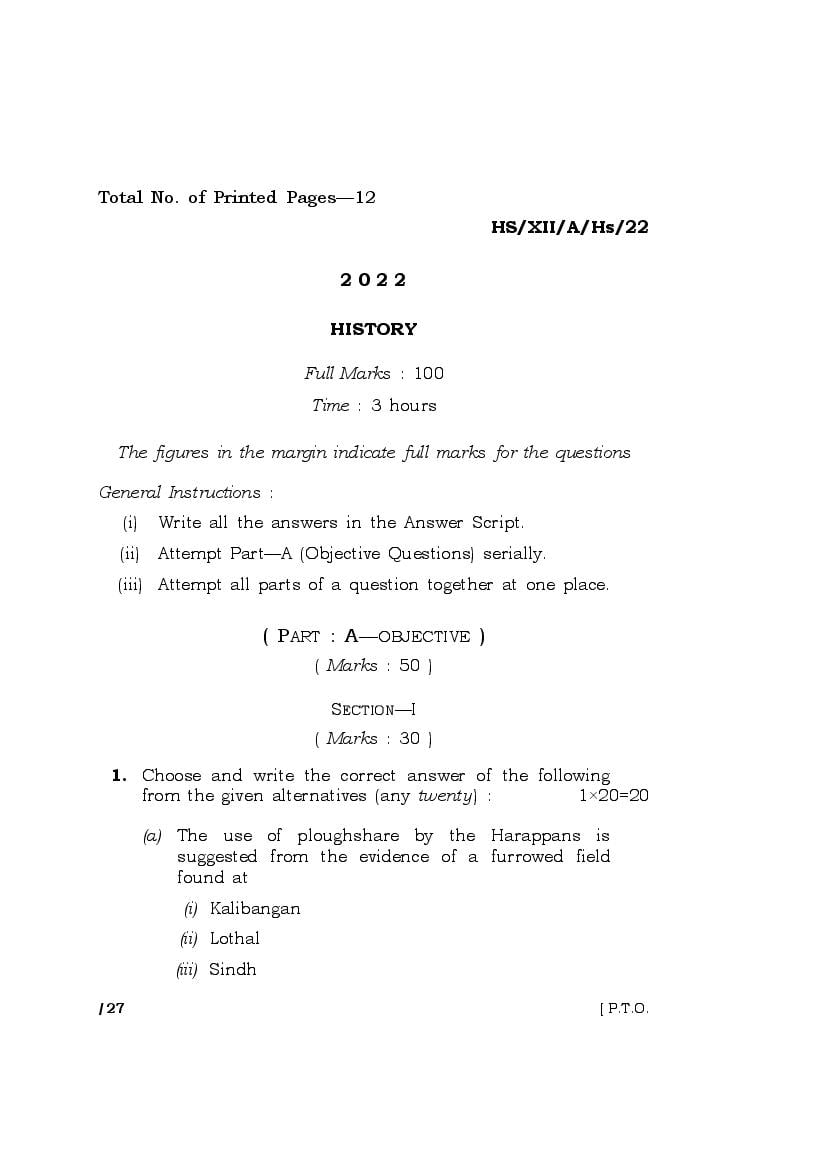
HS/XII/A/Hs/22
2022
HISTORY
Full Marks : 100
Time : 3 hours
The figures in the margin indicate full marks for the questions
General Instructions :
(i) Write all the answers in the Answer Script.
(ii) Attempt Part—A (Objective Questions) serially.
(iii) Attempt all parts of a question together at one place.
( PART : A—OBJECTIVE )
( Marks : 50 )
SECTION—I
( Marks : 30 )
1. Choose and write the correct answer of the following
from the given alternatives (any twenty ) : 1×20=20
(a) The use of ploughshare by the Harappans is
suggested from the evidence of a furrowed field
found at
(i) Kalibangan
(ii) Lothal
(iii) Sindh
/27 [ P.T.O.
Page 2
(b) The most unique feature of the Harappan
Civilization is
(i) art of government
(ii) city planning
(iii) religion
(c) The Mauryan Empire lasted about
(i) 150 years
(ii) 250 years
(iii) 350 years
(d) The ‘Jatakas’ were written in
(i) Prakrit
(ii) Pali
(iii) Sanskrit
(e) Rigveda was composed in the
(i) Deccan valley
(ii) Gangetic valley
(iii) Sapta-Sindhu valley
HS/XII/A/Hs/22/27 [ Contd.
Page 3
(f) The ‘family’ is the English version of the Sanskrit
term
(i) Vamsa
(ii) Kula
(iii) Jati
(g) The practice of erecting Stupas was associated with
(i) Buddhism
(ii) Jainism
(iii) Hinduism
(h) South Indian architecture is mainly the
(i) temple architecture
(ii) domestic building architecture
(iii) palace architecture
(i) The earliest examples of temples in the Dravidian
style belong to the
(i) Pallava period
(ii) Chalukya period
(iii) Chola period
HS/XII/A/Hs/22/27 [ P.T.O.
Page 4
(j) The third book of the Ain-i-Akbari which covers the
fiscal side of Akbar’s empire was
(i) Manzil–abadi
(ii) Sipah–abadi
(iii) Mulk–abadi
(k) What is the meaning of Sulh-Kul?
(i) Absolute peace
(ii) Divine guidance
(iii) Peace
(l) The Nayanars were the saints devoted to
(i) Vishnu
(ii) Shiva
(iii) Krishna
(m) The Khalsa Panth or ‘the army of the pure’ was
founded by
(i) Guru Nanak
(ii) Guru Govind Singh
(iii) Guru Arjan Singh
HS/XII/A/Hs/22/27 [ Contd.
Page 5
(n) Rihla was an account of the famous travels of
(i) Al-Biruni
(ii) Francois Bernier
(iii) Ibn Battuta
(o) To Bernier, Indian towns appeared to be as
(i) big towns
(ii) camp towns
(iii) small towns
(p) The rule of the East India Company was started from
(i) Assam
(ii) Avadh
(iii) Bengal
(q) For the British, the ‘Black’ areas symbolized
(i) filth and disease
(ii) cleanliness and hygiene
(iii) cholera and plague
HS/XII/A/Hs/22/27 [ P.T.O.
Page 6
(r) Kolkata served as the Capital of India during the
British Raj untill
(i) 1911
(ii) 1912
(iii) 1913
(s) Which part of Assam was annexed by the British
in 1828?
(i) Upper Assam
(ii) Central Assam
(iii) Lower Assam
(t) One of the important gifts that Assam received from
the British colonialism was
(i) tea plantation
(ii) coffee plantation
(iii) jute plantation
(u) The chief organizer of the Revolt in Bihar was
(i) Nana Sahib
(ii) Kunwar Singh
(iii) Mangal Pandey
HS/XII/A/Hs/22/27 [ Contd.
Page 7
(v) The ‘Grand Old Man of India’ was
(i) Bal Gangadhar Tilak
(ii) Dadabhai Naoroji
(iii) Surendranath Banerjee
(w) Gandhiji’s first experiment on Indian soil in
Satyagraha came in 1917 in
(i) Gujarat
(ii) Champaran
(iii) Ahmedabad
(x) Who was the President of the Constituent Assembly?
(i) Jawaharlal Nehru
(ii) Dr. B. R. Ambedkar
(iii) Dr. Rajendra Prasad
(y) The Government of India Act, 1935 proposed to
create
(i) separate electorate to Muslims
(ii) bicameral federal legislature
(iii) three-tier confederation
HS/XII/A/Hs/22/27 [ P.T.O.
Page 8
2. Write whether the following statements are True or False
(any ten ) : 1×10=10
(a) The traces of canals have been found at the
Harappan site of Shortughal (Afghanistan).
(b) The Mauryan Empire had four prominent
administrative units.
(c) The Vedas are a large corpus of texts originating in
medieval India.
(d) Buddha attained enlightenment at Bodh Gaya.
(e) Aihole was the cradle of ancient temple architecture.
(f) The term ‘Khud-Kashta’ refers to peasants who were
non-residents of the village.
(g) The Baburnama was translated from Turkish into
the Persian.
(h) Adi Granth is the sacred book of the Rajputs.
(i) All accounts of foreign travellers are alike.
(j) In 1790, the East India Company introduced a
ten-year (decennial) settlement to the Zamindars.
HS/XII/A/Hs/22/27 [ Contd.
Page 9
(k) Fort St. George emerged as the nucleus of the White
town.
(l) The word Meghalaya literally means the ‘abode of
the clouds’ in Sanskrit.
(m) Nawab Wajid Ali Shah was exiled to Bombay.
(n) The Lahore Session of the Congress passed a
Resolution declaring Poorna Swaraj.
(o) Mahatma Gandhi and Jawaharlal Nehru continued
to firmly oppose the idea of Partition.
SECTION—II
( Marks : 20 )
3. Answer any ten questions in 2 or 3 sentences each :
2×10=20
(a) Mention the major sites of the Harappan Civilization.
(b) Who were the Kushanas?
(c) What were the aims of the Puranas?
(d) Why were Stupas built?
HS/XII/A/Hs/22/27 [ P.T.O.
Page 10
(e) What are the three styles of temple architecture?
(f) What was the Jati Panchayat?
(g) What is a chronicle?
(h) What are ‘great’ and ‘little’ traditions?
(i) What were the two postal systems identified by
Ibn Battuta?
(j) Who were the Jotedars?
(k) Give two reasons for the establishment of early hill
stations.
(l) Why did the people not favour women education in
Assam?
(m) Who was Bakht Khan?
(n) What was the Jallianwala Bagh Massacre?
(o) Specify the ideals that Pandit Nehru presented in the
Objective Resolution.
HS/XII/A/Hs/22/27 [ Contd.
Page 11
( PART : B—DESCRIPTIVE )
( Marks : 50 )
4. Answer Question No. ( j) and any three from the rest :
(a) Explain the causes that led to the decline and end
of the Harappan Civilization. 12
(b) What are Inscriptions? Describe the limitations of
inscriptional evidence. 2+10=12
(c) Describe the Pallava style of architecture. 12
(d) Explain the role of women in the medieval agrarian
society. 12
(e) Who was the author of the Akbarnama? How did the
Akbarnama describe the history of Akbar’s reign?
2+10=12
(f) How did the Santhals reach Rajmahal Hills? What
led to the Santhal Uprising? 6+6=12
(g) Describe the emergence of new social group in
Assam. 12
HS/XII/A/Hs/22/27 [ P.T.O.
Page 12
(h) What were the steps taken by the British to
suppress the Revolt of 1857? 12
(i) Write an essay on the Civil Disobedience Movement. 12
(j) Write short notes on any two of the following : 7×2=14
(i) Chandalas
(ii) Main teachings of Mahavira
(iii) Kabir
(iv) Al-Biruni’s description of India
(v) Shillong—A hill station in the East
(vi) Swadeshi Movement
(vii) The Cabinet Mission (1946)
HS/XII/A/Hs/22/27 22K—16880
Document Details
| Board / Org | Meghalaya Board |
| Exam | Class 12 |
| Type | Question Paper |
| Pages | 12 |
| Updated | 22 Jul 2026 |