WB SET 2018 Question Paper 2 Earth Atmospheric Ocean and Planetary Sciences
Finished viewing? Save it for later —
Download WB SET 2018 Question Paper 2 Earth Atmospheric Ocean and Planetary Sciences (PDF · 16 pages)About WB SET 2018 Question Paper 2 Earth Atmospheric Ocean and Planetary Sciences
WB SET 2018 Question Paper 2 Earth Atmospheric Ocean and Planetary Sciences is available here for free download. Published by Default for Govt Jobs Exams, this question paper can be viewed online or downloaded as a PDF (16 pages). Candidates preparing for Govt Jobs Exams can use WB SET 2018 Question Paper 2 Earth Atmospheric Ocean and Planetary Sciences to understand the exam pattern, the type of questions asked, and the overall difficulty level.
Frequently Asked Questions
How can I download WB SET 2018 Question Paper 2 Earth Atmospheric Ocean and Planetary Sciences?
Open this page and click the Download button to save WB SET 2018 Question Paper 2 Earth Atmospheric Ocean and Planetary Sciences as a PDF. It is completely free on AglaSem Docs.
Is WB SET 2018 Question Paper 2 Earth Atmospheric Ocean and Planetary Sciences free to download?
Yes. WB SET 2018 Question Paper 2 Earth Atmospheric Ocean and Planetary Sciences can be viewed online and downloaded as a PDF free of cost on AglaSem Docs.
How many pages does WB SET 2018 Question Paper 2 Earth Atmospheric Ocean and Planetary Sciences have?
WB SET 2018 Question Paper 2 Earth Atmospheric Ocean and Planetary Sciences contains 16 pages, which you can read online or download together as a single PDF.
Where can I find more Govt Jobs Exams study material?
You can find more Govt Jobs Exams question papers, sample papers, syllabus, and answer keys on AglaSem Docs.
WB SET 2018 Question Paper 2 Earth Atmospheric Ocean and Planetary Sciences – Text
Read the full text of this question paper below — useful to quickly search, copy and reference the content online without downloading the PDF.
📄 View text version (15 pages)
Page 1
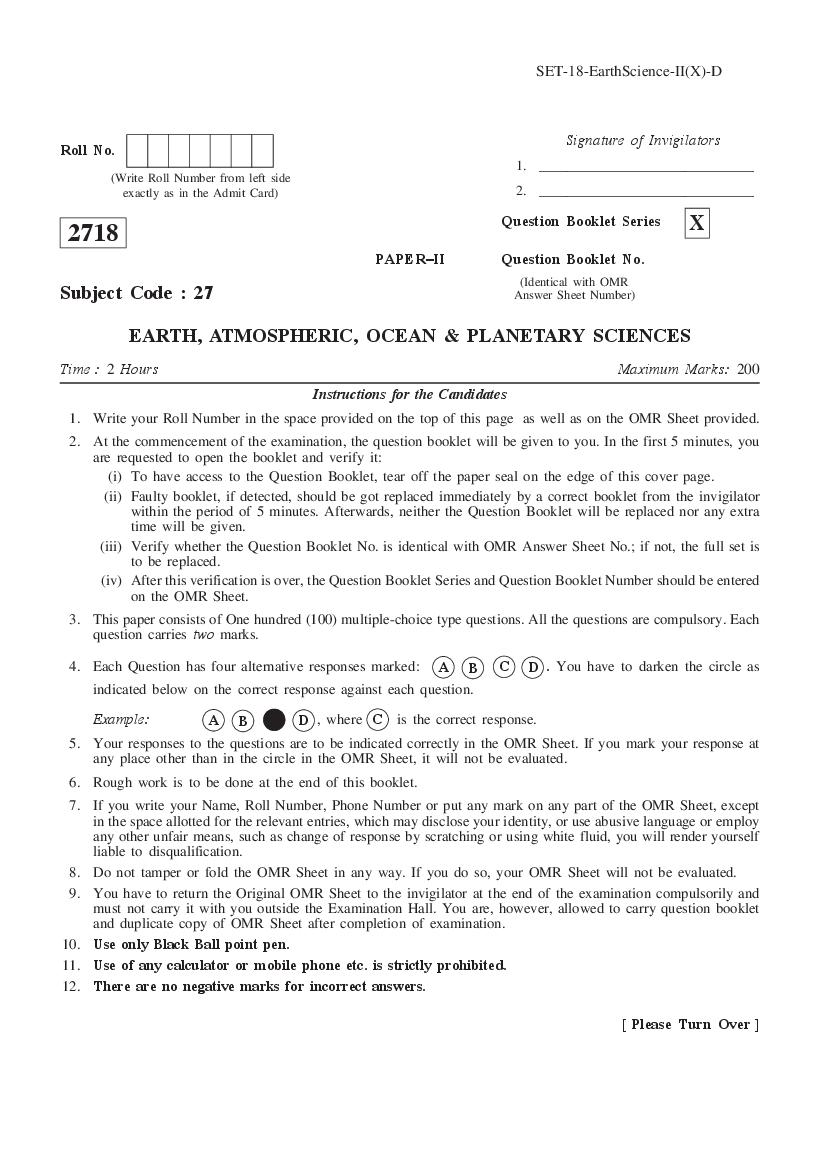
Signature of Invigilators
Roll No.
1. _______________________________
(Write Roll Number from left side
exactly as in the Admit Card) 2. _______________________________
Question Booklet Series X
2718
PAPER–II Question Booklet No.
(Identical with OMR
Subject Code : 27 Answer Sheet Number)
EARTH, ATMOSPHERIC, OCEAN & PLANETARY SCIENCES
Time : 2 Hours Maximum Marks: 200
Instructions for the Candidates
1. Write your Roll Number in the space provided on the top of this page as well as on the OMR Sheet provided.
2. At the commencement of the examination, the question booklet will be given to you. In the first 5 minutes, you
are requested to open the booklet and verify it:
(i) To have access to the Question Booklet, tear off the paper seal on the edge of this cover page.
(ii) Faulty booklet, if detected, should be got replaced immediately by a correct booklet from the invigilator
within the period of 5 minutes. Afterwards, neither the Question Booklet will be replaced nor any extra
time will be given.
(iii) Verify whether the Question Booklet No. is identical with OMR Answer Sheet No.; if not, the full set is
to be replaced.
(iv) After this verification is over, the Question Booklet Series and Question Booklet Number should be entered
on the OMR Sheet.
3. This paper consists of One hundred (100) multiple-choice type questions. All the questions are compulsory. Each
question carries two marks.
4. Each Question has four alternative responses marked: A B C D . You have to darken the circle as
indicated below on the correct response against each question.
Example: A B C D , where C is the correct response.
5. Your responses to the questions are to be indicated correctly in the OMR Sheet. If you mark your response at
any place other than in the circle in the OMR Sheet, it will not be evaluated.
6. Rough work is to be done at the end of this booklet.
7. If you write your Name, Roll Number, Phone Number or put any mark on any part of the OMR Sheet, except
in the space allotted for the relevant entries, which may disclose your identity, or use abusive language or employ
any other unfair means, such as change of response by scratching or using white fluid, you will render yourself
liable to disqualification.
8. Do not tamper or fold the OMR Sheet in any way. If you do so, your OMR Sheet will not be evaluated.
9. You have to return the Original OMR Sheet to the invigilator at the end of the examination compulsorily and
must not carry it with you outside the Examination Hall. You are, however, allowed to carry question booklet
and duplicate copy of OMR Sheet after completion of examination.
10. Use only Black Ball point pen.
11. Use of any calculator or mobile phone etc. is strictly prohibited.
12. There are no negative marks for incorrect answers.
[ Please Turn Over ]
Page 3
EARTH, ATMOSPHERIC, OCEAN & PLANETARY SCIENCES
PAPER II
1. One student is going to date representative samples 5. Angular sand of 1 to 0·5 mm diameter is known
of amphibolites of older Metamorphic Group (OMG) of as
Singhbhum. For getting the proper age-data, he should (A) cobble
go for (B) pebble
(A) K-Ar method (C) grit
(B) Rb-Sr method (D) coarse sand
(C) C14 method
(D) Sm-Nd method
6. Nepheline is an example of
2. A sandstone sequence is consisting of erosional- (A) Complete solid solution
based, fining-upward individual units that (B) Eutectic crystallization
characteristically contain large-sized cross-beds in the (C) Incongruent melting
lower part, and small-sized cross-beds in the upper part. (D) Omission solid solution
The sequence shows unidirectional palaeocurrent with
low variance. The sequence indicates a ________.
(A) fluvial palaeoenvironment
(B) lacustrine palaeoenvironment 7. Polycrystalline quartz grains with sutured and
(C) tidal flat palaeoenvironment stretched internal crystals in a sandstone are indicative of
(D) deltaic palaeoenvironment (A) an acid igneous provenance.
(B) a basic igneous provenance.
(C) a metamorphic provenance.
3. Which of the following statements about (D) a sedimentary provenance.
palaeomagnetism at spreading ridges is TRUE?
(A) There is no clear palaeomagnetic signal in
rocks at spreading ridges.
(B) Rocks along spreading ridges show the same 8. Energy derived from the heat flow rising out of
palaeomagnetic north direction, no matter the Earth is called
how old they are. (A) hydroelectric energy
(C) The palaeomagnetic pattern on one side of a (B) hydrothermal energy
ridge is the mirror image of the pattern on (C) geothermal energy
the other side of the ridge. (D) radioactive energy
(D) There is evidence that Earth’s magnetic poles
reverse every 11 years or so.
9. A body of strata in which maximum abundance
4. East coast bauxite covers the states of of a particular species is found is called
(A) Andhra Pradesh and Odisha. (A) assemblage zone
(B) Andhra Pradesh and Tamil Nadu. (B) range zone
(C) Odisha and Tamil Nadu. (C) acme zone
(D) Andhra Pradesh, Tamil Nadu and Kerala. (D) interval zone
Page 4
10. In a silicate phase diagram, the boundary between 15. A tectonically deformed rock having dominant
one-solid and two-solid fields is known as linear fabric and indicating constrictional type strain is
(A) eutectic known as the ________.
(B) liquidus (A) Pseudo tachylite
(C) solvus (B) Boudin
(D) solidus (C) L-tectonite
(D) S-tectonite
11. Which of the following occurs when two air
masses of sharply contrasting densities collide? 16. The most viable source of energy in mankind’s
(A) Temperate cyclone future, which involves utilizing fission is
(B) Tropical cyclone (A) geothermal energy
(C) Tropical convergence (B) solar energy
(D) Trade winds (C) fossil fuel energy
(D) nuclear energy
12. Most of the beach sands are derived from
(A) sands carried by river 17. Sandstone comprising 55% quartz, 30% feldspar,
(B) sands blown by wind 10% rock fragments and 5% cement is known as
(C) erosion of sea cliffs (A) quartz arenite
(D) debris flow along the shore (B) arkose
(C) grit
(D) graywacke
13. Which of the following forms of harnessing
energy does not involve driving a turbine?
(A) Nuclear power stations 18. Which among the following rocks has the highest
(B) Hydroelectric power plants density?
(C) Photovoltaic power technology (A) Peridotite
(D) Geothermal power stations (B) Basalt
(C) Granite
(D) Andesite
14. Oscillatory zoning in plagioclase may be best
explained by
(A) diminishing PH O condition in the magma. 19. Achondrites are
2
(A) Stony meteorites
(B) rising PH O condition in the magma.
2 (B) Stony-Iron meteorites
(C) fluctuating PH O condition in the magma. (C) Iron meteorite
2
(D) liquid immiscibility. (D) Glassy meteorite
Page 5
20. If a hole is dug into a confined aquifer, the water 25. It is generally believed the main driving force for
will rise up to the level of plate tectonics is
(A) aquiclude (A) tidal forces between the Earth, Sun and
(B) water table Moon.
(C) perched water table (B) lavas pushing through the crust at mid-ocean
(D) artesian pressure surface ridges.
(C) shrinking of the Earth as it cools.
(D) convection in the mantle.
21. Subduction at an ocean-ocean convergent plate
boundary results in the development of a line of volcanic
islands called an (1) ________ made up of (2)________ 26. Which of the following sentences is not true
volcanic rocks. regarding the oceans?
(A) (1) archipelago; (2) limestone (A) The floor of Atlantic Ocean is dominated by
(B) (1) atoll; (2) andesite siliceous oozes.
(C) (1) island arc; (2) andesite (B) The floor of Pacific Ocean is dominated by
(D) (1) island arc; (2) basalt siliceous oozes.
(C) Carbonate Compensation Depth (CCD) in
the Atlantic Ocean is deeper than that in the
Pacific Ocean.
22. The temperature of the core of the earth is
(D) There could be ‘lakes’ and/or ‘rivers’ of
estimated to be about ________.
denser water in the deeper parts of the oceans.
(A) 3000ºC
(B) 6000ºC
(C) 9000ºC
27. Formation of Layered Igneous complexes are
(D) 12000ºC
favoured at
(A) active fault zone
(B) subduction zone
23. For silicate structure that involves sharing of one (C) shear zone
oxygen atom by two adjacent tetrahedra is known as
(D) tectonically quiscent condition
(A) Phyllosilicate
(B) Nesosilicate
(C) Sorosilicate
28. Which of the following statements is not true
(D) Tectosilicate
regarding the continental shelves?
(A) Continental shelves are oceanward
extensions of the continental crust.
24. The Siwalik Group forms larger part of the (B) Continental shelves are landward extensions
sub-Himalayan terrane. Its sediments are mainly of the oceanic crust.
deposited by ________.
(C) Passive continental margins generally have
(A) fluvial processes wider shelves than the active continental
(B) glacial processes margins.
(C) shallow marine processes (D) The widest continental shelve lies north of
(D) deep marine processes Siberia, in Arctic ocean.
Page 6
29. Which one of the following statements is correct 33. For trace element, mineral-melt distribution
regarding the GPS satellites? co-efficient (Kd) should be expressed as
(A) The normal altitude is about 20,200 km. Concentration of the trace element in the mineral (ppm)
(A) Concentrationof the trace element in the liquid (ppm) .
(B) The inclination of axis satellite is 55º.
(C) The satellites transmit two L band signals (B) Concentration of the trace element (ppm) in
(L1 with 1575·42 MHz and L2 with melt + that of liquid.
1276·6 MHz). Concentration of the trace element in the melt (ppm)
(C) Concentrationof the trace element in the chondrite (ppm) .
(D) All of the above
(D) Concentration of the trace element (ppm) in
the melt × 100.
34. Which of the following types of waves are
30. You are examining a thin section of unstrained characteristically found in deeper parts of seas/oceans?
quartz (between crossed polars) with the help of a (A) Oscillatory waves
microscope. During 360º stage rotation, the quartz grain (B) Translatory waves
will show extinction for
(C) Littoral waves
(A) only once
(D) Lateral waves
(B) four times
(C) twice 35. When seismic waves from an earthquake reach
(D) thrice the boundary between the mantle and the liquid outer
core
(A) all of the body waves get refracted.
(B) all of the body waves get reflected, but none
are refracted.
31. In ferromagnetic metals, the atoms occupy lattice (C) all P-waves stop because they are unable to
positions that are close enough to allow the exchange of move through the outer core.
electrons between neighbouring atoms. The exchange
(D) all S-waves vanish because they cannot move
interaction produces a very strong molecular field within
through a liquid.
the metal, which aligns the atomic magnetic moments
in ________. 36. You are planning for construction of a dam and
(A) exactly parallel directions for that you are required to know sub-surface data. For
(B) exactly antiparallel directions this purpose you will go for following geophysical
(C) slightly inclined parallel directions method.
(D) slightly inclined antiparallel directions (A) Self-potential method
(B) Gravity method
(C) Seismic Reflection method
(D) Seismic Refraction method
32. The type of landslide that involves slow sliding 37. Typhoons cause heavy rains over continents
of sediment above a concave slip surface is called as well as oceans. They develop and mature ________
(A) a slump (A) inside the deeper oceans only.
(B) a rock slide (B) just near the surface of open oceans only.
(C) a mud flow (C) over the oceans only.
(D) a debris avalanche (D) over the continents only.
Page 7
38. What is the typical depth of the epicenter of an 43. Regions that are underlain by limestone rocks are
earthquake? prone to the development of ________ as a result of
(A) A few km. dissolution by ground water.
(B) Up to 700 km. (A) artesian wells
(C) The same depth as the focus (B) sinkholes
(D) Zero (at the surface) (C) swamps
(D) marble
39. Presence of the element Se in the Gossan zone
indicates
(A) Auriferous vein
44. As per the Köppen classification of climates,
(B) Auriferous lode
Kolkata has ________.
(C) Sulphides of epigenetic origin
(A) Af climate
(D) Presence of water bodies in the sub-surface
(B) Aw climate
(C) Am climate
40. Of the following major river systems of the
peninsular India, which one has the maximum drainage (D) Bw climate
basin area?
(A) Mahanadi
(B) Godavari 45. In a glacial landscape, which of the following is
(C) Cauvery not an erosional landform?
(D) Krishna (A) Drumlin
(B) Roché Moutonnée
41. A well dug into an unconfined aquifer will (C) Arête
(A) dry up during the dry season. (D) Cirque
(B) develop a cone of depression around the
well.
(C) immediately develop into an artesian well.
46. The Earth has a magnetic field because
(D) fill up with water to the level of the water
(A) magnetic minerals are common at
table.
temperatures above the Curie point.
(B) it has a magnetic iron-nickel core.
42. Which of the following statements is true
(C) the liquid outer core creates an electric current
regarding the heatwaves? which induces a magnetic field.
(A) It is defined as a period of abnormally and (D) All of the above
uncomfortably hot and usually humid
weather.
(B) It is a long period of time when unusually 47. The altitudinal distance of a geostationary satellite
fast and abnormally hot winds flow. from the earth is about
(C) It is a long period of abnormally hot and (A) 26,000 km
extremely dry weather. (B) 30,000 km
(D) Heatwaves occur only between 45ºN and (C) 36,000 km
45ºS latitudes. (D) 44,000 km
Page 8
48. The GPS space segment consists of Navigation 53. Most faults in the Himalaya are
Satellite Timing and Ranging whose number is (A) transform
(A) 8 (B) normal
(B) 12 (C) strike-slip
(C) 16 (D) thrust
(D) 24
49. Which of the following is an accurate definition
of the term tsunami? 54. In a neutrally stable atmosphere, the lapse rate is
(A) It is a type of earthquake that occurs under (A) more than dry adiabatic.
the ocean. (B) between dry and moist adiabatic.
(B) It is a type of seismic wave that causes a lot (C) negative.
of damage to tall buildings. (D) equal to dry adiabatic.
(C) It is a water wave generated in the ocean as
a result of an earthquake.
(D) It is an ancient Japanese method of studying 55. Epirogenic activity is related to
earthquakes.
(A) horizontal movement.
(B) large scale strike-slip fault.
50. The mineral stibnite is an example of
(C) vertical movement.
(A) Sulphate
(D) movement which was initially horizontal
(B) Sulphide
then became inclined.
(C) Oxide
(D) Silicate
51. Which of the following is the warm oceanic 56. Which of the following coast has a subduction
current of the ‘Pacific ocean’? zone?
(A) Kuroshio current (A) East African Coast
(B) California current (B) West African Coast
(C) Peru current (C) East-South American Coast
(D) Oyashio current (D) West-South American Coast
52. Which of the following statements about mineral
is incorrect?
(A) Vitreous, resinous and greasy are all types of 57. The earthquake scale that measures energy release
luster. by considering the physical characteristics of motion
(B) Crystal faces and cleavage planes are the along the fault, such as amount of fault slip and the size
same thing. of the fault that ruptured, is called the
(C) Minerals with no cleavage break with a (A) Richter scale
conchoidal fracture. (B) moment magnitude scale
(D) Mineral hardness is controlled by the strength (C) modified Mercalli scale
of the atomic bonds. (D) intensity scale
Page 9
58. What is the name of the geological process for 62. Read carefully the following three statements
the following chemical reaction? regarding the Ekman spiral:
Mg+2 + 2CaCO3 CaMg(CO3 )2 + Ca +2 1. It is generated by winds.
2. It conceptualizes horizontal movements of
(A) Lithification water in a layered water column.
(B) Recrystallization 3. It explains that water in some parts of seas/
(C) Cementation oceans spirals downward to generate
(D) Dolomitization whirlpool motion.
Which of these statements is correct?
(A) Only 1 is correct
(B) Only 1 is incorrect
(C) Only 3 is incorrect
59. The depth zones of the ocean from land mass to (D) All, 1, 2 and 3, are correct
open sea are
(A) abyssal– bathyal– neritic – littoral 63. The only two places on earth that have continental
(B) neritic –bathyal– abyssal– littoral glaciers today are
(C) neritic –bathyal– littoral– abyssal (A) the north pole and the south pole.
(D) littoral– neritic –bathyal– abyssal (B) Greenland and Ice land.
(C) Alaska and Antarctica.
(D) Antarctica and Greenland.
64. Bauxite is mainly formed by
60. During magmatic crystallization, the early formed (A) Residual concentration process.
plagioclase is calcic (rather than sodic) because (B) Mechanical concentration process.
(A) Na cation prefers assimilation. (C) Magmatic concentration process.
(B) Ca cation prefers assimilation. (D) Supergene enrichment process.
(C) Ca cation is bigger than Na cation.
65. Heavy mineral indicolite suggests the existence
(D) Ca cation has greater charge than Na cation. of
(A) acid pegmatite in provenance.
(B) basic igneous rock in provenance.
(C) low-rank metamorphic rock in provenance.
(D) high-rank metamorphic rock in provenance.
61. The grain size of constituent minerals of pegmatite
are very coarse; this is because of
66. Which of the following statements is not true
(A) Volatile–controlled prolonged crystallization. regarding the gyres?
(B) Liquid immiscibility controlled (A) These are caused by the Coriolis Effect of
crystallization. the earth’s rotation.
(C) Quenching of magma due to very fast (B) There are five major ocean-wide gyres in
crystallization. the world.
(D) Liquid immiscibility controlled (C) The most powerful gyre occurs at the equator.
crystallization followed by assimilation. (D) These influence the climate of continents.
Page 10
67. Which of the following Himalayan faults/thrusts 72. RADAR Interferometry can be used to ______.
is seismically the most active? (A) infer focal depth of an earthquake
(A) Himalayan Frontal Fault/Thrust (B) measure crustal deformation caused by an
(B) Main Boundary Thrust earthquake
(C) Main Central Thrust (C) estimate energy released by an earthquake
(D) South Tibetan Detachment (D) predict recurrence period of an earthquake
68. Choose the correct statement about troposphere.
(A) The thickness of the troposphere is the 73. Kennelly–Heaviside layers in the atmosphere
greatest at the equator. refer to
(B) It is densest of all the layers. (A) ozonosphere
(B) troposphere
(C) It is responsible for creating the climatic and
weather conditions on the earth’s surface. (C) mesosphere
(D) All of the above (D) ionosphere
69. The Mn nodules in the deep sea are formed
74. Which mineral of the following is having variable
due to
hardness?
(A) organic reactions of the deep sea sediments.
(A) Graphite
(B) inorganic reactions of the deep sea
(B) Magnesite
sediments.
(C) Kyanite
(C) inorganic and organic both reactions of the
deep sea sediments. (D) Quartz
(D) transportation of the rivers and stream
sediments.
75. Solar rays penetrate in the ocean water up to a
depth of
70. Thickening and thinning of beds at crests and
troughs are seen in (A) 20 m
(A) open fold (B) 100 m
(B) similar fold (C) 200 m
(C) parallel fold (D) 400 m
(D) concentric fold
76. In the following list, the granulite belt is
71. Following area is famous for copper deposit: represented by
(A) Malanjkhand (A) Eastern Ghats
(B) Kolar (B) Dalma
(C) Sukinda (C) Dhanjori
(D) Jadugoda (D) Cuddapah
Page 11
77. Which of the following landform exemplifies 82. Piggy-back basins form on ________.
the ‘sudden modification’ in a fluvial landscape (A) hanging wall of normal faults
evolution?
(B) footwall of normal faults
(A) A long stretch of palaeochannel.
(C) hanging wall of reverse faults
(B) A perfect oxbow lake adjoining a
(D) footwall of reverse faults
meandering channel.
(C) A crevasse splay.
(D) A submerged channel bar.
83. In a stress-strain binary diagram where the
ordinate represents the increasing stress and the abscissa
78. The clouds of gas and volcanic ash are known as represents the increasing strain, a line almost parallel to
(A) nuée ardent the abscissa is characteristic of
(B) col (A) plastic material
(C) bergschrund (B) brittle material
(D) None of the above (C) elastoplastic material
(D) ductile material
79. Amorphous variety of magnesite is found in
(A) Salem Distt., Tamil Nadu
(B) Pithoragarh, Uttarakhand 84. Gondite rocks in India are associated with the
(C) Almora, Uttarakhand deposit of
(D) Keonjhor, Odisha (A) Iron
(B) Manganese
(C) Pb-Zn
80. When the isobars are circular or elliptical in
shape and the pressure is lowest at the centre, the system (D) Magnesite
is called
(A) cyclone
(B) anticyclone 85. The total annual insolation is greatest at
(C) doldrum (A) equator
(D) monsoon trough (B) tropic of cancer
(C) tropic of capricorn
81. The concept of isostasy can be regarded as (D) arctic circle
(A) Floating equilibrium amongst different
crustal blocks.
(B) Intense disequilibrium amongst different
86. ‘Norm’ in an igneous rock refers to
crustal blocks.
(A) theoretically possible minerals.
(C) Faulting and folding between adjacent
crustal blocks. (B) actually existing minerals.
(D) Shearing movement involving the most (C) chemical composition of the rock.
dense unit of the crustal block. (D) density of the rock.
Page 12
87. Which planet is nearest to the Earth? 92. Ground-penetrating Radar is a powerful
(A) Mercury instrument used for near-surface geophysical
exploration. It produces images through reflections of
(B) Venus
targetted electromagnetic energy having frequencies in
(C) Mars the range of
(D) Jupiter (A) 1 MHz to 100 MHz
(B) 100 MHz to 1 GHz
(C) 1 GHz to 10 GHz
88. Width of outcrop of a bed on the ground depends (D) 10 GHz to 100 GHz
upon
93. Which instrument is used to measure the wind
(A) thickness of the bed.
velocity?
(B) dip of the bed.
(A) Photometer
(C) slope of the ground.
(B) Barometer
(D) All of the above (C) Anemometer
(D) Lysimeter
94. What are the essential properties should be present
89. What happens when fresh water from an in a mineral for the formation of placer deposit?
underground source oozes out into a sea/ocean?
(A) High specific gravity, durability and
(A) It ‘floats’ on the sea/ocean water. chemically resistant.
(B) It ‘sinks’ down the sea/ocean water. (B) Low specific gravity, durability and
(C) It immediately mixes with the sea/ocean chemically resistant.
water and thus no issue of ‘floating’ or (C) Low specific gravity, friable and
‘sinking’ arises. chemically resistant.
(D) It cannot at all ooze out into sea/ocean. (D) High specific gravity, durability and
chemically very reactive.
95. The Poisson’s ratio is the ratio of
90. Brazilian test is used to determine (A) lateral strain to longitudinal strain.
(A) crushing strength
(B) tangential stress to shearing strain.
(B) shear strength
(C) confining stress to lateral strain.
(C) tensile strength (D) stress to strain.
(D) transverse strength
96. In the Diopside–Albite–Anorthite system (1 atm
dry), along the cotectic line
(A) only Diopside is crystallizing.
91. Leucite is an example of
(B) Plagioclase and Diopside both show
(A) Feldspathoid exsolution.
(B) Feldspar (C) Plagioclase and Diopside crystallize together.
(C) Pyroxene (D) Diopside and Plagioclase react with each
(D) Olivine other.
Page 13
97. The correct ascending order of the atmospheric 99. As compared to clay, fine grained sandstone
layers, from the earth, is has
(A) troposphere, stratosphere, mesosphere, (A) lower porosity and higher permeability.
thermosphere, exosphere.
(B) higher porosity and higher permeability.
(B) stratosphere, troposphere, mesosphere,
thermosphere, exosphere. (C) lower porosity and lower permeability.
(C) troposphere, thermosphere, stratosphere, (D) higher porosity and lower permeability.
mesosphere, exosphere.
(D) thermosphere, troposphere, mesosphere,
stratosphere, exosphere.
100. The largest single contributor to the planetary
98. In calcite the refractive index for the ordinary ray albedo of the Earth is
is (1) _______ and for extraordinary ray is (2) ______.
(A) clouds
(A) (1) 1·52 (2) 1·69
(B) (1) 1·66 (2) 1·89 (B) snow
(C) (1) 1·66 (2) 1·49 (C) oceans
(D) (1) 1·72 (2) 1·98 (D) volcanic dust
Page 14
ROUGH WORK
Page 15
ROUGH WORK
Page 16
ROUGH WORK
Document Details
| Board / Org | Default |
| Exam | Govt Jobs Exams |
| Type | Question Paper |
| Pages | 16 |
| Updated | 30 Apr 2026 |