WB SET 2018 Question Paper 2 Law
Finished viewing? Save it for later —
Download WB SET 2018 Question Paper 2 Law (PDF · 20 pages)About WB SET 2018 Question Paper 2 Law
WB SET 2018 Question Paper 2 Law is available here for free download. Published by Default for Govt Jobs Exams, this question paper can be viewed online or downloaded as a PDF (20 pages). Candidates preparing for Govt Jobs Exams can use WB SET 2018 Question Paper 2 Law to understand the exam pattern, the type of questions asked, and the overall difficulty level.
Frequently Asked Questions
How can I download WB SET 2018 Question Paper 2 Law?
Open this page and click the Download button to save WB SET 2018 Question Paper 2 Law as a PDF. It is completely free on AglaSem Docs.
Is WB SET 2018 Question Paper 2 Law free to download?
Yes. WB SET 2018 Question Paper 2 Law can be viewed online and downloaded as a PDF free of cost on AglaSem Docs.
How many pages does WB SET 2018 Question Paper 2 Law have?
WB SET 2018 Question Paper 2 Law contains 20 pages, which you can read online or download together as a single PDF.
Where can I find more Govt Jobs Exams study material?
You can find more Govt Jobs Exams question papers, sample papers, syllabus, and answer keys on AglaSem Docs.
WB SET 2018 Question Paper 2 Law – Text
Read the full text of this question paper below — useful to quickly search, copy and reference the content online without downloading the PDF.
📄 View text version (19 pages)
Page 1
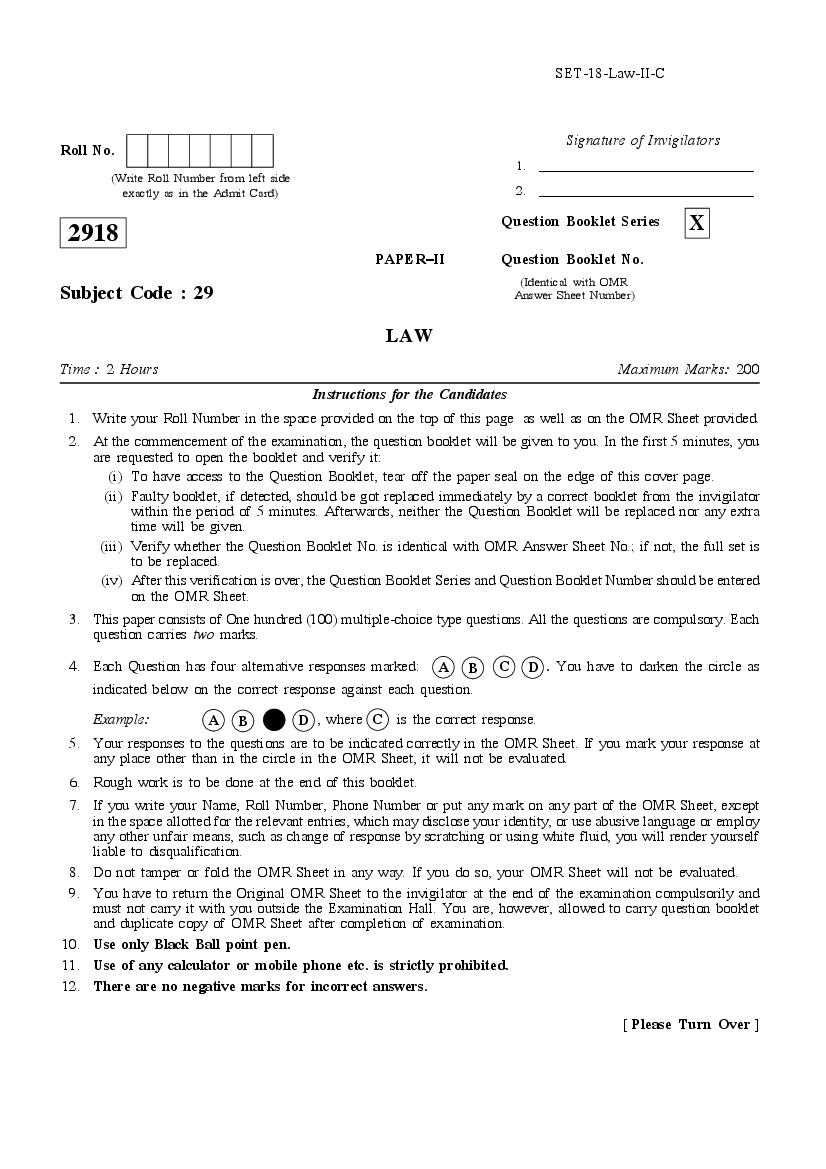
Signature of Invigilators
Roll No.
1. _______________________________
(Write Roll Number from left side
exactly as in the Admit Card) 2. _______________________________
Question Booklet Series X
2918
PAPER–II Question Booklet No.
(Identical with OMR
Subject Code : 29 Answer Sheet Number)
LAW
Time : 2 Hours Maximum Marks: 200
Instructions for the Candidates
1. Write your Roll Number in the space provided on the top of this page as well as on the OMR Sheet provided.
2. At the commencement of the examination, the question booklet will be given to you. In the first 5 minutes, you
are requested to open the booklet and verify it:
(i) To have access to the Question Booklet, tear off the paper seal on the edge of this cover page.
(ii) Faulty booklet, if detected, should be got replaced immediately by a correct booklet from the invigilator
within the period of 5 minutes. Afterwards, neither the Question Booklet will be replaced nor any extra
time will be given.
(iii) Verify whether the Question Booklet No. is identical with OMR Answer Sheet No.; if not, the full set is
to be replaced.
(iv) After this verification is over, the Question Booklet Series and Question Booklet Number should be entered
on the OMR Sheet.
3. This paper consists of One hundred (100) multiple-choice type questions. All the questions are compulsory. Each
question carries two marks.
4. Each Question has four alternative responses marked: A B C D . You have to darken the circle as
indicated below on the correct response against each question.
Example: A B C D , where C is the correct response.
5. Your responses to the questions are to be indicated correctly in the OMR Sheet. If you mark your response at
any place other than in the circle in the OMR Sheet, it will not be evaluated.
6. Rough work is to be done at the end of this booklet.
7. If you write your Name, Roll Number, Phone Number or put any mark on any part of the OMR Sheet, except
in the space allotted for the relevant entries, which may disclose your identity, or use abusive language or employ
any other unfair means, such as change of response by scratching or using white fluid, you will render yourself
liable to disqualification.
8. Do not tamper or fold the OMR Sheet in any way. If you do so, your OMR Sheet will not be evaluated.
9. You have to return the Original OMR Sheet to the invigilator at the end of the examination compulsorily and
must not carry it with you outside the Examination Hall. You are, however, allowed to carry question booklet
and duplicate copy of OMR Sheet after completion of examination.
10. Use only Black Ball point pen.
11. Use of any calculator or mobile phone etc. is strictly prohibited.
12. There are no negative marks for incorrect answers.
[ Please Turn Over ]
Page 3
LAW
PAPER II
1. The Preamble to the Constitution of India provides 4. An instrumentality or agency of the State having
operates in India
(A) Liberty of Thought, Belief, Expression,
Faith and Worship (A) is a State under Article 12 of the Constitution.
(B) is a State under Article 366 of the
(B) Liberty of Thought, Expression, Belief,
Constitution.
Faith and Worship
(C) is a State under Companies Act 2013.
(C) Liberty of Expression, Thought, Belief, (D) is a State under law of agency.
Faith and Worship
(D) Liberty of Faith, Worship, Expression,
5. According to Article 13 (3) (a) of the Constitution
Thought and Belief
of India, “law” includes
(A) Rule, Ordinance, Order, Legislation, Custom,
2. The objectives specified in the Preamble of the
Case law
Constitution of India contain the basic structure of our
(B) Rule, Regulation, Notification, Custom,
Constitution cannot be amended in exercise of the power
Usage, Supreme Court decisions
under Article 368 of the Constitution of India, held in
(C) Ordinance, Delegated law, Rule of law,
(A) Bhim Singhji v. Union of India
Regulation, Notification, Custom or usage
(B) State of Punjab v. Balbir (D) Ordinance, Order, Bye-law, Rule,
(C) Amar Singh v. State of Rajasthan Regulation, Notification, Custom or usage
(D) Masthan Sahib v. Chief Commissioner
6. India is a Sovereign because
3. According to Article I(3) of the Constitution of
(A) it contains more than 300 Articles in the
India, the territory of India shall comprise
Constitution of India.
(A) the territory of the states. (B) its Supremacy in deciding matters internal
(B) the Union territories specified in the First as well as external interest of the country.
Schedule. (C) it has promises for justice.
(C) such other territories as may be acquired. (D) it has a government for the people by the
(D) Aforementioned (A), (B) and (C) are correct people of the people.
Page 4
7. Which Articles of the Constitution of India deals 10. The Sarkaria Commission was appointed in India
with adult suffrage? for examining the Centre and State relation which
recommended
(A) Article 320 (A) adjustment in the administrative or functional
(B) Article 326 relation between the Centre and State.
(C) Article 225 (B) greater decentralisation in the decision
making and execution upto the village level.
(D) Article 226
(C) None of the above
(D) Both of them
8. In case there is a conflict between the Preamble 11. Fundamental rights under the Constitution of
and other provision of the Constitution of India: India
(A) can be claimed by citizens only.
(A) the Preamble will prevail.
(B) can be claimed by citizens as well as
(B) other provision will prevail. non-citizens.
(C) Both of the above go side by side. (C) some of them can only be claimed by the
citizen of India, but other apply equally to
(D) interpretation by the Supreme Court will
non-citizens.
prevail subject to basic structure.
(D) it is the discretion of the Supreme Court,
only case to case be applied.
9. The expression “Hindu” in Article 25 of the 12. When President is to be impeached for violation
Constitution of India include of Constitution of India, the challenge shall be preferred
by
(A) Jains
(A) Lok Sabha
(B) Sikhs (B) Rajya Sabha
(C) Buddhists (C) Either house
(D) All of the above (D) None of the above
Page 5
13. Under the Constitution of India, the directive 16. The Vice-President shall hold office for a term
principles of state policy are contained in
(A) of six years from the date of which he received
(A) Part IV, under Articles 36 - 51 the letter.
(B) Part IV, under Articles 37 - 51 (B) of five years from the date on which he
enters upon his office.
(C) Part V, under Articles 36 - 51
(C) of either (A) or (B) of the above
(D) Part V, under Articles 37 - 51
(D) None of the above
17. The President’s resignation has to be addressed to
the Vice-President, who shall forthwith communicate the
same to,
14. In which of the following Articles of the (A) Speaker of the House of People
Constitution of India provides for right to free legal aid?
(B) Speaker of the Rajya Sabha
(A) Article 39 (A)
(C) Chief Justice of India
(B) Article 38 (A)
(D) Prime Minister of India
(C) Article 48 (A)
(D) Article 40 (A) 18. Read Assertion (A) and Reason (R) and with the
help of codes given below, point out the correct
explanation.
Assertion (A): A legal right is a legally protected
interest.
Reason (R): An element of advantage is
15. Organisation of village Panchayat is a directive essential to constitute right.
principle of state policy. Which of the following Codes:
amendment is a major step in this regard? (A) Both (A) and (R) are true, and (R) is the
correct explanation of (A).
(A) 72nd and 73rd amendment
(B) Both (A) and (R) are true, but (R) is not the
(B) 62nd and 64th amendment correct explanation of (A).
(C) 60th and 61st amendment (C) (A) is true, but (R) is false.
(D) All of the above (D) (A) is false, but (R) is not true.
Page 6
19. Which of the following statement(s) is true? 21. According to Eugen Ehrlich, the main source of
legal development is
(A) Law consist of rules in accordance with reason
and nature has formed the basis of imperative (A) Legislation
law.
(B) Juristic Science
(B) Natural Law is a type of command.
(C) Judicial decision
(C) Law, according to positivist, is made through
(D) Society
medium of courts.
(D) Hart talks in terms of conduct supplemented by 22. About the influence of morals on law one of the
an attitude of mind to the effect that the conduct following jurist observed, “The law of every modern
in question is obligatory because it is required state shows as at a thousand points the influence of both
by rule. the accepted social morality and wider moral ideals.”
(A) Salmond
(B) Hart
(C) Korkunov
20. Match List-I with List-II and select the correct (D) Bentham
answer using the codes given below:
23. Which of the following is incorrectly matched?
List-I List-II
(A) Fuller – inner morality
(1) Utilitarian individualism (i) Duguit
(B) Bentham – utilitarianism
(2) Social Engineering (ii) Ihering
(C) Maine – status of contract
(3) Social Solidarity (iii) Bentham
(D) None of the above
(4) Social Utilitarian (iv) Roscoe Pound
Codes:
24. ‘Corporation aggregate’ means
(1) (2) (3) (4)
(A) incorporated series or successive persons.
(A) (i) (ii) (iii) (iv)
(B) an incorporated group of co-existing persons.
(B) (ii) (iii) (iv) (i)
(C) legal personality has been conferred upon a
(C) (iii) (iv) (i) (ii) fund dedicated for a special purpose.
(D) (iii) (ii) (iv) (i) (D) None of the above
Page 7
25. Norm is the meaning of an act by which certain 29. A’s right to enjoy his legally possessed land is a
behaviour is commanded, permitted or authorise.
(A) right to land
Who amongst the following gave above definition of
(B) moral right
norm?
(C) right to REM
(A) Austin
(D) right to personam
(B) Bentham
(C) Kelsan
(D) Holland 30. Duties without a corresponding rights are called
(A) Absolute duty
26. _______ means ‘a precept or rule of action
imposed upon men by some authority which enforces (B) Relative duty
obedience to it’. (C) Secondary duty
(A) Natural or moral law (D) None of the above
(B) Conventional law
(C) Imperative law
31. Who is considered as father of international law?
(D) Customary law
(A) Gortious
27. The Indian Constitutional basis of the doctrine (B) Gentilis
of precedent is found in
(C) Austin
(A) Article 12 of the Constitution of India
(D) Jermy Bentham
(B) Article 136 of the Constitution of India
(C) Article 141 of the Constitution of India
(D) Article 21 of the Constitution of India 32. According to Austin, international law lacks
(A) a determinant superior political authority
28. Which of the following is/are the correct mode(s)
and effective legislative and executive
of acquisition of possession?
machinary.
(A) Taking (B) corrective enforcement agency and a potent
(B) Delivery judiciary.
(C) By operation of law (C) None of the above
(D) All of the above (D) Both (A) and (B)
Page 8
33. Who wrote the book “Mare Liberum”? 37. The principles of ex-aqued-et-bono is enshrined
under Article
(A) Grotius
(B) Liberaze (A) 38(1) of the Statute of ICJ.
(C) Holland (B) 38(1)(a) of the Statute of ICJ.
(D) Maine (C) 38(2) of the Statute of ICJ.
(D) 38(5) of the Statute of ICJ.
34. Who defined treaties as “Treaties are agreements 38. According to Constitutive theory
between subjects of international law creating a binding
(A) unrecognised state has rights or duties at
obligation in international law”?
international law.
(A) Oppenheim
(B) unrecognised state has no rights or duties at
(B) Schwazanbargar international law.
(C) Austin (C) Recognition is of no consequence of
(D) Viner international law.
(D) None of the above
35. “Customary norms, may be created by means of
39. De jure recognition
treaty”, was rendered by ICJ in
(A) can not be withdrawn.
(A) North sea continental shelf case
(B) can be withdrawn if more than 5 states
(B) Paquete v. Habana
consent thereto.
(C) Altmarke case
(C) revocable if coup takes place.
(D) None of the above
(D) on the condition of granting de facto one can
withdraw de jure recognition.
36. General principles of law recognised by civilized
states are 40. The retiring age of a Judge of the International
(A) specifically codified law. Court of Justice is
(B) the basic or fundamental principles of which (A) 65 years
UN charter is based.
(B) 62 years
(C) principles common to the municipal law of
all civilized nations. (C) 63 years
(D) None of the above (D) No retiring age
Page 9
41. Rights of Minorities has been recognised in 45. Third generation of human rights includes
(A) Article 27 of the 1966 ICCPR (A) rights relating to equality and justice
(B) rights of “fraternity” or “solidarity”
(B) Article 26 of the UN Charter
(C) rights relating to freedom
(C) Article 26 of the 1948 Universal Declaration
(D) None of the above
of Human Rights
(D) Article 25 of the 1960 Convention of
Prohibition of Discrimination 46. Quran was given to the world in fragments,
during a period of
(A) 20 years
42. Arunachal Pradesh State Human Rights (B) 21 years
Commission was established on
(C) 23 years
(A) 10 December, 2015
(D) 26 years
(B) 10 December, 2016
(C) 10 December, 2017
47. Direction: Point out incorrect response.
(D) None of the above
The essentials of Muslim marriage are
(A) proposal and acceptance
43. The Tobar doctrine is also known as (B) competent parties
(A) The doctrine of effectiveness
(C) writing and religious ceremony
(B) The doctrine of legitimacy
(D) no legal disability
(C) The doctrine of separation
(D) The doctrine of simplicity
48. In which of the following case, the Privy Council
said that nikah (marriage) under the Muslim Law is a
religious ceremony?
44. The Tobar doctrine was propounded in the year
(A) Abdul Kadir v. Salima
(A) 1901
(B) Anis Begum v. Mohammad Istafa
(B) 1919
(C) 1907 (C) Hassan Kutty v. Jainbha
(D) 1942 (D) Shoharat Singh v. Jafri Begum
Page 10
49. Under Shia Law, marriage with the fifth wife is 53. Direction: Point out incorrect response.
All agreements are contracts if they are made
(A) Valid
(A) by the free consent of the parties competent
(B) Irregular
to contract.
(C) Voidable (B) for a lawful consideration which may be real
(D) Void or illusory.
(C) with a lawful object.
(D) and not declared to be void.
50. Where a muslim husband who has attained
majority and is of sound mind, swears by God that he will
not have sexual intercourse with his wife and leaves the
54. A patient in a lunatic asylum, who is, at intervals,
wife to observe iddat, he is said to make of sound mind,
(A) Ila (A) may not contract during those intervals.
(B) Zihar (B) may contract during those intervals.
(C) Talaq-e-Tafweez (C) may contract during those intervals if doctors
advise.
(D) Talaq-e-Taliq
(D) may contract if and when cured.
51. An agreement not enforceable by law is said to be
(A) Voidable 55. ‘A’ sells, by auction, to ‘B’, a horse which ‘A’
knows to be unsound. ‘A’ says nothing to ‘B’ about the
(B) Void horse’s unsoundness.
(C) Illegal (A) This is not fraud in ‘A’
(D) Unlawful (B) This is fraud in ‘A’
(C) This is not misrepresentation by ‘A’
52. B accepts A’s proposal by a letter sent by post. (D) This is intentional misrepresentation by ‘A’
The communication of the acceptance is complete, as
against B,
56. When consent to an agreement is caused by
(A) when the letter is posted.
coercion, fraud or misrepresentation, the agreement is
(B) when the letter is received by A.
(A) a void contract
(C) when duly addressed and adequately stamped (B) a voidable contract
letter is posted / despatched. (C) an illegal contract
(D) either of the time of posting or receiving. (D) an unenforceable contract
Page 11
57. A contract is not voidable because it was caused 61. The concept of “privity of contract” was rejected
by a mistake as to any law in force in India; but a mistake in
as to a law not inforce in India has the same effect as (A) Winterbottom v Wright
(A) a mistake of law. (B) Donoghue v Stevenson
(B) a mistake of fact. (C) Longmeid v Holliday
(C) a mistake of fact and law. (D) Heaven v Pender
(D) a mistake as to the identity of law and thereby
a mistake of fact.
62. “Ex turpi causa non oritur actio” means
58. When a contract is caused by one of the parties to
it being under a mistake as to a matter of fact, it is (A) action arises from all acts.
(B) no action arises in connection with his own
(A) Valid
illegal act.
(B) Voidable
(C) act and action based on remedy.
(C) Void
(D) every bad act should be compensated.
(D) Unenforceable
59. X and Y contract to marry each other. Before the
time fixed for marriage, X goes mad. The contract 63. Sec. 499 of Indian Penal Code covers
(A) is void (A) Libel
(B) becomes void (B) Slander
(C) becomes physically impossible (C) Libel as well as Slander
(D) becomes unlawful (D) No such classification is recognised under
IPC.
60. In estimating the loss or damage arising from a
breach of contract, the means which existed of remedying
the inconvenience caused by the non-performance of the
64. The malice necessary to be established in an
contract
action for malicious prosecution is
(A) may be taken into account.
(A) malice in law
(B) may not be taken into account. (B) malice in fact
(C) must be taken into account. (C) both malice in law and malice in fact
(D) must not be taken into account. (D) None of the above
Page 12
65. Respondent superior means 69. In which of the following cases no action lies for
defamation?
(A) let the servant be liable
(B) let the master be liable (A) Defamatory matter written in a post card.
(C) let both of them be liable (B) Defamatory matter written in a telegram.
(C) Defamatory matter written on a notice board.
(D) let none of them be liable
(D) Defamatory matter written in an inland letter.
66. The ‘Absolute theory’ as the basis for liability in
tort for industrial injuries was propounded by
70. The liability of joint tortfeasor is joint and several.
(A) V. R. Krishna Iyer J. It means aggrieved party
(B) P. N. Bhagwati C. J.
(A) may sue all the wrongdoers jointly but not
(C) Black Burn J. separately.
(D) Lord Atkin (B) may either sue all the wrongdoers or only the
principal wrongdoer.
67. The liability of master and servant under the (C) may sue all the wrongdoers jointly or
concept of liability is separately.
(A) several and not joint. (D) None of the above
(B) joint and several.
(C) joint but not several.
71. The object of Indian Penal Code (45 of 1860) as
(D) may be joint or several according to the facts set out in the Preamble is
of the case. (A) to define and amend the law of crimes in
India.
68. Which one of the following statements is true? (B) to consolidate, define and amend the penal
law of India.
(A) Both public as well as private nuisance are
(C) to provide a general and special penal code
punishable under criminal law. for India.
(B) Only private nuisance is available under (D) to provide a general penal code for India.
criminal law, while there is no punishment
for general nuisance.
(C) Public nuisance is punishable under criminal 72. Nothing is an offence which is done by a child
under
law while private nuisance is a moral wrong
(A) six years of age.
only.
(B) seven years of age.
(D) Public nuisance is punishable under criminal (C) eight years of age.
law, while private nuisance under civil law. (D) nine years of age.
Page 13
73. The right of private defence of property does not 77. Whoever, at any time after the passing of Indian
extend to causing death in which of the following? Penal Code, shall have been habitually associated with
any other or others for the purpose of committing robbery
(A) Robbery
or child stealing by means of or accompanied with
(B) House-breaking by night murder, is a
(C) Mischief by fire
(A) habitual offender.
(D) Throwing or administering acid
(B) person involved in trafficking.
74. A, by shooting at a fowl with intent to kill and steal (C) proclaimed offender.
it, kills B who is behind a bush; A not knowing that he was (D) thug.
there. Here,
(A) since A was doing an unlawful act, he was
guilty of culpable homicide. 78. Whoever causes bodily pain, disease or infirmity
(B) since A was doing an unlawful act, he was to any person is said
guilty of murder. (A) to cause grievous hurt.
(C) although A was doing an unlawful act, he (B) to voluntarily causing hurt.
was not guilty of culpable homicide. (C) to cause hurt.
(D) although A was doing an unlawful act, his act (D) to voluntarily causing grievous hurt.
was rash and negligent.
75. Whether provocation was grave and sudden
enough to prevent the offence from amounting to murder 79. A shakes his fist at Z, intending or knowing it to
is a be likely that he may thereby cause Z to believe that A is
about to strike Z, A has
(A) question of law.
(A) used force
(B) question of fact.
(B) used criminal force
(C) mixed question of law and fact.
(C) committed an assault
(D) question to be decided by court at its (D) committed an assault or used criminal force
discretion.
76. Under Section 304B of Indian Penal Code, the
burden of proof that the harassment due to cruelty was 80. A, being Z’s servant, and entrusted by Z with the
related to the demand for dowry and such was caused care of Z’s plate, dishonestly runs away with the plate,
without Z’s consent. A has committed
“soon before her death” lies on
(A) theft
(A) the husband
(B) theft by clerk or servant of property in
(B) the family of the husband possession of master
(C) the husband or the family members (C) dishonest misappropriation of property
(D) the prosecution (D) criminal breach of trust
Page 14
81. In which case the Supreme Court held that 84. Section 7 of the Hindu Marriage Act, 1955
“Cohabitation leads to presumption that persons are provides for
living as husband and wife”? (A) Conditions of marriage
(A) Balasubramanyam v. Suruttayan, AIR 1992 (B) Capacity to marry
SC 756 (C) Ceremonies for marriage
(B) Seema v. Ashwin Kumar, AIR 2006 SC (D) Registration of marriage
1158
(C) Vishnu Prakash v. Sheela Devi, (2001) 4
SCC 729 85. Section 18 of the Hindu Marriage Act, 1955
(D) None of the above prescribes punishment for
(A) Child marriage
82. The ancient sources of Hindu Law include: (B) Marriage between Sapindas
(a) Shruti (C) Marriage between persons falling within the
(b) Smriti degrees of prohibited relationship
(c) Customs (D) All of the above
(d) Digests and Commentaries
Codes:
(A) (a), (b) and (d) 86. A petition for the dissolution of the marriage by
(B) (a), (b) and (c) a decree of divorce may be presented, if cohabitation as
between the parties to the marriage, after the passing of
(C) (d), (b) and (c)
a decree of judicial separation, is not resumed for a
(D) (b), (c), (d) and (a)
period of
(A) one year or upward.
83. Which of the following are fault grounds of (B) two years or upward.
divorce under the Hindu Marriage Act, 1955? (C) six months or upwards.
(D) None of the above
(a) Adultery
(b) Consent obtained by force or fraud
(c) Desertion
(d) Convertion to other religion 87. Which one of the following statement is true?
Codes: (A) All Government departments are industries.
(B) No Government department can be industry.
(A) (a), (b) and (c)
(C) Government department carrying on business
(B) (b), (c) and (d)
or trade may be industry.
(C) (b), (a) and (d) (D) Government department carrying on only
(D) (a), (c) and (d) sovereign function may be industry.
Page 15
88. The power of the Government to refer a dispute 91. “The public trust doctrine primarily rests on the
under the Industrial Disputes Act is principle that certain resources like air, sea, water and
(A) Mandatory the forests have such a great importance to the people as
a whole that it would be wholly unjustified to make them
(B) Discretionary
a subject of private ownership.”
(C) Recommendatory
The above doctrine was discussed in detail in one
(D) Either mandatory or discretionary
of the following cases:
(A) M. C. Mehta v. Kamalnath, AIR 2000 SC
1997.
(B) Rural Litigation and Environment Kendra
89. The term company is defined under which Section v. State of Uttar Pradesh, AIR 1987 SC 359.
of the Companies Act, 2013? (C) Vellore Citizen’s Welfare Forum v. Union
of India, AIR 1996 SC 2715.
(A) Section 2(15)
(D) M. C. Mehta v. Union of India, AIR 1987 SC
(B) Section 2(20)
1086.
(C) Section 2(5)
(D) Section 2(18)
90. Which statements are correct? Answer using
codes given below:
(a) Directors are trustees of company.
(b) Directors are mentors of company.
92. The polluter pays principle has been incorporated
(c) Directors are agents of company. in
(d) Directors are agents of shareholders. (A) principle 15 of the Rio Declaration on
Environment and Development.
Codes:
(B) principle 27 of the Rio Declaration on
(A) (a) and (b) are correct Environment and Development.
(B) (a) and (c) are correct (C) principle 8 of the Rio Declaration on
Environment and Development.
(C) (a) and (d) are correct
(D) principle 16 of the Rio Declaration on
(D) (b) and (d) are correct Environment and Development.
Page 16
93. What is the harm from the depletion of Earth’s 97. What do you mean by constructive delivery?
ozone layer? (A) Right of delivery of possession of goods
(A) Increased amount of ultra violet radiation (B) Conditional promise
will reach earth’s surface. (C) Symbolic possession
(B) Sea levels will rise at the polar ice caps will (D) None of the above
gradually melt.
(C) The average temperature of earth’s surface
will increase gradually.
(D) The oxygen content of the atmosphere will
decrease.
94. Noise pollution has been inserted as pollution in
the Air Act in
(A) 1981 98. Match items in List-I with items in List-II using
(B) 1987 the codes given below:
(C) 1982
List-I List-II
(D) 2000
(a) Liability for (i) Section 26
misappropriation by
a partner
95. Choose correct statement from the following:
(A) Right against the goods can be exercised (b) Liability of a partners (ii) Section 27
only by a paid seller. for torts
(B) Right against the goods can be exercised (c) Liability of a partners (iii) Section 28
only by an unpaid seller. for holding out
(C) Right against the goods can be exercised
only by a paid buyer. (d) Doctrine of implied (iv) Sections 18 and 19
(D) Right against the goods can be exercised authority of a partner
only by an unpaid buyer. Codes:
(a) (b) (c) (d)
(A) (iii) (iv) (i) (ii)
96. Who is called buyer?
(A) A person who buys or agrees to buy goods. (B) (ii) (i) (iv) (iii)
(B) A person who buys goods.
(C) (i) (ii) (iii) (iv)
(C) A person who agrees to buy goods.
(D) Who offers consideration. (D) (ii) (i) (iii) (iv)
Page 17
99. Essential feature of partnership is 100. Partnership is
(a) Agreement (A) Trust
(b) Object to carry on a business (B) Company
(c) To share profits (C) Mutual agency
(d) Business is to be carried out by all or any of (D) Mutual fund
them acting for all
(A) Only (a) is correct
(B) (a) and (b) are correct
(C) (a), (b) and (c) are correct
(D) All of the above are correct
Page 18
ROUGH WORK
Page 19
ROUGH WORK
Page 20
ROUGH WORK
Document Details
| Board / Org | Default |
| Exam | Govt Jobs Exams |
| Type | Question Paper |
| Pages | 20 |
| Updated | 30 Apr 2026 |