NCERT Book Class 10 Science Chapter 10 The Human Eye and the Colourful World
Finished viewing? Save it for later —
Download NCERT Book Class 10 Science Chapter 10 The Human Eye and the Colourful World (PDF · 10 pages)About NCERT Book Class 10 Science Chapter 10 The Human Eye and the Colourful World
NCERT Book Class 10 Science Chapter 10 The Human Eye and the Colourful World is available here for free download. Published by NCERT for Class 10, this books can be viewed online or downloaded as a PDF (10 pages). Candidates preparing for Class 10 can use NCERT Book Class 10 Science Chapter 10 The Human Eye and the Colourful World to understand the exam pattern, the type of questions asked, and the overall difficulty level.
Frequently Asked Questions
How can I download NCERT Book Class 10 Science Chapter 10 The Human Eye and the Colourful World?
Open this page and click the Download button to save NCERT Book Class 10 Science Chapter 10 The Human Eye and the Colourful World as a PDF. It is completely free on AglaSem Docs.
Is NCERT Book Class 10 Science Chapter 10 The Human Eye and the Colourful World free to download?
Yes. NCERT Book Class 10 Science Chapter 10 The Human Eye and the Colourful World can be viewed online and downloaded as a PDF free of cost on AglaSem Docs.
How many pages does NCERT Book Class 10 Science Chapter 10 The Human Eye and the Colourful World have?
NCERT Book Class 10 Science Chapter 10 The Human Eye and the Colourful World contains 10 pages, which you can read online or download together as a single PDF.
Where can I find more Class 10 study material?
You can find more Class 10 question papers, sample papers, syllabus, and answer keys on AglaSem Docs.
NCERT Book Class 10 Science Chapter 10 The Human Eye and the Colourful World – Text
Read the full text of this books below — useful to quickly search, copy and reference the content online without downloading the PDF.
📄 View text version (1 page)
Page 1
The Human Eye and
the Colourful World
Y ou have studied in the previous chapter about refraction of light by
lenses. You also studied the nature, position and relative size of
images formed by lenses. How can these ideas help us in the study of
the human eye? The human eye uses light and enables us to see objects
around us. It has a lens in its structure. What is the function of the lens
in a human eye? How do the lenses used in spectacles correct defects of
vision? Let us consider these questions in this chapter.
We have learnt in the previous chapter about light and some of its
properties. In this chapter, we shall use these ideas to study some of the
optical phenomena in nature. We shall also discuss about rainbow
formation, splitting of white light and blue colour of the sky.
10.1 THE HUMAN EYE
The human eye is one of the most valuable and sensitive sense organs.
It enables us to see the wonderful world and the colours around us. On
closing the eyes, we can identify objects to some extent by their smell,
taste, sound they make or by touch. It is, however, impossible to identify
colours while closing the eyes. Thus, of all the sense organs, the human
eye is the most significant one as it enables us to see the beautiful,
colourful world around us.
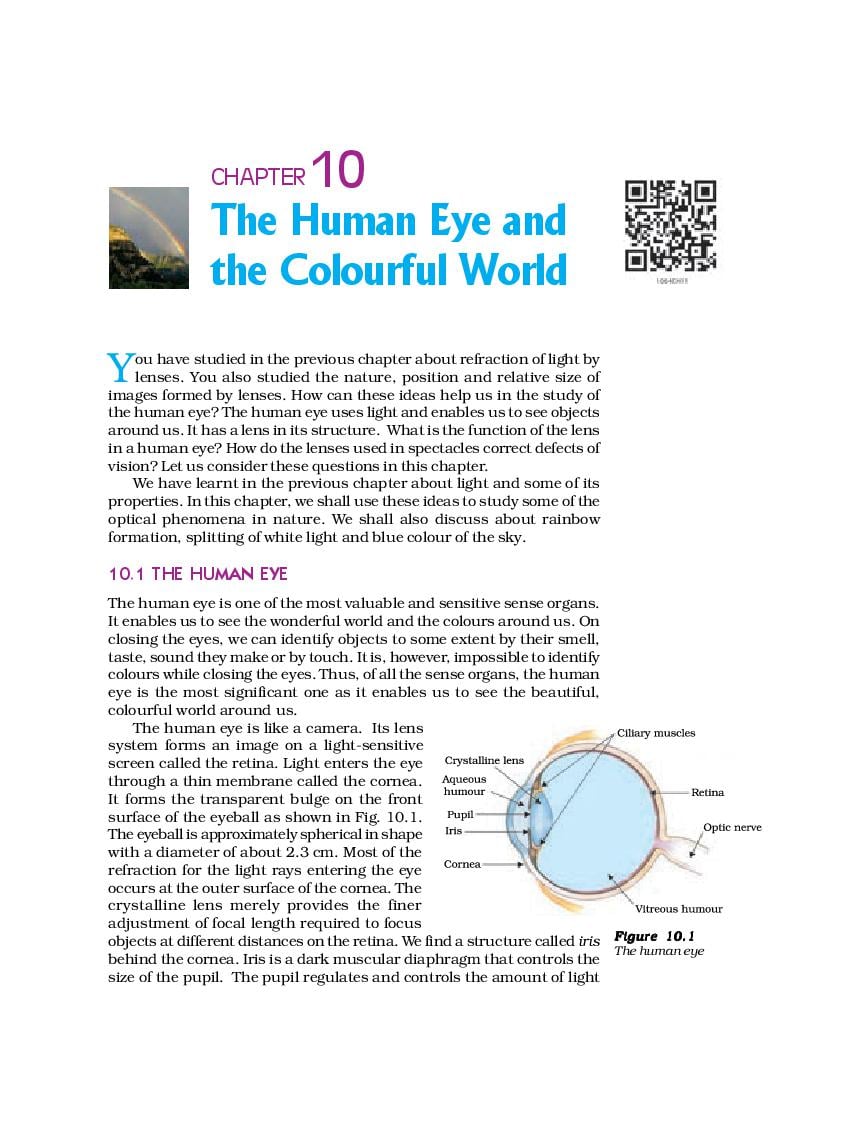
The human eye is like a camera. Its lens
system forms an image on a light-sensitive
screen called the retina. Light enters the eye
through a thin membrane called the cornea.
It forms the transparent bulge on the front
surface of the eyeball as shown in Fig. 10.1.
The eyeball is approximately spherical in shape
with a diameter of about 2.3 cm. Most of the
refraction for the light rays entering the eye
occurs at the outer surface of the cornea. The
crystalline lens merely provides the finer
adjustment of focal length required to focus
objects at different distances on the retina. We find a structure called iris Figure 10.1
The human eye
behind the cornea. Iris is a dark muscular diaphragm that controls the
size of the pupil. The pupil regulates and controls the amount of light
Showing the first page only. Download the PDF above for the complete document.
Document Details
| Board / Org | NCERT |
| Exam | Class 10 |
| Type | Books |
| Pages | 10 |
| Language | english |
| Updated | 29 Aug 2026 |