HBSE Class 12 Question Paper 2017 Chemistry
Finished viewing? Save it for later —
Download HBSE Class 12 Question Paper 2017 Chemistry (PDF · 13 pages)About HBSE Class 12 Question Paper 2017 Chemistry
HBSE Class 12 Question Paper 2017 Chemistry is available here for free download. Published by Haryana Board for Class 12, this question paper can be viewed online or downloaded as a PDF (13 pages). Candidates preparing for Class 12 can use HBSE Class 12 Question Paper 2017 Chemistry to understand the exam pattern, the type of questions asked, and the overall difficulty level.
Frequently Asked Questions
How can I download HBSE Class 12 Question Paper 2017 Chemistry?
Open this page and click the Download button to save HBSE Class 12 Question Paper 2017 Chemistry as a PDF. It is completely free on AglaSem Docs.
Is HBSE Class 12 Question Paper 2017 Chemistry free to download?
Yes. HBSE Class 12 Question Paper 2017 Chemistry can be viewed online and downloaded as a PDF free of cost on AglaSem Docs.
How many pages does HBSE Class 12 Question Paper 2017 Chemistry have?
HBSE Class 12 Question Paper 2017 Chemistry contains 13 pages, which you can read online or download together as a single PDF.
Where can I find more Class 12 study material?
You can find more Class 12 question papers, sample papers, syllabus, and answer keys on AglaSem Docs.
HBSE Class 12 Question Paper 2017 Chemistry – Text
Read the full text of this question paper below — useful to quickly search, copy and reference the content online without downloading the PDF.
📄 View text version (13 pages)
Page 1
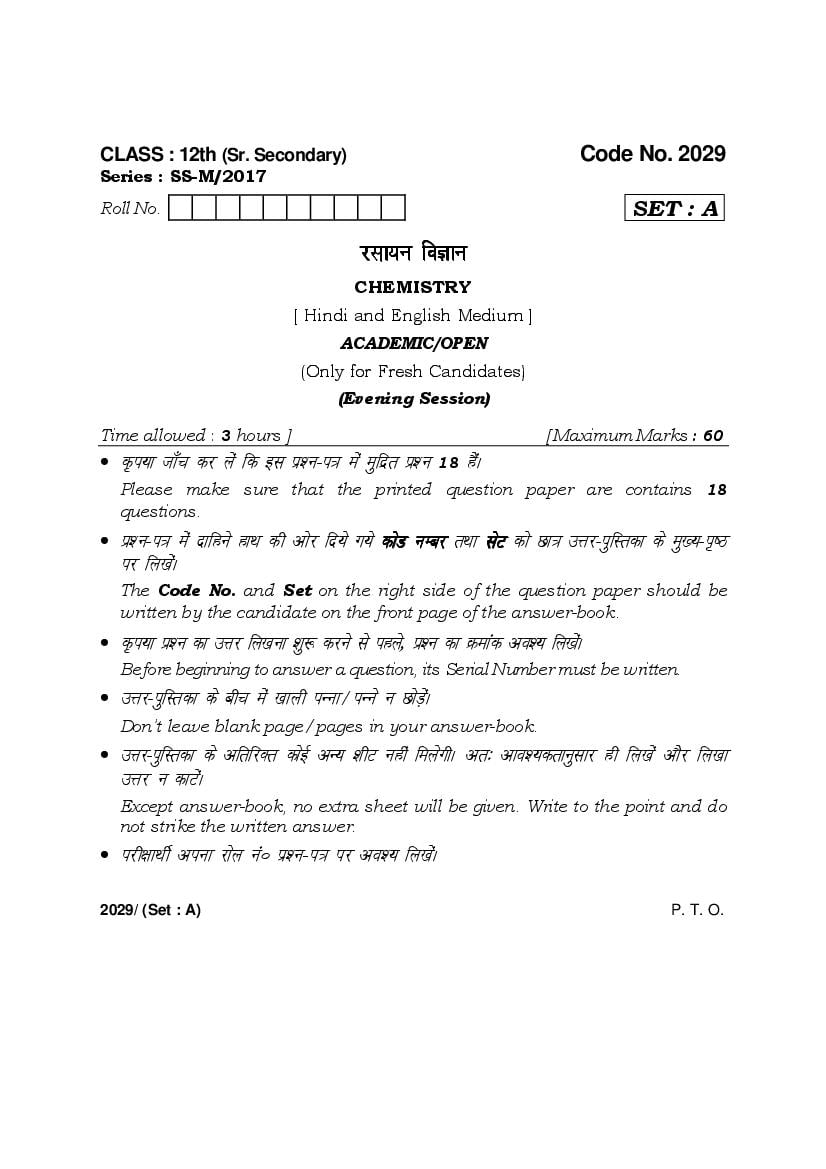
Series : SS-M/2017
Roll No. SET : A
jlk;u foKku
CHEMISTRY
[ Hindi and English Medium ]
ACADEMIC/OPEN
(Only for Fresh Candidates)
(Evening Session)
Time allowed : 3 hours ] [ Maximum Marks : 60
• d`i;k tk¡p dj ysa fd bl iz'u-i= esa eqfnzr iz'u 18 gSaA
Please make sure that the printed question paper are contains 18
questions.
• iz'u-i= esa nkfgus gkFk dh vksj fn;s x;s dksM uEcj rFkk lsV dks Nk= mÙkj-iqfLrdk ds eq[;-i`"B
ij fy[ksaA
The Code No. and Set on the right side of the question paper should be
written by the candidate on the front page of the answer-book.
• d`i;k iz'u dk mÙkj fy[kuk 'kq: djus ls igys] iz'u dk Øekad vo'; fy[ksaA
Before beginning to answer a question, its Serial Number must be written.
• mÙkj-iqfLrdk ds chp esa [kkyh iUuk / iUus u NksMsa+A
Don’t leave blank page / pages in your answer-book.
• mÙkj-iqfLrdk ds vfrfjDr dksbZ vU; 'khV ugha feysxhA vr% vko';drkuqlkj gh fy[ksa vkSj fy[kk
mÙkj u dkVsaA
Except answer-book, no extra sheet will be given. Write to the point and do
not strike the written answer.
• ijh{kkFkhZ viuk jksy ua0 iz'u-i= ij vo'; fy[ksaA
2029/ (Set : A) P. T. O.
Page 2
Candidates must write their Roll Number on the question paper.
• d`i;k iz'uksa dk mÙkj nsus lss iwoZ ;g lqfuf'pr dj ysa fd iz'u-i= iw.kZ o lgh gS] ijh{kk ds
mijkUr bl lEcU/k esa dksbZ Hkh nkok Lohdkj ugha fd;k tk;sxkA
Before answering the question, ensure that you have been supplied the
correct and complete question paper, no claim in this regard, will be
entertained after examination.
lkekU; funsZ'k %
(i) LkHkh iz'u vfuok;Z gSaA
(ii) izR;sd iz'u ds vad mlds lkeus n'kkZ, x, gSaA
(iii) ç'u la[;k 1 esa ckjg (i - xii) cgqfodYih; iz'u gSAa izR;sd 1 vad dk gSA ftuds lgh
mÙkj viuh mÙkj&iqfLrdk esa fy[kus gSaA
(iv) ç'u la[;k 2 ls 10 rd vfry?kq mÙkjh; ç'u gSaA çR;sd 2 vadksa dk gSA izR;sd iz'u
dk mÙkj yxHkx 30 'kCnksa esa nhft,A
(v) ç'u la[;k 11 ls 15 rd y?kq mÙkjh; ç'u gSaA çR;sd ç'u 3 vadksa dk gSA izR;sd iz'u
dk mÙkj yxHkx 40 'kCnksa esa nhft,A
(vi) ç'u la[;k 16 ls 18 rd nh?kZ mÙkjh; ç'u gSaA çR;sd ç'u 5 vadksa dk gSA izR;sd
iz'u dk mÙkj yxHkx 70 'kCnksa esa nhft,A
(vii) iz'u-i= esa lexz :i ls dksbZ fodYi ugha gSA rFkkfi 5 vadksa okys lHkh nh?kZ mÙkjh;
iz'uksa esa vkarfjd p;u iznku fd;k x;k gSA ,sls iz'uksa esa ls vkidks dsoy ,d gh iz'u
djuk gSA
General Instructions :
(i) All questions are compulsory.
(ii) Marks for each question are indicated against it.
(iii) Question Number 1 consists of twelve (i-xii) multiple choice questions
carrying 1 mark each. Candidates have to write the correct answer
in their answer-book.
2029/ (Set : A)
Page 3
(iv) Question Numbers 2 to 10 are very short answer type questions of 2
marks each. Answer these in about 30 words each.
(v) Question Numbers 11 to 15 are short answer type questions of 3
marks each. Answer these in about 40 words each.
(vi) Question Numbers 16 to 18 are long answer type questions of 5
marks each. Answer these in about 70 words each.
(vii) There is no over all choice. However, internal choice is given in all
long answer type questions of 5 marks each. You have to attempt
only one of the given choice in such questions.
1. (i) FCC ;wfuV lsy esa fdrus VsVªkgsMªy okW;M gSa \ 1
(A) 8 (B) 4
(C) 6 (D) 12
Number of tetrahedral voids in the FCC unit cell is :
(A) 8 (B) 4
(C) 6 (D) 12
(ii) 2.5 eksyy foy;u esa lkWY;wV dk eksy ÝsD'ku gS % 1
(A) 0.43 (B) 0.043
(C) 4.3 (D) 43
2029/ (Set : A) P. T. O.
Page 4
Mole fraction of a solute in 2.5 molal aqueous solution is :
(A) 0.43 (B) 0.043
(C) 4.3 (D) 43
(iii) DoFkukad ds mUu;u ds fy, lgh O;atd (expression) gS % 1
(A) ∆Tb = K b . m (B) ∆T f = K f . m
(C) π = CRT (D) buesa ls dksbZ ugha
Correct expression for elevation in boiling point is :
(A) ∆Tb = K b . m (B) ∆T f = K f . m
(C) π = CRT (D) None of these
(iv) bysDVªksykbV foy;u dh pkydrk fuHkZj djrh gS % 1
(A) bysDVªksykbV dh izÑfr
(B) AC lkslZ dh 'kfDr
(C) nks bysDVªksM ds chp dh nwjh
(D) mijksDr esa ls dksbZ ugha
Conductance of an electrolytic solution depends :
(A) Nature of electrolyte
(B) Power of AC source
(C) Distance between two electrodes
(D) None of the above
2029/ (Set : A)
Page 5
(v) ,d mRizsjd dk dk;Z ifjorZu ykuk gS % 1
(A) fØ;k dh fxCl ÅtkZ
(B) fØ;k dh ,UFkSYih
(C) fØ;k dh lfØ;u ÅtkZ
(D) mijksDr esa ls dksbZ ugha
Role of a catalyst is to change :
(A) Gibbs energy of reaction
(B) Enthalpy of reaction
(C) Activation energy of reaction
(D) None of the above
(vi) thjks vkMZj vfHkfØ;k dh jsV dkWUlVsUV dh bdkbZ gS % 1
(A) mol L−1s −1 (B) L mol −1s −1
(C) L2mol −2s −1 (D) s −1
Unit of rate constant for a Zero order reaction is :
(A) mol L−1s −1 (B) L mol −1s −1
(C) L2mol −2s −1 (D) s −1
(vii) ckWDlkbM v;Ld esa lkekU;r% v'kq)rk gksrh gS % 1
(A) CuO (B) ZnO
2029/ (Set : A) P. T. O.
Page 6
(C) Fe2O3 (D) buesa ls dksbZ ugha
Common impurities present in Bauxite ore :
(A) CuO (B) ZnO
(C) Fe2O3 (D) None of these
(viii) fuEu esa dkSu&lk rRo vi:irk ugha n'kkZrk gS \ 1
(A) ukbVªkstu (B) fcLeFk
(C) ,UVheuh (D) vklsZfud
Which of the following element does not show allotropy ?
(A) Nitrogen (B) Bismuth
(C) Antimony (D) Arsenic
(ix) dkSu&lk dkWEIysDl T;kferh; vkblksesfjTe n'kkZrk gS \ 1
2+
(A) [MnBr4 ]
+
(B) [Pt(NH 3 )3 Cl ]
(C) [PtCl2 (P (C2H 5 )3 )2 ]
2+
(D) [Fe(H 2O )5 NO ]
Which complex exhibit geometrical isomerism ?
2+
(A) [MnBr4 ]
+
(B) [Pt(NH 3 )3 Cl ]
(C) [PtCl2 (P (C2H 5 )3 )2 ]
2+
(D) [Fe(H 2O )5 NO ]
2029/ (Set : A)
Page 7
(x) ,Ydksgfyd KOH ds lkFk ,fYdy gsykbM~l ds fMgkbMªksgSyksftus'ku dh lqxerk gS % 1
(A) 3° < 2° <1° (B) 3° > 2° > 1°
(C) 3° < 2° > 1° (D) buesa ls dksbZ ugha
The ease of dehydrohalogenation of alkyl halides with alcoholic
KOH is :
(A) 3° < 2° <1° (B) 3° > 2° > 1°
(C) 3° < 2° > 1° (D) None of these
(xi) fuEu esa dkSu KOH(aq) ds lkFk xeZ djus ij ,slhVsfYMgkbM cukrk gS \ 1
(A) CH 3 − CH − Cl 2
(B) CH 3 − CO − Cl
(C) CH 3 − CH 2 − Cl
(D) CH 2 − Cl − CH 2 − Cl
Which on heating with aqueous KOH, produces acetaldehyde ?
(A) CH 3 − CH − Cl 2
(B) CH 3 − CO − Cl
(C) CH 3 − CH 2 − Cl
(D) CH 2 − Cl − CH 2 − Cl
(xii) fuEu esa 3° vehu dkSu&lh gS \ 1
(A) Vªkb,fFky,sehu (B) t-C;wfVy,sehu
(C) N-esfFky,sehu (D) ,fFky,sehu
2029/ (Set : A) P. T. O.
Page 8
Which of the following is a 3° amine ?
(A) Triethylamine (B) t- Butylamine
(C) N-methylamine (D) Ethylamine
2. fuEu inksa dh ifjHkk"kk nhft, % 2
(i) fgekad
(ii) eksyy fMiz's ku dkWUlVsUV
Define the terms :
(i) Freezing point
(ii) Molal depression constant
3. fuEu inksa dh ifjHkk"kk nhft, % 2
(a) v)Z vk;q
(b) vfHkfØ;k dh dksfV
Define the following terms :
(a) Half life time
(b) Order of a reaction
4. Qsu Iyou fØ;k esa fMizslUV dk D;k jksy gS \ 2
What is the role of a depressant in froth floatation process ?
5. ,d vkWDVsgsMªy fØLVy QhYM esa d-vkfcZVy dh fLIyfVax dk fp= cukb,A 2
Draw the diagram to show splitting of d-orbital in an octahedral crystal
field.
2029/ (Set : A)
Page 9
6. fuEu ;kSfxdksa ds IUPAC uke fyf[k, % 2
(i) CH3-CHOH-CH2-CHOH-CH3
(ii) C6H5-O-C6H5
Write the IUPAC names of following compounds :
(i) CH3-CHOH-CH2-CHOH-CH3
(ii) C6H5-O-C6H5
7. ,sfyQsfVd vehu ,sjksesfVd vehu ls T;knk {kkjh; gS] O;k[;k dhft,A 2
Aliphatic amines stronger base than aromatic amines, explain.
8. dks&ikWfyesjkbts'ku dh mnkgj.k lfgr O;k[;k dhft,A 2
Explain the term co-polymerization with example.
9. QhukWy ds vEyh; izÑfr dh O;k[;k dhft,A 2
Discuss the acidic nature of phenols.
10. izfrj{kd D;k gS \ nks mnkgj.k nhft,A 2
What are antibiotics ? Give two examples.
11. fuEu MsVk ls vkoksxzknzks la[;k (N0 ) dh x.kuk dhft, % 3
(i) NaCl dk ?kuRo = 2.165 gm cm–3
Na o Cl ds chp dh nwjh = 281 pm
+ –
(ii)
2029/ (Set : A) P. T. O.
Page 10
Calculate the value of Avogadro number (N0) from following data :
(i) Density of NaCl = 2.165 gm cm–3
+ –
(ii) Distance between Na & Cl in NaCl = 281pm
12. ukWeZy gkbMªkstu bysDVªksM dh jpuk ,oa dk;Z dh O;k[;k dhft,A
3
Describe the construction and working of Normal Hydrogen Electrode.
13. fV.My izHkko dh laf{kIr O;k[;k dhft,A bldk egÙo D;k gS \
3
Briefly explain Tyndal effect. Give its importance.
14. CH 3 − CH 2 − Br dks fuEu esa dSls cnysaxs \ 3
(i) CH 3 − CH 3
(ii) C 2 H 5 − O − C 2H 5
(iii) CH 3 − CH 2 − CN
How will you convert CH 3 − CH 2 − Br into following ?
(i) CH 3 − CH 3
(ii) C 2 H 5 − O − C 2H 5
(iii) CH 3 − CH 2 − CN
2029/ (Set : A)
Page 11
15. vko';d rFkk vuko';d vehuks vEy D;k gSa \ izR;sd dk ,d mnkgj.k nhft,A 3
What are essential and non-essential amino acids ? Give one example
of each.
16. (a) PF5 dh lajpuk dh O;k[;k dhft,A 3
Discuss the structure of PF5.
(b) ukbVªkstu ds vlkekU; O;ogkj ds eq[; dkj.k D;k gSa \ 2
What are main reasons for anomalous properties of Nitrogen ?
vFkok
OR
(a) vksLVokYM izØe ls vki HNO3 dSls rS;kj djsaxs \ 3
How will you prepare HNO3 by Ostwald process ?
(b) veksfu;k ds dksbZ nks VsLV dk uke crkb,A 2
Name any two tests for ammonia.
17. (a) laØe.k rRo D;k gSa \ Cr(24) ,oa Cu(29) dk bysDVªkWfud foU;kl fyf[k,A 3
What are transition elements ? Write the electronic configuration of
Cr(24) & Cu(29).
(b) ysUFksukbM ladqpu ij uksV fyf[k,A 2
Write a note on lanthanide contraction.
2029/ (Set : A) P. T. O.
Page 12
vFkok
OR
(a) laØe.k rRoksa ds fuEu xq.kksa dh laf{kIr O;k[;k dhft, % 3
(i) vkW;fud f=T;k
(ii) dkWEIysfDlax VsUMsUlh
(iii) dSVkfyfVd izkiVhZt+
Discuss briefly the following properties of transition metals :
(i) Ionic radii
(ii) Complexing tendency
(iii) Catalytic properties
(b) laØe.k rRo fofHkUu vkWDlhdj.k voLFkk n'kkZrs] gSa D;ksa \ 2
Why transition elements show variable oxidation state ?
18. (a) fuEu ls ,fYMgkbM dSls rS;kj djsaxs \ 3
(i) ,sYdksgkWy
(ii) (RCOO)2-Ca
(iii) ,sYdkbu
How will you prepare Aldehyde from :
(i) Alcohol
(ii) (RCOO)2-Ca
(iii) Alkyne
2029/ (Set : A)
Page 13
(b) fuEu ds IUPAC uke fyf[k, % 2
Write the IUPAC names of :
(i) CH 3 − CH 2Br − COOH
(ii) COOH − CH 2 − CH 2 − COOH
vFkok
OR
(a) D;ksa ,fYMgkbM] dhVksu dh vis{kk vf/kd 'kh?kz ukfHkd Lusgh ;ksxkRed vfHkfØ;k ls
xqtjrk gS] O;k[;k dhft,A 3
(b) D;ksa dkcksZfDlfyd vEy] dkcksZfuy lewg ds fof'k"V vfHkfØ;kvkas dks ugha nsrk gS \ 2
(a) Why Aldehyde undergo nucleophilic addition reactions more readily
than ketones ? Explain.
(b) Why carboxylic acids do not give characteristic reactions of
Carbonyl group ?
S
2029/ (Set : A) P. T. O.
Document Details
| Board / Org | Haryana Board |
| Exam | Class 12 |
| Type | Question Paper |
| Pages | 13 |
| Updated | 30 Apr 2026 |