Page 1
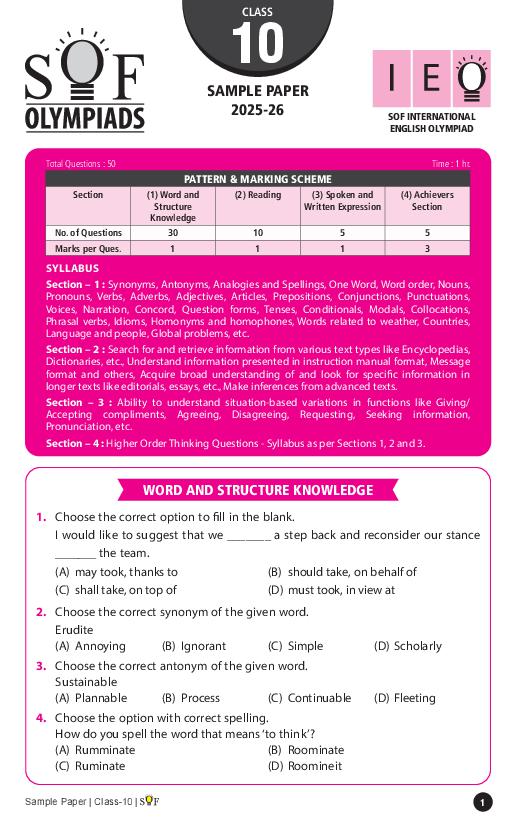
CLASS 10 SAMPLE PAPER 2025-26 SOF INTERNATIONAL ENGLISH OLYMPIAD Total Questions : 50 Time : 1 hr. PATTERN & MARKING SCHEME Section (1) Word and (2) Reading (3) Spoken and (4) Achievers Structure Written Expression Section Knowledge No. of Questions 30 10 5 5 Marks per Ques. 1 1 1 3 SYLLABUS Section – 1 : Synonyms, Antonyms, Analogies and Spellings, One Word, Word order, Nouns, Pronouns, Verbs, Adverbs, Adjectives, Articles, Prepositions, Conjunctions, Punctuations, Voices, Narration, Concord, Question forms, Tenses, Conditionals, Modals, Collocations, Phrasal verbs, Idioms, Homonyms and homophones, Words related to weather, Countries, Language and people, Global problems, etc. Section – 2 : Search for and retrieve information from various text types like Encyclopedias, Dictionaries, etc., Understand information presented in instruction manual format, Message format and others, Acquire broad understanding of and look for specific information in longer texts like editorials, essays, etc., Make inferences from advanced texts. Section – 3 : Ability to understand situation-based variations in functions like Giving/ Accepting compliments, Agreeing, Disagreeing, Requesting, Seeking information, Pronunciation, etc. Section – 4 : Higher Order Thinking Questions - Syllabus as per Sections 1, 2 and 3. WORD AND STRUCTURE KNOWLEDGE 1. Choose the correct option to fill in the blank. I would like to suggest that we _______ a step back and reconsider our stance _______ the team. (A) may took, thanks to (B) should take, on behalf of (C) shall take, on top of (D) must took, in view at 2. Choose the correct synonym of the given word. Erudite (A) Annoying (B) Ignorant (C) Simple (D) Scholarly 3. Choose the correct antonym of the given word. Sustainable (A) Plannable (B) Process (C) Continuable (D) Fleeting 4. Choose the option with correct spelling. How do you spell the word that means ‘to think’? (A) Rumminate (B) Roominate (C) Ruminate (D) Roomineit Sample Paper | Class-10 | 1
Page 2
READING Directions (For Q. No. 5 and 6) : Read the passage and answer the questions that follow. The Paleolithic remains have been found in all parts of India, especially in the Deccan. In ancient times, south of the Vindhya mountain and the Narmada river, was known as Dakshinapath; now it is called the Deccan. There were two main cultures in the Paleolithic Age, the Sonnian and the Acheulian. Some tools from the Sonnian culture have been found in the Shivalik hills of the Indian subcontinent. Most Sonnian tools belong to late middle period found into past Shivalik sediments. Sonnian artifacts have been recovered in Pakistan. Acheulian sites have been divided in early Acheulian and late Acheulian, on the basis of the tools produced. Early Acheulian tools have been recovered at the edge of the Vindhya hills in the Narmada Basin. Flake tools were the major features of the late Acheulian Age. Small and medium size hand axes and cleavers were main tools of this age used for chopping meat. Various sites of Acheulian in the Deccan are excavated like Chirki-Nevasa, Guhox, Saswad, Nasre, Yeduwadi, Attirampakkam and Bhimbetka. Various Acheulian tools have been discovered from Nevasa, a tributary of the Godavari in Maharashtra. All this indicates that Nevasa was a popular habitation of the Paleolithic man for a long time. From these stone-tools we come to know about food and shelters of early man. One of these sites is Attirampakkam valley in the northwest of Tamil Nadu. Archaelogical research has discovered evidence of fossil remains of animals and primitive stone implements in northern Tamil Nadu around 300,000 BC. Man in Deccan lived in this Paleolithic period for a long time, using only crude implements. 5. Which of the following area was known as ‘Dakshinapath’ in ancient times? (A) North to Narmada river (B) South of Vindhya mountain and Narmada river (C) Shivalik Hills (D) None of these 6. Name the two main cultures of the Paleolithic age. (A) Dakshinapath and Deccan (B) Vindhya hills and Narmada basin (C) The Sonnian and the Acheulian (D) The new and the old Paleolithic SPOKEN AND WRITTEN EXPRESSION Directions (For Q. No. 7 and 8) : Choose the correct option to complete each conversation. 7. Shama : Siya _____ reporting, at a small-town newspaper before moving to the city. (A) cut to the quick (B) cut her teeth on (C) cut corners (D) cut both ways 8. Claire : Kids are asked to practise _______ and save money if they want new toys. (A) scrimping (B) disbursing (C) grousing (D) mafficking ACHIEVERS SECTION 9. Choose the correct option to fill in the blank. Science ________ that hunger affects our tongue’s taste receptors and how the brain perceives _______ information. (A) proving, gustation (B) proved, guilelessness (C) has proven, gustatory (D) could prove, gusseting 10. Choose the correct antonym of the given word. Condescending (A) Acquiescing (B) Descending (C) Welcoming (D) Condensing ANSWER KEY 1. (B) 2. (D) 3. (D) 4. (C) 5. (B) 6. (C) 7. (B) 8. (A) 9. (C) 10. (C) 2 | Sample Paper | Class-10