CUSAT CAT 2022 Question Paper Zoology
Finished viewing? Save it for later —
Download CUSAT CAT 2022 Question Paper Zoology (PDF · 26 pages)About CUSAT CAT 2022 Question Paper Zoology
CUSAT CAT 2022 Question Paper Zoology is available here for free download. Published by Cochin University for CUSAT Common Admission Test, this question paper can be viewed online or downloaded as a PDF (26 pages). Candidates preparing for CUSAT Common Admission Test can use CUSAT CAT 2022 Question Paper Zoology to understand the exam pattern, the type of questions asked, and the overall difficulty level.
Frequently Asked Questions
How can I download CUSAT CAT 2022 Question Paper Zoology?
Open this page and click the Download button to save CUSAT CAT 2022 Question Paper Zoology as a PDF. It is completely free on AglaSem Docs.
Is CUSAT CAT 2022 Question Paper Zoology free to download?
Yes. CUSAT CAT 2022 Question Paper Zoology can be viewed online and downloaded as a PDF free of cost on AglaSem Docs.
How many pages does CUSAT CAT 2022 Question Paper Zoology have?
CUSAT CAT 2022 Question Paper Zoology contains 26 pages, which you can read online or download together as a single PDF.
Where can I find more CUSAT Common Admission Test study material?
You can find more CUSAT Common Admission Test question papers, sample papers, syllabus, and answer keys on AglaSem Docs.
CUSAT CAT 2022 Question Paper Zoology – Text
Read the full text of this question paper below — useful to quickly search, copy and reference the content online without downloading the PDF.
📄 View text version (26 pages)
Page 1
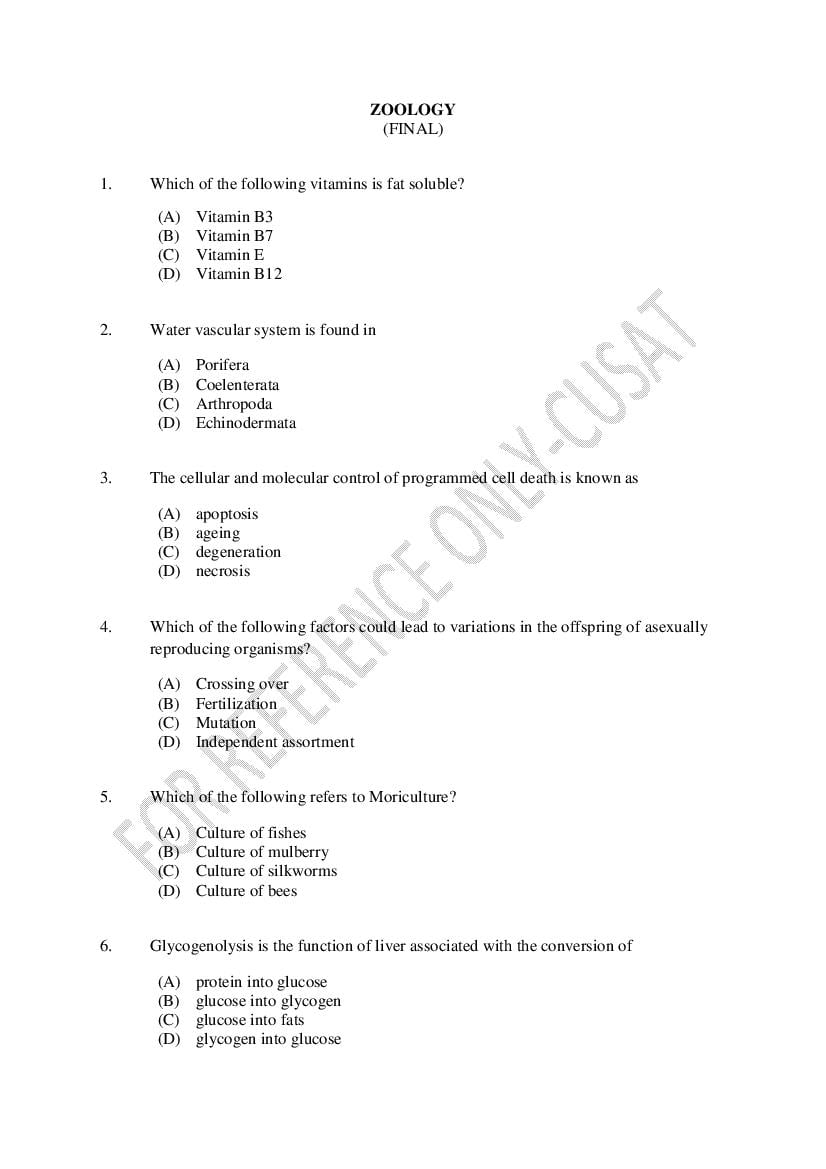
(FINAL)
1. Which of the following vitamins is fat soluble?
(A) Vitamin B3
(B) Vitamin B7
(C) Vitamin E
(D) Vitamin B12
2. Water vascular system is found in
(A) Porifera
(B) Coelenterata
(C) Arthropoda
(D) Echinodermata
3. The cellular and molecular control of programmed cell death is known as
(A) apoptosis
(B) ageing
(C) degeneration
(D) necrosis
4. Which of the following factors could lead to variations in the offspring of asexually
reproducing organisms?
(A) Crossing over
(B) Fertilization
(C) Mutation
(D) Independent assortment
5. Which of the following refers to Moriculture?
(A) Culture of fishes
(B) Culture of mulberry
(C) Culture of silkworms
(D) Culture of bees
6. Glycogenolysis is the function of liver associated with the conversion of
(A) protein into glucose
(B) glucose into glycogen
(C) glucose into fats
(D) glycogen into glucose
Page 2
(A) quadriradial
(B) bilateral
(C) radial
(D) asymmetrical
8. Which cells in the pancreas secrete glucagon that convert liver glycogen into glucose?
(A) Beta cells
(B) Alpha cells
(C) Delta cells
(D) Gamma cells
9. The poultry birds exclusively grown for meat are called as
(A) Layers
(B) Broilers
(C) Rooster
(D) Cockerel
10. Which of the following sets hormones is responsible for the
“fight-or-flight” response?
(A) Thyroxin and melatonin
(B) Insulin and glucagon
(C) Estrogen and progesterone
(D) Epinephrine and norepinephrine
11. Some animals adopt a similar state like sleep to reduce their metabolic rate in
winter. It is called
(A) Migration
(B) Transpiration
(C) Hibernation
(D) Aestivation
12. Shelford’s law of tolerance is named after
(A) Ernest Shelford
(B) James Shelford
(C) Jacob Shelford
(D) Ronaldo Shelford
Page 3
(A) Cloaca
(B) Tympanum
(C) Bidder’s canal
(D) Nictitating membrane
14. The period immediately after birth to four weeks of age is called
(A) Infancy
(B) Neonatal
(C) Adolescent
(D) Senescent
15. Implantation is the process of
(A) attachment of blastocyst to uterine wall
(B) egg fertilization
(C) degeneration of egg
(D) egg movement
16. The contractile vacuole in protozoans is chiefly concerned with the process of
(A) digestion
(B) osmoregulation
(C) excretion
(D) assimilation
17. The phenomenon of ‘cell drinking’ is referred to as
(A) Phagocytosis
(B) Exocytosis
(C) Endocytosis
(D) Pinocytosis
18. The vertebrate animal that has a gizzard in the alimentary canal
(A) Pigeon
(B) Frog
(C) Rat
(D) Lizard
Page 4
(A) Gastropoda
(B) Cephalopoda
(C) Scaphapoda
(D) Pelecypoda
20. Malaria is transmitted by
(A) Anopheles
(B) Culex
(C) Aedes
(D) Housefly
21. In elasmobranches, the type of scales is
(A) Ganoid
(B) Cycloid
(C) Placoid
(D) Cosmoid
22. Sunderban Wetland is located in
(A) Maldives
(B) Nicobar Island
(C) Orissa
(D) West Bengal
23. Binomial nomenclature was proposed by
(A) Robert Whittaker
(B) Carl Linnaeus
(C) Charles Darwin
(D) Gregor Mendel
24. In arthropods, X-organ produces the
(A) growth hormone
(B) ecdysone
(C) gonadotropin
(D) molting inhibiting hormone
Page 5
(A) WHO
(B) IUCN
(C) UNEP
(D) UNESCO
26. Echolocation technique is found in
(A) Elephant
(B) Dolphin
(C) Lion
(D) Octopus
27. Where are “Islets of Langerhans” found?
(A) Anterior pituitary
(B) Cortex
(C) Spleen
(D) Endocrine pancreas
28. Animals in which nitrogen is excreted predominantly in the form of urea are
(A) Ammonotelic
(B) Aminotelic
(C) Ureotelic
(D) Uricotelic
29. Which among the following is necessary to carry out blood
coagulation in a cut or wound?
(A) Thrombocytes
(B) Blood plasma
(C) Leukocytes
(D) Red Blood Cells
30. The contraction and expansion movement of the walls of the food pipe is called
(A) translocation
(B) peristalsis
(C) transpiration
(D) digestion
Page 6
(A) Apoenzyme and zymogen
(B) Apoenzyme and co-enzyme
(C) Co-enzyme and prosthetic group
(D) Prosthetic group and co-factor
32. Cystic Fibrosis and Haemophilia are examples of
(A) hereditary diseases
(B) infectious diseases
(C) deficiency diseases
(D) degenerative diseases
33. Amniocentesis is a method for
(A) determination of foetal health
(B) inducing abortion
(C) artificial insemination
(D) determination of amino acid sequence
34. Anglo-Nubian is a breed of
(A) goat
(B) cat
(C) poultry
(D) cow
35. Pyorrhoea is a disease which affects the
(A) heart
(B) gums
(C) lungs
(D) kidney
36. Of the following taxonomical categories, which is the most inclusive
(that is the highest in hierarchy)?
(A) Order
(B) Species
(C) Genus
(D) Class
Page 7
(A) Thiamine
(B) Riboflavin
(C) Retinal
(D) Folic acid
38. Eugenics is the study of
(A) different races of mankind
(B) different races of apes
(C) genetics of plants
(D) altering genetic components of mankind
39. Paleontology is a branch of science that deals with the
(A) behaviour of animals
(B) fossils of plants and animals
(C) origin and growth of plants
(D) formation of stars
40. The vein which brings clean blood from the lungs into the heart is
(A) Pulmonary vein
(B) Hepatic vein
(C) Superior vena cava
(D) Pulmonary artery
41. Hypertonic environment results in loss of water and ultimately the cell
(A) die
(B) wilt
(C) shrink
(D) turgid
42. Respiration that occurs in the presence of oxygen is called
(A) Fermentation
(B) Anaerobic respiration
(C) Glycolysis
(D) Aerobic respiration
Page 8
in the process of Human Digestion?
(A) Digestion, Ingestion, Assimilation, Egestion and Absorption
(B) Ingestion, Digestion, Absorption, Assimilation and Egestion
(C) Egestion, Absorption, Digestion, Assimilation and Ingestion
(D) Assimilation, Absorption, Ingestion, Digestion and Egestion
44. Movement of particles or molecules against concentration gradient is called
(A) active transport
(B) osmosis
(C) passive transport
(D) diffusion
45. The membranous covering of the brain is called
(A) meninges
(B) pericardium
(C) pleura
(D) peritoneum
46. Animals adapting to a similar condition, resulting in superficial similarities in the
structures is termed as
(A) biological evolution
(B) structural evolution
(C) divergent evolution
(D) convergent evolution
47. Cells produced as a result of cleavage are named as
(A) morula
(B) blastomeres
(C) blastula
(D) zygote
48. Nymph is the name of young ones of
(A) housefly
(B) beetle
(C) cockroach
(D) honey bee
Page 9
(A) eye
(B) ears
(C) lungs
(D) kidney
50. Total number of chromosome in Down’s syndrome is
(A) 49
(B) 48
(C) 46
(D) 47
51. Example of micronutrients is
(A) carbohydrates
(B) proteins
(C) vitamins
(D) fats
52. Mordant used in Gram staining is
(A) crystal violet
(B) safranin
(C) acid alcohol
(D) iodine
53. Dipnoi are considered as
(A) flying fish
(B) jumping fish
(C) lung fish
(D) cat fish
54. Parental care is well performed in
(A) Hippocampus
(B) Exocoetus
(C) Scoliodon
(D) Echeneis
Page 10
(A) branchiostoma
(B) tongue worm
(C) lamprey
(D) sea squirt
56. A reptile that has two-chambered ventricle
(A) tortoise
(B) crocodile
(C) snake
(D) lizard
57. Neumatic bones are found in
(A) whale
(B) frog
(C) shark
(D) birds
58. When the power of ocular lens is 10 X and objective lens is 20 X, the magnification is
(A) 30 times
(B) 200 times
(C) 2000 times
(D) 20 times
59. Neurofibril nodes were formerly called as
(A) nodes of ranveir
(B) schwann cells
(C) myofibrils
(D) motor nerves
60. In sickle cell anaemia, the defect lies in which polypeptide?
(A) Beta chain
(B) Alpha chain
(C) Gamma chain
(D) Delta chain
Page 11
(A) breakdown of fats
(B) breakdown of food into chime
(C) breakdown of carbohydrates
(D) breakdown of proteins
–
62. Which among the following is known as 5p (5p minus) syndrome?
(A) Down’s syndrome
(B) Turner’s syndrome
(C) Klinefelter’s syndrome
(D) Cri-du-chat syndrome
63. Which tissue acts as first line of protection for body from
any physical or chemical damage?
(A) Adipose tissue
(B) Areolar tissue
(C) Muscular tissue
(D) Epithelial tissue
64. A change due to experience in behaviour of an organism is known as
(A) maturation
(B) social behaviour
(C) learning
(D) imprinting
65. If cleavages cannot divide embryo completely, resulting cleavages are called as
(A) vertical cleavages
(B) horizontal cleavages
(C) holoblastic cleavages
(D) meroblastic cleavages
66. Phenomenon of bio-magnification is shown by
(A) distillery wastes
(B) domestic waste
(C) heavy metals
(D) gases
Page 12
(A) Mitosis
(B) Amitosis
(C) Both (A) and (B)
(D) Meiosis
68. Kaziranga National Park is situated in
(A) Assam
(B) Gujarat
(C) Karnataka
(D) Tamil Nadu
69. Peripatus is a connecting link between the following
(A) annelids and molluscs
(B) annelids and arthropods
(C) molluscs and echinoderms
(D) annelids and Platyhelminthes
70. A symbiotic inter specific relationship where one partner is benefitted and the other
partner is neither harmed nor benefitted is
(A) parasitism
(B) commensalism
(C) mutualism
(D) symbiosis
71. Scapula is a bone of
(A) Vertebral column
(B) Skull
(C) Pelvic girdle
(D) Pectoral girdle
72. Air bladder is
(A) Excreatory organ of mammals
(B) Respiratory organ of cephalopods
(C) Hydrostatic organ of bony fish
(D) Excreatory organ of fish
Page 13
(A) Spherical
(B) Convex
(C) Concave
(D) Bi-concave
74. Which of the following is NOT a function of plasma membrane?
(A) Intracellular interactions
(B) Responding to external stimuli
(C) Energy transduction
(D) Assist in chromosomal segregation
75. Which of the following fossil men was expert in making tools,
weapons and paintings?
(A) Peking man
(B) Cro magnon man
(C) Java ape man
(D) Neanderthal man
76. ……………….. acts as excretory organ in adult Ascaris.
(A) Excretory canal
(B) Renette cells
(C) Nephridia
(D) Malpighian tubules
77. Ink gland is found in
(A) Pila
(B) Mytilus
(C) Unio
(D) Sepia
78. Larva of Urochordata is known as
(A) Bipinnaria larva
(B) Tunicate larva
(C) Tornaria larva
(D) Auricularia larva
Page 14
(A) Cotylosauria
(B) Crocodila
(C) Squamata
(D) Rhyncocephalia
80. Keratin is the type of protein that makes
(A) blood
(B) feathers
(C) hormones
(D) neuron
81. In birds, the sound vibration is produced by
(A) syringeal membrane
(B) trachea
(C) hyoid apparatus
(D) arytenoid cartilages
82. Chiroptera is
(A) Crepuscular
(B) Nocturnal
(C) Diurnal
(D) Cathemeral
83. In mammals, the sweat glands are also known as
(A) Endocrine glands
(B) Poison glands
(C) Green glands
(D) Sudoriferous glands
84. The cell was first discovered by Robert Hooke in the year
(A) 1665
(B) 1666
(C) 1675
(D) 1676
Page 15
(A) Red blood cells
(B) Osteoclasts
(C) Liver cells
(D) Keratinocytes
86. The DNA wraps around histone proteins to form
(A) Nucleolus
(B) Nucleoplasm
(C) Nucleosome
(D) Microfilaments
87. Nucleic acid was first discovered by
(A) Friedrich Miescher
(B) Watson and Crick
(C) Albrecht Kossel
(D) S.J. Singer
88. Buffers are mixtures of
(A) Strong acid and strong base
(B) Strong acid and weak base
(C) Weak acid and their conjugate base
(D) Strong base and their conjugate acid
89. The net gain of ATP during the conversion of glucose to pyruvate is
(A) 1 ATP
(B) 2 ATP
(C) 1 ATP + 1 GTP
(D) 4 ATP
90. The first amino acid discovered is
(A) Asparagine
(B) Aspartate
(C) Glutamate
(D) Glutamine
Page 16
(A) Hexose sugar
(B) Amino acids
(C) Fatty acids
(D) Inorganic phosphate
92. The sugar molecule in a nucleotide is
(A) Pentose
(B) Hexose
(C) Tetrose
(D) Triose
93. Penicillin is an antibiotic discovered by Alexander Fleming from
(A) Bacteria
(B) Fungi
(C) Virus
(D) Algae
94. In ……………….. phase, the population of bacteria increase in a logarithmic fashion.
(A) Lag phase
(B) Log phase
(C) Stationary phase
(D) Death phase
95. Antimicrobial substances used on living tissues to reduce the infection from
pathogens are known as
(A) Disinfectants
(B) Antiseptics
(C) Sepsis
(D) Putrification
96. Recombination occurs in ……………….. substage of Prophase-I of Meiosis.
(A) Leptotene
(B) Zygotene
(C) Pachytene
(D) Diplotene
Page 17
and female gametes is known as
(A) Bateson Square
(B) Mendel Square
(C) Punnett Square
(D) Morgan Square
98. An allele is
(A) another word for a gene
(B) a homozygous genotype
(C) a heterozygous genotype
(D) one of several possible forms of a gene
99. In human beings, males are much more likely to have hemophilia (a failure of blood
to clot properly) than females. This is the case because
(A) hemophilia is a contagious disease to which males are more susceptible
(B) the gene for hemophilia is carried on the Y chromosome
(C) hemophilia is carried on the autosomes
(D) the gene for hemophilia is sex-linked
100. Extra nuclear genetic material is found in
(A) Ribosome
(B) Centriole
(C) Endoplasmic Reticulum
(D) Mitochondria
101. The transfer of genetic material from one bacterium to another by virus is
(A) Transduction
(B) Translation
(C) Conjugation
(D) Transformation
102. Ultraviolet radiation on DNA induce mutation by
(A) formation of thymine dimmers
(B) methylation of base pairs
(C) deletion of base pairs
(D) addition of base pairs
Page 18
(A) inversion
(B) random mutation
(C) point mutation
(D) mispairing
104. Karyotyping can be done from
(A) any cell in your body
(B) only sex cells
(C) only embryonic cells
(D) only somatic cells
105. Which one of the following pairs is mismatched?
(A) Savanna – Tiger
(B) Tropical evergreen forest – Jaguar
(C) Tundra – Polar Bear
(D) Desert – Sidewinder Snake
106. In a lake ecosystem, the bottom area is known as
(A) Littoral zone
(B) Limnetic zone
(C) Profundal zone
(D) Tidal zone
107. Which of the following is a denitrifying bacteria?
(A) Bacillus
(B) Pseudomonas
(C) Clostridium
(D) Azotobacter
108. Addition of nitrate and phosphate fertilizers into water bodies lead to
(A) increased growth of decomposers
(B) increased fish growth
(C) increased zooplankton growth
(D) eutrophication
Page 19
(A) Mosses
(B) Lichens
(C) Climbers
(D) Grasses
110. Minamata disease is due to pollution by
(A) organic waste into drinking water
(B) oil spills in oceans
(C) industrial waste mercury into fishing water
(D) entry of cadmium into drinking water
111. In Bhopal gas tragedy, which of the following compounds was
responsible for pollution?
(A) NH4OH
(B) CH3NCO
(C) CH3NH2O
(D) CHCL3
112. Yellow coloured bins are used to collect
(A) general waste
(B) plastics
(C) infected waste
(D) glassware
113. ……………….. is defined as the study of the characteristics and
parameters of the population.
(A) Demography
(B) Population ecology
(C) Population density
(D) Mortality
114. The relationship seen in lichen is
(A) parasitism
(B) commensalism
(C) symbiosis
(D) mutualism
Page 20
(A) trophic structure
(B) niche
(C) habit
(D) habitat
116. Which country hosted the first world earth summit on conservation of environment?
(A) Spain
(B) Peru
(C) Brazil
(D) India
117. Constant regulation of organs to internal and external changes is known as
(A) Thermoregulation
(B) Ionic regulation
(C) Homeostasis
(D) Adaptations to pressure
118. Animals that cannot regulate their body temperature are known as
(A) poikilotherms
(B) homeotherms
(C) endotherms
(D) ectotherms
119. The metabolic process by which an organism receives energy is known as
(A) Oxidation
(B) Reduction
(C) Respiration
(D) Phosphorylation
120. Cutaneous respiration is NOT seen in which of the following animals?
(A) Insects
(B) Amphibians
(C) Fish
(D) Birds
Page 21
(A) Spirometer
(B) Oxymeter
(C) Glucometer
(D) Nebulizer
122. Circulatory system is absent in
(A) Liver fluke
(B) Tapeworm
(C) Jelly fish
(D) Flatworm
123. The removal of interstitial fluid from the tissues is carried out by
(A) Cardiovascular system
(B) Lymphatic system
(C) Excretory system
(D) Respiratory system
124. Supply of blood to the lungs and to all other body organs and systems is done by
(A) ventricular diastole
(B) ventricular systole
(C) atrial diastole
(D) atrial sysstole
125. High blood pressure is
(A) 140 or more systolic mm HG
(B) 90 or more systolic mm HG
(C) less than 120 systolic mm HG
(D) less than 80 diastolic mm HG
126. Which of the following groups of animals is Uricotelic?
(A) Insects
(B) Fishes
(C) Crustaceans
(D) Echinoderms
Page 22
(A) Sympatric
(B) Allopatric
(C) Siblings
(D) Biospecies
128. Hardy-Weinberg equation is given as
(A) p + 2 pq + q = 1
(B) p2 + q = 1
(C) p 2 + 2 pq + q 2 = 1
(D) q2 + p = 1
129. Change of allele frequency due to random sampling is known as
(A) gene expression
(B) gene linkage
(C) genetic drift
(D) gene mutation
130. ……………….. ecogeographical rule states that animals adapted to cold climates
have shorter limbs and body appendages than animals adapted to warm climates.
(A) Allen's rule
(B) Bergmann's rule
(C) Island rule
(D) Thorson's rule
131. The molecular clock hypothesis states that
(A) the molecules are constant for long times
(B) the mutations in DNA accumulate at roughly a constant rate
(C) the matings are random in this population
(D) the prokaryotes are more easily classified than eukaryotes
132. Which of the following theories of evolution can best explain the vestigial organs?
(A) Darwinism
(B) Lamarckism
(C) Natural selection
(D) Special creation
Page 23
constant from one generation to the next in the absence of disturbing factors.
(A) Genetic drift
(B) Natural selection
(C) Founder effect
(D) Hardy–Weinberg equilibrium
134. Ontogeny is called as
(A) the development of the head
(B) the development of cancer cells
(C) the development of appendages
(D) the development of an individual organism
135. Piercing and sucking type mouth- Parts are present in
(A) Diptera
(B) Orthoptera
(C) Lepidoptera
(D) Isoptera
136. The sting apparatus is absent in
(A) Worker bees
(B) Nursing bees
(C) Drones
(D) Queen
137. Which of the following is an Agricultural pest?
(A) Musca domestica
(B) Aedes aegypti
(C) Pediculus humanis
(D) Chilo infuscatellus
138. ……………….. produces testosterone in the presence of luteinizing hormone.
(A) Leydig cells
(B) Sertoli cells
(C) Spermatogonia
(D) Primary spermatocytes
Page 24
fate of the surrounding cells is known as
(A) morphogen gradient
(B) differentiation
(C) determination
(D) induction
140. Sparse and even distribution of yolk is seen in ……………….. eggs.
(A) Mesolecithal
(B) Telolecithal
(C) Isolecithal
(D) Centrolecithal
141. The Irreversible learning developed at the very early stage is known as
(A) Habituation
(B) Imprinting
(C) Spatial learning
(D) Cognitive learning
142. The practice of mating of animals in the absence of any social bonds is known as
(A) Monogamy
(B) Polygamy
(C) Polygyny
(D) Promiscuity
143. ……………….. is the change of coloration and patterns by the animals similar to
those in the visual background.
(A) Camouflage
(B) Flash coloration
(C) Aposematism
(D) Warning colouration
144. Which of the following hormones have a short chain of amino acids?
(A) Amino acid derived hormones
(B) Lipid derived hormones
(C) Carbohydrate derived hormones
(D) Peptide hormones
Page 25
(A) Pancreas
(B) Gonads
(C) Adrenal gland
(D) Parathyroid glands
146. Which of the following is a primary lymphoid organ?
(A) Lymph nodes
(B) Spleen
(C) Bone marrow
(D) Tonsils
147. Which of the following cells is an agranulocyte?
(A) Monocytes
(B) Eosinophils
(C) Basophils
(D) Neutrophils
148. Antibodies are synthesized exclusively by
(A) Bone marrow cells
(B) T-cells
(C) B-cells
(D) Lymph
149. The process of introduction of attenuated pathogen that causes a disease is called
(A) Immunization
(B) Vaccination
(C) Attenuation
(D) Sterilization
150. The first vaccine was developed against
(A) Pox virus
(B) Hepatitis virus
(C) Rabies virus
(D) Polio virus
Page 26
Subject Name: 615 ZOOLOGY
SI No. Key SI No. Key SI No. Key SI No. Key SI No. Key
1 C 31 B 61 B 91 B 121 A
2 D 32 A 62 D 92 A 122 C
3 A 33 A 63 D 93 B 123 B
4 C 34 A 64 C 94 B 124 B
5 B 35 B 65 D 95 B 125 A
6 D 36 D 66 C 96 C 126 A
7 C 37 C 67 D 97 C 127 B
8 B 38 D 68 A 98 D 128 C
9 B 39 B 69 B 99 D 129 C
10 D 40 A 70 B 100 D 130 A
11 C 41 C 71 D 101 A 131 B
12 A 42 D 72 C 102 A 132 B
13 D 43 B 73 D 103 C 133 D
14 B 44 A 74 D 104 A 134 D
15 A 45 A 75 B 105 A 135 A
16 B 46 D 76 B 106 C 136 D
17 D 47 B 77 D 107 B 137 D
18 A 48 C 78 B 108 D 138 A
19 D 49 A 79 C 109 B 139 A
20 A 50 D 80 B 110 C 140 C
21 C 51 C 81 A 111 B 141 B
22 D 52 D 82 B 112 C 142 D
23 B 53 C 83 D 113 A 143 A
24 D 54 A 84 A 114 D 144 D
25 B 55 D 85 B 115 B 145 C
26 B 56 B 86 C 116 C 146 C
27 D 57 D 87 A 117 C 147 A
28 C 58 B 88 C 118 A 148 C
29 A 59 A 89 B 119 C 149 B
30 B 60 A 90 A 120 D 150 C
Document Details
| Board / Org | Cochin University |
| Exam | CUSAT Common Admission Test |
| Type | Question Paper |
| Pages | 26 |
| Updated | 09 Jun 2026 |