MAHA SET 2015 Question Paper 2 Education
Finished viewing? Save it for later —
Download MAHA SET 2015 Question Paper 2 Education (PDF · 28 pages)About MAHA SET 2015 Question Paper 2 Education
MAHA SET 2015 Question Paper 2 Education is available here for free download. Published by Maharashtra Exams for Maharashtra State Eligibility Test, this question paper can be viewed online or downloaded as a PDF (28 pages). Candidates preparing for Maharashtra State Eligibility Test can use MAHA SET 2015 Question Paper 2 Education to understand the exam pattern, the type of questions asked, and the overall difficulty level.
Frequently Asked Questions
How can I download MAHA SET 2015 Question Paper 2 Education?
Open this page and click the Download button to save MAHA SET 2015 Question Paper 2 Education as a PDF. It is completely free on AglaSem Docs.
Is MAHA SET 2015 Question Paper 2 Education free to download?
Yes. MAHA SET 2015 Question Paper 2 Education can be viewed online and downloaded as a PDF free of cost on AglaSem Docs.
How many pages does MAHA SET 2015 Question Paper 2 Education have?
MAHA SET 2015 Question Paper 2 Education contains 28 pages, which you can read online or download together as a single PDF.
Where can I find more Maharashtra State Eligibility Test study material?
You can find more Maharashtra State Eligibility Test question papers, sample papers, syllabus, and answer keys on AglaSem Docs.
MAHA SET 2015 Question Paper 2 Education – Text
Read the full text of this question paper below — useful to quickly search, copy and reference the content online without downloading the PDF.
📄 View text version (28 pages)
Page 1
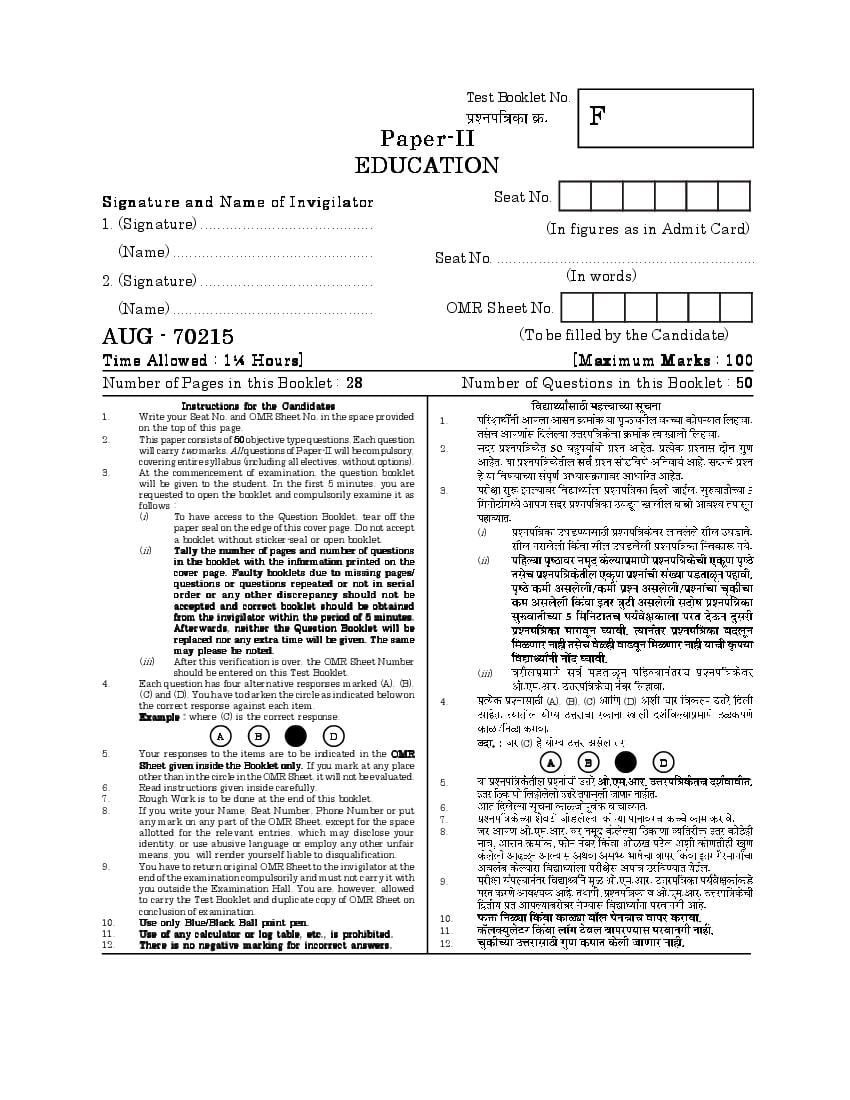
F
EDUCATION
Signature and Name of Invigilator Seat No.
1. (Signature) ......................................... (In figures as in Admit Card)
(Name) ................................................ Seat No. ..............................................................
2. (Signature) ......................................... (In words)
(Name) ................................................ OMR Sheet No.
AUG - 70215 (To be filled by the Candidate)
Time Allowed : 1¼ Hours] [Maximum Marks : 100
Number of Pages in this Booklet : 28 Number of Questions in this Booklet : 50
Instructions for the Candidates
1. Write your Seat No. and OMR Sheet No. in the space provided 1.
on the top of this page.
2. This paper consists of 50 objective type questions. Each question
will carry two marks. All questions of Paper-II will be compulsory, 2.
covering entire syllabus (including all electives, without options).
3. At the commencement of examination, the question booklet
will be given to the student. In the first 5 minutes, you are
requested to open the booklet and compulsorily examine it as 3.
follows :
(i) To have access to the Question Booklet, tear off the
paper seal on the edge of this cover page. Do not accept
(i)
a booklet without sticker-seal or open booklet.
(ii) Tally the number of pages and number of questions
in the booklet with the information printed on the (ii)
cover page. Faulty booklets due to missing pages/
questions or questions repeated or not in serial
o rder or any other discre pancy should not be
accepted and correct booklet should be obtained
from the invigilator within the period of 5 minutes.
Afterwards, neither the Question Booklet will be
replaced nor any extra time will be given. The same
may please be noted.
(iii) After this verification is over, the OMR Sheet Number
should be entered on this Test Booklet. (iii)
4. Each question has four alternative responses marked (A), (B),
(C) and (D). You have to darken the circle as indicated below on
the correct response against each item. 4. (A), (B), (C) (D)
Example : where (C) is the correct response.
A B D
(C)
5. Your responses to the items are to be indicated in the OMR
Sheet given inside the Booklet only. If you mark at any place A B D
other than in the circle in the OMR Sheet, it will not be evaluated.
5.
6. Read instructions given inside carefully.
7. Rough Work is to be done at the end of this booklet.
8. If you write your Name, Seat Number, Phone Number or put 6.
any mark on any part of the OMR Sheet, except for the space 7.
allotted for the relevant entries, which may disclose your 8.
identity, or use abusive language or employ any other unfair
means, you will render yourself liable to disqualification.
9. You have to return original OMR Sheet to the invigilator at the
end of the examination compulsorily and must not carry it with 9.
you outside the Examination Hall. You are, however, allowed
to carry the Test Booklet and duplicate copy of OMR Sheet on
conclusion of examination.
10. Use only Blue/Black Ball point pen. 10.
11. Use of any calculator or log table, etc., is prohibited. 11.
12. There is no negative marking for incorrect answers. 12.
Page 2
Page 3
Paper II
II
Time Allowed : 75 Minutes] [Maximum Marks : 100
Note : This Paper contains Fifty (50) multiple choice questions, each question
carrying Two (2) marks. Attempt All questions.
(50) (2)
1. Whitehead gives more importance to 1.
......... while defining education.
(A) Wisdom (A)
(B) Experience (B)
(C) Skill (C)
(D) Values (D)
2. According to idealism .................. is 2.
the true tool of achievement of
knowledge.
(A)
(A) Sense organs
(B)
(B) Intelligence
(C)
(C) Experience
(D)
(D) Object
3 [P.T.O.
Page 4
nothing is permanent.’ This
thinking is related to the .............
school of philosophy.
(A)
(A) Idealism
(B)
(B) Naturalism
(C)
(C) Pragmatism
(D) Realism (D)
4. According to ............. the aim of 4.
education should be preparation
for the life of the man of the
world.
(A)
(A) Social realism
(B)
(B) Humanistic realism
(C)
(C) Sense realism
(D)
(D) Critical realism
4
Page 5
but it is self-expression.’ This slogan
is of .............
(A) Naturalism (A)
(B) Realism (B)
(C) Spiritualism (C)
(D) Pragmatism (D)
6. The maxim of teaching ‘Simple to 6.
Complex’ is based on ............. school
of philosophy.
(A)
(A) Realism
(B)
(B) Pragmatism
(C) Idealism (C)
(D) Spiritualism (D)
7. ‘Education should be self-
7.
supporting.’ This idea was given
by ..............
(A) Vivekananda (A)
(B) Vinoba Bhave (B)
(C) Mahatma Gandhi (C)
(D) Rabindranath Tagore
(D)
5 [P.T.O.
Page 6
8.
of India that safeguards the
interests of minority institutions
is ............. (A) 30
(A) Article 30 (B) 45
(B) Article 45
(C) 14
(C) Article 14
(D) 28
(D) Article 28
9.
9. ‘There is no religion for the state.’
This philosophy is relevant to the
................... value in the Indian
Constitution.
(A)
(A) Socialism
(B)
(B) Secularism
(C) Equality (C)
(D) Justice
(D)
6
Page 7
universal truths and they differ from
each other. This is the assumption
of .............
(A)
(A) Vedant
(B)
(B) Buddhism
(C)
(C) Sankhya
(D) Jainism (D)
11. Philosophers from ......................... 11.
school deny transcendental
metaphysics because this cannot be
verified. (A)
(A) Realism
(B)
(B) Pragmatism
(C)
(C) Logical positivism
(D) Existentialism (D)
7 [P.T.O.
Page 8
the Article ................ of the Indian
Constitution.
(A) 17
(A) 17
(B) 30
(B) 30
(C) 25
(C) 25
(D) 29
(D) 29
13. The scope of Sociology ............. 13.
(A) is limited to a particular society (A)
only
(B)
(B) is limited to global social
interaction only
(C)
(C) ranges from interaction between
two persons to global social
interaction
(D) includes interaction in
(D)
schools among students and
teachers
8
Page 9
community can be established
through ............
(A)
(A) Common school system
(B) Parental participation in (B)
teaching
(C)
(C) Mid-day meal programme
(D)
(D) Reservation for SC/STs
15. ................is useful in overcoming 15.
caste, creed and religious
discrimination based on.
(A) Equal political opportunity to
all
(A)
(B) Equal financial opportunity to
all
(B)
(C) Equal educational opportunity
to all (C)
(D) Equal vocational opportunity to
(D)
all
9 [P.T.O.
Page 10
values, social beliefs and etiquetts
are components of ............
(A) Industrial culture (A)
(B) Non-material culture (B)
(C) Material culture (C)
(D) Intellectual culture (D)
17. Emphasis on equal opportunities in
17.
education makes .............
(A) Status attainment important
(A)
(B) Family background
important (B)
(C) Geographical mobility
(C)
difficult
(D)
(D) Social mobility easier
10
Page 11
a higher social class is known
as .............
(A)
(A) Social change
(B)
(B) Social mobility
(C)
(C) Social transformation
(D) Geographical mobility (D)
19. Education is a ............... 19.
(A) Social effort (A)
(B) Global effort (B)
(C) Ideological effort (C)
(D) Physical effort (D)
20. Politics of education is not concerned
20.
with ............
(A) Conflicts in educational
institutions
(A)
(B) Development of educational
policies (B)
(C) Influence of education on
politics (C)
(D) Influence of politics on
(D)
education
11 [P.T.O.
Page 12
21.
are ..............
(A) Geographical mobility, (A)
democratic and secular
attitudes
(B) Wearing of western clothes (B)
(C) Education in English medium
(C)
schools
(D) High rise buildings,
technological modes of
(D)
communication, well laid out
roads
22. Family as a social institution 22.
performs the following function :
(A) Procreation (A)
(B) Rearing of children (B)
(C) Informal education
(C) (Informal education)
(D) Taking forward family name
(D)
12
Page 13
correct ?
(A)
(A) Schools are affected by the
social and economic situations
and changes in civilisation
(B)
(B) Schools are powerful agents of
(Agents)
social change
(C)
(C) Schools are sources of social
conflicts
(D)
(D) Schools are agents of
acculturation (Agents)
24. The scope of sociology of education 24.
is ............
(A) role and structure of education
in society (A)
(B) global practices (B) (Practices)
(C) ideology of education
(C)
(D) personality and behaviour of
students (D)
13 [P.T.O.
Page 14
concerned with ...........
(A) Manpower planning
(A)
(B) Determining the rate of return
of education (B)
(C) Higher economic development
vis-a-vis educational
(C)
expenditure
(D) Commercialisation of
(D)
education
26.
26. Habit formation is related with
............. theory of learning.
(A) Bandura’s (A)
(B) Pavlov’s (B)
(C) Tolman’s (C)
(D) Kohler’s (D)
14
Page 15
knowledge into action purposefully
and with determination.’’
This statement is related to ...........
theory of transfer of learning.
(A)
(A) Thorndike’s
(B)
(B) Judd’s
(C)
(C) Bagley’s
(D) Woodworth’s (D)
28. Ramesh was trying to solve a 28.
geometrical problem in various ways
but was unable to get a solution. All
of a sudden he got a solution for the
problem. This type of learning is an
example of ..............
(A)
(A) learning by trial and error
(B)
(B) learning by conditioning
(C) learning by imitation (C)
(D) learning by insight (D)
15 [P.T.O.
Page 16
29.
are :
(A)
(A) originality, fluency, flexibility
(B) imagination, constructivity, (B)
intelligence
(C)
(C) novelty, critical thinking,
(Fantacy)
fantacy
(D)
(D) fantacy, novelty, productivity
30. According to Freud boys and girls 30.
prefer to be in the company of their
own sex and hate members from the
opposite sex at the ..........
(A)
(A) Oral stage
(B)
(B) Anal stage
(C) Latency stage (C)
(D) Genital stage (D)
16
Page 17
retarded children ............. criteria is
used.
(A)
(A) Low I.Q. and deficient adaptive
behaviour
(B) Deficient adaptive and social (B)
behaviour
(C)
(C) Low I.Q. and in-attentiveness
(D)
(D) Attention deficiency and poor
motor co-ordination
32. The process of guidance is .............
32.
(A) giving direction
(A)
(B) assisting the individual to
(B)
develop his capacity for self-
direction
(C) imposing one person’s point of
view upon another person
(C)
(D) making decision for an
individual (D)
17 [P.T.O.
Page 18
33. 4
intelligence test correctly that is
made for 4 years of age. He then
solves four questions correctly from 5 4
the test made for 5 years of age. Then
6 3
he solves three questions correctly
from the test made for 6 years of age 7
followed by one question from
8
the test made for 7 years of age.
He is unable to solve any
questions from the test made for 8
years of age.
(A) 137.50
Thus Arnav’s IQ will be .........
(A) 137.50 (B) 72.72
(B) 72.72
(C) 100
(C) 100
(D) 125
(D) 125
18
Page 19
individuals we need to use
...................
(A)
(A) Likert’s technique
(B)
(B) Thurston’s scale
(C) Kuder’s preference record (C)
(D) Differential aptitude test (D)
35. Savita does not get satisfactory 35. (SSC)
marks in SSC examination but she
always says that she is satisfied as
she secured the first rank in the fifth
standard. This is an example
of ..............
(A) Compensation (A)
(B) Regression (B)
(C) Identification (C)
(D) Rationalization (D)
19 [P.T.O.
Page 20
C.E. Skinner has given stress
on ...........
(A) Teaching and learning
(A)
(B) Life stages in development
(B)
(C) Solution for educational
(C)
problems
(D) Study of behaviour (D)
37. ‘‘At the time of teaching a poem a 37.
teacher should read the full text of
the poem and then teach line by
line.’’ This statement is an
application of .............. theory of
learning.
(A)
(A) Thorndike’s
(B)
(B) Kohler’s
(C)
(C) Pavlov’s
(D) Skinner’s (D)
20
Page 21
38. 115
by conducting participant
observation for about 115 hours in
a school and several unstructured
interviews. The approach used for
conducting this study is ...........
(A)
(A) Quantitative
(B)
(B) Qualitative
(C)
(C) Positivist
(D)
(D) Historical
39. The following is an example of 39.
experimental research :
(A) Education thoughts of
(A)
Dr. Ambedkar
(B) An analysis of opinions of (B)
teachers towards semester
system
(C)
(C) Factors affecting stress
amongst students of Standard
X (D)
(D) Effect of constructivist teaching-
learning treatment programme
on students’ academic
performance in Mathematics
21 [P.T.O.
Page 22
as .............
(A) post-test only equivalent groups
(A)
design
(B)
(B) pre-test post-test design
(C)
(C) correlational research
(D) causal-comparative research (D)
41. Among the various research tools/ 41.
techniques/methods, the most cost-
effective is ................
(A)
(A) Questionnaire
(B)
(B) Interview
(C)
(C) Case-study
(D)
(D) Observation
42.
42. The most important characteristic of
a good research tool is ...........
(A) Neatness (A)
(B) High validity (B)
(C) Simplicity
(C)
(D) Correct language
(D)
22
Page 23
essence of the lived experience of
this phenomenon for a person or
group of people ? This is the central
question of ...........
(A)
(A) Ecological psychology
(B)
(B) Phenomenology
(C)
(C) Ethnography
(D) Ethno-methodology (D)
44. The worthiness of a research
44.
problem is not judged by .............
(A) contribution to knowledge
development
(A)
(B) utility to society
(B)
(C) contribution by way of new
invention
(C)
(D) the cost involved in the conduct
of research (D)
23 [P.T.O.
Page 24
45.
related to ............
(A)
(A) standard of accuracy in the
investigation (B)
(B) preference of the investigator
(C)
(C) time of investigation
(D)
(D) cost of investigation
46. To study the Mode of dressing 46.
in a city ....................... is most
appropriate.
(A)
(A) Interview
(B)
(B) Checklist
(C)
(C) Questionnaire
(D) Observation (D)
24
Page 25
someone else has already collected
which may be coded or uncoded, for
his/her own research, such data is
called ............... data.
(A) Resource (A)
(B) Analysed (B)
(C) Archived (C)
(D) Primary (D)
48. You want to compare the mean job 48.
satisfaction of permanent and
temporary teachers. The following
statistical test will used for this :
(A) ANOVA (A) ANOVA
(B) Pearson’s r (B) r
(C) Spearman’s Rho (C) Rho
(D) t-test (D)
25 [P.T.O.
Page 26
(A) Square root of mean plus mode
(A)
(B) Square of standard deviation
(B)
(C) Square root of standard
(C)
deviation
(D) Square of Geometric Mean (D)
50. You want to compare the working 50.
conditions of teachers teaching in
ICSE, CBSE and SSC schools. The
following statistical technique will be
used for this purpose :
(A) ANCOVA (A) ANCOVA
(B) ANOVA (B) ANOVA
(C) MANOVA
(C) MANOVA
(D) Chi-square
(D) Chi-square
26
Page 27
27 [P.T.O.
Page 28
28
Document Details
| Board / Org | Maharashtra Exams |
| Exam | Maharashtra State Eligibility Test |
| Type | Question Paper |
| Pages | 28 |
| Updated | 09 Jun 2026 |