MBOSE Class 12 Question Paper 2022 for Music
Finished viewing? Save it for later —
Download MBOSE Class 12 Question Paper 2022 for Music (PDF · 8 pages)About MBOSE Class 12 Question Paper 2022 for Music
MBOSE Class 12 Question Paper 2022 for Music is available here for free download. Published by Meghalaya Board for Class 12, this question paper can be viewed online or downloaded as a PDF (8 pages). Candidates preparing for Class 12 can use MBOSE Class 12 Question Paper 2022 for Music to understand the exam pattern, the type of questions asked, and the overall difficulty level.
Frequently Asked Questions
How can I download MBOSE Class 12 Question Paper 2022 for Music?
Open this page and click the Download button to save MBOSE Class 12 Question Paper 2022 for Music as a PDF. It is completely free on AglaSem Docs.
Is MBOSE Class 12 Question Paper 2022 for Music free to download?
Yes. MBOSE Class 12 Question Paper 2022 for Music can be viewed online and downloaded as a PDF free of cost on AglaSem Docs.
How many pages does MBOSE Class 12 Question Paper 2022 for Music have?
MBOSE Class 12 Question Paper 2022 for Music contains 8 pages, which you can read online or download together as a single PDF.
Where can I find more Class 12 study material?
You can find more Class 12 question papers, sample papers, syllabus, and answer keys on AglaSem Docs.
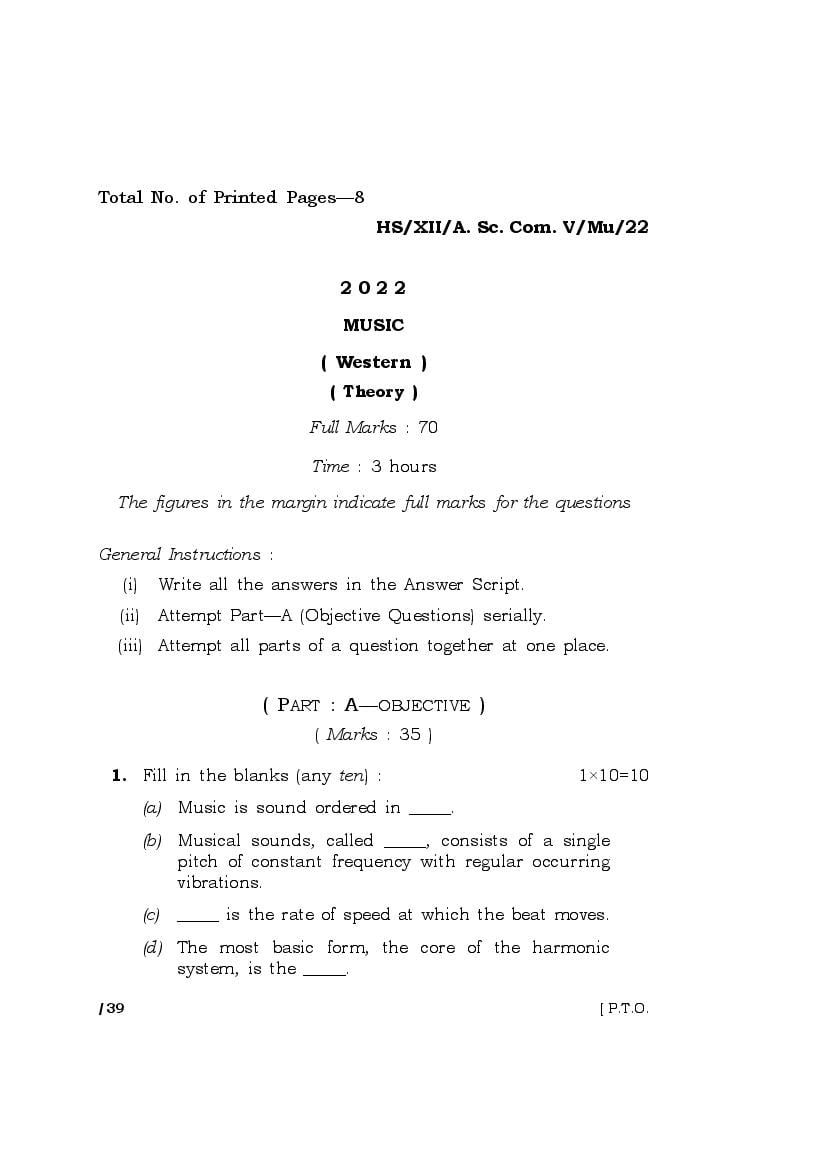
MBOSE Class 12 Question Paper 2022 for Music – Text
Read the full text of this question paper below — useful to quickly search, copy and reference the content online without downloading the PDF.
📄 View text version (8 pages)
Page 1
HS/XII/A. Sc. Com. V/Mu/22
2022
MUSIC
( Western )
( Theory )
Full Marks : 70
Time : 3 hours
The figures in the margin indicate full marks for the questions
General Instructions :
(i) Write all the answers in the Answer Script.
(ii) Attempt Part—A (Objective Questions) serially.
(iii) Attempt all parts of a question together at one place.
( PART : A—OBJECTIVE )
( Marks : 35 )
1. Fill in the blanks (any ten) : 1×10=10
(a) Music is sound ordered in _____.
(b) Musical sounds, called _____, consists of a single
pitch of constant frequency with regular occurring
vibrations.
(c) _____ is the rate of speed at which the beat moves.
(d) The most basic form, the core of the harmonic
system, is the _____.
/39 [ P.T.O.
Page 2
(e) In the dynamic notation, _____ means very soft.
(f) The classical music ranges in the period from _____.
(g) _____ is somewhat like a mirrored image of the
original melody.
(h) The aristocratic musicians in Germany were known
as _____.
(i) The dynamic notation ffff means _____.
(j) Patterns of rhythm and melody were repeated in the
added parts in a style known as _____.
(k) The _____ is a happy marriage between a
chordophone and a percussion instrument.
(l) Fugue, is taken from a Latin word meaning _____.
(m) _____ is the most basic manifestation of additive
form is instrumental music.
(n) Literature played a major role in shaping the
musical art of the _____ period.
(o) The Triad, built on the first tone of the scale is called
the _____.
2. State whether the following statements are True or
False (any ten) : 1×10=10
(a) Duration, pitch, timbre and dynamics are the
elements of music that are common to every sound.
(b) The concept of time is separable from the concept of
music.
HS/XII/A. Sc. Com. V/Mu/22/39 [ Contd.
Page 3
(c) Dynamics is the element of music concerned with
the relative loudness or softness of noise.
(d) A beat is the smallest basic unit of measurement in
musical time.
(e) Mezzo forte means to play moderately fast.
(f) The Baroque Period range is between 1450–6000.
(g) Augmentation increases the duration of each note by
a uniform proportion.
(h) Traditional music is folk music.
(i) The Gregorian Chant belongs to the Renaissance
Period.
(j) The most basic song form was a purely strophic
canso consisting of nine-line stanzas.
(k) The four members of the violin family are violin,
viola, cello and ukelele.
(l) The E Maj scale has four sharps.
(m) AB 12 A is known as the Binary Form.
(n) EGC is called the 2nd inversion of C Maj Chord.
(o) The sub-mediant is the 3rd Degree of a scale.
HS/XII/A. Sc. Com. V/Mu/22/39 [ P.T.O.
Page 4
3. Choose the correct answer from the choices given
(any five) : 1×5=5
(a) The elements of music are
(i) duration, pitch, timbre and dynamics
(ii) duration, pitch, timbre and beat
(iii) duration, pitch, timbre and rests
(iv) duration, pitch, timbre and intervals
(b) The frequency observed in a sound wave is called
(i) beat
(ii) bar
(iii) pitch
(iv) tone
(c) Presto means
(i) lively
(ii) as fast as possible
(iii) very fast
(iv) fast
(d) An ordered succession of tones that comprises the
basic organizational structure of both melody and
harmony is called
(i) a chord
(ii) a scale
(iii) harmony
(iv) melody
HS/XII/A. Sc. Com. V/Mu/22/39 [ Contd.
Page 5
(e) Twelve half steps comprise a unit of measurement
called the
(i) scale
(ii) minor scale
(iii) major scale
(iv) octave
(f) The three categories of music are
(i) cultural, spiritual and traditional
(ii) art, traditional and popular
(iii) professional, amateur and beginner
(iv) international, national and regional
(g) The romantic period is from
(i) 1600–1750
(ii) 1750–1828
(iii) 1828–1900
(iv) 1900–to date
(h) ______ is the use of the same melody in different
voices as the voices enter at successive time
intervals.
(i) Augmentation
(ii) Canon
(iii) Diminution
(iv) Inversion
HS/XII/A. Sc. Com. V/Mu/22/39 [ P.T.O.
Page 6
4. Answer the following questions (any five) : 2×5=10
(a) What do you understand by ‘Timbre’?
(b) What are the meaning of the following terms :
(i) Andante
(ii) Vivace
(iii) Largo
(iv) Adagio
(c) What is a chord? How do you construct a chord?
(d) Define melody.
(e) What are consonant and dissonant intervals?
(f) What is art music?
(g) What were the style characteristics of the Classic
period?
(h) What is a chant?
( PART : B—DESCRIPTIVE )
( Marks : 35 )
Answer any one from each unit.
UNIT—I
5. (a) Using a Treble Clef, write a 3 part diatonic
secondary triad of the following keys in crotchets :
3+3=6
(i) C Major _____ ii
(ii) E Major _____ vib
HS/XII/A. Sc. Com. V/Mu/22/39 [ Contd.
Page 7
(b) Construct a V7 chord in the key of a major scale in
the bass clef. 3+2=5
OR
6. (a) What do you understand by the term ‘Chord
Progression’? Illustrate how you will write the chord
progression for any song of your choice. 2+4=6
(b) How many scale degrees or scale steps are there?
Name them along with their numerals. 2+3=5
UNIT—II
7. (a) What do you understand by the term, ‘Dynamics’?
Explain the following terms : 3+4=7
(i) Mezzo piano
(ii) Forte
(iii) Crescendo
(iv) Diminuendo
(b) What is Sonata? Briefly explain the different
structures of the Sonata Form. 2+5=7
OR
8. (a) How are musical instruments classified? Explain
about membranophones and chordophones citing
examples of your own traditional instruments. 3+4=7
(b) Explain the characteristics of traditional music. 7
HS/XII/A. Sc. Com. V/Mu/22/39 [ P.T.O.
Page 8
UNIT—III
9. (a) Write what you know about the Gregorian chant. 5
(b) What is Renaissance music? Explain about the
sacred music of the renaissance period. 2+3=5
OR
10. (a) What were the instrumental genres of the Classic
period? Explain atleast two of them. 2+3=5
(b) Do you think the modern music has an effect as
traditional music? Give reasons to support your
answer. 2+3=5
HS/XII/A. Sc. Com. V/Mu/22/39 22K—110
Document Details
| Board / Org | Meghalaya Board |
| Exam | Class 12 |
| Type | Question Paper |
| Pages | 8 |
| Updated | 22 Jul 2026 |