Finished viewing? Save it for later —
Download NCERT Book Class 8 Mathematics (Part II) Chapter 3 Proportional Reasoning-2 (PDF · 15 pages)About NCERT Book Class 8 Mathematics (Part II) Chapter 3 Proportional Reasoning-2
NCERT Book Class 8 Mathematics (Part II) Chapter 3 Proportional Reasoning-2 is available here for free download. Published by NCERT for Class 8, this books can be viewed online or downloaded as a PDF (15 pages). Candidates preparing for Class 8 can use NCERT Book Class 8 Mathematics (Part II) Chapter 3 Proportional Reasoning-2 to understand the exam pattern, the type of questions asked, and the overall difficulty level.
Frequently Asked Questions
How can I download NCERT Book Class 8 Mathematics (Part II) Chapter 3 Proportional Reasoning-2?
Open this page and click the Download button to save NCERT Book Class 8 Mathematics (Part II) Chapter 3 Proportional Reasoning-2 as a PDF. It is completely free on AglaSem Docs.
Is NCERT Book Class 8 Mathematics (Part II) Chapter 3 Proportional Reasoning-2 free to download?
Yes. NCERT Book Class 8 Mathematics (Part II) Chapter 3 Proportional Reasoning-2 can be viewed online and downloaded as a PDF free of cost on AglaSem Docs.
How many pages does NCERT Book Class 8 Mathematics (Part II) Chapter 3 Proportional Reasoning-2 have?
NCERT Book Class 8 Mathematics (Part II) Chapter 3 Proportional Reasoning-2 contains 15 pages, which you can read online or download together as a single PDF.
Where can I find more Class 8 study material?
You can find more Class 8 question papers, sample papers, syllabus, and answer keys on AglaSem Docs.
NCERT Book Class 8 Mathematics (Part II) Chapter 3 Proportional Reasoning-2 – Text
Read the full text of this books below — useful to quickly search, copy and reference the content online without downloading the PDF.
📄 View text version (1 page)
Page 1
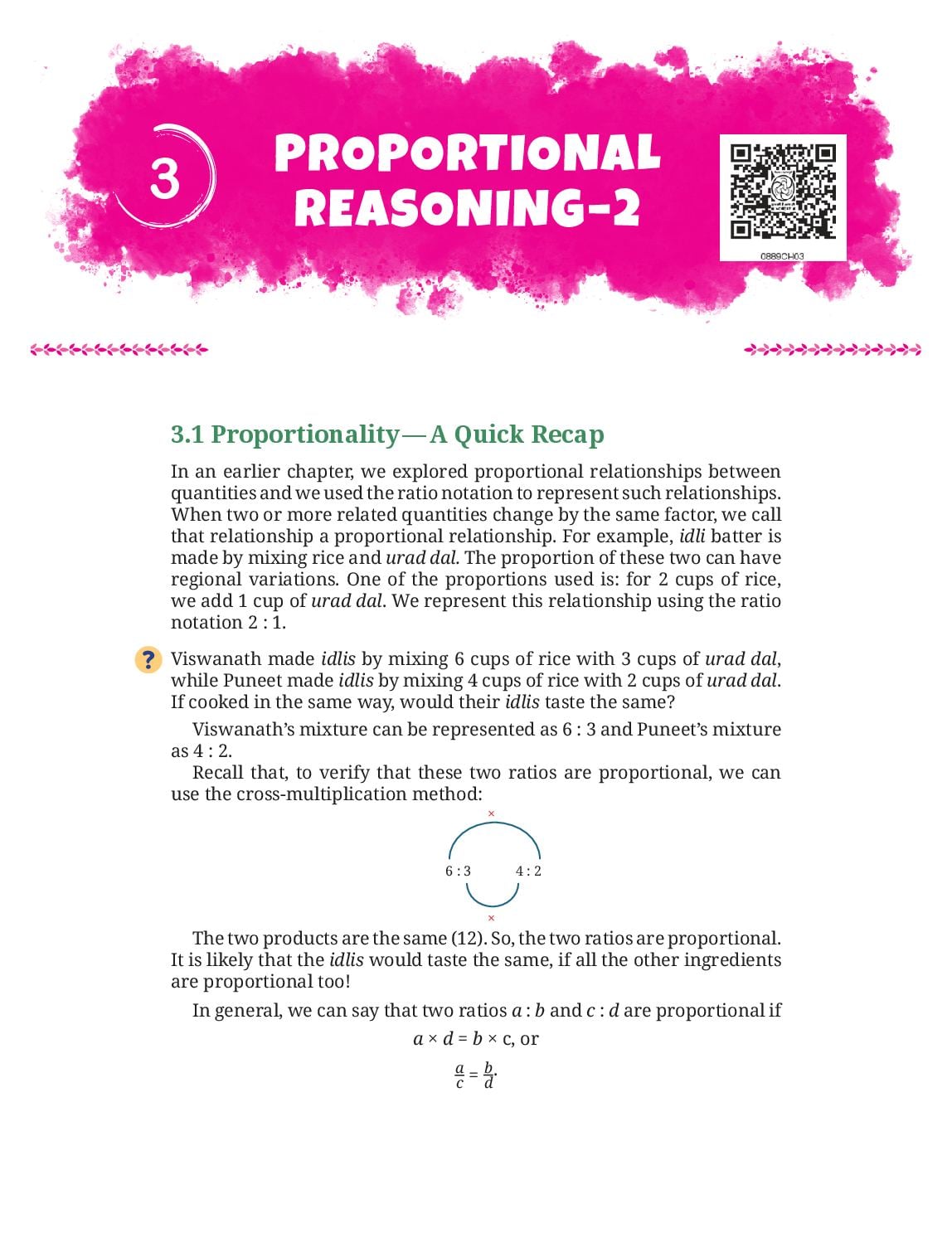
3 REASONING–2
3.1 Proportionality — A Quick Recap
In an earlier chapter, we explored proportional relationships between
quantities and we used the ratio notation to represent such relationships.
When two or more related quantities change by the same factor, we call
that relationship a proportional relationship. For example, idli batter is
made by mixing rice and urad dal. The proportion of these two can have
regional variations. One of the proportions used is: for 2 cups of rice,
we add 1 cup of urad dal. We represent this relationship using the ratio
notation 2 : 1.
Viswanath made idlis by mixing 6 cups of rice with 3 cups of urad dal,
while Puneet made idlis by mixing 4 cups of rice with 2 cups of urad dal.
If cooked in the same way, would their idlis taste the same?
Viswanath’s mixture can be represented as 6 : 3 and Puneet’s mixture
as 4 : 2.
Recall that, to verify that these two ratios are proportional, we can
use the cross-multiplication method:
×
6:3 4:2
×
The two products are the same (12). So, the two ratios are proportional.
It is likely that the idlis would taste the same, if all the other ingredients
are proportional too!
In general, we can say that two ratios a : b and c : d are proportional if
a × d = b × c, or
a b.
c=d
Showing the first page only. Download the PDF above for the complete document.
Document Details
| Board / Org | NCERT |
| Exam | Class 8 |
| Type | Books |
| Pages | 15 |
| Language | english |
| Updated | 24 Sep 2026 |