Karnataka 2nd PUC Biology Biotechnology and Its Applications MCQ with Answers
Finished viewing? Save it for later —
Download Karnataka 2nd PUC Biology Biotechnology and Its Applications MCQ with Answers (PDF · 14 pages)About Karnataka 2nd PUC Biology Biotechnology and Its Applications MCQ with Answers
Karnataka 2nd PUC Biology Biotechnology and Its Applications MCQ with Answers is available here for free download. Published by Karnataka Board for Class 12, this question bank can be viewed online or downloaded as a PDF (14 pages). Candidates preparing for Class 12 can use Karnataka 2nd PUC Biology Biotechnology and Its Applications MCQ with Answers to understand the exam pattern, the type of questions asked, and the overall difficulty level.
Frequently Asked Questions
How can I download Karnataka 2nd PUC Biology Biotechnology and Its Applications MCQ with Answers?
Open this page and click the Download button to save Karnataka 2nd PUC Biology Biotechnology and Its Applications MCQ with Answers as a PDF. It is completely free on AglaSem Docs.
Is Karnataka 2nd PUC Biology Biotechnology and Its Applications MCQ with Answers free to download?
Yes. Karnataka 2nd PUC Biology Biotechnology and Its Applications MCQ with Answers can be viewed online and downloaded as a PDF free of cost on AglaSem Docs.
How many pages does Karnataka 2nd PUC Biology Biotechnology and Its Applications MCQ with Answers have?
Karnataka 2nd PUC Biology Biotechnology and Its Applications MCQ with Answers contains 14 pages, which you can read online or download together as a single PDF.
Where can I find more Class 12 study material?
You can find more Class 12 question papers, sample papers, syllabus, and answer keys on AglaSem Docs.
Karnataka 2nd PUC Biology Biotechnology and Its Applications MCQ with Answers – Text
Read the full text of this question bank below — useful to quickly search, copy and reference the content online without downloading the PDF.
📄 View text version (14 pages)
Page 1
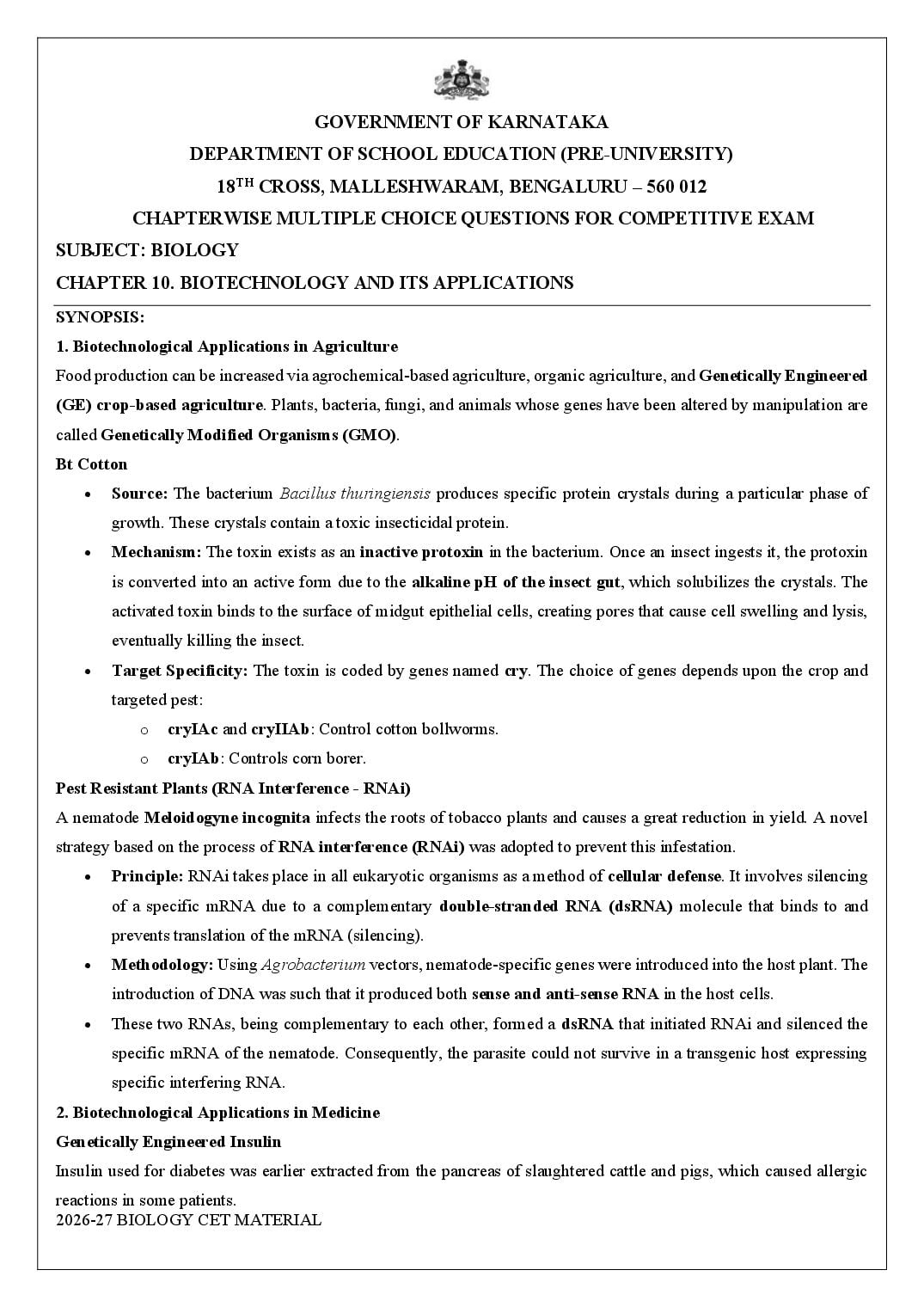
DEPARTMENT OF SCHOOL EDUCATION (PRE-UNIVERSITY)
18TH CROSS, MALLESHWARAM, BENGALURU – 560 012
CHAPTERWISE MULTIPLE CHOICE QUESTIONS FOR COMPETITIVE EXAM
SUBJECT: BIOLOGY
CHAPTER 10. BIOTECHNOLOGY AND ITS APPLICATIONS
SYNOPSIS:
1. Biotechnological Applications in Agriculture
Food production can be increased via agrochemical-based agriculture, organic agriculture, and Genetically Engineered
(GE) crop-based agriculture. Plants, bacteria, fungi, and animals whose genes have been altered by manipulation are
called Genetically Modified Organisms (GMO).
Bt Cotton
• Source: The bacterium Bacillus thuringiensis produces specific protein crystals during a particular phase of
growth. These crystals contain a toxic insecticidal protein.
• Mechanism: The toxin exists as an inactive protoxin in the bacterium. Once an insect ingests it, the protoxin
is converted into an active form due to the alkaline pH of the insect gut, which solubilizes the crystals. The
activated toxin binds to the surface of midgut epithelial cells, creating pores that cause cell swelling and lysis,
eventually killing the insect.
• Target Specificity: The toxin is coded by genes named cry. The choice of genes depends upon the crop and
targeted pest:
o cryIAc and cryIIAb: Control cotton bollworms.
o cryIAb: Controls corn borer.
Pest Resistant Plants (RNA Interference - RNAi)
A nematode Meloidogyne incognita infects the roots of tobacco plants and causes a great reduction in yield. A novel
strategy based on the process of RNA interference (RNAi) was adopted to prevent this infestation.
• Principle: RNAi takes place in all eukaryotic organisms as a method of cellular defense. It involves silencing
of a specific mRNA due to a complementary double-stranded RNA (dsRNA) molecule that binds to and
prevents translation of the mRNA (silencing).
• Methodology: Using Agrobacterium vectors, nematode-specific genes were introduced into the host plant. The
introduction of DNA was such that it produced both sense and anti-sense RNA in the host cells.
• These two RNAs, being complementary to each other, formed a dsRNA that initiated RNAi and silenced the
specific mRNA of the nematode. Consequently, the parasite could not survive in a transgenic host expressing
specific interfering RNA.
2. Biotechnological Applications in Medicine
Genetically Engineered Insulin
Insulin used for diabetes was earlier extracted from the pancreas of slaughtered cattle and pigs, which caused allergic
reactions in some patients.
Page 2
together by disulfide bridges. In mammals, insulin is synthesized as a pro-hormone containing an extra stretch
called the C-peptide. The C-peptide is removed during maturation into functional insulin.
• The Breakthrough (1983): An American company, Eli Lilly, prepared two DNA sequences corresponding to
chains A and B of human insulin. They introduced these sequences into plasmids of E. coli to produce insulin
chains. The chains A and B were produced separately, extracted, and combined by creating disulfide bonds to
form mature human insulin (Humulin).
Gene Therapy
A collection of methods that allows the correction of a gene defect that has been diagnosed in a child or embryo.
• First Case (1990): Given to a four-year-old girl with Adenosine Deaminase (ADA) deficiency, caused by the
deletion of the gene encoding ADA. This enzyme is crucial for the immune system to function.
• Treatment Options:
o Bone marrow transplantation or enzyme replacement therapy (periodic injections of functional ADA),
but neither is completely curative.
o Gene Therapy approach: Lymphocytes from the patient's blood are grown in a culture outside the body.
A functional ADA cDNA (using a retroviral vector) is introduced into these lymphocytes, which are
then returned to the patient. Since these cells are not immortal, the patient requires periodic infusion of
such genetically engineered lymphocytes.
o Permanent Cure: If the gene isolated from marrow cells producing ADA is introduced into cells at
early embryonic stages, it serves as a permanent cure.
Molecular Diagnosis
Early detection of disease is not possible using conventional methods of diagnosis (like serum or urine analysis). Modern
molecular tools allow early diagnosis even when pathogen concentration is low:
• PCR (Polymerase Chain Reaction): Detects very low amounts of a pathogen (bacterium or virus) by
amplifying its nucleic acid. Used routinely to detect HIV in suspected AIDS patients or mutations in cancer
genes.
• ELISA (Enzyme-Linked Immunosorbent Assay): Based on the principle of antigen-antibody interaction.
Infection by pathogens can be detected by the presence of antigens (proteins, glycoproteins) or by detecting the
antibodies synthesized against the pathogen.
3. Transgenic Animals
Animals that have had their DNA manipulated to possess and express an extra (foreign) gene are known as transgenic
animals (mice, rats, rabbits, pigs, sheep, cows, and fish). Over 95% of all existing transgenic animals are mice.
Main Applications
1. Normal Physiology and Development: To study how genes are regulated and how they affect the normal
functions of the body and its development (e.g., studying growth factors like insulin-like growth factor).
2. Study of Disease: Transgenic models exist for human diseases like cystic fibrosis, rheumatoid arthritis,
Alzheimer's, and cancer to investigate new treatments.
3. Biological Products: Transgenic animals can be engineered to produce useful biological materials.
Page 3
The milk contained the human gene alpha-lactalbumin and was nutritionally more balanced for human
babies than natural cow milk.
o 𝛼-1-antitrypsin: Transgenic sheep/animals produce this protein, which is used to treat emphysema.
4. Vaccine Safety: Transgenic mice are being developed for use in testing the safety of vaccines (e.g., polio
vaccine) before they are used on humans.
5. Chemical Safety Testing: Known as toxicity/safety testing. Transgenic animals are made more sensitive to
toxic substances than non-transgenic animals, allowing rapid toxicity evaluation.
4. Ethical Issues
The manipulation of living organisms by the human race requires regulatory frameworks. The Indian Government has
set up organizations such as the GEAC (Genetic Engineering Appraisal Committee), which makes decisions
regarding the validity of GM research and the safety of introducing GM organisms for public services.
• Biopiracy: The use of bio-resources by multi-national companies and other organizations without proper
authorization from the countries and people concerned without compensatory payment.
• Rice & Patents: Rice is an important food grain in Asia. There are an estimated 200,000 varieties of rice in
India alone. Basmati rice is distinct for its unique aroma and flavor. In 1997, an American company got patent
rights on Basmati rice through the US Patent and Trademark Office. This allowed the company to sell a 'new'
variety of Basmati, which was derived from Indian farmer's varieties by crossing with semi-dwarf varieties,
triggering international biopiracy conflicts.
MULTIPLE CHOICE QUESTIONS
1. Which of the GMO is used by biotechnology?
(a) Microbes and fungi (b) Plants (c) Animals (d) All of these
2. Critical research areas of biotechnology are
(a) Providing the best catalyst in the form of improved organism usually a microbe or pure enzyme.
(b) Creating optimal condition through engineering for a catalyst to act.
(c) Downstream processing technologies to purify the protein organic compound.
(d) All the above
3. Salt stress, disease resistance and cold stress in plants can be introduced by
(a) Genetic engineering (b) Tissue culture
(c) Hybridoma technology (d) None of these
4. Increased yield in Green Revolution is mainly due to
(a) Use of agrochemicals (fertilizers and pesticides) (b) Use of improved crop varieties
(c) Use of GM crops (d) All of these
5. Humulin was first marketed by
(a) Eli Lilly (b) Sun pharma (c) Nova Industry (d) May and Baker
6. Bt-toxin is insecticidal because
Page 4
and lysis and eventually cause death of the insect.
(b) It decreases the growth of the nervous system of the insect.
(c) It makes the insects unable to fly
(d) It kills insects by affecting its blood flow.
7. DNA probe is used in
(a) Gel electrophoresis (b) Western blot
(c) DNA fingerprinting ( d) Interferon synthesis
8. Bt-crops are not affected by Bt-toxin because
(a) Toxin exist as inactive protoxin.
(b) It has special antibodies against toxin.
(c) Its intracellular medium is alkaline so toxin remains inactive.
(d) All the above
9. Hepatitis-B vaccine is a
(a) First generation vaccine (b) Third generation vaccine
(c) Product of biotechnology (d) Second generation vaccine
10. Golden rice is enriched in
(a) Beta carotene (b) Lysine (c) Vitamin C (d) Iron
11. The first transgenic crop plant was
(a) Cotton (b) Cereals (c) Tobacco (d) Pea
12. The abbreviation ‘B’ in Bt-toxin stands for
(a) Biotechnology (b) Biotoxin
(c) Bacillus (d) Toxin released by bacillus thuringiensis
13. Some of the characteristics of Bt-cotton are
(a) Long fiber and resistance of aphids.
(b) Maximum yield, long fiber and resistance to beetle pests.
(c) High yield and production of toxin protein crystal which kills dipteran pests only.
(d) High yield and resistance to bollworms.
14. Which of the following is produced by genetically engineered bacterium?
(a) Tyrosine (b) Insulin (c) Glycogen (d) ADH
15. Which of the following is not used as a bioweapon?
(a) Bacillus anthracis (b) Botulinum toxin
(c) Bacillus thuringiensis (d) Small pox
16. During the process of prohormone ‘proinsulin’ into mature insulin synthesis
(a) C-peptide is added to proinsulin (b) C-peptide is removed from proinsulin
(c) β-peptide is added to proinsulin (d) β-peptide is removed from proinsulin
Page 5
desired genes into plant cells?
(a) Agrobacterium tumefaciens (b) Thermophilus aquaticus
(c) Pyro coccus furious (d) Aedes aegypti
18. The first clinical gene therapy was given in
(a) 1992 (b) 1990 (c) 1995 (d) 1997
19. Which one of the following genes is defective in patients suffering from serve combined
immunodeficiency syndrome (SCID)?
(a) RNA ase (b) ADA (c) Carbonic anhydrase (d) DNA ase
20. Transgenic organisms are used
(a) To study disease (b) To produce biological product
(c) To test vaccine safety (d) All of these
21. Rosie was produced in the year
(a) 2000 (b) 1999 (c) 1997 (d) 2007
22. Which Indian plants have either been patented or attempts have been made to patent them by
western nations for their commercial use?
(a) Basmati rice (b) Turmeric (c) Neem (d) All of these have been targeted
23. ADA is an enzyme which is deficient in the genetic disorder SCID. What is the full form of ADA?
(a) Adenosine deoxyaminase (b) Adenosine deaminase
(c) Aspartate deaminase (d) Arginine deaminase
24. Crystals of Bt-toxin produced by some bacteria do not kill the bacteria themselves because
(a) Bacteria are resistant to the toxin (b) Toxin is immature
(c) Toxin is inactive (d) Bacteria encloses toxin in a special sac
25. DNA or RNA segment tagged with a radioactive molecule is called
(a) Vector (b) Probe (c) Clone (d) Plasmid
26. Bacillus thuringiensis forms protein crystals which contain insecticidal protein. This protein
(a) Binds with epithelial cells of midgut of the insect pest ultimately killing it.
(b) Is coded by several genes including the gene cry.
(c) Is activated by acid pH of the foregut of the insect pest.
(d) Does not kill the carrier bacterium which is itself resistant to this toxin.
27. Silencing of mRNA has been used in producing transgenic plants resistant to
(a) Bollworms (b) Nematodes (c) White rusts (d) Bacterial blights
28. Tobacco plants resistant to a nematode have been developed by the introduction of DNA that
produced (in the host cells)
(a) A particular hormone (b) An antioxidant
(c) A toxic protein (d) Both sense and anti-sense RNA
Page 6
organism for public services?
(a) Bio-safety committee
(b) Indian Council of Agricultural Research
(c) Genetic Engineering Approval Committee
(d) Research Committee on Genetic manipulation
30. The crops engineered for glyphosate are resistant/tolerant to
(a) Fungi (b) Bacteria (c) Insects (d) Herbicides
31. C-peptide of human insulin is
(a) A part of mature insulin molecule.
(b) Responsible for the formation of disulphide bridges.
(c) Removed during the maturation of pro-insulin to insulin.
(d) Responsible for its biological activity.
32. A probe which is a molecule is used to locate specific sequences in a mixture of DNA or RNA
molecules, it could be
(a) A single stranded RNA (b) A single stranded DNA
(c) Either RNA or DNA (d) Can be ssDNA but not ssRNA
33. The trigger for activation of toxin Bacillus thuringiensis is
(a) Acidic pH of stomach (b) High temperature
(c) Alkaline pH of gut (d) Mechanical action in the insect gut
34. Bt toxin is –
(a) Intracellular lipids (b) Intracellular crystalline protein
(c) Extracellular crystalline protein (d) Intracellular polysaccharide
35. cry-genes have been introduced in –
(a) Cotton and corn (b) Rice (c) Potato and Soyabean (d) All
36. Which of the following is for increasing food production?
(a) Agro-chemical based agriculture (b) Organic agriculture
(c) Genetically engineered crop-based agriculture (d) All
37. Biotechnology is the use of genetically engineered organisms to produce biopharmaceuticals and
biologicals on an industrial scale.
(a) Microbes only (b) Fungi Only
(c) Plants and animals only (d) All of the above
38. The application of biotechnology includes all except -
(a) Therapeutics (b) Diagnostics
(c) Conventual hybridization (d) Bioremediation
39. Three critical research areas of biotechnology are –
Page 7
(II) Multiple Ovulation Transfer Technology (MOET)
(III) Creating optimal conditions through engineering for a catalyst to act.
(IV) Downstream processing technologies
(a) (I), (II), (III), (IV) (b) (I), (III), (IV)
(c) (I), (II) (d) (II) and (IV)
40. Which of the following is not included under the application of biotechnology?
(a) Genetically modified crops (b) Processed food
(c) Waste treatment; and energy production (d) None
41. The first human drug made using recombinant DNA technology was-
(a) Glyphosatase (b) TPA (c) Insulin (d) Erythropoietin
42. Fill up the blanks –
At present, about _______ recombinant therapeutics have been approved for human-use the world
over and______ of these are presently being marketed.
(a) 30, 12 (b) 40, 20 (c) 109, 32 (d) 111, 9
43. How does Bt toxin kill the larvae of certain insects?
(a) by binding of activated toxin on mid gut epithelial cells, creating pores, leading to swelling and lysis
(b) By stopping transcription of larval cells
(c) By altering central dogma taking place in the cells of gut of larva
(d) by stopping protein synthesis
44. The RNAi stands for –
(a) RNA inactivation (b) RNA initiation (c) RNA interference (d) RNA interferon
45. Bt toxin is harmful to insects like –
(a) Lepidopterans (tobacco budworm, armyworms) (b) Coleopterans (battles)
(c) Dipterans (flies and mosquito) (d) All
46. Which of the following nematode infects the roots of tobacco plants and causes a great reduction in
yield?
(a) Wuchereria (b) Ancylostomiasis (c) Meloidogyne incognita (d) Enterobius
47. Introduction of transgenes will result in –
(a) Formation of new species (b) Formation of new protein
(c) Alter a biosynthetic pathway (d) Both (b) and (c)
48. Bt gene produces protein toxin to insect larvae is –
(a) Cry (b) fry (c) typ (d) trp
49. Several nematodes parasitize -
(a) A wide variety of plants (b) A wide variety of animals
(c) Human (d) All
Page 8
you, suspected himself to have contracted the virus which test will you advise him to rule out/
confirm his suspicion?
(a) PCR (b) Routine urine examination (c) TLC (d) DLC
51. Which of the following techniques serve the purpose of early diagnosis?
(I) R-DNA technology
(II) PCR
(III) ELISA
(IV) Conventual method of diagnosis (serum, urine analysis, etc)
(a) (I), (II), (III) (b) (IV) only (c) (III) only (d) All
52. Human gene therapy requires-
(a) Gene isolation (b) Introduction of DMA into target cells
(c) Inclusion of a promoter sequence (d) All
53. Why is repeated transfusions of genetically engineered cells required in SCID patients?
(a) Transfused cells have a limited life span (b) The introduced gene is mutated
(c) Transfused cells are immortal (d) Both (a) and (b)
54. Which of the following could be a permanent cure for treatment of severe combined
immunodeficiency? (SCID) –
(a) Bone marrow transplantation (b) Gene therapy
(c) Enzyme replacement therapy (d) Both (a) and (c)
55. For effective treatment of a disease –
(a) Early diagnosis is needed but understanding of its pathophysiology is not needed
(b) Early diagnosis is not needed but understanding of its pathophysiology is needed
(c) Early diagnosis and understanding of its pathophysiology are required
(d) Neither early diagnosis nor understanding of its pathophysiology is needed
56. The first clinical gene therapy was given in 1990 to a 4 years old girl with which of the following
enzyme deficiency?
(a) Adenosine deaminase (ADA) (b) Tyrosine oxidase
(c) Monoamine oxidase (d) Glutamate dehydrogenase
57. Which of the following peptide chain is removed during maturation of pro-insulin into insulin?
(a) A peptide (b) B-peptide (c) C-peptide (d) A and C peptide
58. Following are the steps in one type of gene therapy –
(I) Inject engineered cells into patients bone marrow
(II) Viral DNA earring the normal allele inserts into chromosome
(III) Let retrovirus infect bone marrow cells that have removed from patient and cultured
(IV) Insert RNA version of normal allele into retrovirus
Page 9
(a) (I), (II), (III), (IV) (b) (IV), (III), (II), (I)
(c) (I), (II), (IV), (III) (d) (IV), (III), (I), (II)
59. Which of the following is correct about ADA?
(a) ADA is crucial for immune system to function
(b) In the absence of this enzyme, purine metabolism is disturbed and T-cells fail to function
(c) ADA deficiency is caused by deletion of the gene for ADA
(d) All
60. Transgenic rats, rabbits, pigs, sheep cows and fish have produced although over 95 percent of all
existing transgenic animals are-
(a) pigs (b) fish (c) rats (d) mice
61. Deliberate alteration of genome for treatment of disease is called -
(a) Transformation rescue (b) Imprinting (c) Exon shuffle (d) Gene therapy
62. Which one of the following genes is defective in patients suffering from severe combined immune-
deficiency syndrome (SCID)?
(a) RNAase (b) ADA (c) Ribonucleotide reductase (d) DNase
63. Which method of cellular defence is common to all eukaryotic organisms?
(a) RNA interference (b) Phagocytosis
(c) VNTR (d) Reverse transcription
64. The DMA probe, 3' - GGCTTA, will hybridize with which of the following?
(a) 5'-CCGUUA (b) 5'-GGCTTA (c) 5'-CCGAAT (d) 3'-CCGAAT
65. The use of bioresources by multinational companies and other organisations without proper
authorisation from the countries and people concerned without compensatory payment is called –
(a) Bioethics (b) Biopiracy (c) Bioterror (d) Bioweapon
66. Which of the following is correct?
(a) The procedure for chemical safety testing / toxicity is the same as that used for testing toxicity of
drugs.
(b) Transgenic animals are more sensitive to the toxic substances than non-transgenic animals
(c) Golden rice, a genetically engineered rice has high vitamin A (retinol) content
(d) All
67. To test the vaccine safety before its use on human, transgenic _______ are used to test. If
successful, _______are used to test the safety of vaccine-
(a) Mice, monkeys (b) Monkeys, mice (c) Cows, mice (d) Sheep, cows
68. "Rosie" a transgenic cow known to produce a type of milk which has all the following
characteristics except
(a) Protein content of 2.4 gm/litre (b) Has human a-lactalbumin
Page 10
69. Technique of production of monoclonal antibodies was developed by
(a) Fredrick Miescher (b) Bentham and Hooker
(c) Milstein and Kohler (d) Watson and Crick
70. Reagent used in ELISA test is
(a) Endonuclease (b) Polymerase (c) Ligase (d) Peroxidase
71. A transgenic crop has genes for
(a) Synthesis of new proteins (b) Resistance to antibiotics
(c) Formation of enzymes for antibiotics (d) All the above.
72. Transgenic bacteria are being used for producing
(a) Epinephrine (b) Human insulin (c) Thyroxine (d) Cortisol
73. Main objective of producing herbicide resistant GM crops is
(a) Encourage eco-friendly herbicides
(b) Reduce herbicide accumulation in food articles for health safety
(c) Eliminate weeds from fields without the use of manual labour
(d) Eliminate weeds from the fields without the use of herbicides.
74. It is now possible to breed plants and animals with desired characters through
(a) Genetic engineering (b) Chromosome engineering
(c) Ikebana technique (d) Bonsai technique.
75. Biotechnology deals with industrial scale production of biopharmaceuticals and using genetically
modified
(a) microbes only (b) fungi only (c) plants and animals only (d) all of these
76. Genetically modified plants are useful in increasing
(a) crop yield (b) reduces post-harvest loss
(c) make crops more tolerant to stresses (d) all of these
77. Golden rice can be identified as
(a) a variety of rice grown along the yellow river in China
(b) a long-stored rice having yellow colour tint
(c) a transgenic rice having gene for b-carotene
(d) a wild variety of rice with yellow coloured grains
78. Consider the following statements.
Statement I: In some countries, the problem of night blindness is solved by using GM plants.
Statement II: GM plants can carry gene for the biosynthesis of vitamin A.
(a) Statement I is true, but II is false (b) Statement I is false, but II is true
(c) Both Statements I and II are true (d) Both Statements I and II are false
79. Golden rice was created by transforming rice with two beta carotene biosynthesis genes namely
Page 11
80. Cultivation of Bt cotton has been much in the news. The prefix Bt means
(a) barium treated cotton seeds
(b) bigger thread variety of cotton with better tensile strength
(c) produced by biotechnology using restriction enzymes and ligases
(d) carrying an endotoxin gene from Bacillus thuringiensis
81. Bt toxin protein crystals present in bacterium B. thuringiensis do not kill the bacteria even though
it is produced in them because
(a) bacteria are resistant to the toxin (b) bacteria enclose toxins in a special sac
(c) toxins occur as inactive protoxin in bacteria (d) none of these
82. Bt toxin kills insects by
(a) inhibiting protein synthesis
(b) generating excessive heat
(c) creating pores in the midgut epithelial cells, leading to cell swelling and lysis
(d) obstruction of biosynthetic pathway
83. The tumor inducing capacity of Agrobacterium tumefaciens is located in large extrachromosomal
plasmid called
(a) Ti – plasmid (b) Ri – plasmid (c) Lambda phage (d) Plasmid pBR322
84. Cry1 endotoxins obtained from Bacillus thuringiensis are effective against:-
(a) Flies (b) Nematodes (c) Boll worms (d) Mosquitoes
85. gene control cotton bollworms.
(a) CryIAc (b) CryIIAb (c) CryIAb (d) Both (a) & (b)
86. RNA Interference is called gene silencing because
(a) Processing of hnRNA is blocked
(b) Transcription of mRNA is blocked
(c) Translation of mRNA is blocked by complementary RNA
(d) Translation of mRNA is blocked by protein
87. Agro - chemical based agriculture includes
(a) Fertilizers and pesticides (b) Genetically modified crops
(c) RNA interference (d) All of these
88. The C-peptide is
(a) Not present in proinsulin (b) Present in mature insulin
(c) Removed during maturation of insulin (d) Also present in artificial insulin
89. First clinical gene therapy was given to
(a) ADA deficiency (b) Sickle cell anemia
(c) Phenylketonuria (d) Colour blindness
Page 12
(a) PCR (b) ELISA (c) WIDAL test (d) Both (a) & (b)
91. Adenosine deaminase deficiency cannot be permanently cured by which of the following methods?
(a) Bone marrow transplantation (b) Enzyme replacement therapy
(c) Gene therapy at early embryonic stages (d) Both (a) and (b)
92. Human insulin is being commercially produced from a transgenic species of
(a) Mycobacterium (b) Rhizobium (c) Saccharomyces (d) Escherichia coli
93. The genetic defect - adenosine deaminase (ADA) deficiency may be cured permanently by :-
(a) Enzyme replacement therapy
(b) Periodic infusion of genetically engineered lymphocytes having functional ADA cDNA
(c) Administering adenosine deaminase activators
(d) Introducing bone marrow cells producing ADA into cells at early embryonic stages
94. In .…(A)…. first transgenic cow ….(B).... produced human protein - enriched milk. This milk
possess a human protein - ……(C)....... and was nutritionally better than natural cow milk for
human babies. Select the option with correct identification-
(a) (A) − 1997, (B) − Rosie (b) (A) − 1983, (C) − ANDI
(c) (B) - ANDI, (C) - α – lactalbumin (d) (C) − γ̇ - Globulin, (A) − 1990
95. Which of the following is not a benefit of transgenic animals?
(a) To study the normal functions and development of the body organs
(b) To produce useful biological products
(c) Use in testing the safety of vaccines
(d) Study and early detection of diseases
96. Read the assertion and reason carefully to mark the correct option out of the options given below:
Assertion: rDNA therapeutics are better than similar products isolated from non-human sources.
Reason: rDNA therapeutics do not induce unwanted immunological responses.
(a) If both the assertion and the reason are true and the reason is a correct explanation of the assertion.
(b) If both the assertion and reason are true but the reason is not a correct explanation of the assertion.
(c) If the assertion is true but the reason is false.
(d) If both the assertion and reason are false.
97. Read the assertion and reason carefully to mark the correct option out of the options given below:
Assertion: Alpha - 1 – antitrypsin is used to treat emphysema.
Reason: Transgenic mice are being used to test the safety of the polio vaccine.
(a) If both the assertion and the reason are true and the reason is a correct explanation of the assertion.
(b) If both the assertion and reason are true but the reason is not a correct explanation of the assertion.
(c) If the assertion is true but the reason is false.
(d) If both the assertion and reason are false.
Page 13
Assertion: Biopiracy is the team used to refer to the use of bio-resources by multinational companies
and other organizations without proper authorization from the countries and people concerned without
compensatory payment.
Reason: Bioprospecting is the process of discovery and commercialization of new products based on
biological resources.
(a) If both the assertion and the reason are true and the reason is a correct explanation of the assertion.
(b) If both the assertion and reason are true but the reason is not a correct explanation of the assertion.
(c) If the assertion is true but the reason is false.
(d) If both the assertion and reason are false.
99. Read the assertion and reason carefully to mark the correct option out of the options given below:
Assertion: GM plants are useful to us.
Reason: We have introduced many useful characters in GM plants like resistance to abiotic stress,
enhanced nutritional value of food.
(a) If both the assertion and the reason are true and the reason is a correct explanation of the assertion.
(b) If both the assertion and reason are true but the reason is not a correct explanation of the assertion.
(c) If the assertion is true but the reason is false.
(d) If both the assertion and reason are false.
100. Read the assertion and reason carefully to mark the correct option out of the options given
below:
Assertion: serum and urine analysis is not sensitive methods of diagnosis
Reason: Early detection of pathogen is not possible by these methods
(a) If both the assertion and the reason are true and the reason is a correct explanation of the assertion.
(b) If both the assertion and reason are true but the reason is not a correct explanation of the assertion.
(c) If the assertion is true but the reason is false.
(d) If both the assertion and reason are false.
KEY ANSWERS:
1. (d) 2. (d) 3. (a) 4. (b) 5. (a) 6. (a) 7. (c)
8. (a) 9. (c) 10. (a) 11. (c) 12. (c) 13. (d) 14. (b)
15. (c) 16. (b) 17. (a) 18. (b) 19. (b) 20. (d) 21. (c)
22. (d) 23. (b) 24. (c) 25. (b) 26. (a) 27. (b) 28. (d)
29. (c) 30. (d) 31. (c) 32. (c) 33. (c) 34. (b) 35. (d)
36. (d) 37. (d) 38. (c) 39. (b) 40. (d) 41. (c) 42. (a)
43. (a) 44. (c) 45. (d) 46. (c) 47. (d) 48. (a) 49. (d)
50. (a) 51. (a) 52. (d) 53. (a) 54. (b) 55. (c) 56. (a)
57. (c) 58. (b) 59. (d) 60. (d) 61. (d) 62. (b) 63. (a)
Page 14
71. (d) 72. (b) 73. (c) 74. (a) 75. (d) 76. (d) 77. (c)
78. (c) 79. (a) 80. (d) 81. (c) 82. (c) 83. (a) 84. (c)
85. (d) 86. (c) 87. (a) 88. (c) 89. (a) 90. (d) 91. (b)
92. (d) 93. (d) 94. (a) 95. (c) 96. (a) 97. (c) 98. (a)
99. (a) 100. (a)
Document Details
| Board / Org | Karnataka Board |
| Exam | Class 12 |
| Type | Question Bank |
| Pages | 14 |
| Updated | 24 Sep 2026 |