Karnataka 2nd PUC Biology Biotechnology Principles and Processes MCQ with Answers
Finished viewing? Save it for later —
Download Karnataka 2nd PUC Biology Biotechnology Principles and Processes MCQ with Answers (PDF · 14 pages)About Karnataka 2nd PUC Biology Biotechnology Principles and Processes MCQ with Answers
Karnataka 2nd PUC Biology Biotechnology Principles and Processes MCQ with Answers is available here for free download. Published by Karnataka Board for Class 12, this question bank can be viewed online or downloaded as a PDF (14 pages). Candidates preparing for Class 12 can use Karnataka 2nd PUC Biology Biotechnology Principles and Processes MCQ with Answers to understand the exam pattern, the type of questions asked, and the overall difficulty level.
Frequently Asked Questions
How can I download Karnataka 2nd PUC Biology Biotechnology Principles and Processes MCQ with Answers?
Open this page and click the Download button to save Karnataka 2nd PUC Biology Biotechnology Principles and Processes MCQ with Answers as a PDF. It is completely free on AglaSem Docs.
Is Karnataka 2nd PUC Biology Biotechnology Principles and Processes MCQ with Answers free to download?
Yes. Karnataka 2nd PUC Biology Biotechnology Principles and Processes MCQ with Answers can be viewed online and downloaded as a PDF free of cost on AglaSem Docs.
How many pages does Karnataka 2nd PUC Biology Biotechnology Principles and Processes MCQ with Answers have?
Karnataka 2nd PUC Biology Biotechnology Principles and Processes MCQ with Answers contains 14 pages, which you can read online or download together as a single PDF.
Where can I find more Class 12 study material?
You can find more Class 12 question papers, sample papers, syllabus, and answer keys on AglaSem Docs.
Karnataka 2nd PUC Biology Biotechnology Principles and Processes MCQ with Answers – Text
Read the full text of this question bank below — useful to quickly search, copy and reference the content online without downloading the PDF.
📄 View text version (14 pages)
Page 1
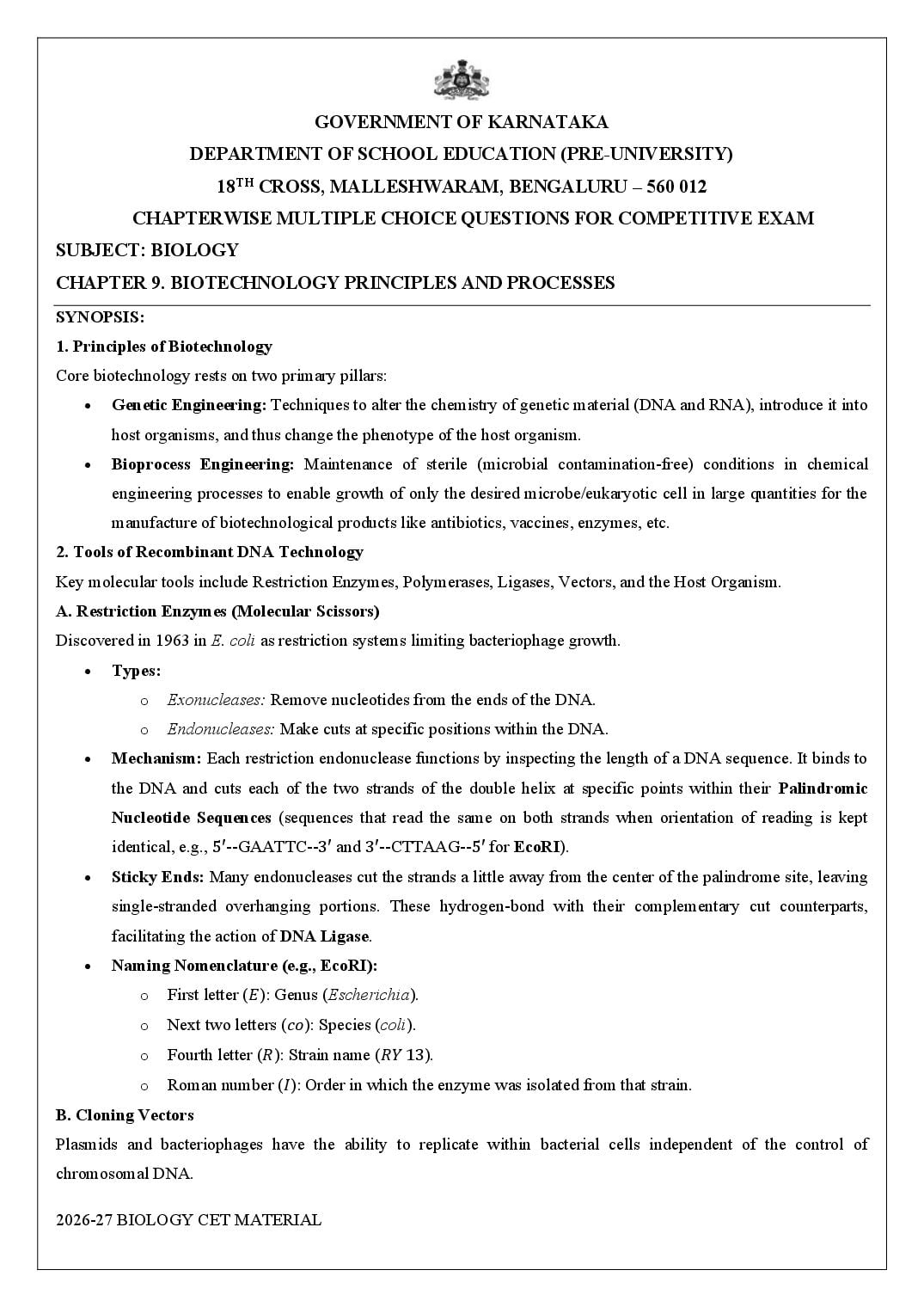
DEPARTMENT OF SCHOOL EDUCATION (PRE-UNIVERSITY)
18TH CROSS, MALLESHWARAM, BENGALURU – 560 012
CHAPTERWISE MULTIPLE CHOICE QUESTIONS FOR COMPETITIVE EXAM
SUBJECT: BIOLOGY
CHAPTER 9. BIOTECHNOLOGY PRINCIPLES AND PROCESSES
SYNOPSIS:
1. Principles of Biotechnology
Core biotechnology rests on two primary pillars:
• Genetic Engineering: Techniques to alter the chemistry of genetic material (DNA and RNA), introduce it into
host organisms, and thus change the phenotype of the host organism.
• Bioprocess Engineering: Maintenance of sterile (microbial contamination-free) conditions in chemical
engineering processes to enable growth of only the desired microbe/eukaryotic cell in large quantities for the
manufacture of biotechnological products like antibiotics, vaccines, enzymes, etc.
2. Tools of Recombinant DNA Technology
Key molecular tools include Restriction Enzymes, Polymerases, Ligases, Vectors, and the Host Organism.
A. Restriction Enzymes (Molecular Scissors)
Discovered in 1963 in E. coli as restriction systems limiting bacteriophage growth.
• Types:
o Exonucleases: Remove nucleotides from the ends of the DNA.
o Endonucleases: Make cuts at specific positions within the DNA.
• Mechanism: Each restriction endonuclease functions by inspecting the length of a DNA sequence. It binds to
the DNA and cuts each of the two strands of the double helix at specific points within their Palindromic
Nucleotide Sequences (sequences that read the same on both strands when orientation of reading is kept
identical, e.g., 5′--GAATTC--3′ and 3′--CTTAAG--5′ for EcoRI).
• Sticky Ends: Many endonucleases cut the strands a little away from the center of the palindrome site, leaving
single-stranded overhanging portions. These hydrogen-bond with their complementary cut counterparts,
facilitating the action of DNA Ligase.
• Naming Nomenclature (e.g., EcoRI):
o First letter (𝐸): Genus (Escherichia).
o Next two letters (𝑐𝑜): Species (coli).
o Fourth letter (𝑅): Strain name (𝑅𝑌 13).
o Roman number (𝐼): Order in which the enzyme was isolated from that strain.
B. Cloning Vectors
Plasmids and bacteriophages have the ability to replicate within bacterial cells independent of the control of
chromosomal DNA.
Page 2
1. Origin of Replication (ori): Sequence where replication starts. A piece of DNA linked to this sequence can be
made to replicate within the host cell. It also controls the copy number of the linked DNA.
2. Selectable Marker: Helps in identifying and eliminating non-transformants and selectively permitting the
growth of transformants. Essential markers for E. coli include antibiotic resistance genes such as ampicillin
(𝑎𝑚𝑝𝑅 ), tetracycline (𝑡𝑒𝑡 𝑅 ), chloramphenicol, and kanamycin.
3. Cloning Sites: To link the alien DNA, the vector needs unique recognition sites for commonly used restriction
enzymes.
Insertional Inactivation: A selection method based on the ability to produce color in the presence of a chromogenic
substrate. A recombinant DNA is inserted within the coding sequence of an enzyme, such as 𝛽-galactosidase (lacZ
gene).
• Non-recombinants: Give blue colored colonies.
• Recombinants: The enzyme gets inactivated by insertion, resulting in white/colorless colonies.
• Vectors for Cloning in Plants/Animals:
o Plants: Agrobacterium tumefaciens delivers a piece of DNA known as 'T-DNA' to transform normal
plant cells into tumors. Its Ti plasmid is modified into a non-pathogenic cloning vector.
o Animals: Retroviruses are disarmed and used to deliver desirable genes into animal cells.
C. Competent Host (For Transformation)
Since DNA is a hydrophilic molecule, it cannot pass through cell membranes. Hosts are treated with a specific
concentration of a divalent cation (e.g., Calcium 𝐶𝑎2+ ) to increase pore efficiency.
• Micro-injection: Recombinant DNA is directly injected into the nucleus of an animal cell.
• Biolistics / Gene Gun: Plant cells are bombarded with high-velocity micro-particles of gold or tungsten coated
with DNA.
• Disarmed Pathogen Vectors: Allowed to infect the cell, transferring the recombinant DNA naturally.
3. Processes of Recombinant DNA Technology
1.Isolation of Genetic Material (DNA):Enzymatic Lysis.
Cells are broken open using enzymes: Lysozyme (bacteria), Cellulase (plants), or Chitinase (fungi). RNA is removed
by Ribonuclease, proteins by Protease. Purified DNA is precipitated out by adding chilled ethanol, appearing as a
collection of fine threads.
2.Cutting of DNA & Amplification (PCR):Polymerase Chain Reaction.
DNA is cut with restriction endonucleases. The gene of interest is amplified millions of times using PCR. PCR involves
three distinct steps repeated in cycles:
1. Denaturation: Heating target DNA to separate strands (~94°C).
2. Annealing: Primers bind to complementary sequences (~54°C).
3. Extension: Taq Polymerase (thermostable DNA polymerase isolated from Thermus aquaticus) extends
primers using nucleotides (~72°C).
3.Ligation and Insertion:Vector Joining.
The amplified gene of interest and cut vector are ligated using DNA ligase to form a recombinant DNA molecule. This
construct is introduced into the competent recipient host cell via transformation methods.
Page 3
Cells harboring the cloned gene are grown in bioreactors (large vessels of 100–1000 liters providing optimal growth
conditions: pH, temperature, substrate, salts, vitamins, oxygen). The culture is then subjected to Downstream
Processing, which includes separation and purification steps, formulated with preservatives, and clinically validated
before market release.
Bioreactor Types
• Simple Stirred-Tank Bioreactor: A cylindrical vessel with a curved base to facilitate mixing. A stirrer
circulates contents and mixes oxygen throughout the bioreactor.
• Sparged Stirred-Tank Bioreactor: Sterile air bubbles are sparged (pumped through the bottom), dramatically
increasing the surface area for oxygen transfer
MULTIPLE CHOICE QUESTIONS
1. Which of the following is true about EFB definition of biotechnology?
(a) It includes traditional view.
(b) It includes modern molecular biotechnology.
(c) Definition is the integration of natural science and organisms, cells, parts thereof, and
molecular analogues for products and services.
(d) All the above
2. For making GMO, the three basic steps that are required are
(a) Identification of DNA with desirable gene.
(b) Introduction of identified DNA into the host.
(c) Maintenance of introduced DNA in the host and transfer of the DNA to its progeny.
(d) All the above
3. In ‘EcoRI’ R stands for
(a) Genus (b) Species (c) Strain (d) Restriction enzyme
4. By which method is rDNA directly placed in nucleus of animal cell?
(a) Gene gun (biolistics) (b) Heat shock (c) CaCl2 (d) Micro-injection
5. The way to introduce alien DNA into host cell includes
(a) Disarmed pathogens (b) Biolistics or gene gun
(c) Micro-injection (d) All of these
6. Arrange the following process in the sequence used in rDNA technology.
(1) Isolation of DNA
(2) Fragmentation of DNA by RE
(3) Isolation of desired DNA fragment
(4) Ligation of DNA fragments into vector
(5) Transferring rDNA into host
(6) Culturing host cells in a medium at large scale
Page 4
(a) 1, 2, 3, 4, 5, 6, 7 (b) 1, 2, 3, 4, 6, 5, 7
(c) 2, 1, 3, 4, 5, 6, 7 (d) 1, 2, 3, 5, 4, 6, 7
7. In majority of organisms the genetic material is
(a) DNA (b) RNA (c) mRNA (d) Protein
8. If any protein encoding gene is expressed in a _________ host, it is called a _________ protein.
(a) Homologous host, recombinant (b) Heterologous host, recombinant
(c) Heterologous host, non-recombinant (d) Homologous host, non-recombinant
9. Bioreactors have
(a) Foam control system, temperature control system (b) Oxygen delivery system
(c) pH control system (d) All the above
10. Which of the following DNA is undigested by restriction endonuclease in this diagram?
(a) Lane 1 (b) Lane 2 (c) Lane 3 (d) Lane 4
11. The best cloning organism for genetic engineering and biotechnology is
(a) Agrobacterium (b) Pseudomonas (c) E. coli (d) Lambda phage
12. Electrophoresis and Southern blotting techniques are used in
(a) DNA fingerprinting (b) Gene synthesis (c) Gene cloning (d) All of these
13. Bacteria possessing restriction endonuclease enzymes remain
(a) Affected by bacteriophages (b) Unattached by bacteriophages
(c) Resistant to bacteriophages (d) None of these
14. Tumour producing plasmid transforms
(a) Animals (b) Plants (c) Bacteria (d) Fungi
15. _________ is the use of biology in industrial process and improvement of quality of life.
(a) Genetic engineering (b) Biotechnology (c) Eugenics (d) Microbiology
16. PCR technique is considered as best for
(a) DNA synthesis (b) DNA amplification (c) Protein synthesis (d) Amino acid synthesis
17. Bacteria protects themselves from viral attack by producing
(a) Exonuclease (b) Endonuclease (c) DNA ligase (d) Gyrase
18. Significance of the ‘heat shock’ method in bacterial transformation is to facilitate
(a) Binding DNA to the cell wall.
(b) Uptake of DNA through membrane transport proteins.
Page 5
(d) Expression of antibiotic resistance gene.
19. In genetic engineering, a DNA segment (gene) of interest, is transferred to the host cell through a
vector. Consider the following four agents (A to D) in this regard and select the correct option
about which one or more of these can be used as a vector/ vectors.
(A) A bacterium
(B) Plasmid
(C) Plasmodium
(D) Bacteriophage
(a) (A), (B) and (D) only (b) (A) only (c) (A) and (C) only (d) (B) and (D) only
20. Which one of the following techniques made it possible to genetically engineer living organisms?
(a) Recombinant DNA techniques (b) X-ray diffraction
(c) Heavier isotope labeling (d) Hybridization
21. Agarose extracted from sea weeds finds use in
(a) Tissue culture (b) PCR (c) Gel electrophoresis (d) Spectrophotometry
22. Which one of the following represents a palindromic sequence in DNA?
(a) 5’-CCAATG-3’ (b) 5’-CATTAG-3’
3’-GAATCC-5’ 3’-GATAAC-5’
(c) 5’-GATACC-3’ (d) 5’-GAATTC-3’
3’-CCTAAG-5’ 3’-CTTAAG-5’
23. Which one is a true statement regarding DNA polymerase used in PCR?
(a) It is used to ligate introduced DNA in recipient cells. (b) It serves as a selectable marker.
(c) It is isolated from a virus. (d) It remains active at high temperature.
24. DNA fragments generated by the restriction endonucleases in a chemical reaction can be
separated by
(a) Centrifugation (b) Polymerase chain reaction
(c) Electrophoresis (d) Restriction mapping
25. Which vector can clone only a small fragment of DNA?
(a) Bacteria artificial chromosome (b) Yeast artificial chromosome
(c) Plasmid (d) Cosmid
26. The taq polymerase enzyme is obtained from:
(a) Thermus aquaticus (b) Thiobacillus ferroxidans
(c) Bacillus subtilis (d) Pseudomonas putida
27. An enzyme catalysing the removal of nucleotides from the ends of DNA is
(a) Endonuclease (b) Exonuclease (c) DNA ligase (d) Hind-II
Page 6
electrophoresis?
(a) DNA can be seen in visible light.
(b) DNA can be seen without staining in visible light.
(c) Ethidium bromide stained DNA can be seen in visible light.
(d) Ethidium bromide stained DNA can be seen under exposure to UV light.
29. In bacterial cells, the membrane is digested with the help of enzyme
(a) cellulose (b) lysozyme (c) chitinase (d) lipase
30. Purified DNA ultimately precipitates out and this can be seen as collection of fine threads in the
suspension as seen in the figure. It refers to
(a) DNA Spooling (b) DNA digestion (c) DNA recognition (d) DNA bands
31. Which of the following statements does not hold true for restriction enzyme?
(a) It recognizes a palindromic nucleotide sequence
(b) It is an endonuclease
(c) It is isolated from viruses
(d) It can produce the same kind of sticky ends in different DNA molecules
32. Which of the following contributed popular using the PCR (Polymer enchain Reaction)
technique?
(a) Easy availability of DNA template (b) Availability of synthetic primers
(c) Availability of cheap deoxyribonucleotides (d) Availability of ‘thermostable’ DNA polymerase
33. Which of the following should be chosen for best yield if one were to produce a recombinant
protein in large amounts?
(a) Laboratory flask of largest capacity (b) A stirred-tank bioreactor without in-lets and out-lets
(c) A continuous culture system (d) All of the above
34. Number of bacterial strains from which restriction enzymes have been isolated.
(a) 230 (b) 450 (c) 300 (d) 270
35. How many fragments will be generated, if a closed circular DNA molecule is digested using a
restriction enzyme having six recognition sites on the DNA?
(a) 12 (b) 6 (c) 3 (d) 0
36. Which of the following option (s) is not correct regarding Eco RI enzyme?
Page 7
(c) Cuts at specific position within the DNA (d) None of the above
37. The DNA fragments separated on an agarose gel can be visualised after staining with
(a) bromophenol blue (b) acetocarmine (c) aniline blue (d) ethidium bromide
38. Read the statements.
I. In the process of recombinant DNA technology, after several treatment the purified DNA is
precipitated by adding chilled acetone.
II. The bacterial/plant, animal cell is broken down by enzymes to release DNA, along with RNA,
proteins, polysaccharides and lipids.
Choose the correct option for above statements.
(a) I is true, but II is false (b) I is false, but II is true
(c) I and II are true (d) I and II are false
39. I. DNA being a hydrophilic molecule cannot pass through cell membranes.
II. The bacteria should be made competent to accept the DNA molecule.
The correct option regarding the above statements is
(a) I is true, but II is false (b) II is true, but I is false
(c) I and II are true (d) I and II are false
40. The method(s) that is/are used to differentiate recombinants and non-recombinants is/are
(a) antibiotic affected gene (b) insertional inactivation
(c) gene cloning (d) Both (a) and (b)
41. Agrobacterium tumefaciens deliver a piece of DNA into dicot plant. The piece of DNA is called as
(a) rDNA (b) T-DNA (c) mDNA (d) cDNA
42. Restriction endonucleases:
(a) Cleave DMA at highly specific recognition sequences
(b) Are inserted into bacteria by bacteriophages
(c) Are made only by eukaryotic cells
(d) Add methyl groups to specific DNA sequences
43. R-Plasmids are
(a) circular protein molecules (b) linear DNA molecules in bacteria
(c) modified bacteria (d) DNA molecules that confer resistance to antibiotics
44. Polyethylene glycol method in used for-
(a) Biodiesel production (b) Seedless fruit production
(c) Energy production from sewage (d) Gene transfer without a vector.
45. Which are among the following in a first cloning plasmid and not an expression plasmid?
(a) pBR-18 (b) Pbr19 (c) pUC18 (d) pBR333
46. Plasmids are-
Page 8
(c) Circular extra chromosomal DNA bacteria (d) viral RNA
47. Identify the plasmid-
(a) Eco RI (b) pBR322 (c) Alu l (d) Hind II
48. Process by which we can add or delete certain gene is:
(a) Gene therapy (b) Biotechnology (c) Genetic engineering (d) Cytogenetics.
49. DNA finger printing is based on:
(a) Clones of DMA (b) DNA segments formed by RE enzymes
(c) Human efforts (d) Gene library.
50. Fill up the blanks -
A. The construction of the first recombinant DNA emerged from the possibility of linking a gene
encoding antibiotic resistance with a native _____ of_____.
B. Hind II always cut DNA molecules at a particular point by recognising a specific sequence of
______ base pairs. This specific sequence is known as ______for Hind II.
C. The ______ in DNA is a sequence of base that reads same on the two strands when orientation of
reading is kept the same.
D. ______, a pathogen of several dicot plants is able to deliver a piece of DNA known as ______to
transform normal plant cells into tumor cells.
(a) A - Plasmid, Salmonella typhimurium; B - Six, Recognition sequence, C - Palindrome, D -
Agrobacterium
tumifaciens, T-DNA
(b) A- Plasmid, Salmonella typhimurium; B - Seven, Recognition sequence, C - Palindrome, D -
Agrobacterium tumifaciens, T-DNA
(c) A- Chromosome, Salmonella typhimurium; B - Six, Recognition sequence, G - Palindrome, D -
Agrobacterium tumifaciens, T-DNA
(d) A - Plasmid, Salmonella typhimurium; B - Six, Recognition sequence, C - Palindrome, D -
Agrobacterium
tumifaciens, Z-DNA
51. Which of the following method can be used for making the bacterial cell 'competent'?
(a) Treating with specific cone, of divalent cation (Ca2+)
(b) Treating with specific cone, of monovalent cation (K+)
(c) Heat shock
(d) Both (a) & (c)
52. Insertional inactivation is related to
(a) Microinjection (b) Gene gun
(c) Gel electrophoresis (d) Selection of recombinants
Page 9
galactosidase, the recombinant colonies should
(a) Give blue colour (b) Not give blue colour
(c) Have active a -galactosidase (d) Both (b) & (c)
54. DNA fingerprinting is done by a technique called:
(a)ELISA (b) Northern blotting (c) Southern blotting (d)RIA.
55. X technique is now routinely used to detect HIV in suspected AIDS patients. It is being used to
detect mutations in genes in suspected cancer patients too. It is a powerful technique to identify
many other genetic disorders. Identify X-
(a) X = PCR (b)X = DMA fingerprinting (c) X = Bioinformatic (d) X = X-ray diffraction
56. Ligase in used for-
(a) Separating DNA (b) Joining two DNA fragments
(c) DNA polymerase reaction (d) All of these
57. Which of the following palindromic sequence is recognised by EcoRI?
(a) (b)
(c) (d)
58. Which of the following can transform normal cells into cancerous cells in animals?
(a) Agrobacterium tumefaciens (b) Retroviruses
(c) DNA-viruses (d) Plasmids
59. The procedure through which a piece of DNA is introduced in a host bacterium is called
(a) Cloning (b) Transformation (c) PCR (d) Clonal selection
60. T-DNA is found in
(a) Saccharomyces (b) Agrobacterium (c) Penicillium (d) Puccinia
61. The first restriction endonuclease reported was
(a) Hind II (b) EcoRI (c) Hind III (d) Bam HI
62. The controlled use of biological agents, such as microorganisms or cellular components, for
beneficial use is called
(a) plant biology (b) biochemistry (c) biotechnology (d) molecular biology
63. Which of the following is used as cloning vehicle?
(a) Bacteriophage (b)Ti plasmid (c) Plasmid pBR 322 (d) All of these
64. Which enzyme is used as gum to join ends of DMA?
(a)EcoRI (b)Ligase (c) Cellulose (d)Pectinase
65. A bioreactor (fermenter) refers to
Page 10
(b) a nuclear reactor for biological studies
(c) a tank for biochemical reactions
(d) organisms reacting to a stimulus
66. In which country first artificial cultivation of mushroom started?
(a) France (b) Italy (c) Austria (d) Germany
67. Which of the following are required to facilitate cloning into a vector?
(a) Origin of replication (b) Selectable marker (c) Cloning sites (d) All of these
68.
Column I Column II
I. Plasmid A. Selectable marker
II. ampr B. Extrachromosomal DNA
III. Ti-plasmic C. Enzyme
IV. Chitinase D. Agrobacterium tumifaciens
(a) I- D, II-A, III-B, IV-C (b)l-B, II-A, III-D, IV-C
(c)l-D, II-A, III-C, IV-B (d)l-A, II-D, III-B, IV-C
69. The technique in which a foreign DNA in precipitated on the surface of tungsten or gold particle
and shot into the targets cells is known as-
(a) Microinjection (b) Chemical mediated gene transfer
(c) Electroporation (d) Particle gun
70. Which of the following vectors are used to deliver a desirable gene into animal and plant cells,
respectively?
(a) Ti plasmid and retroviruses (b) retroviruses and Ti plasmid
(c) bacteriophage and pBR322 (d) pBR322 and bacteriophage
71. Which steps are involved in genetically modifying an organism?
A Identification of desirable DNA
B. Insertion of DNA into the host
C. Maintenance of introduced DNA in the host
D. Isolation of recombinant protein
(a) A, B (b) B, C (c) A, B, C (d) A, B, C, D
72. Which statement is incorrect?
A. Genetic engineering is also called recombinant DNA technology
B. Bacteriophage is not used as vector
C. MALAYALAM is a palindrome
D. Ethidium bromide cannot be used for staining DNA
(a) A, B (b) B, D (c) C, D (d) A, B, C, D
Page 11
processes useful to humans, come under
(a) Biochemistry (b) Biotechnology (c) Biophysics (d) Microbiology
74. Which of the following method is not a part of traditional biotechnology processes?
(a) Curd making (b) Fermentation of bread (c) Wine production (d) PCR
75. The definition of biotechnology given by EFB encompasses
(a) traditional view (b) modern molecular biotechnology
(c) natural science (d) all of these
76. Plasmid vector in recombinant DNA technology means
(a) a virus that transfer gene to bacteria
(b) extra chromosomal replicating circular DNA
(c) sticky end of DNA
(d) any fragment of DNA carrying desirable gene
77. The role of DNA ligase in the construction of a recombinant DNA molecule is
(I) formation of phosphodiester bond between two DNA fragments.
(II) formation of hydrogen bonds between sticky ends of DNA fragments.
(III) ligation of all purine and pyrimidine bases.
(a) I and II (b) II and III (c) I and III (d) I only
78. Match the columns.
Column-I Column-II
(A) Restriction enzymes (1) Extra chromosomal DNA
(B) Cloning (2) Molecular scissors
(C) Plasmid (3) Making multiple identical copies
(D) DNA ligase (4) Sealing enzyme
Codes
A B C D
(a) 2 3 1 4
(b) 4 3 2 1
(c) 1 2 3 4
(d) 3 1 4 2
79. Recombinant DNA Technology can be accomplished only if we use
(I) Restriction enzymes
(II) Ligases
(III) Vectors
(IV) Host organism Choose the correct option
(a) I and II (b) II and III (c) II and IV (d) I, II, III and IV
Page 12
(a) single stranded RNA (b) double stranded DNA
(c) single stranded DNA (d) double stranded RNA
81. Which of the following enzyme is known as molecular scissors?
(a) Ligase (b) DNA polymerase (c) Restriction enzyme (d) Helicase
82. The discovery of molecular scissors-
(a) 1962 (b) 1972 (c) 1982 (d) 1992
83. Genetic engineering aims at:
(a) Destroying wild gene (b) Replacing defective gene
(c) Curing human disease by introducing new gene (d) All the above
84. The term "molecular scissors" refers to
(a) Polymerases (b) Endonucleases (c) Ribonucleases (d) Cellulose
85. Extra chromosomal, self-replicating double stranded circular DNA in bacterial cell is called
(a) Plasmid (b) Cosmid (c) Phagemid (d) Bacteriophage
86. Read the following statement (𝐀 − 𝐄) and answer the question which follows them-
(A) Biotechnology is an integration of natural science and organism, cells, parts thereof and molecular
analogues for production and services.
(B) DNA can be chemically altered by genetic engineering.
(C) Recombinant DNA use DNA polymerase of its host for replication.
(D) Cohen and Boyer are responsible for first artificial synthesis of RNA.
(E) Replication of DNA initiates at origin of replication.
How many of the above statement are correct?
(a) One (b) Two (c) Three (d) Four
87. Sexual reproduction results in-
(a) No variations
(b) Introduction of desirable variations only
(c) Introduction of undesirable variations only
(d) Introduction of many undesirable variations along with desirable variations.
88. Which of the following results in growth of desired organism in biotechnology?
(a) Genetic engineering (b) Maintenance of sterile ambience
(c) Use of restriction enzyme (d) All of the above
89. Which technique results in introduction of one or more desired gene only into the specific host?
(a) Asexual reproduction (b) Sexual reproduction
(c) Genetic engineering (d) Maintaining sterile ambience
90. Modern biotechnology is based on
(a) Protoplast fusion (b) Tissue culture
Page 13
91. Plasmids are used as vectors in genetic engineering because of their:
(a) Resistance to restriction enzymes (b) Ability to cause infection in host
(c) Resistance to antibiotics (d) Ability to carry foreign genes
92. Electrophoresis is used to separate which molecules?
(a) DNA (b) RNA (c) Protein (d) All the above
93. DNA fragments separate according to size through?
(a) Attractive force effect (b) Sieving effect (c) Electrical effect (d) Centrifugal force
94. If the r-plasmid does not have an insert, it will give colonies of which colour?
(a) Green colour (b) Red colour (c) Blue colour (d) No colour
95. A restriction endonuclease breaks bond between
(a) Base pairs of a DNA molecule
(b) Base pairs of a DNA - RNA
(c) Sugar and phosphate components of a nucleic acid molecule
(d) Exons & introns of a DNA molecule
96. Key tools to be involved in recombinant DNA technology are
(A)Restriction enzymes
(B)Polymerase enzyme
(C)Ligase enzyme
(D)Vectors
(a) (A) only (b) (A) & (C) only (c) (A), (B), (C) only (d) All of these
97. The procedure through which a piece of DNA is introduced in a host bacterium is called
(a) Cloning (b) Transformation (c) PCR (d) Clonal selection
98. Separation and purification processes are done in
(a) Downstream processes (b) Gel electrophoresis
(c) Upstream process (d) Selective marker
99. Appropriate techniques have been developed for large scale cell culture using bioreactors for
producing
(a) Foreign gene product (b) Vaccines (c) Hormones (d) All of these
100. Taq polymerase enzyme is a
(a) DNA polymerase obtained from a bacterium (b) DNA polymerase obtained from a fungi
(c) RNA polymerase obtained from a bacterium (d) RNA polymerase obtained from a fungi
KEY ANSWERS:
1. (d) 2. (d) 3. (c) 4. (d) 5. (d) 6. (a) 7. (a)
8. (b) 9. (d) 10. (a) 11. (c) 12. (a) 13. (C) 14. (b)
15. (b) 16. (b) 17. (b) 18. (c) 19. (d) 20. (a) 21. (c)
Page 14
29. (b) 30. (a) 31. (c) 32. (d) 33. (c) 34. (a) 35. (b)
36. (d) 37. (d) 38. (b) 39. (c) 40. (b) 41. (b) 42. (a)
43. (d) 44. (d) 45. (c) 46. (c) 47. (b) 48. (c) 49. (b)
50. (a) 51. (d) 52. (d) 53. (b) 54. (c) 55. (a) 56. (b)
57. (a) 58. (b) 59. (b) 60. (b) 61. (a) 62. (c) 63. (d)
64. (b) 65. (a) 66. (a) 67. (d) 68. (b) 69. (d) 70. (b)
71. (c) 72. (b) 73. (b) 74. (d) 75. (d) 76. (b) 77. (d)
78. (a) 79. (d) 80. (b) 81. (c) 82. (b) 83. (d) 84. (b)
85. (a) 86. (d) 87. (d) 88. (d) 89. (c) 90. (d) 91. (d)
92. (d) 93. (b) 94. (c) 95. (c) 96. (d) 97. (b) 98. (a)
99. (d) 100. (a)
Document Details
| Board / Org | Karnataka Board |
| Exam | Class 12 |
| Type | Question Bank |
| Pages | 14 |
| Updated | 24 Sep 2026 |