Karnataka 2nd PUC Biology Ecosystem MCQ with Answers
Finished viewing? Save it for later —
Download Karnataka 2nd PUC Biology Ecosystem MCQ with Answers (PDF · 13 pages)About Karnataka 2nd PUC Biology Ecosystem MCQ with Answers
Karnataka 2nd PUC Biology Ecosystem MCQ with Answers is available here for free download. Published by Karnataka Board for Class 12, this question bank can be viewed online or downloaded as a PDF (13 pages). Candidates preparing for Class 12 can use Karnataka 2nd PUC Biology Ecosystem MCQ with Answers to understand the exam pattern, the type of questions asked, and the overall difficulty level.
Frequently Asked Questions
How can I download Karnataka 2nd PUC Biology Ecosystem MCQ with Answers?
Open this page and click the Download button to save Karnataka 2nd PUC Biology Ecosystem MCQ with Answers as a PDF. It is completely free on AglaSem Docs.
Is Karnataka 2nd PUC Biology Ecosystem MCQ with Answers free to download?
Yes. Karnataka 2nd PUC Biology Ecosystem MCQ with Answers can be viewed online and downloaded as a PDF free of cost on AglaSem Docs.
How many pages does Karnataka 2nd PUC Biology Ecosystem MCQ with Answers have?
Karnataka 2nd PUC Biology Ecosystem MCQ with Answers contains 13 pages, which you can read online or download together as a single PDF.
Where can I find more Class 12 study material?
You can find more Class 12 question papers, sample papers, syllabus, and answer keys on AglaSem Docs.
Karnataka 2nd PUC Biology Ecosystem MCQ with Answers – Text
Read the full text of this question bank below — useful to quickly search, copy and reference the content online without downloading the PDF.
📄 View text version (13 pages)
Page 1
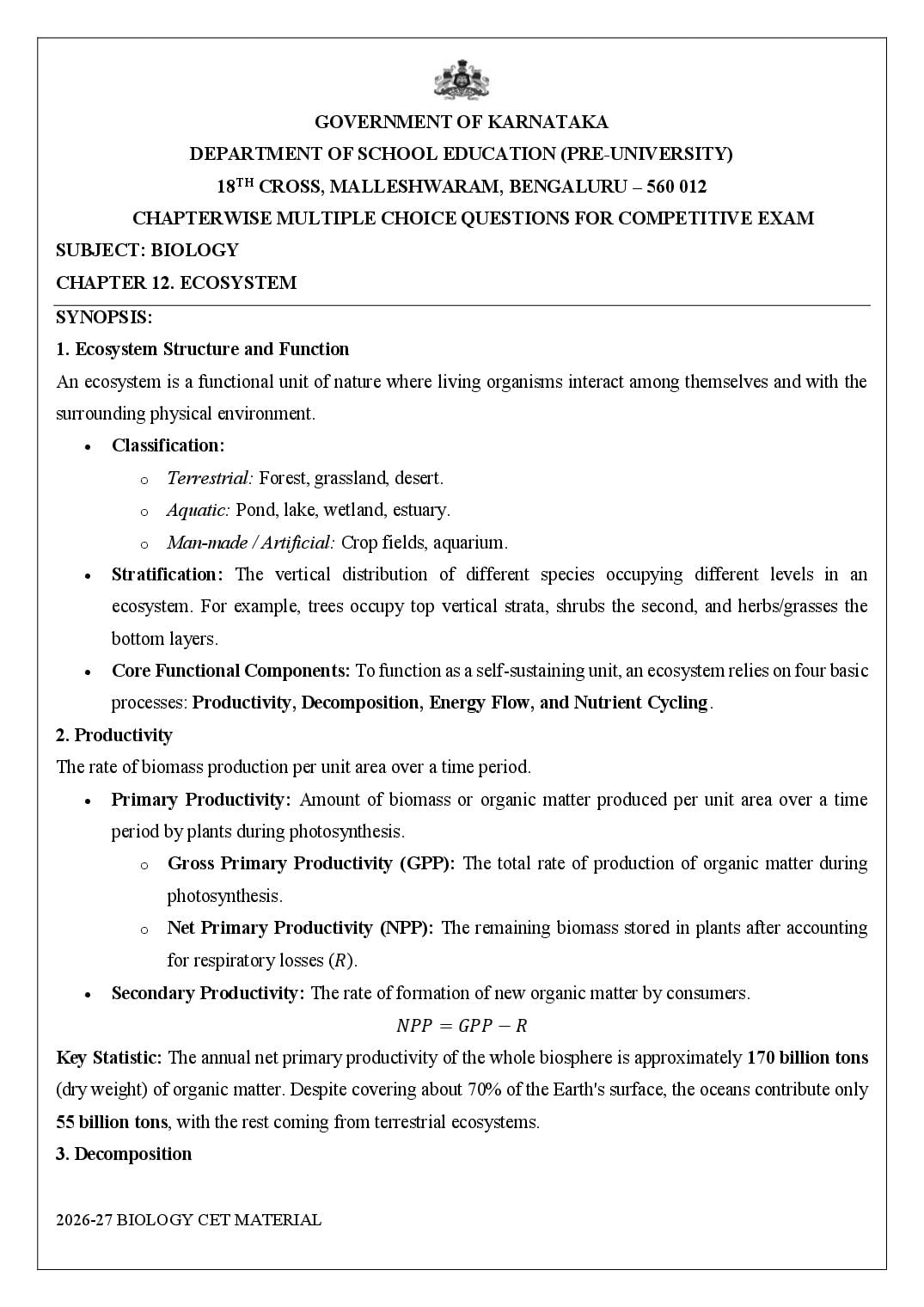
DEPARTMENT OF SCHOOL EDUCATION (PRE-UNIVERSITY)
18TH CROSS, MALLESHWARAM, BENGALURU – 560 012
CHAPTERWISE MULTIPLE CHOICE QUESTIONS FOR COMPETITIVE EXAM
SUBJECT: BIOLOGY
CHAPTER 12. ECOSYSTEM
SYNOPSIS:
1. Ecosystem Structure and Function
An ecosystem is a functional unit of nature where living organisms interact among themselves and with the
surrounding physical environment.
• Classification:
o Terrestrial: Forest, grassland, desert.
o Aquatic: Pond, lake, wetland, estuary.
o Man-made / Artificial: Crop fields, aquarium.
• Stratification: The vertical distribution of different species occupying different levels in an
ecosystem. For example, trees occupy top vertical strata, shrubs the second, and herbs/grasses the
bottom layers.
• Core Functional Components: To function as a self-sustaining unit, an ecosystem relies on four basic
processes: Productivity, Decomposition, Energy Flow, and Nutrient Cycling.
2. Productivity
The rate of biomass production per unit area over a time period.
• Primary Productivity: Amount of biomass or organic matter produced per unit area over a time
period by plants during photosynthesis.
o Gross Primary Productivity (GPP): The total rate of production of organic matter during
photosynthesis.
o Net Primary Productivity (NPP): The remaining biomass stored in plants after accounting
for respiratory losses (𝑅).
• Secondary Productivity: The rate of formation of new organic matter by consumers.
𝑁𝑃𝑃 = 𝐺𝑃𝑃 − 𝑅
Key Statistic: The annual net primary productivity of the whole biosphere is approximately 170 billion tons
(dry weight) of organic matter. Despite covering about 70% of the Earth's surface, the oceans contribute only
55 billion tons, with the rest coming from terrestrial ecosystems.
3. Decomposition
Page 2
dioxide, water, and nutrients. The raw material for decomposition is detritus (dead plant remains and animal
fecal matter).
1.Fragmentation:Mechanical Action.
Detritivores (e.g., earthworms) break down large fragments of detritus into smaller particles.
2.Leaching:Water Transport.
Water-soluble inorganic nutrients sink down into the soil profile and precipitate out as unavailable salts.
3.Catabolism:Enzymatic Break Down.
Bacterial and fungal enzymes degrade complex organic compounds in detritus into simpler inorganic
molecules.
4.Humification:Humus Accumulation.
Leads to the accumulation of a dark-colored, amorphous substance called humus. Humus is highly resistant
to microbial action, undergoes decomposition at an extremely slow rate, and serves as a reservoir of nutrients.
5.Mineralization:Nutrient Release.
The humus is further degraded by specific microbes, releasing inorganic nutrients back into the soil.
Factors Controlling Decomposition:
• Decomposition is an oxygen-consuming process.
• It is slower if detritus is rich in lignin and chitin.
• It is faster if detritus is rich in nitrogen and water-soluble substances like sugars.
• Warm and moist environments favor rapid decomposition, whereas low temperature and anaerobiosis
inhibit it.
4. Energy Flow
Except for deep-sea hydrothermal vents, the Sun is the sole source of energy for all ecosystems on Earth.
• PAR (Photosynthetically Active Radiation): Less than 50% of the total incident solar radiation falls
in this zone. Plants capture only 2–10% of the PAR to sustain the entire living world.
• Thermodynamics: Energy flow is unidirectional (𝑆𝑢𝑛 → 𝑃𝑟𝑜𝑑𝑢𝑐𝑒𝑟 → 𝐶𝑜𝑛𝑠𝑢𝑚𝑒𝑟) and obeys the
Second Law of Thermodynamics (energy is lost as heat at each metabolic transfer step).
Food Chains and Trophic Levels
Organisms occupy a specific place in the natural environment based on their source of nutrition, known as a
trophic level. The mass of living material at a particular trophic level at a given time is called the standing
crop, measured as the biomass or numbers per unit area.
• Grazing Food Chain (GFC): Begins with primary producers (plants) as the major energy conduit in
aquatic ecosystems.
Phytoplankton ⟶ Zooplankton ⟶ Small Fish ⟶ Large Fish
Page 3
(heterotrophic fungi and bacteria). In terrestrial ecosystems, a much larger fraction of energy flows
through the DFC than the GFC.
• Lindeman's 10% Law: Only 10% of the energy is transferred to each higher trophic level from the
lower level; the remaining 90% is lost as heat during metabolic processes.
5. Ecological Pyramids
Graphic representations of trophic structures. The base represents producers, while successive tiers represent
higher trophic levels.
• Pyramid of Number: Typically upright (e.g., grassland ecosystem supporting millions of grasses,
fewer herbivores, and even fewer carnivores). Exception: An inverted pyramid occurs when a single
big tree supports numerous herbivorous insects, which in turn support hyperparasites.
• Pyramid of Biomass: Generally, upright on land. Exception: Inverted in aquatic systems because
the standing crop of phytoplankton (producers) is smaller than that of zooplankton and fish
(consumers), maintained by the rapid turnover rate of phytoplanktons.
• Pyramid of Energy: ALWAYS upright. Energy can never be inverted because some energy is
invariably lost as heat during transfer from one trophic level to the next.
MULTIPLE CHOICE QUSTIONS
1. The following are examples of terrestrial ecosystem except
(a) Forest (b) Wetland (c) Grassland (d) Desert
2. Which of these are examples of aquatic ecosystem?
(a) Pond (b) River (c) Estuary (d) All of these
3. Pond Ecosystem is a
(a) Shallow freshwater body (b) Deep freshwater body
(c) Shallow marine water body (d) Deep marine water body
4. Secondary productivity means
(a) Rate of formation of organic matter by producer.
(b) Rate of formation of new organic matter by consumers.
(c) Rate of formation of inorganic matter by producers.
(d) Rate of formation of inorganic matter by consumers.
5. Net primary productivity (NPP) means
(a) Available biomass for the consumption of heterotrophs
(b) Biomass produced by producers
(c) Gross primary product of respiratory losses
(d) All of the above
6. Detritus contains
(a) Dead plant remains (leaves, bark and flower) (b) Dead animal remains
Page 4
7. Which of these are true about humus?
(a) Dark colored amorphous substance (b) Colloidal in nature
(c) Reservoir of nutrient (d) All of these
8. Decomposition is favored by
(a) Warm and moist environment.
(b) Rich amount of nitrogen and water-soluble substance like sugar in detritus.
(c) Aerobic environment
(d) All the above
9. PAR (Photosynthetically active radiation) from incident solar radiation is
(a) 50% (b) 30% (c) 70% (d) 20%
10. Which law is obeyed during energy flow in an ecosystem?
(a) First law of thermodynamics (b) Second law of thermodynamics
(c) Third law of thermodynamics (d) Both (a) and (b)
11. Which of the following represents simple GFC (Grazing Food Chain)?
(a) Grass → Goat → Man (b) Goat → Grass → Man
(c) Detritus → Fungi → Man (d) Fungi → Detritus → Grass
12. GFC is a major conduit for energy flow in
(a) Terrestrial ecosystem (b) Aquatic ecosystem
(c) Both (a) and (b) (d) None of these
13. Decomposers show
(a) Intracellular digestion (b) Extracellular digestion
(c) Both intra and extracellular digestion (d) No digestion at all
14. Each tropic level has a certain mass of living material at a particular time called
(a) Standing state (b) Stranding crop (c) Ecological pyramid (d) GPP
15. Stranding crop is measured in terms of
(a) Biomass/unit area (b) Number of organism/unit area
(c) Both (a) or (b) (d) None of these
16. A graphical representation known as _________ is required to express food or energy relationship
between organisms at different trophic levels.
(a) Ecological pyramid (b) Standing state
(c) Ecological quadrilateral (d) Standing crop
17. Ecological pyramids are based on
(a) Food chain (b) Food web (c) Energy flow (d) All of these
18. A. Lichens are pioneer species on rocks. (RATIONALISED)
R. They secrete acids to dissolve rocks, it helps in weathering and soil formation.
Page 5
(c) A is correct but R is incorrect (d) R is correct but A is incorrect
19. How many types of nutrient cycles are there? (RATIONALISED)
(a) 1 (b) 2 (c) 3 (d) 4
20. The following elements shows gaseous type of nutrient cycles except(RATIONALISED)
(a) Carbon (b) Nitrogen (c) Oxygen (d) Phosphorus
21. Which nutrients flows through the sedimentary cycle? (RATIONALISED)
(a) Sulphur (b) Phosphorus (c) Both (a) and (b) (d) Carbon
22. Human activities mainly influence the
(a) Carbon cycle (b) Nitrogen cycle (c) Phosphorus cycle (d) Sulphur cycle
23. Global GNP is about: (RATIONALISED)
(a) 33 trillion US $ (b) 18 trillion US $ (c) 12 trillion US $ (d) 22 trillion US $
24. Out of the total cost of various ecosystem services, the soil account for _________ %, recreation
and nutrient cycling are less than _________ % and climate regulation and habitat for wildlife is
about _________ % each. (RATIONALISED)
(a) 50, 6, 10 (b) 50, 10, 6 (c) 50, 30, 20 (d) 20, 30, 50
25. Which of the following nutrient cycle is the most complex? (RATIONALISED)
(a) Nitrogen cycle (b) Phosphorous cycle (c) Carbon cycle (d) Oxygen cycle
26. A plant eaten by a herbivorous animal which in turn is eaten by a carnivorous animal forms a
(a) Food web (b) Food chain (c) Food pyramid (d) Food cycle
27. Which of the following statements is correct for secondary succession? (RATIONALISED)
(a) It occurs on a deforested site
(b) It follows primary succession
(c) It is similar to primary succession except that it has a relatively fast pace
(d) It begins on a bare rock
28. Mass of living matter at a trophic level in an area at any time is called
(a) Detritus (b) Humus (c) Standing state (d) Standing crop
29. Natural reservoir of phosphorus is(RATIONALISED)
(a) Sea water (b) Animal bones (c) Rock (d) Fossils
30. What happens during ecological succession? (RATIONALISED)
(a) The establishment of a new biotic community is very fast in its primary phase.
(b) The numbers and types of animals remain constant.
(c) The changes lead to a community that is in near equilibrium with the environment and is called
pioneer community.
(d) The gradual and predictable change in species composition occurs in a given area
31. In which of the following both pairs have correct combination? (RATIONALISED)
Page 6
cycle sulphur
Sedimentary Nitrogen and
nutrient cycle phosphorus
(b) Gaseous nutrient Nitrogen and
cycle sulphur
Sedimentary Carbon and
nutrient cycle phosphorus
(c) Gaseous nutrient Sulphur and
cycle phosphorus
Sedimentary Carbon and
nutrient cycle nitrogen
(d) Gaseous nutrient Carbon and
cycle nitrogen
Sedimentary Sulphur and
nutrient cycle phosphorus
32. The term ecosystem was coined by:
(a) E. P. Odum (b) A.G. Tansley (c) E. Haeckel (d) E. Warming
33. Which of the following is correctly matched?
(a) Age pyramid-Biome
(b) Parthenium hysterophorus – heart to biodiversity
(c) Stratification-Population
(d) Aerenchyma-Opuntia
34. Maximum primary productivity of pond is achieved by
(a) phytoplankton (b) zooplankton (c) floating plants (d) red algae
35. The process of breaking down complex organic matter into inorganic substances like CO2, water
and nutrient is called
(a) humification (b) mineralization (c) decomposition (d) leaching
36. Humus is
(a) dark coloured amorphous organic matter rich in lignin
(b) dark coloured organic matter rich in cellulose
(c) Both (a) and (b)
(d) red coloured substance rich in iron
37. Which one of the following processes can slow down the process of decomposition?
Page 7
38. All the animals that depend on plants (directly or indirectly) for food are called
(a) decomposers (b) root feeders (c) consumers (d) grazers
39. Frog that feeds on insects, is a
(a) primary consumer (b) secondary consumer
(c) tertiary consumer (d) decompose
40. What is common characteristic of earthworm, soil mites and dung beetle of an ecosystem?
(a) Primary producer (b) Primary consumer
(c) Secondary consumer (d) None of these
41. Identify the possible link ‘A’ in the following food chain.
Plant Insect Frog ‘A’ Eagle
(a) Rabbit (b) Wolf (c) Cobra (d) Parrot
42. The mass of living material at a trophic level at a particular time is called
(a) gross primary productivity (b) standing state
(c) net primary productivity (d) standing crop
43. The tiger is left with 10J of energy in a grass–deer–tiger food chain. The energy available at grass
level is
(a) 200 J (b) 3000 J (c) 1000 J (d) 12,000 J
44. Which one of the following is not a gaseous biogeochemical cycle in ecosystem?
(RATIONALISED)
(a) Oxygen cycle (b) Phosphorus cycle (c) Nitrogen cycle (d) Carbon cycle
45. The relation between producers and consumers in an ecosystem can be graphically represented in
the form of a pyramid called
(a) ecological pyramid (b) trophic level (c) Pi chart (d) pyramid of biomass
46. In the past 150 years there has been a major new input to the carbon cycle. What is it?
(RATIONALISED)
(a) There are more humans releasing large quantities of carbon dioxide as respiration.
(b) Increased animal farming has resulted in greater carbon dioxide releases.
(c) Indoctrination has resulted in the burning of fossil fuels such as oil and coal, which releases carbon
dioxide into the atmosphere.
(d) Changes in ocean currents have lead to the release of large quantities of carbon dioxide
47. What do primary producers have available to convert into biomass?
(a) 10% of secondary productivity (b) energy used for respiration
(c) gross primary productivity (d) net primary productivity
48. Which of the following is not true of a pyramid of productivity?
(a) Only about 10% of the energy in one trophic level is passed into the next level.
Page 8
(c) The pyramid of productivity of some aquatic ecosystems is inverted because of the large zooplankton
primary consumer level
(d) Eating grain-fed beef is an inefficient means of obtaining the energy trapped by photosynthesis
49. Primary productivity
(a) is equal to the standing crop of an ecosystem.
(b) is greatest in freshwater ecosystems.
(c) is the rate of conversion of light to chemical energy in an ecosystem.
(d) is inverted in some aquatic ecosystems.
50. The nature's cleaners are-
(a) Produces (b) Consumers (c) Decomposer and scavenger (d) Symbionts
51. Chemosynthetic bacteria found around deep-sea vents are examples of
(a) producers. (b) decomposers.
(c) chemical cycling. (d) secondary productivity
52. Which of the following always has a "pyramidal" shape, that is, decreasing values at higher
trophic levels?
(a) Pyramids of numbers only (b) Pyramids of biomass only
(c) Pyramids of energy only (d) Both pyramids of biomass and pyramids of energy
53. Which of the following statements about food chains and energy flow through ecosystems is false?
(a) A single organism can feed at several trophic levels.
(b) The lower the trophic level at which an organism feeds, the more energy is available.
(c) Detritivores feed at all trophic levels except the producer level.
(d) Food webs include two or more food chains
54. What is true about photolithotrophs? (RATIONALISED)
(a) Obtain energy from radiations and hydrogen from organic compounds
(b) Obtain energy from radiations and hydrogen from inorganic compounds
(c) Obtain energy from organic compounds
(d) Obtain energy from inorganic compounds
55. Which of the following biogeochemical cycles is characterized by a major reservoir that is gaseous,
and a major inorganic form that can only be utilized by a small group of bacteria and
cyanobacteria? (RATIONALISED)
(a) Carbon cycle (b) Nitrogen cycle (c) Phosphorus cycle (d) Sulfur cycle
56. How much energy, excluding plants' conversion of solar energy into chemical energy, is typically
transferred from production at one trophic level to the next?
(a) 5 - 20% (b) Less than 1 % (c) 20 - 30% (d) 30 - 50%
57. Which of the following biogeochemical cycles lacks a gaseous phase? (RATIONALISED)
Page 9
58. The length of time needed for a lake to regain its pre-eutrophication conditions after nitrogen
input is stopped depends on
(a) the rate of turnover of its waters. (b) the presence of the appropriate algae-eating fish,
(c) whether there is a thermocline in the lake. (d) the amount of groundwater reaching the lake.
59. In the human-induced condition called eutrophication, the main biogeochemical cycle that is
altered is the ______cycle, and the effect is to create ________ conditions and decrease species
diversity. (RATIONALISED)
(a) hydrological, aerobic (b) phosphorus, anaerobic
(c) hydrological, aerobic (d) phosphorus, aerobic
60. Which of the following statements about biogeochemical cycles is false? (RATIONALISED)
(a) Caibon and nitrogen cycle faster than phosphorus.
(b) All biogeochemical cycles include both organisms and nonliving components.
(c) Most elements remain longest in the living portion of their cycle.
(d) You may have atoms in your body that were once part of a dinosaur.
61. Termite is a-
(a) Detrivore (b) Decomposer (c) Saprotroph (d) All of these
62. Which of the following statements about biogeochemical cycles is not true? (RATIONALISED)
(a) Most elements remain longest in the living portion of their cycle.
(b) Gaseous elements cycle more quickly than elements without a gaseous phase.
(c) You may have some atoms in your body that were once part of a dinosaur.
(d) Biogeochemical cycles all include both organismal and nonliving components.
63. The energy transferred from one trophic level to another is-
(a) 1% (b) 10% (c) 3% (d) 40%
64. Second most important trophic level is a lake is
(a) Phytoplankton (b) Zooplankton (c) Benthos (d) Fishes.
65. Percentage of nitrogen in air is about
(a) 78% (b)99% (c) 41% (d) 0.03-.03%
66. Which is correct sequence in the food chain?
(a) Grass -> Wolf -» Deer -» Buffalo (b) Bacteria -» Grass -> Rabbit -> Wolf
(c) Grass ~» insect -> Bird --> Snake (d) Grass -> Snake ~> insect -> Deer.
67. In a food chain, herbivores are
(a) Primary consumers (b) Primary producers (c) Secondary consumers (d) Decomposers
68. The secondary productivity means
(a) Rate of increase in the biomass of autotrophs
(b) Rate of increase in the biomass of heterotrophs
Page 10
(d) The rate at which organic molecules are used up by an autotroph.
69. Mild grazing in grasslands by herbivores-
(a) Retards growth of grasses (b) Destroys vegetation
(c) Ames’s growth of grasses (d) Stimulates growth of grasses
70. Water-logged soil in-
(a) Physically wet but physiologically dry (b) Physically as well as physiologically
(c) Physically as well as physiologically dry (d) Physically dry
71. Food chain starts with -
(a) Respiration (b) Photosynthesis (c) N2-fixation (d) None
72. Which of the following is not an ecosystem?
(a) Crop field (b) Wetland (c) Grassland (d) Rats in an abandoned dwelling
73. Sun is the source of energy in following ecosystems except:
(a) Pond ecosystem (b) Grazing food chain
(c) Deep sea hydrothermal ecosystem (d) Scrub forest
74. All ecosystems have no boundary because-
(a) They require minerals for their functioning (b) They cannot occur in isolation
(c) They are large in size (d) They require light from all sources
75. The biomass available for consumption by the heterotrophs is called:
(a) Net primary productivity (b) Secondary productivity
(c) Standing crop (d) Gross primary productivity
76. If 𝐀 = Gross primary productivity, 𝐁 = Net primary productivity and 𝐂 = Respiration losses, then
what will be the correct relation between them?
(a) A + B = C (b) A + B + C = 1 (c) A − C = B (d) B − C = A
77. NPP is the available biomass for the consumption of
(a) Herbivores (b) Decomposers (c) Producers (d) Both (a) and (b)
78. It is estimated that 170 billion tons (dry weight) to organic weight is produced annually. What
contribution in terms of billion tons is expected by oceans?
(a) 20 (b) 55 (c) 50 (d) 90
79. How does primary production differ when comparing a dense forest to an open grassland?
(a) It is higher in a dense forest due to more available sunlight.
(b) It is lower in a dense forest because of the reduced rate of photosynthesis.
(c) It is higher in a dense forest due to greater biomass accumulation.
(d) It is similar in both ecosystems as sunlight is equally available.
80. Choose the correct sequence:
(a) Leaching → Fragmentation → Catabolism → Humification → Mineralisation
Page 11
(c) Catabolism → Humification → Fragmentation → Leaching → Mineralisation
(d) Fragmentation → Leaching → Humification → Catabolism → Mineralisation
81. Decomposition is slow when detritus is rich in
(a) Nitrogen and water soluble (b) Lipid and fat
(c) Protein and humus (d) Lignin and chitin
82. Extremely slow rates of decomposition can be observed in-
(a) Intact debris (b) Fragmented debris (c) Humus (d) Both (b) and (c)
83. During decomposition, earthworm is involved in -
(a) Fragmentation (b) Leaching (c) Humification (d) Mineralisation
84. Inorganic nutrients are released from humus by the microbial action during-
(a) Fragmentation (b) Leaching (c) Catabolism (d) Mineralisation
85. How many of the following will act as a decomposer in a pond ecosystem?
[Spider, Earthworm, bacteria, Wood Louse, fungus]
(a) One (b) Two (c) Three (d) Four
86. If we completely remove decomposers from an ecosystem, the ecosystem functioning will be
adversely affected because-
(a) Mineral movement will be blocked
(b) Herbivores will not receive solar energy
(c) Energy flow will be blocked
(d) Rate of decomposition of other components will be very high
87. The bacteria which attack the dead animals are-
(a) First link of the food chain and are known as primary producers
(b) Second link of the food chain and are herbivorous
(c) Third link of the food chain and are tertiary consumers
(d) At the end of the food chain and are decomposers
88. In terrestrial, food chain, major amount of energy flow occurs through:
(a) DFC (Detritus Food Chain) than GFC (Grazing Food Chain)
(b) GFC than DFC
(c) Equal amount of energy can flow from both the chains
(d) Dependents upon different species
89. In an ecosystem, the function of the producers is to:
(a) Convert organic compounds into inorganic compounds
(b) Trap solar energy and convert it into chemical energy
(c) Utilize chemical energy
(d) Release energy
Page 12
(a) Standing crop (b) Tropical level (c) Stratification (d) Decomposition
91. Percentage of photosynthetically active radiation (PAR) that is captured by plants in synthesis of
organic matter is:
(a) (50 − 70)% (b) (30 − 40)% (c) (80 − 100)% (d) (2 − 10)%
92. In an aquatic ecosystem, the organism present at the trophic level equivalent to cows in grasslands
is:
(a) Phytoplanktons (b) Nekton (c) Sea gulls (d) Zooplanktons
93. If 10 J of energy is available at the producer level, then amount of energy present at the level of
secondary consumers is:
(a) 10 J (b) 1 J (c) 0.1 J (d) 0.01 J
94. Food chain refers to -
(a) A number of human beings forming a chain for food
(b) The transfer of food energy from producers to consumers
(c) Animals near a source of food
(d) None of the above
95. In a single tree ecosystem, if 𝐏, 𝐐, 𝐑 and 𝐒 represents the smaller birds, tree, insects and larger birds
respectively, then which will be second most abundant in number?
(a) P (b) Q (c) R (d) S
96. In all of the following pyramids of biomass, base is represented by autotrophs except-
(a) In forest (b) In grassland (c) In pond (d) None of the above
97. Pyramid of numbers deals with number of
(a) Species in an area (b) Individuals in a community
(c) Individuals in a trophic level (d) Subspecies in a community
98. Pyramid of number is:
(a) Always upright (b) Always inverted
(c) Either upright or inverted (d) Neither upright nor inverted
99. Pyramid of sea is inverted because -
(a) lower trophic level has more in number
(b) higher trophic level has less in number
(c) high intensity of sunlight
(d) Number of higher trophic level organisms is more than lower trophic level organism
100. In a pyramid of numbers representing an ecosystem of a large freshwater pond, the numbers
of primary consumers are:
(a) Less than the Top consumers (b) Less than the secondary consumers
(c) Less than the producers (d) Less than the tertiary consumers
Page 13
1. (b) 2. (d) 3. (a) 4. (b) 5. (a) 6. (d) 7. (d)
8. (d) 9. (a) 10. (d) 11. (a) 12. (b) 13. (b) 14. (b)
15. (c) 16. (a) 17. (d) 18. (a) 19. (b) 20. (d) 21. (c)
22. (a) 23. (d) 24. (b) 25. (a) 26. (b) 27. (a) 28. (d)
29. (c) 30. (d) 31. (d) 32. (b) 33. (b) 34. (a) 35. (c)
36. (a) 37. (a) 38. (c) 39. (b) 40. (b) 41. (c) 42. (d)
43. (c) 44. (b) 45. (a) 46. (c) 47. (d) 48. (c) 49. (c)
50. (c) 51. (a) 52. (c) 53. (c) 54. (b) 55. (b) 56. (a)
57. (c) 58. (a) 59. (b) 60. (c) 61. (a) 62. (a) 63. (b)
64. (b) 65. (a) 66. (c) 67. (a) 68. (b) 69. (d) 70. (a)
71. (b) 72. (d) 73. (c) 74. (b) 75. (a) 76. (c) 77. (d)
78. (b) 79. (c) 80. (b) 81. (d) 82. (c) 83. (a) 84. (d)
85. (b) 86. (a) 87. (d) 88. (a) 89. (b) 90. (a) 91. (d)
92. (d) 93. (c) 94. (b) 95. (a) 96. (c) 97. (c) 98. (c)
99. (d) 100. (c)
Document Details
| Board / Org | Karnataka Board |
| Exam | Class 12 |
| Type | Question Bank |
| Pages | 13 |
| Updated | 24 Sep 2026 |