Karnataka 2nd PUC Biology Evolution MCQ with Answers
Finished viewing? Save it for later —
Download Karnataka 2nd PUC Biology Evolution MCQ with Answers (PDF · 15 pages)About Karnataka 2nd PUC Biology Evolution MCQ with Answers
Karnataka 2nd PUC Biology Evolution MCQ with Answers is available here for free download. Published by Karnataka Board for Class 12, this question bank can be viewed online or downloaded as a PDF (15 pages). Candidates preparing for Class 12 can use Karnataka 2nd PUC Biology Evolution MCQ with Answers to understand the exam pattern, the type of questions asked, and the overall difficulty level.
Frequently Asked Questions
How can I download Karnataka 2nd PUC Biology Evolution MCQ with Answers?
Open this page and click the Download button to save Karnataka 2nd PUC Biology Evolution MCQ with Answers as a PDF. It is completely free on AglaSem Docs.
Is Karnataka 2nd PUC Biology Evolution MCQ with Answers free to download?
Yes. Karnataka 2nd PUC Biology Evolution MCQ with Answers can be viewed online and downloaded as a PDF free of cost on AglaSem Docs.
How many pages does Karnataka 2nd PUC Biology Evolution MCQ with Answers have?
Karnataka 2nd PUC Biology Evolution MCQ with Answers contains 15 pages, which you can read online or download together as a single PDF.
Where can I find more Class 12 study material?
You can find more Class 12 question papers, sample papers, syllabus, and answer keys on AglaSem Docs.
Karnataka 2nd PUC Biology Evolution MCQ with Answers – Text
Read the full text of this question bank below — useful to quickly search, copy and reference the content online without downloading the PDF.
📄 View text version (15 pages)
Page 1
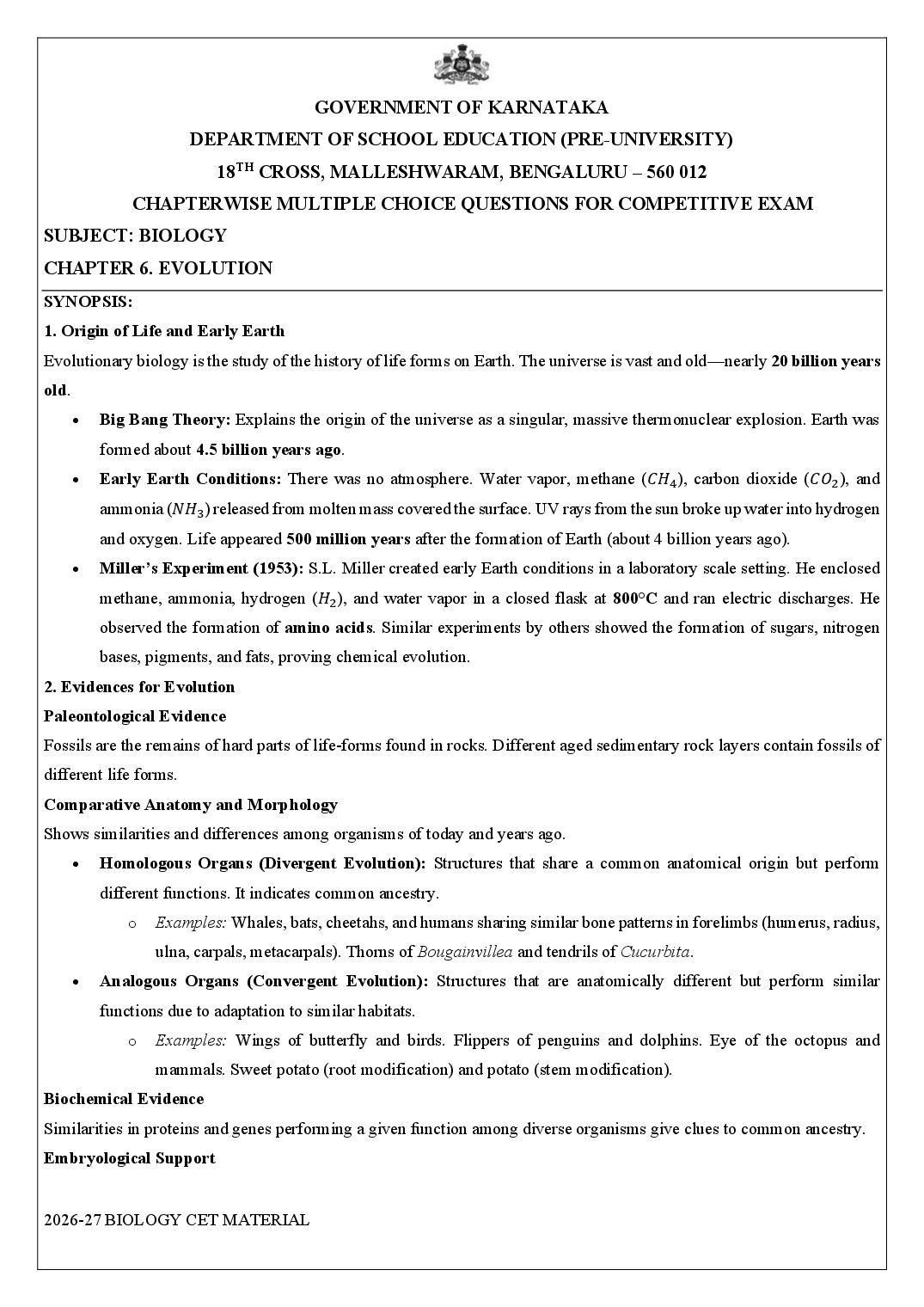
DEPARTMENT OF SCHOOL EDUCATION (PRE-UNIVERSITY)
18TH CROSS, MALLESHWARAM, BENGALURU – 560 012
CHAPTERWISE MULTIPLE CHOICE QUESTIONS FOR COMPETITIVE EXAM
SUBJECT: BIOLOGY
CHAPTER 6. EVOLUTION
SYNOPSIS:
1. Origin of Life and Early Earth
Evolutionary biology is the study of the history of life forms on Earth. The universe is vast and old—nearly 20 billion years
old.
• Big Bang Theory: Explains the origin of the universe as a singular, massive thermonuclear explosion. Earth was
formed about 4.5 billion years ago.
• Early Earth Conditions: There was no atmosphere. Water vapor, methane (𝐶𝐻4 ), carbon dioxide (𝐶𝑂2 ), and
ammonia (𝑁𝐻3 ) released from molten mass covered the surface. UV rays from the sun broke up water into hydrogen
and oxygen. Life appeared 500 million years after the formation of Earth (about 4 billion years ago).
• Miller’s Experiment (1953): S.L. Miller created early Earth conditions in a laboratory scale setting. He enclosed
methane, ammonia, hydrogen (𝐻2 ), and water vapor in a closed flask at 800°C and ran electric discharges. He
observed the formation of amino acids. Similar experiments by others showed the formation of sugars, nitrogen
bases, pigments, and fats, proving chemical evolution.
2. Evidences for Evolution
Paleontological Evidence
Fossils are the remains of hard parts of life-forms found in rocks. Different aged sedimentary rock layers contain fossils of
different life forms.
Comparative Anatomy and Morphology
Shows similarities and differences among organisms of today and years ago.
• Homologous Organs (Divergent Evolution): Structures that share a common anatomical origin but perform
different functions. It indicates common ancestry.
o Examples: Whales, bats, cheetahs, and humans sharing similar bone patterns in forelimbs (humerus, radius,
ulna, carpals, metacarpals). Thorns of Bougainvillea and tendrils of Cucurbita.
• Analogous Organs (Convergent Evolution): Structures that are anatomically different but perform similar
functions due to adaptation to similar habitats.
o Examples: Wings of butterfly and birds. Flippers of penguins and dolphins. Eye of the octopus and
mammals. Sweet potato (root modification) and potato (stem modification).
Biochemical Evidence
Similarities in proteins and genes performing a given function among diverse organisms give clues to common ancestry.
Embryological Support
Page 2
vertebrates (e.g., vestigial gill slits). It was disproved by Karl Ernst von Baer, who noted that embryos never pass through
the adult stages of other animals.
3. Theories of Evolution
Adaptive Radiation
The process of evolution of different species in a given geographical area starting from a point and literally radiating to
other areas of geography (habitats).
• Examples: Darwin's Finches on the Galapagos Islands (evolved from an original seed-eating ancestral stock into
insectivorous and vegetarian finches with altered beaks). Australian Marsupials (a number of different marsupials
evolved from an ancestral stock within the isolated Australian continent).
Biological Evolution
According to Lamarck, evolution occurred by the use and disuse of organs (e.g., giraffes elongating their necks to forage
leaves on tall trees; inherited by progeny). This theory is no longer accepted.
Darwinian theory points to two core concepts: Branching descent and Natural Selection.
• Industrial Melanism: In England, before industrialization (1850s), white-winged moths were abundant on lichen-
covered tree trunks. After industrialization (1920s), dark-winged (melanized) moths became dominant because soot
covered the trunks, making white moths vulnerable to predators. This proved that the nature-selected entity
survives.
Mutation Theory of Evolution
Proposed by Hugo de Vries based on his work on the evening primrose (Oenothera lamarckiana).
• He believed that mutations (large, single-step directional changes) are the real cause of evolution, not the minor
heritable variations Darwin talked about.
• Darwinian variations are small and directional; mutations are random and directionless. De Vries called single-step
large mutations Saltation.
4. Hardy-Weinberg Principle
In a given population, the frequency of occurrence of alleles of a gene or a locus can be calculated. The principle states that
allele frequencies in a population are stable and constant from generation to generation (Genetic Equilibrium).
The algebraic representation is:
𝑝2 + 2𝑝𝑞 + 𝑞 2 = 1
Where:
• 𝑝 and 𝑞 represent the frequencies of individual alleles (e.g., 𝐴 and 𝑎).
• 𝑝2 represents the frequency of homozygous dominant individuals (𝐴𝐴).
• 𝑞 2 represents the frequency of homozygous recessive individuals (𝑎𝑎).
• 2𝑝𝑞 represents the frequency of heterozygous individuals (𝐴𝑎).
Factors Affecting Hardy-Weinberg Equilibrium
Five factors are known to disrupt this equilibrium, leading to evolutionary change:
1. Gene Migration / Gene Flow: Multiple transfers of genes across populations.
2. Genetic Drift: Random change in allele frequencies occurring purely by chance. If a small group splits from a
population and fixes a new gene profile, they act as founders (Founder Effect).
Page 3
4. Genetic Recombination: Shuffling of genes during meiosis.
5. Natural Selection: Can lead to three outcomes:
o Stabilizing Selection: More individuals acquire the mean character value.
o Directional Selection: More individuals acquire value other than the mean character value.
o Disruptive Selection: More individuals acquire peripheral character values at both ends of the distribution
curve.
5. A Brief Account of Evolution
• 2000 mya (million years ago): The first cellular forms of life appeared on Earth.
• 500 mya: Invertebrates were formed and active.
• 350 mya: Jawless fish evolved. Lobefins (fish that could move on land and go back to water) existed; these were
ancestors of modern amphibians.
• 200 mya: Reptiles dominated the Earth (Dinosaurs like Tyrannosaurus rex, which was about 20 feet high with
huge dagger-like teeth). Dinosaurs suddenly disappeared around 65 mya.
6. Origin and Evolution of Man
1.Dryopithecus & Ramapithecus:~15 mya.
Hairy and walked like gorillas and chimpanzees. Dryopithecus was more ape-like, while Ramapithecus was more man-like.
2.Australopithecines:~2-3 mya.
Lived in East African grasslands. Hunted with stone weapons but essentially ate fruit.
3.Homo habilis:First human-like hominid.
Brain capacity was between 650–800 cc. They did not eat meat.
4.Homo erectus:~1.5 mya.
Had a large brain capacity of around 900 cc. They ate meat.
5.Neanderthal Man:100,000 to 40,000 years ago.
Brain size of 1400 cc. Lived in near-East and Central Asia. Used hides to protect their bodies and buried their dead.
6.Homo sapiens:75,000 to 10,000 years ago.
Modern humans arose in Africa during the ice age and moved across continents. Pre-historic cave art developed around
18,000 years ago; agriculture started around 10,000 years ago.
MULTIPLE CHOICE QUESTIONS
1. Select the false statement from the following.
(a) Big bang theory is used to explain the origin of the universe.
(b) Expansion of the universe after the explosion lead to a decrease in temperature.
(c) Hydrogen and helium had formed before the explosion.
(d) Gases condensed under gravitation and formed galaxies.
2. Find out the correct statement from the following.
(A) According to Darwin, there is a gradual evolution of life forms.
(B) Darwin travelled around the world in a sail ship named H.M.S. Beagle.
(C) Alfred Wallace worked in Malay Archipelago.
Page 4
(a) A and B only (b) B only (c) C only (d) All are correct
3. Which of the following is an example of anthropogenic evolution?
(a) Selection of resistant varieties due to herbicides.
(b) Selection of resistant varieties due to pesticides.
(c) Industrial melanism
(d) All the above
4. Homo habilis had a cranial capacity of nearly
(a) 650–800 cc (b) 900 cc (c) 1400 cc (d) 1500 cc
5. Which of these features belong/s to mammals?
(a) Viviparous, avoid danger (b) More intelligent in sensing
(c) Both (a) and (b) (d) None of these
6. Conifers were most abundant in
(a) Paleozoic era (b) Mesozoic era (c) Cenozoic era (d) All eras
7. The five factors affecting genetic equilibrium are
(a) Gene flow, genetic drift (b) Mutation, genetic recombination
(c) Natural selection (d) All of these
8. Natural selection is which of the following types?
(a) Stabilizing (b) Disruptive (c) Directional (d) Any of these
9. Variation may be due to
(a) Mutation (b) Genetic recombinant during gametogenesis
(c) Gene flow or genetic drift (d) All the above
10. Life was created by some supernatural power. This theory is
(a) Abiogenesis (b) Spore theory (c) Special creation theory (d) Spontaneous generation
11. Stanley Miller proposed the origin of life by
(a) Biogenesis (b) Abiogenesis (c) Chemical synthesis (d) None of these
12. Organs which have the same fundamental structure but different functions are called
(a) Vestigial organs (b) Analogous organs (c) Homoplastic organs (d) Homologous organs
13. Name the organism represented by A to F in the illustration.
(a) A: Tigercat, B: Banded anteater, C: Marsupial rat, D: Wombat, E: Bandicoot, F: Koala
Page 5
(c) A: Koala, B: Banded anteater, C: Tigercat, D: Bandicoot, E: Marsupial rat, E: Wombat
(d) A: Wombat, B: Tigercat, C: Koala, D: Bandicoot, E: Banded anteater, F: Marsupial rat
14. Analogy is found between
(a) Wings of birds and bats (b) Wings of bat and butterfly
(c) Hands of man and flippers of whale (d) Hands of man and forelimbs of horse
15. The study of fossils as evidence of evolution is called
(a) Anatomy (b) Embryology (c) Palaeontology (d) Biogeography
16. Our best estimate for the age of Earth, which is 4.5 billion years is supported by
(a) Gradualism (b) Big bang theory
(c) Assumption of uniformitarianism (d) Radioactive dating of the oldest rocks found
17. If you want to see a dinosaur, it would be the best to set the controls of your time machine for
the
(a) Mesozoic era (b) Precambrian era (c) Palaeozoic era (d) Pleistocene period
18. The most important theory of evolution was proposed by
(a) Beadle and Tatum (b) Watson and Crick
(c) Darwin and Wallace (d) Mendel and Morgan
19. Most modern breeds of domestic dog have been evolved through
(a) Isolation (b) Sexual selection (c) Artificial selection (d) Natural selection
20. The material in which Hugo de Vries experimented to explain the mechanism of evolution
thus pioneering the theory of mutations was
(a) Fruit fly (b) China rose (c) Garden pea (d) Evening primrose
21. The processes of ________ and ________ generate variation and ________ produces adaptation
to the environment.
(a) Sexual selection, natural selection, mutation (b) Mutation, sexual recombination, genetic drift
(c) Genetic drift, mutation, sexual recombination (d) Mutation, sexual recombination, natural selection
22. The spread of genes from one breeding population to another by migration which may result
in change in gene frequency is
(a) Gene flow (b) Genetic drift (c) Gene frequency (d) None of these
23. Darwin’s finches are found in
(a) Tahiti (b) Tundra (c) Galapagos Island (d) None of these
24. Which of the following defines Hardy–Weinberg’s law?
(a) p2 + 2pq + q2 = 0 (b) q2 + p2 + 2pq = 0
(c) p2 + 2pq + q2 = 1 (d) p2 + 3pq + q2 = 1
25. In this figure, which kind of selection does A, B and C represent respectively?
Page 6
(c) A: Disruptive, B: Stabilizing, C: Directional (d) A: Directional, B: Disruptive, C: Stabilizing
26. The most apparent change during the evolutionary history of Homo sapiens is raced in
(a) Loss of body hair (b) Walking upright
(c) Shortening of the jaws (d) Remarkable increase in brain size
27. The tendency of population to remain in genetic equilibrium may be disturbed by
(a) Random mating (b) Lack of migration
(c) Lack of mutations (d) Lack of random mating
28. Industrial melanism is an example of:
(a) Natural selection (b) Mutation (c) Leo Lamarckism (d) Neo Darwinism
29. The bones of forelimbs of whale, bat, cheetah and man are similar in structure, because
(a) One organism has given rise to another (b) They share a common ancestor
(c) They perform the same function (d) They have biochemical similarities
30. Analogous organs arise due to
(a) Divergent evolution (b) Artificial selection (c) Genetic drift (d) Convergent evolution
31. Viviparity is considered to be more evolved because
(a) The young ones are left on their own.
(b) The young ones are protected by a thick shell.
(c) The young ones are protected inside the mother’s body and are looked after when they are born
leading to more chances of survival.
(d) The embryo takes a long time to develop.
32. For the MN-blood group system, the frequencies of M and N alleles are 0.7 and 0.3, respectively.
The expected frequency of MN-blood group bearing organisms is likely to be
(a) 42 per cent (b) 49 per cent (c) 9 per cent (d) 58 per cent
33. Which of the following is an example for link species?
(a) Lobe fish (b) Dodo bird (c) Seaweed (d) Chimpanzee
34. Which theory arguments that life on earth came from outer space through spores?
(a) Theory of panspermia (b) Cosmozoic theory
(c) Spore theory (d) More than one option is correct
35. The given diagram represents Miller’s experiment. Choose the correct combination of labelling for A,
B, C and D.
Page 7
(b) A–Electrodes, B–NH4 + H2 + CO2 + CH3, C–Vacuum pump, D–U-trap
(c) A–Electrodes, B–NH3 + H2O, C–Condenser, D–Vacuum pump
(d) A–Electrodes, B–NH3 + H2 + H2O+ CH4, C–Boiling water, D–Vacuum pump
36. Which of the following statements regarding the evolution of plants and animals are correct?
I. Amphibians evolved into reptiles.
II. Fish with stout and strong fins could move on land and go back to water. This was about 350 million
years ago.
III. Giant ferns fell to form coal deposits slowly.
IV. About 65 million years ago dinosaurs died out.
V. Archaeopteryx is the connecting link between birds and reptiles.
The correct combination is
(a) I and II (b) III and IV (c) V and I (d) I, II, III, IV and V
37. Choose the correct statements with reference to organic evolution.
I. Flippers of whale and wings of bat exhibit analogy.
II. Wings of butterflies and wings of birds exhibit homology.
III. Organs with dissimilar structures are called analogous organs.
IV. Organs with similar structure and origin are called homologous organs.
(a) I and IV (b) I and III (c) III and IV (d) II and IV
38. Consider the following statements.
I. Darwin asserted that heritable variations and better resource utilization enable an individual to
reproduce efficiently.
II. Darwinian variations were small and directional select the correct option.
(a) I is true, II is false (b) I is false, II is true
(c) Both I and II are true (d) Both I and II are false
39. Which one of the following was not explained by Darwinism?
(a) Natural selection (b) Struggle for existence
(c) Arrival of the fittest (d) Origin of species
40. Hardy-Weinberg principle is the
Page 8
(c) varying allele frequency in a population (d) phenotypic structure of a non-evolving population
41. Analogous organs arise due to
(a) divergent evolution (b) artificial selection (c) genetic drift (d) convergent evolution
42. Which of the following is used as an atmospheric pollution indicator?
(a) Lepidoptera (b) Lichens (c) Lycopersicon (d) Lycopodium
43. Giant dinosaurs and reptiles predominated during the Jurassic period. This period was also marked
for the evolution of higher insects and angiosperms, conifers, cycads, etc. Jurassic period belongs to
which era?
(a) Cenozoic (b) Palaeozoic (c) Mesozoic (d) Proterozoic
44. Choose the incorrect pair.
(a) Ramapithecus – Man-like
(b) Dryopithecus – Ape-like
(c) Fossil of man-like bones were discovered – Ethiopia and Tanzania
(d) Australopithecus – Probably lived in Western Africa desert
45. First human like hominid is known as
(a) Neanderthal man (b) Homo habilis (c) Dryopithecus (d) Homo erectus
46. The presence of salts (NaCI and others) in the animal body fluids gives an inference that life
originated in the:
(a) rain water (b) salt solutions (c) primitive ocean (d) none of these
47. Select the wrong pair:
(a) Oparin — Protobiont (b) Spallanzani — Abiogenesis
(c) Fox — Coacervates (d) Haldane — Hot dilute soup
48. The most primitive cell-like chemical aggregates capable of growth and division were -
(a)eobionts (b) prokaryotes (c) microspheres (d) chemoautotrophs
49. Origin of life as a result of chemical evolution was properly explained by:
(a) Fax (b) Oparin (c) Watson (d) Haeckel
50. Evolutionary convergence is the development of:
(a) common set of characters in groups of different ancestry
(b) common set of characters in closely related groups
(c) dissimilar characters in closely related groups
(d) random mating
51. Which of the following are not analogous organs?
(a) Stings of honeybee and scorpion (b) Fins of fishes and flippers of whales
(c) Wings of insect and wings of pterosaur (d) Thorn of Bougainvillea and tendril of Cucurbita . ,,
52. Which group includes homologous organs?
Page 9
(b) Tentacles of Hydra and arms of starfish
(c) Fins of seal, wings of birds and forelimbs of man
(d) Horns of cattle, tail of horse and teeth of mammals
53. Convergent evolution is shown by:
(a) rabbit and dog (b) starfish and jellyfish (c) fish and whale (d) bacteria and Amoeba
54. Which of the following are analogous organs?
(a) Wings of bird and bat (b) Wings of insect and bird
(c) Forelegs of horse and arms of man (d) Flippers of whale and forelimbs of man
55. Some organisms escape detection from enemies by resembling other organisms.
(a) mimicry (b) homology (c) natural selection (d) artificial selection
56. Which one(s) is / are correct -
(a) Directional selection favours one extreme form over the other extreme and over intermediate forms of a
trait.
(b) Stabilizing selection favours intermediate forms of a trait
(c) Disruptive selection favours both extreme forms of a trait.
(d) All of the above
57. The sequence of origin of life may be-
(a) Inorganic materials ---- organic materials ---- colloidal aggregate ---- Eobiont ---- cell.
(b) Organic materials ---- Inorganic materials ---- colloidal aggregate ---- Eobiont ---- cell
(c) Inorganic materials ---- organic materials ---- Eobiont -» cell -» colloidal aggregate.
(d) Organic materials ---- Inorganic materials ---- Eobiont ---- cell ---- colloidal aggregate.
58. Which is-the correct chronological sequence of human evolution -
(a) Dryopithecus -» Ramapithecus -» Australopithecus -» Homohabilis -» H. erectus -> Cro-magnonon -> H.
sapiens sapeins
(b) Ramapithecus -» Australopithecus -> Homohabilis -> H. erectus -> Cro-magnonon -» Dryopithecus ->
H.sapiens sapeins
(c) Dryopithecus -> Ramapithecus -» Homohabilis -» H. erectus -» Cro-magnonon -» Australopithecus -> H.
sapiens sapeins
(d) Dryopithecus ->• Ramapithecus -» H. sapiens sapeins -> Australopithecus -» Homohabilis —> H. erectus ->
Cro-magnonon
59. What can you infer about these structures?
Page 10
(c) they are analogous (d) they have nothing to do with each other
60. Which of these statements is true?
(a) A higher percentage of light moths were recaptured in the city compared to dark moths recaptured in the
city.
(b) A higher percentage of dark moths were recaptured in the country compared to dark moths recaptured in the
city.
(c) A higher percentage of light and dark moths were recaptured in the country compared to-light and dark
moths recaptured in the city.
(d) A higher percentage of light moths were recaptured in the country compared to dark moths recaptured in the
Country
61. The diagram below represents a section of undisturbed layers of sedimentary rock in New York State
and shows the location of fossils of several closely related species. According to currently accepted
evolutionary theory, which is the most probable assumption about species A, B, and C?
(a) Species B is more abundant than species C (b) Species C existed before species B
(c) Species A and B are genetically identical (d) Species B descended from species A
62. The illustration below shows the skull of two different mammals. Use the illustration to answer the
question that follows
Which of the following accurately describes the differences between these skulls?
(a) Skull A has more teeth than skull B
(b) Skull A has more brain capacity than skull B
(c) Skull A is of a primate, and skull B is not of a primate
(d) Skull A is the skull of an ape and skull B is the skull of human
Page 11
form intermediate between these two, are found in Britain today. The melanic form was first
observed in 1848 and its frequency subsequently increased. This is thought to be the result of
(a) adaptive radiation. (b) convergent evolution.
(c) divergent evolution. (d) natural selection.
64. Which of the following ways is most likely to decrease the genetic diversity in a population?
(a) Gene mutation (b) Genetic Recombination
(c) Stabilizing natural selection (d) Immigration of individuals
65. Mark the incorrect statement
(a) The fitness of the individuals, according to Charles Barwin, means reproductive fitness
(b) Homology in> vertebrates'; brain indicates their common ancestry
(c) The idea of survival of fittest of Alfred R Wallace was based on his studies
(d) All of these
66. Darwin believed that a giraffe has a long neck because
(a) a creator designed it that way
(b) catastrophes eliminated short-necked forms
(c) its ancestors stretched their necks to get food
(d) ancestral giraffes with slightly longer necks than other got more food and left more surviving offspring
67. Which statement about the rates of evolution for different species is in agreement with the theory of
evolution?
(a) They are identical, since the species live on the same planet.
(b) They are identical, since each species is at risk of becoming extinct.
(c) They are different, since each species has different adaptations that function within a changing environment.
(d) They are different, since each species has access to unlimited resources within its environment.
68. Many animals exist today in a form that is almost identical to the form they had a million years ago.
What is the most probable explanation for this lack of evolutionary change?
(a) Genetic mutations have occurred among animals.
(b) The environment of these animals remained about the same.
(c) These animals reproduce by sexual reproduction.
(d) Complex organisms evolved into simpler ones.
69. Which one of the following options gives one correct example each of convergent evolution and
divergent evolution? Convergent evolution Divergent evolution
(a) Eyes of octopus and mammals Bones of forelimbs of vertebrates
(b) Thorns of Bougainvillea and tendrils of Cucurbita Wings of butterflies and birds
(c) Bones of forelimbs of vertebrates Wings of butterfly and birds
(d) Thorns of Bougainvillea and tendrils of Cucurbita Eyes of Octopus and mammals
Page 12
Neanderthals to be related?
(a) Yes, because we share a common ancestor
(b) Yes, but only if humans and Neanderthals could have interbred
(c) No, because the human evolutionary tree is strictly linear and without branches
(d) No, because this means that Neanderthals evolved from an entirely different branch of organisms than
humans did
71. Which of the following factor does not affect Hardy-Weinberg's equilibrium
(a) Gene migration (b) Natural selection
(c) Genetic drift (d) Replication of genetic material
72. The most apparent change during the evolutionary history of Homo sapiens is traced in
(a) Loss of body hair (b) Walking upright
(c) Shortening of the jaws (d) Remarkable increase in the brain size
73. Which of the following statements regarding evolution is incorrect?
(a) Evolution explains the origin of both present and extinct organisms.
(b) Evolution creates diversity in populations.
(c) Evolution is the accumulation of genetic changes in a population over generations.
(d) In biology, evolution refers to the genetically identical line of descent.
74. The concept of chemical evolution was given by
(a) Louis Pasteur (b) Oparin and Haldane (c) Morgan (d) Darwin
75. The conditions simulated by Miller in his experiment to prove the chemical evolution of life on
primitive Earth include:
(a) low temperature, volcanic storms, atmosphere rich in oxygen
(b) low temperature, volcanic storms, reducing atmosphere
(c) high temperature, volcanic storms, non-reducing atmosphere
(d) high temperature, volcanic storms, reducing atmosphere containing CH4, NH3, etc.
76. Given below is the diagrammatic representation of Miller’s experiment. Which of the following
options correctly describe all the labels?
(a) A: Spark; B: Electrodes; C: Condenser; D: Gases
Page 13
(c) A: Condenser; B: Spark; C: Gases; D: Electrodes
(d) A: Spark; B: Condenser; C: Gases; D: Electrodes
77. Which of the following sets of organic products were obtained in the Miller experiment?
(a) 25 amino acids, fatty acids, hydroxyl acids and amide products
(b) more than 2 amino acids, fatty acids, hydroxyl acids and amide products
(c) Fatty acids, hydroxyl acids, and amide products
(d) 25 amino acids and amide products
78. According to Oparin, which of the following was not present in the primitive atmosphere of the
ease?
(a) Methane (b) Oxygen (c) Hydrogen (d) Water vapour
79. Which of the following was not found in free form during origin of life?
(a) Ammonia (b) Methane (c) Oxygen (d) Hydrogen
80. Who demonstrated that life comes from life with the help of flask with boiled broth?
(a) Reddi (b) Pasteur (c) Van Helmont (d) Arrhenius
81. Which of the following amino acids was not found to be synthesised in Miller's experiment?
(a) Glutamic acid (b) Glycine (c) Aspartic acid (d) Alanine
82. Wings of bat/bird and insect show:
(a) Atavism (b) Homology (c) Connecting link (d) Analogy
83. Adaptive radiation refers to
(a) Adaptations due to geographical isolation
(b) Evolution of different species from a common ancestor
(c) Migration of members of a species to different geographical areas
(d) Power of adaptation in an individual to a variety of environments
84. One of the important consequences of geographical isolation is
(a) No change in the isolated fauna
(b) Preventing speciation
(c) Speciation through reproductive isolation
(d) Random creation of new species
85. Which of following selection shows adaptive radiation?
(a) Disruptive selection (b) Stabilizing selection
(c) Directional selection (d) Both (a) and (c)
86. The factors involved in the formation of new species are
(a) Isolation and gene flow (b) Gene flow and competition
(c) Competition and mutation (d) Isolation and variation
Page 14
(a) Theory of special creation (b) Inheritance of acquired characters
(c) Survival of the fittest (d) Theory of Cosmozoa
88. Which one does not favour Lamarckian concept of inheritance of acquired characters?
(a) Lack of pigment in cave dwellers (b) Absence of limbs in snakes
(c) Presence of webbed toes in aquatic birds (d) Melanisation of Peppered Moth in industrial areas.
89. Which of the following evidences do not famous the Lamarckian concept of inheritance of acquired
characters?
(a) Lack of pigment in cave - dwelling animals (b) Melanization in peppered moth
(c) Absence of limbs in snakes (d) Elongation of giraffe’s neck
90. Single step large mutations leading to speciation is also called
(a) Founder effect (b) Saltation (c) Branching ascent (d) Natural selection
91. Mutations are considered raw materials of evolution because they
(a) Cause death of organisms (b) Contribute to new variations
(c) Are stable (d) Random
92. De Vries theory of mutation is
(a) Opposed to natural selection theory (b) Not opposed to natural selection theory
(c) Opposed to germplasm theory (d) Opposed to Lamarck's theory.
93. Hardy - Weinberg equilibrium is affected by
(a) Gene migration (b) Gene flow (c) Gene drift (d) All the above
94. DDT resistance in mosquitoes is an example of:
(a) Directional selection (b) Stabilizing selection (c) Disruptive selection (d) Genetic drift
95. In random mating population in equilibrium, which of the following brings about a change in gene
frequency in a non-directional manner?
(a) Mutations (b) Selection (c) Random drift (d) Migration
96. In a population in Hardy -Weinberg equilibrium, if the dominant allele frequency is 0.50 , then the
frequency of heterozygotes is
(a) 0.10 (b) 0.25 (c) 0.75 (d) 0.50
97. Coenozoic era does not include
(a) Pliocene (b) Miocene (c) Devonian (d) Pleistocene
98. 'Golden Age of Dinosaurs'/Age of reptiles was:
(a) Psychozoic (b) Coenozoic (c) Palaeozoic (d) Mesozoic
99. Man like primates were first found in
(a) East America (b) West America (c) East Africa (d) West Africa
100. The primate which existed 15 mya was
(a) Homo habilis (b) Australopithecus (c) Ramapithecus (d) Homo erectus
Page 15
1. (c) 2. (d) 3. (d) 4. (a) 5. (c) 6. (b) 7. (d)
8. (d) 9. (d) 10. (c) 11. (c) 12. (d) 13. (a) 14. (b)
15. (c) 16. (d) 17. (a) 18. (c) 19. (c) 20. (d) 21. (d)
22. (a) 23. (c) 24. (c) 25. (b) 26. (d) 27. (d) 28. (a)
29. (b) 30. (d) 31. (c) 32. (a) 33. (a) 34. (a) 35. (a)
36. (d) 37. (c) 38. (c) 39. (c) 40. (a) 41. (d) 42. (b)
43. (c) 44. (d) 45. (b) 46. (c) 47. (b) 48. (c) 49. (b)
50. (a) 51. (d) 52. (c) 53. (c) 54. (b) 55. (a) 56. (d)
57. (a) 58. (a) 59. (a) 60. (d) 61. (b) 62. (d) 63. (d)
64. (c) 65. (c) 66. (d) 67. (c) 68. (b) 69. (a) 70. (a)
71. (d) 72. (d) 73. (d) 74. (b) 75. (d) 76. (b) 77. (b)
78. (b) 79. (c) 80. (b) 81. (a) 82. (d) 83. (b) 84. (d)
85. (a) 86. (d) 87. (b) 88. (d) 89. (b) 90. (b) 91. (b)
92. (b) 93. (d) 94. (a) 95. (c) 96. (d) 97. (c) 98. (d)
99. (c) 100. (c)
Document Details
| Board / Org | Karnataka Board |
| Exam | Class 12 |
| Type | Question Bank |
| Pages | 15 |
| Updated | 24 Sep 2026 |