Karnataka 2nd PUC Biology Biodiversity and Conservation MCQ with Answers
Finished viewing? Save it for later —
Download Karnataka 2nd PUC Biology Biodiversity and Conservation MCQ with Answers (PDF · 15 pages)About Karnataka 2nd PUC Biology Biodiversity and Conservation MCQ with Answers
Karnataka 2nd PUC Biology Biodiversity and Conservation MCQ with Answers is available here for free download. Published by Karnataka Board for Class 12, this question bank can be viewed online or downloaded as a PDF (15 pages). Candidates preparing for Class 12 can use Karnataka 2nd PUC Biology Biodiversity and Conservation MCQ with Answers to understand the exam pattern, the type of questions asked, and the overall difficulty level.
Frequently Asked Questions
How can I download Karnataka 2nd PUC Biology Biodiversity and Conservation MCQ with Answers?
Open this page and click the Download button to save Karnataka 2nd PUC Biology Biodiversity and Conservation MCQ with Answers as a PDF. It is completely free on AglaSem Docs.
Is Karnataka 2nd PUC Biology Biodiversity and Conservation MCQ with Answers free to download?
Yes. Karnataka 2nd PUC Biology Biodiversity and Conservation MCQ with Answers can be viewed online and downloaded as a PDF free of cost on AglaSem Docs.
How many pages does Karnataka 2nd PUC Biology Biodiversity and Conservation MCQ with Answers have?
Karnataka 2nd PUC Biology Biodiversity and Conservation MCQ with Answers contains 15 pages, which you can read online or download together as a single PDF.
Where can I find more Class 12 study material?
You can find more Class 12 question papers, sample papers, syllabus, and answer keys on AglaSem Docs.
Karnataka 2nd PUC Biology Biodiversity and Conservation MCQ with Answers – Text
Read the full text of this question bank below — useful to quickly search, copy and reference the content online without downloading the PDF.
📄 View text version (15 pages)
Page 1
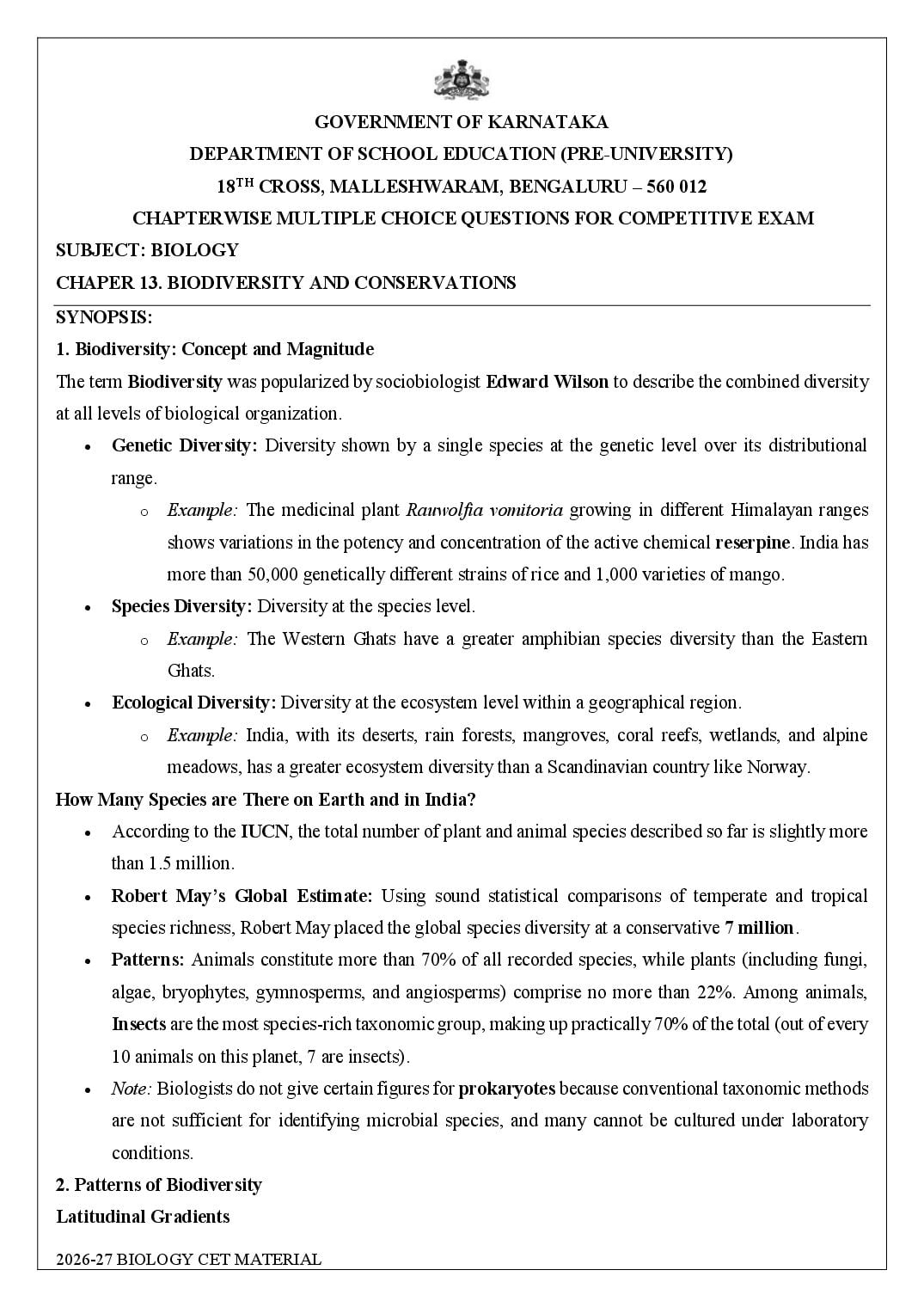
DEPARTMENT OF SCHOOL EDUCATION (PRE-UNIVERSITY)
18TH CROSS, MALLESHWARAM, BENGALURU – 560 012
CHAPTERWISE MULTIPLE CHOICE QUESTIONS FOR COMPETITIVE EXAM
SUBJECT: BIOLOGY
CHAPER 13. BIODIVERSITY AND CONSERVATIONS
SYNOPSIS:
1. Biodiversity: Concept and Magnitude
The term Biodiversity was popularized by sociobiologist Edward Wilson to describe the combined diversity
at all levels of biological organization.
• Genetic Diversity: Diversity shown by a single species at the genetic level over its distributional
range.
o Example: The medicinal plant Rauwolfia vomitoria growing in different Himalayan ranges
shows variations in the potency and concentration of the active chemical reserpine. India has
more than 50,000 genetically different strains of rice and 1,000 varieties of mango.
• Species Diversity: Diversity at the species level.
o Example: The Western Ghats have a greater amphibian species diversity than the Eastern
Ghats.
• Ecological Diversity: Diversity at the ecosystem level within a geographical region.
o Example: India, with its deserts, rain forests, mangroves, coral reefs, wetlands, and alpine
meadows, has a greater ecosystem diversity than a Scandinavian country like Norway.
How Many Species are There on Earth and in India?
• According to the IUCN, the total number of plant and animal species described so far is slightly more
than 1.5 million.
• Robert May’s Global Estimate: Using sound statistical comparisons of temperate and tropical
species richness, Robert May placed the global species diversity at a conservative 7 million.
• Patterns: Animals constitute more than 70% of all recorded species, while plants (including fungi,
algae, bryophytes, gymnosperms, and angiosperms) comprise no more than 22%. Among animals,
Insects are the most species-rich taxonomic group, making up practically 70% of the total (out of every
10 animals on this planet, 7 are insects).
• Note: Biologists do not give certain figures for prokaryotes because conventional taxonomic methods
are not sufficient for identifying microbial species, and many cannot be cultured under laboratory
conditions.
2. Patterns of Biodiversity
Latitudinal Gradients
Page 2
poles. Tropics (latitudinal range of 23.5∘ N to 23.5∘ S) harbor more species than temperate or polar areas.
• Amazonian Rain Forest: Located in South America, it has the greatest biodiversity on Earth—
harboring more than 40,000 species of plants, 3,000 of fishes, 1,300 of birds, 427 of mammals, 427 of
amphibians, 378 of reptiles, and more than 125,000 invertebrates.
• Why Tropics Have Higher Diversity:
1. Speciation is a function of time: Unlike temperate regions subjected to frequent glaciations in
the past, tropical latitudes have remained relatively undisturbed for millions of years, allowing
long evolutionary time for species diversification.
2. Environment: Tropical environments are less seasonal, relatively more constant, and
predictable, promoting niche specialization.
3. Solar Energy: There is more solar energy available in the tropics, contributing to higher
productivity, which indirectly supports greater diversity.
Species-Area Relationships
German naturalist and geographer Alexander von Humboldt observed that within a region, species richness
increases with increasing explored area, but only up to a limit.
On a logarithmic scale, the relationship is a straight line described by the equation:
log 𝑆 = log 𝐶 + 𝑍 log 𝐴
Where:
• 𝑆 = Species richness
• 𝐴 = Area
• 𝐶 = Y-intercept
• 𝑍 = Slope of the line (regression coefficient)
Value of Z: Regardless of the taxonomic group or region (e.g., plants in Britain or birds in California), the
value of 𝑍 remarkably stays in the range of 0.1 to 0.2. However, if you analyze the species-area relationship
in very large regions like entire continents, the slope becomes much steeper, with 𝑍 values ranging from 0.6
to 1.2 (e.g., for frugivorous birds and mammals in tropical forests of different continents, the slope is 1.15).
3. The Importance of Biodiversity & Loss Rates
• David Tilman’s Long-term Ecosystem Experiments: Proved that plots with more species showed
less year-to-year variation in total biomass and that increased diversity contributes directly to higher
productivity.
• Rivet Popper Hypothesis: Proposed by Stanford ecologist Paul Ehrlich. He compared the ecosystem
to an airplane and individual species to rivets holding its parts together. If every passenger pops a rivet
(causing a species to go extinct), it may not disrupt flight safety initially. But as more rivets are
removed, the plane becomes dangerously weak. Losing a "key rivet" on the wings (a keystone species
driving major ecosystem functions) is catastrophic.
Biodiversity Loss: The "Evil Quartet"
Page 3
representing a Sixth Extinction phase. The four major causes are:
1. Habitat Loss and Fragmentation: The most important cause driving animals and plants to extinction.
The Amazon rain forest (the "lungs of the planet") once covered 14% of the Earth's land surface but
now covers no more than 6% because it is being cleared for cultivation of soybeans or conversion to
grasslands for raising beef cattle. When large habitats are broken into small fragments due to human
activities, mammals and birds requiring large territories suffer severely.
2. Over-Exploitation: When human "need" turns to "greed," it leads to over-exploitation of natural
resources. Many species have gone extinct in the last 500 years due to over-exploitation by humans
(e.g., Steller’s sea cow, Passenger pigeon).
3. Alien Species Invasions: When alien species are introduced unintentionally or deliberately, some turn
invasive and cause the decline or extinction of indigenous species.
o Nile Perch: Introduced into Lake Victoria in East Africa, leading to the extinction of an
ecologically unique assemblage of more than 200 species of cichlid fish.
o Invasive Weeds: Parthenium (carrot grass), Lantana, and Eichhornia (water hyacinth).
o African Catfish: The recent illegal introduction of the African catfish Clarias gariepinus for
aquaculture poses a threat to indigenous catfishes in Indian rivers.
4. Co-Extinctions: When a species becomes extinct, the plant and animal species associated with it in
an obligatory way also become extinct (e.g., when a host fish species goes extinct, its unique
assemblage of parasites meets the same fate; co-evolved plant-pollinator mutualisms).
4. Biodiversity Conservation
Why conserve? Reasons are grouped into three categories: Narrowly utilitarian (direct economic benefits
like timber, food, medicine), Broadly utilitarian (ecosystem services like 𝑂2 production via photosynthesis,
pollination, aesthetic pleasures), and Ethical (every species has an intrinsic value, and we have a duty to pass
on our biological legacy safely).
How do we conserve?
A. In-Situ Conservation (On-Site)
Protecting the endangered species within its natural habitat by protecting the entire ecosystem.
• Biodiversity Hotspots: Regions with very high levels of species richness, high degree of endemism
(species confined to that region and not found anywhere else), and accelerated habitat loss. Initially
25, the global count stands at 34. Three cover India: Western Ghats and Sri Lanka, Indo-Burma,
and Himalaya. Although they cover less than 2% of the Earth's land, strict protection could reduce
ongoing mass extinctions by almost 30%.
• Protected Areas in India: India has 14 Biosphere Reserves, 90 National Parks, and 448 Wildlife
Sanctuaries.
• Sacred Groves: Tracts of forest set aside where all wild trees and wildlife are venerated and given
total protection. Examples: Khasi and Jaintia Hills in Meghalaya, Aravalli Hills of Rajasthan, Western
Page 4
Pradesh. In Meghalaya, sacred groves are the last refuges for a large number of rare and threatened
plants.
B. Ex-Situ Conservation (Off-Site)
Threatened animals and plants are taken out from their natural habitat and placed in special settings where
they can be protected and given care.
• Examples: Zoological parks, botanical gardens, and wildlife safari parks.
• Advanced Techniques:
o Gametes of threatened species can be preserved in viable and fertile conditions for long periods
using cryopreservation techniques (at −196∘ C in liquid nitrogen).
o Eggs can be fertilized in vitro, and plants can be propagated using tissue culture methods.
o Seeds of different genetic strains of commercially important plants can be kept for long periods
in seed banks.
5. International Conventions
1. The Earth Summit: Held in Rio de Janeiro in 1992. It called upon all nations to take appropriate
measures for the conservation of biodiversity and the sustainable utilization of its benefits.
2. The World Summit on Sustainable Development: Held in Johannesburg, South Africa in 2002.
190 countries pledged their commitment to achieve a significant reduction in the current rate of
biodiversity loss at global, regional, and local levels by the year 2010.
MULTIPLE CHOICE QUESTIONS
1. How many different varieties of mango are found in India?
(a) 50,000 (b) 5000 (c) 2000 (d) 1000
2. If the present rate of species losses continues, we will lose our biological wealth in how much time?
(a) Less than one century (b) Less than 2 centuries
(c) Less than 50 years (d) Next 20 years
3. Robert May places the global species diversity at about _________ million.
(a) 2 (b) 3 (c) 6 (d) 7
4. More than _________ % of all species recorded are animals.
(a) 60 (b) 70 (c) 90 (d) 10
5. Match Column-I (Place) with Column-II (Number of bird species)
Column - I Column - II
(I) Colombia (A) 1200
(II) New York (B) 1300
(III) India (C) 1400
(IV) Amazonian rain forest (D) 105
(a) A:III, B:IV, C:II, D:I (b) A:II, B:I, C:IV, D:III
(c) A:II, B:IV, C:III, D:I (d) A:III, B:IV, C:I, D:II
Page 5
S-species richness
A-Area
C-Y-intercept
Z-Slope of line (regression coefficient)
(a) S = CAZ (b) S = CZA (c) S = ZCA (d) Z = SCA
7. Tropical environments, unlike temperate ones, are
(a) Less seasonal (b) Relatively more constant
(c) More predictable (d) All of these
8. IUCN Red list (2004) documents the extinction of how many species have been in last 500 years?
(a) 784 (b) 874 (c) 478 (d) 487
9. Match the Column- I (Recently extinct animals) with Column-II (Places from where they are
extinct).
Column-I Column-II
(A) Dodo (I) Russia
(B) Quagga (II) Australia
(C) Thylacine (III) Africa
(D) Steller's sea cow (IV) Mauritius
(a) A:I, B:II, C:III, D:IV (b) A:IV, B:III, C:II, D:I
(c) A:IV, B:II, C:III, D:I (d) A:IV, B:I, C:II, D:III
10. Approximately how many species face the threat of extinction?
(a) 3000 (b) 1500 (c) 15,500 (d) 70,000
11. Which of these are examples of alien species invasion?
(a) Nile perch was introduced in Lake Victoria in east Africa
(b) African catfish in Indian River
(c) Water hyacinth in India
(d) All the above
12. Which of these is not a narrowly utilitarian argument for conserving biodiversity?
(a) Food (b) Medicine (c) Construction material (d) Pollination
13. All are examples of broadly utilitarian except
(a) Pollination (b) Oxygen
Page 6
14. ‘We save the entire forest to save the tiger’. This approach of conservation is
(a) In situ (b) Ex situ (c) In vitro (d) In vivo
15. What percentage of the earth’s land area is covered by all biodiversity hotspots put together?
(a) 6% (b) 10% (c) 2% (d) 15%
16. The following are examples of ex situ conservation except
(a) Zoological parks (b) Botanical Garden
(c) Wildlife safari parks (d) Biosphere reserve
17. Hotspots are characterized by
(a) Very high species richness (b) High degree of endemism
(c) Region of accelerated habitat loss (d) All of these
18. Which of these are hotspots of India?
(a) Western Ghats (b) Himalaya (c) Indo-Burma (d) All of these
19. How do ecologists estimate the total number of species present in the world?
(a) By counting them all.
(b) By counting the number of any one species and applying this to various genus.
(c) By making statistical comparison of the temperate–tropical species richness of an exhaustively
studied group of insects and extrapolating this ratio to other group of animals and plants.
(d) By calculating biomass of all the species.
20. At present, how many biosphere reserves does India have?
(a) 11 (b) 14 (c) 18 (d) 40
21. The following are indirect benefits from biodiversity except
(a) Pest control (b) Climate moderation (c) Flood control (d) Dyes, resins and perfumes
22. Which area of M.P. (Madhya Pradesh) contains sacred groves?
(a) Sarguja (b) Chanda (c) Bastar (d) All of these
23. Which one of the following is an example of ex-situ conservation?
(a) Wildlife sanctuary (b) Seed bank (c) Sacred groves (d) National Park
24. Biodiversity of a geographical region represents
(a) Endangered species found in the region.
(b) The diversity in the organism living in the region.
(c) Genetic diversity in the dominant species of the region.
(d) Species endemic to the region.
25. Select the correct statement about biodiversity.
(a) Large scale planting of Bt cotton has no adverse effect on biodiversity.
(b) Western Ghats has a very high degree of species richness and endemism.
(c) Conservation of biodiversity is just a fad pursued by the developed countries.
(d) The desert areas of Rajasthan and Gujarat have a very high level of desert animal species
Page 7
26. Sacred groves are specially useful in
(a) Preventing soil erosion (b) Year-round flow of water in rivers
(c) Conserving rare and threatened species (d) Generating environmental awareness
27. The highest number of species in the world is represented by
(a) Fungi (b) Mosses (c) Algae (d) Lichen
28. Which of the following represent maximum number of species among global biodiversity?
(a) Algae (b) Lichens (c) Fungi (d) Mosses and Ferns
29. A species facing extremely high risk of extinction in the immediate future is called
(a) Vulnerable (b) Endemic (c) Critically endangered (d) Extinct
30. Vertical distribution of different species occupying different levels in a biotic community is known
as
(a) Divergence (b) Stratification (c) Zonation (d) Pyramid
31. Most animals are tree dwellers in a
(a) Coniferous forest (b) Thorn woodland
(c) Temperature deciduous forest (d) Tropical rain forest
32. How many hot spots biodiversity in the world have been identified till date by Norman Myers?
(a) 25 (b) 34 (c) 43 (d) 17
33. Which of the following is not an invasive alien species in the Indian context?
(a) Lantana (b) Cyanodon (c) Parthenium (d) Eichhornia
34. Where among the following will you find the pitcher plant?
(a) Rain forest of Northeast India (b) Sundarbans
(c) Thar Desert (d) Western Ghats
35. Match the animals given in column A with their location in column B.
Column A Column
B
(I) Dodo (A) Africa
(II) Quagga (B) Russia
(III) Thylacine (C) Mauritius
(IV) Steller’s sea cow (D) Australia
Choose the correct match from the following:
(a) I-A, II-C, III-B, IV-D (b) I-D, II-C, III-A, IV-B
(c) I-C, II-A, III-B, IV-D (d) I-C, II-A, III-D, IV-B
36. The extinction of passenger pigeon was due to
(a) Increased number of predatory birds (b) Over exploitation by humans
(c) Non-availability of the food (d) Bird flu virus infection
37. The active chemical drug reserpine is obtained from
Page 8
38. The historic convention on Biological Diversity held in Rio de Janeiro in 1992 is known as
(a) CITES Convention (b) The Earth Summit
(c) G-16 Summit (d) MAB Programme
39. What is common to the techniques (i) in vitro fertilization, (ii) Cryopreservation and (iii) tissue
culture?
(a) All are in situ conservation methods.
(b) All are ex-situ conservation methods.
(c) All require ultra-modern equipment and large space.
(d) All are methods of conservation of extinct organisms.
40. The important levels of biodiversity are
(a) genetic biodiversity (b) species biodiversity
(c) ecological biodiversity (d) All of these
41. Which of the following is not an invasive alien species in the Indian context?
(a) Lantana (b) Cynodon (c) Parthenium (d) Eichhornia
42. Match the animals given in Column I with their location in Column II.
Column I Column II
(A) Dodo (I) Africa
(B) Quagga (II) Russi
(C) Thylacine (III) a
(D) Stellar's sea cow (IV) Mauritius
Codes
A B C D
(a) I III II IV
(b) IV III I II
(c) III I II IV
(d) III I IV II
43. As estimated by Robert May, what is the total number of species present on earth?
(a) 3 million (b) 5 million (c) 7 million (d) 9 million
44.
Which of the matches above is/are correct?
(a) I and III (b) I and II (c) II and III (d) III and IV
Page 9
(a) ecological biodiveristy (b) law of limiting factor
(c) species-area relationships (d) population growth equation
46. If log A = 4, Z = 0.3 and log C = 0.8, find the value of log ‘S’?
(a) 3.20 (b) 200 (c) 5.24 (d) 2
47. The organisation, which publishes the Red List of species is
(a) ICFRE (b) IUCN (c) UNEP (d) WWF
48. Which of the following is responsible for biodiversity loss?
(a) Habitat loss and fragmentation (b) Alien species invasions
(c) Coextinctions (d) All of the above
49. Exploration of molecular, genetic and species level diversity for novel products of economic
importance is known as
(a) biopiracy (b) bioenergetics (c) bioremediation (d) bioprospecting
50. Core zone, buffer zone and manipulation zone are found in
(a) national park (b) sanctuary (c) tiger reserve (d) biosphere reserve
51. The region of biosphere reserve, which is legally protected and where no human activity is allowed
is known as
(a) core zone (b) buffer zone (c) transition zone (d) restoration zone
52. Sacred groves in India are found in
(a) Jaintia hills of Karnataka (b) Western Ghat regions of Tamil Nadu
(c) Aravalli hills of Meghalaya (d) Bastar areas of Madhya Pradesh
53. Which one of the following is related to ex situ conservation of threatened animals and plants?
(a) Wildlife safari parks (b) Biodiversity hotspots
(c) Amazon rainforest (d) Himalayan region
54. Which of the following phyla has largest number of species?
(a) Arthropoda (b) Echinodermata (c) Cephalochordata (d) Annelida
55. What is Biodiversity referred to as?
(a) species in a region
(b) genes & species in a region
(c) Genetic, species & ecological diversity in a region
(d) Genes and species in an ecosystem
56. What are the total number of hot spots present in the world?
(a) 45 (b) 29 (c) 74 (d) 34
57. What is the approximate percentage of the earth covered by terrestrial hot spots?
(a) 1.5% (less than 2%) (b) 2.5% (c) 3.5% (d) 4.5%
58. Wildlife is destroyed mostly by
(a) Lack of proper care (b) Mass scale Hurting
Page 10
59. Which of the following is NOT a benefit that humans receive from a biologically diverse world?
(a) source of medicine (b) source of water
(c) source of economic gains (d) source of food
60. Idri Idri is found is
(a) Australia (b) Madagascar (c) Mauritius (d) Tasmania
61. Why are conservationists calling for immediate, and often expensive, action on behalf of
endangered species and habitats?
(a) Biodiversity is beneficial to humans.
(b) Man has brought on climate change.
(c) Extinction is an unnatural process.
(d) It would be more costly, financially, if we did not act
62. Which is not a valid reason for the species-area relationship?
(a) larger areas have higher z values
(b) extinction rates are greater on small islands
(c) larger "core" areas.
(d) larger areas contain more habitats
63. Commercial latex in obtained from-
(a) Euphorbiaceae (b) Acacia arabica (c) Tectona grandis (d) Manihot esculenta
64. The ____ encourages the division of protected areas into zones with different purposes and levels
of human impact.
(a) Man, and Biosphere Program (MAB) (b) Biosphere Reserve
(c) Chipko Andolan Movement (d) IUCN world conservation strategy
65. Identify the odd combination of the habitat and the particular animal concerned.
(a) Sunderbans______ Bergal tiger (b) Periyar______Elephant
(c) Rann of kutch______wwil Ass (d) Dachigam national park______Snao leopard
66. Which of these statements is true?
(a) Biodiversity tends to increase as you get closer to the equator
(b) Tropical regions of Earth contain very few of the world's land species.
(c) Coral reefs tend to be less biologically diverse than temperate deciduous forests.
(d) Cold climates have greater amounts of biodiversity than warm climates
67. A keystone species is one that
(a) has a higher likelihood of extinction than a non-keystone species.
(b) exerts a strong influence on an ecosystem.
(c) causes other species to become extinct.
(d) has a weak influence on an ecosystem.
68. How much of the Earth's land surface have humans disturbed or degraded?
Page 11
69. Ex situ strategies include -
(A) Botanical garden
(B) Zoos
(C) Seed / Pollen banks
(D) Gene bank and tissue culture
(a) A, B (b)A, B, C (c) B, C, D (d) A, B, C, D
70. The impacts of loss of biodiversity include –
(A). Decrease in plant production.
(B). Lowered resistance to environmental perturbation
(C). Increased variability in ecosystem processes like water use, pest / disease cycle, plants
productivity.
(D). None
(a) A, B (b)A, B, C (c) B, C (d) D
71. The variety of living beings considered at genetic, species and ecosystem level is known as
(a) biological diversity (b) biodiversity (c) biomass (d) both (a) and (b)
72. Consider the following statements. (A) Genetic diversity includes individual genetic variations
within a population. (B) It considers the genetic diversity among the geographically separated
populations of a species. Select the correct option.
(a) Both A and B are true (b) A is true, but B is false
(c) Both A and B are false (d) A is false, but B is true
73. Variety of ecosystem found on the earth makes the
(a) genetic diversity (b) species diversity
(c) ecological diversity (d) alpha diversity
74. Which of the given statements is incorrect about biodiversity?
(a) Alpha diversity represents the species diversity within a community.
(b) Beta diversity represents species diversity among the communities.
(c) Gamma diversity reflects the rate of change in the species composition in communities across
landscape.
(d) Gamma diversity represents the diversity of various communities within a landscape.
75. Animal species comprise more than of the total biodiversity of the earth while plants make only of
the total.
(a) 22%, 70% (b) 70%, 22% (c) 80%, 25% (d) 25%, 80%
76. Which of the following have the highest number of species in nature?
(a) Insects (b) Birds (c) Angiosperms (d) Fungi
77. Rauwolfia vomitoria is an example of –
(a) Species diversity (b) Genetic diversity (c) Ecological diversity (d) All the above
Page 12
was given by -
(a) Edward Wilson (b) Alexander Von Humboldt
(c) Robert Constanza (d) E. Haeckel
79. Rivet popper hypothesis was given by?
(a) Edward Wilson (b) Tilman's (c) Robert Constanza (d) Paul Ehrlich
80. Which information is correct for our country?
(a) India is one of the twelve mega biodiversity countries of the world.
(b) India comprises 2.4% biodiversity of world.
(c) India contains more than 7% plant species of world.
(d) India stands at 7th rank in traditional crop varieties.
81. Dodo, passenger pigeon and Steller’s sea cow became extinct in last 500 years due to-
(a) Habitat destruction (b) Over-exploitation
(c) Bird - flu virus infection (d) Pollution
82. The exotic species, which when introduced in India became notorious weed (s), is/are:
(a) Lantana (b) Eichhornia (c) Parthenium (d) All of these
83. For frugivorous birds and mammals in the tropical forests,
the value of 𝒁 is found to be-
(a) 1.10 (b) 2.15 (c) 1.15 (d) 1.25
84. Which of the following is considered a hot-spot of biodiversity in India?
(a) Eastern Ghats (b) Aravalli Hills (c) Western Ghats (d) Indo-Gangetic Plain
85. How many ecological hotspots are present in India?
(a) One (b) Two (c) Four (d)Three
86. Presently, total number of biodiversity hotspots in the world are
(a) 25 (b) 34 (c) 37 (d) 40
87. 'Ex situ' conservation is the term applied to
(a) Protection of biosphere reserves
(b) Creation of wildlife sanctuaries
(c) Prevention of poaching in protected forests
(d) Breeding of endangered species in zoological parks
88. What percentage of drugs currently sold in the market are derived from plants?
(a) 80% (b) 25% (c) 55% (d) 35%
89. Choose the correct option showing the Sacred groves that are found in Khasi and Jaintia hills of
(i), Aravali hills of (ii), Western Ghat regions of (iii) and the Sarguja, Chanda and Bastar areas of
(iv).
(i) (ii) (iii) (iii)
Page 13
(b) Meghalaya Rajasthan Madhya Pradesh Karnataka
(c) Madhya Pradesh Rajasthan Meghalaya Karnataka
(d) Rajasthan Meghalaya Karnataka Madhya Pradesh
90. What percentage of total oxygen in the earth's atmosphere is contributed by amazon forest?
(a) 20 (b) 80 (c) 90 (d) 75
91. Which one is not included under in situ conservation?
(a) National Park (b) Sanctuary (c) Botanical garden (d) Biosphere reserve
92. Hot spots of biodiversity are areas with-
(a) Little biodiversity (b) Maximum biodiversity
(c) Maximum conservation (d) Both (a) and (c)
93. Wildlife conservation means the protection and preservation of-
(a) Wild flora (b) Wild fauna
(c) Cultivated plants and domesticated animals (d) All livings in natural habitat
94. Read the assertion and reason carefully to mark the correct option out of the options given below:
Assertion: Current estimates do not give any figure for prokaryotes taxonomic.
Reason: Conventional taxonomic methods are not suitable for identifying microbial species.
(a) If both the assertion and the reason are true and the reason is a correct explanation of the assertion.
(b) If both the assertion and reason are true but the reason is not a correct explanation of the assertion .
(c) If the assertion is true but the reason is false.
(d) If both the assertion and reason are false.
95. Read the assertion and reason carefully to mark the correct option out of the options given below:
Assertion: Ex situ conservation is carried out in biosphere reserves, national parks and sanctuaries.
Reason: NGOs are involved in the maintenance of these protected areas.
(a) If both the assertion and the reason are true and the reason is a correct explanation of the assertion.
(b) If both the assertion and reason are true but the reason is not a correct explanation of the assertion .
(c) If the assertion is true but the reason is false.
(d) If both the assertion and reason are false.
96. Read the assertion and reason carefully to mark the correct option out of the options given below:
Assertion: Insects are enormously diversified.
Reason: It is because of the presence of exoskeleton made up of chitin.
(a) If both the assertion and the reason are true and the reason is a correct explanation of the assertion.
(b) If both the assertion and reason are true but the reason is not a correct explanation of the assertion .
(c) If the assertion is true but the reason is false.
Page 14
97. Read the assertion and reason carefully to mark the correct option out of the options given below:
Assertion: India has more than 50000 genetically different strains of rice.
Reason: India has approximately 1000 varieties of mango
(a) If both the assertion and the reason are true and the reason is a correct explanation of the assertion.
(b) If both the assertion and reason are true but the reason is not a correct explanation of the assertion.
(c) If the assertion is true but the reason is false.
(d) If both the assertion and reason are false.
98. Read the assertion and reason carefully to mark the correct option out of the options given below:
Assertion: Most diversified organism on earth is insects.
Reason: insects possess chitinous exoskeleton
(a) If both the assertion and the reason are true and the reason is a correct explanation of the assertion.
(b) If both the assertion and reason are true but the reason is not a correct explanation of the assertion .
(c) If the assertion is true but the reason is false.
(d) If both the assertion and reason are false.
99. Read the assertion and reason carefully to mark the correct option out of the options given below:
Assertion: Colombia located near the equator has nearly 1400 species of birds which New York 41° N
has 105 species and green land at 71°N only 56 species.
Reason: Generally, tropics harbour more species than temperate or polar regions.
(a) If both the assertion and the reason are true and the reason is a correct explanation of the assertion.
(b) If both the assertion and reason are true but the reason is not a correct explanation of the assertion.
(c) If the assertion is true but the reason is false.
(d) If both the assertion and reason are false.
100. Read the assertion and reason carefully to mark the correct option out of the options given
below:
Assertion: Removal of key stone from an ecosystem leads to destruction of ecosystem.
Reason: Keystone species drive major ecosystem functions.
(a) If both the assertion and the reason are true and the reason is a correct explanation of the assertion.
(b) If both the assertion and reason are true but the reason is not a correct explanation of the assertion .
(c) If the assertion is true but the reason is false.
(d) If both the assertion and reason are false.
KEY ANSWERS:
1. (d) 2. (b) 3. (d) 4. (b) 5. (d) 6. (a) 7. (d)
8. (a) 9. (b) 10. (c) 11. (d) 12. (d) 13. (d) 14. (a)
15. (c) 16. (d) 17. (d) 18. (d) 19. (c) 20. (c) 21. (d)
22. (d) 23. (b) 24. (b) 25. (b) 26. (c) 27. (a) 28. (c)
29. (c) 30. (b) 31. (d) 32. (a) 33. (b) 34. (a) 35. (d)
Page 15
43. (c) 44. (d) 45. (c) 46. (d) 47. (b) 48. (d) 49. (d)
50. (d) 51. (a) 52. (d) 53. (a) 54. (a) 55. (c) 56. (d)
57. (a) 58. (c) 59. (b) 60. (b) 61. (a) 62. (a) 63. (a)
64. (a) 65. (d) 66. (a) 67. (b) 68. (a) 69. (d) 70. (b)
71. (d) 72. (a) 73. (c) 74. (c) 75. (b) 76. (a) 77. (b)
78. (b) 79. (d) 80. (a) 81. (b) 82. (d) 83. (c) 84. (c)
85. (c) 86. (b) 87. (d) 88. (b) 89. (a) 90. (a) 91. (c)
92. (b) 93. (d) 94. (a) 95. (d) 96. (a) 97. (b) 98. (a)
99. (a) 100. (a)
Document Details
| Board / Org | Karnataka Board |
| Exam | Class 12 |
| Type | Question Bank |
| Pages | 15 |
| Updated | 24 Sep 2026 |