MBOSE Class 12 Question Paper 2022 for Philosophy
Finished viewing? Save it for later —
Download MBOSE Class 12 Question Paper 2022 for Philosophy (PDF · 12 pages)About MBOSE Class 12 Question Paper 2022 for Philosophy
MBOSE Class 12 Question Paper 2022 for Philosophy is available here for free download. Published by Meghalaya Board for Class 12, this question paper can be viewed online or downloaded as a PDF (12 pages). Candidates preparing for Class 12 can use MBOSE Class 12 Question Paper 2022 for Philosophy to understand the exam pattern, the type of questions asked, and the overall difficulty level.
Frequently Asked Questions
How can I download MBOSE Class 12 Question Paper 2022 for Philosophy?
Open this page and click the Download button to save MBOSE Class 12 Question Paper 2022 for Philosophy as a PDF. It is completely free on AglaSem Docs.
Is MBOSE Class 12 Question Paper 2022 for Philosophy free to download?
Yes. MBOSE Class 12 Question Paper 2022 for Philosophy can be viewed online and downloaded as a PDF free of cost on AglaSem Docs.
How many pages does MBOSE Class 12 Question Paper 2022 for Philosophy have?
MBOSE Class 12 Question Paper 2022 for Philosophy contains 12 pages, which you can read online or download together as a single PDF.
Where can I find more Class 12 study material?
You can find more Class 12 question papers, sample papers, syllabus, and answer keys on AglaSem Docs.
MBOSE Class 12 Question Paper 2022 for Philosophy – Text
Read the full text of this question paper below — useful to quickly search, copy and reference the content online without downloading the PDF.
📄 View text version (12 pages)
Page 1
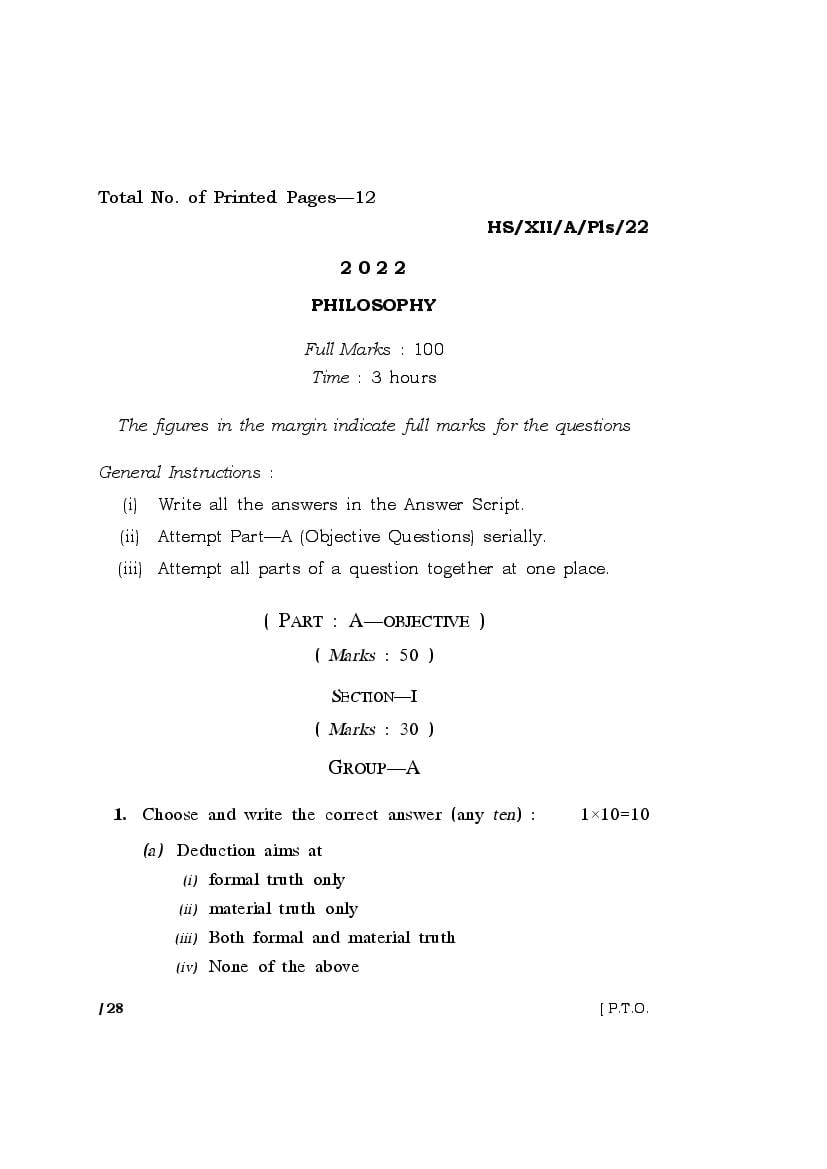
HS/XII/A/Pls/22
2022
PHILOSOPHY
Full Marks : 100
Time : 3 hours
The figures in the margin indicate full marks for the questions
General Instructions :
(i) Write all the answers in the Answer Script.
(ii) Attempt Part—A (Objective Questions) serially.
(iii) Attempt all parts of a question together at one place.
( P A R T : A —O B JE C TIV E )
( Marks : 50 )
S E C TIO N —I
( Marks : 30 )
G R O U P —A
1. C h o o s e a n d w r ite th e co r r e ct a n s w e r (a n y ten) : 1×10 =10
(a) D e d u ctio n a im s a t
(i) f o r m a l tr u th o n ly
(ii) m a te r ia l tr u th o n ly
(iii) B o th f o r m a l a n d m a te r ia l tr u th
(iv) N o n e o f th e a b o v e
/28 [ P.T.O.
Page 2
(b) In d u ctiv e le a p co n s is ts in p a s s in g f r o m th e
(i) o b s e r v e d ca s e s to th e u n o b s e r v e d ca s e s
(ii) u n o b s e r v e d ca s e s to th e o b s e r v e d ca s e s
(iii) o b s e r v e d ca s e s to th e o b s e r v e d ca s e s
(iv) u n o b s e r v e d ca s e s to th e u n o b s e r v e d ca s e s
(c) Th e te r m ‘co llig a tio n o f f a cts ’ w a s o r ig in a lly u s e d b y
(i) M ill
(ii) W h e w e ll
(iii) C a r v e th R e a d
(iv) B a co n
(d) E x N ih ilo N ih il F it m e a n s
(i) th e s a m e ca u s e h a s th e s a m e e f f e ct
(ii) ca u s e is e q u a l to th e e f f e ct
(iii) th e s a m e ca u s e h a s d if f e r e n t e f f e cts
(iv) o u t o f n o th in g , n o th in g co m e s
(e) Th e same effect may be produced by different causes
at different times. This is
(i) co n ju n ctio n o f ca u s e s
(ii) in te r m ix tu r e o f e f f e cts
(iii) p lu r a lity o f ca u s e s
(iv) N o n e o f th e a b o v e
HS/XII/A/Pls/22/28 [ Contd.
Page 3
(f) Th e tw o f u n d a m e n ta l m e th o d s a cco r d in g to M ill a r e
(i) m e th o d o f A g r e e m e n t a n d D if f e r e n ce
(ii) m e th o d o f A g r e e m e n t a n d m e th o d o f R e s id u e
(iii) m e th o d o f D if f e r e n ce a n d m e th o d o f R e s id u e
(iv) m e th o d o f D if f e r e n ce a n d C o n co m ita n t v a r ia tio n
(g ) Th e Jo in t m e th o d o f A g r e e m e n t a n d D if f e r e n ce is a
d o u b le e m p lo y m e n t o f th e m e th o d o f
(i) A g re e m e n t
(ii) D if f e r e n ce
(iii) C o n co m ita n t v a r ia tio n
(iv) R e s id u e
(h) Th e La w o f G r a v ita tio n is a /a n
(i) P r im a r y la w
(ii) S e co n d a r y la w
(iii) E m p ir ica l la w
(iv) N o n e o f th e a b o v e
(i) W h ich o f th e f o llo w in g is /a r e h e te r o d o x s ch o o ls ?
(i) C a rv a k a
(ii) Ja in a
(iii) B u d d h a
(iv) A ll o f th e a b o v e
HS/XII/A/Pls/22/28 [ P.T.O.
Page 4
(j) H y p o th e s is ca n n o t b e p r o v e d w ith o u t
(i) a n a ly s is
(ii) s e n s a tio n
(iii) v e r if ica tio n
(iv) p e r ce p tio n
(k) ‘p is e q u iv a le n t to q ’ is s y m b o lize d a s
(i) p · q
(ii) p q
(iii) p q
(iv) pq
(l) “N e ith e r Jim n o r To m is e le cte d ” is a /a n
(i) co n ju n ctio n
(ii) im p lica tio n
(iii) d is ju n ctio n
(iv) n e g a tio n o f d is ju n ctio n
HS/XII/A/Pls/22/28 [ Contd.
Page 5
(m ) ‘A p r io r i’ m e a n s
(i) b e f o r e e x p e r ie n ce
(ii) a f te r e x p e r ie n ce
(iii) B o th b e f o r e a n d a f te r e x p e r ie n ce
(iv) in tu itio n
(n) D a r s h a n a m e a n s
(i) lo v e o f k n o w le d g e
(ii) lo v e o f w is d o m
(iii) lo v e o f a r g u m e n t
(iv) v is io n o f tr u th
G R O U P —B
2. W r ite w h e th e r th e f o llo w in g s ta te m e n ts a re True o r
False (a n y ten) : 1×10 =10
(a) In p a r ity o f r e a s o n in g , th e r e is n o o b s e r v a tio n a t a ll.
(b) In d u ctio n is co llig a tio n a n d co llig a tio n is n e ce s s a r ily a n
in d u ctio n .
(c) In d u ctiv e a r g u m e n t m a y b e b o th f o r m a lly a n d m a te r ia lly
tr u e .
HS/XII/A/Pls/22/28 [ P.T.O.
Page 6
(d) Th e q u a n tita tiv e m a r k o f th e ca u s e is its e q u a lity w ith
th e e f f e ct.
(e) N o n -o b s e r v a tio n is a n e g a tiv e f a lla cy .
(f) Th e m e th o d o f A g r e e m e n t is p r e -e m in e n tly a m e th o d
o f O b s e r v a tio n .
(g ) O b s e r v a tio n a n d e x p e r im e n t a r e th e m a te r ia l g r o u n d s o f
in d u ctio n .
(h) N e g a tiv e co n d itio n s m e a n th e a b s e n ce o f p r e v e n tin g
ca u s e .
(i) ‘ ’ is a s y m b o l f o r n e g a tio n .
(j) In in d u ctio n , th e r e is n o in d u ctiv e le a p .
(k) D e s ca r te s is a r a tio n a lis t p h ilo s o p h e r .
(l) C a r v a k a s ch o o l b e lo n g s to th e o r th o d o x s ch o o l o f
th o u g h ts .
(m ) Th e r e a r e s ix N a s tik a S ch o o ls in In d ia n P h ilo s o p h y .
(n) Th e s ta te m e n t ‘p · q ’ is a co n tin g e n t.
HS/XII/A/Pls/22/28 [ Contd.
Page 7
G R O U P —C
3. F ill in th e b la n k s (a n y ten) : 1×10 =10
(a) Th e e s ta b lis h m e n t o f a g e n e r a l tr u th o n th e b a s is o f
p a r ticu la r e x p e r ie n ce s is ca lle d _____.
(b) Th e _____ s ta te s th a t e v e r y e v e n t m u s t h a v e a ca u s e .
(c) In d u ctio n s im p r o p e r ly so ca lle d a re a ls o k n o w n a s
_____ in d u ctio n .
(d) In d u ctio n a n d d e d u ctio n d if f e r in th e ir s ta r tin g p o in t
b u t n o t in th e ir _____.
(e) Th e la w o f u n if o r m ity o f n a tu r e is a _____ o r fo rm a l
g r o u n d o f in d u ctio n .
(f) O b s e r v a tio n is f in d in g a _____ a n d e x p e r im e n t is
m a k in g o n e .
(g ) H y p o th e s is is th e _____ p o in t o f in d u ctio n .
(h) Th e e x p e r im e n ta l m e th o d s h a v e b e e n ca lle d b y M ill,
th e m e th o d o f _____.
HS/XII/A/Pls/22/28 [ P.T.O.
Page 8
(i) A _____ co n d itio n is o n e th a t ca n n o t b e o m itte d w ith o u t
f r u s tr a tin g th e e f f e ct.
(j) Th e ca u s e is th e _____ a n te ce d e n t o f th e e f f e ct.
(k) E x p e r im e n t is th e _____ r e p r o d u ctio n o f e v e n ts .
(l) Th e h y p o th e s is w h e n v e r if ie d , b e co m e s a _____.
(m ) R a tio n a lis m h o ld s th a t _____ is th e o n ly s o u r ce o f
k n o w le d g e .
(n) _____ s ch o o ls b e lie v e in th e a u th o r ity o f th e V e d a s .
S E C TIO N —II
( Marks : 20 )
4. A n s w e r th e f o llo w in g q u e s tio n s in 2 o r 3 s e n te n ce s e a ch
(a n y ten) : 2×10 =20
(a) W h y p e r f e ct in d u ctio n h a s b e e n n a m e d in d u ctio n b y
co m p le te e n u m e r a tio n ?
(b) W h a t is in d u ctio n b y s im p le e n u m e r a tio n ?
HS/XII/A/Pls/22/28 [ Contd.
Page 9
(c) D e f in e a ca u s e .
(d) W h a t is p a r a d o x o f in d u ctio n ?
(e) W h a t is la w o f u n if o r m ity o f n a tu r e ?
(f) W h a t is h y p o th e s is ?
(g ) S ta te tw o a d v a n ta g e s o f o b s e r v a tio n o v e r e x p e r im e n t.
(h) W h a t is n o n -o b s e r v a tio n ?
(i) W h a t is e x p e r im e n t?
(j) W h a t is o b s e r v a tio n ?
(k) W h a t is p lu r a lity o f ca u s e s ?
(l) W h a t is th e m e th o d o f d if f e r e n ce ?
(m ) W h a t a r e s ta te m e n t f o r m s ?
(n) W h a t is im p lica tio n ?
HS/XII/A/Pls/22/28 [ P.T.O.
Page 10
( P A R T : B —D E S C R IP TIV E )
( Marks : 50 )
A n s w e r Q u e s tio n N o . 5 a n d any th re e f r o m th e r e s t
5. (a) S y m b o lize a n y five o f th e f o llo w in g : 2×5=10
(i) N e ith e r In d ia n o r P a k is ta n w ill w in th e A s ia C u p .
(ii) E ith e r C h ica g o o r D a lla s w ill w in th e S u p e r B o w l
b u t th e y w ill n o t b o th w in th e S u p e r B o w l.
(iii) It is n o t tr u e th a t A la n is s h o r t o r h a n d s o m e .
(iv) Ir a n a n d Lib y a r a is e s th e p r ice o f o il b u t th e y b o th
n o t d o so .
(v) If R a v i is e le cte d cla s s p r e s id e n t, th e n e ith e r B ill is
e le cte d v ice p r e s id e n t o r A li is e le cte d tr e a s u r e r .
(vi) If A m h e s t w in s its f ir s t g a m e , th e n C o lg a te w ill
n o t w in its f ir s t g a m e .
(vii) A lice a n d B e tty w ill n o t b o th b e e le cte d .
HS/XII/A/Pls/22/28 [ Contd.
Page 11
(b) U s e tr u th ta b le to d e te r m in e th e v a lid ity o r in v a lid ity
o f a n y two o f th e f o llo w in g a r g u m e n t f o r m s : 5×2=10
(i) (p q )·(p r)
p
q r
(ii) p q
p
~q
(iii) p q
~ q ~p
(iv) p · ~q
p
6 . W h a t is in d u ctio n ? Is p e r f e ct in d u ctio n a n in d u ctio n
a t a ll? 2+8 =10
7. D e f in e a n a lo g y . H o w d o e s a n a lo g y d if f e r f r o m s cie n tif ic
induction? 3+7=10
8 . S ta te th e a d v a n ta g e s o f e x p e r im e n t o v e r o b s e r v a tio n . 10
9 . W h a t is th e m e th o d o f A g r e e m e n t? E x p la in w ith e x a m p le s . 10
10 . E x p la in R a tio n a lis m a s a th e o r y o f k n o w le d g e . 10
HS/XII/A/Pls/22/28 [ P.T.O.
Page 12
11. E x p la in th e d is tin ctiv e f e a tu r e s o f In d ia n P h ilo s o p h y . 10
12. W r ite s h o r t n o te s o n a n y two o f th e f o llo w in g : 5×2=10
(a) C o llig a tio n o f f a cts
(b) E m p ir icis m
(c) M a l-o b s e r v a tio n
(d) V a r ia b le s a n d co n s ta n ts
HS/XII/A/Pls/22/28 22K—6500
Document Details
| Board / Org | Meghalaya Board |
| Exam | Class 12 |
| Type | Question Paper |
| Pages | 12 |
| Updated | 22 Jul 2026 |