Finished viewing? Save it for later —
Download ISC Class 12 Syllabus 2028 Elective English (PDF · 11 pages)About ISC Class 12 Syllabus 2028 Elective English
ISC Class 12 Syllabus 2028 Elective English is available here for free download. Published by CISCE for Class 12, this syllabus can be viewed online or downloaded as a PDF (11 pages). Candidates preparing for Class 12 can use ISC Class 12 Syllabus 2028 Elective English to understand the exam pattern, the type of questions asked, and the overall difficulty level.
Frequently Asked Questions
How can I download ISC Class 12 Syllabus 2028 Elective English?
Open this page and click the Download button to save ISC Class 12 Syllabus 2028 Elective English as a PDF. It is completely free on AglaSem Docs.
Is ISC Class 12 Syllabus 2028 Elective English free to download?
Yes. ISC Class 12 Syllabus 2028 Elective English can be viewed online and downloaded as a PDF free of cost on AglaSem Docs.
How many pages does ISC Class 12 Syllabus 2028 Elective English have?
ISC Class 12 Syllabus 2028 Elective English contains 11 pages, which you can read online or download together as a single PDF.
Where can I find more Class 12 study material?
You can find more Class 12 question papers, sample papers, syllabus, and answer keys on AglaSem Docs.
ISC Class 12 Syllabus 2028 Elective English – Text
Read the full text of this syllabus below — useful to quickly search, copy and reference the content online without downloading the PDF.
📄 View text version (11 pages)
Page 1
INDIAN SCHOOL CERTIFICATE
EXAMINATION
YEAR 2028
ELECTIVE ENGLISH
(850)
Page 2
Research, Development and Curriculum Division (RDCD)
CISCE
January 2026
____________________________________________________________________________________________
© Copyright, Council for the Indian School Certificate Examinations
All rights reserved. The copyright to this publication and any part thereof solely vests in the Council for the Indian
School Certificate Examinations. This publication and no part thereof may be reproduced, transmitted, distributed or
stored in any manner whatsoever, without the prior written approval of the Council for the Indian School Certificate
Examinations.
Page 3
MISSION STATEMENT
The Council for the Indian School Certificate
Examinations is committed to serving the nation's
children, through high quality educational
endeavours, empowering them to contribute towards
a humane, just and pluralistic society, promoting
introspective living, by creating exciting learning
opportunities, with a commitment to excellence.
ETHOS OF CISCE
Trust and fair play.
Minimum monitoring.
Allowing schools to evolve their own niche.
Catering to the needs of the children.
Giving freedom to experiment with new ideas
and practices.
Diversity and plurality - the basic strength for
evolution of ideas.
Schools to motivate pupils towards the
cultivation of:
Excellence - The Indian and Global
experience.
Values - Spiritual and cultural - to be the bedrock
of the educational experience.
Schools to have an 'Indian Ethos', strong roots in
the national psyche and be sensitive to national
aspirations.
Page 4
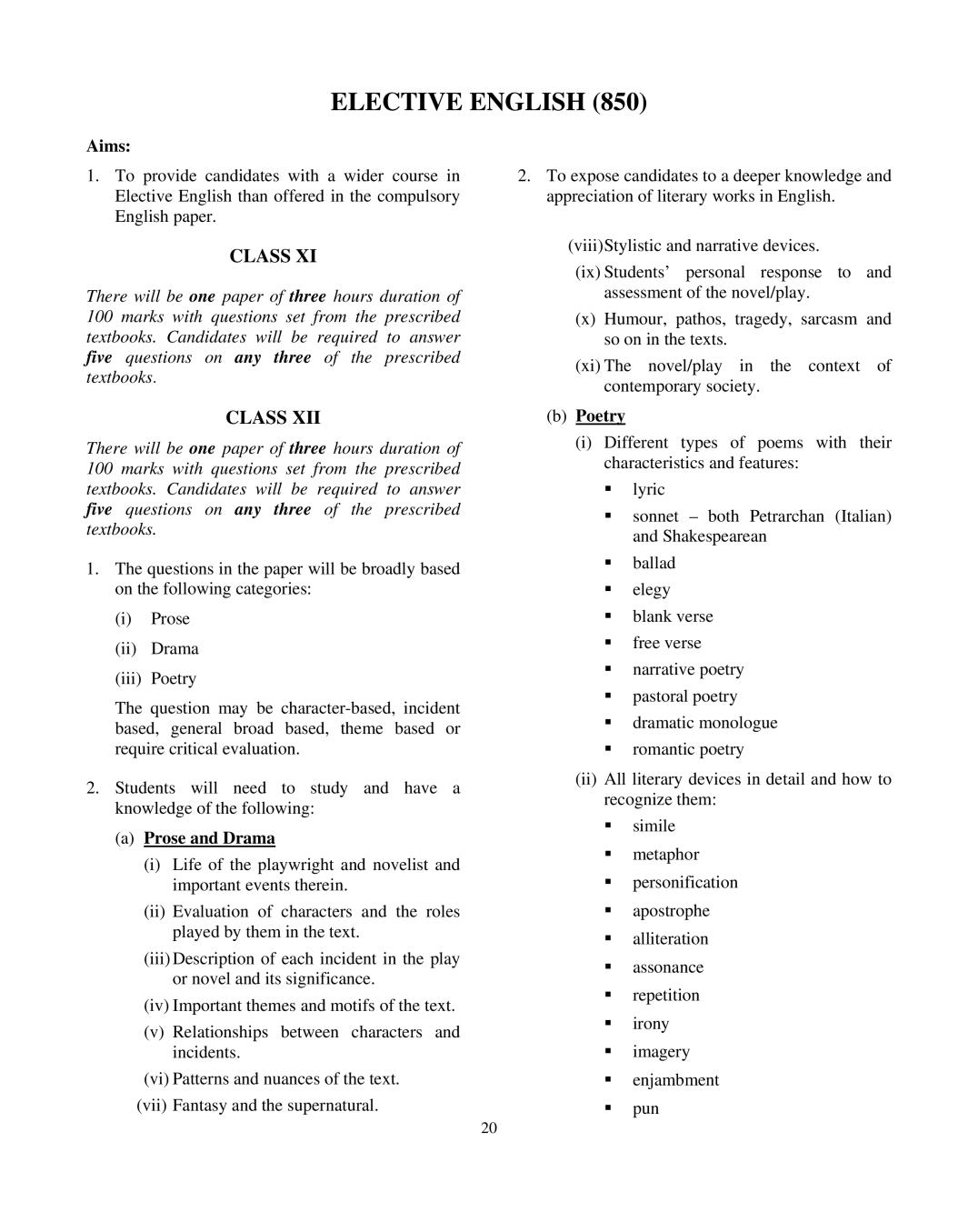
Aims:
1. To provide candidates with a wider course in Elective English than offered in the compulsory English
paper.
2. To expose candidates to a deeper knowledge and appreciation of literary works in English.
CLASSES XI & XII
There will be two papers in the subject:
Paper I - Theory: 3 hours…… 80 Marks
Paper II - Project Work ……. 20 Marks
PAPER I (THEORY) : 80 Marks
Candidates will be compulsorily required to answer questions based on Prose, Drama and Poetry.
For both Class XI & XII:
• There will be a choice between two of the prescribed novels.
• There will also be a choice between two of the prescribed Drama (plays).
• The poems prescribed will however be compulsory.
1. The questions in the paper will be broadly based on the following categories:
(i) Prose
(ii) Drama
(iii) Poetry
The question may be character-based, incident based, general broad based, theme based or require critical
evaluation.
2. Students will need to study and have a knowledge of the following:
(a) Prose and Drama
(i) Life of the playwright and novelist and important events therein.
(ii) Evaluation of characters and the roles played by them in the text.
(iii) Description of each incident in the play or novel and its significance.
(iv) Important themes and motifs of the text.
(v) Relationships between characters and incidents.
(vi) Patterns and nuances of the text.
(vii) Fantasy and the supernatural.
(viii) Stylistic and narrative devices.
(ix) Students’ personal response to and assessment of the novel/play.
(x) Humour, pathos, tragedy, sarcasm and so on in the texts.
(xi) The novel/play in the context of contemporary society.
1
Page 5
(i) Different types of poems with their characteristics and features:
• lyric
• sonnet – both Petrarchan (Italian) and Shakespearean
• ballad
• elegy
• blank verse
• free verse
• narrative poetry
• pastoral poetry
• dramatic monologue
• romantic poetry
(ii) All literary devices in detail and how to recognise them:
• simile
• metaphor
• personification
• apostrophe
• alliteration
• assonance
• repetition
• irony
• imagery
• enjambment
• pun
• contrast
• climax and anti-climax
• onomatopoeia
• hyperbole
• oxymoron
• litotes
• symbolism
(iii) A thorough knowledge of the poets’ lives and styles of writing.
(iv) Important themes of the poems.
(v) Patterns and nuances of the poems.
(vi) Fantasy and the supernatural if present in any poem.
(vii) Symbolism and Imagery.
(viii) How to write a proper Critical Evaluation / Appreciation, which must contain the following
components:
2
Page 6
• Autobiographical element in the poem
• Type of poem
• Setting
• Theme
• Mood and atmosphere
• Different levels of meaning in the poem, if any
• Rhyme scheme and its significance
• Symbolism
• Imagery
• Literary devices
• The student’s own personal response to the poem.
Note: Credit is given for textual detail and for the candidate’s own response.
Candidates are advised to exercise their options with great care, keeping in view their knowledge and
understanding of the question(s) chosen. Candidates are also expected to be precise and to avoid unnecessary
details.
Syllabus to be covered in Class XI
Prescribed Books
I. Novel: Animal Farm : George Orwell
OR
From Heaven Lake: Vikram Seth
II. Drama: Twelve Angry Men: Reginald Rose
OR
The Importance of Being Earnest:
Oscar Wilde
III. Poetry: Fireflies (A Collection of Poems) (Macmillan Education India Pvt. Ltd.)
The following poets and poems are to be studied:
John Milton: Song on May Morning; When I consider how my light is spent (On His Blindness); From
Paradise Lost; Book I – Satan’s speech (lines 242-270); From Paradise Lost Book IX - Eve’s lines (lines
733 – 785)
Percy Bysshe Shelley: England in 1819; To a Skylark; The Cloud ; Autumn: A Dirge
Thomas Hardy: Neutral Tones; The Man He Killed; The Going; The Convergence of the Twain
William Butler Yeats: No Second Troy; Easter 1916; The Wild Swans at Coole; The Second Coming
Wilfred Owen: Arms and the Boy; The Last Laugh; Anthem for Doomed Youth; Mental Cases
Dylan Thomas: Death Shall Have No Dominion, Poem in October; Fern Hill; Do not go gentle into that
good night
Carol Ann Duffy: War Photographer; In Mrs Tilscher’s Class; History; Mrs Midas
3
Page 7
Prescribed Books
I. Novel: The Book Thief: Markus Zusak
OR
The Namesake: Jhumpa Lahiri
II. Drama: An Enemy of the People: Henrik Ibsen
OR
Tughlaq by Girish Karnad
III. Poetry: Fireflies (A Collection of Poems) (Macmillan Education India Pvt. Ltd.)
The following poets and poems are to be studied:
T.S. Eliot (American-English): The Love Song of J. Alfred Prufrock; Preludes; The Journey of the Magi
Maya Angelou (American): The Mothering Blackness, Still I Rise, Awaking in New York
Sylvia Plath (American): Mirror; Tulips; Pursuit
Gieve Patel (Indian): Post Mortem; On Killing a Tree; From Bombay Central; Squirrels in Washington
Sujata Bhatt (Indian – emigrated to USA in 1968): Search for My Tongue; The Stare; A Different
History
Benjamin Zephania (British- Jamaican):What If; Faceless; We Refugees
Seamus Heaney (Northern Ireland - moved to the Irish Republic in 1972): Digging, Casualty,
Whatever You Say Nothing
PAPER II (PROJECT WORK) : 20 Marks
In addition to the syllabus prescribed above for Classes XI and XII, candidates are also required to be
assessed in Project Work.
Details of the same are given below
PROJECT WORK FOR CLASS XI
The candidates will produce original, creative, critical/ analytical, insightful perspectives on any TWO of the
texts (novel/ poetry/ drama – to be taken only from the syllabus to be covered in Class XI) that they have
chosen to study.
Project Work in Class XI (only from the syllabus to be covered in Class XI) is to be assessed internally by
the School.
Candidates will be required to complete two projects:
(A) One written assignment (800 to 1000 words)
and
(B) One Audio-visual (PPT) presentation (15 to 20 minutes duration)
(A) The written assignment should be organised in the following manner:
1. The title of the assignment/ presentation should be in the form of a question that allows the
candidate to explore and critically analyse the specified text(s).
2. The assignment should follow the structure given below:
• An introduction that states the reason for choosing that particular topic/ question and text.
Teachers could assist by suggesting a list of questions.
• A brief description of the methods adopted – what did the candidate do to answer the research
question?
• Results – What was the answer to the question? What were the candidate’s findings?
4
Page 8
perspective / views on the question.
• Candidates should include a bibliography that mentions ALL the material that they referred
to.
Assessment Criteria for the Written Assignment
Marks will be awarded as per the criteria given below (10 Marks):
Assessment Candidates should be able to: Marks
Criteria
1. Process Choose topic/question. 2
Plan a detailed assignment.
Submit a written outline for approval.
2. Content Give an interesting introduction that presents a clear explanation and scope 4
of the topic.
present information in a cohesive well-structured manner.
display a knowledge of the topic by referring to other sources.
sum up main points in conclusion.
3. Presentation Prepare a document of 800 to 1000 words. 4
and The document should have:
References a title page stating the topic/ question.
an introduction.
appropriate headings and sub-headings.
a well worded conclusion that ties together all the main points made.
TOTAL 10
B. The Audio-visual presentation (15 to 20 minutes duration)
The Audio-visual Presentation should be organised in the following manner:
1. The presentation should be in the form of a powerpoint presentation with 20 to 25 slides.
2. The presentation is to last between 15 to 20 minutes.
3. The title slide of the presentation should be in the form of a question that allows the candidate to
explore and critically analyse the specified text(s). The last slide should be an
acknowledgement of the references used to create the presentation.
4. The presentation should follow the structure given below:
• An introduction that states the reason for choosing that particular topic/ question and text.
(Teachers could assist by suggesting a list of questions).
• A brief description of the methods adopted – what did the candidate do to answer the research
question?
• Results – What was the answer to the question? What were the candidate’s findings?
• Conclusion – A brief discussion on the significance of the project and the candidate’s own
perspective / views on the question.
5. The slide presentation must make judicious use of AV clips/ pictures, animations and effects to create
interest.
5
Page 9
Criteria for Evaluation by the Teacher (10 Marks)
Assessment Candidates should be able to: Marks
Criteria
1. Organisation/ state topic and scope of presentation in the introduction 4
content explain what s/he intends to cover within the allotted time
display a knowledge of topic by referring to other sources
sum up main points in conclusion
2. Presentation display confidence and maintain eye contact 2
speak clearly, correctly, distinctly and confidently
maintain the interest of the audience
explain thoughts and ideas - not read from a paper/ off the slides
use visual/audio clips/ pictures/ effects and animation, etc. effectively
3. Discussion use appropriate strategies to initiate discussion handle questions/ 4
comments from the class
deal confidently with question posed by teacher
effectively raise a question and increased the class’ knowledge of the topic
through the presentation
TOTAL 10
List of suggested assignments for Project Work:
1. Choose a text from the ones prescribed in your syllabus, and conduct a thorough research on the
background, social-cultural and political milieu, the author’s own life experiences, his emotional and
psychological concerns that might have influenced /impacted or affected his/ her piece of writing.
2. How have the genre, stylistic techniques, and characters- their costumes, personalities, and language
spoken by them, helped the text chosen by you emerge as an engrossing and an engaging piece of literary
work?
3. The texts that you have read have protagonists that have shaped the plot, setting, relationships and
conclusion. If you were given a chance to choose a protagonist from one of the characters in the same text,
who would it be, and why? How would he/she shape the plot, setting, relationships and the conclusion of
your chosen text?
4. Compare and contrast the technical novelties of any two poets prescribed in your syllabus.
Note: The Powerpoint presentation and the written assignment should not be based on the same text.
PROJECT WORK FOR CLASS XII
Project Work in Class XII is to be assessed internally by the subject teacher and externally by the Visiting
Examiner appointed locally and approved by CISCE.
The candidates will produce original, creative, critical/ analytical, insightful perspectives on any ONE text
(novel/ poetry/ drama – to be taken only from the syllabus to be covered in Class XII) that they have chosen
to study.
Candidates will be required to produce ONE written assignment (1000 to 1500 words).
The written assignment should be organised in the following manner:
1. The title of the assignment should be in the form of a question that allows the candidate to explore and
critically analyse the specified text(s).
2. The assignment should follow the structure given below:
• An introduction that states the reason for choosing that particular topic/ question and text. Teachers
could assist by suggesting a list of questions.
• A brief description of the methods adopted – what did the candidate do to answer the research
question?
• Results – What was the answer to the question? What were the candidate’s findings?
6
Page 10
/ views on the question.
• Candidates should include a bibliography that mentions ALL the material that they referred to.
Note: The text/texts that is/are analysed should be chosen from the prescribed syllabus for grade XII.
EVALUATION
Marks (out of a total of 20) should be distributed as given below:
1. Internal Assessment by the Teacher* 10 Marks
2. External Evaluation by the Visiting Examiner ** 10 Marks
TOTAL 20 Marks
*Internal Assessment Criteria for the Written Assignment by the Teacher:
Assessment Criteria Candidates should be able to: Marks
1. Process Identify the topic. Plan a detailed written assignment. Produce 3
a written outline.
2. Understanding, Application Use a range of literary aspects such as plot, setting, characters, 4
of Knowledge and Analysis action, style and ideas in order to present an organised and
well-structured complete assignment.
3. Presentation Prepare the document (overall format: headings, sub- 3
headings, paragraphing) writing within a word limit of 1000 -
1500 words and provide a separate title page.
TOTAL 10
**External Evaluation by the Visiting Examiner:
Assessment Candidates should be able to: Marks
Criteria
1. Presentation The project should adhere to the word limit of 1000 to 1500 words. 4
The document should have:
a title page stating the topic/ question
an introduction,
appropriate headings and sub-headings
a well worded conclusion that ties together all the main points made an
acknowledgement of all sources of information/ references in a proper format
2. Content Give an interesting introduction that presents a clear explanation and scope of 6
knowledge topic
present information in a cohesive well structured manner
display a knowledge of topic by referring to other sources
sum up main points in conclusion
TOTAL 10
List of suggested assignments for Project Work:
1. How do the plot, setting, characters, action and stylistic techniques contribute to the evolution of a
successful literary work? What in your opinion constitutes a ‘relevant’ text?
2. Compare a prescribed text to another text of the same genre on a similar topic that you have read. What
are the interesting similarities /dissimilarities that you have discovered?
3. In what ways would a text of your choice be different if it were set in another era?
4. If you were given an opportunity to make changes in the text chosen by you, what would they be? Discuss
in detail why you think these changes would make it more appealing and engrossing.
7
Page 11
to change the responses that were made by the character to the events in the plot? Give your reasons for
the same.
Note: No Question Paper for Project Work will be set by CISCE.
8
Document Details
| Board / Org | CISCE |
| Exam | Class 12 |
| Type | Syllabus |
| Pages | 11 |
| Updated | 05 Aug 2026 |