Kerala NMMS 2019 Question Paper SAT
Finished viewing? Save it for later —
Download Kerala NMMS 2019 Question Paper SAT (PDF · 28 pages)About Kerala NMMS 2019 Question Paper SAT
Kerala NMMS 2019 Question Paper SAT is available here for free download. Published by Kerala Board for Kerala National Means-cum-Merit Scholarship, this question paper can be viewed online or downloaded as a PDF (28 pages). Candidates preparing for Kerala National Means-cum-Merit Scholarship can use Kerala NMMS 2019 Question Paper SAT to understand the exam pattern, the type of questions asked, and the overall difficulty level.
Frequently Asked Questions
How can I download Kerala NMMS 2019 Question Paper SAT?
Open this page and click the Download button to save Kerala NMMS 2019 Question Paper SAT as a PDF. It is completely free on AglaSem Docs.
Is Kerala NMMS 2019 Question Paper SAT free to download?
Yes. Kerala NMMS 2019 Question Paper SAT can be viewed online and downloaded as a PDF free of cost on AglaSem Docs.
How many pages does Kerala NMMS 2019 Question Paper SAT have?
Kerala NMMS 2019 Question Paper SAT contains 28 pages, which you can read online or download together as a single PDF.
Where can I find more Kerala National Means-cum-Merit Scholarship study material?
You can find more Kerala National Means-cum-Merit Scholarship question papers, sample papers, syllabus, and answer keys on AglaSem Docs.
Kerala NMMS 2019 Question Paper SAT – Text
Read the full text of this question paper below — useful to quickly search, copy and reference the content online without downloading the PDF.
📄 View text version (28 pages)
Page 1
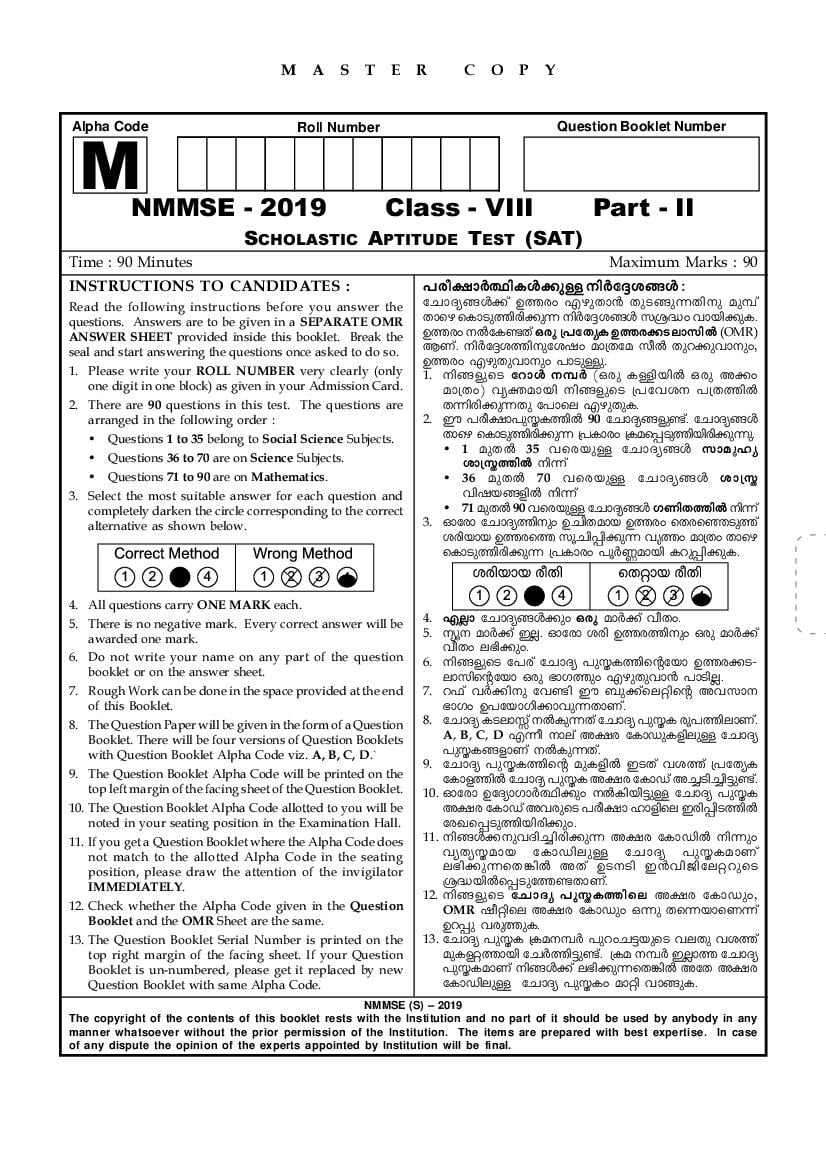
Alpha
ClassCode
– VIII Roll Number SAT Question Booklet Number M
M NMMSE - 2019 Class - VIII Part - II
SCHOLASTIC APTITUDE TEST (SAT)
Time : 90 Minutes Maximum Marks : 90
INSTRUCTIONS TO CANDIDATES : kq}ƒL¡À]W¥¨Oç j]¡SÇw°¥ :
Read the following instructions before you answer the S\Lh|°¥¨V D¾qU IuOfL¢ fOa°OÐf]jO oOÒV
questions. Answers are to be given in a SEPARATE OMR fLRu RWLaO¾]q]¨OÐ j]¡SÇw°¥ yèÈU vLp]¨OW.
ANSWER SHEET provided inside this booklet. Break the D¾qU j¤SWºfV KqO NkSf|W D¾q¨asLy]¤ (OMR)
seal and start answering the questions once asked to do so.
BeV. j]¡SÇw¾]jOSwxU oLNfSo y}¤ fOr¨OvLjOU,
D¾qU IuOfOvLjOU kLaOçO.
1. Please write your ROLL NUMBER very clearly (only 1. j]°tORa SrL¥ jÒ¡ (KqO Wç]p]¤ KqO A¨U
one digit in one block) as given in your Admission Card. oLNfU) v|©oLp] j]°tORa NkSvwj kNf¾]¤
2. There are 90 questions in this test. The questions are fÐ]q]¨OÐfO SkLRs IuOfOW.
arranged in the following order : 2. CT kq}ƒLkOñW¾]¤ 90 S\Lh|°tOºV. S\Lh|°¥
• Questions 1 to 35 belong to Social Science Subjects. fLRu RWLaO¾]q]¨OÐ NkWLqU NWoRÕaO¾]p]q]¨OÐO.
• 1 oOf¤ 35 vRqpOç S\Lh|°¥ yLoPz|
• Questions 36 to 70 are on Science Subjects. wLNñ¾]¤ j]ÐV
• Questions 71 to 90 are on Mathematics. • 36 oOf¤ 70 vRqpOç S\Lh|°¥ wLNñ
3. Select the most suitable answer for each question and v]xp°t]¤ j]ÐV
completely darken the circle corresponding to the correct • 71 oOf¤ 90 vRqpOç S\Lh|°¥ Ye]f¾]¤ j]ÐV
alternative as shown below. 3. KLSqL S\Lh|¾]jOU D\]foLp D¾qU RfqR´aO¾V
wq]pLp D¾qR¾ yP\]Õ]¨OÐ vQ¾U oLNfU fLRu
RWLaO¾]q]¨OÐ NkWLqU kP¡¹oLp] WrOÕ]¨OW.
4. All questions carry ONE MARK each.
5. There is no negative mark. Every correct answer will be 4. IsæL S\Lh|°¥¨OU KqO oL¡¨V v}fU.
awarded one mark. 5. j|Pj oL¡¨V Csæ. KLSqL wq] D¾q¾]jOU KqO oL¡¨V
v}fU sn]¨OU.
6. Do not write your name on any part of the question 6. j]°tORa SkqV S\Lh| kOñW¾]R£SpL D¾q¨a&
booklet or on the answer sheet. sLy]R£SpL KqO nLY¾OU IuOfOvL¢ kLa]sæ.
7. Rough Work can be done in the space provided at the end 7. rlV v¡¨]jO Svº] CT mO¨V R sã]R£ AvyLj
of this Booklet. nLYU DkSpLY]¨LvOÐfLeV.
8. The Question Paper will be given in the form of a Question 8. S\Lh| WasLôV j¤WOÐfV S\Lh| kOñW qPk¾]sLeV.
Booklet. There will be four versions of Question Booklets A, B, C, D IÐ} jLsV Aƒq SWLcOWt]sOç S\Lh|
with Question Booklet Alpha Code viz. A, B, C, D.` kOñW°tLeV j¤WOÐfV.
9. S\Lh| kOñW¾]R£ oOWt]¤ CafV vw¾V NkSf|W
9. The Question Booklet Alpha Code will be printed on the SWLt¾]¤ S\Lh| kOñW Aƒq SWLcV A\ÿa]\ÿ]ŸOºV.
top left margin of the facing sheet of the Question Booklet. 10. KLSqL DSh|LYL¡À]¨OU j¤W]p]ŸOç S\Lh| kOñW
10. The Question Booklet Alpha Code allotted to you will be Aƒq SWLcV AvqORa kq}ƒL zLt]Rs Cq]Õ]a¾]¤
noted in your seating position in the Examination Hall. SqXRÕaO¾]p]q]¨OU.
11. If you get a Question Booklet where the Alpha Code does 11. j]°¥¨jOvh]\ÿ]q]¨OÐ Aƒq SWLc]¤ j]ÐOU
not match to the allotted Alpha Code in the seating v|f|ñoLp SWLc]sOç S\Lh| kOñWoLeV
position, please draw the attention of the invigilator sn]¨OÐRfË]¤ AfV Daja] C¢v]^]SsãrORa
IMMEDIATELY.
èÈp]¤RÕaOS¾ºfLeV.
12. j]°tORa S\Lh| kOñW¾]Rs Aƒq SWLcOU,
12. Check whether the Alpha Code given in the Question OMR x}ã]Rs Aƒq SWLcOU KÐO fRÐpLReÐV
Booklet and the OMR Sheet are the same. DrÕO vqO¾OW.
13. The Question Booklet Serial Number is printed on the 13. S\Lh| kOñW NWojÒ¡ kOrU\ŸpORa vsfO vw¾V
top right margin of the facing sheet. If your Question oOWtã¾Lp] S\¡¾]ŸOºV. NWo jÒ¡ CsæL¾ S\Lh|
Booklet is un-numbered, please get it replaced by new kOñWoLeV j]°¥¨V sn]¨OÐRfË]¤ ASf Aƒq
Question Booklet with same Alpha Code. SWLc]sOç S\Lh| kOñWU oLã] vL°OW.
NMMSE (S) – 2019
The copyright of the contents of this booklet rests with the Institution and no part of it should be used by anybody in any
manner whatsoever without the prior permission of the Institution. The items are prepared with best expertise. In case
ofENG+MAL 1
any dispute the opinion of the experts appointed by Institution will be final. P.T.O.
Page 2
Class – VIII SAT M
E
ER
H
E
IT
R
W
T
O
N
O
D
ENG+MAL 2
Page 3
Class – VIII SAT M
There are 90 questions in all. For each question BRW 90 S\Lh|°¥ DºV . KLSqL
four alternative answers are given marked as S\Lh|¾]jOU (1), (2), (3), (4) IÐV
(1), (2), (3), (4). From these, find the most AapLtRÕaO¾]p jLsV v|f|ñ D¾qU
appropriate answer. The number denoting this v}fU RWLaO¾]ŸOºV. Avp]¤ wq]pLpSfL
answer is there in the answer sheet against the JãvOU AjOSpL^|oLpSfL Bp D¾qU
question number concerned. Darken the circle WºOk]a]¨OW. CT D¾qR¾ WOr]¨OÐ
with Blue/Black Ball Pen only. Record the jÒ¡ D¾q¨asLy]¤ AfLfV
answers thus in the OMR answer sheet only. S\Lh|¾]Rjf]Rq DºV. CT jÒ¡ Aa°]p
Do not write anything in the question booklet vQ¾U j}s ARsæ Ë ]¤ WrOÕV ox]pOç
except your Roll Number on the cover page and mL¥ Rk¢ DkSpLY]\ÿ V WrOÕ]¨OW.
rough work in the space provided for the D¾q°¥ ANkWLqU OMR
purpose. D¾q¨asLy]¤ oLNfU SqXRÕaO¾OW.
S\Lh|°¥ Aa°]p mO¨]R£ Wv¡ Sk^]¤
j]°tORa SrL¥ jÒqOU, rlV v¡¨]jO Svº]
fÐ]ŸOç òs¾V Af]jOç WOr]ÕOW¥
Ku]RW oRãLÐOU IuOfqOfV.
1. Who described changes in the Neolithic age 1. jv}j w]sLpOY¾]Rs oLã°Rt
as ‘Neolithic Revolution’ ? "jv}jw]sLpOY v]kæ v U' IÐV
v]Swx]Õ]\ÿfLqV ?
(1) John Marshall (1) S^L¦ oL¡x¤
(2) R.D. Banerjee (2) B¡.c]. mLj¡^]
(3) Gordon Childe (3) SYL¡c¢ RR\¤cV
(4) Alexander Cunningham (4) AsWVVyLº¡ W¹]UYVzLU
2. The Mesolithic site, Bagor is situated in : 2. oi|w]sLpOY SWNÎoLp mLRYL¡
ò]f] R\áOÐfV :
(1) Madhya Pradesh (1) oi|NkShwV
(2) Rajasthan (2) qL^òL¢
(3) Karnataka (3) W¡¹LaWU
(4) Gujarat (4) YO^rL¾V
ENG+MAL 3 P.T.O.
Page 4
Class – VIII SAT M
3. Name the Second Capital of Magadha 3. oYi qL^|¾]R£ qºLU fsòLj&
Kingdom. ¾]R£ SkRquOfOW.
(1) Pataliputra (1) kLas}kONfU
(2) Gandhara (2) YLÌLqU
(3) Ujjaini (3) D²p]j]
(4) Rajagriha (4) qL^YQzU
4. Identify the common feature of 4. RoRyLRÕLŸLo]p¢, CT^]kV x |¢,
Mesopotamian, Egyptian and Chinese RR\j}yV IÐ} yUØLq°tORa
civilizations. RkLfO yv]Swxf WRº¾OW.
(1) Use of iron tools (1) CqOÒOkWqe°tORa DkSpLYU
(2) Ziggurats (2) y]YOrL¾OW¥
(3) Preparation of calendar (3) Wsºr]R£ j]¡oLeU
(4) Preparation of water clock (4) ^sZa]WLq¾]R£ j]¡oLeU
5. The Sangam work ‘Akananuru’ belongs 5. yUZU WQf]pLp "AWjLjPrV '
to the category of : D¥R¨LçOÐ v]nLYU :
(1) Grammar text (1) v|LWqeU
(2) Ettuthokai (2) IŸOR¾LRRW
(3) Pathupattu (3) k¾OÕLŸV
(4) Pathinenkeezhkanakku (4) kf]Rj¦W}uVWe¨V
6. The causes for the decline of Harappan 6. zqÕ¢ yUØLq¾]R£ Aikfj&
Civilization does not include : WLqe°t]¤ D¥RÕaL¾fV :
(1) Flood (1) RvçRÕL¨U
(2) Deforestation (2) vjjw}WqeU
(3) Absence of a centralised authority (3) KqO SWNÎ}WQf Ai]WLq¾]R£
AnLvU
(4) Decline of agriculture (4) WQx]pORa fW¡\ÿ
ENG+MAL 4
Page 5
Class – VIII SAT M
7. Identify the correct pair from among the 7. \OvRa fÐ]ŸOçf]¤ j]ÐOU
following. wq]pLp S^Lc] WRº¾OW.
(1) The Cheras - Muchiri (1) S\q¢oL¡ - oO\]q]
(2) The Pandyas - Pataliputra (2) kL¼|¢oL¡ - kLas}kONfU
(3) The Cholas - Madurai (3) S\Lt¢oL¡ - oiORRq
(4) The Mauryas - Uraiyur (4) oTq|¢oL¡ - DRRrpP¡
8. The Ajivikas and the Charvakas belonged 8. A^}v]WÓLqOU \L¡vLW¢oLqOU
to the category of : D¥RÕŸ]qOÐ v]nLYU :
(1) Umanar (2) Brahmanas (1) Doe¡ (2) NmLzVoe¡
(3) Sramanas (4) Kshatriyas (3) èoe¡ (4) ƒNf]p¡
9. Rock Shelter is the salient feature of : 9. WsæORWLºV j]¡Ú]\ÿ vLyòs°¥
NkiLj yv]SwxfpLp]qOÐ SWNÎU :
(1) Hunsgi (2) Adamgarh (1) z¢yVY] (2) BhUYcV
(3) Edakkal (4) Bhimbetka (3) Ia¨¤ (4) n]USmcVW
10. Name the Harappan Cultural Site from 10. KqO j¡¾W]pORa RvËs Nkf]o sn]\ÿ
where the bronze statuette of a dancing zqÕ¢ yUØLq SWNξ]R£
girl was discovered. SkRquOfOW.
(1) Kalibangan (1) WLs]mUY¢
(2) Mohenjodaro (2) SoLz¢R^LhLRqL
(3) Chanhudaro (3) \L¢zOhLRqL
(4) Lothal (4) SsLgL¤
ENG+MAL 5 P.T.O.
Page 6
Class – VIII SAT M
11. The names of certain places and their 11. \]s òs°tORa SkqOWtOU AvpORa
importance are given below. Match them NkLiLj|vOoLeV \OvRa j¤W]p]ŸO&
correctly. çfV. Av wq]pLp] SpL^]Õ]¨OW.
Places Importance òs°¥ NkLiLj|U
(a) Lumbini (i) Buddha attained (a) sOUm]j] (i) mOÈ¢
enlightenment
SmLSiLhpU
RRWvq]\ÿO
(b) Sarnath (ii) Birth Place of (b) yLqjLgV (ii) mOÈR£ ^Ó
Buddha
òsU
(c) Bodhgaya (iii) Buddha attained (c) SmLiYp (iii) mOÈ¢ j]¡vLeU
Nirvana
Sja]
(d) Kushinagar (iv) First Sermon of (d) WOw]jYqU (iv) mOÈR£ Bh|
Buddha
NknLxeU
(1) (a)-(ii), (b)-(iv), (c)-(i), (d)-(iii) (1) (a)-(ii), (b)-(iv), (c)-(i), (d)-(iii)
(2) (a)-(ii), (b)-(iv), (c)-(iii), (d)-(i) (2) (a)-(ii), (b)-(iv), (c)-(iii), (d)-(i)
(3) (a)-(ii), (b)-(iii), (c)-(i), (d)-(iv) (3) (a)-(ii), (b)-(iii), (c)-(i), (d)-(iv)
(4) (a)-(iii), (b)-(iv), (c)-(i), (d)-(ii) (4) (a)-(iii), (b)-(iv), (c)-(i), (d)-(ii)
12. Identify the geographical feature of the 12. RjpÅ ¤ f]epORa nPo]wLNñ yv]&
Tinai, Neytal. Swxf WRº¾OW.
(1) Hilly Region (1) WOÐ]¢ NkShwU
(2) Dry land (2) vqºOe°]p NkShwU
(3) Grassland (3) kO¤SoaV
(4) Coastal Region (4) f}qNkShwU
ENG+MAL 6
Page 7
Class – VIII SAT M
13. Identify the correct statement regarding 13. w]sWtOoLp] mÌRÕŸ NkñLvj&
rocks. Wt]¤ wq]pLpSffV ?
(1) Gneiss is an igneous rock, but (1) jp]yV KqO BS®pw]spOU
Granite is metamorphic. NYLRRjãV KqO WLpLÍq]f
w]spOoLeV.
(2) Granite is an igneous rock, but (2) NYLRRjãV KqO BS®pw]spOU
Gneiss is metamorphic. jp]yV KqO WLpLÍq]f
w]spOoLeV.
(3) Both Granite and Gneiss are igneous (3) NYLRRjãOU jp]yOU BS®p
rocks. w]sWtLeV.
(4) Both Granite and Gneiss are (4) NYLRRjãOU jp]yOU WLpLÍq]f
metamorphic rocks. w]sWtLeV.
14. Suppose you are facing the setting sun, 14. j]°¥ Añop yPq|jV An]oOXoLp]
what may be the direction to the right side j]åOÐO IÐV yˤÕ]¨OW. IË]¤
of you ? j]°tORa vsfO vw¾V JfV
h]¨Lp]q]¨OU ?
(1) East (2) West (1) W]u¨V (2) ka]´LrV
(3) North (4) South (3) va¨V (4) Rf¨V
15. Which among the following districts in 15. fo]uV j LaOoLp] Af]¡¾] kË]aL¾
Kerala is not sharing boundary with SWqt¾]Rs ^]sæSpfV ?
Tamil Nadu ?
(1) Wayanad (1) vpjLaV
(2) Pathanamthitta (2) k¾jUf]Ÿ
(3) Kozhikode (3) SWLu]S¨LaV
(4) Kollam (4) RWLsæU
ENG+MAL 7 P.T.O.
Page 8
Class – VIII SAT M
16. Match the following Map Symbols with 16. \OvRa jä]p]ŸOç nPka\]ø°Rt
their respective colours. AjOmÌ j]r°tOoLp] S\qOUka]
S\¡¨OW.
Map Symbols Colours nPka\]ø°¥ j]r°¥
(a) Roads Brown (a) SrLcV fv]ŸV
(b) Railway lines Blue (b) rp]¤Sv RRs¢yV j}s
(c) Sand dunes Black (c) oe¤ WPj WrOÕV
(d) Waterbodies Red (d) ^sLwp°¥ \OvÕV
(1) (a)-Red, (b)-Blue, (c)-Black, (1) (a)- \OvÕV , (b)- j}s , (c)- WrOÕV ,
(d)-Brown (d)-fv]ŸV
(2) (a)-Black, (b)-Red, (c)-Brown, (2) (a)- WrOÕV , (b)- \OvÕV , (c)-fv]ŸV ,
(d)-Blue (d)-j}s
(3) (a)-Black, (b)-Brown, (c)-Blue, (3) (a)- WrOÕV , (b)- fv]ŸV , (c)- j}s,
(d)-Red (d)-\OvÕV
(4) (a)-Red, (b)-Black, (c)-Brown, (4) (a)- \OvÕV , (b)- WrOÕV , (c)-fv]ŸV ,
(d)-Blue (d)-j}s
17. What are hailstones ? 17. Bs]ÕuU IÐLRsÍV ?
(1) Precipitation in the form of tiny ice (1) Sj¡¾ z]oWe]WWtORa qPk&
crystals. (less than 0.2 inch) or (less ¾]sOç v¡xeU. ( 5 mm &¤
than 5 mm) WOrvV) ARsæË]¤ (0.2 inch &¤
WOrvV)
(2) Precipitation in the form of ice (2) o´OWŸWtORa qPk¾]sOç
pellets. (0.2 inch to 6 inch) or (5 mm v¡xeU. (0.2 inch &jOU 6 inch
to 15 cm) &jOU Cap]¤ ) ARsæ Ë ]¤ (5 mm
oOf¤ 15 cm vRq)
(3) Condensed droplets of water. (3) Zj}nv]\ÿ ^s¾Oç]W¥.
(4) Rainbearing clouds formed by (4) Zj}Wqe¾L¤ qPkRÕaOÐ
condensation. ouSoZ°¥.
18. Which among the following rivers in India 18. jä]p]ŸOçvp]¤ Arm]¨as]¤
joins Arabian Sea ? kf]¨OÐ CÍ|p]Rs jh]SpfV ?
(1) Indus (2) Ganga (1) y]ÌO (2) YUY
(3) Brahmaputra (4) Godavari (3) NmùkONf (4) SYLhLvq]
ENG+MAL 8
Page 9
Class – VIII SAT M
19. India is situated between the latitudes : 19. CÍ| JRfsæ L U AƒLUw°¥¨]a&
p]sLeV ò]f]R\áOÐfV ?
(1) 23½8 N to 66½8 North (1) 23½8 va¨V oOf¤ 66½8 va¨V
vRq
(2) 884’ N and 23½8 North (2) 884’ va¨V oOf¤ 23½8 va¨V vRq
(3) 884’ N and 3786’ North (3) 884’ va¨V oOf¤ 3786’ va¨V vRq
(4) 18825’ N and 37806’ North (4) 18825’ va¨V oOf¤ 37806’ va¨V
vRq
20. 66½8 North latitude is called : 20. 66½8 D¾q AƒLUwR¾ v]t]¨OÐ
SkRqÍV ?
(1) Tropic of Cancer (1) D¾qLpj SqX
(2) Antarctic Circle (2) A£L¡Ÿ]WV vQ¾U
(3) Arctic Circle (3) B¡Ÿ]WV vQ¾U
(4) Tropic of Capricorn (4) hƒ]eLpj SqX
21. The first Earth Summit was held at : 21. Bh| nTo D\ÿ S WLa] Iv]RapLp]&
qOÐO ?
(1) Rio de Janeiro (1) r]SpL c] ^j}SrL
(2) Geneva (2) ^j}v
(3) Tokyo (3) SaLSW|L
(4) Paris (4) kLq}yV
22. Hygrometer is used to measure : 22. RRzSNYLo}ã¡ DkSpLY]\ÿV At¨OÐfV
IÍV ?
(1) Atmospheric humidity (1) AÍq}ƒ B¡Nhf
(2) Atmospheric pressure (2) AÍq}ƒo¡ÇU
(3) Level of water table (3) ^sk}b¾]R£ j]qÕV
(4) Velocity of wind (4) WLã]R£ SvYf
ENG+MAL 9 P.T.O.
Page 10
Class – VIII SAT M
23. Preamble to the Constitution of India is 23. CÍ|¢ nqe ZajpORa BoOXR¾
termed as “Political Horoscope” by : ""qLNì}p^LfWU'' IÐV v]Swx]Õ]\ÿ&
fLqLeV ?
(1) B.R. Ambedkar (1) m].B¡. AUmhVW¡
(2) K.M. Munshi (2) RW.IU. oO¢x]
(3) Rajendra Prasad (3) qLS^NÎNkyLhV
(4) K.T. Shah (4) RW.a]. xL
24. Who appoints the State Governor ? 24. yUòLj Yv¡eRr j]po]¨OÐ&
fLqLeV ?
(1) Chief Minister (1) oOX|oNÍ]
(2) Prime Minister (2) NkiLjoNÍ]
(3) Chief Justice of High Court (3) RRzS¨Laf] \}lV^ð]yV
(4) Indian President (4) CÍ|¢ Nky]c£V
25. The country having oldest written 25. JãvOU ku¨oOç s]X]f nqeZaj&
Constitution : pOç qL^|U :
(1) Britain (2) France (1) Nm]Ÿ¢ (2) NlL¢yV
(3) U.S.A. (4) Japan (3) pO.IyV.I. (4) ^ÕL¢
26. The day NITI Aayog was formed : 26. j}f] BSpLYV qPk}Wq]¨RÕŸ h]jU :
(1) 1st January 2013 (1) ^jOvq] 1, 2013
(2) 1st January 2014 (2) ^jOvq] 1, 2014
(3) 1st January 2015 (3) ^jOvq] 1, 2015
(4) 1st January 2016 (4) ^jOvq] 1, 2016
27. Who is the final authority in India 27. kTqf~R¾ yUmÌ]\ÿ V CÍ|p]Rs
regarding citizenship ? AÍ]o Ai]WLq]pLqLeV ?
(1) Parliament (1) kL¡sRo£V
(2) Indian President (2) CÍ|¢ Nky]c£V
(3) Supreme Court (3) yONk}USWLaf]
(4) Election Commission (4) Csƒ¢ WÚ}x¢
ENG+MAL 10
Page 11
Class – VIII SAT M
28. The impeachment of President of India can 28. CÍ|¢ qLNìkf]Rp j}¨U R\áOÐ&
be initiated in : f]jOç jaka] NWoU fOaS°ºfV :
(1) Joint sitting of both Houses of (1) kL¡sRo£]R£ yUpO©
Parliament ySÚtj¾]¤
(2) Either House of Parliament (2) kL¡sRo£]R£ JRfË]sOU
ynp]¤
(3) Lok Sabha (3) SsLWVynp]¤
(4) Rajya Sabha (4) qL^|ynp]¤
29. The country in which the methods of 29. Nkf|ƒ ^jLi]kf| oL¡«°¥
Direct Democratic Devices remain as a yv]Swx sƒeoLp]ŸOç qL^|U :
distinct feature :
(1) India (2) China (1) CÍ| (2) RR\j
(3) Switzerland (4) Britain (3) y~]ãVy¡sL£V (4) Nm]Ÿ¢
30. Who is the present Union Minister for 30. CÍ|p]Rs CSÕLuR¾ SWNÎ oLjv
Human Resource Development in India ? v]nvSwx] v]Wyj vWOÕV oNÍ] :
(1) Prakash Javadekar (1) NkWLwV ^LvSh¨¡
(2) Piyush Goyal (2) k]pOxV SYLp¤
(3) Smriti Irani (3) yVVNo]f] CrLj]
(4) Ramesh Pokhriyal (4) qSowV RkLNW]pL¤
31. In India, “Right to Work’’ is a : 31. "RfLu]¤ R\áOvLjOç AvWLwU'
CÍ|p]¤ :
(1) Directive Principle (1) j]¡SÇwWff~oLeV
(2) Fundamental Right (2) oTs]WLvWLwoLeV
(3) Constitutional Right (3) nqeZajL AvWLwoLeV
(4) Fundamental Duty (4) oTs]W W¡¾|v|oLeV
32. The minimum strength of a State 32. yUòLj j]poj]¡ÚLe WT¦&-
Legislative Council is fixed as : y]s]¤ SvºOÐ \OqO°]p AUY
yUX| :
(1) 30 (2) 40 (1) 30 (2) 40
(3) 50 (4) 60 (3) 50 (4) 60
ENG+MAL 11 P.T.O.
Page 12
Class – VIII SAT M
33. The term of office of a Judge of 33. AÍLqLNì j}f] j|Lp SWLaf]p]Rs
International Court of Justice : ^cV ^ ]pORa KTSh|LY]W WLsLvi]
INfpLeV ?
(1) 5 years (2) 6 years (1) 5 v¡xU (2) 6 v¡xU
(3) 8 years (4) 9 years (3) 8 v¡xU (4) 9 v¡xU
34. Who among the following decides whether 34. KqO m]¤ ijm]sæLSeL AsæRpL IÐV
a Bill is money bill or not ? f}qOoLj]¨OÐfV fLRu RWLaO¾]ŸO&
çf]¤ BqLeV ?
(1) Speaker of Lok Sabha (1) SsLWVynL y×}¨¡
(2) Finance Minister (2) ijWLq|oNÍ]
(3) Vice-President of India (3) DkqLNìkf]
(4) Prime Minister (4) NkiLjoNÍ]
35. The Chairman of State Reorganisation 35. yUòLj kOjyUZaj WÚ}x¢
Commission : R\p¡oL¢ BqLp]qOÐO :
(1) Dhar (1) i¡
(2) H.N. Kunzru (2) I\ÿV.I¢. XO¢NyO
(3) Fazal Ali (3) ly¤ As]
(4) V.P. Menon (4) v].k]. SoSjL¢
ENG+MAL 12
Page 13
Class – VIII SAT M
36. Which of the following distance-time 36. fLRu fÐ]q]¨OÐvp]¤ JfV
graph represents motion with uniform hPq&yop NYLlLeV yo SvY¾]sOç
speed ? \sjR¾ yP\]Õ]¨OÐfV ?
(1) (1)
(2) (2)
(3)
(3)
(4)
(4)
ENG+MAL 13 P.T.O.
Page 14
Class – VIII SAT M
37. Which of the following is true about virtual 37. fLRuÕrpOÐvp]¤ KqO h¡Õe&
images produced by a mirror ? oOºL¨OÐ o]g|L Nkf]m]Um°Rt
yUmÌ]\ÿV wq]pLpSffV ?
(1) always diminished (1) IsæLpVSÕLuOU R\rOfLp]q]¨OU
(2) always enlarged (2) IsæLpVSÕLuOU vsOfLp]q]¨OU
(3) always same size as the object (3) IsæLpVSÕLuOU vñOv]R£ ASf
vsOÕoLp]q]¨OU
(4) always erect (4) Isæ L pV S ÕLuOU j]v¡ÐfLp]&
q]¨OU
38. Which of the following devices employs 38. Cvp]SsfLeV RRvh|Of NkvLz&
the magnetic effect of electric current ? ¾]R£ WLÍ]W ls¾]¤ Nkv¡¾]&
¨OÐfV ?
(1) Filament Lamp (1) l]so£V sLUmV
(2) Electric Heater (2) RRvh|Of z}ã¡
(3) Electric Bell (3) RRvh|Of Rm¤
(4) Electric Cell (4) RRvh|Of qLyRy¤
39. A train of length 200 m takes 1 minute to 39. 200 o}ã¡ j}toOç KqO RNap]¢ 1 W].o}.
cross a bridge of length 1 km. How long j}toOç KqO kLsU Wa¨OÐf]jV KqO
does it take to cross another bridge of o]j]ãV yopU IaO¨OÐO. RNap]¢ CSf
length 400 m with the same speed ? SvYfp]¤ yµq]\ÿ L ¤ 400 o}ã¡
j}toOç oRãLqO kLsU Wa¨OÐf]&
RjaO¨OÐ yopU :
(1) 24 s (2) 30 s (1) 24 Ry¨£V (2) 30 Ry¨£V
(3) 42 s (4) 15 s (3) 42 Ry¨£V (4) 15 Ry¨£V
40. A unit of length is : 40. Cvp]SsfLeV j}t¾]R£ pPe]ãV ?
(1) pound (1) kTºV
(2) angstrom (2) B‚VyVSNaLU
(3) galvanometer (3) YL¤vSjLo}ã¡
(4) arc second (4) B¡¨V Ry¨£V
ENG+MAL 14
Page 15
Class – VIII SAT M
41. Identify the renewable energy source. 41. kOj@òLk]¨L¢ Wu]pOÐ DT¡^U
JfV ?
(1) Coal (1) W¤¨q]
(2) Petroleum (2) RkSNaLt]pU
(3) Natural gas (3) NkWQf] vLfWU
(4) Solar cell (4) SyLtL¡ Ry¤
42. The weight of air column over an area of 42. nPo]pORa Dkq]fs¾]Rs 1 cm 2
1 cm2 on the surface of the earth is about : kqÕtv]¤ AjOnvRÕaOÐ vLpO
pPk¾]R£ nLqU :
(1) 1 kg wt. (2) 10 kg wt. (1) 1 kg wt. (2) 10 kg wt.
(3) 100 kg wt. (4) 1000 kg wt. (3) 100 kg wt. (4) 1000 kg wt.
43. The heat from an electric bulb fixed on the 43. oOr]pORa So¤¨Pqp]sOç RRvh|Of
roof of a room is transmitted to the floor m¥m]¤ j]ÐV fLkU fLSu¨V
by the process of : SNkxeU R\áRÕaOÐ q}f]SpfV ?
(1) convection (1) yUvzjU
(2) radiation (2) v]W]qeU
(3) convection and radiation (3) yUvzjvOU v]W]qevOU
(4) conduction (4) \LsjU
44. A bar magnet as shown in figure (1) is cut 44. \]NfU (1)&¤ WLeOÐfOSkLRs mL¡
into two pieces. The two pieces are then WLÍR¾ qºLp] oOr]¨OÐO. CT
arranged as shown in figure (2). The force Wxe°Rt \]NfU (2)&SsfO SkLRs
between the ends B and C will be : v\ÿ L ¤ B ANYvOU C ANYvOU
fÚ]sOç msU I°Rj BWOU ?
(1) attractive (1) BW¡xeU
(2) repulsive (2) v]W¡xeU
(3) zero (3) kP^|U
(4) neutral (4) j|PNa¤
ENG+MAL 15 P.T.O.
Page 16
Class – VIII SAT M
45. Which of the following module of 45. CÍ|p]Rs NkoOX wLNñ³R£ KL¡Ú&
Chandrayaan 2 is named to commemorate ¨Lp] Skq]aRÕŸ \NÎpL¢ 2 &R£
a famous Indian Scientist ? nLYU :
(1) Launcher (2) Orbiter (1) SsLµ¡ (2) KL¡m]ã¡
(3) Lander (4) Rover (3) sL¢c¡ (4) SrLv¡
46. Light travels through curved path in a : 46. NkWLw¾]jV vNWkLfp]sPRa yµq]&
¨L¢ Wu]pOÐfV Cvp]Ssf]sLeV ?
(1) Convex mirror (1) SWL¦RvWVVyV o]r¡
(2) Concave mirror (2) SWL¦SWvV o]r¡
(3) Optic fibre (3) KLkVVa]WV RRlm¡
(4) Plane mirror (4) yofs h¡ÕeU
47. Which among the following is incorrect ? 47. \OvRa j¤W]p]ŸOçvp]¤ wq]&
psæL¾fVV JfV ?
(1) A salt is formed by the neutralisation (1) By]cOU SmyOU fÚ]sOç
reaction between an acid and a base. j]¡vÿ}q}Wqe¾]R£ lsoLpLeV
KqO sveU DºLWOÐfV.
(2) All salts are neutral substances. (2) Isæ L sve°tOU j]¡vÿ } q|
(j|PNa¤) khL¡À°tLeV.
(3) Salts may be acidic, basic or neutral (3) sve°¥ By]cV YOeSoL
in nature. Smy]W YOeSoL j]¡vÿ } q|SoL
BWLU.
(4) Sodium Chloride is a salt formed by (4) RRzSNcLSWæ L r]WV By]cOU
the neutralisation of Hydrochloric SyLc]pU RRzSNcLRRWõ c OU
acid and Sodium Hydroxide. fÚ]sOç j]¡vÿ } q}Wqe ls&
oLpLeV SyLc]pU SWæ L RRrcV
sveU DºLWOÐfV.
ENG+MAL 16
Page 17
Class – VIII SAT M
48. A physical change occurs when : 48. KqO nTf]WoLãU ja¨OÐfV fLRu
RWLaO¾]q]¨OÐvp]¤ JfV Av&
yq¾]sLeV ?
(1) Vinegar is mixed with baking soda. (1) v]jLY]q] Sm¨]UYV SyLcpO&
oLp] Ws¡¾OSÒL¥
(2) Carbon dioxide gas is passed through (2) Rft]´ \O¹LÒO Rvç¾]¤
freshly prepared lime water. WPa] WL¡m¦ RRcKLRRWõ c V
vLfWU Wa¾] v]aOSÒL¥
(3) An iron nail is dropped into Copper (3) KqO CqOÒLe] SWLÕ¡ y¥SlãV
Sulphate solution. sLpj]p]¤ CaOSÒL¥
(4) Sodium Chloride is added to water. (4) Wr]pOÕV ^s¾]Ss¨O S\¡¨O&
SÒL¥
49. When solid naphthalene is heated, it 49. XqLvòp]sOç jLlVfs}¢ \PaL¨O&
changes into vapour. This phenomenon SÒL¥ mLx× o Lp] oLrOÐO. CT
is called : Nkf]nLyR¾__________ IÐO
v]t]¨OÐO.
(1) Vapourisation (2) Sublimation (1) mLx×}WqeU (2) DfVkfjU
(3) Condensation (4) Liquefaction (3) yLNÎ}WqeU (4) Nhv}WqeU
50. Which among the following is not a 50. fLRu j¤W]p]ŸOçvp]¤ yo}WQf
balanced chemical equation ? qLyyovLW|U AsæL¾SffV ?
(1) CH4+2O2 → CO2+2H2O (1) CH4+2O2 → CO2+2H2O
(2) 3N2+2H2 → 2NH3 (2) 3N2+2H2 → 2NH3
(3) CaCO3 → CaO+CO2 (3) CaCO3 → CaO+CO2
(4) 2H2O2 → 2H2O+O2 (4) 2H2O2 → 2H2O+O2
51. Certain medicines and chemicals are 51. \]s oqOÐOWtOU qLyvñO¨tOU
stored in brown coloured bottles to protect fv]ŸOj]r¾]sOç WOÕ]Wt]¤ yPƒ]&
them from undergoing __________. ¨OÐfV JfO qLy Nkv¡¾jU
fapOÐf]jLeV ?
(1) photochemical reaction (1) NkWLw qLyNkv¡¾jU
(2) electrochemical reaction (2) RRvh|Of qLyNkv¡¾jU
(3) thermochemical reaction (3) fLk qLyNkv¡¾jU
(4) exothermic reaction (4) fLk SoL\WqLy Nkv¡¾jU
ENG+MAL 17 P.T.O.
Page 18
Class – VIII SAT M
52. Which among the following is a poor 52. \OvRa S\¡¾]ŸOçvp]¤ JfLeV
conductor of heat energy ? fLSkL¡²¾]R£ WO\LsWU ?
(1) Aluminium (2) Copper (1) AsPo]j]pU (2) SWLÕ¡
(3) Iron (4) Sulphur (3) Ap¦ (4) y¥l¡
53. Bronze is an alloy of __________. 53. "KLaV ' (SNmL¦yV ) IÐ SsLz
yËqe¾]R£ ZaW°¥ _________ ,
IÐ]vpLeV.
(1) Copper and Zinc (1) SWLÕ¡, y]ËV
(2) Copper and Silver (2) SWLÕ¡, y]¤v¡
(3) Copper and Tin (3) SWLÕ¡, a]¢
(4) Copper and Gold (4) SWLÕ¡, SYL¥cV
54. It is dangerous to burn coal in a closed room 54. Aa\ÿ]Ÿ oOr]p]¤ W¤¨q] W¾]¨OÐfV
because of the production of __________. AkWaWqoLReÐV krpL¢ WLqeU
__________ DºLWOÐfLeV.
(1) Carbon dioxide (1) WL¡m¦ RRcKLRRWõcV
(2) Carbon monoxide (2) WL¡m¦ SoLSeLRRWõcV
(3) Hydrogen (3) RRzNc^¢
(4) Water (4) ^sU
55. The incorrect statement among the 55. \OvRa j¤W]p]ŸOçvp]¤ wq]&
following is : psæL¾ NkñLvj JfV ?
(1) metals are lustrous (1) SsLz°¥ h|Of] DçvpLeV
(2) generally metals are malleable (2) RkLfORv, SsLz°Rt Aa]\ÿO
kq¾L¢ Wu]pOU
(3) metal oxides are generally acidic (3) SsLz KLWVRRycOW¥ RkLfORv
Ay]c]WV y~nLvU WLe]¨OÐO
(4) some metals react with bases to (4) \]s SsLz°¥ SmyOWtOoLp]
produce hydrogen Nkf]Nkv¡¾]\ÿ V RRzNc^¢
DºLWOÐO.
ENG+MAL 18
Page 19
Class – VIII SAT M
56. Identify the exothermic change from the 56. \OvRa j¤W]p]ŸOçvp]¤ fLk&
following. SoL\W Nkv¡¾jU JfV ?
(1) neutralisation reaction between an (1) By]cOU SmyOU fÚ]sOç
acid and a base j]¡vÿ}q}WqeU
(2) decomposition of potassium (2) \PaL¨OSÒL¥ RkLŸLy|U
permanganate on heating Rk¡oLUYSjãV v]Za]¨OÐfV
(3) melting of ice (3) RIyV DqOWOÐfV
(4) thermal decomposition of calcium (4) WLÃ|U WL¡mSeã]R£ fLk}p
carbonate v]ZajU
57. Separating funnel is an apparatus which 57. RyÕSrã]‚V le¤ IÐ DkWqeU
can be used for the separation of DkSpLY]\ÿV __________ Sv¡f]q]¨L¢
__________. Wu]pOU.
(1) Miscible liquids with large difference (1) f]tj]sWt]¤ vs]p v|f|LyoOç
in their boiling points. kqy×qU WsqOÐ NhLvW°¥
(2) Miscible liquids with very small (2) f]tj]sWt]¤ R\r]p v|f|L&
difference in their boiling points. yoOç kqy× q U WsqOÐ
NhLvW°¥
(3) Common salt from sea water. (3) Wa¤ ^s¾]sOç Wr]pOÕV
(4) Immiscible liquids. (4) kqy×qU WsqL¾ NhLvW°¥
58. Which among the following symbols is not 58. \OvRa S\¡¾]ŸOç oPsW°t]¤
derived from the Latin name of the sLã]¢ jLo¾]¤ j]ÐV Nkf}WU
element ? y~}Wq]\ÿ]Ÿ]sæL¾fV JfV ?
(1) Na (2) K (1) Na (2) K
(3) Ca (4) Cu (3) Ca (4) Cu
ENG+MAL 19 P.T.O.
Page 20
Class – VIII SAT M
59. The incorrect statement among the 59. \OvRa j¤W]p]ŸOçvp]¤ wq]&
following is : psæL¾ NkñLvj JfV ?
(1) Electrical energy is consumed during (1) RRvh|OfSskjU ja¨OSÒL¥
electroplating. RRvh|OSfL¡^U BY]qeU
R\áRÕaOÐO.
(2) Electroplating is an electrochemical (2) RRvh|OfSskjU KqO RRvh|Of
reaction. qLy Nkv¡¾joLeV.
(3) Electroplating is an endoergic (3) RRvh|OfSskjU KqO DT¡^L&
reaction. Y]qe Nkv¡¾joLeV.
(4) Electrical energy is released during (4) RRvh|OfSskjU ja¨OSÒL¥
electroplating. RRvh|OSfL¡^U SoL\]Õ]¨&
RÕaOÐO.
60. Production of seeds through artificial 60. KSq v¡Y¾]¤RÕŸfOU v|f|ñ
pollination between plants of the same y~nLvyv]SwxfW¥ DçfOoLp
species but of different characteristics is R\a]W¥ fÚ]¤ WQNf]o kqLYeU
called : ja¾] v]¾OW¥ D¤ÕLh]Õ]¨OÐ
q}f]pLeV :
(1) Tissue Culture (1) a]x|O W¥\ÿ¡
(2) Hybridisation (2) v¡YyËqeU
(3) Layering (3) kf]và¤
(4) Cloning (4) SWæLe]UYV
61. Choose the peculiarity of kingdom Protista 61. \OvRa j¤W]p]q]¨OÐvp]¤
from the following. W]‚V c U SNkLŸ]ðpORa yv]Swxf
f]qR´aO¨OW.
(1) Multicellular prokaryotes (1) mzOSWLw]WtLp SNkLWLq]&
SpLŸOW¥
(2) Multicellular eukaryotes (2) mzOSWLw]WtLp pPWLq]&
SpLŸOW¥
(3) Unicellular prokaryotes (3) JWSWLw]WtLp SNkLWLq]&
SpLŸOW¥
(4) Unicellular eukaryotes (4) JWSWLw]WtLp pPWLq]&
SpLŸOW¥
ENG+MAL 20
Page 21
Class – VIII SAT M
62. Which one of the following is not true 62. \OvRa fÐ]q]¨OÐvp]¤ Bvqe&
about epithelial tissue ? WsRp WOr]\ÿV wq]psæL¾fV JfV ?
(1) Controls and Coordinates (1) wLq}q]WNkv¡¾j°¥ j]pNÍ]&
physiological functions ¨OWpOU JSWLk]Õ]¨OWpOU
R\áOÐO.
(2) Produces secretions (2) Nyv°¥ D¤ÕLh]Õ]¨OÐO.
(3) Lines the inner wall of the digestive (3) AÐkg¾]R£ D¥n]¾]Rp
tract BvqeU R\áOÐO.
(4) Covers and protects the body (4) wq}qR¾ RkLf]´V yUqƒ]&
¨OÐO.
63. Tonoplast is the membrane of __________. 63. __________ - & R£ BvqeoLeV
SaLSeLkæLðV.
(1) Mitochondria (1) RRoSãLSWL¦Nc]p
(2) Ribosome (2) RRrSmLSyLU
(3) Lysosome (3) RRsSyLSyLU
(4) Vacuole (4) SljU
64. Choose the correctly matched pair. 64. wq]pLp] S^Lc] S\¡ÐfV f]q&
R´aO¨OW.
(1) John Ray - Coined the (1) S^L¦ Sr - y×}x]yV IÐ
term Species khU qPk}Wq]\ÿO
(2) Carl Linnaeus - Father of (2) WL¥ s]SjpyV - yy|wLNñ¾]R£
Botany k]fLvV
(3) Aristotle - Father of (3) Aq]yVSãLŸ]¤ - v¡Y}Wqe wLNñ-
Taxonomy ¾]R£ k]fLvV
(4) Charakan - Father of (4) \qW¢ - ^}vwLNñ¾]R£
Biology k]fLvV
ENG+MAL 21 P.T.O.
Page 22
Class – VIII SAT M
65. A stock means : 65. yVVSãL¨V IÐL¤ :
(1) A branch selected for layering (1) kf]vàOÐf]jLp] f]qR´aO&
¨OÐ wLX
(2) A rooted branch formed through (2) kf]vàs]sPRa DºLp SvqOç
layering wLX
(3) A rooted plant selected for grafting (3) KŸ]¨s]jO Svº] f]qR´aO&
¨OÐ SvSqLaO WPa]p R\a]
(4) A branch selected for grafting (4) KŸ]¨s]jO Svº] f]qR´aO&
¨OÐ wLX
66. Rearing of varieties like grey giant, white 66. SNY ^p£V , RRvãV ^p£V fOa°]p
giant etc., is known as : Cj°Rt vt¡¾OÐfLeV :
(1) Mushroom Culture (1) oxVrPU W¥\ÿ¡
(2) Cuniculture (2) W|Pe]W¥\ÿ¡
(3) Apiculture (3) IÕ]W¥\ÿ¡
(4) Sericulture (4) Ryr]W¥\ÿ¡
67. Which one of the following is not a 67. \OvRa j¤W]pvp]¤ v¡Y}Wqe
taxon ? fs¾]¤ D¥RÕaL¾fV JfV ?
(1) Species (2) Order (1) yVk}x]yV (2) KL¡c¡
(3) Class (4) Population (3) WæLyV (4) ^}v]YeU
68. Which one of the following is not an 68. \OvRa j¤W]p]q]¨OÐvp]¤
excretory organ ? v]y¡^jLvpvU AsæL¾fV JfV ?
(1) Kidney (1) vQ¨
(2) Lungs (2) w~LySWLwU
(3) Stomach (3) BoLwpU
(4) Skin (4) f~¨V
ENG+MAL 22
Page 23
Class – VIII SAT M
69. Choose the incorrect statement from the 69. \OvRa fÐ]q]¨OÐvp]¤ j]ÐOU
following. RfãLp NkñLvj f]qR´aO¨OW.
(1) Plant cell wall is made up of chitin. (1) yy|°tORa SWLwn]¾] j]¡o]&
\ÿ]q]¨OÐfV RRWã]¢ RWLºLeV.
(2) Mitochondria is the powerhouse of (2) SWLw¾]R£ DT¡^ j]spoLeV
the cell. RRoSãLSWL¦Nc]p.
(3) Ribosomes are not surrounded by a (3) RRrSmLSyLoOWRt BvqeU
membrane. R\pVfV yVfqU WLeOÐ]sæ.
(4) Animal cells lack cell wall. (4) ^ÍOSWLw¾]¤ SWLwn]¾]
WLeRÕaOÐ]sæ.
70. When fruits ripen, starch is converted to : 70. ls°¥ kLWoLWOSÒL¥ AÐ^U
IÍLp] oLrOÐO ?
(1) Protein (1) oLUy|U
(2) Sugar (2) kµyLq
(3) Lactose (3) sLSW›LyV
(4) Amino acid (4) Ao]SjL By]cV
71. If a 4 digit number formed by 7, 3, 2, x is 71. 7, 3, 2, x IÐ} A¨°¥ RWLºV
exactly divisible by 9, then what is the DºL¨LvOÐ KqO jLs¨yUX|Rp 9
value of x ? RWLºV j]SêxU zq]¨L¢
Wu]pORoË]¤ x- R£ v]s IÍV ?
(1) 0 (2) 2 (1) 0 (2) 2
(3) 4 (4) 6 (3) 4 (4) 6
72. (56) 2 −(41) 2 is exactly divisible by the 72. (56) 2 −(41) 2 Rj j]SêxU zq]¨L¢
number : Wu]pOÐ yUX| :
(1) 2 (2) 3 (1) 2 (2) 3
(3) 4 (4) 7 (3) 4 (4) 7
73. If x−y=5 and xy=6, then which of the 73. x−y=5, xy=6 BpL¤ x+y &R£ v]s
following is the value of x+y ? \OvRa fÐ]q]¨OÐvp]¤ JfV ?
(1) 6 (2) 8 (1) 6 (2) 8
(3) 7 (4) 5 (3) 7 (4) 5
ENG+MAL 23 P.T.O.
Page 24
Class – VIII SAT M
74. If milk and water ratio in 16 litre mixture 74. 16 s]ã¡ o]è]f¾]¤ 5 : 3 IÐ
is 5 : 3, then the amount of milk to be AUwm̾]¤ kLsOU RvçvOU
added to make this ratio 2 : 1 is : DRºË]¤ INf kL¤ S\¡¾L¤
AUwmÌU 2 : 1 BWOU ?
(1) 1 litre (2) 2 litre (1) 1 s]ã¡ (2) 2 s]ã¡
(3) 3 litre (4) 4 litre (3) 3 s]ã¡ (4) 4 s]ã¡
75. If the hypotenuse of a right triangle is 75. KqO oŸNf]SWLe¾]R£ W¡e¾]R£
20 cm, then what is the maximum area of j}tU 20 Ry.o}. BpL¤ B
the triangle ? Nf]SWLe¾]R£ kqoLvi] kqÕtvV
INf ?
(1) 100 sq.cm (1) 100 \.Ry.o}.
(2) 120 sq.cm (2) 120 \.Ry.o}.
(3) 90 sq.cm (3) 90 \.Ry.o}.
(4) 80 sq.cm (4) 80 \.Ry.o}.
76. What is the value of 0.3×0.02×0.004 ? 76. 0.3×0.02×0.004 &R£ v]s IÍV ?
(1) 0.024 (2) 0.000024 (1) 0.024 (2) 0.000024
(3) 0.0024 (4) 0.0000024 (3) 0.0024 (4) 0.0000024
77. If (684)2=467854, then what is the value 77. (684) 2 =467854 BpL¤ 46.7854 &R£
of 46.7854 ? v]s IÍV ?
(1) 0.684 (2) 6.84 (1) 0.684 (2) 6.84
(3) 0.0684 (4) 0.00684 (3) 0.0684 (4) 0.00684
78. The remainder when 915+6 is divided by 78. 9 15 +6 &Rj 8 RWLºV zq]\ÿ L ¤
8 is : w]xVaU :
(1) 7 (2) 3 (1) 7 (2) 3
(3) 5 (4) 4 (3) 5 (4) 4
79. Which of following is the smallest 79. \OvRa fÐ]q]¨OÐvp]¤ JãvOU
fraction ? R\r]p n]ÐyUX| JfV ?
12 13 12 13
(1) (2) (1) (2)
14 19 14 19
17 7 17 7
(3) (4) (3) (4)
21 8 21 8
ENG+MAL 24
Page 25
Class – VIII SAT M
80. The figure shows a circle of radius one unit 80. \]Nf¾]¤ O SWNÎoLp KqO pPe]ãV
with centre O and ∠ACB=308. Find AB. BqoOç vQ¾U fÐ]q]¨OÐO,
∠ACB=308 BpL¤ AB WLeOW.
1 1
(1)
2
unit (2) 1 unit (1)
2
pPe]ãV (2) 1 pPe]ãV
3 3
(3)
2
unit (4) 2 unit (3)
2
pPe]ãV (4) 2 pPe]ãV
81. Find the angle formed between the hour 81. yopU WQf|U 2 oe]pLWOSÒL¥ KqO
hand and minute hand of a clock at SWæL¨]Rs oe]¨P¡ yP\]pOU o]j]ãV
2 o’clock. yP\]pOU fÚ]sOç SWLetvV WLeOW.
(1) 708 (2) 508 (1) 708 (2) 508
(3) 608 (4) 558 (3) 608 (4) 558
82. The figure shows a regular octagon with 82. \]Nf¾]¤ 8 \. pPe]ãV kqÕtvOç
area 8 sq. unit. What is the area of the KqO yo AìnO^U fÐ]q]¨OÐO.
shaded region ? WrOÕ]\ÿ]q]¨OÐ nLY¾]R£ kqÕtvV
INf?
(1) 3 sq. unit (1) 3 \. pPe]ãV
(2) 1 sq. unit (2) 1 \. pPe]ãV
(3) 1.5 sq. unit (3) 1.5 \. pPe]ãV
(4) 2 sq. unit (4) 2 \. pPe]ãV
ENG+MAL 25 P.T.O.
Page 26
Class – VIII SAT M
83. In the figure AD??BC, then find ∠BAC. 83. \]Nf¾]¤ AD??BC BpL¤ ∠BAC
WLeOW.
(1) 508 (2) 608 (1) 508 (2) 608
(3) 708 (4) 808 (3) 708 (4) 808
1 1 2 1
84. If x + = 3 , then what is the value of 84. x + = 3 BpL¤ x + 2 &R£ v]s
x x x
1
x2 + 2 ?
x IÍV ?
(1) 1 (2) 11 (1) 1 (2) 11
(3) 7 (4) 9 (3) 7 (4) 9
85. If 15 men can reap a field in 28 days, in 85. 15 kOqOxÓL¡ 28 h]vyU RWLºV KqO
how many days will 5 men reap it ? WQx] òsU RWLáORoË]¤ 5
kOqOxÓL¡ INf h]vyU RWLºV
RWLáÿOU ?
(1) 84 days (2) 64 days (1) 84 h]vyU (2) 64 h]vyU
(3) 80 days (4) 72 days (3) 80 h]vyU (4) 72 h]vyU
86. If two numbers are respectively 20% and 86. qºV yUX|W¥ oPÐLoRfLqO
50% more than a third, what percentage yUX|Rp¨L¥ pgLNWoU 20%, 50%
of the second number is the first number ? WPaOfsLReË]¤ qºLoR¾
yUX|pORa INf wfoLjoLeV
KÐLoR¾ yUX| ?
(1) 70% (2) 80% (1) 70% (2) 80%
(3) 90% (4) 60% (3) 90% (4) 60%
ENG+MAL 26
Page 27
Class – VIII SAT M
87. In 30 years using simple interest an 87. 30 v¡xU RWLºV yLiLqe ks]w
amount becomes 4 times the original j]q¨]¤ KqO fOW 4 oa°LWOÐO. ks]w
amount. What is the rate of interest ? j]q¨V IÍLeV ?
(1) 10% (2) 11% (1) 10% (2) 11%
(3) 12% (4) 13% (3) 12% (4) 13%
88. The figure shows a regular hexagon with 88. \]Nf¾]¤ KqO pPe]ãV vwoOç KqO
side 1 unit. What is the length of the yoxcV n O^U fÐ]q]¨OÐO. WrOÕ]&
longest side of the shaded triangle ? \ÿ]q]¨OÐ Nf]SWLe¾]R£ JãvOU
vs]p vw¾]R£ j}tU INf ?
(1) 2 units (2) 3 units (1) 2 pPe]ãV (2) 3 pPe]ãV
2 4 2 4
(3)
3
units (4)
3
units (3)
3
pPe]ãV (4)
3
pPe]ãV
89. What is the average of first 65 natural 89. Bh|R¾ 65 I¹¤ yUX|pORa
numbers ? wqLwq] INf ?
(1) 33 (2) 32 (1) 33 (2) 32
(3) 66 (4) 64 (3) 66 (4) 64
90. Rohan was 4 times as old as his son 6 years 90. 6 v¡xU oOÒV SqLzR£ vpôV
ago. After 6 years Rohan will be twice as ASÇz¾]R£ oWR£ vpy]R£ 4
old as his son. What is the son’s present oa°Lp]qOÐO. 6 v¡x°¥¨V SwxU
age ? SqLzR£ vpôV ASÇz¾]R£ oWR£
vpy]R£ qºV oa°LpL¤ oWR£
CSÕLuR¾ vpôV INf ?
(1) 10 years (2) 12 years (1) 10 vpôV (2) 12 vpôV
(3) 13 years (4) 18 years (3) 13 vpôV (4) 18 vpôV
-oOo- -oOo-
ENG+MAL 27 P.T.O.
Page 28
Class – VIII SAT M
SPACE FOR ROUGH WORK
ENG+MAL 28
Document Details
| Board / Org | Kerala Board |
| Exam | Kerala National Means-cum-Merit Scholarship |
| Type | Question Paper |
| Pages | 28 |
| Updated | 09 Jun 2026 |