MBOSE Class 12 Question Paper 2022 for Physics
Finished viewing? Save it for later —
Download MBOSE Class 12 Question Paper 2022 for Physics (PDF · 11 pages)About MBOSE Class 12 Question Paper 2022 for Physics
MBOSE Class 12 Question Paper 2022 for Physics is available here for free download. Published by Meghalaya Board for Class 12, this question paper can be viewed online or downloaded as a PDF (11 pages). Candidates preparing for Class 12 can use MBOSE Class 12 Question Paper 2022 for Physics to understand the exam pattern, the type of questions asked, and the overall difficulty level.
Frequently Asked Questions
How can I download MBOSE Class 12 Question Paper 2022 for Physics?
Open this page and click the Download button to save MBOSE Class 12 Question Paper 2022 for Physics as a PDF. It is completely free on AglaSem Docs.
Is MBOSE Class 12 Question Paper 2022 for Physics free to download?
Yes. MBOSE Class 12 Question Paper 2022 for Physics can be viewed online and downloaded as a PDF free of cost on AglaSem Docs.
How many pages does MBOSE Class 12 Question Paper 2022 for Physics have?
MBOSE Class 12 Question Paper 2022 for Physics contains 11 pages, which you can read online or download together as a single PDF.
Where can I find more Class 12 study material?
You can find more Class 12 question papers, sample papers, syllabus, and answer keys on AglaSem Docs.
MBOSE Class 12 Question Paper 2022 for Physics – Text
Read the full text of this question paper below — useful to quickly search, copy and reference the content online without downloading the PDF.
📄 View text version (11 pages)
Page 1
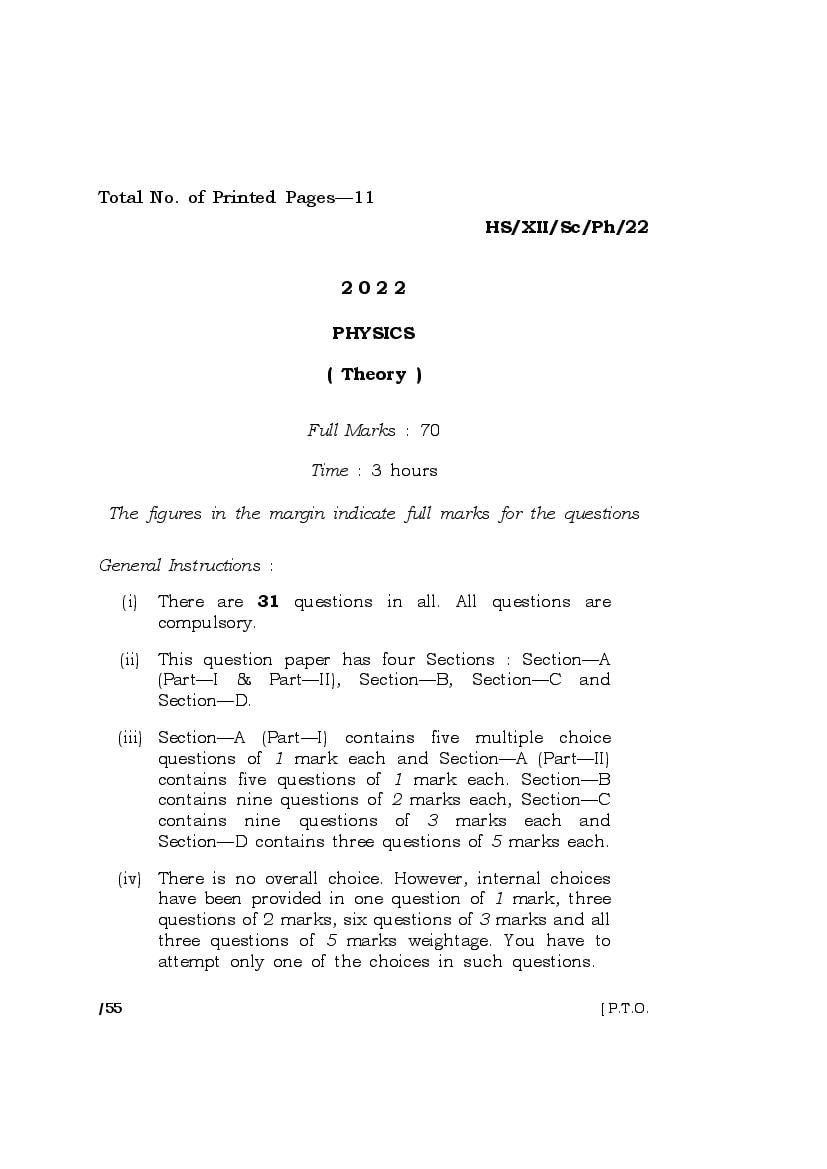
HS/XII/Sc/Ph/22
2022
PHYSICS
( Theory )
Full Marks : 70
Time : 3 hours
The figures in the margin indicate full marks for the questions
General Instructions :
(i) There are 31 questions in all. All questions are
compulsory.
(ii) This question paper has four Sections : Section—A
(Part—I & Part—II), Section—B, Section—C and
Section—D.
(iii) Section—A (Part—I) contains five multiple choice
questions of 1 mark each and Section—A (Part—II)
contains five questions of 1 mark each. Section—B
contains nine questions of 2 marks each, Section—C
contains nine questions of 3 marks each and
Section—D contains three questions of 5 marks each.
(iv) There is no overall choice. However, internal choices
have been provided in one question of 1 mark, three
questions of 2 marks, six questions of 3 marks and all
three questions of 5 marks weightage. You have to
attempt only one of the choices in such questions.
/55 [ P.T.O.
Page 2
(v) You may use the following values of physical constants,
wherever necessary :
c = 3 ×10⁸ m/s
h = 6·63 × 10–34 J-s
e = 1·6 × 10–19 C
0 = 4 × 10⁻⁷ T m A–1
0 = 8·854 × 10–12 C2 N–1 m–2
me = 9·1 × 10–31 kg
Mass of neutron = 1·675 × 10–27 kg
Mass of proton = 1·673 × 10–27 kg
SECTION—A
PART—I
( Multiple choice type questions )
Choose the correct option from the following : 1×5=5
1. For sustained interference of light, we must have
(A) two real monochromatic sources of same wavelength
(B) two real white sources
(C) two virtual sources obtained from a single
monochromatic source
(D) two virtual white sources 1
HS/XII/Sc/Ph/22/55 [ Contd.
Page 3
2. In terms of susceptibility , a material is diamagnetic if
(A) is negative
(B) is positive and small
(C) is large and positive
(D) is zero 1
3. The work function of cesium is 2·14 eV. The threshold
frequency for cesium is
(A) 8 15 1013 Hz
(B) 5 16 1014 Hz
(C) 7 12 1012 Hz
(D) 9 16 1015 Hz 1
4. Optical fibres are based on the phenomenon of
(A) reflection
(B) refraction
(C) dispersion
(D) total internal reflection 1
5. The magnitude of induced e.m.f. in a coil of inductance
1 mH in which a current is changing from 0·1 A to 2·1 A
in 0·01 sec is
(A) 0·02 V
(B) 0·2 V
(C) 2 V
(D) 20 V 1
HS/XII/Sc/Ph/22/55 [ P.T.O.
Page 4
PART—II
( Very short answer type questions )
Answer each of the following questions in 1 sentence/step :
1×5=5
6. The resistance of a given carbon resistor is
2 4 106 5% . What is the sequence of colours on
the resistor? 1
7. Complete the following nuclear reaction : ½+½=1
32
(a) 15 32
P 16 S + _____
(b) 22 22
11 Na 10 Ne + _____
8. In passing through a refracting prism, which component
colour of white light bends the most? Write the equation
for the speed of electromagnetic waves in terms of 0
and 0 . 1
9. What is an LED? 1
10. Either
Unpolarized light is incident on a plane glass surface of
1 5 . What should be the angle of incidence so that
the reflected and refracted rays are perpendicular to
each other? 1
Or
Two slits are made 1 mm apart and the screen is placed
1 m away.
What is the fringe separation when light of wavelength
500 nm is used? 1
HS/XII/Sc/Ph/22/55 [ Contd.
Page 5
SECTION—B
( Short answer type–I questions )
Answer each of the following questions within 20 to 30 words,
wherever applicable : 2×9=18
11. State Biot-Savart law. Write the equation in vector
form. 1+1=2
12. Either
A uniform magnetic field of 3000 G is established along
the positive Z-direction.
A rectangular loop of side 10 cm and 5 cm carries a
current of 12 A.
What is the torque acting on the loop shown in the
figure? (Use 1 G 10 4 T ) 2
Or
Consider a uniform electric field E 3 103 NC 1 , acting
along x-axis.
(a) What is the flux through a square of side 10 cm
whose plane is parallel to Y-Z plane?
HS/XII/Sc/Ph/22/55 [ P.T.O.
Page 6
(b) What is the flux through the same square if the
normal to its plane makes a 60° angle with the
x-axis? 1+1=2
13. Complete the ray diagram for the incident rays OA, OA1,
OA2, OA3. 2
14. Either
Define half-life of a radioactive substance.
Write the expression for it. 1+1=2
Or
What is mass defect?
Write the expression for the mass defect of a nucleus of
mass M, mass number A and atomic number Z. 1+1=2
15. What are polar and non-polar dielectrics? 1+1=2
16. Explain briefly the blue colour of the sky on the basis
of Rayleigh scattering. 2
17. Define the terms magnetic declination and inclination
or dip. 1+1=2
HS/XII/Sc/Ph/22/55 [ Contd.
Page 7
18. How are X-rays generated? What is the wavelength
range of X-rays? Mention one use of X-rays. 1+½+½=2
19. Either
Draw a properly labelled diagram showing the main
components of an AC generator. 2
Or
What are Eddy currents? How can they be minimised?
1+1=2
SECTION—C
( Short answer type–II questions )
Answer each of the following questions within 30 to 40 words,
wherever applicable : 3×9=27
20. Either
Derive an expression for the mutual inductance of two
long co-axial solenoids. 3
Or
State Lenz’s law.
Show that Lenz’s law is a consequence of law of
conservation of energy. 1+2=3
21. Either
What are extrinsic semiconductors? Citing suitable
examples, explain how p-type and n-type semi-
conductors are obtained. 1+1+1=3
HS/XII/Sc/Ph/22/55 [ P.T.O.
Page 8
Or
Explain the terms depletion layer and potential barrier
for a p-n junction diode.
What happens to the width of the depletion layer when
the junction is under forward bias and reverse bias?
1+1+1=3
22. Either
With suitable circuit diagram, derive the required
expression for the value of shunt, to convert a
galvanometer into an ammeter.
A galvanometer of resistance 10 gives full-scale
deflection for a current of 4 mA. How can it be converted
into an ammeter of range 0 to 5 A? 2+1=3
Or
State Ampere’s circuital law.
A part of infinite long wire carrying current I is bent into
a circle of radius r as shown in the figure. Calculate the
magnetic field at the centre of the circular loop. 1+2=3
23. Either
Obtain an expression for the torque on a rectangular
loop placed in a uniform magnetic field. 3
Or
Obtain an expression for the magnetic dipole moment of
a revolving electron. 3
HS/XII/Sc/Ph/22/55 [ Contd.
Page 9
24. Prove that
n 2 n1 n 2 n1
v u R
when refraction takes place for a ray of light travelling
from rarer medium to denser medium at a convex
spherical refracting surface.
( n1 and n 2 are the refractive indices of rarer and denser
medium) 3
25. Either
What is resonance in a series LCR circuit?
Write an expression for the resonant frequency for the
same circuit. Also draw a resonance curve in LCR circuit
for at least two different values of resistance R. 1+1+1=3
Or
What is a transformer? Explain the theory and working
of a transformer. 1+2=3
26. Either
What is a rectifier? Explain with circuit diagram the
working of a full-wave rectifier. 1+2=3
Or
Explain with circuit diagram, how a Zener diode can
function as a voltage regulator. 1+2=3
27. Deduce the equation for the torque acting on an electric
dipole, placed in a uniform electric field. 3
HS/XII/Sc/Ph/22/55 [ P.T.O.
Page 10
28. With regards to the study of photoelectric effect, explain
the following terms briefly :
(a) Work function
(b) Cut-off or stopping potential
Also draw a graph showing variation of photoelectric
current with collector plate potential for incident
radiation of different frequency but same intensity.
1+1+1=3
SECTION—D
( Long answer type questions )
Answer each of the following questions within 70 to 80 words,
wherever applicable : 5×3=15
29. Either
State Huygen’s principle for wave theory of light. Using
Huygen’s principle, derive the laws of refraction for
plane waves. 2+3=5
Or
What are coherent sources? Establish the conditions for
constructive and destructive super position of waves
emitted by coherent sources. 1+4=5
30. Either
State Gauss’s law.
Using Gauss’s law, derive the equation for the electric
field intensity at a point due to an infinitely long
straight uniformly charged wire. 1+4=5
Or
Derive the equation for the electric field intensity at a
point on the equatorial line of a short electric dipole.
Also write the equation in vector form. 4+1=5
HS/XII/Sc/Ph/22/55 [ Contd.
Page 11
31. Either
State Bohr’s postulates for hydrogen atom.
Using Bohr’s postulate, derive the expression for the
energy of an electron in any orbit of the hydrogen atom.
2+3=5
Or
Draw the energy-level diagram for the hydrogen atom.
Using equation for the energy of an electron in the nth
orbit of hydrogen atom, calculate the energy required to
excite an electron from ground state to—
(a) first excited state;
(b) second excited state.
Also find the value of the kinetic energy and potential
energy of the electron in the first excited state. 2+2+1=5
HS/XII/Sc/Ph/22/55 22K—4440
Document Details
| Board / Org | Meghalaya Board |
| Exam | Class 12 |
| Type | Question Paper |
| Pages | 11 |
| Updated | 22 Jul 2026 |