WB SET 2018 Question Paper 2 Psychology
Finished viewing? Save it for later —
Download WB SET 2018 Question Paper 2 Psychology (PDF · 16 pages)About WB SET 2018 Question Paper 2 Psychology
WB SET 2018 Question Paper 2 Psychology is available here for free download. Published by West Bengal Exams for WB SET, this question paper can be viewed online or downloaded as a PDF (16 pages). Candidates preparing for WB SET can use WB SET 2018 Question Paper 2 Psychology to understand the exam pattern, the type of questions asked, and the overall difficulty level.
Frequently Asked Questions
How can I download WB SET 2018 Question Paper 2 Psychology?
Open this page and click the Download button to save WB SET 2018 Question Paper 2 Psychology as a PDF. It is completely free on AglaSem Docs.
Is WB SET 2018 Question Paper 2 Psychology free to download?
Yes. WB SET 2018 Question Paper 2 Psychology can be viewed online and downloaded as a PDF free of cost on AglaSem Docs.
How many pages does WB SET 2018 Question Paper 2 Psychology have?
WB SET 2018 Question Paper 2 Psychology contains 16 pages, which you can read online or download together as a single PDF.
Where can I find more WB SET study material?
You can find more WB SET question papers, sample papers, syllabus, and answer keys on AglaSem Docs.
WB SET 2018 Question Paper 2 Psychology – Text
Read the full text of this question paper below — useful to quickly search, copy and reference the content online without downloading the PDF.
📄 View text version (15 pages)
Page 1
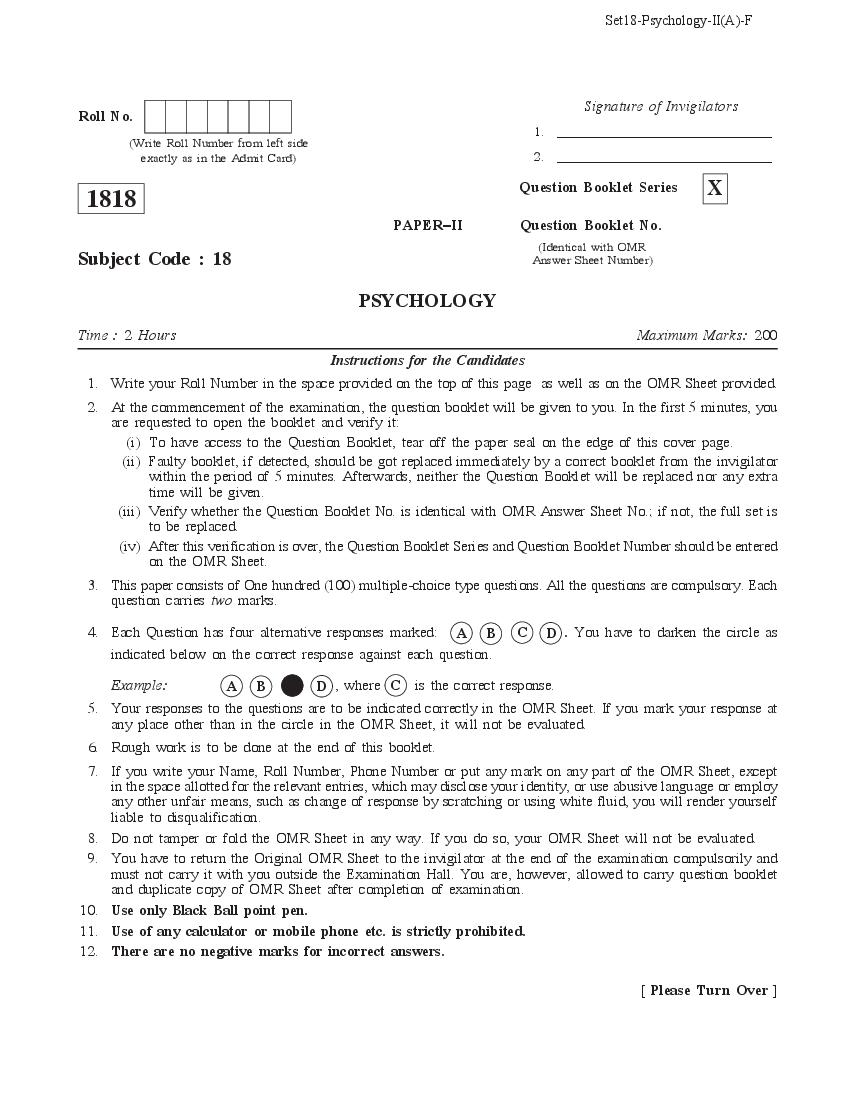
Signature of Invigilators
Roll No.
1. _______________________________
(Write Roll Number from left side
exactly as in the Admit Card) 2. _______________________________
Question Booklet Series X
1818
PAPER–II Question Booklet No.
(Identical with OMR
Subject Code : 18 Answer Sheet Number)
PSYCHOLOGY
Time : 2 Hours Maximum Marks: 200
Instructions for the Candidates
1. Write your Roll Number in the space provided on the top of this page as well as on the OMR Sheet provided.
2. At the commencement of the examination, the question booklet will be given to you. In the first 5 minutes, you
are requested to open the booklet and verify it:
(i) To have access to the Question Booklet, tear off the paper seal on the edge of this cover page.
(ii) Faulty booklet, if detected, should be got replaced immediately by a correct booklet from the invigilator
within the period of 5 minutes. Afterwards, neither the Question Booklet will be replaced nor any extra
time will be given.
(iii) Verify whether the Question Booklet No. is identical with OMR Answer Sheet No.; if not, the full set is
to be replaced.
(iv) After this verification is over, the Question Booklet Series and Question Booklet Number should be entered
on the OMR Sheet.
3. This paper consists of One hundred (100) multiple-choice type questions. All the questions are compulsory. Each
question carries two marks.
4. Each Question has four alternative responses marked: A B C D . You have to darken the circle as
indicated below on the correct response against each question.
Example: A B C D , where C is the correct response.
5. Your responses to the questions are to be indicated correctly in the OMR Sheet. If you mark your response at
any place other than in the circle in the OMR Sheet, it will not be evaluated.
6. Rough work is to be done at the end of this booklet.
7. If you write your Name, Roll Number, Phone Number or put any mark on any part of the OMR Sheet, except
in the space allotted for the relevant entries, which may disclose your identity, or use abusive language or employ
any other unfair means, such as change of response by scratching or using white fluid, you will render yourself
liable to disqualification.
8. Do not tamper or fold the OMR Sheet in any way. If you do so, your OMR Sheet will not be evaluated.
9. You have to return the Original OMR Sheet to the invigilator at the end of the examination compulsorily and
must not carry it with you outside the Examination Hall. You are, however, allowed to carry question booklet
and duplicate copy of OMR Sheet after completion of examination.
10. Use only Black Ball point pen.
11. Use of any calculator or mobile phone etc. is strictly prohibited.
12. There are no negative marks for incorrect answers.
[ Please Turn Over ]
Page 3
PSYCHOLOGY
PAPER II
1. The smallest changes in the intensity of a 6. Long-term memories for autobiographical
stimulus that can be detected by a person is events and the contexts in which they occur are called
(A) just noticeable difference (A) Semantic memory
(B) absolute noticeable threshold (B) Event memory
(C) minimal threshold (C) Episodic memory
(D) minimum noticeable difference (D) Contextual memory
2. Total acceptance of individuals for who and
what they are, even if one disagrees with their actions is 7. Hyperphagia is associated with lesion is
termed as (A) Hypothalamus
(A) Self-acceptance (B) Medulla oblangata
(B) Congruence (C) Cerebellum
(C) Unconditional positive regard (D) Reticular formation
(D) Genuineness
8. The key term for Skinner’s operant conditioning
3. The reinforcement schedule in which
is
reinforcement is given after a specific number of
response is (A) Punishment
(A) Fixed interval schedule (B) Reinforcement
(B) Intermittent schedule (C) Extinction
(C) Fixed number schedule (D) Foresight
(D) Fixed ratio schedule
9. Which of the following is not outcome of job
4. A state of mental confusions, disorientation and stress?
extreme difficulty in concentration is called
(A) Anxiety
(A) Amnesia
(B) Bipolar disorder
(B) Dementia
(C) Burn out
(C) Delirium
(D) High blood pressure
(D) Alzheimer’s disorder
5. The conception of collective unconscious was 10. A release of emotional tension as termed by
put forth by Freud is
(A) Sigmund Freud (A) Cathexis
(B) Jung (B) Catharsis
(C) Carl Rogers (C) Discharge
(D) Adler (D) Diversion
Page 4
11. Tokens in token-economy are 16. Parallel distribution process (PDP) model
(A) Primary reinforcers explains cognitive processes as
(B) Add-on reinforcers (A) activation flowing through networks that
link the nodes together.
(C) Principal reinforcers
(B) focalised in content-relevant parts of cartex.
(D) Secondary reinforcers
(C) stored in parallel in cortical and subcortical
structures.
12. Structure of intellect is propounded by (D) None of the above
(A) Eysenck 17. ABBA design is used to control
(B) Miller (A) Irrelevant variables
(C) Guilford (B) Situational relevant variables
(D) Wechsler (C) Sequence relevant variables
(D) Subject variables
13. Culture-based generalisation about groups, 18. A random sample can be defined as
which is often unfounded is termed as (A) careful selection of participants from the
(A) Prejudice larger population matching with the
(B) Belief characteristics of larger population.
(C) Stereotype (B) a sample in which each potential participant
has the equal chance to be selected.
(D) Generalised decision
(C) selection of sample keeping relevance with
the purpose of the study.
14. The term ‘cardinal trait’ is associated with the (D) None of the above
name of
19. Which of the following is not true of
(A) Murray correlations?
(B) Gordon Allport (A) Helps to demonstrate causation
(C) Eysenck (B) Helps to discover relationships
(D) Guilford (C) Helps to discover strength of relationship
(D) Helps to identify nature of relationship
15. Size constancy refers to the fact that we perceive 20. Test reliability is
(A) the proximal stimulus as unchanging in (A) consistency of the test results on repeated
size despite changes in our viewing trials.
position. (B) how well a scientific test measures what it
(B) the distal stimulus as unchanging in size intends to measure.
despite changes in our viewing position. (C) how well the sample represents the
(C) the distal stimulus as being the same size of population.
the proximal stimulus. (D) standard of behaviour accepted in a given
(D) all proximal stimuli as being of equal size. group.
Page 5
21. The Achievement motivation theory has been 26. A person’s knowledge about the world is known
propounded by as one’s
(A) Solomon (A) Semantic memory
(B) Mc. Clelland (B) Implicit memory
(C) Maslow (C) Consciousness
(D) Herzberg (D) Short-term memory
22. An individual’s affective orientation towards a
particular item is called 27. One’s knowledge about memory process is
(A) Approach gradient of the outcome called
(B) Valence of the outcome (A) Metamemory
(C) Avoidance gradient of the outcome (B) Learning
(D) None of the above (C) Strategy
(D) Inference
23. Emotional response that is caused by threat
from superego to ego is called
28. The last stage of creative thinking is
(A) Neurotic anxiety
(A) Verification
(B) Social anxiety
(B) Evaluation
(C) Moral anxiety
(C) Inculcation
(D) Ego anxiety
(D) Preparation
24. Yerkes-Dodson law states that
(A) physiological changes in body create 29. When we make use of many experiences and
emotion. examples for arriving at a generalised conclusion, it is
(B) body maintains homeostasis. known as
(C) emotion and physiological changes occur (A) Deductive reasoning
simultaneously. (B) Convergent thinking
(D) performance is best when there is a task- (C) Inductive reasoning
relevant optimal level of arousal. (D) Divergent thinking
25. The three processes of memory are encoding,
———— and retrieval. 30. ‘Functional fixedness’ is an important factor in
(A) rehearsal (A) Thinking
(B) recollection (B) Imagination
(C) fixation (C) Problem-solving
(D) storage (D) Cognitive bias
Page 6
31. ‘Primary process’ is characteristic of the 36. If a child’s chronological age is 8 and his mental
(A) Id age is 9, his IQ will be
(B) Well adjusted personality (A) 120·50
(C) Superego (B) 116·50
(D) Ego (C) 113·50
(D) 112·50
32. Opponent-process theory is a theory of
37. Concurrent validity is
(A) Colour-vision
(A) items on the test consistently relate to each
(B) Decision-making
other.
(C) Information processing
(B) scores on a test correlate highly with scores
(D) Audition
from the tests that measure the same attribute.
(C) two tests are done at the same time.
(D) two psychologists agree on the outcome.
33. A general principle of perception of form is the
law of Pregnanz which was termed by
(A) Structuralists 38. Chronbach alpha determines
(B) Gestalt psychologists (A) Concurrent validity
(C) Behaviourists (B) Inter-rater reliability
(D) Functionalists (C) Internal consistency
(D) Test-retest reliability
34. Who is associated with multi-factor theory of
intelligence? 39. In a split brain procedure, which part of the brain
(A) Guilford is severed?
(B) Wechsler (A) Left hemisphere
(C) Spearman (B) Right hemisphere
(D) Thurstone (C) Subcortical area
(D) Corpus Callosum
35. Vernon has proposed that the elements of
G-factor theory and the multifactor theories can be 40. Neural signals travel along a neuron in the order
combined to form a/an of
(A) Unitary theory (A) axon, dendrite, soma, terminal branches.
(B) Hierarchical theory (B) axon, soma, dendrite, terminal branches.
(C) Monarchic theory (C) dendrite, soma, axon, terminal branches.
(D) Anarchic theory (D) dendrite, axon, soma, terminal branches.
Page 7
41. Signal detection theory is a means to measure 45. Suppose you learn that the IQs of the six
(A) ability to differentiate between information- teachers in a department in a college are as 89, 154, 83,
90, 79. If someone asks ‘What’s the overall level of
bearing patterns and random patterns that
intelligence in the department? ‘what should you
distract from the information.
calculate’?
(B) ability to discriminate sensation coming from (A) Median
different modalities. (B) Mean
(C) ability to assimilate figure and ground. (C) Mode
(D) None of the above (D) None of the above
46. The standard deviation of the following scores
42. Which of the following is true about effect size? of 17, 15, 23, 7, 9, 13 are
(A) As effect size increases power decreases. (A) 5·76
(B) Effect size analysis answers the question (B) 6·64
‘Can’t we reject null hypothesis?’. (C) 5·08
(C) Effect size analysis enables comparisons (D) 4·32
among a variety of different studies.
(D) Effect size analysis is not effective. 47. When people are classified like white, black etc.
in terms of body complexion, they are in
(A) ordinal scale
43. What differentiates interval from ratio scales of
(B) nominal scale
measurement?
(C) interval scale
(A) Interval scales have equal intervals
(D) ratio scale
between points but ratio scales donot
always have the equal intervals. 48. In studying the public opinion
(B) Sources of zero is not possible on interval (A) Field study method is applied
scales but on ratio scales, a score of zero (B) Action research is applied
means the absence of phenomenon being (C) Survey research is applied
measured.
(D) None of the above
(C) In ratio scales, a higher number always
means ‘more’ of the phenomenon being 49. The concept of ‘masculine protest’ was
measured but interval scale donot maintain developed by
the order characteristics. (A) C. G. Jung
(D) All of the above (B) Alfred Adler
(C) Karen Horney
44. Descriptive statistics is to inferential statistics as (D) Melanie Klein
_________ .
50. Rager’s self-theory falls in the realm of
(A) Type I error is to Type II error (A) Existential Psychology
(B) Generalising is to Summarising (B) Humanistic Psychology
(C) Sample is to Population (C) Individual Psychology
(D) Mean is to Standard deviation (D) Self Psychology
Page 8
51. ‘Our tendency to perceive sensory patterns as 56. In Piaget’s theory of cognitive development,
well-organized wholes rather than as separate, isolated thinking in which a child seeks to test the validity of
parts’ is proposed by several propositions is referred to as
(A) Behaviourists (A) Hypothetico deductive thinking
(B) Psychoanalysts (B) Conservational thinking
(C) Interpropositional thinking
(C) Gestaltists
(D) Concrete operational thinking
(D) Structuralists
52. Instances in which perception yields false
interpretations of physical reality are termed as 57. The tendency to think of using objects only as
they have been used in the past is termed as
(A) Delusions
(A) functional autonomy
(B) Persecutions (B) functional fixedness
(C) Illusions (C) functional behaviour
(D) None of the above (D) functional perception
53. Stimuli that strengthen those responses that
compel the organism to avoid or escape from their 58. Putting coded information into memory for
presence, are referred to as future use is called as
(A) negative reinforcers (A) Recognition
(B) positive reinforcers (B) Retrieval
(C) negative punishers (C) Recall
(D) positive punishers (D) None of the above
54. A schedule of reinforcement in which
reinforcement is delivered after a variable number of 59. Which theory claims that emotional feelings
responses have been performed, is called as and bodily expressions occur simultaneously?
(A) variable-interval schedule (A) Common sense theory
(B) fixed-ratio schedule (B) Cannon-Bard theory
(C) continuous reinforcement schedule (C) Attribution theory
(D) James-Lange theory
(D) None of the above
55. Research comparing groups of persons of
different ages in order to determine how certain aspects 60. The concept of ‘Mental chemistry’ was
of behaviour or cognition change with age, is termed as developed by
(A) Longitudinal research (A) J. S. Mill
(B) Cross-sectional research (B) J. B. Watson
(C) Cohort research (C) E. B. Titchener
(D) None of the above (D) William James
Page 9
61. Who is very popular in psychology for the 66. A person who has had a head injury, is unable to
theory of ‘Instinct’? recall the events that took place before the accident.
(A) J. B. Watson This is known as
(A) Retrograde Amnesia
(B) I. P. Pavlov
(B) Astasia Abasia
(C) C. G. Jung
(C) Aphonia
(D) William Mc Dougall
(D) Phobia
62. Who has rightly commented that ‘The study of 67. The ‘Sour-grapes’ attitude characterizes
crippled, stunted, immature, and unhealthy specimens (A) Sublimation
can yield only a cripple psychology and a cripple (B) Regression
philosophy.’? (C) Rationalization
(A) Abraham Maslow (D) Repression
(B) Carl Rogers
(C) Goldstein
68. Who has defined frustration as that condition
(D) Spielberger which, when exists, a goal response suffers
(A) Latane and Darley
(B) Miller and Dollard
63. The concept of consolidations in memory was
(C) Sherif and Sherif
helpful to explain the phenomenon of
(D) Watson and Reyner
(A) Emotion
(B) Forgetting
(C) Thinking 69. Scale, devised primarily to identify mentally
deficient children in the school of Paris, is known as
(D) Personality
(A) Thurstone scale
(B) 1905 Binet-Simon scale
(C) Wechsler scale
64. E. R. Guthrie was popularly known for
(D) Galton scale
(A) Conditioning theory
(B) Physiological theory
(C) Instinct theory 70. To compare IQ, we generally use ____ formula.
(D) Contiguity theory 100
(A) I.Q. CA
MA
CA
(B) I.Q. 100
65. H. Ebbinghans was a German MA
(A) Psychoanalyst MA
(C) I.Q. 100
(B) Psychiatrist CA
(C) Associationist 100
(D) I.Q. MA
(D) Structuralist CA
Page 10
71. Allport has dealt with the concept of 76. What is the mean of the following ungrouped
(A) Functional fixedness data?
(A) 4
(B) Functional autonomy
(B) 3
(C) Functional Psychosis
(C) 5
(D) Functionalism
(D) 2
72. Which one of the following comes under 77. A research study in a realistic situation in which
projective techniques? one or more independent variables are manipulated by
(A) WAIS the researcher under as carefully controlled conditions
as the situation permits, is known as
(B) DAT
(A) Field experiment
(C) TAT
(B) Case study
(D) MMPI (C) Observational study
(D) None of the above
73. Freud recognized three types of anxiety in his
psychoanalytic theory. These are
(A) reality anxiety, neurotic anxiety, moral 78. To ensure that the influence of all relevant
anxiety. variables is the same for all the subjects and does not
change during the experimental period is the main
(B) floating anxiety, static anxiety, dynamic
objective of
anxiety.
(A) Experimental error
(C) pleasure anxiety, libido anxiety, severe
(B) Experimental control
anxiety.
(C) Experimental variables
(D) reality anxiety, pain anxiety, moral anxiety.
(D) Experimental hypothesis
74. The secretion of endocrine gland is known as 79. By changing one’s attitude to become more
(A) Liquid congruent with the behaviour
(B) Humor (A) Consonance is reduced
(B) Distance is reduced
(C) Bile
(C) Dissonance is reduced
(D) Hormone
(D) Transfer is reduced
75. Weight, length, time and speed are some 80. By vicarious learning, the individual learns
variables which can be measured on something through
(A) Ratio scale (A) Introspection
(B) Interval scale (B) Observation of others
(C) Nominal scale (C) Self reporting
(D) Ordinal scale (D) None of the above
Page 11
81. Who propounded the expectancy theory of 85. Who talked about peak experiences?
learning? (A) Mc Cllend
(A) Guthrie (B) Mc Gregor
(B) Hull (C) Maslow
(C) Tolman (D) Herzberg
(D) Thorndike
82. If you do not like milk you may not like other 86. To convert standard deviation into a variance,
milk products too; like—cheese, butter, ghee and curd. one must
This is due to (A) take the square root of the standard
(A) Generalization gradient deviation.
(B) Avoidance learning (B) multiply the standard deviation by 1/X.
(C) Transfer of training (C) divide the standard deviation.
(D) Biological constraints (D) square the standard deviation.
83. Who among the following emphasized on
identity crisis?
87. _______ set up an experiment, known as
(A) Freud Stanford Prison Experiment where people played the
(B) Adler role of a prison guard. The goal was to observe if this
(C) Erickson authority position would cause them to act differently.
(A) Stanley Milgram
(D) None of the above
(B) Phillip Zimbardo
(C) Soloman Ache
(D) Muszaffer Sherif
84. On which point do the Cannon-Bard and
James-Lange theory differ?
(A) Physiological changes create the
experience of emotion
(B) The role of hypothalamus is crucial in 88. Muszaffer Sherif believed that ________ would
emotion reduce prejudice behaviour.
(C) Emotions are entirely dependent on cognitive (A) working together to solve problem
interpretation (B) sharing background
(D) Physiological changes takes place in (C) group sharing
connection with emotion (D) talking out differences
Page 12
89. What is meant by the term “scientific literacy”? 93. ________ is known as the father of scientific
(A) A person’s capacity to understand scientific management.
concepts and the processes of reasoning (A) F. W. Taylor
used in science, as well as their ability to
(B) Henry Fayol
use scientific principles to reason through
problems. (C) Robert Owen
(B) A person’s abilities with regard to running (D) None of them
experiments or conducting statistical
analysis.
(C) The extent to which person has received
formal education in science.
(D) A person’s knowledge of facts about physics,
chemistry and other sciences. 94. According to Herzberg which of the following is
a Hygiene factor?
(A) Salary
90. Who among the following gave the dual coding (B) Autonomy
theory in memory? (C) Responsibility
(A) Craik and Lockhart (D) Recognition
(B) Allan Paivio
(C) Tulving
(D) Loftus
95. The purpose of job enrichment is to
91. Beck (1979) found that depressed people are
(A) expand the number of task an individual
mere likely to
can do.
(A) make stable, negative, global attribution.
(B) increase job efficiency.
(B) make stable, positive specific attribution. (C) device different tools to do specific job.
(C) blame specific others for their depression. (D) None of the above
(D) make stable, negative specific attribution.
92. The field of Psychology that focuses on helping
persons with problems pertaining to education,
96. One of the concepts of the humanistic existential
marriage or occupation is known as
approach is
(A) Abnormal Psychology (A) Rationalism
(B) Industrial Psychology (B) Transference
(C) Educational Psychology (C) Deviation from statistical norms
(D) Counselling Psychology (D) Unconditional positive regard
Page 13
97. What is Id? 99. Carl Rogers developed an approach called client
(A) Which monitors our behaviour centered therapy, wherein he noted that maladjustment
(B) A description of innate instinctual needs occur due to discripencies between
(C) Which controls our behaviour (A) “Ideal” selves and imperfect “real” selves
(D) All of the above (B) “Ideal” selves and “idealized” selves
(C) Conflict between child ego and adult ego
(D) None of the above
98. Which of the following is an example of a
specific learning disability? 100. Jung’s therapeutic approach was known as
(A) Autistic spectrum disorders (A) Psychoanalytic approach
(B) Dyslexia (B) Analytic therapy
(C) Mental retardation (C) Eclectic approach
(D) Amnesia (D) None of the above
Page 14
ROUGH WORK
Page 15
ROUGH WORK
Page 16
ROUGH WORK
Document Details
| Board / Org | West Bengal Exams |
| Exam | WB SET |
| Type | Question Paper |
| Pages | 16 |
| Updated | 23 Oct 2026 |