MBOSE Class 12 Question Paper 2022 for Political Science
Finished viewing? Save it for later —
Download MBOSE Class 12 Question Paper 2022 for Political Science (PDF · 12 pages)About MBOSE Class 12 Question Paper 2022 for Political Science
MBOSE Class 12 Question Paper 2022 for Political Science is available here for free download. Published by Meghalaya Board for Class 12, this question paper can be viewed online or downloaded as a PDF (12 pages). Candidates preparing for Class 12 can use MBOSE Class 12 Question Paper 2022 for Political Science to understand the exam pattern, the type of questions asked, and the overall difficulty level.
Frequently Asked Questions
How can I download MBOSE Class 12 Question Paper 2022 for Political Science?
Open this page and click the Download button to save MBOSE Class 12 Question Paper 2022 for Political Science as a PDF. It is completely free on AglaSem Docs.
Is MBOSE Class 12 Question Paper 2022 for Political Science free to download?
Yes. MBOSE Class 12 Question Paper 2022 for Political Science can be viewed online and downloaded as a PDF free of cost on AglaSem Docs.
How many pages does MBOSE Class 12 Question Paper 2022 for Political Science have?
MBOSE Class 12 Question Paper 2022 for Political Science contains 12 pages, which you can read online or download together as a single PDF.
Where can I find more Class 12 study material?
You can find more Class 12 question papers, sample papers, syllabus, and answer keys on AglaSem Docs.
MBOSE Class 12 Question Paper 2022 for Political Science – Text
Read the full text of this question paper below — useful to quickly search, copy and reference the content online without downloading the PDF.
📄 View text version (12 pages)
Page 1
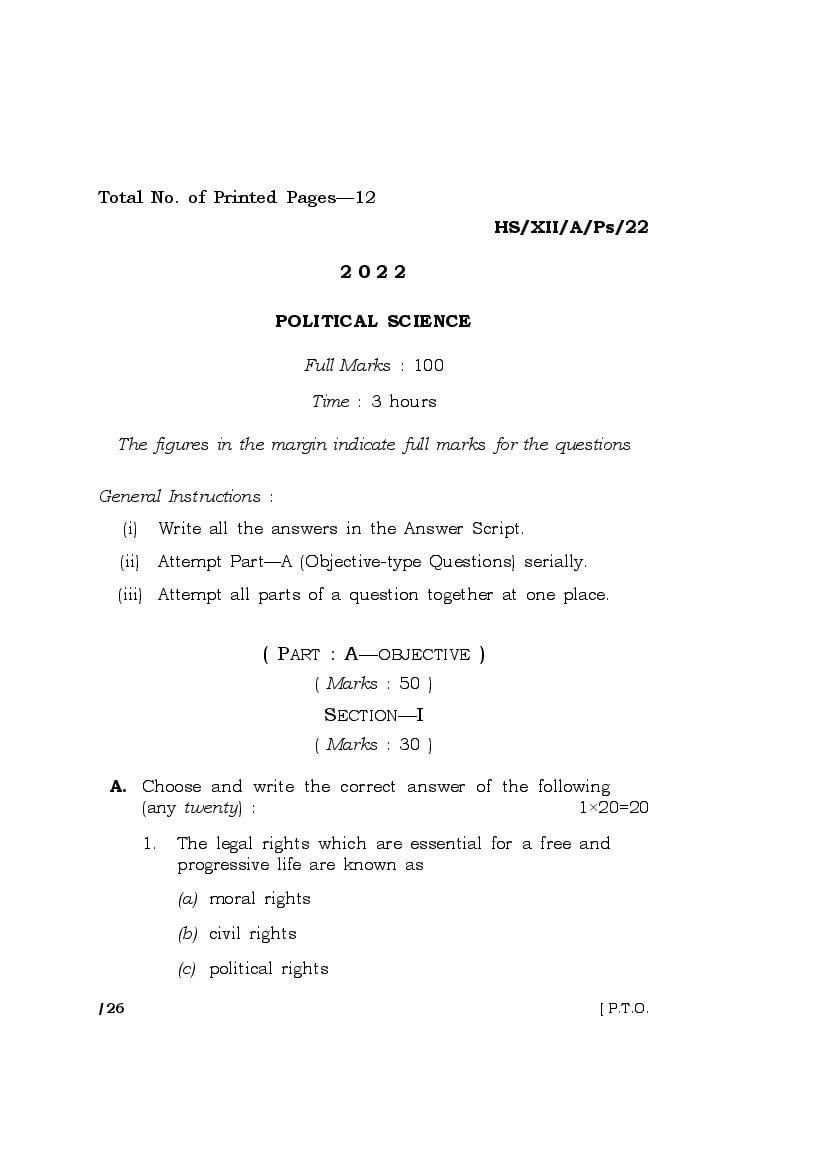
HS/XII/A/Ps/22
2022
POLITICAL SCIENCE
Full Marks : 100
Time : 3 hours
The figures in the margin indicate full marks for the questions
General Instructions :
(i) Write all the answers in the Answer Script.
(ii) Attempt Part—A (Objective-type Questions) serially.
(iii) Attempt all parts of a question together at one place.
( PART : A—OBJECTIVE )
( Marks : 50 )
SECTION—I
( Marks : 30 )
A. Choose and write the correct answer of the following
(any twenty) : 1×20=20
1. The legal rights which are essential for a free and
progressive life are known as
(a) moral rights
(b) civil rights
(c) political rights
/26 [ P.T.O.
Page 2
2. The right to work is a/an
(a) social right
(b) political right
(c) economic right
3. “Every State is known by the system of rights it
maintains.” Who said this?
(a) Laski
(b) T. H. Green
(c) Hobhouse
4. Which of the following is the duty of a citizen?
(a) Allegiance to the State
(b) Payment of taxes
(c) Both (a) and (b)
5. The word ‘liberty’ is derived from the Latin word
(a) liber
(b) labour
(c) liver
6. “Justice is the source of the social and democratic
principles like liberty, equality and fraternity.”
According to
(a) Cephalus
(b) Aristotle
(c) Barker
HS/XII/A/Ps/22/26 [ Contd.
Page 3
7. In case of conflict between Constitutional law and
Ordinary law
(a) ordinary law prevails
(b) Constitutional law prevails
(c) None of the above
8. In representative government, the Sovereign Will of
the people is expressed through
(a) election
(b) nomination
(c) None of the above
9. Which of the following is a source of law?
(a) Executive decision
(b) Judicial decision
(c) Superstition
10. Liberalism emphasises the value of
(a) liberty
(b) unity
(c) integrity
11. The ‘right to vote’ in India was subsequently reduced
to 18 years from 21 years in the year
(a) 1984
(b) 1988
(c) 1998
HS/XII/A/Ps/22/26 [ P.T.O.
Page 4
12. Which of the following types of representation is not
conducive to national unity and integrity?
(a) Territorial representation
(b) Functional representation
(c) Communal representation
13. The book, Wealth of Nations was written by
(a) Adam Smith
(b) Rousseau
(c) Bentham
14. Which of the following is not a feature of liberalism?
(a) Nationalism
(b) Impersonalism
(c) Universalism
15. Surplus value or the profit for the bourgeois lies at
the heart of the exploitation of the labourers in the
(a) capitalist system
(b) capitalist society
(c) classless society
HS/XII/A/Ps/22/26 [ Contd.
Page 5
16. Which of the following countries is not a permanent
member of UN Security Council?
(a) China
(b) France
(c) Japan
17. The ‘right to property’ was deleted from the list of
fundamental rights by the
(a) 38th Amendment
(b) 42nd Amendment
(c) 44th Amendment
18. The Directive Principles of State Policy in the Indian
Constitution are found in
(a) Part–III
(b) Part–IV
(c) Part–IVA
19. The President of India is elected by an Electoral
College consisting of
(a) elected members of the Parliament
(b) members of the Legislative Assemblies
(c) elected members of the Parliament and elected
members of the Legislative Assemblies of the
States
HS/XII/A/Ps/22/26 [ P.T.O.
Page 6
20. The Vice President of India may be removed from his
office by a resolution passed by a majority of the
members of the
(a) Council of States
(b) House of the People
(c) Council of States and agreed to by the House of
the People
21. Who is the leader of the Nation?
(a) The President of India
(b) The Prime Minister of India
(c) The Vice President of India
22. Which is the exclusive power of the Rajya Sabha?
(a) To initiate money bill
(b) To declare a subject of State List as a subject of
national importance
(c) To impeach the President
HS/XII/A/Ps/22/26 [ Contd.
Page 7
23. A candidate for election to the House of the People
must be
(a) 25 years
(b) 30 years
(c) 35 years
24. A Judge of the Supreme Court may be removed from
office on ground of
(a) misbehaviour
(b) incapacity
(c) proved misbehaviour and incapacity
25. In 1954, India and China signed an agreement
which contained the
(a) four principles
(b) five principles
(c) six principles
B. Write whether the following statements are True or
False (any ten) : 1×10=10
1. All nationals of the Indian origin are not citizens.
2. A right comes with duties.
HS/XII/A/Ps/22/26 [ P.T.O.
Page 8
3. As a source of law, custom is very old.
4. Only a free and independent nation can provide
freedom to its citizens.
5. The UNO is an organization of the sovereign states
of the world, but itself is not a state.
6. Fundamental Duties were added to our Constitution
by the 44th Amendment.
7. Positive liberalism gave birth to the idea of Welfare
State.
8. The Vice President of India is ex-officio Chairman of
the Council of States.
9. The Council of Ministers consists of four kinds of
ministers.
10. Money bill can be introduced in the Council of
States.
11. The normal duration of the House of the People is
five years.
12. The Chief Justice of the Supreme Court of India is
appointed by the President.
13. The idea of Non-Aligned Movement was first given
shape by Nasser of Egypt.
HS/XII/A/Ps/22/26 [ Contd.
Page 9
SECTION—II
( Marks : 20 )
C. Answer the following questions in about 2 or 3
sentences each (any ten) : 2×10=20
1. Mention two differences between citizens and aliens.
2. Write any two merits of universal adult franchise.
3. Write any two differences between law and morality.
4. Mention any four basic tenets of Marxism.
5. Write any two demerits of proportional represen-
tation.
6. Give the full forms of IAEA and UNICEF.
7. Write any two purposes of the United Nations.
8. Name any four freedoms guaranteed to citizens of
India under Article 19 of the Indian Constitution.
9. Write any two functions of the Vice President of
India.
10. What is the link of the Prime Minister with the
President of India?
11. What happens to a State Government when the State
comes under Constitutional Emergency? (Article 356)
HS/XII/A/Ps/22/26 [ P.T.O.
Page 10
12. Point out any two differences between the Cabinet
Ministers and the Union Council of Ministers.
13. What are the qualifications required for the members
of the Rajya Sabha?
14. Write any two original jurisdictions of the Supreme
Court of India.
15. Name any four members of the SAARC.
16. What is the meaning of ‘equality before the law’
and ‘equal protection of law’?
( PART : B—DESCRIPTIVE )
( Marks : 50 )
GROUP—A
( Political Theory )
Answer any three of the following questions : 10×3=30
1. Define liberty. Explain the relationship between law
and liberty. 2+8=10
2. What is justice? Explain the various kinds of justice.
2+8=10
3. Define citizenship. Explain the methods of acquiring
citizenship. 2+8=10
4. Briefly explain the main features or tenets of
liberalism. 10
HS/XII/A/Ps/22/26 [ Contd.
Page 11
5. Explain the main sources of law. 10
6. What are the aims and principles of the United
Nations? 5+5=10
7. Write short notes on any two of the following : 5×2=10
(a) Duties of the citizens
(b) Negative and positive meaning of liberty
(c) Territorial representation
(d) Class struggle
(e) The Economic and Social Council
GROUP—B
( The Indian Constitution and Political System in Operation )
Answer any two of the following questions : 10×2=20
8. Describe the different kinds of Directive Principles of
State Policy as enumerated in the Indian Constitution. 10
9. Explain the powers and functions of the Lok Sabha. 10
10. Describe the powers and functions of the President
of India. 10
11. Describe the powers and functions of the Union
Council of Ministers. 10
12. What has been India’s role in the activities of SAARC? 10
HS/XII/A/Ps/22/26 [ P.T.O.
Page 12
13. Write short notes on any two of the following : 5×2=10
(a) Right to Constitutional remedies
(b) National Human Rights Commission
(c) Qualifications and methods of removal of the
Judges of the Supreme Court of India
(d) Powers and functions of the Prime Minister as a
leader of the Parliament
(e) Right against Exploitation
HS/XII/A/Ps/22/26 22K—24280
Document Details
| Board / Org | Meghalaya Board |
| Exam | Class 12 |
| Type | Question Paper |
| Pages | 12 |
| Updated | 22 Jul 2026 |