NEET Biology Question Bank - Animal Morphology and Anatomy I - Earthworm and Cockroach
Finished viewing? Save it for later —
Download NEET Biology Question Bank - Animal Morphology and Anatomy I - Earthworm and Cockroach (PDF · 25 pages)About NEET Biology Question Bank - Animal Morphology and Anatomy I - Earthworm and Cockroach
NEET Biology Question Bank - Animal Morphology and Anatomy I - Earthworm and Cockroach is available here for free download. Published by NTA for National Eligibility cum Entrance Test (Undergraduate), this question bank can be viewed online or downloaded as a PDF (25 pages). Candidates preparing for National Eligibility cum Entrance Test (Undergraduate) can use NEET Biology Question Bank - Animal Morphology and Anatomy I - Earthworm and Cockroach to understand the exam pattern, the type of questions asked, and the overall difficulty level.
Frequently Asked Questions
How can I download NEET Biology Question Bank - Animal Morphology and Anatomy I - Earthworm and Cockroach?
Open this page and click the Download button to save NEET Biology Question Bank - Animal Morphology and Anatomy I - Earthworm and Cockroach as a PDF. It is completely free on AglaSem Docs.
Is NEET Biology Question Bank - Animal Morphology and Anatomy I - Earthworm and Cockroach free to download?
Yes. NEET Biology Question Bank - Animal Morphology and Anatomy I - Earthworm and Cockroach can be viewed online and downloaded as a PDF free of cost on AglaSem Docs.
How many pages does NEET Biology Question Bank - Animal Morphology and Anatomy I - Earthworm and Cockroach have?
NEET Biology Question Bank - Animal Morphology and Anatomy I - Earthworm and Cockroach contains 25 pages, which you can read online or download together as a single PDF.
Where can I find more National Eligibility cum Entrance Test (Undergraduate) study material?
You can find more National Eligibility cum Entrance Test (Undergraduate) question papers, sample papers, syllabus, and answer keys on AglaSem Docs.
NEET Biology Question Bank - Animal Morphology and Anatomy I - Earthworm and Cockroach – Text
Read the full text of this question bank below — useful to quickly search, copy and reference the content online without downloading the PDF.
📄 View text version (25 pages)
Page 1
16
(Earthworm and Cockroach)
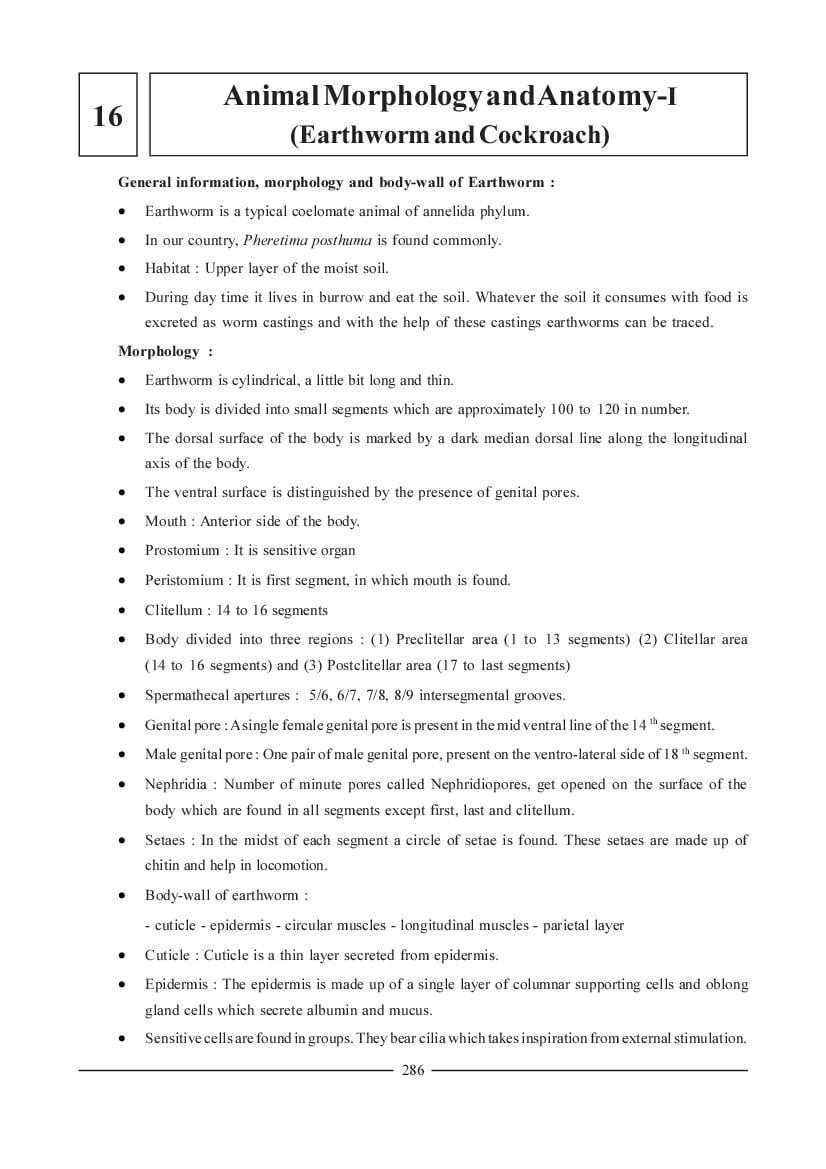
General information, morphology and body-wall of Earthworm :
· Earthworm is a typical coelomate animal of annelida phylum.
· In our country, Pheretima posthuma is found commonly.
· Habitat : Upper layer of the moist soil.
· During day time it lives in burrow and eat the soil. Whatever the soil it consumes with food is
excreted as worm castings and with the help of these castings earthworms can be traced.
Morphology :
· Earthworm is cylindrical, a little bit long and thin.
· Its body is divided into small segments which are approximately 100 to 120 in number.
· The dorsal surface of the body is marked by a dark median dorsal line along the longitudinal
axis of the body.
· The ventral surface is distinguished by the presence of genital pores.
· Mouth : Anterior side of the body.
· Prostomium : It is sensitive organ
· Peristomium : It is first segment, in which mouth is found.
· Clitellum : 14 to 16 segments
· Body divided into three regions : (1) Preclitellar area (1 to 13 segments) (2) Clitellar area
(14 to 16 segments) and (3) Postclitellar area (17 to last segments)
· Spermathecal apertures : 5/6, 6/7, 7/8, 8/9 intersegmental grooves.
· Genital pore : A single female genital pore is present in the mid ventral line of the 14 th segment.
· Male genital pore : One pair of male genital pore, present on the ventro-lateral side of 18 th segment.
· Nephridia : Number of minute pores called Nephridiopores, get opened on the surface of the
body which are found in all segments except first, last and clitellum.
· Setaes : In the midst of each segment a circle of setae is found. These setaes are made up of
chitin and help in locomotion.
· Body-wall of earthworm :
- cuticle - epidermis - circular muscles - longitudinal muscles - parietal layer
· Cuticle : Cuticle is a thin layer secreted from epidermis.
· Epidermis : The epidermis is made up of a single layer of columnar supporting cells and oblong
gland cells which secrete albumin and mucus.
· Sensitive cells are found in groups. They bear cilia which takes inspiration from external stimulation.
286
Page 2
(A) x = Coelenterata, y = Rana, z = tigrina (B) x = Annelida, y = Pheritima, z = tigrina
(C) x = Annelida, y = Pheritima, z = posthuma (D) x = Arthropoda, y = Periplanata, z = americana
(2) Which sentence is wrong in reference to earthworm ?
(A) Earthworm can be located upper layer of moist soil
(B) During night, it lives in burrow and eat the soil
(C) Earthworm can be traced by extretory castings
(D) Its colour is reddish brown
(3) The body of Earthworm has x segments and its number is y .
(A) x = small, y = 100 to 120 (B) x = small, y = 80 to 100
(C) x = big, y = 100 to 120 (D) x = big, y = 100 to 150
(4) In how many regions the earthworm can be divided on the basis of clitellum ?
(A) One (B) Two (C) Three (D) Four
(5) The Earthworm has preclitellar x segments, clitellar y segments and post clitellar z segments.
(A) x = 4 to 13, y = 14 to 15, z = 16 to last
(B) x = 1 to 13, y = 14 to 16, z = 17 to 20
(C) x = 1 to 10, y = 11 to 13, z = 14 to 16
(D) x = 1 to 13, y = 14 to 16, z = 17 to last
(6) In earthworm, female genital pore are located on x segment and on y line.
(A) x = 18, y = mid-ventral (B) x = 14, y = mid-ventral
(C) x = 14, y = ventro-lateral (D) x = 18, y = ventro-lateral
(7) In earthworm, male genital pore remain on x segment and on y side.
(A) x = 18, y = ventro-lateral (B) x = 18, y = mid-ventral
(C) x = 14, y = ventro-lateral (D) x = 14, y = mid-ventral
(8) On which segments, spermathecal (apertures) are located ?
(A) 4/5, 5/6, 6/7, 7/8 (B) 6/7, 7/8, 8/9, 9/10
(C) 5/6, 6/7, 7/8, 8/9 (D) 14/15, 15/16, 16/17, 17/18
(9) On which segments of earthworm, Nephridiopores are absent ?
(A) First, last, clitellar (B) First, Fourth, Sixth
(C) First, last, 17 to 20 (D) Last and 2 to 4
(10) By whose secretion the cuticle is synthesized in earthworm ?
(A) Circular muscles (B) Longitudinal muscles (C) Epidermis (D) Parietal layer
(11) Which one is secreted by gland cells of epidermis in earthworm ?
(A) Keratin, mucus (B) Fibrinogen, mucus (C) Mucus, Albumin (D) Keratin, Albumin
Answers : (1-C), (2-B), (3-A), (4-C), (5-D), (6-B), (7-A), (8-C), (9-A), (10-C), (11-C)
287
Page 3
· Alimentary canal of earthworm is simple tubular passage from mouth to anal opening.
· Terminal mouth : It opens into the buccal cavity which spreads upto 1-3 segments.
· Mouth cavity : Because of the contraction of muscles joining body wall, buccal cavity
protrudes out of the body and accepts the food.
· Pharynx : It is muscular tube found after buccal cavity and is extended upto fourth segment.
· Oesophagus : It is extended from 5 to 7 segments which opens into gizzard.
· Gizzard : The wall of Gizzard is thick and there are thick layers of circular muscles. The internal
surface of it is made up of columnar cells covered with cuticle. Due to the contraction of circular
muscles gizzard grinds the soil particles and decaying leaves like a grinder.
· Stomach : It is extended from 9 to 14 segments. Calciferous glands are found in stomach, neutralize
the humic acid present in humus.
· Intestine : It starts from 15th segments and continues till last segment.
· Caecum : A pair of short and conical intestinal caecum projects from the intestine on the 26th
segment, which secrets enzyme for carbohydrate digestion.
· Pretyphlosole region : From segment 1 to 25, it is called pretyphlosolar region.
· Typhlosole region : From 26 to 95 segments internal median fold of dorsal wall called typhlosole is
present, which increases the area of absorption.
· Post typhlosole region : Last 23 to 25 segments of intestine lack typhlosole, so it is called post-
typhlosole region ?
· Anal aperture : The alimentary canal opens to the exterior by a small rounded anal aperture.
· The ingested organic rich soil passes through alimentary canal and digestive enzymes breakdown
complex food into smaller absorbable units.
· Circulatory system :
· In earthworm, closed type of circulatory system is found.
· In circulatory system, blood vessels, capillaries and heart is included.
· Due to closed circulatory system blood is confined to the heart and blood vessels.
· Due to contraction, blood circulates into one direction.
· Small blood vessels supply blood to gut, nerve cord and the body wall.
· Blood glands are present on the 4th, 5th and 6th segments, which produce blood cells and haemoglobin.
· Blood cells are of phagocytic type.
· In earthworm there is absence of specialized breathing device.
· Respiratory exchange occurs through moist body surface and oxygen gets mixed into blood stream.
(12) By which, the internal wall of gizzard is covered in earthworm ?
(A) Keratin (B) Mucus (C) Chitin (D) Cuticle
(13) Which muscle layers are found in gizzard and in which segment it is located ?
(A) Circular muscle, 9th (B) Longitudinal muscle, 8th
(C) Circular muscle, 8th (D) Longitudinal muscle, 9th
288
Page 4
(A) x = 8 to 14, y = Calciferous (B) x = 8 to 13, y = Calciferous
(C) x = 9 to 14, y = Calciferous (D) x = 9 to 14, y = Pancreas
(15) Intestine of earthworm is extended from x to y segments.
(A) x = 14, y = 95 (B) x = 15, y = Last
(C) x = 26, y = Last (D) x = 23, y = Last
(16) In earthworm, small blood vessels supply blood to...
(A) Mouth, Stomach, Intestine (B) Body wall, Nerve cord, Intestine
(C) Body wall, Oesophagus, Stomach (D) Mouth, Nerve cord, Intestine
(17) In which segment of earthworm blood glands are located ?
(A) 4th, 5th and 6th (B) 3rd, 4th and 5th
(C) 1st, 2nd and 4th (D) 7th, 8th and 9th
(18) In earthworm, haemoglobin is dissolved in...
(A) RBCs (B) Platelets (C) Blood plasma (D) WBCs
(19) What type of blood cells are found in earthworm ?
(A) Mast cells (B) Phagocyte cells (C) Fibrous cells (D) All of the given
(20) Which organ is absent in earthworm ?
(A) Sensory (B) Excretory (C) Reproductive (D) Respiratory
(21) From where O2 enters in to the earthworm ?
(A) Respiratory organs (B) Lungs (C) Body wall (D) Mouth cavity
Answers : (12-D), (13-C), (14-C), (15-B), (16-B), (17-A), (18-C), (19-B), (20-D), (21-C)
Nephridia, Nervous system and reproductive system of Earthworm :
· There are three types of Nephridia in earthworm :
Septal Nephridia Integumentary Nephridia Pharyngeal Nephridia
- From 15 to last segment - From 3rd segment, it is - Three pairs in 4th, 5th and 6th
- Found on both side of the attached to the lining of segment
inter-segmental septa body woll - Discharge their waste into
- Opens into intestine - Open into external surface of alimentary canal
the body through minute
pores
· All three types of nephridia basically similar in structure.
Function :
· Regulates the volume and composition of body fluid.
· By the help of nephrostome, they absorb excretory waste from coelome and discharge through
a pore to the surface of the body wall and into the digestive tube.
289
Page 5
· Nervous system is ganglionated.
· Ganglia : Formed by gathering nerve cells.
· Ventral nerve cord : One pair of nerve ganglia is found at the ventral surface of each segment after
the fifth segment.
· Sub pharyngeal ganglion : One pair of ganglia is found at the posterior part of ventral side
of third segment.
· Suprapharyngeal ganglion : One pair of ganglia found at the dorsal side of pharynx
in the 3rd segment.
· These ganglioa are connected by circumpharyngeal connective.
· These pair of connective and subpharyngeal ganglion connected with suprapharyngeal ganglion and
formes nerve ring.
· Suprapharyngeal ganglion and other nerve rings complies the information and reach immediately by
making the body muscles to implement it.
· In earthworm, specific sensory organs like eyes are not present.
· Only sensory cells of the body wall perform as a sensory receptor organs.
· These cells are inspired by the intensity of light, vibrations of the land, etc. Some of the sensory cells
are inspired by chemical instigator.
Reproductive system of earthworm :
· Earthworm is hermaphrodite (bisexual) i.e. testes and ovary both are present in same animal.
Male reproductive organs :
· Testes : Two pairs of testes are found in the 10th and 11th segments.
· Vasadeferentia : It runs upto 18th segment where they join with prostate duct.
· Accessory glands : Two pairs are present in 17th and 19th segments.
· Male genital pores : Common prostate and spermatic duct opens to the exterior by a pair of male
genital pores on the ventrolateral side of the 18th segment.
· Spermathecae : It is located in segment 6, 7, 8 and 9. It stores the sperms of companion earthworm
during mating.
Female reproductive organs :
· Ovary : One pair of ovaries is attached at the inter-segmental septum of 12/13.
· Oviduct : Front part of it forms oviductal funnel.
· Female genital pore : Both the oviduct joins and opens as a female genital pore of body surface on
ventral side of 14th segment.
Mating :
· During mating two earthworms come together and get arranged into juxtaposing directions.
Thus the mouth region of one faces the anus of the other.
290
Page 6
In this situation released sperm cells enter into the spermathecae of companion animal. Thus animals
get separated after exchanging the sperms.
Formation of cocoon :
· After short time the secretion of clitellum gland forms white cocoon. In this cocoon eggs are released.
· Due to the contraction of body wall the cocoon slips towards anterior end.
· When cocoon slipping towards the anterior end and passes through spermathecal region, sperms are
entered into cocoon and fertilizes the eggs of cocoon.
· Both the ends of the cocoon are sealed when it comes out of the body.
· After 3 weeks, two to twenty four baby earthworms are produced from cocoon.
· The development of earthworm is direct. There is no larva formed during development.
· Earthworms are known as friends of farmers because they make burrows in the soil and thus
they provide life giving gas for respiration to the developing plant roots.
· To increase fertility of soil earthworms are breeded which is called vermicomposting. In
addition to this earthworms as bait are used in fishing.
(22) In which segment of earthworms, septal nephridia are located ?
(A) 13 to last (B) 14 to last
(C) 15 to last (D) 23 to last
(23) Which is the nephridia of earthworm which opens on the body surface after 3rd segment ?
(A) Septal (B) Pharyngeal (C) Integumentary (D) All of the given
(24) In which segment, pharyngeal nephridia are located ?
(A) 15 to last (B) 3 to last
(C) 4th, 5th and 6th (D) 15 to 23
(25) Where does the nephridia empty their waste ?
(A) Intestine (B) Pharynx (C) Out of body wall (D) All of the given
(26) Where is the location of subpharyngeal ganglia in earthworm ?
(A) Posterior side of 3rd segment and at dorsal side (B) Posterior side of 4th segment and at ventral side
(C) Posterior side of 3rd segment and at ventral side (D) Posterior side of 5th segment and at ventral side
(27) How many pair of testes and ovaries are present respectively in earthworm ?
(A) 2, 1 (B) 2, 2 (C) 1, 2 (D) 1, 3
(28) Where is the location of two pair of testes in earthworm ?
(A) 9th and 10th segments (B) 9th and 11th segments
(C) 10th and 11th segments (D) 11th and 18th segments
(29) In earthworm, accessory glands are located in x and y segment.
(A) x = 14, y = 17 (B) x = 17, y = 19
(C) x = 18, y = 19 (D) x = 15, y = 16
291
Page 7
(A) x = 11/12, y = 13 (B) x = 10/11, y = 12
(C) x = 12/13, y = 13 (D) x = 12/13, y = 14
(31) How many days it will take to form baby animal from earthworm cocoon ?
(A) 3 weeks (B) 4 weeks (C) 2 weeks (D) 1 week
Answers : (22-C), (23-C), (24-C), (25-D), (26-C), (27-A), (28-C), (29-B), (30-C), (31-A)
General information and morphology of cockroach :
General information :
· It is in class insecta of phylum Arthropoda.
· Generally it is brown or black bodied insect.
· However, in tropical region, they may be yellow, green or red coloured.
· It is omnivore and nocturnal animal.
Morphology :
· Scientific name : Periplaneta americana.
· Length and Breadth : 25-45 mm u 8-12 mm.
· Exoskeleton : It is made up of stiff chitin layer.
· Segmentation : Only externally segmented not internally.
· In each segment exoskeleton has hardened to thin and flexible articular membrane.
· Body is divided into three regions : (1) Head, (2) Thorax and (3) Abdomen.
(1) Head :
· It is triangular.
· Head lies anteriorly at right angle to the longitudinal body axis. It is formed by fusion of six segments.
· It is attached to thorax through a flexible neck. So that it can move easily in all the directions.
· A pair of sessile, kidney shaped compound eyes occur on head.
· Mouth parts : Sensitive mouth parts are associated with mouth. It is useful in collection of food and
its chewing.
· It consist of a pair of mandibles, a pair of the first maxillae, labium and labrum.
· Hypopharynx : It is located in mouth parts and is muscular, folded structure. Salivary glands open at
its basal region.
(2) Thorax : It has 3 parts :
(1) Prothorax, (2) Meso thorax and (3) Meta thorax
· One pair of walking legs arise from ventral side of each segment.
· Each walking leg has 5 segments :
· (1) Coxa, (2) Trochanter, (3) Femur, (4) Tibia and (5) Tarsus.
292
Page 8
protective. The second pair of wings develops from the dorsal side of meta thorax. It is bilobed and
transparent and is used for flying.
(3) Abdomen : In male and female, abdomen is made up of 10 segments.
· Each segment has a dorsal tergum, a ventral sternum and lateral pleurae.
· Eight and ninth terga are covered under tergum of seventh segment.
· The 10th tergum a median groove, from where anus open.
· A pair of anal cerci is associated, with a 10th tergum, it is phonoreceptor structures.
· In male cockroach, a pair of anal styles develop from ninth sternum.
· In female cockroach, the 8th and 9th sterna jointly form a genital pouch.
· Seventh sterna is boat shaped.
· The male genital opening occurs in mid-ventral region of ninth segment and female genital opening
opens in the eight segment.
(32) Cockroach is x colour animal, although in the tropical region it is of y coloured also.
(A) x = Brown, Black, y = Yellow, Red, Green
(B) x = Brown, Black, y = White, Yellow, Red
(C) x = Brown, White, y = Black, Yellow, Green
(D) x = Brown, Yellow, y = Black, Red, Green
(33) Normally, the length of cockroach is x mm and bredth is y mm.
(A) x = 20-40, y = 15-20
(B) x = 15-45, y = 10-15
(C) x = 25-45, y = 8-12
(D) x = 20-25, y = 8-10
(34) Cockroach can move its head easily in all the directions. Because ......... .
(A) Head of cockroach is made up of 6 segments.
(B) Head is connected with throax by a tender neck
(C) Due to structure of mouth parts
(D) Head joins with abdomen, so ......... .
(35) x pair, y and z shaped eyes are located on head of cockroach.
(A) x = 1, y = Stalked, z = compound and round
(B) x = 2, y = Stalked, z = compound and round
(C) x = 1, y = Sessile, z = compound and kidney
(D) x = 1, y = Sessile, z = simple and round
(36) By which structure head of cockroach is connected with thorax ?
(A) neck (B) throat (C) Oesophagus (D) Salivary gland
293
Page 9
(A) Snaut (B) Anal cerci (C) Mouth parts (D) Hypostome
(38) What is correct for mouth parts of cockroach ?
(A) One pair mandible, one pair first maxillae, labium and labrum
(B) One pair first maxillae, one pair labium, mandible and labrum
(C) One pair labium, one pair labrum, first maxillae and mandible
(D) One pair mandible, one pair labrum, first maxillae and labium
(39) From where does wings develops in cockroach ?
(A) Ventral side of thorax (B) Lateral side of thorax
(C) Dorsal side of abdomen (D) None of the given
(40) From where does wings arises in cockroach ?
(A) Ventral side of thorax (B) Lateral side of thorax
(C) Dorsal side of thorax (D) None of the given
(41) Which structure is connected with the 10th segment of cockroach ?
(A) Anal style (B) Anal cerci (C) Tarsus (D) Trochanter
(42) Which type of the organ anal cerci in cockroach ?
(A) Reproduction (B) Excretory (C) Phonoreceptor (D) Respiratory
(43) In which segment, the genital pore opens in male cockroach ?
(A) 8th (B) 7th (C) 9th (D) 10th
(44) In which segment, female genital pore open in cockroach ?
(A) 8th (B) 7th (C) 9th (D) 10th
(45) By which segmental sternum, genital pouch is formed in cockroach ?
(A) 9th and 10th (B) 7th and 8th
(C) 7th and 9th (D) 8th and 9th
Answers : (32-A), (33-C), (34-B), (35-C), (36-A), (37-C), (38-A), (39-A), (40-C), (41-B), (42-C),
(43-C), (44-A), (45-D)
Body wall, Alimentary canal and digestion in cockroach :
Body wall :
· It is made up of main three layers.
· Outermost layer is of cuticle, which forms exoskeleton.
· Middle layer is of epidermis, which is single columnar celled.
· Innermost layer is basement membrane.
Alimentary canal :
· It is complete alimentary canal. Mouth is located at the anterior end of head.
· Mouth parts : It is adapted for gathering and cutting food and are arranged surrounding the mouth.
· Pharynx : The tubular region following mouth is called pharynx. Then onwards, alimentary canal is
divided into 3 parts : (1) Foregut, (2) Midgut and (3) Hindgut
· The cavity of foregut and midgut are lined by cuticle.
294
Page 10
consists of two secreting lobes and two reserviors.
· Oesophagus : It is narrow, tubular structure which follows pharynx.
· It enlarges at its posterior end into a crop.
· Crop : Crop opens into a muscular gizzard and is spreaded into thorax and abdomen.
· Gizzard : It has six chitinous teeth inside.
· At the posterior end of the gizzard, a sieve-like structure made up of chitinous bristles. The region of
alimentary canal upto gizzard constitutes the foregut. Gizzard opens into the midgut.
· Midgut : Eight blind hepatic caeca occur in the midgut and midgut opens into the hindgut.
· Malpighian tubules : It is located at the juncture of mid and hindgut are about 150 and yellowish in
colour. It is excretory unit of cockroach.
· Ileum : It is the proximal region of hindgut and is narrow. Rest of the part of hindgut is somewhat coiled.
· Colon : The distal region of hindgut is colon.
· Rectum : The bag like posterior end region of hindgut is called rectum. It is folded inside. Rectum
opens to the outside through anus. Anal is located under the tergum of 10th abdominal segment.
Digestion in cockroach :
· It is omnivorous animal. It searches food by its antennae.
· In salivary gland, saliva is prepared by secretory lobes. Mucus present in saliva makes food wet. The
enzyme - amylase affect the starch of food and digestion begins.
· Now food enters into crop and digestion proceeds further. Now food enters into gizzard where it cuts
down into small pieces with chitinous teeth and food enters into midgut.
· Columnar cells of midgut and hepatic caeca, secrete enzymes.
· Various proteolytic enzymes convert protein into amino acids.
· Lipase digests lipid into fatty acids and glycerol.
· Amylase produces sugar from starch.
(46) Which is the correct sequence for the body wall layer from inside to outside ?
(A) Cuticle ® Epidermis ® Basement membrane(B) Epidermis ® Cuticle ® Basement membrane
(C) Basement membrane ® Epidermis ® Cuticle (D) Cuticle ® Basement membrane ® Epidermis
(47) The cells of epidermis of cockroach body wall are of x type.
(A) x = columnar (B) x = squamous
(C) x = cuboidal (D) x = ciliated
(48) x salivary glands are present in thoracic region of cockroach. Which has y secretory lobes and z
reserviors.
(A) x = two pair, y = two, z = one (B) x = one pair, y = two, z = one
(C) x = one pair, y = one, z = two (D) x = one pair, y = two, z = two
(49) Gizzard of cockroach is a x structure. It has y chitinous teeth into its lumen.
(A) x = Muscular, y = Four (B) x = Glandular, y = Six
(C) x = Muscular, y = Eight (D) x = Muscular, y = Six
295
Page 11
(A) 80 (B) 125 (C) 140 (D) 150
(51) Of whose unit, the malpighian tubule is in cockroach ?
(A) Excretory (B) Digestive (C) Respiratory (D) Reproductive
(52) In cockroach, the anal opens at x tergum out of the body.
(A) x = 9th (B) x = 8th (C) x = 10th (D) x = 7th
(53) The rectum of cockroach is x inside and y outside.
(A) x = folded, y = baglike (B) x = Secretory, y = folded
(C) x = Baglike, y = folded (D) x = Baglike, y = processes
(54) Starch
X
o Sugars.
(A) x = Amylase (B) x = Lipase (C) x = Sucrase (D) x = Protease
(55) x enzymes converts protein into y components.
(A) x = Lipase, y = Fatty acids (B) x = Protease, y = Amino acids
(C) x = Amylase, y = Amino acids (D) x = Protease, y = Fatty acids
(56) In which components, lipase will convert the lipid in cockroach ?
(A) Amino acids (B) Sugars (C) Fatty acids, Glycerol (D) All of the given
Answers : (46-C), (47-A), (48-B), (49-D), (50-D), (51-A), (52-C), (53-C), (54-A), (55-B), (56-C)
Circulatory system and Respiratory system in cockroach :
Circulatory system of cockroach :
· Blood vascular system of cockroach is an open type. It means during circulation blood enters
into the body cavity instead of blood vessels.
· Thus body cavity acts as a haemocoel and organs of the body and tissues are directly connected with
the blood.
· The haemolymph is mostly composed of plasma and uncertain shaped cells.
· The heart is made up of thirteen units. Three units occur in thoracic region and ten occur in the
abdominal region.
· Anterior end of the heart is slightly narrow and posterior end is broad. Two valved openings occur
between two nearby units. They are called Ostia.
· The cells of haemolymph are of two types. Proleucocytes of smaller size and phagocytes of larger
size. Blood from sinuses enters heart through ostia and is pumped anteriorly to sinuses again.
Respiratory system of cockroach :
· Branched tubes known as trachea are main components of respiratory system.
· Terminal branches of tracheal tubes are called tracheoles which carry oxygen to entire body.
· The trachea have direct contact with the air in atmosphere through pores known as spiracles.
· Ten pairs of spiracles occur. Two pairs occur in thoracic region and eight pair on abdominal region.
· The wall of spiracles are framed with chitinous bristles. These bristles works as a filter and prevents
water and other waste substances entering into the respiratory system.
296
Page 12
fluid and gets dissolved in it.
· The tissues of body use this dissolved oxygen to get energy to work. The carbon dioxide produced
consequently gets dissolved in tissue fluid generally which comes out through exhaling.
(57) The blood of cockroach is mainly made up of ......... and ......... .
(A) Haemolymph, RBCs (B) Haemolymph, Haemoglobin
(C) Haemolymph, Uncertain shaped cells (D) Haemolymph, certain shaped cells
(58) The x units of cockroach heart is remain in thoracic region and y units in abdomin region.
(A) x = 10, y = 3 (B) x = 3, y = 10 (C) x = 7, y = 6 (D) x = 4, y = 9
(59) Which sentence is correct for circulatory system of cockroach ?
(A) It has closed type system.
(B) It has complete type system.
(C) Heart has 13 units. Each unit has two ostia.
(D) Blood circulates without help of sinuses.
(60) What is called the end branching of trachea ?
(A) Fine broncheal (B) Fine tracheoles (C) Fine trachea (D) Fine sinuses
(61) The number of spiracles in cockroach are ......... .
(A) 2 = Thorax, 8 = Abdomen (B) 3 = Thorax, 7 = Abdomen
(C) 4 = Thorax, 6 = Abdomen (D) 5 = Thorax, 5 = Abdomen
(62) What is present in the wall of spiracle of cockroach ?
(A) Chitinous bristles (B) Mast cells (C) Areolar tissue (D) Glandular cells
Answers : (57-C), (58-B), (59-C), (60-B), (61-A), (62-A)
Excretion, Excretory process and nervous system of cockroach
Excretion and process of excretion in cockroach :
· At the junction of midgut and hindgut about 150 yellowish thread-like malpighian tubules open.
They are main excretory units.
· These blind tubules always float in the haemolymph.
· They absorb nitrogenous waste products and convert them into uric acid which is excreted out
through the hindgut. Therefore, cockroach is a uricotelic animal.
· Excretory substances enter into hindgut having large amount of water. This water is absorbed by the
wall of hindgut.
Nervous system of Cockroach :
· It is made up of paired ganglia, nerve cords and nerves.
· Supra oesophageal ganglia formed by the fusion of three ganglia or a pair of brain ganglia
are located on oesophagus.
· They are connected with suboesophageal ganglia through circum-oesophageal commisures.
297
Page 13
· Three pairs of ganglia occur in thorax region and six pairs in abdominal region.
· Thus, nervous system of cockroach is spreaded throughout the body.
· Amongst sense organs in cockroach, antennae, eyes, maxillary palps, tarsus of walking legs and anal
cercus are included.
· Mosaic vision : The compound eyes are situated at the dorsal surface of the head. Each eye consist
of about 2000 hexagonal ommatidium. With the help of several ommatidium a cockroach can receive
several images of an object. This kind of vision is known as mosaic vision.
(63) Malpighian tubules are ......... .
(A) Excretory organ of insect (B) Excretory organ of frog
(C) Excretory organ of earthworm (D) Respiratory organ of insect
(64) Which one is excreted by cockroach ?
(A) Urea (B) Uric acid (C) Ammonia (D) Amino acid
(65) How many ganglia fuses to form supraoesophageal ganglia in cockroach ?
(A) One (B) Two (C) Three (D) Four
(66) In cockroach, thorax has x ganglia and abdomen has y .
(A) x = 2, y = 8 (B) x = 3, y = 5 (C) x = 3, y = 6 (D) x = 2, y = 7
(67) How many ommatidium are present in compound eye of cockroach ?
(A) 20 (B) 2000 (C) 2200 (D) 200
(68) Which one is the phonoreceptor organ of cockroach ?
(A) Anal style (B) Antennae (C) Compound eyes (D) Anal cerci
Answers : (63-A), (64-B), (65-C), (66-C), (67-B), (68-D)
Reproductive system of cockroach :
· It is unisexual animal. Both sexes has well developed reproductive organs.
Male reproductive system of cockroach :
· Testes : A pair of testes lying one on each lateral side in the 4 to 6 abdominal segments.
· Vas deferens : It arises from each testes and opens into ejaculatory duct through seminal vesicle.
· Ejaculatory duct : It opens into male gonopore situated ventral to anus.
· Mushroom gland : It occur in segment 6 and 7. It is an accessory reproductive gland.
· Gonapophysis : It is located at the end of abdomen and forms external reproductive organs.
· Seminal vesicle : Sperms are stored into this vesicle. Sperms are glued together in the form of
bundles called spermatophores which are discharged during copulation.
· Female reproductive system of cockroach :
· Ovary : Two ovaries lying laterally in 2 to 6 abdominal segments.
· Ovarioles : Each ovary is formed of a group of eight ovarian tubules or ovarioles, containing a chain
of developing ova.
· Oviduct or Vagina : Oviduct of each ovary unit into a single median-oviduct called vagina which
opens into the genital chamber.
298
Page 14
· Ootheca : Dark brown coloured Ootheca is formed by the group of fertilized eggs. Each ootheca
has 14 to 16 eggs.
· Cockroach is developed through nyphal stage (or young insect). The nymphs look very much like adults.
· The nymph grows by moulting about 6 to 7 times to reach the adult form.
(69) What is the location of testes in male cockroach ?
(A) Lateral side of the 5 to 6 segment of abdomen (B) Lateral side of the 4 to 6 segment of abdomen
(C) Dorsal side of the 5 to 6 segment of abdomen (D) Dorsal side of the 4 to 8 segment of abdomen
(70) What is the location of mushroom gland in cockroach ?
(A) 6 to 7 (B) 4 to 6 (C) 5 to 7 (D) 4 to 8
(71) What is the location of ovary in female cockroach ?
(A) Lateral side of the 2 to 7 abdomenal segment (B) Lateral side of the 3 to 7 abdomenal segment
(C) Lateral side of the 2 to 6 abdomenal segment (D) Lateral side of the 2 to 4 abdomenal segment
(72) Each ovary is made up x in female cockroach.
(A) x = 4 tubular ovarioles (B) x = 6 tubular ovarioles
(C) x = 7 tubular ovarioles (D) x = 4 tubular ovarioles
Answers : (69-B), (70-A), (71-C), (72-D)
· True - False (T - F) type questions :
Select the true or false option for given sentences.
(73) (1) Earthworm belongs to annelida and is coelomate animal.
(2) Scientific name of the earthworm is Pheretima posthuma.
(3) Earthworm remain lower level of moist soil.
(4) Earthworm is segmented into 100 120 segments.
(A) T, T, T, T (B) T, F, T, F (C) T, T, F, T (D) F, F, T, T
(74) (1) First segment of earthworm is called peristomium.
(2) 14 to 16 segment of mature earthworm is called clitellum.
(3) There is only one female genital pore on mid-ventral line in 18th segment of earthworm.
(4) There is one pair of male genital pores on mid-ventral line in 18th segment of earthworm.
(A) T, F, T, F (B) T, T, F, F (C) T, T, F, T (D) T, F, F, T
(75) (1) Earthworm has open circulatory system.
(2) Small blood vessels supply blood to body wall, nerve cord and intestine in earthworm.
(3) Blood glands are present in 4, 5 and 6 segment in earthworm.
(4) Haemoglobin is dissolved in plasma in earthworm.
(A) T, T, F, F (B) T, F, T, F (C) F, T, T, F (D) F, T, T, T
299
Page 15
(2) Gaseous exchange takes place through spiracles in earthworm.
(3) One pair of ganglia posterior side of 3rd segment on ventral side of earthworm. It is called
subpharyngeal ganglion.
(4) Earthworm has no sensory organ like eyes.
(A) T, T, F, F (B) F, F, T, T (C) T, F, T, F (D) F, F, F, T
(77) (1) Earthworm is bisexual animal.
(2) Earthworm has two testes in 10th and 11th segment respectively.
(3) Earthworm is useful as a bait in fishing.
(4) After 3 weeks, baby earthworm comes out from cucoon in earthworm.
(A) T, T, T, T (B) T, F, T, F (C) F, T, F, T (D) F, F, T, T
(78) (1) Cockroach has 25-45 mm length and 8-12 mm bredth.
(2) 4 segments are fused to form head of cockroach.
(3) Function of mouth parts is to catch and chew food.
(4) Anterior part of cockroach head, it has mouth.
(A) T, T, F, T (B) T, T, F, F (C) F, F, T, T (D) T, F, T, T
(79) (1) First segment of cockroach walking leg is called coxa.
(2) Third segment of cockroach walking leg is called trochanter.
(3) Fourth segment of cockroach walking leg is called tibia.
(4) Fifth segment of cockroach walking leg is called tarsus.
(A) T, F, T, T (B) T, T, F, F (C) T, T, T, F (D) F, T, T, F
(80) (1) Cockroach anal cerci is phonoreceptor organ.
(2) Cockroach abdomen is made up of 10 segments.
(3) Cockroach alimentory canal can be divided into three region.
(4) 150 malpighian tubuler opens at the juncture of midgut and hindgut in cockroach.
(A) T, F, T, F (B) T, T, F, F (C) T, T, T, T (D) F, F, F, T
(81) (1) Starch give sugar by Amylase in cockroach.
(2) Protein components
Proteases
o Amino acids.
(3) Lipid components Lipase
o Fatty acids and Glycerol
(4) Mucus of salivary gland of Cockroach heats food.
(A) T, T, F, F (B) T, T, T, F (C) F, F, T, T (D) T, F, T, F
(82) (1) Body coelom is called Haemocoelam in cockroach.
(2) Heart is made up of 13 units in cockroach.
(3) Malpighian tubules are 100 in cockroach.
(4) Spiracles are ten pairs in cockroach.
(A) T, T, F, F (B) T, F, T, F (C) T, T, F, T (D) T, F, F, T
300
Page 16
(2) Mushroom gland of male cockroach is located in 6 to 7 abdominal segment.
(3) Every Ootheca of cockroach posses 14 to 16 eggs.
(4) Cockroach nymph undergoes 4 to 5 time moulting to transform into adult form.
(A) T, F, F, T (B) F, T, T, F (C) F, F, T, T (D) T, T, T, F
(84) (1) In cockroach, gizzard has 6 chitinous teeth and eight tubular hepatic caeca are connected to midgut.
(2) Cockroach has 13 chambered (lobbed) heart.
(3) Cockroach has 10 pair of spiracles and 150 malpighian tubules.
(4) Cockroach is uricotelic animal.
(A) T, F, T, T (B) T, T, F, T (C) T, T, T, T (D) F, T, T, T
Answers : (73-C), (74-B), (75-D), (76-B), (77-A), (78-D), (79-A), (80-C), (81-B), (82-C), (83-D), (84-C)
· A - Assertion, R - Reason type questions :
Choose correct option for answer of given questions :
(A) A and R both are correct. R is correct explanation of A.
(B) A and R both are correct. R is not correct explanation of A.
(C) A - correct, R - incorrect.
(D) A - incorrect, R - correct.
(85) Assertion A : Body of earthworm is tubular, slightly elongated and thin.
Reason R : Body of earthworm is divided in small segment which are 100 to 120.
(A) (B) (C) (D)
(86) Assertion A : Genital pores are located on dorsal side in earthworm.
Reason R : Anterior part of earthworm has mouth and prostomium.
(A) (B) (C) (D)
(87) Assertion A : 1 to 13 segment of earthworm is called preclitellar region.
Reason R : Clitellum is present in 14 to 16 segment in earthworm.
(A) (B) (C) (D)
(88) Assertion A : Only one female genital pore is present on mid-ventral line of 14th segment
of earthworm.
Reason R : Spermathecal pore is present on 18th segment of earthworm.
(A) (B) (C) (D)
(89) Assertion A : Nephridia are present in first, last and clitellar region.
Reason R : Setae of earthworm are made up of chitin.
(A) (B) (C) (D)
(90) Assertion A : Cuticle is secreted by epidermis of earthworm.
Reason R : In epidermis of earthworm, long, thin support cell and oblong glandular cells are
present.
(A) (B) (C) (D)
301
Page 17
Reason R : Narrow oesophagus of earthworm elongated upto 5 to 8 segments.
(A) (B) (C) (D)
(92) Assertion A : Stomach of earthworm is spreaded from 9 to 14 segments.
Reason R : Calciferous glands are present in stomach.
(A) (B) (C) (D)
(93) Assertion A : In earthworm, closed type of circulatory system is present.
Reason R : Blood circulates in blood vessels and heart in earthworm.
(A) (B) (C) (D)
(94) Assertion A : Haemoglobin is dissolved in RBC, in earthworm.
Reason R : Blood cells of earthworm are of phagocytic cells.
(A) (B) (C) (D)
(95) Assertion A : In earthworm, after 5th segment one pair of ganglia is present in each segment,
which is known as ventral nerve cord.
Reason R : In earthworm, one pair of ganglia is present on ventral side on posterior part of
3rd segment, which is called as subpharyngeal ganglia.
(A) (B) (C) (D)
(96) Assertion A : Earthworm is bisexual Animal.
Reason R : Development in earthworm is direct, that means no larva is formed.
(A) (B) (C) (D)
(97) Assertion A : Earthworm is called friend of farmer.
Reason R : They make burrow in soil and provide life giving gas for respiration to the
developing plant root.
(A) (B) (C) (D)
(98) Assertion A : Cockroach has incomplete alimentary canal.
Reason R : Anterior part of head, cockroach has mouth.
(A) (B) (C) (D)
(99) Assertion A : Cockroach is omnivorus animal.
Reason R : Cockroach search food by its antennae.
(A) (B) (C) (D)
(100) Assertion A : Eight blind hepatic caeca joins with midgut of cockroach.
Reason R : 6 Chitinous teeth are present into the gizzard of cockroach.
(A) (B) (C) (D)
(101) Assertion A : Circulatory system of cockroach is open type.
Reason R : Blood circulates only in blood vessels in the cockroach.
(A) (B) (C) (D)
302
Page 18
Reason R : Initial three units are located in thorax and rest of the ten in abdomen.
(A) (B) (C) (D)
(103) Assertion A : Ten pair of spiracles are present in cockroach.
Reason R : Four pairs are present in thorax and 6 pairs in abdomen.
(A) (B) (C) (D)
(104) Assertion A : Cockroach is called uricotelic animal.
Reason R : Cockroach tranforms nitrogenous waste into uric acid.
(A) (B) (C) (D)
(105) Assertion A : In cockroach, suboesophageal ganglia innervates mouth parts.
Reason R : Nervous system of cockroach is spreaded through out its body.
(A) (B) (C) (D)
(106) Assertion A : Cockroach is bisexual animal.
Reason R : One pair of testes in arranged posterior part of 4 to 6 abdominal segment in
male reproductive system of cockroach.
(A) (B) (C) (D)
(107) Assertion A : Gaseous exchange takes place through moist body wall in earthworm.
Reason R : Certain respiratory organs are absent in earthworm.
(A) (B) (C) (D)
Answers : (85-B), (86-D), (87-A), (88-C), (89-D), (90-B), (91-C), (92-B), (93-A), (94-D), (95-B),
(96-B), (97-A), (98-D), (99-B), (100-B), (101-C), (102-B), (103-C), (104-A), (105-B),
(106-D), (107-A)
(108) Match the column :
Column - I Column - II
(a) First segment (i) One pair male genital pore
(b) 14th segment (ii) Female genital pore
(c) 18th segment (iii) Clitellum-Glandular tissue band
(d) 14 to 16 segment (iv) Peristomium
(A) (a iv), (b ii), (c i), (d iii) (B) (a i), (b iii), (c ii), (d iv)
(C) (a ii), (b i), (c iii), (d iv) (D) (a iv), (b ii), (c iii), (d i)
(109) Match the column :
Column - I Column - II
(a) Setae (i) Secretes albumin and mucus
(b) Cuticle (ii) Helps in locomotion
(c) Excretory pores (iii) Made up of secretion by epidermis
(d) Long-thin support cells, (iv) Present in all segment, except first, last
Glandular cells in epidermis, and clitellar segment
(A) (a i), (b ii), (c iii), (d iv) (B) (a iii), (b i), (c iv), (d ii)
(C) (a ii), (b iii), (c iv), (d i) (D) (a ii), (b iii), (c i), (d iv)
303
Page 19
Column - I Column - II
(a) Pharynx (i) 8th segment
(b) Small narrow oesophagus (ii) 9 to 14 segments
(c) Gizzard (iii) 5 to 7 segments
(d) Stomach (iv) 4th segment
(A) (a ii), (b iii), (c iv), (d i) (B) (a iv), (b iii), (c i), (d ii)
(C) (a iv), (b iii), (c ii), (d i) (D) (a i), (b ii), (c iii), (d iv)
(111) Match the column :
Column - I Column - II
(a) Blood glands (i) From 15th segment to last segment
(b) Spermatheca (ii) After 3rd segment, internal surface of body wall
(c) Septal nephridia (iii) 6, 7, 8 and 9 segments
(d) Integumentary nephridia (iv) 4, 5 and 6 segments
(A) (a iv), (b iii), (c i), (d ii) (B) (a iv), (b ii), (c iii), (d i)
(C) (a i), (b ii), (c iii), (d iv) (D) (a ii), (b iii), (c i), (d iv)
(112) Match the column :
Column - I Column - II
(a) First segment (i) Trochanter
(b) Second segment (ii) Femur
(c) Third segment (iii) Coxa
(d) Fourth segment (iv) Tibia
(e) Fifth segment (v) Tarsus
(A) (a ii), (b i), (c iv), (d iii), (e v)
(B) (a iii), (b i), (c ii), (d iv), (e v)
(C) (a iii), (b i), (c iv), (d ii), (e v)
(D) (a v), (b ii), (c iii), (d i), (e iv)
(113) Match the column :
Column - I Column - II
(a) Testes (i) 14 to 16 eggs
(b) Ovary (ii) 6 to 7 abdominal segments
(c) Mushroom gland (iii) 4 to 6 abdominal segments
(d) Cocoon (iv) 2 to 6 abdominal segments
(A) (a ii), (b i), (c iv), (d iii) (B) (a ii), (b i), (c iii), (d iv)
(C) (a i), (b ii), (c iii), (d iv) (D) (a iii), (b iv), (c ii), (d i)
Answers : (108-A), (109-C), (110-B), (111-A), (112-B), (113-D)
304
Page 20
(114) What is indicated by P and Q in given figure ? P
(A) P = Mouth, Q = Peristomium (B) P = Peristomium, Q = Mouth
Q
(C) P = Mouth cavity, Q = Peristomium (D) P = Mouth cavity, Q = Mouth
(115) What is indicated by P and Q in given figure ? P
(A) P = Cuticle, Q = Longitudinal muscle layer
Q
(B) P = Parietal layer, Q = Circular muscle layer R
(C) P = Cuticle, Q = Epidermis T
(D) P = Cuticle, Q = Parietal layer S
(116) Which layer is formed by secretion of epidermis in the above figure ?
(A ) P (B ) Q (C ) R (D) S
(117) What is indicated by R, S and T in given above figure ?
(A) R = Circular muscle, S = Parietal layer, T = Cuticle
(B) R = Circular muscle, S = Longitudinal muscle, T = Parietal layer
(C) R = Parietal layer, S = Longitudinal muscle, T = Circular muscle
(D) R = Cuticle, S = Circular muscle, T = Longitudinal muscle a
(118) What is indicated by a and b in given figure ? b
(A) a = Mouth, b = Pharynx c
(B) a = Mouth cavity, b = Pharynx d
(C) a = Mouth, b = Mouth cavity e
(D) a = Pharynx, b = Oesophagus f
(119) What is indicated by c and d in the given figure ?
g
(A) c = Oesophagus, d = Pharynx
(B) c = Mouth cavity, d = Oesophagus
h
(C) c = Mouth, d = Pharynx
(D) c = Pharynx, d = Oesophagus
i
(120) What is indicated by e, f and g in the given figure ?
(A) e = Stomach, f = Gizzard, g = Pre typhlosolar region
(B) e = Gizzard, f = Stomach, g = Post typhlosolar region
(C) e = Gizzard, f = Stomach, g = Pre typhlosolar region
(D) e = Stomach, f = Gizzard, g = Post typhlosolar region
(121) What is indicated by h and i in the given figure ?
(A) h = Typhlosole, i = Caecum (B) h = Caecum, i = Typhlosole
(C) h = Caecum, i = Lateral hearts (D) h = Typhlosole, i = Lateral hearts
(122) Which part indicates neutralization of Humic acid in the given figure ?
(A ) f (B ) g (C ) h (D) e
305
Page 21
(A) a = Dorsal blood vessel, c = Lateral oesophageal hearts, d = Alimentary canal a
(B) a = Alimentary canal, c = Hearts, d = Blood Vessel
g
(C) a = Nerve vessel, c = Alimentary canal, d = Dorsal blood vessel
(D) a = Lateral hearts, c = Alimentary canal, d = Blood vessel b
f
(124) By which later, lateral hearts are indicated in the given figure ?
(A ) a (B ) c (C ) b (D) d c
(125) What is indicated by e, f and g in given figure ?
(A) e = Dorsal blood vessel, f = Subnerve vessel, g = Supranerve vessel d
(B) e = Supranerve vessel, f = Ventral blood vessel, g = Sub neural vessel
e
(C) e = Sub neural vessel, f = Dorsal blood vessel, g = Supra neural vessel
(D) e = Sub neural vessel, f = Ventral blood vessel, g = Lateral Oesophgeal Blood vessels
(126) What is the number of segment for given part "a" in the given figure ? a
(A) 1-3 segments (B) 2-5 segments b
(C) Third segment (D) Second segment c
(127) Which parts connected with nerve ring in the given figure ? d
(A) b, c, d (B) b, c e
(C) a, c (D) a, b, c f
(128) What is indicated by a, b and c in the given figure ?
(A) a = Suprapharyngeal ganglia, b = Circumpharyngeal connective, c = Subpharyngeal ganglia
(B) a = Subpharyngeal ganglia, b = Circumpharyngeal connective, c = Suprapharyngeal ganglia
(C) a = Nerve ring, b = Ganglia, c = Connective
(D) a = Circumpharyngeal connective, b = Nerve ring, c = Ganglia
(129) What is indicated by d, e and f in the given figure ?
(A) d = Ventral nerve cord, e = Nerve ring, f = Connective
(B) d = Ventral nerve cord, e = Segmental ganglia, f = Segmental nerve
(C) d = Dorsal nerve cord, e = Segmental nerve, f = Ganglionic cord
(D) d = Neural axis, e = Neural cells, f = Sensory cord
306
Page 22
(A) a (B) i (C) e (D) j
(131) Which are included in male reproductive organ in the given figure ?
(A) j, k, d (B) a, b, k
(C) a, b, f (D) g, h, i
(132) What is indicated by a, b, c and d in the given figure ? a
(A) a = Testes, b = Seminal vesicles, c = Spermiductal funnel, d = Spermatheca
b
(B) a = Spermatheca, b = Testes, c = Seminal vesicles, d = Spermiductal funnel
c
(C) a = Seminal vesicles, b = Spermatheca, c = Testes, d = Spermiductal funnel
j d
(D) a = Spermatheca, b = Testes, c = Spermiductal funnel, d = Seminal vesicles
e
(133) What is indicated by e, f, g and i in the given figure ? k f
(A) e = Testes sac, f = Vasadeferentia, g = Prostate gland, i = Accessory gland
g
(B) e = Ovarian funnel, f = Vasadeferentia, g = Accessory gland, i = Prostate gland
h
(C) e = Spermiductal funnel, f = Oviduct, g = Prostate gland, i = Accessory gland
i
(D) e = Testes sac, f = Oviduct, g = Accessory gland, i = Prostate gland
(134) What is indicated by j and k in the given figure ?
(A) j = Ootheca, k = Accessory gland (B) j = Ovary, k = Female genital pore
(C) j = Testes, k = Male genital pore (D) j = Testes, k = Spermathecal pore
(135) What is indicated by P, Q, R and S in the given figure ? P
(A) P = Labrum, Q = Mandible, R = Maxillary palp, S = Maxilla Q
(B) P = Mandible, Q = Labrum, R = Maxilla, S = Maxillary palp
(C) P = Mandible, Q = Labrum, R = Maxillary palp, S = Maxilla R W
(D) P = Labrum, Q = Mandible, R = Maxilla, S = Maxillary palp
(136) What is indicated by T, U, V and W in the given figure ? S
(A) T = Labium, U = Maxillary palp, V = Secondary palp, W = Primary palp T
(B) T = Labium, U = Labial palp, V = Primary palp, W = Secondary palp V
(C) T = Anterior labium, U = Labial palp, V = Secondary palp, W = Primary palp U
(D) T = Anterior labium, U = Labial palp, V = Primary palp, W = Secondary palp
(137) What is indicated by a, d and e in given figure ?
(A) a = Coxa, d = Trochanter, e = Femur (B) a = Coxa, d = Tebia, e = Tarsus
(C) a = Tebia, d = Femur, e = Trochanter (D) a = Trochanter, d = Coxa, e = Tarsus
(138) What is indicated by b and c in given figure ?
(A) b = Trochanter, c = Femur
a
(B) b = Tibia, c = Femur
b
(C) b = Trochanter, c = Tarsus
c
(D) b = Tibia, c = Tarsus d
(139) What is indicated by a, b, c and d in the given figure ? e
(A) a = Pharynx, b = Salivary reservior, c = Salivary gland, d = Oesophagus
(B) a = Pharynx, b = Salivary gland, c = Salivary reservior, d = Oesophagus
(C) a = Oesophagus, b = Salivary reservior, c = Salivary gland, d = Pharynx
(D) a = Oesophagus, b = Salivary gland, c = Salivary reservior, d = Pharynx
307
Page 23
b
Column-I Column-II
c
(a) Caeca (1) k
d
(b) Malpighian tubules (2) g
e
(c) Ileum (3) h
(d) Colon (4) j f
(e) Mesentory (5) i g
(A) (a 3), (b 2), (c 1), (d 4), (e 5) h
(B) (a 2), (b 5), (c 4), (d 1), (e 3) i
(C) (a 5), (b 4), (c 3), (d 2), (e 1) j l
(D) (a 5), (b 3), (c 2), (d 1), (e 4) k
(141) What is indicated by a, b and c in the given figure ? a b c
(A) a = Alary muscle, b = Posterior aorta, c = Heart chamber
(B) a = Posterior aorta, b = Heart chamber, c = Alary muscle
(C) a = Heart chamber, b = Posterior aorta, c = Alary muscle
(D) a = Anterior aorta , b = Alary muscle, c = Heart chamber
(142) What is indicated by a, b, c and d in the given figure ? a
(A) a = Brain, b = Thoracic ganglia, c = Abdominal ganglia, d = Ventral nerve cord
b
(B) a = Thoracic ganglia, b = Abdominal ganglia, c = Brain, d = Dorsal nerve cord
(C) a = Thoracic ganglia, b = Brain, c = Abdominal ganglia, d = Ventral nerve cord
c
(D) a = Brain, b = Abdominal ganglia, c = Dorsal nerve cord, d = Thoracic ganglia d
(143) Match the column :
Column-I Column-II
(i) Ejeculatoryduct (1) b
a
(ii) Testes (2) d
(iii) Conglobate gland (3) e b
(iv) Vasdeference (4) c c
(v) Gonapophyses (5) f
d
(vi) Mushroom gland (6) a
e
(A) (i a), (ii b), (iii c), (iv d), (v e), (vi f)
(B) (i a), (ii f), (iii c), (iv e), (v d), (vi b) f
(C) (i e), (ii a), (iii b), (iv d), (v f), (vi c)
(D) (i f), (ii c), (iii a), (iv d), (v b), (vi e)
(144) What is indicated by a, b, c, d and e in the given figure ?
(A) a = Labrum, b = Mandible, c = Maxillary palp, d = Maxilla, e = Colleterial glands
a
(B) a = Mandible, b = Labrum, c = Maxilla, d = Maxillary palp, e = Genital chamber
b
(C) a = Mandible, b = Labrum, c = Maxillary palp, d = Maxilla, e = Genital chamber
c
(D) a = Labrum, b = Mandible, c = Maxilla, d = Maxillary palp, e = Mushroom gland e d
Answers : (114-A), (115-C), (116-A), (117-B) , (118-A), (119-D), (120-C), (121-B), (122-A),
(123-A), (124-B), (125-D), (126-C), (127-D), (128-A), (129-B), (130-A), (131-C), (132-D), (133-B),
(134-C), (135-D), (136-B), (137-B), (138-A), (139-B), (140-B), (141-D), (142-A), (143-C), (144-C)
308
Page 24
(145) Which pair is correct in earthworm ?
(A) Mouth cavity = 1 to 5 segment (B) Stomach = 11 to 12 segment
(C) Typhlosole = 26 to 95 segment (D) Testes = 10 to 14 segment
(146) Blood of earthworm...
(A) is blue due to presence of haemoglobin in RBCs.
(B) is blue due to presence of haemocyanin in plasma.
(C) is red due to presence of haemoglobin in RBCs.
(D) is red due to presence of haemoglobin in plasma.
(147) From where earthworm gets food ?
(A) Living plants
(B) From decaying leaves and shaded leaves which remains in soil
(C) Insects of soil
(D) Fresh leaves from soil
(148) Where is the correct location of Typhlosole in the earthworm ?
(A) 5 9 segments (B) 9 14 segments
(C) 26 95 segments (D) 15 segments onwards
(149) What is correct for earthworm ?
(A) Integumentary and septal nephridia are endo-excretory
(B) Integumentary and pharyngeal nephridia are exo-excretory
(C) Pharyngeal and septal nephridia are exo-excretory
(D) Pharyngeal and septal nephridia are endo-excretory
(150) What is the main function of spermatheca in earthworm ?
(A) Maturation location of sperms
(B) Production of sperms
(C) Storage of sperms of companion earthworm
(D) After mating it will play an important role
(151) What is true for respiration in earthworm ?
(A) It will perform anaerobic respiration
(B) O2 diffuses from air into haemoglobin of RBCs
(C) No important role of blood in conduction of O2
(D) O2 diffuses from air into haemoglobin of plasma
(152) In earthworm....
(A) No eyes (B) Many eyes (C) One eye (D) Two eyes
309
Page 25
(A) 9/7, 7/8, 8/9, 9/10 (B) 5/6, 6/7, 7/8, 8/9
(C) 10/11, 11/12, 12/13, 13/14 (D) 4/5, 5/6, 6/7, 7/8
(154) How male and female cockroach can be differentiated from each other ?
(A) In male anal style (B) Anal cerci in female
(C) Anal style and antennae in female (D) (A) and (B) both
(155) In which animal ommatidia is present for photosensitivity ?
(A) Cockroach (B) Frog (C) Human (D) Earthworm
(156) What is main function of salivary reservior in cockroach ?
(A) Storage of saliva (B) Secretion of saliva
(C) Secretion of enzymes (D) Storage of enzymes
(157) In cockroach, Salivary glands opens at ......... .
(A) Labrum (B) Mandible (C) Hypopharynx (D) Secondary palp
(158) How many abdominal segments are present in male and female cockroach ?
(A) 10, 10 (B) 9, 10 (C) 8, 10 (D) 9, 9
(159) In which animal, blood is colourless ?
(A) Leech (B) Earthworm (C) Cockroach (D) Rabbit
(160) What is correct sequence for the parts of walking leg of cockroach ?
(P) Tebia (Q) Trochanter (R) Coxa (S) Tarsus (T) Femur
(A) R, Q, T, P, S (B) Q, T, R, S, P (C) S, T, Q, P, R (D) P, Q, R, S, T
(161) How many ommatidia are present in one eye of cockroach for mosaic vision ?
(A) 100 (B) 2000 (C) 1000 (D) 200
Answers : (145-C), (146-D), (147-B), (148-C), (149-D), (150-C), (151-D), (152-A), (153-B),
(154-A), (155-A), (156-A), (157-C), (158-A), (159-C), (160-A), (161-B)
·
310
Document Details
| Board / Org | NTA |
| Exam | National Eligibility cum Entrance Test (Undergraduate) |
| Type | Question Bank |
| Pages | 25 |
| Updated | 30 Apr 2026 |