NEET Biology Question Bank - Animal Morphology and Anatomy II - Frog
Finished viewing? Save it for later —
Download NEET Biology Question Bank - Animal Morphology and Anatomy II - Frog (PDF · 27 pages)About NEET Biology Question Bank - Animal Morphology and Anatomy II - Frog
NEET Biology Question Bank - Animal Morphology and Anatomy II - Frog is available here for free download. Published by NTA for National Eligibility cum Entrance Test (Undergraduate), this question bank can be viewed online or downloaded as a PDF (27 pages). Candidates preparing for National Eligibility cum Entrance Test (Undergraduate) can use NEET Biology Question Bank - Animal Morphology and Anatomy II - Frog to understand the exam pattern, the type of questions asked, and the overall difficulty level.
Frequently Asked Questions
How can I download NEET Biology Question Bank - Animal Morphology and Anatomy II - Frog?
Open this page and click the Download button to save NEET Biology Question Bank - Animal Morphology and Anatomy II - Frog as a PDF. It is completely free on AglaSem Docs.
Is NEET Biology Question Bank - Animal Morphology and Anatomy II - Frog free to download?
Yes. NEET Biology Question Bank - Animal Morphology and Anatomy II - Frog can be viewed online and downloaded as a PDF free of cost on AglaSem Docs.
How many pages does NEET Biology Question Bank - Animal Morphology and Anatomy II - Frog have?
NEET Biology Question Bank - Animal Morphology and Anatomy II - Frog contains 27 pages, which you can read online or download together as a single PDF.
Where can I find more National Eligibility cum Entrance Test (Undergraduate) study material?
You can find more National Eligibility cum Entrance Test (Undergraduate) question papers, sample papers, syllabus, and answer keys on AglaSem Docs.
NEET Biology Question Bank - Animal Morphology and Anatomy II - Frog – Text
Read the full text of this question bank below — useful to quickly search, copy and reference the content online without downloading the PDF.
📄 View text version (27 pages)
Page 1
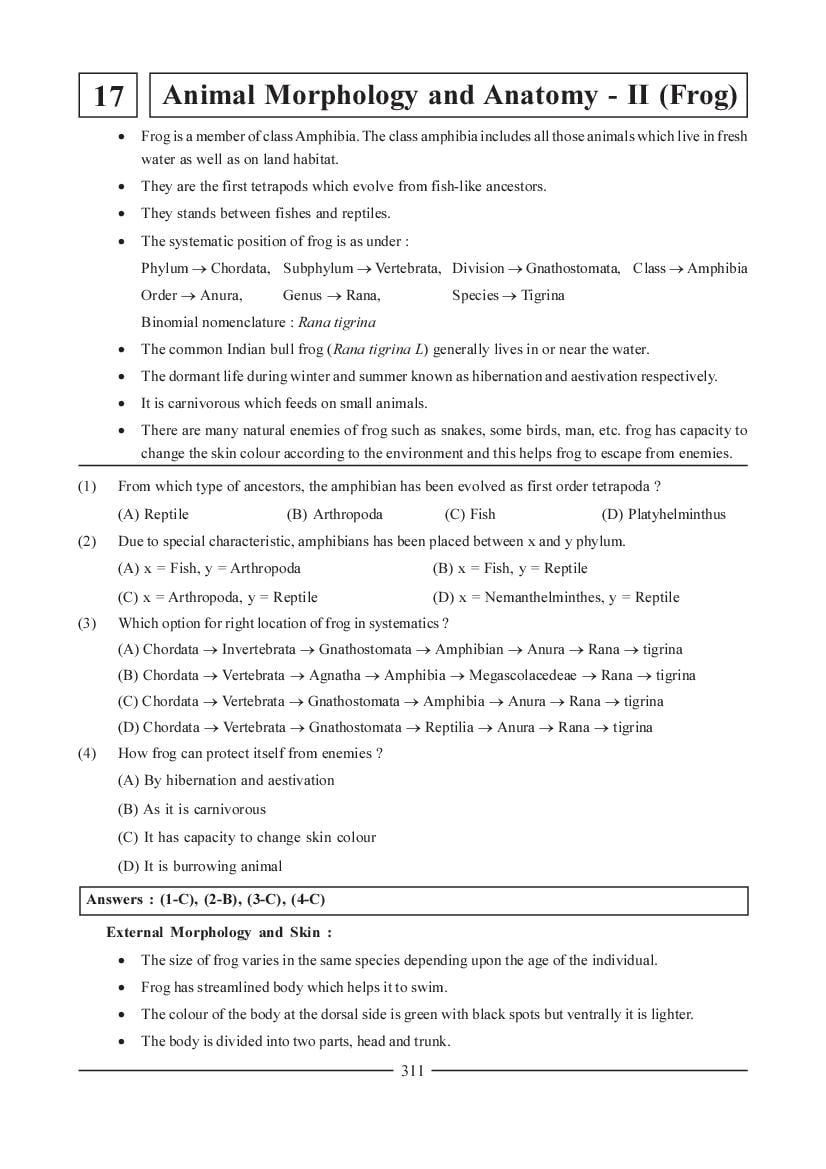
· Frog is a member of class Amphibia. The class amphibia includes all those animals which live in fresh
water as well as on land habitat.
· They are the first tetrapods which evolve from fish-like ancestors.
· They stands between fishes and reptiles.
· The systematic position of frog is as under :
Phylum ® Chordata, Subphylum ® Vertebrata, Division ® Gnathostomata, Class ® Amphibia
Order ® Anura, Genus ® Rana, Species ® Tigrina
Binomial nomenclature : Rana tigrina
· The common Indian bull frog (Rana tigrina L) generally lives in or near the water.
· The dormant life during winter and summer known as hibernation and aestivation respectively.
· It is carnivorous which feeds on small animals.
· There are many natural enemies of frog such as snakes, some birds, man, etc. frog has capacity to
change the skin colour according to the environment and this helps frog to escape from enemies.
(1) From which type of ancestors, the amphibian has been evolved as first order tetrapoda ?
(A) Reptile (B) Arthropoda (C) Fish (D) Platyhelminthus
(2) Due to special characteristic, amphibians has been placed between x and y phylum.
(A) x = Fish, y = Arthropoda (B) x = Fish, y = Reptile
(C) x = Arthropoda, y = Reptile (D) x = Nemanthelminthes, y = Reptile
(3) Which option for right location of frog in systematics ?
(A) Chordata ® Invertebrata ® Gnathostomata ® Amphibian ® Anura ® Rana ® tigrina
(B) Chordata ® Vertebrata ® Agnatha ® Amphibia ® Megascolacedeae ® Rana ® tigrina
(C) Chordata ® Vertebrata ® Gnathostomata ® Amphibia ® Anura ® Rana ® tigrina
(D) Chordata ® Vertebrata ® Gnathostomata ® Reptilia ® Anura ® Rana ® tigrina
(4) How frog can protect itself from enemies ?
(A) By hibernation and aestivation
(B) As it is carnivorous
(C) It has capacity to change skin colour
(D) It is burrowing animal
Answers : (1-C), (2-B), (3-C), (4-C)
External Morphology and Skin :
· The size of frog varies in the same species depending upon the age of the individual.
· Frog has streamlined body which helps it to swim.
· The colour of the body at the dorsal side is green with black spots but ventrally it is lighter.
· The body is divided into two parts, head and trunk.
311
Page 2
· The anterior most part of the head is snout with two nostrils and laterally proputed eyes. On the mid
dorsal line, in between two eyes there is browspot.
· Mid ear is represented by tympanic membrane.
· On the ventral side wide mouth is seen.
· The trunk bears two pairs of limbs; fore limbs are shorter with four digits while hind limbs are larger
with five toes.
· Toes of hind limbs are connected by webs, which helps the animal in swimming.
· Rana tigrina exhibits external sexual dimorphism as :
Male Female
- Two vocal sacs are present - Vocal sacs are absent
- Nuptial pad present in the - Nuptial pad is absent
index finger
- The skin shows dark yellow colour - Skin colour is not changed.
during breeding season
- The abdominal region narrow and flat - The abdominal region is broad and bulged.
Skin :
· The skin of frog is moist, smooth, slimy and without any exoskeleton. It consist of two layers.
(1) Outer Epidermis : The epidermis formed of several layers and it is further divided into two
layer, i.e. outer stratum corneum and inner stratum germinativum.
- Stratum corneum formed of a single layer of cells. This layer is dead and sheds periodically.
- Stratum germinativum is formed of columnar cells. New cells are formed from this layer.
(2) Inner Dermis : It is differentiated into two layers, outer stratum spongiosum and inner
stratum compactum.
- The stratum spongiosum consists of loose network of connective tissue, blood vessels and
mucus glands. Superficial part of this layer contains chromatophores.
- The stratum compactum is made by dense connective tissue, smooth muscle fibres, nerves
and blood vessels.
Functions of the skin :
· It gives definite shape and texture to the body.
· It protects the body against foreign bodies and fungi.
· It acts as a chief respiratory organ.
· It acts as an important sensory organ.
· The frog never drinks water but absorbs water through skin.
(5) The colour of frog on dorsal side is X and on ventral side is Y.
(A) X = Yellow with black spot, Y = Dark (B) X = Green with black spot, Y = Light
(C) X = Green with black spot, Y = Dark (D) X = Yellow with black spot, Y = Light
(6) What is absent in frog ?
(A) Head (B) Trunk (C) True neck and tail (D) Limb
312
Page 3
(A) 5, 5 (B) 4, 4 (C) 8, 10 (D) 4, 5
(8) How many total limbs and fingers are there in frog ?
(A) Limbs = 4, Fingers = 20 (B) Limbs = 2, Fingers = 20
(C) Limbs = 4, Fingers = 18 (D) Limbs = 2, Fingers = 18
(9) Which finger of forelimb of frog has nuptial pad on its proximal end ?
(A) Second (B) Third (C) Fourth (D) First
(10) Which one is suitable for female frog during breeding season ?
(A) Vocal sac absent (B) Skin colour is not changed
(C) Nuptial pad absent (D) Abdomen is narrow and bulged
(11) Which statement is true in reference to frog skin ?
(A) Skin is moist, smooth, slimy and without exoskeleton
(B) It is moist, smooth, slimy and with exoskeleton
(C) It is not moist, smooth, dry and without exoskeleton
(D) It is moist, smooth, dry and with exoskeleton
(12) The outer layer of frog skin is called X and inner one is called Y .
(A) X = Dermis, Y = Epidermis (B) X = Stratum spongiosum, Y = Stratum corneum
(C) X = Epidermis, Y = Dermis (D) X = Stratum compactum, Y = Stratum germinativum
(13) Which layer of frog skin becomes dead and sheds periodically ?
(A) Stratum corneum (B) Stratum spongiosum (C) Stratum germinativum (D) Stratum compactum
(14) Which tissue is present in stratum germinativum of frog ?
(A) Squamous epithelium (B) Cuboidal epithelium
(C) Ciliated epithelium (D) Columnar epithelium
(15) The epidermis of frog is made up of X tissue and dermis is of Y tissue.
(A) X = Connective tissue, Y = Epidermal tissue (B) X = Epidermal tissue, Y = Connective tissue
(C) X = Epidermal tissue, Y = Muscle tissue (D) X = Nerve tissue, Y = Connective tissue
(16) In which layer of frog skin, mucous glands are present ?
(A) Stratum corneum (B) Stratum spongiosum (C) Stratum compactum (D) Stratum germinativum
(17) Which is true for stratum spongiosum of skin of frog ?
(A) Loose network of connective tissue, blood vessels and nerves are present.
(B) Compact connective tissue, blood vessels and mucus glands are present.
(C) Simple muscle fibers, blood vessels and nerves are present.
(D) Loose network of connective tissue, blood vessels and mucus glands are present.
(18) What is true for stratum compactum of frog skin ?
(A) Loose network of connective tissue, nerves and blood vessels are present.
(B) Compact connective tissue, simple muscle fibers, nerves and blood vessels are present.
(C) Compact connective tissue, simple muscle fibers, blood vessels are present.
(D) Compact connective tissue, blood vessels and mucus glands are present.
313
Page 4
(A) It gives definite shape and texture (B) It protects body against foreign bodies and fungi
(C) It acts as a cheif respiratory organ (D) It will not act as a sensory organ
Answers : (5-B), (6-C), (7-D), (8-C), (9-D), (10-D), (11-A), (12-C), (13-A), (14-D), (15-B), (16-B),
(17-D), (18-B), (19-D)
Digestive system :
· The digestive system of frog mainly includes the alimentary canal and digestive glands.
Alimentary canal starts from mouth and ends at cloaca. The alimentary canal includes buccal
cavity, pharynx, oesophagus, stomach, intestine, rectum and cloaca.
Alimentary canal :
· Mouth is wide opening located at the anterior end of the head. It is bounded by the upper and lower jaws.
A single raw of teeth is present in the upper jaw.
· Mouth leads into a wide and broad cavity called buccal cavity which lies in between two jaws.
· The buccal cavity contains, maxillary teeth, vomarine teeth, internal nostrils, inbulging of eye-ball,
eustachian aperture, opening of vacal sacs (only in male) and bifid tongue.
· The internal nostrils are a pair of openings located near the vomarine teeth. They serve in respiration.
· The two vocal sacs are present only in male frog.
· Behind the vomerine teeth there are two inbulging areas on the roof of the buccal cavity known as
eye-balls.
· A pair of eustachian aperture lies on the roof of buccal cavity, almost at the angle of jaws.
· The eustachian aperture connects the pharynx with the middle ear and help in keeping the air pressure
equal on both the sides of tympanic membrane.
· The bifid tongue is soft, slimy and fleshy. It is attached by its anterior end and is free at the posterior end.
The free end of the tongue is bilobed.
· The posterior end of the buccal cavity is the pharynx due to absence of neck. There is no demarcation
between the buccal cavity and the pharynx. Hence, both the structures sometimes are collectively
known as a bucco-pharyngeal cavity.
· The oesophagus is short, wide, muscular and highly distensible tube leading into the stomach.
· The stomach lies on the left side in the body cavity. It is large, broad and slightly curved chamber. It is
formed of two regions, large broader anterior part is called cardiac stomach and posterior narrow part is
called pyloric stomach.
· Its mucus epithelium contains multicellular gastric glands secreting the pepsinogen enzyme, dilute HCl
and mucus.
· Posterior end of pyloric stomach contains pyloric sphincter valve.
· The stomach is an organ for temporary food storage churning and partly digestion of protein. The pyloric
stomach leads to the small intestine.
· The small intestine divide into anterior duodenum a posterior ileum.
· Duodenum runs ahead parallel to stomach forming a U-shaped structure. It receives the hepatopancreatic
duct from liver and pancreas which brings bile and parcreatic juice.
· The coiled ileum is the longest part of alimentary canal.
· Digestion and absorption of digested food occur in the small intestine.
· The ileum leads to the large intestine. Anterior is a short, wide tube, running straight and opens into the
cloaca. Its function is the re-absorption of water and the preparation and storage of faeces.
· Cloaca is the small terminal sac like part. The term cloaca is used to denote the end part of the large
intestine which opens into the rectum and the urinogenital apertures.
· Cloaca opens outside by the vent or cloacal aperture located at the dorsal end of body.
314
Page 5
· The organ in which food does not enter but its secretion helps in physiological process of digestion
are called digestive gland which includes Liver and Pancreas.
(1) Liver :
· Liver is the largest gland found in frog.
· It is dark brown coloured gland located close to the heart and lungs.
· Liver is divided into two lobes and the left is again subdivided so it appears trilobed.
· A gall bladder lies between the right and left lateral lobes.
· The liver secretes greenish liquid called bile which is stored in gall bladder.
· The bile is transported to gall bladder by small hepatic ducts. Cystic ducts from gall bladder and
hepatic ducts from liver combine to form a common bile duct.
· The bile duct passes through the pancreas and receives numerous parncreatic ducts. Now the bile
duct is called hepatopancreatic duct. It opens into the duodenum.
· Bile has no digestive enzymes. It only emulsifies fat so that liver is not truly a digestive gland.
(2) Pancreas :
· It is the exocrine and endocrine pale coloured gland.
· It is situated at the junction between the stomach and duodenum. The pancreas produces pancreatic
juice which contains various enzymes which helps in digestion of proteins, carbohydrates and fats.
· In between the pancreatic lobule groups of cells are found which are known as islets of Langerhans.
· These cells endocrine in nature which secretes hormones like insulin and glucagon directly into
blood vessels.
· Insulin and glucagon maintain level of glucose in blood.
(20) The large anterior part of frog in stomach is X and posterior narrow part is called Y .
(A) X = Pyloric stomach, Y = Cardiac stomach (B) X = Body, Y = Pyloric stomach
(C) X = Cardiac stomach, Y = Pyloric stomach (D) X = Cardiac stomach, Y = Body
(21) Which is true statement for function of stomach of frog ?
(A) Storage of food, churning, lipid digestion
(B) Storage of food temporarily, churning and partial digestion of protein
(C) Storage of food temporarily, churning and protein digestion
(D) Storage of food temporarily, churning and carbohydrate digestion
(22) Duodenum gets X and Y from hepato-pancreatic duct of liver and pancreas.
(A) X = Saliva, Y = Bile juice (B) X = Saliva, Y = Pancreatic juice
(C) X = Bile juice, Y = Pancreatic juice (D) X = Bile juice, Y = Saliva
(23) Which is the longest and coiled part of alimentary canal of frog ?
(A) Stomach (B) Ileum (C) Oesophagus (D) Large intestine
315
Page 6
(A) X = Rectum, Y = Ureter (B) X = Anal aperture, Y = Urethra
(C) X = Rectum, Y = Urinary bladder (D) X = Anal aperture, Y = Rectum
(25) Liver is dark brown and remain with X and Y .
(A) X = Heart, Y = Lungs (B) X = Oesophagus, Y = Heart
(C) X = Heart, Y = Stomach (D) X = Heart, Y = Small intestine
(26) Where does storage and secretion of Bile juice takes place in frog ?
(A) Liver, gall bladder (B) Pancreas, gall bladder
(C) Gall bladder, liver (D) Gall bladder, pancreas
(27) Pancreas is located at the junction of X and Y and produces Z .
(A) X = Ileum, Y = Duodenum, Z = Pancreas
(B) X = Pyloric stomach, Y = Ileum, Z = Bile salt
(C) X = Stomach, Y = Duodenum, Z = Pancreatic juice
(D) X = Stomach, Y = Ileum, Z = Bile salt
(28) Islets of Langerhans of pancreas are X type and it produces Y and Z type of hormones which
directly mixes up with blood.
(A) X = Exocrine, Y = Insulin, Z = Glucagon (B) X = Endocrine, Y = Insulin, Z = Secretin
(C) X = Endocrine, Y = Gastrin, Z = Secretin (D) X = Endocrine, Y = Insulin, Z = Glucagon
Answers : (20-C), (21-B), (22-C), (23-B), (24-C), (25-A), (26-C), (27-C), (28-D)
Absortion, adsorption, digestion and egestion :
Digestion :
· Generally frog feeds on insects, worms, crustaceans, molluscs etc.
· The prey is captured by rapid action of its prehensile tongue. If prey is large, it is gripped with jaw,
and prevented from escape. The prey is swallowed. The mucus helps in swallowing. The digestion of
captured prey takes place in the stomach, duodenum and intestine.
Digestion : Digestion means converting large particals, complex and unabsorbable food into simple,
small particals and absorbable by alimentary canal.
· Mucus glands of oesophagus secretes mucin. Which is constantly changes the physical form of the
food by peristalsis, so as to send the food into stomach.
· Gastric juice is secreted by gastric glands into the stomach. Gastric juice contains Gastrin and
dil. HCl. Dil. HCl destroys micro-organisms of food and stimulates gastric glands. It also provides
acidic medium for the activity of pepsinogen enzyme.
Inactive pepsinogen :
Inactive pepsinogen + HCI ® Active pepsin
Protein + Pepsin ® Peptones + Proteoses
· Mucus keeps wall of stomach very smooth. Thus, this type of partially digested food in stomach is known
as chyme.
· Liver as a digestive gland, produces bile juice which has bile salts. This is greenish basic liquid. It will
removes acidity of chyme, emulsification of fats and makes lipase active.
316
Page 7
(1) In active trypsinogen + Enterokinase ® Active trypsin, this active trypsin makes all the proteolytic
enzymes active.
(2) Peptones + Trypsin (E) ® Peptide and Amino acid
(3) Polysaccharides + Amylase (E) ® Maltose
(4) Emulsi fied fats + Lipase (E) ® Fatty acids + Glycerol
Various hormones of Duodenum works as .....
(1) Enterogastrone (H) ® It reaches to stomach and prevents secretion of Gastric juice.
(2) Cholecystokinin (H) ® It reaches to Gall bladder and contracts gall bladder so as to secretes bile juice
into duodenum.
(3) Secretin and pancreozymin (H) ® Combine effect of both the hormone activates pancreas to se-
cretes pancreatic juice into duodenum.
(4) Enterokinin and duokinin (H) ® Stimulates the small intestine to produce intestinal juice.
Secretion of intestinal juice into intestine,
(1) Peptide + Erepsin (E) ® Amino acids (2) Maltose + Maltase (E) ® Glucose + Glucose
(3) Sucrose + Sucrase (E) ® Glucose + Fructose (4) Lipid + Lipase (E) ® Fatty acids + Glycerol
Absorption :
· Absorption is a process in which the digested food is taken into blood. Mainly this process take place
into the duodenum and ileum.
· The walls of these organs are folded with villi which increase the absorptive surface.
· Water, minerals, salts and other nutrients in solution are directly absorbed through the epithelial lining
and then pass into blood capillaries.
Adsorption and egestion :
· As the food passes downward in the alimentary canal the water and the digested products are absorbed
whereas the undigested food, debries, epithelial cells, leucocytes, bile pigments and large number of
bacteria from faeces are removed time to time trough cloacal opening.
(29) Frog takes as a food, like ......... .
(A) Insects, worms, crustaceans and protozoan
(B) Insects, worms, crustaceans and molluscs
(C) Insects, worms, crustaceans and coelenterata
(D) Insects, worms, crustaceans and annelida
(30) Which organs are useful to catch and to engulf prey ?
(A) Jaw (B) Mucus (C) Tongue (D) All the given
(31) Inactive pepsinogen + HCl ®
(A) Inactive pepsin (B) Active pepsin (C) Inactive trypsin (D) Active trypsin
(32) Protein + Pepsin ®
(A) Amino acid (B) Glycerol (C) Proteoses (D) Fatty acid
317
Page 8
(A) X = Inactive trypsinogen, Y = Enterokinase (B) X = Active trypsinogen, Y = Enterokinase
(C) X = Inactive trypsinogen, Y = Inactive pepsin (D) X = Active pepsinogen, Y = Enterokinase
(34) Peptones or proteoses + Trypsin ®
(A) Amino acids (B) Fructose
(C) Peptide (D) Peptide and Amino acids
(35) Polysaccharides + X ® Maltose
(A) X = Lipase (B) X = Trypsin (C) X = Amylase (D) X = Pepsin
(36) Emulsified fats + X ® Y + Z.
(A) X = Maltase, Y = Fatty acids, Z = Glycerol (B) X = Sucrase, Y = Peptide, Z = Amino acids
(C) X = Lactase, Y = Glucose, Z = Lactose (D) X = Lipase, Y = Fatty acids, Z = Glycerol
(37) Which one is responsible to stimulate the contraction of gall bladder to secrete of bile juice into
duodenum ?
(A) Hormone (B) Enzyme (C) Co-enzyme (D) All of the given
(38) Whose combine effects activates pancrease to secrete pancreatic juice into duodenum ?
(A) Secretin and Pancreozymin (B) Cholecystokinin and Secretin
(C) Pancreozymin and Enterocrinin (D) Enterogastrone and Secretin
(39) In which organs, the digested food is absorbed and mixed with blood in frog ?
(A) Stomach and Duodenum (B) Duodenum and Foregut
(C) Duodenum and Ileum (D) Stomach and Ileum
(40) In which organ of frog villi increases the absorption area ?
(A) Ileum (B) Duodenum (C) Stomach (D) Oesophagus
(41) Which is not the composition of frog faeces ?
(A) Dead epithelial cells (B) Leucocytes (C) Bile pigments (D) Sucrose
Answers : (29-B), (30-D), (31-B), (32-C), (33-A), (34-D), (35-C), (36-D), (37-A), (38-A), (39-C),
(40-A), (41-D)
· Respiratory system :
· Respiration is a process in which living organisms obtain oxygen for oxidation and CO2 is
removed regularly from the body.
· Organs involved in respiration are known as respiratory organs.
· Frog as an amphibian animal shows three types of respiration, i.e. (i) Cutaneous respiration or respi
ration through skin, (ii) Bucco-pharyngeal respiration and (iii) Pulmonary respiration or respiration
through lungs.
· Generally frog respires through skin, but when the need of oxygen is greater it respires through
bucco-pharyngeal cavity and lungs.
(i) Cutaneous respiration : This type of respiration takes place through the skin, so it is known as
cutaneous respiration.
The characteristic of skin : Skin remains moist due to mucus, secreted by the mucous glands.
· Skin is permeable for gases.
· Skin is very thin.
318
Page 9
· Cuteneous repiration takes place in both medium, i.e. water as well as on land, so, when frog lives in
any habitat, either water or land, it respires through skin.
(ii) Bucco-pharyngeal respiration :
· Respiration takes place through the buccal cavity and the pharynx then it is called bucco-pharyngeal
respiration.
· It is terrestrial respiration.
· Both the organs are lined with thin mucus, permeable to gases and rich with blood vessels.
· Lowering and raising of the floor of the buccal cavity bring the bucco-pharyngeal respiration.
(iii) Pulmonary respiration :
· Respiration takes place through lungs in terrestrial habitat is called pulmonary respiration.
· The entire process of pulmonary respiration is completed in three steps.
(i) Aspiration : The entry of gases into the bucco-pharyngel cavity is called aspiration.
(ii) Inspiration : The gases pass through the bucco-pharyngeal cavity to lungs is called inspiration.
During this process diffusion of oxygen occurs.
(iii) Expiration : The passage of impure air from the lungs to the outside of the body is called expiration.
(42) Which respiration is performed by frog in water and land medium ?
(A) Bucco-pharyngel respiration (B) Pulmonary respiration
(C) Cuteneous respiration (D) Nasal respiration
(43) Which type of respiration takes place on terrestrial condition ?
(A) Pulmonary respiration (B) Bucco-pharyngeal respiration
(C) Nasal respiration (D) (A) and (B) both
(44) X respiration is performed by lowering and raising of bottom of buccal cavity. During this process,
the air is absorbed continuously by Y .
(A) X = Cutaneous respiration, Y = Buccal cavity
(B) X = Pulmonary respiration, Y = Lungs
(C) X = Bucco-pharyngeal respiration, Y = Mouth cavity
(D) X = Cuteneous respiration, Y = Internal nares
(45) In which type of respiration oesophagus remain closed ?
(A) Cuteneous respiration (B) Bucco-pharyngeal respiration
(C) Pulmonary respiration (D) All of the given
(46) Which sequence is correct for pulmonary respiration ?
(A) External nares ® Nasal cavity ® Bucco-pharyngeal cavity ® Glottis ® laryngotracheal chamber ® Lungs
(B) External nares ® Nasal cavity ® Epiglottis ® Glottis ® Lungs
(C) Internal nares ® Nasal cavity ® Bucco-pharyngeal cavity ® Epiglottis ® Lungs
(D) External nares ® Nasal cavity ® Bucco-pharyngeal cavity ® Glottis ® Lungs
(47) Entry of air into bucco-pharyngeal cavity is called X .
(A) X = Inspiration (B) X = Apsiration
(C) X = Expiration (D) All the given
(48) Through bucco-pharyngeal cavity air enters into X and is called Y type of respiration.
(A) X = Lungs, Y = Aspiration (B) X = Lungs, Y = Expiration
(C) X = Nasal cavity, Y = Inspiration (D) X = Lungs, Y = Inspiration
319
Page 10
(A) Skin remains slimy due to secretion of mucus from mucus glands
(B) Skin is permeable to air
(C) Skin is very thick
(D) Blood supply is in large amount through skin blood capillaries
Answers : (42-C), (43-D), (44-C), (45-B), (46-A), (47-B), (48-D), (49-C)
Circulatory system :
· Frog as a vertebrate animal has closed type of circulatory system. This system has four main
components i.e. blood, heart, arteries and veins.
· Blood is red coloured liquid connective tissue. It is composed of blood cells and blood plasma.
Heart : Heart is protected inside a double walled bag called pericardium. In between this walls
pericardium fluid is present.
· It is muscular, conical and three chambered.
· On the dorsal side of heart sinus venosus is located. Which collects deoxygenated blood from various
parts of the body and empty up into right auricle through sino-auricular aperture.
· The left auricle receives oxygenated blood from lungs through a common pulmonary vein. The blood
from both auricles enters the ventricle through a single opening called auriculo-ventricular aperture.
· Thus, oxygenated blood from left auricle and deoxygenated blood from right auricle is mixed in
ventricle. As a result in frog, mixed blood is circulated through arterial system.
· The ventricle contracts and forces the blood into truncus arteriosus from where it enters into arterial
system.
Arterial system :
· The arterial system, supplies blood from heart to different parts of the body.
· The system starts from truncus arteriosus and supplies mixed blood through aortic arteries.
(1) Carotid arch : External carotid and internal carotid arteries supply blood to head.
(2) Systemic arch : Both systemic arch unites to form a dorsal aorta. It supplies blood to posterior region
through various arteries such as -
· Coeliaco-mesenteric artery : Supply blood to alimentary canal.
· Gonadial artery : Supply blood to gonads.
· Renal artery : Supply blood to kidneys.
· Iliac artery : Supply blood to hind limbs.
(3) Pulmo-cutaneous artery : It supply blood to lungs and skin.
Venous system :
· The venous system brings blood from different parts of the body to heart.
· Collected impure blood from all the parts of the body is empty up into sinus venosus through three
cavals (two pre-cavals and one post-caval).
· Each pre-cavals receives blood from both sides through external jugular, innominate and sub-clavian veins.
· These veins drains impure blood from different organs like tongue, lower-jaw, head, brain, fore-limb, etc.
320
Page 11
· Renal veins emerging from two kidney enter right lobe of liver and from this it leads to sinus venosus
through post-caval which bring blood into sinus venosus from kidney, gonads and liver through different
veins.
· Generally arteries and veins are divided to form capillaries, vertebrate like frog exhibits a special type of
vein arrangement called portal system. Frog has two types of portal system.
(1) Renal portal system : In this system blood vessels carrying blood from the hind limbs to the kidneys.
(2) Hepatic portal system : It supplies blood to the liver from alimentary canal.
(50) The deoxygenated blood from different parts of body is conducted to P ® Q ® R ® auricle ®
ventricle valve ® S.
(A) P = Right auricle, Q = Veins, R = Sinus venosus, S = Ventricle
(B) P = Veins, Q = Left ventricle, R = Sinus venosus, S = Ventricle
(C) P = Veins, Q = Sinus venosus, R = Right auricle, S = Ventricle
(D) P = Veins, Q = Sinus venosus, R = Left auricle, S = Ventricle
(51) Oxygenated blood from lungs and skin conducted to P ® Q ® R ® ventricle.
(A) P = Pulmonary vein, Q = Left auricle, R = Auriculo-ventricular valve
(B) P = Pulmonary vein, Q = Right auricle, R = Auriculo-ventricular valve
(C) P = Veins, Q = Sinus venosus, R = Right auricle
(D) P = Auriculo-ventricular valve, Q = Left auricle, R = Pulmonary vein
(52) The mixed blood of from ventricle is conducted to various parts of body through P ® Q ® R ® with
the help of auriculo-ventricular valve.
(A) P = Artery, Q = Aorta, R = Aortic arch
(B) P = Aorta, Q = Aortic arch, R = Arteries
(C) P = Aortic arch, Q = Aorta, R = Arteries
(D) P = Aorta, Q = Right auricle, R = Arteries
(53) The blood of frog vein, before entering into right auricle, enters into which organ ?
(A) Arterial cavity (B) Lymphatic cavity (C) Sinus venosus (D) None of the given
(54) In which chamber of heart, the blood from sinus venosus will be emptied ?
(A) Right ventricle (B) Left ventricle (C) Right auricle (D) Left auricle
(55) Which vessel is formed by union of two systemic arch ?
(A) Ventral aorta (B) Dorsal aorta (C) Dorsal sinus (D) Ventral sinus
(56) By how many cavals, the impure blood of whole body, is emptied into sinus venosus ?
(A) One (B) Two (C) Three (D) Four
(57) From where blood is collected into pre-caval ?
(A) External jugular (B) Innominate (C) Sub-clavian (D) All the given
(58) To which organs, the coeliaco-mesenteric artery supplies the blood in frog ?
(A) Alimentary canal (B) To the gonads (C) Hind limbs (D) Kindneys
Answers : (50-C), (51-A), (52-B), (53-C), (54-C), (55-B), (56-C), (57-D), (58-A)
321
Page 12
· In the frog the nervous system is located on the dorsal side of the body as found in all vertebrates.
It is divided into two sections :
(i) Voluntary nervous system and (ii) Involuntary nervous system.
· The regulation of voluntary nervous system is under the willingness of animals. Voluntary nervous
system divides into central and peripheral nervous system.
· Central nervous system consist of brain and spinal cord. Brain is situated in the head and protected
within the cranium. Which is divided into three regions : Fore brain, mid brain and hind brain.
· Fore brain includes a pair of olfactory lobes, a pair of cerebral hemispheres and diencephalons.
· On the ventral side of diencephalons, one hollow, bilobed and pouch like part is located, which is known
as infundibulum. Pituitary gland is attached to the broad posterior end of it. It is master endrocrine gland
controlling various physiological activities, animal growth and development.
· The mid brain includes of two large oval and obliquely arranged optic lobes.
· While hind brain is composed of cerebellum and medulla oblongata. The medulla oblongata continues as
the spinal cord in the vertebral column, spinal cord forms the voluntary central nervous system in the
trunk region and terminates in the hollow cavity of urostyle of a vertebral column as a filum terminale.
· Involuntary of autonomous nervous system is associated with the controlling of involuntary activity of
animal. It has two sections.
· Sympathetic nervous system and parasympathetic nervous system - both types are complementory to
each other.
· For example, the sympathetic nervous system accelerates the heart beat while parasympathetic
nervous system deaccelerates the heart beats.
Sensory organs : It is of five kinds.
· Touch sensory, taste sensory, smell sensory, sight sensory and sound sensory.
· Of these, eye and ears has well organized structures.
· Other kinds of sense organs are constituted by specialized groups of cells, connected at near nerve
endings.
· Tactile structures occur in skin. The tongue possesses taste receptors. In the lining of olfactory
chambers, smell sensory structures are located.
Eye :
· Two eyes of frog are located in the orbits. The wall of eye ball is made up of three layers. The outer
layer is sclerotic, the middle layer is choroids and the inner layer is retina.
· Towards the outerside a transparent cornea occurs in the eye ball.
· On the inner side, the choroid coat forms an iris. In the center of iris, an aperture known as pupil occurs.
· Behind iris, the lens is arranged.
Ear :
· The ear consist of an inner ear and a middle ear. Exteral ear is absent.
· The internal ear is also called membranous labyrinth. It is located in a fluid-filled auditory capsule.
· Middle ear is an air-filled chamber which possesses the tympanic membrane at its outer end.
Over and above the nervous system, frog has endocrine regulatory system made of endocrine glands.
· Which includes pituitary glands located in brain, thyroid gland in throat region, adrenal gland sunk in
kidneys and gonads (testis and ovary).
· Islets of Langerhans of Pancreas also secretes hormones. Hormones are chemical regulators. It
releases Insulin and Glucagon.
322
Page 13
(A) X = Head, Y = Cranium (B) X = Head, Y = Neck
(C) X = Snout, Y = Cranium (D) X = Head, Y = Trunk
(60) Which parts are included in fore brain of frog brain ?
(A) One pair of olfactory lobes, two big eye balls, Diencephalons
(B) One pair of olfactory lobe, one pair of cerebral hemisphere, medulla oblongata
(C) One pair of olfactory lobes, one pair of cerebral hemisphere, Diencephalon
(D) One pair of olfactory lobes, cerebellum, meddula oblongata
(61) The Z is bag like and Y structure, remain X side of Diencephalon.
(A) X = Dorsal, Y = One hollow bilobed, Z = Infundibulum
(B) X = Ventral, Y = Two hollow bilobed, Z = Infundibulum
(C) X = Ventral, Y = One hollow bilobed, Z = Cerebellum
(D) X = Ventral, Y = One hollow bilobed, Z = infundibulum
(62) In frog mid brain X and Y arranged Z are included.
(A) X = Two big spherical, Y = Longitudinally, Z = Optic lobes
(B) X = Two big oval, Y = Oblique, Z = Optic lobes
(C) X = Two big oval, Y = Longitudinally, Z = Olfactory lobes
(D) X = Two big spherical, Y = Oblique, Z = Optic lobes
(63) The hind brain of frog is made up of ......... .
(A) Cerebellum, Diencephalon (B) Cerebellum, Infundibulum
(C) Olfactory lobes, optic lobes, medulla oblongata (D) Cerebellum, medulla oblongata
(64) The frog has X pairs of cranial nerves and Y pairs of spinal cord nerves.
(A) X = 10, Y = 08 (B) X = 09, Y = 10
(C) X = 10, Y = 09 (D) X = 11, Y = 08
(65) Sympathetic nervous sytem X heart beats and parasympathetic nervous system Y heart beats.
(A) X = Accelerates, Y = Deaccelerates (B) X = Deaccelerates, Y = Accelerates
(C) X = Medium, Y = Deaccelerates (D) X = Deaccelerates, Y = Medium
(66) What is called the posterior end of spinal cord ?
(A) Urostyle (B) Filum terminale (C) Plasmo desmata (D) White fibres
(67) Which sensory organs has well organized structure in frog ?
(A) Eye, ears (B) Eyes, skin (C) Tongue, ears (D) Ears, nares
(68) Frog has X touch sensory, Y tastes sensory and Z (olfactory) smell sensory organ.
(A) X= Tongue, Y = Skin, Z = Nares (B) X = Skin, Y = Nares, Z = Tongue
(C) X = Tongue, Y = Skin, Z = Internal ears (D) X = Skin, Y = Tongue, Z = Nares
(69) Which are the chemical regulators in frog ?
(A) Vitamins (B) Protein (C) Hormones (D) Lipid
(70) What is the structure which is made up of cranial nerves and spinal cord nerves ?
(A) Peripheral nervous system (B) Parasympathetic nervous system
(C) Central nervous ystem (D) Sympathetic nervous system
323
Page 14
(A) Peripheral nervous system (B) Parasympathetic nervous system
(C) Central nervous system (D) Parasympathetic nervous system
(72) Filum terminale is the end part of which organ ?
(A) Nerve fibers (B) Muscle fibers (C) Vertebral column (D) Spinal cord
Answers : (59-A), (60-C), (61-D), (62-B), (63-D), (64-C), (65-A), (66-B), (67-A), (68-D),
(69-C), (70-A), (71-C), (72-D)
Urinogenital system :
· The urinogenital system comprises the excretory and the reproductive organs.
· The excretory system is closely associated with the genital system in male but they are separate
in female.
Excretory system :
· A pair of kidney acts as main excretory system in frog.
· They are arranged on lateral sides of vertebral column in posterior part of the body. Kidneys are flat,
oblong and brown in colour.
· A large number of uriniferous tubules occur in each kidney as units of excretion called Nephrons.
· Each uriniferous tubule possesses a double walled bowl like structure at its anterior end called
Bowman's capsule.
· Glomerulus is located within the Bowman's capsule which jointly called malpighian body.
· The process of urine formation begins here.
· The liquid urine formed in kidneys, is transported through ureters. Ureters come out from posterior
lateral ends of kidneys. They transport urine towards cloaca.
· A bilobed, thin walled urinary bladder is associated with cloaca, urinary bladder stores urine. When it
is filled up, it contracts and discards urine through the cloacal aperture.
· The main excretory substance in urine is urea.
· In male frog, transport of sperms also occurs through the ureters, hence, the ureters are called
urinogenital ducts.
(73) In frog, X pair kidneys, remain Y side of body and lateral side of Z .
(A) X = Two, Y = Posterior, Z = Spinal cord (B) X = One, Y = Ventral, Z = Spinal cord
(C) X = One, Y = Posterior, Z = Spinal cord (D) X = Two, Y = Ventral, Z = Spinal cord
(74) The frog kidneys are of X coloured, flat and are Y shaped.
(A) X = Dark red, Y = Oval (B) X = Dark brown, Y = Oval
(C) X = Light brown, Y = Round (D) X = Dark brown, Y = Round
(75) What is called the excretory unit in the frog ?
(A) Uriniferous tubule (B) Malpighian tubule (C) Nephridia (D) Malpighian corpuscle
(76) What is called the cup shaped structure remain at the distal end of the uriniferous tubule in frog ?
(A) Kidney pouch (B) Malpighian tubule (C) Bowman's capsule (D) Malpighian corpuscle
(77) What is called the combine structure of Bowman's capsule and Glomerulus ?
(A) Malpighian corpuscle(B) Malpighian tubule (C) Malpighian cup (D) Malpighian layer
324
Page 15
(A) Uriniferous tubule (B) Malpighian corpuscle (C) Malpighian tubule (D) Malpighian cup
Answers : (73-C), (74-B), (75-A), (76-C), (77-A), (78-B)
Reproductive system :
· Frog is a unisexual animal.
· The male reproductive system includes a pair of testis, vasa efferentia, Bidder's canal and
urinogenital ducts.
· Each tests is located at the antero-lateral part of the kidney. It is oval-shaped, small and yellowish
in colour. It remains attached to the kidney by mesorchium.
· The sperms produce in testis are transported to vasa efferentia, Bidder's canal and finally, it is
transported by urinogenital ducts to cloaca.
· The reproductive organs of frog includes a pair of ovaries, a pair of oviducts and ovisac. Ovaries
enlarge during the breeding season and produce ova.
· Each ovary is located at antero-lateral region of kidney.
· It is attached through mesorchium.
· Each oviduct begins as an oviductal funnel.
· It is highly coiled structure which terminates into an ovisac and opens into the cloaca.
· The female frog releases large number of ova in water.
· The fat bodies situated at anterior end of kidney also act as accessory reproductive organs which
supply energy during formation of gonadial cells.
· The breeding season of frog is monsoon, when it exhibits external and cross-fertilization. The
medium of fertilization is water.
· Embryonic development is incomplete, external and metamorphosis type. So, instead of baby frog,
the larval form of tadpole comes out from the egg.
· The tadpole passes through different forms like tadpole with external gills, internal gills, hind limbs,
tetrapod tadpole, etc. and it gets converted into baby frog.
(79) Which organs are included in male reproductive system ?
(A) One pair testis, vasa efferentia, Bidder's canal and one urinogenital ducts.
(B) One testis, vasa efferentia, Bidder's canal, one pair of urinogenital ducts.
(C) One pair testis, vasa efferentia, Bidder's canal, one pair of urinogenital ducts.
(D) One pair testis, vasa efferentia, cloaca, urinary bladder.
(80) The testis of male frog is arranged X side of kidney and are Y coloured small organs.
(A) X = Antero-lateral, Y = Round, Yellowish (B) X = Ventro-lateral, Y = Oval, Yellowish
(C) X = Antero-lateral, Y = Oval, Greenish (D) X = Antero-lateral, Y = Oval, Yellowish
(81) What is the right path for conduction of sperms which are produced from testis ?
(A) Sperms ® Vasa efferentia ® Urinogenital ducts ® Bidder's canal ® Cloaca
(B) Sperms ® Vasa efferentia ® Bidder's canal ® Urinogenital canal ® Cloaca
(C) Sperms ® Bidder's canal ® Vasa effernita ® Cloaca ® Urinogenital ducts
(D) Sperms ® Vasa effernita ® Urinogenital ducts ® Cloaca ® Bidder's canal
325
Page 16
(A) One ovary, one oviduct, ovisac (B) One ovary, one pair oviduct, ovisac
(C) One pair ovary, one pair oviduct, ovisac (D) One pair ovary, Bidder's canal, ovisac
(83) The location of ovaries is X side of kidney and are connected to Y .
(A) X = Antero-lateral, Y = Mesorchium (B) X = Antero-lateral, Y = Mesorchium
(C) X = Antero-ventral, Y = Mesorchium (D) X = Antero-ventral, Y = Mesorchium
(84) Which accessory reproductive organ is located on anterior of frog kidney ?
(A) Ovary (B) Testes (C) Ovisac (D) Fat body
(85) Which structure provides energy for gametogenesis in frog ?
(A) Fat body (B) Bidder's canal (C) Vasa efferntia (D) Oviduct
(86) The fertilization medium for frog is X and embryo development is Y type.
(A) X = Water, Y = Incomplete, external and metamorphosis
(B) X = Land, Y = Incomplete, external, metamorphosis
(C) X = Water, Y = Complete, external, metamorphosis
(D) X = Land, Y = Complete, internal, metamorphosis
(87) Which sequence is correct for various stage of frog metamorphosis ?
(A) Egg ® External gills ® Hind limb ® Mature frog
(B) Egg ® External gills ® Internal gills ® Hind limb ® Tetrapoda ® Mature frog
(C) Egg ® External gills ® Tetrapoda ® Mature frog
(D) Egg ® Posterior gills ® Tetrapoda ® External gills ® Internal gills ® Mature frog.
Answers : (79-C), (80-D), (81-B), (82-C), (83-B), (84-D), (85-A), (86-A), (87-B)
· True - False (T - F) type questions :
Choose the correct alternative option for answer :
(88) (1) Frog is descended from the Aves.
(2) Series of frog is Anura.
(3) Frog is omnivorous animal.
(4) Frog can change skin colour according to surrounding environment.
(A) T,T, F, F (B) T, F, T, F (C) F, T, F, T (D) F, F, T, T
(89) (1) True tail and neck is absent in frog.
(2) Anterior part of frog head is called snout.
(3) Frog has eye-brow spot on mid-dorsal line on head.
(4) During breeding season, the abdomen of female frog is narrow and flat.
(A) T, T, F, F (B) F, F, T, T (C) F, T, T, T (D) T, T, T, F
(90) (1) The frog skin is moist, smooth, slimy and with exoskeleton.
(2) The germinative layer is cuboidal in frog.
(3) The skin of frog is main respiratory organ in frog.
(4) The skin of frog protects from external factors and fungi.
(A) F, F, T, T (B) T, T, F, F (C) T, F, T, F (D) F, T, F, T
326
Page 17
(2) Anterior bigger part of stomach is cardiac stomach and lower narrow portion is pyloric valve.
(3) Frog duodenum runs parallel to stomach to form "U" shape.
(4) In frog, the digested food is absorbed in small intestine.
(A) T, T, F, F (B) F, T, T, T (C) F, F, T, T (D) T, F, T, F
(92) (1) The function of cloaca in frog is reabsorption of water and formation as well as storage of faeces.
(2) Liver is the largest gland of frog.
(3) Pancreas is located at the junction of stomach and ileum.
(4) The aperture of oesophagus is useful to engulf the food as the internal lining of oesophagus is smooth.
(A) T, T, F, T (B) T, T, F, F (C) F, F, T, T (D) T, F, T, F
(93) (1) Peptide + Peptidase ® Amino acids (2) Maltose + Maltase ® Glucose + Fructose
(3) Sucrose + Sucrase ® Glucose + Glucose (4) Lipid + Lipase ® Fatty acids + Glycerol
(A) F, F, F, T (B) F, F, T, T (C) T, F, F, T (D) F, T, T, F
(94) (1) The skin of frog is impermeable for gas.
(2) The skin of frog is very thin.
(3) Large amount of capillary supplies blood to skin.
(4) Due to mucus, frog skin remains slimy.
(A) F, T, T, T (B) F, F, T, T (C) F, T, F, T (D) T, F, T, F
(95) (1) RBCs of frog are non-nucleated and contains haemoglobin.
(2) WBCs of frog are nucleated and colourless.
(3) Frog platelets are nucleated.
(4) Blood plasma of frog is liquid and contains water and salts.
(A) T, F, T, F (B) T, T, F, F (C) F, F, T, T (D) F, T, T, T
(96) (1) Pituitary gland is located at posterior part of infundibulum.
(2) The wall of eye ball of frog is unilayered.
(3) Behind the iris, the lens is arranged in frog.
(4) Interal ear of frog is arranged in fluid-filled cavity called auditory capsule.
(A) T, F, T, T (B) F, T, T, T (C) F, F, T, T (D) T, T, F, F
(97) (1) Pituitary gland is in throat in frog and Adrenal gland is embaded in kidney.
(2) Hormone of frog is chemical regulators.
(3) Malpighian tubules are excretory units in frog.
(4) Main excretory substance in frog is urea.
(A) T, F, T, F (B) T, T, F, F (C) F, T, F, T (D) F, F, T, T
Answers : (88-C), (89-D), (90-A), (91-B), (92-A), (93-C), (94-A), (95-D), (96-A), (97-C)
327
Page 18
Choose correct option :
(A) A and R both are correct, R is correct explanation of A.
(B) A and R both are correct, R is not correct explanation of A.
(C) A - correct, R - incorrect.
(D) A - incorrect, R - correct.
(98) Assertion A : Frog belongs to class Amphibia.
Reason R : Frog can live either on land or in water.
(A) (B) (C) (D)
(99) Assertion A : Frog is placed in between Fish and Reptile.
Reason R : Frog is first tetrapod which is evolved from Fish.
(A) (B) (C) (D)
(100) Assertion A : Frog passes dormant life during winter and summer.
Reason R : Frog is carnivorous animal.
(A) (B) (C) (D)
(101) Assertion A : Frog has true neck.
Reason R : Tail is absent in frog.
(A) (B) (C) (D)
(102) Assertion A : Anterior portion of mouth in frog is called snout.
Reason R : Eye-brow spot remains between two eyes in frog.
(A) (B) (C) (D)
(103) Assertion A : Male frog has two vocal sacs.
Reason R : Abdomen of male frog is broad and flat.
(A) (B) (C) (D)
(104) Assertion A : Female frog has naptial pad.
Reason R : Female frog has broad and flat abdomen.
(A) (B) (C) (D)
(105) Assertion A : Frog skin is moist, smooth slimy and without any exoskeleton.
Reason R : The germinative layer of frog is made up of columnar cells.
(A) (B) (C) (D)
(106) Assertion A : Dermis of frog is internal layer of skin.
Reason R : It is divided into two sublayers.
(A) (B) (C) (D)
(107) Assertion A : Stratum spongiosum possesses loose network of connective tissue, smooth
muscles and mucus glands.
Reason R : Superficial part of stratum spongiosum contains chromatophores.
(A) (B) (C) (D)
328
Page 19
muscles, nerves and blood vessels.
Reason R : Skin gives definite shape and texture to the body of frog.
(A) (B) (C) (D)
(109) Assertion A : Mouth cavity and pharynx is also known as bucco-pharyngeal cavity.
Reason R : As frog has no neck, there is no demarcation between mouth and pharynx.
(A) (B) (C) (D)
(110) Assertion A : Anterior bigger part of stomach is known as cardiac stomach in frog.
Reason R : Posterior narrow part of stomach is known as pyloric stomach in frog.
(A) (B) (C) (D)
(111) Assertion A : Liver and parcreas are known as accessory digestive glands.
Reason R : Liver is the largest gland of frog.
(A) (B) (C) (D)
(112) Assertion A : Liver is not true digestive gland.
Reason R : It only emulsifies lipid but has no digestive enzymes.
(A) (B) (C) (D)
(113) Assertion A : Pancreas is endocrine as well exocrine gland.
Reason R : Pancreas is located at the juncture of stomach and duodenum.
(A) (B) (C) (D)
(114) Assertion A : Frog is carnivorous animal.
Reason R : Frog generally, takes insects, worms, crustaceans and molluscs as a food.
(A) (B) (C) (D)
(115) Assertion A : As the wall of ileum possesses villi, it increases the surface for absortion.
Reason R : The epithelial layer of frog absorbs water, minerals and nutrient substance and
mixes it into blood.
(A) (B) (C) (D)
(116) Assertion A : Frog respires by skin.
Reason R : Due to mucus into the skin of frog, it is moist, permeable to gases and very thin
and gets blood supply from capillaries.
(A) (B) (C) (D)
(117) Assertion A : Bucco-pharyngeal respiration is terrestrial type.
Reason R : During this type of respiration aperture of oesophagus remains open.
(A) (B) (C) (D)
(118) Assertion A : Entry of air into bucco-pharyngeal cavity is inspiration.
Reason R : Removal of impure air from lungs is called expiration.
(A) (B) (C) (D)
329
Page 20
Reason R : In frog, blood circulates in heart, artery and veins.
(A) (B) (C) (D)
(120) Assertion A : In arterial system of frog, mixed blood is circulated.
Reason R : Oxygenated blood of left auricle and deoxygenated blood of right auricle mixes
into ventricle.
(A) (B) (C) (D)
(121) Assertion A : Arterial system of frog supplies blood to various organs of the body by heart.
Reason R : Arterial system starts from aorta.
(A) (B) (C) (D)
(122) Assertion A : Carotid arch supply blood to head region in frog.
Reason R : The systemic arch supplies blood to skin in frog.
(A) (B) (C) (D)
(123) Assertion A : Coeliaco-mesentric artery supplies blood to kidney.
Reason R : Sciatic artery supplies blood to hind limbs.
(A) (B) (C) (D)
(124) Assertion A : The venus system of frog collects blood from various parts of body and brings it
towards heart.
Reason R : Impure blood from whole body emptied into sinus venosus by three cavals.
(A) (B) (C) (D)
(125) Assertion A : The nervous system is divided into main two parts.
Reason R : The nervous system of frog is located towards ventral side.
(A) (B) (C) (D)
(126) Assertion A : Pituitary gland of frog is located at the posterior side of infundibulum.
Reason R : Pituitary gland is a master gland in frog.
(A) (B) (C) (D)
(127) Assertion A : Pituitory gland is a master gland in frog.
Reason R : In frog, it regulates physiological processes, growth and development.
(A) (B) (C) (D)
(128) Assertion A : In frog, parasympathetic and sympathetic nervous systems are complementary
to each other.
Reason R : Sympathetic nervous system accelerates the heart beats while parasympathetic
nervous system deaccelerates the heart beats.
(A) (B) (C) (D)
(129) Assertion A : In frog, external ear is developed.
Reason R : In frog, internal ear is called membranous labyrinth.
(A) (B) (C) (D)
(130) Assertion A : In frog, hormones are chemical regulators.
Reason R : Islets of Langerhas of pancreas forms hormones in frog.
(A) (B) (C) (D)
330
Page 21
Reason R : Urine formation starts from malpighian tubules in frog.
(A) (B) (C) (D)
(132) Assertion A : Ureter of male frog is called urinogenital duct.
Reason R : It conducts both, sperms as well as urine.
(A) (B) (C) (D)
(133) Assertion A : In male frog, testes are located ventro-lateral side on kidneys.
Reason R : In Female frog, ovaries are located antero-lateral side on kidneys.
(A) (B) (C) (D)
Answers : (98-A), (99-B), (100-B), (101-D), (102-B), (103-C), (104-D), (105-B), (106-B), (107-B),
(108-B), (109-A), (110-B), (111-B), (112-A), (113-B), (114-A), (115-B), (116-A), (117-C), (118-D),
(119-A), (120-A), (121-B), (122-C), (123-D), (124-B), (125-C), (126-B), (127-A), (128-A),
(129-D), (130-B), (131-B), (132-A), (133-D)
· Match the columns and choose the correct option :
(134) Match the Column :
Column - I Column - II
(a) Frog (Amphibian) (1) Abdomen is narrow and flat (A) (a - 4), (b - 3), (c - 1), (d - 2)
(b) Eye-brow spot (2) Abdomen is broad and bulged (B) (a - 4), (b - 3), (c - 2), (d - 1)
(c) Male frog (3) Between two eyes, on mid dorsal line (C) (a - 3), (b - 4), (c - 1), (d - 2)
(d) Female frog (4) Descended from fish (D) (a - 2), (b - 1), (c - 3), (d - 4)
(135) Match the Column :
Column - I Column - II
(a) Stratum corneum (1) Chromatophores are present. (A) (a - 3), (b - 1), (c - 4), (d - 2)
(b) Stratum germinativum (2) It is inner layer of frog skin. (B) (a - 3), (b - 4), (c - 1), (d - 2)
(c) Stratum spongiosum (3) It is made up of unicellular thickness. (C) (a - 3), (b - 4), (c - 2), (d - 1)
(d) Dermis (4) It is made up of columnar cells. (D) (a - 1), (b - 2), (c - 3), (d - 4)
(136) Match the Column :
Column - I Column - II
(a) Pharynx (1) Digetion and absorption of digested food.
(b) Oesophagus (2) Left side of the body cavity.
(c) Stomach (3) Posterior part of the mouth cavity.
(d) Small intestine (4) Short, broad, muscular and special tube.
(A) (a - 2), (b - 1), (c - 3), (d - 4) (B) (a - 3), (b - 4), (c - 1), (d - 2)
(C) (a - 3), (b - 4), (c - 2), (d - 1) (D) (a - 4), (b - 3), (c - 2), (d - 4)
331
Page 22
Column - I Column - II
(a) Ileum (1) Islets of Langerhans
(b) Cloaca (2) Emulsifies the fats
(c) Liver (3) Largest and coiled part of alimentary canal
(d) Pancreas (4) End part of large intestine
(A) (a - 3), (b - 4), (c - 2), (d - 1) (B) (a - 3), (b - 4), (c - 1), (d - 2)
(C) (a - 3), (b - 2), (c - 1), (d - 4) (D) (a - 1), (b - 2), (c - 3), (d - 4)
(138) Match the Column :
Column - I Column - II
(a) Carotid arch (1) Supply blood to alimentary canal
(b) Coelico-mesentric artery (2) Supply blood to gonads
(c) Gonadial artery (3) Supply blood to head region
(d) Pulmocutaneous artery (4) Supply blood to skin and lungs
(A) (a - 3), (b - 2), (c - 1), (d - 4) (B) (a - 3), (b - 1), (c - 4), (d - 2)
(C) (a - 3), (b - 1), (c - 2), (d - 4) (D) (a - 3), (b - 4), (c - 2), (d - 1)
(139) Match the Column :
Column - I Column - II
(a) Fore brain (1) Medulla oblongata and cerebellum
(b) Mid brain (2) One pair olfactory lobes, one pair of cerebral
hemisphere and diencephalon
(c) Hind brain (3) Two large, oval and oblique eye balls
(A) (a - 2), (b - 3), (c - 1) (B) (a - 2), (b - 1), (c - 3)
(C) (a - 1), (b - 2), (c - 3) (D) (a - 3), (b - 2), (c - 1)
(140) Match the Column :
Column - I Column - II
(a) Eye (1) Smell sensory structures
(b) Ear (2) Touch sensory structures
(c) Skin (3) Vision sensory structures
(d) Tongue (4) Audio sensory structures
(e) Nares (5) Taste sensory structures
(A) (a - 3), (b - 1), (c - 2), (d - 5), (e - 4) (B) (a - 3), (b - 4), (c - 2), (d - 5), (e - 1)
(C) (a - 3), (b - 4), (c - 2), (d - 1), (e - 5) (D) (a - 3), (b - 4), (c - 1), (d - 2), (e - 5)
(141) Match the Column :
Column - I Column - II
(a) Cholecystokinin (1) Activates trypsinogen
(b) Enterokinase (2) Collects deoxygenated blood
(c) Sinus venosus (3) Provides energy for formation of gonadial cells
(d) Fat body (4) Contracts gall blader
(A) (a - 4), (b - 1), (c - 2), (d - 3) (B) (a - 4), (b - 1), (c - 3), (d - 2)
(C) (a - 4), (b - 3), (c - 2), (d - 1) (D) (a - 1), (b - 2), (c - 3), (d - 4)
Answers : (134-A), (135-B), (136-C), (137-A), (138-C), (139-A), (140-B), (141-A)
332
Page 23
c a
(142) What is indicated by a, c and d in given figure ? d
(A) a = Dermis, c = Stratum germinativum, e
d = stratum corneum
f
(B) a = Epidermis, c = Stratum corneum,
d = Stratum germinativum g b
(C) a = Epidermis, c = Stratum germinativum,
h
d = Stratum corneum
(D) a = Stratum spongiosum,, c = Epidermis, d = Dermis i
(143) What is indicated by b, e and f in given figure ?
(A) b = Dermis, e = Mucus gland, f = Stratum spongiosum
(B) b = Epidermis, e = Mucus gland, f = Stratum spongiosum
(C) b = Mucus gland, e = Dermis, f = Stratum spongiosum
(D) b = Stratum spongiosum, e = mucus gland, f = Dermis
(144) What is indicated by g, h and i in the given figure ?
(A) g = Stratum compactum, h = Longitudinal muscle, i = Blood vessel
(B) g = Longitudinal muscle, h = Stratum compactum, i = Blood vessel.
(C) g = Longitudinal muscle, h = Blood vessel, i = Stratum compactum
(D) g = Stratum spongiosum, h = Blood vessel, i = Longitudinal muscle
(145) What is indicated by a, b, c and d in given figure ?
(A) a = Maxillary teeth, b = Subrostral fossae, a
c = Inbulging of eye ball, d = Eustachian aperture i b
(B) a = Subrostral fossae, b = Vomerine teeth, j
c = Inbulging of eye ball, d = Eustachian aperture
(C) a = Subrostral fossae, b = Maxillary teeth, c
c = Inbulging of eye ball, d = Vomerine teeth d
e
(D) a = Subrostral fossae, b = Internal nares, f
c = Maxillary teeth, d = Vomerine teeth
(146) What is indicated by e, f and g in given figure ? g
(A) e = Oesophageal aperture, f = Aperture of vocal sacs, g = glottis
(B) e = Oesophageal aperture, f = Maxillary teeth, g = glottis h
(C) e = Glottis, f = Maxillary teeth, g = Gullet
(D) e = Gullet, f = Glottis, g = Opening of vocal sacs p
(147) What is indicated by h, i and j in given figure ? q
(A) h = Vomarine teeth, i = Internal nares, j = Bifid tongue
(B) h = Bifid tongue, i = Internal nares, j = Vomerine teeth
(C) h = Glottis, i = Vomerine teeth, j = Internal nares x
(D) h = Bifid tongue, i = Glottis, j = Vomerine teeth
(148) What is indicated by p, q and r in given figure ? r
w
(A) p = Gall bladder, q = Cystic duct, r = Stomach
(B) p = Duodenum, q = Hepatic duct, r = Pancreas v
s
(C) p = Lobes of the liver, q = Hepatic duct, r = Stomach
u
(D) p = Pancreatic lobes, q = Pancreatic duct, r = Stomach t
(149) What is indicated by t, v and w in given figure ?
(A) t = Stomach, v = Duodenum, w = Gall bladder (B) t = Pancreas, v = Duodenum, w = Gall bladder
(C) t = Liver, v = Pancreas, w = Stomach (D) t = Pancreas, v = Gall bladder, w = Duodenum
333
Page 24
(A) s = Cystic ducts, u = Pancreatic ducts, x = Hepatic ducts
(B) s = Hepatic ducts, u = Common bile duct, x = Pancreatic ducts
(C) s = Pancreatic ducts, u = Cystic ducts, x = Gastric duct
(D) s = Pancreatic ducts, u = Hepatopancreatic duct, x = Cystic duct
(151) On which organ, cholecystokinin affects ?
(A) p (B) r (C) t (D) w
(152) Which system of frog is indicated in given figure ? j
(A) Digestive system (B) Arterial system i a
(C) Venule system (D) Excretory system b
(153) Match the Column :
Column - I Column - II c
(a) Pulmonary artery (i) f d
h
(b) Renal artery (ii) a e
(c) Dorsal aorta (iii) e
g
(d) Pulmocutaneous artery (iv) j
(e) Femoral artery (v) h f
(A) (a - ii), (b - iii), (c - v), (d - iv), (e - i) (B) (a - iii), (b - i), (c - ii) (d - iv), (e - v)
(C) (a - ii), (b - iii), (c - i), (d - v), (e - iv) (D) (a - iv), (b - v), (c - iii), (d - ii), (e - i)
(154) What is indicated by b, c, d and i in given figure ?
(A) b = Coelico artery, c = Subclavian artery, d = Gonadial artery, i = Cutaneous artery
(B) b = Cutaneous artery, c = Gonadial artery, d = Subclavian artery, i = Coelico mesentric artery
(C) b = Gonadial artery, c = Cutaneous artery, d = Coelico mesentric artery, i = Subclavian artery
(D) b = Subclavian artery, c = Coelico mesentric artery, d = Gonadial artery, i = Cateneous artery
(155) Which system of frog is indicated by given figure ?
(A) Reproductive system (B) Arterial system (C) Venule system (D) Excretory system
(156) What is indicated by a, d, f and j in given figure ?
(A) a = Pulmonary vein, d = Renal portal vein, k l
f = Renal vein, j = Subclavian vein a
j
(B) a = Gonadial vein, d = Renal vein,
f = Subclavian vein, j = Pulmonary vein
(C) a = Pulmonary vein, d = Subclavian vein, i b
f = Renal vein, j = Gonadial vein h
(D) a = Subclavian vein, d = Renal vein,
f = Renal portal vein, j = Pulmonary vein g c
(157) What is indicated by b, c, e and g in given figure ?
f d
(A) b = Hepatic portal vein, c = Dorsal lumbar vein, e = Pelvic vein, g = Gonadial vein
e
(B) b = Hepatic vein, c = Pelvic vein, e = Renal vein, g = Dorsal lumbar vein
(C) b = Pelvic vein, c = Gonadial vein, e = Dorsal lumbar vein, g = Renal vein
(D) b = Renal vein, c = Pelvic vein, e = Gonadial vein, g = Dorsal lumbar vein
334
Page 25
(A) h = Pre caval, i = Cutaneous vein, k = Pelvic vein, l = Musculocuteneous vein
(B) h = Post caval, i = Musculocutaneous vein, k = Innominate vein, l = Pre caval
(C) h = Post caval, i = Innominate vein, k = External jugular vein, l = Pre caval
(D) h = Post caval, i = Pre caval, k = Innominate vein, l = Musculocutaneous vein
a
(159) What are included in fore brain in given figure ?
b
(A) b, c, e (B) a, b, c, d c
d j
(C) a, b, c, d, e (D) a, b, e e
g f k
h
(160) What is indicated by b, c, e and f in given figure ? i
(A) b = Olfactory nerve, c = Olfactory lobes, e = Optic lobes, f = Diencephalon
(B) b = Olfactory lobe, c = Cerebral hemisphere, e = Diencephalon, f = Optic lobes
(C) b = Optic lobes, c = Cerebral hemisphere, e = Cerebellum, f = Olfactory lobes
(D) b = Olfactory nerves, c = Optic lobes, e = Olfactory lobes, f = Diencephalon
(161) What is indicated by d, g, j and k in given figure ?
(A) d = Pituitary gland, g = Infundibulum, j = Cerebellum, k = Pineal stalk
(B) d = Pineal stalk, g = Optic lobes, j = Medulla oblongata, k = Pituitary gland
(C) d = Pineal body, g = Pituitary gland, j = Cerebellum, k = Mushroom gland
(D) d = Pineal stalk, g = Cerebellum, j = Optic chiasmata, k = Pituitary gland
(162) Which structure is formed by combining g and i in given figure ?
(A) Fore brain (B) Mid brain (C) Hind brain (D)Vertebral column
(163) What is indicated by a, b, c and h in given figure ?
a
(A) a = Cornea, b = Sclera, c = Choroid, h = Retina b
(B) a = Choroid, b = Sclera, c = Cornea, h = Retina h c
g
(C) a = Retina, b = Choroid, c = Sclera, h = Cornea d
f
e
(D) a = Sclera, b = Choroid, c = Retina, h = Cornea
(164) What is indicated by d, e, f and g in given figure ?
(A) d = Lens, e = Optic nerve, f = Iris, g = Pupil
(B) d = Pupil, e = Optic nerve, f = Iris, g = Lens
(C) d = Eye ball, e = Pupil, f = Lens, g = Musculo-nerve
(D) d = Pupil, e = Iris, f = Optic nerve, g = Lens
335
Page 26
Column - I Column - II c
h d
(p) Systemic arch (1) i
e
(q) Dorsal aorta (2) c
g f
(r) Carotid artery (3) b
(s) Pre caval (4) a i
(t) Pulmocuteneous artery (5) h
(A) (p - 1), (q - 3), (r - 2), (s - 4), (t - 5) (B) (p - 3), (q - 1), (r - 4), (s - 5), (t - 2)
(C) (p - 5), (q - 3), (r - 4), (s - 1), (t - 2) (D) (p - 3), (q - 1), (r - 5), (s - 4), (t - 2)
(166) Match the column :
Column - I Column - II
(p) Sino-auricular aperture (i) e (A) (p - iii), (q - ii), (r - i), (s - iv), (t - v)
(q) Auriculo ventricular valve (ii) g (B) (p - i), (q - iii), (r - v), (s - iv), (t - ii)
(r) Apperture of pulmonary vein (iii) f (C) (p - v), (q - iii), (r - i), (s - ii), (t - iv)
(s) Pre caval (iv) h (D) (p - ii), (q- iii), (r - iv), (s - v), (t - i)
(t) Aorta (v) d
(167) What is indicated by a, b, c and d in given figure ?
(A) a = Testes, b = Fat body, c = Adrenal gland, d = Kidney c
(B) a = Testes, b = Adrenal gland, c = Fat body, d = Kidney
e
(C) a = Kidney, b = Adrenal gland, c = Fat body, d = Testes a
(D) a = Kidney, b = Fat body, c = Adrenal gland, d = Testes
d
b
(168) What is indicated by e, f, g and h in given figure ?
f
(A) e = Urinogenital duct, f = Vasa efferentia, g = Urinary bladder, h = Cloaca
(B) e = Vasa efferentia, f = Urinogenital duct, g = Cloaca, h = Urinary bladder
g
(C) e = Urinogenital duct, f = Cloaca, g = Urinary bladder, h = Spermatheca h
(D) e = Vasa efferentia, f = Urinogenital duct, g = Fat body, h = Urinary bladder
(169) Which is the accessory reproductive organ in given figure ?
(A) a (B) b
(C) c (D) f
(170) What is indicated by b, c, d and e in given figure ?
(A) b = Ovary, c = Ureter, d = Kidney, e = Oviduct
(B) b = Kidney, c = Oviduct, d = Ovary, e = Ureter a
(C) b = Ovary, c = Oviduct, d = Kidney, e = Ureter b
(D) b = Kidney, e = Ureter, d = Ovary, e = Oviduct c
(171) What is indicated by f, g and h in given figure ? d
(A) f = Ovisac, g = Urinary bladder, h = Cloaca e
(B) f = Urinary bladder, g = Cloaca, h = Ovisac
f
(C) f = Cloaca, g = Ovisac, h = Urinary bladder h g
(D) f = Ovisac, g = Cloaca, h = Urinary bladder
336
Page 27
Column - I Column - II
(i) Internal gill tadpole (p) a a
b
(ii) Tetrapoda tadpole (q) c
(iii) Mature frog (r) b
(iv) External gill tadpole (s) f (s) f c
(v) Hind limb tadpole (t) d f
(vi) Egg (u) e
d
(A) (i - r), (ii - q), (iii - s), (iv - t), (v - u), (vi - p) e
(B) (i - q), (ii - u), (iii - s), (iv - r), (v - t), (vi - p)
(C) (i - t), (ii - r), (iii - s), (iv - u), (v - q), (vi - p)
(D) (i - q), (ii - p), (iii - s), (iv - r), (v - u), (vi - t)
Answers : (142-B), (143-A), (144-C), (145-B), (146-A), (147-B), (148-C), (149-B), (150-D),
(151-D), (152-B), (153-A), (154-D), (155-C), (156-D), (157-A), (158-B), (159-A), (160-B), (161-D),
(162-C), (163-D), (164-A), (165-B), (166-B), (167-C), (168-B), (169-A), (170-C), (171-D), (172-B)
· NEET questions :
(173) Frog is amphibian animal, Because ...........
(A) It has no lungs (B) Its tadpole stage is aquatic
(C) It can live on land as well as in water (D) It has no true tail and neck
(174) Which sequence of classification is correct upto genus for Rana tigrina ?
(A) Chordata, Vertebrata, Amphibians, Gnathostomata, Rana
(B) Chordata, Vertebrata, Ganthostomata, Amphibians, Anura, Rana
(C) Chordata, Amphibians, Ganthostomata, Vertebrata, Anura, Tigrina
(D) Ganthostomata, Vertebrata, Chordata, Rata, Tigrina
(175) How skin of frog is useful ?
(A) Protection (B) Absorption of water (C) Respiration (D) All the given
(176) Which gland is remain in frog skin ?
(A) Sweat gland (B) Sweat gland and mucous gland
(C) Mucous gland (D) Sebaceous gland
(177) Which animal can respire with skin ?
(A) Cockroach (B) Rat (C) Rabbit (D) Frog
(178) Which characteristic is not of frog ?
(A) Heart is trilobed
(B) Presence of liver and renal portal system
(C) Every fore limb with five fingers which are long
(D) Skin of frog is moist, smooth, slimy and without exoskeleton
(179) Which one is not the function of Gall bladder of frog ?
(A) Destroys micro-organisms (B) Emulsification of fat
(C) Saponification (D) Removes acidity of chyme
Answers : (173-C), (174-B), (175-D), (176-C), (177-D), (178-C), (179-A)
·
337
Document Details
| Board / Org | NTA |
| Exam | National Eligibility cum Entrance Test (Undergraduate) |
| Type | Question Bank |
| Pages | 27 |
| Updated | 22 Jul 2026 |