NEET Biology Question Bank - Biodiversity and its Conservation
Finished viewing? Save it for later —
Download NEET Biology Question Bank - Biodiversity and its Conservation (PDF · 25 pages)About NEET Biology Question Bank - Biodiversity and its Conservation
NEET Biology Question Bank - Biodiversity and its Conservation is available here for free download. Published by NTA for National Eligibility cum Entrance Test (Undergraduate), this question bank can be viewed online or downloaded as a PDF (25 pages). Candidates preparing for National Eligibility cum Entrance Test (Undergraduate) can use NEET Biology Question Bank - Biodiversity and its Conservation to understand the exam pattern, the type of questions asked, and the overall difficulty level.
Frequently Asked Questions
How can I download NEET Biology Question Bank - Biodiversity and its Conservation?
Open this page and click the Download button to save NEET Biology Question Bank - Biodiversity and its Conservation as a PDF. It is completely free on AglaSem Docs.
Is NEET Biology Question Bank - Biodiversity and its Conservation free to download?
Yes. NEET Biology Question Bank - Biodiversity and its Conservation can be viewed online and downloaded as a PDF free of cost on AglaSem Docs.
How many pages does NEET Biology Question Bank - Biodiversity and its Conservation have?
NEET Biology Question Bank - Biodiversity and its Conservation contains 25 pages, which you can read online or download together as a single PDF.
Where can I find more National Eligibility cum Entrance Test (Undergraduate) study material?
You can find more National Eligibility cum Entrance Test (Undergraduate) question papers, sample papers, syllabus, and answer keys on AglaSem Docs.
NEET Biology Question Bank - Biodiversity and its Conservation – Text
Read the full text of this question bank below — useful to quickly search, copy and reference the content online without downloading the PDF.
📄 View text version (25 pages)
Page 1
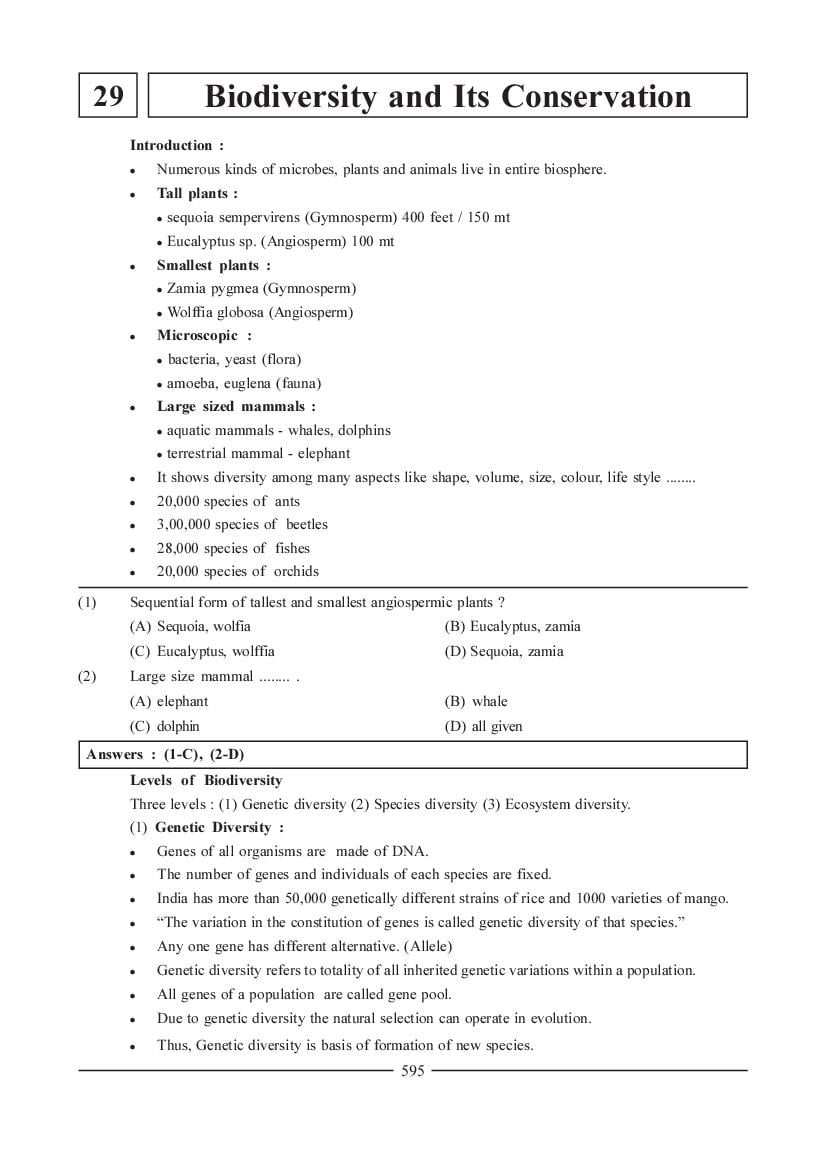
Introduction :
Numerous kinds of microbes, plants and animals live in entire biosphere.
Tall plants :
sequoia sempervirens (Gymnosperm) 400 feet / 150 mt
Eucalyptus sp. (Angiosperm) 100 mt
Smallest plants :
Zamia pygmea (Gymnosperm)
Wolffia globosa (Angiosperm)
Microscopic :
bacteria, yeast (flora)
amoeba, euglena (fauna)
Large sized mammals :
aquatic mammals - whales, dolphins
terrestrial mammal - elephant
It shows diversity among many aspects like shape, volume, size, colour, life style ........
20,000 species of ants
3,00,000 species of beetles
28,000 species of fishes
20,000 species of orchids
(1) Sequential form of tallest and smallest angiospermic plants ?
(A) Sequoia, wolfia (B) Eucalyptus, zamia
(C) Eucalyptus, wolffia (D) Sequoia, zamia
(2) Large size mammal ........ .
(A) elephant (B) whale
(C) dolphin (D) all given
Answers : (1-C), (2-D)
Levels of Biodiversity
Three levels : (1) Genetic diversity (2) Species diversity (3) Ecosystem diversity.
(1) Genetic Diversity :
Genes of all organisms are made of DNA.
The number of genes and individuals of each species are fixed.
India has more than 50,000 genetically different strains of rice and 1000 varieties of mango.
The variation in the constitution of genes is called genetic diversity of that species.
Any one gene has different alternative. (Allele)
Genetic diversity refers to totality of all inherited genetic variations within a population.
All genes of a population are called gene pool.
Due to genetic diversity the natural selection can operate in evolution.
Thus, Genetic diversity is basis of formation of new species.
595
Page 2
The greater the number of species the higher is the species diversity.
Western Ghats have greater amphibian species diversity than the Eastern Ghats.
It also increases the genetic diversity of that area.
It is very important for the normal functioning and sustainability of ecosystems.
It is measured by number of species live there.
Larger the area, more the number of species.
R.H. Whittaker (1965) pointed three types of species diversity :
¯
a-diversity ¯
b-diversity ¯
g-diversity
It is the relative richness of It is relative richness of It refers to richness of
different species in an habitat. different species along a different species in a range
The percentage of each and gradient from one habitat of habitats within a geogra-
every species within a to another habitat within phical area.
community. community. eg. ocean, lakes, ponds,
Birds of pond and birds of mountains, forests
agriculture area of same
grassland
(3) Ecological Diversity : The variation in species richness in different ecosystems of a geographi-
cal area.
It differs from ecosystem to ecosystem.
More the diversity in ecosystem; more efficiences, productivity and stability is of ecosystem.
(3) The variation in the constitution of genes of one species is called ........ .
(A) genetic diversity (B) species diversity
(C) ecological diversity (D) Bio-diversity
(4) What is called the sum total of all genes of a population ?
(A) Gene-frequency (B) Gene-complex (C) Gene pool (D) Gene-mutation
(5) Which diversity is determined by various species of a given area ?
(A) Genetic diversity (B) Species diversity (C) Ecological diversity (D) All given
(6) This diversity is very important for normal functioning and sustainability of ecosystems.
(A) Genetic diversity (B) Species diversity (C) Ecological diversity (D) Bio diversity
(7) Which scientist suggested different types of species diversity ?
(A) Odum (B) Tansley (C) Eichlar (D) R.H.Whittaker
(8) How many types of species-diversity is found ?
(A) 3 (B) 2 (C) 4 (D) 6
(9) The percentage of each and every species within a community belongs to which kind of species
diversity ?
(A) a (B) b (C) g (D) d
(10) Diversity refers to different species in a range of habitats within a geographical area is called ?
(A) a - diversity (B) b- diversity (C) g- diversity (D) d- diversity
Answers : (3-A), (4-C), (5-B), (6-B), (7-D), (8-A), (9-A), (10-C)
596
Page 3
genetic diversity organization diversity (species) ecological diversity
¯ ¯ ¯
populations kingdom biomes
¯ ¯ ¯
species phyla ecosystems
¯ ¯ ¯
chromosomes families habitats
¯ ¯ ¯
genes genera niches
¯ ¯ ¯
nucleotides species populations
¯
sub species
¯
variety
Define : Biodiversity refers to the vareity of microbes, plants and animals of an area.
It shows totality of ecosystem genes and species of an area.
It shows hitrarchial levels of diversity of nature.
It means variety and variability of life.
AIMS of biodiversity :
The knowledge of biodiversity is very important for systematic studies of plants and animals.
Identification of hot spots
Ecosystem studies
Biogeographic studies
Proposing advance conservation programmes
Enriching quality of resources
Conservation of global ethics
Gandhiji had wrote that, The nature has capacity to satisfy the need of man, but not greed.
* Patterns of Biodiversity :
Latitudinal gradients :
The diversity of plants and animals is not uniform throughout the world and shows an uneven
distribution.
As we go from polar region to the equator biodiversity increases.
(trophics latitudinal range of 23.5oN to 23.5o S)
This localities at lower lattitudes have more species than localities at higher latitudes.
It is referred as latitutinal gradient in species diversity.
597
Page 4
While New York at 41oN has 105 species and Greenland at 71oN (North) only 56 species.
India, with much of its land area in the tropical latitudes, has more than 1200 species of birds.
A forest in tropical region like ecuador has upto 10 times as many species of vascular plants
as a forest of equal area in temperate region like the midwest of the USA.
The largely tropical Amazonian rain forest in South America has the greatest biodiversity
on earth.
Where, - 40,000 species of plants
- 3000 species of fishes
- 427 species of mammals
- 427 species of amphibians
- 378 species of reptiles
- more than 1,25,000 species of invertebrates.
Scientists estimated that in this rain forest there might be atleast two million insect species
waiting to be discovered and named.
(11) What does biodiverstiy indicate in nature ?
(A) class (B) designation (C) taxon (D) A and B both
(12) As we go from polar region to the equator, the bio-diversity .......... .
(A) decreases (B) increases (C) lower (D) not certain
(13) In India, which region has large land area ?
(A) Temperate region (B) Tropical latitudes
(C) Tundra region (D) All given
(14) The ........ rain forest in ........ , has the greatest biodiversity on earth.
(A) tropical, South America (B) temperate, North America
(C) temperate, South America (D) tropical, North America
Answer : (11-D), (12-B), (13-B), (14-A)
* High biodiversity in tropics :
Ecologists and evolutionary biologists have proposed various hypothesis for greater biodiversity
in tropics.
(a) Speciation : It is the formation of new and distinct species in the course of evolution.
It is time consuming process.
Tropical latitudes have remained relatively undisturbed for millions of years.
Where frequent glaciations occured in temperate regions in past.
It had a long evolutionary time for species diversification.
598
Page 5
relatively more constant and predictable.
(c) Species - energy hypothesis : More solar energy available in the tropics, which contributes
to higher productivity, which resulted indirectly in high biodiversity.
(d) Species-Area - Relationship : It is a relationship between the area of habitat or part of a
habitat and the number of species found in that area.
According to German naturalist and geographer Alexander Von Humboldt the number of
species increases as the size of a geographical area increases but only upto a limit.
The relation between species richness and area for a wide variety of taxa turns out to be a
rectangular hyperbola.
Importance of Biodiversity :
(1) Food : It provides food for man and their pets.
e.g. Furniture wood, agriculture product, aquatic food, animal husbundary product, medicines,
papers, clothes, pesticids.
Plants are consumed by animals as food.
It is the consumptive value of biodiversity.
(2) Productive use value : The marketable items of bio-diversity form the productive use value.
eg, Antibiotics are synthesized by microbes.
eg, Penicillin from fungus.
(3) Aesthetic and Cultural Benefits :
e.g. furniturewood, agriculture products, aquatic food, animal husbundory product, pearls,
medicine, papers, cotton, pesticide (neem tree).
Ecotourism, bird-watching, wildlife, pet keeping, gardening etc. are examples of bio-diversity.
Throughout human history people have related bio-diversity, to the very existence of human
race through cutural and religious believes.
eg. : Oscimum sanctum (Tulsi)
Calotropis procera (Akdo)
Polyalthia longifolia (Asopalav)
Ficus religiosa (Pipal)
Prosopis cineraria (Khejdo)........various other trees are planted.
Several birds and even snakes have been considered sacred.
India : tiger National animal
peacock National bird
Symbols of Gujarat Asiatic Lion
Flamingo (bird)
Indian laburnum (wild flower)
Neem (tree)
(4) Ecosystem services :
Biodiversity is important in the maintenance of biosphere and its ecosystems.
599
Page 6
Green house effect, maintenance of global temperature, oceanic currents and winds for
maintenance of climate, regulation of rain fall maintained by forests conservation of soil,
pollinations of plants and purification of ground water are made possible due to biodiversity
The ecosystem services have been valued in the range of 16 to 54 trillion (1012) US dollar per
year.
(15) Formation of new and distinct species in the course of evolution is called ........ .
(A) evolution (B) succession (C) bio-diversity (D) speciation
(16) The environment of this area relatively more constant and predictable.
(A) Temperate (B) Tropical
(C) Amazon rain forests (D) All given
(17) Which naturalist and geographer has suggested that the number of species increases as the size of
geographical area increases but only upto a limit.
(A) Odum (B) Humboldt
(C) Tansley (D) Eichlar
(18) The ecosystem service value per year ........ .
(A) 61 to 74 trillion US dollar
(B) 45 to 61 trillion US dollar
(C) 16 to 54 trillion US dollar
(D) 16 to 45 trillion US dollar
Answer : (15-D), (16-B), (17-B), (18-C)
*Biodiversity at world, National and Gujarat levels :
(A) Biodiversity at World Level :
Estimated species may be approximately 50
lacs to 5 crore. Plants
Approximately about 1.7 to 1.8 millions spe-
cies are identified till today. Insects
Microbes
That includes - 3,00,000 species of an-
Verterates
giosperms.
- 8,00,000 species of insects
- 40,000 species of vertebrates
- 3,60,000 species of microorganisms Biodiversity at global level
Largest number of species Plants - Angiosperms
in the world animal- Arthropods kingdom
The number of insects alone may be as high as 10 millions.
More than half of the species on the earth live in moist tropical forests. Which are only 7% of
the total land surface.
600
Page 7
India is one of the twelve mega biodiversity countries of the world.
The richness of biodiversity in India is mainly due to wide variety of climatic and altitudinal
conditional characteristics of this country.
The climate varies from humid tropical area (Western Ghats) to icy mountains (Trans-
Himalaya) via hot desert (Thar) and plains.
Ten geographical regions of our country form a wide variety of ecological habitat
which give shelter to so many kinds of plants and animals.
India covers only 2.4% of total area of the world, but it has 11% of the worlds
total biota, i.e., 45,500 member of species of plants and 86,874 species of
animals.
India has more than 7% of the total animal species in the world.
Indian flora is the confluence of flora from the surrounding countries like
Malaya, China, Tibet, Japan and Europe and even from distant countries like America,
Africa and Australia.
About 5000 species of flowering plants belonging to 141 genera of 47 families
had originated in India.
Hundreds of species of grasses.
India is a source of traditional crop varieties ranking first amongst the 12 regions
of diversity of crop plants and seventh so far in contribution to agricultural species.
India is origin place of 166 species of crop plants, 320 species of wild relatives of cultivated
crops.
At present 30,000 to 50,000 varieties of cultivated plants are found in India.
Total number of plant species in India.
4000 species used in medicine
3000 used as food
500 yield fibre
400 species as fodder
300 species yield gum
100 species used to extract essential oils and scents
Marine bio-diversity in India :
coastline 7500 km.
productive ecosystems : mangroves, coral reefs, estuaries, lagoons.
45 species of mangrove plants
341 species of coral reefs
601
Page 8
location : North-east, Western ghats, Andaman and Nicobar islands.
birds representing about 14% of global avian fauna show relatively high endemism.
endemic birds : Nilgiri pipit, Nilgiri wood pigeon, Malbar parakeet, Rofous babbler.
(C) Biodiversity of Gujarat :
Gujarat is home of nearly 7000 species of plants and animals.
It is famous for its unique saline desert called Rann of Kachchh.
The coral reefs in Gulf of Kachchh as widely admired for their amazing beauty and
spectacular diversity.
Gujarat as seen in the 4320 species of plants, 2198 species of higher plants belonging to 901
genera and 155 families, 2,728 species of animals.
In Gujarat : 14 % fishes
9 % amphibians
19 % reptiles
37 % birds
25 % mammals
Flamingo city : The area between khadir and Paccham islands in the great Rann of Kachchh,
is the largest breeding ground of flamingos, a migratory species.
The great Rann of Kachchh and the little Rann of Kachchh are the worlds only saline desert
spread in 25,000 sq.km.
The Wild Ass Sanctuary is a unique habitat of Indian Wild Ass, the remnant gene pool in the
world.
Specialities :
Bhal region (arid and saline area) known for its indigenous varieties of Bhalia and Rata
Wheat.
Painted frog (rare and endangered sp) is found in Vansada National Park (Valsad District)
Safed Musli is available from Vijaynagar forest (Sabarkantha District) and (Danta forest of
Banaskantha district)
Velavedar Black buck National Park (Bhavnagar District), has dense population of Blackbucks.
602
Page 9
Narayan Sarovar chinkara sanctuary (Kachchh District) rich in ecosystem in arid region of
Gujarat and endangered species such as Guggal among plants and Chinkara, Lesser-Florican,
Spring Tailed Lizard among animals.
Ratanmahal Sloth Bear sanctuary (Panchamahal District) is important habitat for sloth bear.
Giant flying squirrel is found in shool paneshwar wild life Sanctuary.
Marine Wild life sanctuary and National Park is famous for its rich coral, marine algae and
mangrove diversity.
Many migratory and local migratory birds take visit to Nalsarovar Bird Sanctuary as well as
Thol Bird Sanctuary.
Four categories of forest in Gujarat.
(i) Tropical dry deciduous forests
(ii) Tropical thorn forests
(iii) Tropical moist deciduous forests
(iv) Littoral forests
Major plants found here are Tectona, Terminalia, Madhuca, Bamboo, Acacia, Zizyphus,
Mangroves.
(19) How many species estimated on the earth ?
(A) 5 lacs to 50 lacs (B) 50 lacs to 5 crores
(C) 5 lacs to 5 crores (D) 50 thousands to 50 lacs
(20) Which forests are the richest in animal and plant diversity ?
(A) Temperate (B) Tropical (C) Temperate rain forests (D) Tropical decudious
(21) How many biogeographical region of our country form a wide variety of ecological habitat.
(A) 12 (B) 7 (C) 11 (D) 10
(22) India has how many of the total animal speices in the world ?
(A) 7% (B) more than 7% (C) 11% (D) more than 11%
(23) India is a source of traditional crop varieties ranking .......... and .......... so far in the
contribution of agricultural species respectively.
(A) 1st, 12th (B) 1st, 7th (C) 10th, 7th (D) 2nd, 7th
(24) There are about ......... species of mangrove plants and over ......... species of coral reefs found in
India.
(A) 45, 341 (B) 341, 45 (C) 47, 141 (D) 141, 47
(25) The species which is distributed only in a small restricted area is known as ......... .
(A) migratory species (B) endemic species (C) extinct species (D) dangered species
(26) Gujarat is home of nearly how many species of plants and animals ?
(A) 400 (B) 6000 (C) 7000 (D) 900
(27) It is the only remnant gene pool in the world.
(A) Velavdar Black buck National Park (B) Ratanmahal Sloth Beer Sanctuary
(C) Vasanda National Park (D) Wild Ass Sanctuary
(28) It is a rich ecosystem in arid region of Gujarat.
(A) Narayan Sarovar Chinkara Sanctuary (B) Shool Paneshwar Wild Life Sanctuary
(C) Velavadar Black Buck National Park (D) Ratanmahal Sloth Bear Sanctuary
603
Page 10
(A) 6 (B) 4 (C) 2 (D) 8
Answers : (19-C), (20-B), (21-D), (22-B), (23-B), (24-A), (25-B), (26-C), (27-D), (28-A), (29-B)
*Loss of Bio-diversity *
The biological wealth has been declining rapidly.
IUCN (International Union for Conservation of Nature and national resources) Red
List (2004) documents the extinction of 784 species in the last 500 years.
Examples of recent extinctions
Dodo (Mauritius)
Guagga (Africa)
Stellers sea cow (Russia)
Three subspecies of tiger-Bali, Javan, Caspian
The last twenty years alone have witnessed disappearance of 27 species.
The current rate of extinction is 1000 to 10,000 times higher than the past rate of extinction.
Ecologists warn that if the present trends continues by the end of twenty first century there
will be a reduction by 50% in the biodiversity of the earth.
* Causes of Biodiversity Losses *
(1) Habitat loss and fragmentation :
It is most important cause driving animals and plants to extinct.
major reasons : quarrying, laying new railway tracks, constructing dams, felling of trees,
cleaning of land for agriculture, deforestation.
The tropical rain forests was covering more than 14% of the earths land surface, but now
cover more than 6% only.
The Amazon rain forest, lungs of the planet, is being cut and cleared for cultivating soyabeans.
Bignonia and Habenaria formed luxuriant growth on rocks of the Western Ghats before
quarrying the rocks with dynamite.
In southern part of Western Ghats, lion tailed macaque found in large numbers has become
endangered due to loss of habitat.
Of the 370 butterfly species available here, upto 70 are on the average of extinction.
(2) Over-exploitation :
Human uses natural resources for food and other purposes, but when need turns to greed,
it leads to over-exploitation of natural resources.
eg. fishes, Molluscs, crustaceans, sea cows and sea turtles.
victim species : elephants, rhinoceros, tigers, musk deer, crocodiles, spiny tail lizards ...... going
to extinct.
Passenger pigeon of North America was killed for food as result before 500 years this species
has been at the stage of extinction.
All over the world large number of animals are collected for laboratory study, dissections,
research point of view.
Frog is well known example of it.
Rabbits and monkey are also used.
(3) Alien species invasions :
New species entering a geographical region are called alien species.
They cause disappearance of native species.
604
Page 11
(1) The purposely or accidently introduced species like carrot grass (parthenium), Gandhari
(Lantana) and Water hyacinth (Eichornia) have lead to extinction of many local species as
well as adversely affected human health.
(2) The recent illegal introduction of African catfish Clarias gariepinus for aquaculture purposes is
posing a threat to the indigenous catfishes in our rivers.
(4) Co-extinctions : When a species become extinct, the plant and animal species associated with it
in an obligatory way also become extinct.
eg. When a host fish species become extinct, its unique assemblage of parasites also meets
the same fate.
(30) According to Red List how many species extincted in last 500 years ?
(A) 784 (B) 748 (C) 874 (D) 478
(31) How many subspecies of tigers disappeared ?
(A) 2 (B) 4 (C) 3 (4) 5
(32) The current rate of extinction is how many times higher than the past rate of extinction ?
(A) 100 to 1000 (B) 100 to 10,000 (C) 10 to 10,000 (D) 1000 to 10,000
(33) These forests are called lungs of the planet.
(A) Tropical (B) Temperate (C) Amazon (D) All given
(34) Where was Lion tailed macaque found ?
(A) Rocks of Western Ghats (B) North of Western Ghats
(C) Southern part of Western Ghats (D) All given
(35) It is not cause for loss of Biodiversity ?
(A) Mass-extinction
(B) Alien species invasions
(C) Habitat loss and fragmentation
(D) Over-exploitation
Answers : (30-A), (31-C), (32-D), (33-C), (34-C), (35-A)
* Bio-diversity Conservation *
Means conversion of gene complexes, species and ecosystems.
The maintenance and preservation of biodiversity is called biodiversity conservation.
In two ways it can be conserved.
(1) In-situ conservation (on site)
It is the conservation of genetic resources in their natural habitat.
It includes protected areas and biosphere reserves.
Wild life sancturies and National parks are examples of protected areas.
As a September 2002, India has 581 protected areas (89 National parks and 492 wild life
sanctuaries.)
Forests, grasslands and oceanic regions are identified in the concerned state or the country for
the purpose of conservation of biodiversity and declared as Protected areas.
605
Page 12
Maintain viable populations of all native species and subspecies.
Maintain the number and distribution of communities and habitats and conserve the genetic
diversity of all the present species.
Prevent man made introduction of alien species.
Hot Spot :
The area which is rich in plant and animal species, of which many are endemic and
endangered is called biodiversity hot spot.
Initially 25 biodiversity hot spots, late 9 more have been added, so total 34 all over world.
3 hot spots of India are : (1) Western Ghats (2) Indo-Burma (3) Eastern Himalayan region in
India.
Western Ghats has a total of 310 endemic vertrebrates among total of 32,678 species in the world.
National Parks :
Kaziranga National Park (Assam)
Sundarbans (Tiger Reserves, West Bengal)
Hazaribagh National Park (Bihar)
Corbett National Park (Uttar Pradesh)
Gir National Park (Gujarat dist. Junagadh)
Kanha Patiala Park (Madhya Pradesh)
Tandoba National Park (Maharashtra)
Bandipur National Park (Karnataka)
Marine National Park (Jamnagar)
Gujarat has 4 National Parks
Sanctuaries :
A sanctuary is an area, which is reserved for the conservation of animals only.
Operations such as harvesting of timber, collection of minor forest products and private
ownership rights are allowed with condition that they do not affect the animals adversely.
Sancturies of India :
Annamali sactuary (Tamilnadu)
Jaldapara Sanctuary (West Bengal)
Keoladeo Ghana Bird Sanctuary (Bharatpur-Rajasthan)
Sultanpur Lake Bird Sanctuary (Hariyana)
Shikari Devi Sanctuary (Himachal Pradesh)
Dachigam Sanctuary [Srinagar (Jammu and Kashmir)]
Mudumalai Sagar Sanctuary (Andhra Pradesh)
Chilka Lake Bird Sanctuary (Orissa)
Periyar Sanctuary (Kerala)
Manas Wild Life Sanctuary (Assam)
Gujarat : Nalsarovar Bird Sanctuary Thol Bird Sanctuary
Gujarat has 21 Sanctuaries.
606
Page 13
The man and Biosphere (MAB) programme of UNESCO formulated the concept of biosphere
reserves in 1975.
In this programme people are integral components of the system.
In India 14 biosphere reserves are found.
It includes Nanda Devi, Manas, Sundarbans, Great Nicobar, Gulf of Mannar.
A biosphere reserves has 3 zones.
Core Zone :
It comprises an undisturbed and legally protected ecosystem.
Buffer Zone :
It surrounds the core area and is managed to use for research and educational activities.
Transitional Zone :
It is the outermost part of the biosphere reserves.
There is active cooperation between reserve management and the local people wherein
certain activities are allowed with conservation goals.
Some special projects are also established in a special cares.
eg. Project tiger, Gir lion project, Crocodile breeding project, Rhinos conservation, Snow-
leopard project, Project elephant.
(2) Ex-situ conservation (Offsite conservation) :
It is the conservation of genetic resources outside their natural habitat.
They includes : Botanical gardens, Arboreta, Herbal Gardens (for plants), Zoos (for animals), Seed
bank, gene bank, Biotechnology use (Tissue culture, genetic engineering), Culture collection (for
microorganisms).
There are 1500 or more botanical gardens in the world.
About 80,000 species are maintained in these gardens.
Of these nearly 800 important gardens are documented in the international Association of
Botanical Garden (IABG).
There are more than 800 zoos in the world.
In our state, the Vaghai Botanical Garden maintains many medicinal plants.
Seed Bank :
Seed bank can be developed through botanical garden.
In a seed bank seeds are stored for long duration through cold storage in seed bank.
Germ plasm of primitive cultivators or land races and other cultivars are kept in seed bank.
Seeds are maintained here to maintain gene pool.
The seeds of those plants which have a possibility of extinction are stored in seed bank.
Germplasm : It is a living genetic source. It can be maintained in the form of seeds or tissues
which are used for culture of plants and animals and also used for storage and research.
Seeds has to be stored for many years, with a minimum loss of viability.
Many forests and fruit species requires some different ways for the storage involving three
fold strategy (1) Dry storage, (2) Cryogenic storage, (3) Storage of fully of practically
hydrated seeds at ambient temperature.
607
Page 14
Here, crop varieties and wild genetic resources are conserved due to their utility in future crop
improvement and a forestation programmes.
List of gene banks :
National Bureau of plant Genetic Resources, Delhi for wild relatives of crop plants.
National Bureau of Animal Genetic Resources, Karnal for domesticated animals.
National Bureau of Fish Genetic Resources, Allahabad, for economically valuable fish
species.
In India several varieties of rice have been preserved in gene-banks.
At present gene-bank collections have over 34,000 cereals and 22,000 pulses.
Cryopreservation : The reproductive units of plants and reproductive cells of animals can
be deep frozen at a very low temperature and thus conserved for future use.
This method of conservation at -196oC in liquid nitrogen is called Cryopreservation - Its bank
is called cryobank.
Eggs can be fertilized in and plants can be propagated using tissue culture method.
The World Conservation Union (WCU) and the World Wildlife Fund (WWF) are active in
biodiversity conservatin all over the world.
Environmental Education (EE) is given first priority to youth.
(36) The maintenance and preservation of biodiversity means ........ .
(A) Conservation of genetic-diversity (B) Conservation of ecosystem
(C) Conservation of species-diversity (D) Conservation of bio-diversity
(37) How many ways are there to conserve biodiversity ?
(A) 2 (B) 3 (C) 4 (D) not certain
(38) The conservation of genetic recourses in their natural habitat means ........ .
(A) in-situ conservation (B) ex-situ conservation
(C) in-ex-situ conservation (D) all given
(39) Protected areas includes .......... .
(A) Seed bank, National parks
(B) Gene bank, National parks
(C) Seed bank, Gene bank
(D) National parks, Wild-life sanctuaries
(40) As september 2002, India has ........ national parks and ........ wild-life sanctuaries.
(A) 98, 482 (B) 89, 492 (C) 78, 492 (D) 89, 429
(41) How many hotspots are located in the world ?
(A) 25 (B) 29 (C) 34 (D) 31
(42) How many hot spots are there in India ?
(A) 25 (B) 3 (C) 34 (D) 28
608
Page 15
(A) 21 (B) 14 (C) 17 (D) 4
(44) Here human activities are allowed with conditions ?
(A) National Parks (B) Sanctuaries
(C) A, B both (D) Reserved areas
(45) How many sanctuaries has Gujarat ?
(A) 13 (B) 4 (C) 17 (D) 21
(46) Which programme of UNESCO formulated the conept of biosphere reserves ?
(A) Man of Biosphere (B) Man of Biography
(C) Man and Biosphere (D) Man and Biography
(47) In India how many biosphere reserves are found ?
(A) 17 (B) 21 (C) 13 (D) 14
(48) How many zones are there in biosphere reserves ?
(A) 6 (B) 2 (C) 3 (D) 4
(49) How many gardens are documented in IBAG ?
(A) 700 (B) More than 700 (C) 800 (D) More than 800
(50) Experimentally seeds are stored at temperature of environment is called .......... .
(A) dry storage (B) cold storage
(C) cryo preservation (D) all given
(51) In gene bank more than ........ cereals and ........ pulses are stored.
(A) 43,000; 22,000 (B) 34,000; 22,000 (C) 22,000; 43,000 (D) 22,000; 34,000
Answers : (36-D), (37-A), (38-A), (39-D), (40-B), (41-C), (42-B), (43-D), (44-B), (45-D),
(46-C), (47-D), (48-C), (49-D), (50-A), (51-B)
· A - Assertion and R - Reason type questions :
Choose the correct answer from given options :
(A) A and R both correct. R is correct explanation of A
(B) A and R both correct. R is not correct explanation of A
(C) A is correct but R is wrong
(D) A is wrong but R is correct
(52) Assertion A : All organisms are not found everywhere.
Reason R : They show diversity in shape, volume, size, colour, life style and many other things.
(A) (B) (C) (D)
(53) Assertion A : The variation in the constitution of genes is called genetic diversity.
Reason R : Species diversity is the basis of formation of new species.
(A) (B) (C) (D)
(54) Assertion A : Western Ghats have greater amphibian species diversity than the Eastern Ghats.
Reason R : The greater the number of species, the higher is the species diversity.
(A) (B) (C) (D)
609
Page 16
Reason R : It is the relative richness of different species in a habitat.
(A) (B) (C) (D)
(56) Assertion A : g- diversity refers to richness of different species in a range of habitats within a
geographical area.
Reason R : Bio diversity of ocean, lakes, ponds, mountains, forest etc. is the examples of g- diversity.
(A) (B) (C) (D)
(57) Assertion A : Species diversity differs from ecosystem to ecosystem.
ReasonR : Each and every ecosystem allows a particular group of plants and animals to
grow there in.
(A) (B) (C) (D)
(58) Assertion A : In New York at 41oN has 105 species and Greenland at 71oN only 56 species.
Reason R : Localities at lower latitudes have more species than localities at higher latitudes.
(A) (B) (C) (D)
(59) Assertion A : More than half of the species on the earth live in moist tropical forests.
Reason R : The tropical forests are regarded as the richest in Animal and plant diversity.
(A) (B) (C) (D)
(60) Assertion A : Nilgiri wood pigeon and Malbar parakeet are endemic species.
Reason R : The species which is distributed only in a small restricted area is called endemic
species.
(A) (B) (C) (D)
(61) Assertion A : In 1957 UNESCO formulated Biosphere reserve hypothesis under MAB programme.
Reason R : They are special category for protected area of land or coastal environments.
(A) (B) (C) (D)
(62) Assertion A : In a seed bank seeds are stored for long duration.
Reason R : Seed bank has cold storage to store seeds.
(A) (B) (C) (D)
(63) Assertion A : When a species becomes extinct, the plant and animal associated with it in an
obligatory way also become extinct.
Reason R : When host fish becomes extinct, parasites lives on it also becomes extinct.
(A) (B) (C) (D)
Answers : (52-B), (53-C), (54-A), (55-D), (56-B), (57-A), (58-A), (59-B), (60-A), (61-D), (62-A), (63-B)
True - False Type Questions
(64) 1. Sequoia sempervirens (Angiosperms) is 400 ft tall.
2. Wolffia globosa (angiosperm) is the smallest plant.
3. Euglena lives as parasite.
4. Shark and Dolphin are large sized mammals.
(A) FTTF (B) TFTF (C) FTFF (D) FTFT
610
Page 17
1. Ecosystem studies.
2. Proposing advance conservation programme.
3. To identify biosphere reserves.
4. Conservation of global ethics.
(A) TTFF (B) TTFT (C) TFFT (D) FTTF
(66) 1. The largely tropical Amazonian rain forest in North America has the greatest biodiversity on
earth.
2. Colombia located near the equator has nearly 1400 species of birds.
3. Localities at higher latitudes have more species than localities at lower latitudes.
4. In rain forest there might be atleast two million insect species waiting to be discovered and
named.
(A) TFFT (B) TTFF (C) FFTT (D) FTFT
(67) 1. India covers 2.4% of the total area of the world .
2. India has 11% of the worlds total biota.
3. India has more than 7% of the total animal species in the world.
4. 12 biogeographical regions of our country form a wide variety of ecological habitat.
(A) TTTF (B) TTFF (C) TFTF (D) FFFT
(68) 1. The coral reefs in the Gulf of Kachchh is widely admired for their amazing beauty and
spectacular diversity.
2. The area of Dhorad and Paccham islands has flamingos in the great Rann of Kachchh.
3. The great Rann of Kachchh and the little Rann of Kachchh are the world only saline desert
spread in 2500 sq.km.
4. Chinkara Sanctuary is the remnant gene pool in the world.
(A) TFFT (B) TFFF (C) TTFF (D) TFTF
(69) Choose right option for benefits of protected areas.
1. Prevent man-made introduction of alien species.
2. Maintain viable populations of all native species and sub-species.
3. Maintain the number and distribution of communities and habitats.
4. Biogeographic studies.
(A) TTTF (B) TTFT (C) TFFT (D) FTTF
(70) 1. Gene bank can be developed for conservation of rare genes.
2. In India varieties of wheat are conserved in gene bank.
3. Gametes of threatened species is stored in a gene bank.
4. At present, gene-bank colletions have 34,000 pulses and 22,000 cereals.
(A) TTFF (B) TFTF (C) TTTF (D) TTTT
611
Page 18
(I) Transitional zone (p) it is managed to use for reaserch and (A) p q r
educational activities (B) q p r
(II) Core zone (q) certain activities are allowed with conservation (C) q r p
goals
(III) Buffer zone (r) legally protected ecosystem (D) r p q
(72) Column-I Column-II I II III IV
(I) West Bengal (p) Keoladeo Ghana Bird Sanctuary (A) q s p r
(II) Tamilnadu (q) Jaldapara Sanctuary (B) p s q r
(III) Bharatpur (r) Sultanpur Lake Bird Sanctuary (C) q s r p
(IV) Hariyana (s) Annamali Sanctuary (D) r s q p
(73) Column-I Column-II I II III IV
(I) Shikari Devi Sanctuary (p) Srinagar (A) r p q s
(II) Dachigam Sanctuary (q) Orissa (B) r p s q
(III) Mudumalai Sagar Sanctuary (r) Himachal Pradesh (C) s q p r
(IV) Chilka Lake Bird Sanctuary (s) Andhra Pradesh (D) p r q s
(74) Column-I Column-II I II III IV
(I) Kaziranga National Park (p) Bihar (A) p q s r
(II) Tiger Reserves (q) Assam (B) q p s r
(III) Hazaribagh National Park (r) Uttar Pradesh (C) s p q r
(IV) Corbett National Park (s) West Bengal (D) q s p r
(75) Column-I Column-II I II III IV
(I) Kanha Patiala Park (p) Kerala (A) q s p r
(II) Bandipur National Park (q) Madhya Pradesh (B) q s r p
(III) Manas Wild Life Sanctuary (r) Assam (C) p q r s
(IV) Periyar Sanctuary (s) Karnataka (D) s p q r
(76) Column-I Column-II I II III IV
(I) Gandhari (p) Lantana (A) p q s r
(II) Catfish (q) Parthenium (B) p r q s
(III) Grass (r) Clarias (C) q p r s
(IV) Water hyacinth (s) Eichornia (D) r p q s
(77) Column-I Column-II Column-III
(I) Soyabean (p) rocks of the Western Ghats (x) destroyed due to quarrying
(II) Bignonia and Habenaria (q) Amazon rain forests (y) endangered
(III) Lion tailed macaque (r) Southern past of Western Ghats (z) lungs of planet
I II III
(A) q®z r®y p®x
(B) r®z p®x q®y
(C) q®z p®x r®y
(D) p®z r®x q®y
612
Page 19
(I) painted frog (p) Vijaynagar forest (A) r q p s
(II) Safed Musli (q) Bhavnagar District (B) r p q s
(III) Black Buck National Park (r) Vasanda National Park (C) p s r q
(IV) Chinkara Sanctuary (s) Kachchh District (D) p r q s
(79) Choose correct pairs for Biodiversity of Gujarat.
Column-I Column-II I II III IV
(I) Fish (p) 19% (A) s p q r
(II) Amphibians (q) 14% (B) q r s p
(III) Reptiles (r) 25% (C) q p s r
(IV) Mammals (s) 9% (D) q s p r
(80) Column-I Column-II I II III IV
(I) Indias coastline ....... km (p) 45,500 (A) s q p r
(II) Species used as medicines in india (q) 7,500 (B) q s p r
(III) Total biota of plants (r) 86,874 (C) r s q p
(IV) Total species of animals (r) 86,874 (D) p q r s
(s) more than 4,000
(81) Column-I Column-II I II III IV
I Calotropis procera (p) Asopalav (A) r p s q
II Polyalthia longifolia (q) Khijdo (B) s q p r
III Ficus religiosa (r) Akdo (C) r q s p
IV Prosopis Cineraria (s) Pipal (D) p r q s
(82) Column-I Column-II Column-III
(I) a-diversity (p) percentage of each species (w) richness of different species of
in community two habitats
(II) b-diversity (q) Lakes, mountains, forests (x) richness of different species in
a habitat
(III) g-diversity (r) Birds of pond and agricuture (A) richness of different species in
area of same grassland area a range of habitats
I II II
(A) p®y r®x q®w
(B) r®x p®w q®y
(C) r®y p®x q®w
(D) p®x r®w q®y
613
Page 20
a b c
¯ ¯ ¯
populations Kingdoms Biomes
¯ ¯ ¯
Species Phyla Ecosystems
¯ ¯ ¯
Chromosomes Families Habitats
¯ ¯ ¯
Genes Genera Niches
¯ ¯ ¯
Nucleotides Species Population
¯
Sub species
¯
Variety
(A) The variation in the constitution of gene is called genetic diversity.
(B) It is important for normal functioning and sustainibility of ecosystems.
(C) Species richness in different ecosystem of a geopgraphical area.
(D) It shows population - diversity.
(84) Choose correct for a,b,c,d in diagram.
(A) a = plants b = micro organisms b
c = insects d = vertebrates
(B) a = vertrebrates b = plants a
c
c = insects d = Micro organisms
(C) a = insects b = plants
c = Micro organisms = vertebrates d
(D) a = insects b = vertebrates
c = plants d = Micro organisms
(85) What does x stand for in given diagram ?
(A) x = insects
(B) x = micro organisms
(C) x = plants
x
(D) x = vertebrates
(86) choose appropriate option for a, b, c, d in given diagram.
(A) a = 18,00,000 b = 3,00,000
c = 3,60,000 d = 40,000
(B) a = 80,000 b = 30,000
c = 30,600 d = 40,000
(C) a = 8,00,00 b = 3,00,000
c = 3,60,000 d = 40,000
(D) a = 40,00,000 b = 8,00,000
c = 3,00,000 d = 3,60,000
614
Page 21
Transitional zone
(A) In India 34 in number
Buffer zone
(B) It is formulated by MAB
Core zone
(C) More than 1500 in the world
Human
(D) All given settlement
(88) What does x and y indicate in diagram ?
(A) x = transitional zone y = human settlement
(B) x = buffer zone y = human settlement
(C) x = buffer zone y = authorised
(D) x = transitional zone y = authorised
(89) What does x indicate ?
(A) x = certain activities are allowed with con
servation goals.
(B) x = It is managed to use for research and
educational activities.
(C) x = It is legally protected ecosystem.
(D) x = It is undisturbed.
Answers : (64-C), (65-B), (66-D), (67-A), (68-B), (69-A), (70-B), (71-C), (72-A), (73-B), (74-D),
(75-B), (76-B), (77-C), (78-B), (79-D), (80-B), (81-A), (82-D), (83-B), (84-A), (85-B), (86-C),
(87-B), (88-B), (89-A)
l NEET Questions :
(90) Wildlife is destroyed most when ....... .
(A) there is lack of proper care
(B) mass scale hunting for foreign trade
(C) its natural habitat is destroyed
(D) natural calamity
(91) Which animal has become extinct from India ?
(A) Snow leopard (B) Hippopotamus (C) Wolf (D) Cheetah
(92) Ranthambore National park is situated in ........ .
(A) Maharashtra (B) Rajasthan (C) Gujarat (D) U.P.
(93) National park associated with Rhinoceros is ........ .
(A) Kaziranga (B) Ranthambore
(C) Corbett (D) Valley of flowers
615
Page 22
(A) high altitude to low altitude and high latitude to low latitude
(B) high altitude to low altitude and low latitude to high latitude
(C) low altitude to high altitude and high latitude to low latitude
(D) low altitude to high altitude and low latitude to high latitude
(95) Which of the following is the correct matching pair of a sanctuary and its main protected wild
animal ?
(A) Gir-Lion (B) Sariska-Tiger
(C) Sunderban-Rhino (D) Kaziranga-Musk deer
(96) A number of natural reserves have been created to conserve specific wild life species. Identify the
correct combination from the following.
(A) Gir forest - Tiger (B) Kaziranga-Elephants
(C) Rann of Kachchh-Wild Ass (D) Manas Wild life sanctuary - Musk deer
(97) If the forest cover is reduced to half, what is most likely to happen on a long term basis ?
(A) Tribals living in these areas will starve to death.
(B) Cattle in these and adjoining areas will die due to lack of fodder.
(C) Large areas will become deserts.
(D) Crop breeding programmes will suffer due to a reduced availability of variety of germplasm.
(98) MAB stands for
(A) Man and Biology programme (B) Man and Biosphere programme
(C) Mammals and Biosphere programme (D) Mammals and Biology programme
(99) At present, the most significant cause of dwindling biodiversity is probably ........ .
(A) the deterioration of ozone layer (B) the destruction of habitat
(C) Biological magnification of DDT (D) global warming
(100) An Institution where valuable Plant material likely to become irretrievably lost in the wild or in
cultivation is preserved in a viable Condition is known as ........ .
(A) Genome (B) Herbarium (C) Gene library (D) Gene bank
(101) Reason of diversity in living beings is due to ........ .
(A) mutation (B) long term evolutionary change
(C) gradual change (D) short term evolutionary change
(102) Which group of vertebrates comprises the highest number of endangered species ?
(A) Birds (B) Mammals (C) Fishes (D) Reptiles
(103) In your opinion, which is the most effective way to conserve the plant diversity of an area ?
(A) By tissue culture method (B) By creating biosphere reserve
(C) By creating botanical garden (D) By developing seed bank
(104) Diversification in plant life appeared ........ .
(A) due to long periods of evolutionagy change (B) due to abrupt mutation
(C) suddenly on earth (D) by seed dispersal
(105) Biodiversity Act of India was passed by the parliament in the year.
(A) 1992 (B) 1996 (C) 2000 (D) 2002
(106) Which one of the following is the correct matched pair of an endangered animal and National
Park ?
(A) Rhinoceros - Kaziranga National Park (B) Wild ass - Dudhwa National Park
(C) Great Indian Bustard - Keoladeo National Park (D) Lion - Corbettt National Park
(107) Which one of the following is not included under in-situ conservation ?
(A) Botanical garden (B) Biosphere reserve (C) National Park (D) Sanctuary
616
Page 23
(A) Indo-Gangetic Plain (B) Eastern Ghats (C) Aravalli Hills (D) Western Ghats
(109) Indentify the odd Combination of the habitat and the particular animal concerned.
(A) Sunderbans- Bengal Tiger (B) Periyar - Elephant
(C) Rann of kachch - Wild Ass (D) Dachigam National Park - Snow leopard
(110) Which one of the following is not observed in biodiversity hotspots ?
(A) Endemism (B) Accelerated species loss
(C) Lesser inter-specific competition (D) Species richness
(111) Which one of the following has maximum genetic diversity in India ?
(A) Mango (B) Wheat (C) Tea (D) Teak
(112) Tiger is not a resident in which one of the following national Park ?
(A) Sunderbans (B) Gir (C) Jim Corbett (D) Ranthambhor
(113) Which one of the following is an example of Exsitu conservation ?
(A) Wildlife Sanctuary (B) Seed bank (C) Sacred groves (D) National Park
(114) A collection of plants and seeds having diverse alleles of all the genes of a crop is called.
(A) herbarium (B) germplasm (C) gene library (D) genome
(115) Which one of the following shows maximum genetic diversity in India ?
(A) Groundnut (B) Rice (C) Maize (D) Mango
(116) Biodiversity of a geographical region represents ........ .
(A) endangered species found in the region
(B) the diversity in the organisms living in the region
(C) genetic diversity present in the dominant species of the region
(D) species endemic to the region
(117) What do species call which will extinct in near future ?
(A) sensitive species (B) endemic species (C) endangerous species (D) extinct species
(118) Which institute makes Red List ?
(A) ICFRE (B) IUCN (C) UNEP (D) WWF
(119) Choose appropriate option for invertebrate animals ?
a b c d
(A) insects curstercean another animal mollusca
group
(B) crustacean insects mollusca other animal
phyla
(C) mollusca another animal phyla crustacean insects
(D) insects mollusea crustacean other animals
Answers : (90 - C), (91 - D), (92 - B), (93 - A), (94 - A), (95 - B), (96 - C), (97 - D), (98 - B), (99 - B),
(100-D), (101-B), (102-B), (103-C), (104-A), (105-D), (106-A), (107-A), (108-D), (109-D), (110-B),
(111-B), (112-B), (113-B), (114-C), (115-B), (116-B), (117-C), (118-B), (119-D)
617
Page 24
Biodiversity and Conservation Diversity in the given
Biodiversity is defined as the vast array of species of community of habitat.
microorganisms, algae, fungi, plants and animals occuring Beta diversity ¬
on the earth and the ecological complexes of which they Diversity between
are a part. This includes diversity within species, between community
species and of the ecosystem Gamma diversity ¬
It is regional diversity
® Levels of biodiversity
¯
¯ ¯ ¯
Genetic diversity Species diversity Community Ecosystem diversity
It is the diversity in the numbers and It is the diversity in It is related to the differnt type of
types of genes as well as chromosomes the number and ecosystems/habitats eg., terrestrial
present in different species and the richness of species and aquatic ecosystems
variations in the genes and their alleles in of a region
the same species.
® Patterns of Biodiversity ¯
¯ ¯
- Species Latitudinal and altiludinal gradient diversity on earth is not Species area relationships
uniformly distributed but shows interesting patterns. It is a relationship between the
It is generally highest in the tropics and decreases towards the poles. area of habitat or part of a habi-
- Important explanations for the species richness in tropics: Tropics tat and the number of specis
had more evolutionary time; they provide a relatively constant en- within that area
vironment and they receive more solar energy which contributes to
greater productivity.
® Importance of Biodiversity
¯
¯ ¯ ¯ ¯ ¯ ¯ ¯
stability sources of sources provide variety provide drugs scientific ecosystem
of food and of fibres of useful products and medicines value services
ecosystem improved such as gums, resins,
varieties dyes, perfumes,
lubricants, rubber,
latex, tea, dryfruits
Loss of Biodiversity
Most serious aspect of ¯
® the loss of biodiversity ¯ ¯
is the extinction species Types of extinction Factors contributing to extinction
® Natural extinction
® Mass extinction ® Habitat loss and fragmentation
® Antropogenic extinction ® Over exploitation
® Alien species invasions
® Disturbance and Degradation
® Pollution
® Coextinctions
® Forestry
® Intensive Agriculture
618
Page 25
® Biodiversity Conservation
B Red Data Book and IUCN
I - IUCN is international union of conservation of nature and natural resources which
O is now called World Conservation Union (WCU).
D - It maintains a Red Data Book or Red List which is a catalogue of taxa facing risk of
I extinction.
V - Red List has eight categories of spieces.
E - These are extinct, extinct in wild, critically endangered, endangered, vulnerable,
R lower risk, data deficient and not evaluated species.
S
I ® Process
T
Y
Ex-Situ In-Situ
Conservation of ® Sacred plants
® ® Hot
Biodiversity Home Gardens Spot
® Seed Banks
®
®
®
Field gene banks Protected
Reasons Process Areas
The reasons for conserving ® Cryopreservation
biodiversity are narrow utilitarian,
broadly utilitarian and ethical ® Botanical Gardens
Arboreta
® Zoological Parks
® A quaria
®
®
®
Sacred forest / Groves, Biosphere National Parks
Sacred Lakes reserves Wild Life
Sanctuaries
619
Document Details
| Board / Org | NTA |
| Exam | National Eligibility cum Entrance Test (Undergraduate) |
| Type | Question Bank |
| Pages | 25 |
| Updated | 22 Jul 2026 |