SEBA Class 9 Class 10 Syllabus 2025 Weaving And Textile Design
Finished viewing? Save it for later —
Download SEBA Class 9 Class 10 Syllabus 2025 Weaving And Textile Design (PDF · 6 pages)About SEBA Class 9 Class 10 Syllabus 2025 Weaving And Textile Design
SEBA Class 9 Class 10 Syllabus 2025 Weaving And Textile Design is available here for free download. Published by Assam Board for Class 10, this syllabus can be viewed online or downloaded as a PDF (6 pages). Candidates preparing for Class 10 can use SEBA Class 9 Class 10 Syllabus 2025 Weaving And Textile Design to understand the exam pattern, the type of questions asked, and the overall difficulty level.
Frequently Asked Questions
How can I download SEBA Class 9 Class 10 Syllabus 2025 Weaving And Textile Design?
Open this page and click the Download button to save SEBA Class 9 Class 10 Syllabus 2025 Weaving And Textile Design as a PDF. It is completely free on AglaSem Docs.
Is SEBA Class 9 Class 10 Syllabus 2025 Weaving And Textile Design free to download?
Yes. SEBA Class 9 Class 10 Syllabus 2025 Weaving And Textile Design can be viewed online and downloaded as a PDF free of cost on AglaSem Docs.
How many pages does SEBA Class 9 Class 10 Syllabus 2025 Weaving And Textile Design have?
SEBA Class 9 Class 10 Syllabus 2025 Weaving And Textile Design contains 6 pages, which you can read online or download together as a single PDF.
Where can I find more Class 10 study material?
You can find more Class 10 question papers, sample papers, syllabus, and answer keys on AglaSem Docs.
SEBA Class 9 Class 10 Syllabus 2025 Weaving And Textile Design – Text
Read the full text of this syllabus below — useful to quickly search, copy and reference the content online without downloading the PDF.
📄 View text version (6 pages)
Page 1
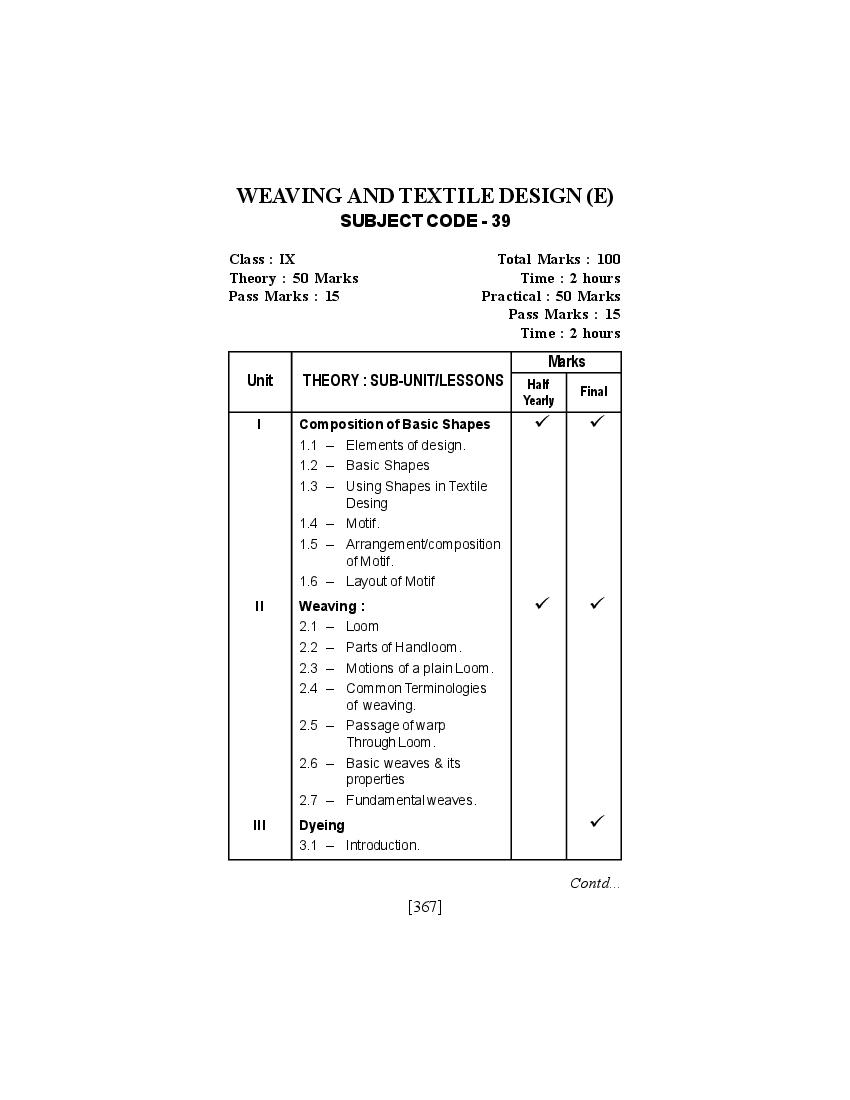
SUBJECT CODE - 39
Class : IX Total Marks : 100
Theory : 50 Marks Time : 2 hours
Pass Marks : 15 Practical : 50 Marks
Pass Marks : 15
Time : 2 hours
Unit THEORY : SUB-UNIT/LESSONS Half
I Composition of Basic Shapes
1.1 – Elements of design.
1.2 – Basic Shapes
1.3 – Using Shapes in Textile
Desing
1.4 – Motif.
1.5 – Arrangement/composition
of Motif.
1.6 – Layout of Motif
II Weaving :
2.1 – Loom
2.2 – Parts of Handloom.
2.3 – Motions of a plain Loom.
2.4 – Common Terminologies
of weaving.
2.5 – Passage of warp
Through Loom.
2.6 – Basic weaves & its
properties
2.7 – Fundamental weaves.
III Dyeing
3.1 – Introduction.
Contd...
[367]
Page 2
3.2 – Dyes.
3.3 – Classification of Dyes.
3.4 – Direct Dyes.
3.5 – Vat Dyes.
3.6 – Acid Dyes.
3.7 – Basic Dyes.
3.8 – Reactive Dyes.
3.9 – Dyes and its use.
3.10 – Methods of Dyeing.
3.11 – Conventional Dyeing
Method of Cotton.
IV Printing
4.1 – Dyeing and printing.
4.2 – Methods used for printing.
4.3 – Sereen printing.
4.4 – Styles of printing.
4.5 – Variant printing effects.
Total 50 50
N.B. - Textile Design & Clothing (E) is renamed as Weaving &
Textile Design (E)
Textbook :
[368]
Page 3
PRACTICAL
SUBJECT CODE - 39 (P)
CLASS IX
Practical : 50 Marks Time : 2 hours
Pass Mark : 15
Unit SUB-UNIT/LESSONS Half
1 Drawing of motif, different floral
desing in drawing paper,
different. Shapes and their
placement process.
2 Introduction to common parts of
loom, General idea of different
types of fabric.
3 Dyeing of cotton yarn by using
direct and reactive dyes by
conventional method using
different colours is different
shades.
Total 50 50
Distri- Theory 50 50
bution Practical 50 50
of marks Grand Total 100 100
[369]
Page 4
SUBJECT CODE - 39
Class - X Full Marks : 100
Theory : 50 Pass Marks : 15
Time : 2 hours
Practical Marks : 50 Pass Marks : 15
Time : 2 hours
THEORY Marks
Unit SUB-UNIT/LESSONS Half
I. Traditional Designs
1.1 Traditional Design
1.2 Traditional Design in India
1.3 Folk Art
1.4 Motifs
1.5 Design
II. Traditional Designs of
North East
2.1 Traditional Designs of
North East
2.2 Assamese Traditional Design
2.3 Bodo, Rabha Traditional
Design
2.4 Mising Traditional Design
2.5 Manipuri Traditional Design
2.6 Arunachal Traditional Design
III. Ornamentation of Fabric
3.1 Ornamentation of fabric by
weaving
Contd...
[370]
Page 5
3.2 Development of decorative
design by weaving
3.3 Ornamentation of fabric by
tie and dye
3.4 Ornamentation of fabric by
batik
IV. Dyeing of Silk
4.1 Conventional method of
silk dyeing
4.2 Dyeing of silk with Acid dye
4.3 Dyeing of silk with Basic
dye
V. Printing Method
5.1 Hand block printing
5.2 Printing paste
5.3 Printing paste preparation
5.4 Screen printing
5.5 Machine printing
5.6 Machine screen printing
5.7. Difference between Roller
and Rotary screen printing.
Total 50 50
[371]
Page 6
SUBJECT CODE - 39 (P)
CLASS - X
PRACTICAL Marks
Unit SUB-UNIT/LESSONS Half
I 1. Drawing of different floral
Design in drawing paper.
2. Drawing of different
Geometrical Design and
traditional design.
II 3. Drawing of diffferent
Asomiya Design used in
Mekhela-Chadar.
4. Drawing of different Bodo Design.
III 5. Drawing of different Asomiya
traditional Design in graph
paper for Handloom.
IV 6. Dyeing of Silk yarn using
Acid Dye by conventional method.
7. Dyeing of cotton fabric by
using Tie & Dye Method.
V 8. Preparation of Screen for
Screen printing in dark room.
(Conventional Method)
9. Printing of fabric by using
screen with pigment colour
10. Printing of fabric by using
block with pigment colour
Total 50 50
Theory 50 50
Practical 50 50
Grand Total 100 100
[372]
Document Details
| Board / Org | Assam Board |
| Exam | Class 10 |
| Type | Syllabus |
| Pages | 6 |
| Updated | 30 Apr 2026 |