NEET Biology Question Bank - Biotechnology
Finished viewing? Save it for later —
Download NEET Biology Question Bank - Biotechnology (PDF · 10 pages)About NEET Biology Question Bank - Biotechnology
NEET Biology Question Bank - Biotechnology is available here for free download. Published by NTA for National Eligibility cum Entrance Test (Undergraduate), this question bank can be viewed online or downloaded as a PDF (10 pages). Candidates preparing for National Eligibility cum Entrance Test (Undergraduate) can use NEET Biology Question Bank - Biotechnology to understand the exam pattern, the type of questions asked, and the overall difficulty level.
Frequently Asked Questions
How can I download NEET Biology Question Bank - Biotechnology?
Open this page and click the Download button to save NEET Biology Question Bank - Biotechnology as a PDF. It is completely free on AglaSem Docs.
Is NEET Biology Question Bank - Biotechnology free to download?
Yes. NEET Biology Question Bank - Biotechnology can be viewed online and downloaded as a PDF free of cost on AglaSem Docs.
How many pages does NEET Biology Question Bank - Biotechnology have?
NEET Biology Question Bank - Biotechnology contains 10 pages, which you can read online or download together as a single PDF.
Where can I find more National Eligibility cum Entrance Test (Undergraduate) study material?
You can find more National Eligibility cum Entrance Test (Undergraduate) question papers, sample papers, syllabus, and answer keys on AglaSem Docs.
NEET Biology Question Bank - Biotechnology – Text
Read the full text of this question bank below — useful to quickly search, copy and reference the content online without downloading the PDF.
📄 View text version (10 pages)
Page 1
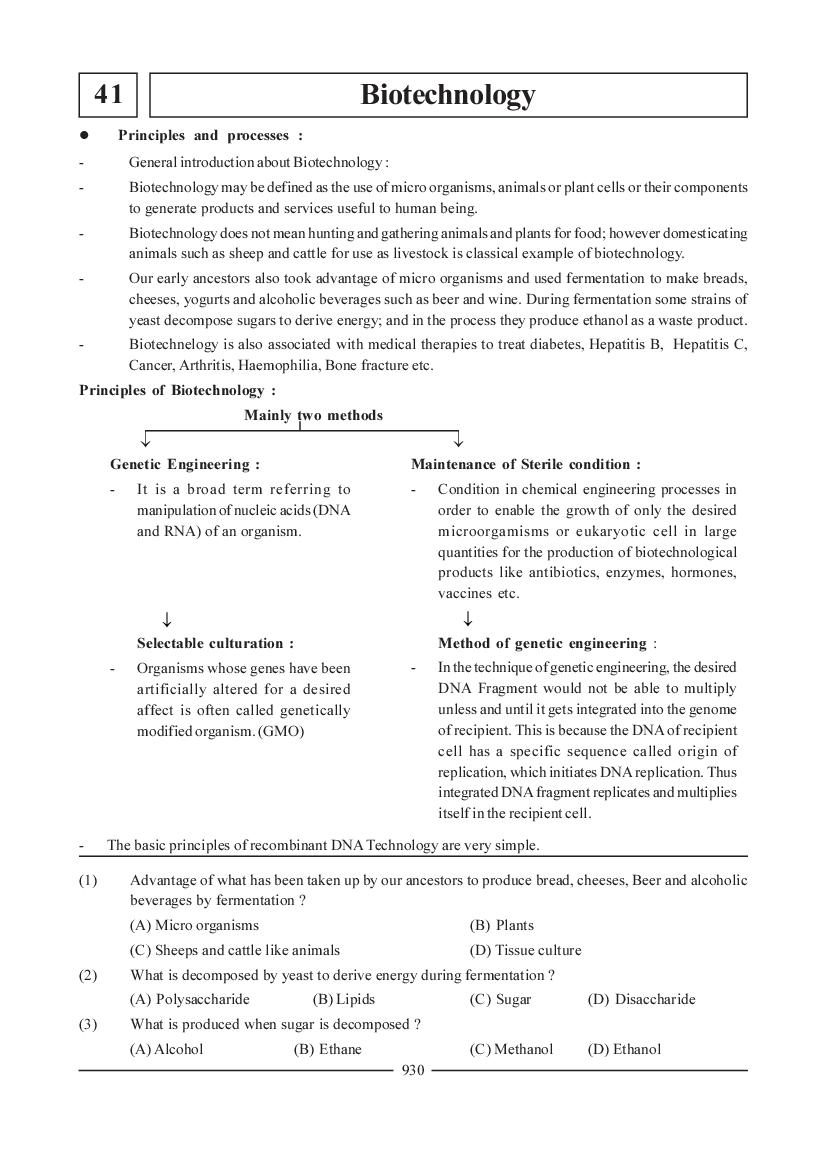
l Principles and processes :
- General introduction about Biotechnology :
- Biotechnology may be defined as the use of micro organisms, animals or plant cells or their components
to generate products and services useful to human being.
- Biotechnology does not mean hunting and gathering animals and plants for food; however domesticating
animals such as sheep and cattle for use as livestock is classical example of biotechnology.
- Our early ancestors also took advantage of micro organisms and used fermentation to make breads,
cheeses, yogurts and alcoholic beverages such as beer and wine. During fermentation some strains of
yeast decompose sugars to derive energy; and in the process they produce ethanol as a waste product.
- Biotechnelogy is also associated with medical therapies to treat diabetes, Hepatitis B, Hepatitis C,
Cancer, Arthritis, Haemophilia, Bone fracture etc.
Principles of Biotechnology :
Mainly two methods
¯ ¯
Genetic Engineering : Maintenance of Sterile condition :
- It is a broad term referring to - Condition in chemical engineering processes in
manipulation of nucleic acids (DNA order to enable the growth of only the desired
and RNA) of an organism. microorgamisms or eukaryotic cell in large
quantities for the production of biotechnological
products like antibiotics, enzymes, hormones,
vaccines etc.
p p
Selectable culturation : Method of genetic engineering :
- Organisms whose genes have been - In the technique of genetic engineering, the desired
artificially altered for a desired DNA Fragment would not be able to multiply
affect is often called genetically unless and until it gets integrated into the genome
modified organism. (GMO) of recipient. This is because the DNA of recipient
cell has a specific sequence called origin of
replication, which initiates DNA replication. Thus
integrated DNA fragment replicates and multiplies
itself in the recipient cell.
- The basic principles of recombinant DNA Technology are very simple.
(1) Advantage of what has been taken up by our ancestors to produce bread, cheeses, Beer and alcoholic
beverages by fermentation ?
(A) Micro organisms (B) Plants
(C) Sheeps and cattle like animals (D) Tissue culture
(2) What is decomposed by yeast to derive energy during fermentation ?
(A) Polysaccharide (B) Lipids (C) Sugar (D) Disaccharide
(3) What is produced when sugar is decomposed ?
(A) Alcohol (B) Ethane (C) Methanol (D) Ethanol
930
Page 2
(A) Undesirable genes (B) Exact gene information
(C) Desirable hybridization (D) Sexual Reproduction diversity
(5) Which fragment would not be able to multiply unless and until it gets integrated into the genome of
recipient ?
(A) mRNA (B) DNA (C) RNA (D) Plasmid
(6) How can we introduce Bt - cotton ?
(A) Transgenic animals (B) Selective breeding (C) Domestic animals (D) Micro organisms
(7) What is the full form of EFB.
(A) Environmental Federation of Britan
(B) European Federation of Biotechnology
(C) Ecological Federation Board
(D) European Foundation of biotechnology
Answers Ñ (1-A), (2-C), (3-D), (4-B), (5-B), (6-A), (7-B)
- Useful tools of Recombinat DNA technology :
(1) Restriction enzymes (2) Cloning vectors and (3) Competent host
- Restriction Enzymes : The technique involved in recombinant DNA technology is to cut the desired
DNA segment and introduce it into a vector (e.g. plasmid)
- This is achieved using specific bacterial enzymes called restriction emzymes or restroction
endonucleases.
- We known more than 900 restriction enzymes that have been isolated from over 230 strains of
bacteria. These enzymes are named according to their bacteria which is gained.
- Nucleases are of two types : (1) Exonucleases and (2) Endonucleases.
- Exonucleases remove nucleotides from the ends of DNA where as, endonucleases make cuts at
specific site within DNA.
- Restriction endonucleases recognize short palindromic sequences and cut at specific sites.
- Palindromic sequence is a sequence of base pairs in double stranded DNA that reads the same
backwards and forward across the double strand.
- Cloning vectors : Vectors are the DNA molecules which can carry a foreign DNA Fragment to be cloned.
- The most important vectors are plasmids and bacteriophages which can replicate in the bacterial cells,
indepndent of the central of chromosomal DNA.
- The following features are required to facilitate cloning into a vector.
(1) Origin of replication : The origin of replication (also called the replication origin) is a particular
sequence in a genome at which replication is initiated. Any fragment of DNA when linked to this
sequence can be made to replicate within the host cell.
(2) Selectable Marker : Beside origin of replication, the vector should have a selectable marker.
Selectable markers are the genes which help in identifying and eliminating nontransformants and
selectively permitting growth of the transformants.
(iii) Cloning sites : In order to link the desired DNA, the vector should have very few, preferably
single recognition site for the commonly used restriction enzymes. The plasmid PBR322 Carries
within its sequences an origin of replication and two antibiotic resistance genes.
(1) ampR (ampicillin resistance) (2) tetR (Tetracycline resistance)
931
Page 3
which a desired DNA fragment can be integrated in such a way that the carrier molecule does not
loose its capacity for self replication. It is used to introduce desired (donor) DNA into host cells.
(3) Competent Host : DNA usually can get across cell membrane since it a hydrophilic molecule. In
order to force bacteria to take up the recombinant DNA, the bacterial cells must be made competent
take up DNA.
- Electroporation : Cells are exposed to rapid pulse of high voltages current to render the plasma
membrane permeable to recombinant DNA.
- Micro-injection : Recombinant DNA is directly injected to the nucleus of animal cell though micro
- injection.
- Lipofection : Recombinant DNA is coated with lipid which allows it to pass though the plasma
membrane.
- Porticle Bombardments : The high velocity particles of tungston or gold are coated with recombinant
DNA and then-shot into cells. This method is also known as biolistics or gene gun.
(8) Which enzyme helps to join cut pieces of DNA ?
(A) RNA - Ligase (B) RNA - Protease (C) DNA - Ligase (D) DNA - Polymerase
(9) .......... has capacity to transform normal cells into cancer cell.
(A) TMV (B) Retrovirus (C) DNA - ligase (D) DNA - Polymerase
(10) In which of the following process, to make easy entry of DNA and permeability of cell membrane
cells are given high voltage current ?
(A) Micro - injection (B) Lipofection (C) Particle bombardment (D) Electroporation
(11) Which coating on DNA helps to enter in cells membrane ?
(A) Protein (B) Lipid (C) Carbohydrate (D) Cholesterol
(12) When the process of cloning is possible ?
(A) DNA of one species gets fixed into another cell.
(B) Recipient cell DNA is destroyed.
(C) Integrated DNA in recipient cell replicates itself.
(D) Need for cloning vector.
Answers Ñ (8-C), (9-B), (10-D), (11-B), (12-C)
- Process of recombinant DNA Technology :
- Recombinant DNA is DNA created artificially by combining the DNA from two or more organisms
into a single recominant molecule.
- The process involves a sequence of steps as set below.
(1) Isolation of the Genetic Material (DNA) :
- Recombinant DNA technology begins with the isolation of a gene of interest i.e the donor DNA. This
can be achieved by cutting the DNA with the enzymes. In order to cut DNA with restriction enzymes,
it needs to be in pure form, free from other macromolecules.
932
Page 4
DNA along with other molecules like RNA, proteins, carbohydrates and also lipids.
(2) Cutting of DNA at specific Locations :
- To do this, a known DNA sequence from the donor cell is identified and removed with a restriction
enzyme.
- When cut, each fragment of DNA has an overhanging piece of single stranded DNA on its ends called
sticky ends.
(3) Amplification of Gene of Interest using PCR :
(1) Denaturation
(2) Annealing
(3) Extension
(4) Insertion of Recombinant DNA into the Host cell / organism :
The recombinant DNA is introduced into the host cell in a process called 'transformation.'
Recipient cells after making them competent to receive, take up DNA present in its surrounding.
If a recombinant DNA possessing antibiotic resistant gene e.g ampicillin is transferred into ampicillin
resistant cells.
(5) Obtaining the foreign Gene product : As the ultimate aim of recombinant technology is to produce
a desirable protein, the gene introduced in a recipient cell should be allowed to express.
(6) Down stream processing :
The processes like separation and purification of the products are collectively referred to as
downstream processing.
(13) What is produced by combination of DNA from one or more living organisms in recombinant DNA ?
(A) Artificial DNA (B) Natural RNA (C) Artificial RNA (D) Natural DNA
(14) What can be removed by treatment of Ribonuclease enzyme ?
(A) DNA (B) RNA (C) mRNA (D) rRNA
(15) What is precipitated by chilled ethanol ?
(A) RNA (B) r RNA (C) mRNA (D) DNA
(16) Which enzyme enables sticky ends to bind with complementory DNA ?
(A) Ligase (B) Protease (C) Lipase (D) Restriction
(17) Which pieces can be separated by agarose gel electrophoresis ?
(A) RNA (B) mRNA (C) DNA (D) rRNA
(18) Which group is responsible negative charge of DNA ?
(A) Carbon (B) Phosphate (C) Sulphur (D) Iodine
(19) What is used to create New copies of DNA ?
(A) GMO (B) EFB (C) REE (D) PCR
Answers : (13-A), (14-B), (15-D), (16-A), (17-C), (18-B), (19-D)
933
Page 5
Answer the following questions, by choosing the appropriate option.
(A) A and R both are true and R is a explanation of A.
(B) A and R both are true and R is not a explanation of A.
(C) A is true and R is false
(D) A is false and R is true
(20) Assertion A : DNA fragment would not be able to multiply unless and until it gets integrated
into the genome of recipient.
Reason R : Recipient cells possess specific sequence.
(A) (B) (C) (D)
(21) Assertion A : During fermentation some strains of yeast decompose sugars to derive energy.
Reason R : In this process ethanol is produced as waste product.
(A) (B) (C) (D)
(22) Assertion A : When both vector (plasmid) and desired DNA cut by the same DNA.
Reason R : The resultant DNA fragments have the same kind of sticky ends.
(A) (B) (C) (D)
(23) Assertion A : Bread is sweet in taste.
Reason R : When bread is produced by yeast, if produces carbohydrates.
(A) (B) (C) (D)
(24) Assertion A : Exonucleases remove nucleosides from the ends of DNA.
Reason R : Endonucleases make cuts at specific site within DNA.
(A) (B) (C) (D)
(25) Assertion A : Treating cells and the DNA with high Ca+2 which allows DNA uptake by cells.
Reason R : High Ca+2 causes membrane changes that reduce barriers to DNA movement.
(A) (B) (C) (D)
(26) Assertion A : The plasmid pBR322 Carries within its sequence an origin of replication and
two antibiotic resistance genes.
Reason R : The tetR gene has Pst - I recognition site.
(A) (B) (C) (D)
(27) Assertion A : Resistance to tetracyclin becomes inactivated.
Reason R : Bam H I cuts the plasmid in the gene that codes for resistance to tetracyclin.
(A) (B) (C) (D)
Answers Ñ (20-A), (21-B), (22-A), (23-C), (24-B), (25-A), (26-C), (27-A)
· T - F type Questions :
Choose the correct option for given statements are true or false.
(28) Choose the correct option for important vector :
(i) Plasmid (ii) Endonuclease (iii) Bacteriophage (iv) Ampicillin
(A) TTTF (B) TFTF (C) FTFT (D) FFTT
934
Page 6
(i) More than 9000 restriction enzymes have been identified.
(ii) Nomenclature is done from the bacteria they were isolated.
(iii) Restriction enzymes are included in major class of enzymes.
(iv) Restriction endonucleases works on palindromic sequences and breaks both DNA strands.
(A) FTFT (B) TTTT (C) TFFT (D) FTTT
(30) Choose the correct option in the context of gene isolation ?
(i) Donor DNA enzyme can break RNA.
(ii) In order to cut DNA with restriction enzymes, it needs to be in pure form.
(iii) RNA can be removed by treating with ribonuclease.
(iv) Pure DNA can be precipitated by adding hot ethanol.
(A) FTFT (B) FTTF (C) TTTF (D) TFTF
(31) Choose correct option in reference to produce identical copies of short DNA sequences by PCR.
(i) A DNA molecule of interest is denatured by heating at 90 - 95oC.
(ii) The primers are complementary to either end of the target sequence but lie on opposite strand.
(iii) As the mixture cools at lower temperature 50-65oC each sequence of DNA molecule becomes
annealed with an oligonucleotide primer.
(iv) DNA polymerase is then added and complementary strands are synthesized.
(A) TTTF (B) FTTT (C) TTTT (D) TFTT
(32) Choose the correct option for competent Host.
(i) High Ca+2 causes membrane changes.
(ii) Barriers are reduced for DNA movement.
(iii) Recombinant DNA can be forced into bacterial cells by incubating the cells with recombinant
DNA on ice followed by placing them at high temp.
(iv) Treated cells are put at 100oC and then again placed on ice.
(A) TTFF (B) TFTT (C) TTTT (D) TTTF
Answers Ñ (28-B), (29-D), (30-A), (31-C), (32-D)
(33) Column - I Column - II
(i) Electroporation (p) Recombinant DNA is coated with lipid.
(ii) Micro - injection (q) Tiny high velocity particles of tungsten or
gold are coated with recombinant DNA.
(iii) Lipofection (r) Cells are exposed to rapid pulse of high voltage current.
(iv) Particle Bombardments (s) Directly injected to the nucleus of animal cell through micro injection.
(A) (i-r) (ii-q) (iii-p) (iv-s) (B) (i-r) (ii-s) (iii-p) (iv-q)
(C) (i-r) (ii-q) (iii-p) (iv-s) (D) (i-p) (ii-s) (iii-q) (iv-r)
935
Page 7
(i) PBR322 (p) Cuts plasmid (A) (i-r) (ii-s) (iii-q) (iv-p)
(ii) ampR (q) Recognition sites for Hind - III, (B) (i-p) (ii-q) (iii-r) (iv-s)
Bam H I and Sal I (C) (i-q) (ii-p) (iii-s) (iv-r)
(iii) tet R (r) Carries two antibiotic resistance genes (D) (i-s) (ii-r) (iii-p) (iv-q)
(iv) Bam H I (s) Recognition site for Pst - I
(35) Column - I Column - II
(i) Exonuclease (p) Make cuts at specific site (A) (i-p) (ii-r) (iii-q) (iv-s)
within DNA (B) (i-q) (ii-r) (iii-p) (iv-s)
(ii) Endonuclease (q) Can separate DNA pieces (C) (i-s) (ii-p) (iii-r) (iv-q)
(D) (i-s) (ii-p) (iii-q) (iv-r)
(iii) Agarose gel (r) Synthesizes complementary chains
electrophoresis
(iv) DNA polymerase (s) Remove nucleotides from ends of DNA
(36) Column - I Column - II
(i) Restriction enzyms (p) Eco RI (A) (i-q) (ii-s) (iii-r) (iv-p)
(ii) Restriction (q) Selectable marker (B) (i-s) (ii-p) (iii-r) (iv-q)
(C) (i-r) (ii-q) (iii-p) (iv-s)
(iii) Plasmid (r) Important vectors (D) (i-p) (ii-s) (iii-r) (iv-q)
(iv) Ampicillin (s) Works on palindrome
Answers : (33-B), (34-A), (35-D), (36-D)
(37) What is indicated as 'X' and 'Y' in the following diagram 1 ?
(A) X-ampR, Y-tetR
(B) X-ampR, Y-Pvu II X
R R
(C) X-tet , Y-amp Y
(D) X-tetR, Y-Pvu II
(38) Which recognition sites are indicated as : 'X' and 'Y' in diagram 1 ?
Figure 1
(A) X-Sal I, Y-Pst I
(B) X-Bam HI, Y-Sal I
(C) X-Pst I, Y-Sal I
(D) X-Hind III, Y-Sal I
936
Page 8
(A) X - Foreign DNA Y - Sticky ends X
(B) X - Plasmid, Y - Foreign DNA
(C) X - Sticky ends, Y - foreign DNA Y Restriction
Enzyme
(D) X - Plasmid and Y - Sticky ends
hybrid + DNA
Ligase
Recombinant
DNA
Bacterial
Bacterial Chromosom
Cell
Cloning
Clone
Recombinant DNA
Technology
Figure 2
Agitation system
Feeding System
(40) What is indicated as 'X' and 'Y' in given diagram 3 ? pump
X
(A) X - Monitor, Y - Submerged aerator Air
(B) X - Submerged aerator, Y - Sensor probes
(C) X - Sensor probes, Y - Submerged aerator Reactor Thermal
tank jacket
(D) X - Monitor, Y - Sensor probes
Y Effluent
Bioreactor
Figure 3
(41) What is used to join antibiotic resistance gene to plasmid ?
(A) DNA ligase (B) Endonuclease (C) DNA polymerase (D) Exonuclease
(42) For what polythene glycol method is used ?
(A) To prepare biodiesel (B) To create seedless fruits
(C) To produce energy from sewage (D) All of above
(43) Find the correct statement :
(A) Biogas can be prepared using aerobic bacteria and animal waste.
(B) Methanogens are anaerobic bacteria.
(C) Biogas known as gobargas is pure methane.
(D) Activated sludge in settling tank is the rich source of aerobic bacteria in STP.
(44) What is used as cloning vector in higher living organisms ?
(A) Baculo virus (B) Salmonella typhimureum
(C) Rhizopus nigricans (D) Retrovirus
937
Page 9
molecule ?
(A) 5'....... CGTTCG ..... 3' (B) 5'....... GATATG ..... 3'
3'....... ATGGTA ..... 5' 3'....... CTACTA..... 5'
(C) 5'....... GAATTC ..... 3' (D) 5'....... CACGTA ..... 3'
3'....... CTTAAG ..... 5' 3'....... CTCAGT ..... 5'
(46) The part of DNA or RNA connected with Radio active molecule is known as ........ .
(A) Vector (B) Probe (C) Clone (D) Plasmid
(47) Enzyme restriction endonucleases ........ .
(A) Cuts DNA molecule at specific sites
(B) Identify specific nucleotide sequence to connect DNA ligase
(C) Prevents the process of enzyme DNA polymerase
(D) Remove nucleotides from ends of DNA molecule
(48) What is appropriate for corestriction endonucleases in eco RI ?
(A) Colon (B) Coelom (C) Coenzyme (D) Coli
(49) What is the use of agarose extracted out from sea weeds ?
(A) Spectrometry (B) PCR (C) Tissue culture (D) Gel electrophoresis
(50) Crystalline insecticidal protein prepared by Bacillus thurengiensis.
(A) Binds to the surface of midgut epithelial cells and destroys the pest at the end.
(B) Some genes possessing cay gene are transcribed.
(C) Protein is activated by acidic pH of foregut.
(D) It does not destroy the vector bacteria which possess resistance to toxin.
Answers : (37-C), (38-A), (39-D), (40-C), (41-A), (42-D), (43-B and D), (44-D), (45-C), (46-B),
(47-A), (48-D), (49-D), (50-A)
938
Page 10
Brotechnology (Erey' 1917) is the technological Restruction eazymes belong in a larger class of en-
employment of microganisms, plant cells, animal ® zymes called nucleases. These are of three kinds. exo-
® cells, their components or biological process to nucleases. endonucleases and restriction endonu-
generate products and services useful to human cleases. Exaleases remove nucleotides from the ends
beings. of the DNA. whreas endonucleases make cuts at spe-
Modern view cific positions within the DNA.
Each restriction endonuclease recognises a specific
Modern biotechnological is the use of genetically
modified organisms (GMOs) or generally engi-
palindromic nucleotide sequences in the DNA.
® neered plant and animal cells in developing pro- For R1, Bam !!, 1, Hin d III are some of the example of
tection technologies that not only enhance their restriction endonucleases.
productivity but also give rise to new products. Gerl electrophoresis
® It is a technique to seperate and isolate DNA fragments.
Biotechnology
Cloning vectors
¯ They are carriers or vehicles of desired DNA fragments
Principles of Chemical ® passenger DNA) which can undergo independent rep-
Biotechnology ® engineering lication to increase copies of desired genes.
¯ Cleaning vectors are of four type - plasmids, viruses,
cosmids and artificial chromosomes.
Genetic engineering
Techniques to alter the chemistry of Competent host
genetic material (DNA and RNA), to (For transformation with recombinant DNA)
Tools recombinant
DNA technologies
introduce these into host organisms and It involves vector transfer and direct or vectorless
thus change the phenotype of the host transfer.
organism. ® ® Vector transfer involves transformation with cloning
The techniques of genetic engineering vectors.
include creation of recombinant DNA Vectories transfer involves.
(rRNA). (i) Microinjection (ii) Particle gene gun or biolistic
(iii) Electroporation (iv) Direct DNA injections
¯
Processes of rDNA technologies
Cutting of DNA at specific locations
Isolation of genetic material Restruction enzyme digestions are performed by in-
To isolate the DNA from the bacterial cells plant or cubating purified DNA molecules with the restriction
animal tissue it is treated with enzymes such as enzyme.
lysozyme (bacteria), cellulase and pectinase (plant The process is repeated with the vector DNA also.
cells), chitinase (fungus). ® After having cut the source DNA as well as the
The treated cells are homogenised and centrifuged. vector DNA with a specific restriction enzyme. The cut
Hormogenised product is then treated with proteases
our gene of interest from the source DNA and the cut
(for digesting histones and other proteins). ribonu-
cleases (digestion of RNAs). amylases and lipases. vector with space are mixed and ligase is added.
DNA remains intact. It is precipitated by the addition of ¬ This results in the preparation of recombinant DNA.
challed ethylalcohol.
Insertion of recombinant DNA into the host
Amplification of gene of interest using PCR cell / organism
PCR or polymicrase chain reaction is the in vitro
The rDNA is inserted into host bacterium by trans-
synthesis of multiple copies of a gene or DNA segment.
Amplified DNA segment can be used to ligate with the ® formation using cold CaCl solution.
vector for formation of rDNA and its cloning. The bacterial cell containing the desired rDNA is
selected uing selective antibiotics in the culture me-
Otbatining the desirable gene product dium.
When rDNA is transferred into a bacterial, plant or animal
cell, the foreign DNA gets multiplited. Downstream processing
The foreign gene gets espressed under appropriate ® Down stream processing is the recovery of
conditions.
If any protein encolding gene is expressed in a product from the fully grown genetically modified
heterologous host, it is called a recombinant protein. The cells, its purification and preservation.
cells harbouring cloned genes of interest may be grown on The procedure and vigour or downstream pro-
a small scale in the laboratory. The cultures may be used
cessing and quality control varies from product to
for extracting the desired protein and then purifying it by
using different separation techniques. product.
Small scheme culture can not yield appreciate quantities
of products. To produce in large quantities, the
development of bioreactors where large volumes of (100-
1000 litres) of culture can be processed is used.
939
Document Details
| Board / Org | NTA |
| Exam | National Eligibility cum Entrance Test (Undergraduate) |
| Type | Question Bank |
| Pages | 10 |
| Updated | 22 Jul 2026 |