NEET Biology Question Bank - Body Fluids and Circulation
Finished viewing? Save it for later —
Download NEET Biology Question Bank - Body Fluids and Circulation (PDF · 27 pages)About NEET Biology Question Bank - Body Fluids and Circulation
NEET Biology Question Bank - Body Fluids and Circulation is available here for free download. Published by NTA for National Eligibility cum Entrance Test (Undergraduate), this question bank can be viewed online or downloaded as a PDF (27 pages). Candidates preparing for National Eligibility cum Entrance Test (Undergraduate) can use NEET Biology Question Bank - Body Fluids and Circulation to understand the exam pattern, the type of questions asked, and the overall difficulty level.
Frequently Asked Questions
How can I download NEET Biology Question Bank - Body Fluids and Circulation?
Open this page and click the Download button to save NEET Biology Question Bank - Body Fluids and Circulation as a PDF. It is completely free on AglaSem Docs.
Is NEET Biology Question Bank - Body Fluids and Circulation free to download?
Yes. NEET Biology Question Bank - Body Fluids and Circulation can be viewed online and downloaded as a PDF free of cost on AglaSem Docs.
How many pages does NEET Biology Question Bank - Body Fluids and Circulation have?
NEET Biology Question Bank - Body Fluids and Circulation contains 27 pages, which you can read online or download together as a single PDF.
Where can I find more National Eligibility cum Entrance Test (Undergraduate) study material?
You can find more National Eligibility cum Entrance Test (Undergraduate) question papers, sample papers, syllabus, and answer keys on AglaSem Docs.
NEET Biology Question Bank - Body Fluids and Circulation – Text
Read the full text of this question bank below — useful to quickly search, copy and reference the content online without downloading the PDF.
📄 View text version (27 pages)
Page 1
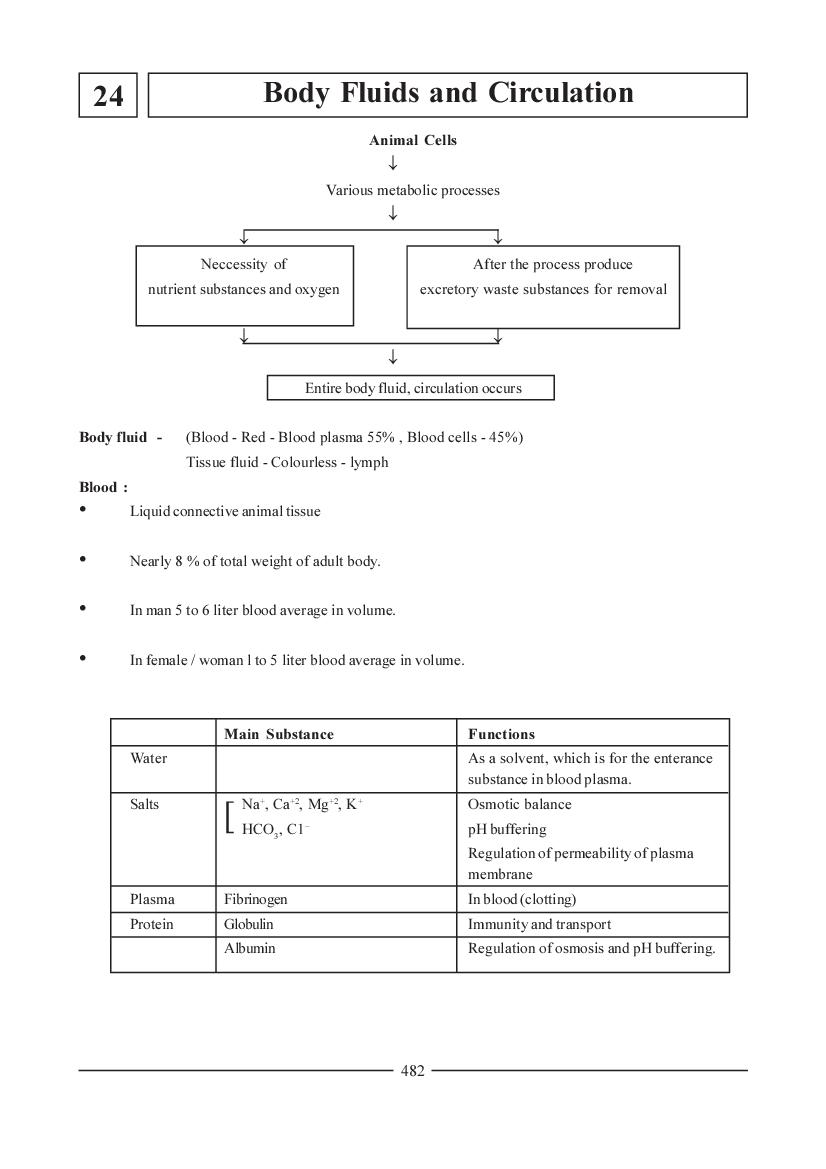
Animal Cells
¯
Various metabolic processes
¯
¯ ¯
Neccessity of After the process produce
nutrient substances and oxygen excretory waste substances for removal
¯ ¯
¯
Entire body fluid, circulation occurs
Body fluid - (Blood - Red - Blood plasma 55% , Blood cells - 45%)
Tissue fluid - Colourless - lymph
Blood :
Liquid connective animal tissue
Nearly 8 % of total weight of adult body.
In man 5 to 6 liter blood average in volume.
In female / woman l to 5 liter blood average in volume.
Main Substance Functions
Water As a solvent, which is for the enterance
substance in blood plasma.
Salts
[ HCO , C1
Na+, Ca+2, Mg+2, K+
3
Osmotic balance
pH buffering
Regulation of permeability of plasma
membrane
Plasma Fibrinogen In blood (clotting)
Protein Globulin Immunity and transport
Albumin Regulation of osmosis and pH buffering.
482
Page 2
¯
¯ ¯ ¯
Red cell or White cell or Thrombocytes
Erythrocytes Leucocytes or or platelets
or RBCS WBCS
50 lac to 60 lac/mm3 4,000 to - 2.5 to 5 lacs/mm3
O2; CO2 , transport 11,000/mm3 - Essential for reactun of blood clotting
of respiratory gases ¯
¯ ¯
Granular Agranular
¯ ¯
¯ ¯ ¯ ¯ ¯
Neutrophil amount Eosinophils Basophils Lymphocytes Monocytes
3000 to 7000 100 to 400 20 to 50 1500 to 3000 100 to 700
40 to 70 % 1 to 4% 0 to 1% 20 to 45% 4 to 8%
of total WBCs Detoxification
Function : Inflammatory
Active chemicals are - Play signi- In immune Active
phagocytes inactivated ficant role system phagocytic
Kill parasitic in allergic Synthesize and
microbes reaction transport antibodies
(1) Blood is liquid connective tissue, because ........ .
(A) It connects WBC and RBC.
(B) Its blood plasma is secrete from blood cells.
(C) It connects all cells, tissues and organs of the body.
(D) Proteins of blood plasma coordinates with each other for functioning.
(2) Find improper substance.
(A) Albumin (B) Haemoglobin (C) Fibrinogen (D) Globulin
(3) State the protein component of blood plasma related with osmoregulatory function.
(A) Globulin (B) Fibrinogen (C) Albumin (D) Thrombin
(4) Which of the following leucocyte participate in allergic reaction?
(A) Erythrocytes (B) Lymphocytes (C) Basophils (D) Eosinophils
483
Page 3
for various leucocytes based on their numbers :
(A) p < s < t < q < r (B) r < q < s < t < p (C) t < r < s < q < p (D) r < q < t < s < p
(6) State the percentage of blood cells (per mm3) in the body, which inactivate chemicals, which produces
burning sensation in the body.
(A) 1500 - 3000 (B) 100 - 700 (C) 100 - 400 (D) 3000 - 7000
(7) It has 4 to 8% of total WBC.
(A) Monocytes (B) Lymphocytes (C) Eosinophils (D) Basophils
(8) Name leucocyte having bilobed nucleus.
(A) Acidophils (B) Basophils (C) Neutrophils (D) Monocytes
(9) Name blood corpuscle without nucleus in human.
(A) Erythrocytes (B) Leucocytes (C) Monocytes (D) Lymphocytes
(10) State pH of Blood.
(A) 4.7 (B) 6.7 (C) 7.4 (D) 3.7
(11) What is approximate life span of erythrocytes ?
(A) 120 days (B) 85 days (C) 40 days (D) 365 days
(12) Of the following living organism, which lacks RBC in blood ?
(A) Frog (B) Kangaroo - rat (C) Earthworm (D) Pigeon
Answers : (1-C), (2-B), (3-C), (4-B), (5-D), (6-C), (7-A), (8-B), (9-A), (10-C), (11-A), (12-C)
Blood Group
Carl Landstiener discovered blood group in human.
Four types of blood groups A, B, AB and O.
In blood of person which type of antigen is present and which type of antibody is present, that two point
are concentrated for the determined blood group.
Blood Group Antigen Antibody
A A anti b
B B anti a
AB A and B None of these
O None Anti a, Anti b
484
Page 4
Universal acceptor / receptor blood group is AB.
Rh Group :
Human having Rh antigen on membrane of RBCs the
person is called Rh+ve.
If Rh antigen is absent so it is (Rhve)
This antigen was originally discovered in blood of Rhesus monkey.
In human poputation 85% of people having Rh+ve and 15% of people having Rhve
Rh related problems are seen at the pregnancy time.
When Rh+ve pregnant Babys Rh+ve antigen Rhve mother, due to
woman and, baby enter in mother by the Rh+ve antigen
â
â
is Rh+ve blood of becomes sensible
placenta
â
(1) Result of Pregnancy
Due to treatment
â
Without â
Healthy Rh+ve baby
treatment Mother can not
produce antibody
Mother produce for Rh+ve antigen
â
Rh+ve antibody
Result of II
This disease is called pregnancy
Erythroblastosis foctalies
â
â
Placenta of mother have
Rh+ve antibody destroy RBCs Rh+ve antibody that enter Second pregnancy of Rhve
â
mother with Rh+ve baby
â
in baby body in foetus
485
Page 5
X : First child having Rh+ve of Rhve women, then Rh+ve anti body should be introduced in womans
blood after the birth of child.
Y : If such woman in second pregnancy carries Rh-ve foetus , such child has possibility of haemolytic
disease.
Z : During first pregnancy Rh+ve antibody is produced in her blood.
(A) X and Y correct, Z false. Y is correct explanation of X.
(B) X and Z correct, Y false. Z is correct reason for X.
(C) X and Z correct, Y false. Z is not correct explanation for X.
(D) X and Z false. Y is correct.
(14) Mr Bean is seriously injured in accident, with tremendous loss of blood, there is no time for blood test.
So Dr. Amish will advise which blood group for transfusion ?
(A) AB+ ve (B) O+ ve (C) AB -ve (D) O- ve
(15) When is Rh+ve antibody produced in Rh-ve woman ?
(A) When her second child is Rh-ve (B) When her second child is Rh+ve
(C) Her first child Rh+ve (D) Her first child Rh+ve
(16) Master Masum is suffering from erythroblastosis fits disease. What would be the blood group of mother ?
(A) O+ve (B) A- ve (C) B+ve (D) AB+ ve
(17) Which of the following marriage is not proper from biological view point ?
(A) Rh+ve Male, Rh+ve female (B) Rh-ve Male, Rh+ve female
(C) Rh-ve Male, Rh-ve female (D) Rh+ve Male, Rh-ve female
(18) Person, having O blood group is called universal donor, as in his blood, on the surface of RBC ........ .
(A) A antigen present (B) Only B antigen absent
(C) Only O antigen present (D) A and B both antigen absent
(19) If in blood plasma of person with A blood group mixed up with blood of person having B blood group
then why blood gets more density?
(A) antibody act as antitoxin. (B) Blood cells become more turgid.
(C) Due to reaction of antibody antigen. (D) Overall increase in amount of antigen.
(20) Which antigen enters through placenta into mother from child with erythroblastosis fits disease ?
(A) Rh+ ve (B) Rh- ve (C) Anti A/a (D) Anti - AB/ab
(21) Which blood corpuscles are destroyed in haemolytic child ?
(A) White corpuscles (B) Red corpuscles (C) Blood platelets (D) Both A and C
(22) Which leucocytes produces serum globulin ?
(A) Monocytes (B) Thrombocytes (C) Lymphocytes (D) Basophils
486
Page 6
(A) Basophils - Allergy (B) Monocytes - Active phagocytes
(C) Lymphocyte - Anti poisonous (D) Neutrophils - Active phagocyte
(24) Number of blood corpuscles per mm3 associated with blood clotting.
(A) 40 to 60 million (B) 5.5 to 7.5 million (C) 2.5 to 5 million (D) 3000 to 4000
(25) Mention the percentage of blood corpuscles in blood having more lobulated nucleas.
(A) 0 to 1% (B) 20 to 45% (C) 40 to 70% (D) 1 to 4%
Answers : (13-B), (14-D), (15-C), (16-B), (17-D), (18-D), (19-C), (20-A), (21-B), (22-C), (23-C),
(24-C), (25-C)
Coagulation of blood : The major chemical defence against blood loss is the formation of the bloodclot.
The process in which the conversion of fluid like blood into jelly-like clot is called blood coagulation.
Complex biological process.
For this process blood plasma and tissues having 13 factors. Most of the factors play role in
formation of thromboplastin by the active inducing principle.
Numerical system for Nomenclature of blood clotting factors.
Roman Numerical Designation Common Name Activation product
I Fibrinogen Fibrin
II Prothrombin Thrombin
III Thromboplastin -
IV Calcium -
V Proaccelerin Accelerin (VI)
VII Proconvertin Convertin
VIII Anti haemophilic Activated AHG
globulin (AHG)
IX Christmas factor Activated Christmas factor
X Stuart factor Activated stuart factor
XI Plasma thromboplastin Activated (PTA)
antecedent (PTA)
XII Hageman factor Activate Hageman factor
XIII Fibrin stabilizing factor Activated FSF
(FSF)
487
Page 7
Intrinsic Pathway Extrinsic path way
Thrombocytes
When blood comes in Damaged tissue +
contact with a damaged Tissue thromboplastin
vessel surface
Glycoprotein
XII a
XII Phospholipid
HMW
KINOGEN
XI a VII
XI
Ca+ 2
IX a â
IX Phosholipio
Xa X
VII (AHG)
+ Ca+ 2 Ca+ 2 +
Xa +V
X + Phospholipid
Xa
Thromboplastin
Phase - II
â
Prothrombin Thromban
Phase - III
Fibrinogena Fibrinogen
â
(soluble fibrin)
XIII a
+ Ca+ 2
Stable fibrin
â
Formation of blood clot
Blood coagulation occurs
External factors effected to blood coagulation :
Vitamin K (less amount)
Heparin
Defibrination
Hirudin (Leech - Phylum - Annelida - Secreted from Pharynx of animal)
488
Page 8
Initiator factors which start this system produce from blood plasma.
This type of Pathway for Coagulation, when blood in contact with surface of blood vessels, that is start.
Initial factor : Hageman factor XII
Extrinsic Pathway :
Initiated factors of this system are derived from outside the blood plasma (injured tissue)
Lymph:
Surrounded fluid Fluid transport by the
to cells Lymphatic vessels
¯ ¯
Tissue fluid Lymph
The Composition of lymph is very much like that of the blood plasma but the dissolved substances are
in different concentrations.
In lymph protein contents are low and it contains less fibrinogen than blood plasma.
Lymph in the smallest capillaries have no cells.
When lymph passes through the lymph nodes; cells are added in it.
99% small lymphocytes (agranular lymphocytes)
1% rarely erythrocytes; Eosinophils, monocytes (anucleated monocytes)
Function : Responsible for the immunity.
Important carreer for nutrients, hormones etc.
(26) Lymph passed through lymph node is more beneficial from functional view point than lymph present in
small lymph vessel ?
(A) It has less amount of nutritive substances.
(B) It has 99% RBC so necessary for respiration.
(C) It has more fibrinogen so readily gets clotted.
(D) It has immunity property.
(27) Of the following group which is essential stuart complex ?
(A) Active X + Active VIII + Active X
(B) Active X + Xa + phospholipid + Ca+2
(C) Active X + Active X + phospholipid + Ca+2
(D) Active X + VIII a + phospholipid + Ca+2
489
Page 9
(A) I (B) IV (C) X (D) XI
(29) Thromboplastin is essential in human for blood clotting, from which cell it is obtained ?
(A) RBCs (B) Platlets (C) lymphocytes (D) Neutrophils
(30) It is function of thromboplastin.
(A) Formation of fibrin from prothrombin (B) Formation of thrombin from prothrombin
(C) Formation of fibrin from thrombin (D) Formation of prothrombin from thrombin
(31) Initiation of formation of thromboplastin through extrinsic passage begins from ........ .
(A) Blood corpuscles (B) Blood plasma (C) Injured tissue (D) A & B Both
(32) Due to formation of stable fibrin in blood ........ .
(A) Inhibits formation of blood nodules (B) Blood nodules dissolved in blood
(C) Hard blood nodules formed (D) Maintains fluidity of blood
(33) In which organism hirudin is normally observed ?
(A) Ascaris (B) Leech (C) Salamander (D) Frog
(34) Who prevents transformation of prothrombin into thrombin in uninjured blood vessel ?
(A) Heparin (B) Soluble fibrin (C) XIII a factor (D) Thromboplastinogenase
(35) Lymph has ........ compare to blood plasma.
(A) less amount of water
(B) some protein factors and collagen in less amount
(C) more amount of erythrocytes
(D) more amount of eosinophils
(36) Which of the following factor is absent in haemophilic patient ?
(A) Factor XII (B) Factor X (C) Factor VIII (D) Factor II
(37) For the activation of stuart factor by active christmas factor, help of which factor is obtained ?
(A) Plasma thromboplastin ancedent (B) Antihaemophilic globulin
(C) Proconvertin (D) Fribin stabilizing factor
(38) Which of the following option is improper for factors participating in blood clotting through intrinsic
passage ?
(A) XII (B) VIII (C) VII (D) XI
(39) Which components participate in the formation of thromboplastin ?
(A) Injured tissue (B) Blood corpuscles (C) A and B (D) Thrombin
490
Page 10
¯ Ca +2
Prothrombin ® Thrombin
¯
¯ ¯
Y X
(A) X - Fibrinogen Y - Insoluble Fibrin
(B) X - Fibrinogen Y - Soluble Fibrinogen
(C) X - Soluble fibrin Y - Fibrinogen
(D) X - Soluble fibrin Y - Stable fibrin
Answers : (26-D), (27-D), (28-A), (29-A), (30-B), (31-C), (32-C), (33-B), (34-A), (35-B), (36-C),
(37-B), (38-C), (39-C), (40-C)
Circulatory system
Type :
Open type Close type
Absence of blood capillaries Presence of blood capillaries
Phylum = Arthropoda Phylum annelida
Mollusca (except cephalopoda) Vertebrates Animals
Pathe way :
Systemic circulation Pulmonary circulation
Heart :
Size : 12 mm length, 9 cm broad, weight nearly 300g.
Location : Between the two lungs arranged oblique in groove
Shape : blunt coneshaped, hollow muscular organ
Pericardium : bilayered - toward outer side : Fibrous coat
Toward inner side : Serosa between the two layer.
There is a very narrow space which is filled with paricardial fluid which gives protection against - jerks
and shocks.
Lobes : Four lobes.
Right atrium RA Righ ventricle RV
Left atrium LA Left ventricle LV
Atria : Small in size, contain thin wall.
Ventricles : Large in size, contain thicker wall.
(Wall of left ventricle is thicker than the wall of right ventricle)
Two grooves present on ventricles
Anterior interventricular sulcus Posterior inter ventricular sulcus.
491
Page 11
Septum between two atrial - Inter atrial septum
Septum between two ventricles - Inter ventricular septum.
Septum between atria and ventricles - Atrio ventricular septum.
Tricupsid valve - Between the right atrial and right ventricle
Bicupsid / mitral valve - Between the left atrial and left ventricle
Semilunar valves :
The valve present between right ventricle and pulmonary trunk is called pulmonary semilunar valve.
A valve present between left ventricle and aorta arteriosis is called aortic semilunar valve.
Haversian valve : Pre venacava protected by Haversian valve which opens in right atrium.
The bacien valve : Postvena cava protected by Thebesian valve which opens in right atrium.
Pulmonary veins are not protected by valves.
A Node : Sinoatrial node : It is present in right upper corner of the right atrium which is like tissue mass.
AV Node : Atrio - Ventricular Node : It is present in the lower left corner of the right atrium close to the
atrio - ventricular septum which is like tissue mass.
Bundles of HIS muscles in interventricular septum.
Perkinje fibers - branches that emerge from the bundle of HIS.
Double circulation : Discovered by William Harvey.
Oxygenated and deoxygenated blood circulation is separated, so it is called double circulation.
Towards lung Toward organs of body by main truncus arteriosus trunk
Pulmonary Vein
Prevenacava
Trancus artetriosus
Pulmonary trunk
Postvenacava
Tricuprid valve Bicupid valve or
Deoxygenated Oxygenated Mittral valve
blood blood
Circulation : a1, a2 ® b ® c ® d ® e ® f
492
Page 12
Pre vena cava
Tricuspid
Right atrial Right Ventricle
valve
Post vena cava
deoxygenated blood
By Pulmonary trunk
Left Ventricle Mitral valve Left atrium By Pulmonary vein Lungs
Truncus arteriosus towards
organs of body Oxygenated blood
Double pump : By the heart, blood circulate from the right lobes to left lobes of heart for the entry of
blood it has to passes through lungs. Thus heart is called double pump. (Accumulation of blood in atria
= suction pump blood circulate from ventricles towards various organs of body pressure pumps because
Right lobes of heart pushes the blood in lungs.
Left lobes of heart pushes the blood toward the entire body organs.
Systemic heart : Left part of heart (eg. Left atrium and left ventricle) which supplies blood in various
organs of body so it is known as systemic circulation and left part of heart is called systemic heart.
Main aim of this circulation is circulation of O2 as well as nutrient substances upto tissues of body and
removal of CO2 and other nitrogenous toxin substances.
Pulmonary heart :
Right part of heart (eg. Right atrium and right ventricle) has blood which pulmonary circulation for
oxygenation, blood absorption or suction. Thus this circulation is known as pulmonary circulation and
right part of heart is called pulmonary heart. By pulmonary circulation impure, deoxygenated blood
which suction in right atrium, which is responsible for oxygenation.
(41) Which option is correct with reference to statement X, Y and Z ?
Statement :
X wall of left Ventricle is more muscular than right ventricle.
Y Blood is transported to various body parts from left ventricle.
Z Blood is transported to lungs from right ventricle.
(A) X and Y correct, Z is wrong. (B) X is correct, Y and Z wrong.
(C) X is wrong, Y and Z correct. (D) X , Y, Z all three are correct.
(42) State the correct sequence of systemic transportation.
(A) Right auricle - Right ventricle - Left auricle - Left ventricle
(B) Left auricle - Left ventricle - body tissue system - vena cava - Right auricle
(C) Right auricle - Right ventricle - Left auricle - Left ventricle
(D) Left auricle - Left ventricle - lungs - Right ventricle - right auricle
493
Page 13
(A) Semilunar (B) mitral (C) Tricuspid (D) Bicuspid
(44) Which part of heart is more muscular ?
(A) RA (B) LA (C) RV (D) LV
(45) Near which valve in human heart only O2 blood passes?
(A) Pulmonary semilunar(B) Tricuspid valve (C) Bicuspid valve (D) A and B Both
(46) Which fibres held bicuspid and tricuspid valve to its proper place ?
(A) Bundle of His (B) Purkinje fibres (C) Chordae tendinae (D) A and B both
(47) Which vein is responsible for reentry of blood to left side of heart?
(A) Anterior Venacava (B) Pulmonary vein
(C) Posterior Venacava (D) Renal portal vein
(48) State the function of pulmonary artery.
(A) Transport of oxygenated blood from heart to lungs.
(B) Transport from left ventricle to body organs.
(C) Deoxygenated blood is transported from heart to lungs.
(D) Transport of O2 blood from lungs to heart.
(49) Exterenal layer of pericardial membrane is formed of ........ .
(A) fibrous envelop (B) serosa (C) muscularis (D) mucosa layer
(50) Blood emptied into heart by venacava Sequentially passes through which valve ?
(A) Bicuspid valve - aortic arch - semilunar valve - mitral valve - pulmonary semilunar valve
(B) Bicuspid valve - pulmonary semilunar valve - mitral valve - aortic arch - semilunar valve
(C) Tricuspid valve - pulmonary semilunar valve - aortic arch - semilunar valve - mitral valve
(D) Tricuspid valve - pulmonary semilunar valve - bicuspid valve - aortic arch - semilunar valve
Answers : (41-D), (42-B), (43-A), (44-D), (45-C), (46-C), (47-B), (48-C), (49-A), (50-D)
Cardiac cycle :
In healthy man, 72 cardiac cycle occurs in 1 minute (72 time pulsation). 0.80 sec time occur for /
cardiac cycle. Systole : Contraction of heart lobes. Diastole : Relaxation of heart lobes.
Time-gap Atria Ventricles
0.10 Sec undergo systole undergo diastole
0.30 Sec undergo diastole undergo systole
0.40 Sec undergo diastole undergo diastole
Cardiac cycle is starts by contraction of atria.
Ventricles accumulated by blood, it takes 0.10 sec.
Atria accumulated by blood, it takes o.70 sec.
494
Page 14
From the right ventricle due to blood pressure semilunar valve of pulmonary trunk opens.
From the left ventricle due to blood pressure semilunar valve of trancus arteriosus opens.
At the time of contraction of both ventricles due to blood pressure tricuspid valve and bicuspid
valve are closed.
At the time of systole of atria through blood pressure tricuspid valve and mitral valve are opens.
At the time of diastole of ventricles through blood pressure semilunar valve closed.
When closing of atrioventricular valve, lubb sound can hear.
When closing of semilunar valve, dubb sound can hear.
Electrocardiogram (ECG) : Discovered by Inthovan (1906)
The electrical charges induced in cardiac muscles during each cardiac cycle can be registered
through electrodes arranged on the body surface. Such a recording is called - Electrocardiogram (ECG)
Upward and downward directional curves arranged and produce ECG.
Uses : This is important method for checking the health or health related problems of heart.
Electodes are arranged at different places on the body. Normally they are placed on wrists and
ankles. (by clamp)
The appearance of ECG depends on particular placement of electrodes.
Atrial and
Atrial Systole Ventricular Ventricular
Systole diastole P wave : Systole of atria.
Stimulation situation SA node to atria.
QRS waves : Systole of ventricle.
Mili Volt
T wave : It indicate diastole of ventricles. This
time atria also goes for diastole situation.
Mili second
Regulation of heart : Normally cardiac activity are auto regulated by nodal tissue.
Heart of man is myogenic because nodal tissue has properties of nerve and muscular both.
Sympathetic nervous system : Heart activity becomes faster (stimulate situation)
Parasympathetic nervous system : Prevent heart activity (Increased pulsation becomes normal)
Nodal tissue :
Pulsation of heart process starts by it. So it is called heart of heart.
It passes massage of contraction of atria by every 0.80 sec; so it known as pacemaker (SA node).
It keeps heart pulsation regulate and rhythematic. This stimulation reaches upto AV node by SA
node.
495
Page 15
From stimuli transport to bundle of His and purkinje fibers of heart by ventricle and by it
contraction can occur.
Failure of S.A. node causes transplants artificial pacemaker in thoracic region and keep heart
pulsation control.
(51) During one cardiac cycle, total how much time blood can be held by auricles ?
(A) 0.10 Sec (B) 0.30 Sec (C) 0.40 Sec (D) 0.70 Sec
(52) What is indicated by P waves in ECG ?
(A) Contraction of ventricles (B) Relaxation of ventricles
(C) Contraction of auricles (D) Relaxation of all chambers
(53) When Ventricle experiences systole ........ .
(A) Tricuspid and Bicuspid valve closes (B) All valve of right chambers of heart opens
(C) Bicuspid and aortic Semilunar valve opens (D) All four valve opens for separation of blood of body
(54) Heart of heart ........ .
(A) pericardial membrane (B) SAN (C) AVN (D) brain
(55) Improper for SAN ........ .
(A) It is called pacemaker
(B) Responsible for stimulation of auricles
(C) Keeps heartbeat rhythemic and regular
(D) Every 0.10 sec sends messages for contraction of auricles
(56) State number of portal veins in human.
(A) 1 (B) 2 (C) 3 (D) Inumerable
(57) State the passage of conduction of stimulation in heartbeating.
(A) SAN - AVN - Bundle of His - purkinje fibre
(B) SAN Bundle of His - AVN - Purkinje fibre
(C) AVN SAN - Purkinje fibre - Bundle of His
(D) SAN Bundle of His Purkinje fibre AVN
(58) State the characteristic of blood in heart at Diastole
(A) Oxygenated (B) De oxygenated (C) Both A and B (D) Arterial blood
(59) During systole of ventricle ........ .
(A) blood enters into ventricle from auricles
(B) O2 blood emptied in pulmonary artery deoxygenated blood emptied into aortic arch
(C) CO2 Containing blood into aortic arch and blood without CO2 emptied in pulmonary vein
(D) Deoxygenated blood into pulmonary arch and O2 blood into aortic arch
(60) Total diastole period of ventricle during one cardiac cycle
(A) 0.10 Sec (B) 0.40 Sec (C) 0.70 Sec (D) 0.50 Sec
496
Page 16
(A) both Semilumar valve opens
(B) both AV valve opens
(C) only tricuspid and pulmonary semilunar valve opens
(D) only tricuspid and pulmonary semilunar valve opens
Answers : (51-D), (52-C), (53-A), (54-B), (55-D), (56-A), (57-A), (58-C), (59-D), (60-D), (61-B)
Disease Related to Blood Circulation :
(A) Hypertension : Blood pressure measured in redial artery of hand by sphigmomanometer.
In a normal healthy person systolic pessure is 120 (i.e 120 mm hg) and diastolic pressure is 80; it
is recorded as 120/80.
Minor variations can occur in blood pressure 140/90. Which is considered as normal.
Situation of Hypertention : If systolic blood pressure > 140 mm Hg. and diastolic blood pressure >
90 mm Hg. Situation is determined as hypertension.
Causes : Smoking, obesity
Obesity : A person can be considered to be obese, when his weight is higher by 20% from the
standard weight determined by age, height and other aspects. In such person more blood is to be
supplied to tissues so blood pressure rises.
Effects of Smoking : Nicotine mixed with blood causes
(1) Contraction of artery so increase in blood pressure. (2) Decrease the absorption capacity of
O2 in lungs. (3) By CO2 carring capacity of haemoglobin decreases.
Atherosclerosis : Also known as hardening of arteries, silent killer.
Effect : Responsible for the heart attack and strock of brain.
Treatment : Angioplasty, by-pass surgery.
Responsible situation for disease : More blood pressure, smoking, diet with more fat etc. By this
substances damage occur in lumens of blood vesselss endodermis below that layer lipid and particu-
larly cholesterol like substances are stored and there produce plaque. In the lumens of wall of blood
vessel groove form as a node. By the producing of plaque lumens of blood vessel becomes narrower
and decreases blood flow. (So that organ can not getting proper amount of blood.)
Plaque are of two types : (1) Thrombus : It is known as stable mode. (same place as a groove)
Embolus : After formation of plaque which free from that place and if circulate in small blood vessels
obstruct occurs in blood flow.
497
Page 17
calcium salts, such a brittle artery can break. The blood from it flows out and clots. Such clots may
circulate in blood and may cause problem in some organ for blood flow.
(62) Blood pressure is measured by which instrument ?
(A) Sphigmo baro meter (B) Stethoscope (C) Spirometer (D) Sphigmomanometer
(63) Diastolic pressure in healthy normal person is how much mmHg ?
(A) 120 (B) 140 (C) 80 (D) 100
(64) Considering physiological condition of normal healthy person, what will be blood pressure?
(A) 90/140 mmHg (B) 140/90 mmHg (C) 80/120 mmHg (D) 158/98 mmHg
(65) Which of the following option is improper for the effects of smoking ?
(A) O2 carrying capacity of haemoglobin reduces by CO.
(B) Decrease O2 accepting capacity of lungs.
(C) Induces contraction of artery increases blood pressure.
(D) Inhibits exchange of gases in excretory unit.
(66) Which method is used for the treatment of atherosclerosis ?
(A) Replacement of AV valve (B) Angiography (C) ECG (D) Angioplasty
(67) Blood nodule formed by plaque start circulating in blood along its flow, it is called ........ .
(A) thrombus (B) angiography (C) embolus (D) stroke
(68) It is most dreadful in human - ........ .
(A) Thrombus (B) Angiography (C) Callus (D) Embolus
(69) Patient of atherosclerosis disease have cholesterol stored in ........... in the form of plaque ?
(A) Endothelium (B) Mesothelium (C) Epithelium (D) B and C Both
(70) Hardening of arterial wall is observed in which disease ?
(A) Atherosclerosis (B) Arteriosclerosis (C) Hypertension (D) Silent killer
(71) How is veins are differentiated from arteries ?
(A) Very narrow lumen (B) Strong and muscular wall
(C) Valves are present to control blood flow (D) Dark coloured wall
Answers : (62-D), (63-C), (64-B), (65-D), (66-D), (67-C), (68-D), (69-B), (70-B), (71-C)
A = Statement, R = Reasoning type questions
Select the answer for questions given below from the options given here.
(A) A and R right, R is explanation of A.
(B) A and R right, but R is not explanation of A.
(C) A is right, R is wrong.
(D) A is wrong, R is right.
(72) Statement A : In each artery of human pure blood is circulated.
Reason R : Left chambers of heart in human receives pure blood.
(A) (B) (C) (D)
498
Page 18
Reason R : Nicotine induces contraction of arteries and increases blood pressure.
(A) (B) (C) (D)
(74) Statement A : In cockroach, open circulalory system is present.
Reason R : Blood capillaries are absent in cockroach.
(A) (B) (C) (D)
(75) Statement A : Human heart is called double pump.
Reason R : In human heart, blood flows from right auricle to right ventricle and left auricle
to left ventricle.
(A) (B) (C) (D)
(76) Statement A : SA node is pacemaker.
Reason R : SA node initiate heart beat.
(A) (B) (C) (D)
(77) Statement A : Heart attack is under the effect of atherosclerosis.
Reason R : Cardiac arteries supplying blood to heart lumen totally or partially obstructed.
(A) (B) (C) (D)
(78) Statement A : Mr. Iyer, call Jethalal obese person.
Reason R : Weight of Jethalal, according to his age, height and other things is 27% more.
(A) (B) (C) (D)
(79) Statement A : Pulmonary veins carry blood containing CO2.
Reason R : Oxygenated blood is circulated in aortic arch.
(A) (B) (C) (D)
(80) Statement A : In the process of blood clotting, soluble fibrin is converted into stable fibrin.
Reason R : Active Hagmen factor activates PTA.
(A) (B) (C) (D)
(81) Statement A : Normally lymph is responsible for immune reaction.
Reason R : Lymph has 99 % small lymphocytes.
(A) (B) (C) (D)
Answers : (72-D), (73-B), (74-A), (75-B), (76-A), (77-A), (78-A), (79-D), (80-B), (81-C)
True - False (T - F) type questions
Select proper option for true or false in the following sentences.
(82) (1) Blood group is determined based on antigen present in blood serum.
(2) RhVe antigen are present on the surface of RBC.
(3) Child with haemolytic disease has Rh-ve factors antibody in their blood.
(4) IX + VIII + phospholipid + Ca+2 is present as essential factor christmas stimulating complex.
(A) TFTF (B) TTFT (C) FFTF (D) FFTT
499
Page 19
(2) Hirudin present in human prevents blood clotting.
(3) In right chambers of heart deoxygenated blood flows.
(4) Pericardial fluid maintains concentration of blood in left chambers of heart.
(A) TFFT (B) TFTF (C) TFFF (D) FFFF
(84) Check the truth regarding AV node in following statements.
(1) Stimulation arising in it, spreads into bundle of HIS muscles.
(2) It sends stimulation to SA Node.
(3) It sends message for initiating contraction of auricles.
(4) It initiates heart beating.
(A) TFTF (B) TFFF (C) FFFF (D) TFTT
(85) (1) In aerteriosclerosis disease blood clots, when come out and such clots are circulated in the blood
(2) In obese person more blood plasma is required by tissue so blood pressure increases
(3) SA - node is called heart of heart.
(4) Relaxation of ventricle is possible by purkinje muscle and bundle of His muscles.
(A) TFTF (B) TTTF (C) FTTF (D) FTTT
Answers : (82-C), (83-D), (84-B), (85-B)
(86) In column-I different types of blood cells are given and in column-II functions of blood cells are given.
Match the proper pair for column-I from column-II.
Column-I Column-II I II III IV
I Lymphocytes P Active phagocytes (A) R Q P S
II Monocytes Q Transports respiratory gases (B) R P Q S
III Erythrocytes R Part of immunity system (C) R S P Q
IV Eosinophils S Nullifies effect of poison (D) P Q R S
(87) In column-I Roman letters are given for factors of blood plasma. In column-II name of factors are
given. Match column-I with column-II.
Column-I Column-II I II III IV
I XIII P Calcium (A) S P Q R
II IV Q Proconvertin (B) P S Q R
III VII R Plasma thromboplastin anticedent (C) S P R Q
IV XI S Fibrin Stabilizing factor (D) S Q P R
(88) Match the proper pair from column-I and column-II
Column-I Column-II I II III IV
I O P Absence of antibody in blood plasma (A) Q S P R
II A Q Anti A and anti b (B) P R Q S
III AB R Anti a (C) P S R Q
IV B S Anti b (D) Q P S R
500
Page 20
Column-I Column-II
I Pulmonary vein P Regulation of blood flow in right chambers of heart
II Tricuspid valve Q Obtain O2 blood from left ventricle
III Anterior venacava R Deoxygenated blood emptied in right ventricle
IV Aortic arch S transport of O2 blood
I II III IV
(A) S R P Q
(B) Q P R S
(C) S P R Q
(D) P Q R S
(90) Find proper Sentence for X, Y, P, Q labelled parts of given diagram.
(A) X - First sound
responsible for LUB
(B) Y - Prevent flow of blood
from left auricle to left ventricle
(C) P - When ventricle show
diastole, valve open
(D) Q - de O2 blood
passes from here Figure 1
(91) Find the proper option for X and Y labelled part in the given diagram.
X Y
(A) Bile pigments Mesothelium
(B) Cholesterol Endothelium
(C) Mesothelium Cholesterol
(D) Endothelium Mesothelium
Figure 2
(92) Find the proper option for P, Q, R, S labelled part in the given diagram - 3.
(A) P - obtain blood from LV
(B) Q - give blood to LV
(C) S - give blood to RA
(D) R - obtain blood from LA
Figure 3
501
Page 21
(A) Carl landsteiner
(B) William parnas
(C) Thomas harvey
(D) William harvey
(94) blood passes through labelled part X- ........ .
(A) Diastole of right auricle
(B) Systole of left auricle
(C) Systole of right ventricle
(D) Systole of left ventricle
Figure - 4
(95) Identify Atrio ventricular - nodle tissue in given diagram - 5.
(A) p
(B) q
(C) r
(D) s
Figure - 5
Z
Y
X
(96) In the given diagram - 6 which labelled part transports O2 blood ?
(A) W
(B) X
(C) Y
(D) Z
W
Figure - 6
Answers : (86-B), (87-A), (88-A), (89-C), (90-A), (91-B), (92-C), (93-D), (94-C), (95-C), (96-C)
502
Page 22
Double circulation discovered by William Harvey. He proposed heart as a pumping station of body.
For unipath flow : eg. fish.
à Heart
CO 2
â
CO 2 gills
O2
Part of Body ß
O2
Double Circulation
Lungs CO 2
CO 2 O2
RA LA
O2
RV LV
large circulation
CO 2 O2
(2) Systemic circulation
Organs
Pulmonary artery and systemic arch cross to each other and at the crossing point they connected
with each other by ligamentum arteriosum.
During the embryonic development in inter atrial spetum ovilocur hole is present and after birth it
can not be closed so deficiency can occur in baby. Blood of both atrial mixed in each other and de-
creases the amount of supplies of O2 and symptoms of cynamss can develop (blue colour of skin can
occurs. This type of baby is known as bluebabies.
Pulsation of heart :
Organism Pulsation per min Organism Pulsation per min
Adult man 72 Shrew 600 800
Embryo 160 Blue whale 25
New born baby 120 140 Elephant 28
Child 100 Sparrow 500
Rabbit 210 Canary bird 1000
Rat 400 600
Pulsation of heart of animals related.
In mammals pulsation are more of small animals.
During the physiological process numbers of pulsation are different. (stressful stage-resting stage)
503
Page 23
Myogenic heart - eg. Human being
Neurogenic heart Myogenic heart
1. In heart impulse of pulsation come Impulses of heart pulsation develop
out from the heart. only in heart.
2. Inpulses origin by nervous system. Impulses origin by specific muscular tissue.
3. Nerve fibers are spread on the heart In it specific type of muscles spread
and contraction and relaxation can occur. impulses.
4. If heart is removed from the body, then If removal of heart from the body, gives
pulsation of heart stops. sufficient nutrient, and favourable
condition, it give pulses for few time
Control / Regulation of heart beats :
Endocrine regulation : Adrenalin = rate (Inscrease)
Noradrenalin = rate (Increase)
Vagus stimulate acetyl coline = ¯ rate (Decrease)
Autonomous nervory system : Sympathetic = rate (Increase)
Parasympathetic = ¯ rate (Decrease)
Tachycardia : Averagely, in adult man one of the situation can arise where heart pulsation per
minute is more than 90. During the fever increase in the temperature of body rate of metabolism can
increase and thus spontaneously stimulation and rhythamacity also increase.
Bradycardia : In adult man where average heart pulsation average below the 60 per minute.
In common situations heart rate and respiration rate ratio is 4 : 1.
0.8 sec time for one cardiac cycle in man.
(1) Atrial systole = 0.1 Sec
(2) Atrial diastole = 0.7 Sec
] 0.8 Sec
(3) Ventricle systole = 0.3 Sec
(4) Ventricle diastole = 0.5 Sec
] 0.8 Sec
- Volume of blood related to heart :
Volume of blood related to heart :
120ml volume of each ventricle is called End Diastolic Volume (EDV)
During the systole becomes empty while nearly 70 ml volume decrease, it is called stroke volume
(SV).
Remaining volume in ventricle nearly 50 ml, it is called End Systolic Volume (ESV) other systolic
volume.
ESV 70
Ejection fraction (EF) = = = 0.583
EDV 120
\ 60 %
504
Page 24
= (120 50) ml
= nearly 70 ml
During the one pulsation 70 ml blood from ventricle towards the organs.
Cardiac Output (CO) = Stroke Heart
×
Volume Beats
= 70 × 72
= 5040 ml
= nearly 5000 ml
CO : 5 lit / min
Feeling of heart (ventricle) : Commonly blood flow from venacava towards atria. Approximate 75% of
blood directly from the atria to ventricle passes. Thats why contraction of atria can occur before that blood
flow can occur. After that contraction of atria can occur and ventricles are full by 25% of more blood.
Systolic duration of atria - 25 % Ventricles are filled.
Diastolic duration of ventricles - 75% Ventricles are filled.
Diastolic of ventricles - First phase - 70% (Rapid transport)
Second phase - 5% (Open Av.valves)
Final phase - 25% (Due to contraction of atria)
Spleen : Biggest lymphnode of the body. Blood bank of body.
Graveyard of RBCs . Origin from mesoderm of embryo
One specific connective tissue feel in spleen, which is known as Reticula endo epithelial tissue or
spleenic pump.
Spleenic pump has two parts : (1) White pulp (2) Red pulp.
Pulp of spleen have large five photocytic cells which is called macrophage cells.
Functions :
(1) Senescenteial blood cell, dead or living microbes or disease infact microbe and waste material of cell
are swallowing by marcophage.
(2) RBCs are forms in embryonic stage.
(3) Several anti-bodies synthesis here.
(4) In adult stage spleen act as a blood blank. Its sinuses act as a reservior of blood. When required blood
is transported in circulation.
505
Page 25
(6) At the time of malaria, increase the volume of spleen because increases the number of lymphocytes
and dead RBCs.
Spleen, liver, kidney three are known as instruments of filtration.
Questions for NEET
(97) Which cells produces thrombokinase ?
(A) Erythrocytes (B) leucocytes
(C) Blood corpuscles (D) Endothelium of blood capillaries
(98) State the name of valve, in post-vena cava which opens in right auricle in mammals.
(A) Mitral valve (B) Thabius valve (C) Tricuspid valve (D) Austatian valve
(99) State the reason of murmur sound in heart.
(A) Pulsation of veins (B) Defect in valve
(C) Thromboplastin (D) Less developed auricle
(100) Thromboplastin is produced by ........ .
(A) Injured tissue (B) Blood corpuscles (C) Both A and B (D) Prothrombin
(101) Which situation is responsible for leukaemia ?
(A) Percentage of WBC less than 5000/mm3. (B) Bone marrow is destroyed.
(C) lymphoocytes reduced by 2 to 5 %. (D) WBC increases by 6000/mm3.
(102) Which situation is responsible for blood clotting ?
(A) Destruction of RBC (B) Destruction of WBC
(C) Destruction of lymphocytes (D) Change in component of lymph
(103) When auriculo - Ventricular valve closes, which sound is hear ?
(A) Dubb (B) Lubb (C) lubb-dubb (D) Dhakdhak
(104) More than normal amount of leucocytes, indicates which condition ?
(A) Anemic (B) Infection
(C) Protection against bacteria (D) Effect on erythrocyte production
(105) Which of the following organism has red coloured blood without RBC ?
(A) Frog (B) Human (C) Cockroach (D) Earthworm
(106) Pressure of blood vessels is ........ .
(A) Diastolic pressure (B) Systolic pressure
(C) Difference of B and A (D) Pressure in vena cava
(107) Blood entering from lungs into heart by pulmonary vein, has more amounts of ........ .
(A) RBC in 1ml blood (B) Hb in 1ml Blood
(C) O2 in 1ml blood (D) Nutritive substance in 1ml
(108) State the location of fovea ovalis
(A) Inter auricular septum (B) Intra ventricular septum
(C) Right intra auriculo - ventricular septum (D) Left intra auriculo - ventricular septum
506
Page 26
(A) Digestive system to liver (B) Kidney to heart (C) Liver to heart (D) Kidney to liver
(110) What is called blood vessel, shows blood circulation begins from capillary and ends in capillaries ?
(A) Portal system (B) Hepatic circulation (C) Cardiac circulation (D) All of above
(111) Which of the following organ is death-place for R.B.C. ?
(A) Kidney (B) Spleen (C) Bone marrow (D) Pancreas
(112) Which type of leycocytes are linked with secretion of Histamine and heparin ?
(A) Neutrophils (B) Basophils (C ) Acidophils (D) Monocytes
(113) What are stages of cardiac cycle ?
(A) Auricle systole - ventricle systole - auricle - ventricle systole
(B) Diastole - auricle systole - ventricle diastole
(C) Auricle systole - ventricle diastole - ventricle systole
(D) Ventricle diastole - auricle diastole - ventricle systole - auricle systole
(114) Billirubin and biliverdin is byproduct of dissociation of ........ .
(A) myoglobin (B) lipid (C) carbohydrate (D) haemoglobin
(115) Increase in percentage of erythrocyte is called ........ .
(A) Poly cythemia (B) leucocytopenia (C) Anaemia (D) leucopenia
(116) Double circulation of blood in heart of normal, healthy person is ........ per minute.
(A) 8 (B) 16 (C) 32 (D) 72
(117) ........ is called father of cardio vascular system.
(A) Wharvey (B) S harvey (C) S thomas (D) Landsteneir
(118) When is difficulty observed in blood circulation ?
(A) Antigen absent in RBC (B) Antibody absent in blood plasma
(C) If antigen is opposite to antibody (D) If antigen - antibody are similar type
(119) When dupp sound of heart is heard ?
(A) When mitral valve opens
(B) When mitral valve closes
(C) When semilunar valve, situated at anterior part of aortic arch closes
(D) When tricuspid valve opens
(120) Output of heart is determined by ........ .
(A) heart - beats (B) size of stroke (C) blood circulation (D) both A and B
(121) Regulation of blood pressure is by ........ .
(A) pituitary gland (B) adrenal gland (C) thymus gland (D) parathyroid gland
(122) Pericardial fluid is secreted from ........ .
(A) myocardium (B) Lateral diaphragm
(C) Visceral membrane (D) pericardial membrane
Answers : (97-C), (98-D), (99-B), (100-C), (101-A), (102-C), (103-B), (104-B), (105-D), (106-C),
(107-C), (108-A), (109-A), (110-A), (111-B), (112-B), (113-C), (114-D), (115-A), (116-D),
(117-A), (118-D), (119-C), (120-D), (121-B), (122-D)
507
Page 27
Blood Vascular System
® They are elastic vessels that transport blood away from the heart
It is a circulatory system
Veins
containing body fluid and
pumping organ ® They are elastic vessels that transport blood to the heart
Capillaries
Blood Vessels
They are extremely small vessels that transport blood from the
They are intricate
arteries to the veins. Respiratory gases, nutrients and wastes
network of hollow
® are exchanged through the capillaries within the tissues
® tubes that transport ®
blood throughout the
entire body. Agranulocytes
Blood Grarnules are not found in cytoplasm and
® are of two types - Lymphocytes and
It is mobile fluid connective tissue ® Monocytes
They are motile and phagocytic in nature
Plasma
It is slightly alkaline, non-cellular, pale
yellow fluid that constitutes about 60% of
® the blood Granulocytes
Gradules are present in cytoplasm and are of
Erythrocytes
® three types - eosinophils, basophils and
Most abundent cells filled neutrophils
® with haemoglobin
Formed
® elements ®
Blood Coagulation
Leucocytes They response to repture of blood vessel or
Colourless cells that show amoeboid tissue damage, a complex, cascade of
movement ® chemical reaction occur which results in the
formation of blood clot
Platelets
They release platelet factors that
® help in the clotting of blood (or
thromosplastin) on injury Heart beat
Rhythmic contraction and relaxation of the
Heart cardiac muscles is known as heart beat
It is a mesodermally derived
organ that comprises four
complete chamers (two auricles Cardiac Cycle
and two ventricles)
® It is the sequence of events that occurs in the heart during one
Right auricle receives ® full heart beat
deoxygenated blood from the
body and left auricle receives
oxygenated blood from lungs
508
Document Details
| Board / Org | NTA |
| Exam | National Eligibility cum Entrance Test (Undergraduate) |
| Type | Question Bank |
| Pages | 27 |
| Updated | 22 Jul 2026 |