NEET Biology Question Bank - Chemical Coordination and Control
Finished viewing? Save it for later —
Download NEET Biology Question Bank - Chemical Coordination and Control (PDF · 18 pages)About NEET Biology Question Bank - Chemical Coordination and Control
NEET Biology Question Bank - Chemical Coordination and Control is available here for free download. Published by NTA for NEET UG, this question bank can be viewed online or downloaded as a PDF (18 pages). Candidates preparing for NEET UG can use NEET Biology Question Bank - Chemical Coordination and Control to understand the exam pattern, the type of questions asked, and the overall difficulty level.
Frequently Asked Questions
How can I download NEET Biology Question Bank - Chemical Coordination and Control?
Open this page and click the Download button to save NEET Biology Question Bank - Chemical Coordination and Control as a PDF. It is completely free on AglaSem Docs.
Is NEET Biology Question Bank - Chemical Coordination and Control free to download?
Yes. NEET Biology Question Bank - Chemical Coordination and Control can be viewed online and downloaded as a PDF free of cost on AglaSem Docs.
How many pages does NEET Biology Question Bank - Chemical Coordination and Control have?
NEET Biology Question Bank - Chemical Coordination and Control contains 18 pages, which you can read online or download together as a single PDF.
Where can I find more NEET UG study material?
You can find more NEET UG question papers, sample papers, syllabus, and answer keys on AglaSem Docs.
NEET Biology Question Bank - Chemical Coordination and Control – Text
Read the full text of this question bank below — useful to quickly search, copy and reference the content online without downloading the PDF.
📄 View text version (18 pages)
Page 1
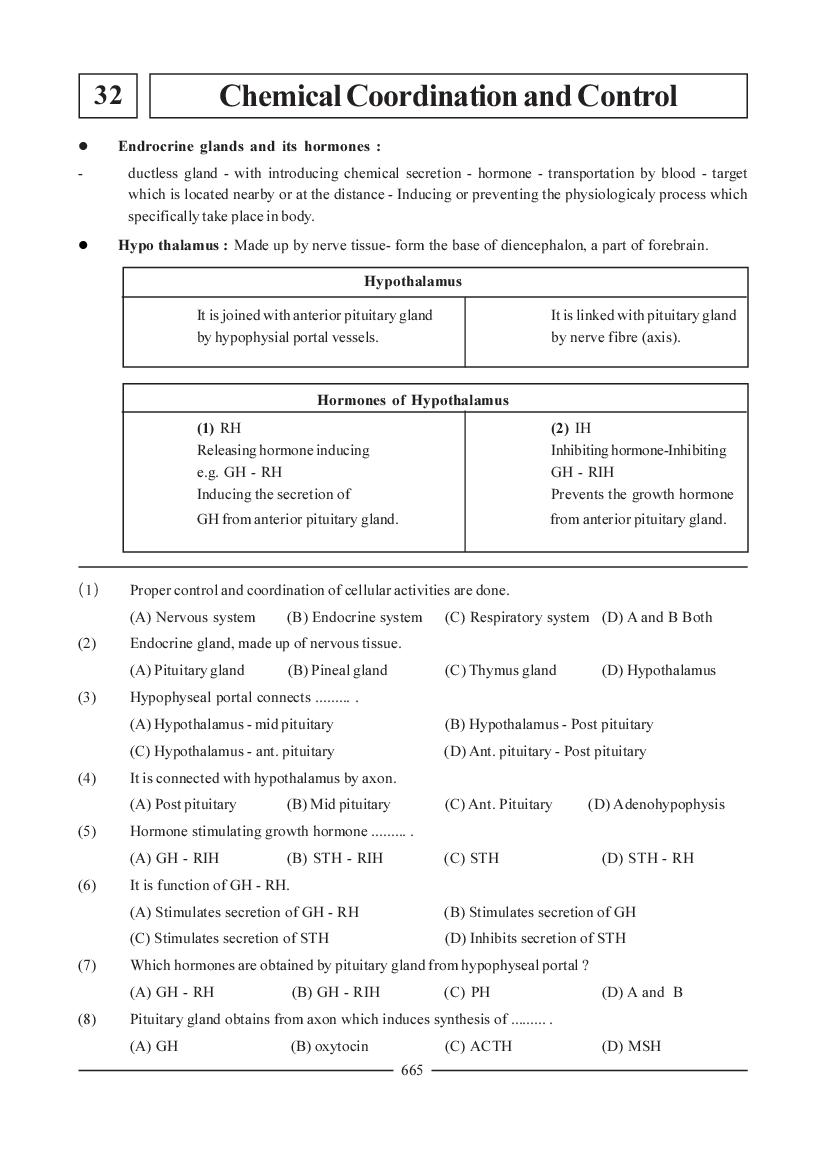
l Endrocrine glands and its hormones :
- ductless gland - with introducing chemical secretion - hormone - transportation by blood - target
which is located nearby or at the distance - Inducing or preventing the physiologicaly process which
specifically take place in body.
l Hypo thalamus : Made up by nerve tissue- form the base of diencephalon, a part of forebrain.
Hypothalamus
It is joined with anterior pituitary gland It is linked with pituitary gland
by hypophysial portal vessels. by nerve fibre (axis).
Hormones of Hypothalamus
(1) RH (2) IH
Releasing hormone inducing Inhibiting hormone-Inhibiting
e.g. GH - RH GH - RIH
Inducing the secretion of Prevents the growth hormone
GH from anterior pituitary gland. from anterior pituitary gland.
(1) Proper control and coordination of cellular activities are done.
(A) Nervous system (B) Endocrine system (C) Respiratory system (D) A and B Both
(2) Endocrine gland, made up of nervous tissue.
(A) Pituitary gland (B) Pineal gland (C) Thymus gland (D) Hypothalamus
(3) Hypophyseal portal connects ......... .
(A) Hypothalamus - mid pituitary (B) Hypothalamus - Post pituitary
(C) Hypothalamus - ant. pituitary (D) Ant. pituitary - Post pituitary
(4) It is connected with hypothalamus by axon.
(A) Post pituitary (B) Mid pituitary (C) Ant. Pituitary (D) Adenohypophysis
(5) Hormone stimulating growth hormone ......... .
(A) GH - RIH (B) STH - RIH (C) STH (D) STH - RH
(6) It is function of GH - RH.
(A) Stimulates secretion of GH - RH (B) Stimulates secretion of GH
(C) Stimulates secretion of STH (D) Inhibits secretion of STH
(7) Which hormones are obtained by pituitary gland from hypophyseal portal ?
(A) GH - RH (B) GH - RIH (C) PH (D) A and B
(8) Pituitary gland obtains from axon which induces synthesis of ......... .
(A) GH (B) oxytocin (C) ACTH (D) MSH
665
Page 2
(A) Roof (B) Right side (C) Floor (D) Left side
Answers : (1-B), (2-D), (3-C), (4-A), (5-D), (6-D), (7-D), (8-B), (9-C)
l Pituitary gland :
Location :- A depression of the sphenoid bone of the skull- In sella turcica.
Adenohypophysis : Anteria pituitary gland - Intermidiate pituitary gland.
Neurohypophysis : Posterior pituitary gland.
(A) Anterior Pituitary gland :
Controlled secreation of GH (Growth Hormone) : Stimulate the growth, development - Rapid cell
division - Protein synthesis.
Less secreation : Dwarfism
Excess Secretion : In Childhood - Abnormal height (Gaigantism) At mature age - Upper- lower jaws
and appandageales get more length (Acromegaly)
- PRL/PH - Prolactin;
After partuirition secretion of milk is produce from the mammary gland.
- TSH/TTH - Thyroid Stimulating Hormone
It stimulates the thyroid gland and the hormones which are originated from it
eg.Thyroxine.
- ACTH - Adreno Cortico Trophic Hormone; Stimulates the secretion of adrenal cortex.
Glucocorticoid and Minarelo corticoid
- GTH - LH - Stimulate the secretion of testosterone, Induce the complete development of
male reproductive system.
- - Development of graffian follicle- induce ovulation - Formation of corpus leutium.
FSH - - Stimulate the spermatogenesis-
- - Stimulate process of oogenesis - Development of follicles occurs in ovary.
(B) Intermediate Pituitary gland :
MSH - Melanocyte Stimulating Hormone, Control of pigments in skin.
(C) Posterior Pituitary gland :
Oxytocin- Stimulates the contraction of smooth muscles of body.- During the Parturition widening of
uterus at the time of child birth- milk secretion from the mammary glands.
- Vasoprasin : Stimulates the reabsorption of water and electrolytes by the distal tubules of kidney.
- Reduces loss of water through urine (diuresis dilute excess urine stopped).
l Deficiency of ADH : Reduces reabsorption of water and increases urine output. This disorder is
known as diabetes incipidus.
l Pineal Gland :
Location : Under the corpus callosum between the two cerebral hemispheres of the brain.
Structure : A very small, solid, vascular, reddish grey and conical body.
Hormone : Melatonin - A biological Clock.
Function : Helps in maintaining sleep - wake cycle regulation.
- Regulates metabolism, menstrual cycle, pigmentation and self defense capacity.
- In dark secretion of melatonin more, due to that more percentrage of sleepness. (More in child
- In adulthood it decreases).
666
Page 3
(A) Ant Pituitary (B) Mid Pituitary (C) A and B both (D) Post Pituitary
(11) Disease, due to less secretion of somatostatin, which causes irregularities : ......... .
(A) Dwarfism (B) Critinism (C) Giantism (D) Acromegaly
(12) In adult stage, excess secretion of STH leads to irregularities of ......... disease.
(A) Giantism (B) Acromagely (C) Critinism (D) Dwarfism
(13) Stimulates synthesis of thyroxine.
(A) TSH - RH (B) TSH - RIH (C) TSH (D) TCT
(14) It is target tissue for ACTH.
(A) Anterior Pituitary gland (B) Adrenal Cortex
(C) Adrenal Medulla (D) Post pituitary
(15) Stimulates mammary gland for secretion of milk.
(A) PH (B) PIH (C) Oxytocin (D) A and C
(16) LH stimulates secretion of which hormone ?
(A) Tastosterone (B) progesterone (C) A and B (D) oxytocin
(17) Origin of secretion, which stimulates synthesis of FSH.
(A) Ant. Pituitary (B) Ovule (C) Hypothalamus (D) Ovarian follicle
(18) Reason for Diabetes incipedus.
(A) More secretion of insulin (B) More secretion of vasopressin
(C) Less secretion of vasopressin (D) Less secretion of insulin
(19) Number of hormones originating from adenohypophysis.
(A) 6 (B) 2 (C) 9 (D) 7
(20) Origin of hormone, which helps in facilitating normal delivary.
(A) Ant. Pituitary (B) Mid Pituitary (C) Neuro hypophysis (D) Adenohypophysis
(21) Secretion of pituitary gland regulates the process of spermatogenesis.
(A) LH (B) FSH (C) Androgen (D) B and C
(22) Gland present beneath corpus callosum.
(A) Pituitary gland (B) Hypothalamus
(C) Pineal gland (D) Thymus gland
Answers : (10-D), (11-A), (12-B), (13-C), (14-B), (15-D), (16-C), (17-C), (18-C), (19-D), (20-C),
(21- B), (22- C)
l Thyroid Gland :
Location :- Bilobed and located on either side of the upper part of the trachea. The two lobes con-
nected by a narrow connective tissue band called isthmus.
Mineral elements : For the formation of hormone I2 is necessary. Deficiency of I2 goiter can occur.
Hormones : (1) T3 - Triiodothyronin, (2) T4 - Tetra iodothyronin and TCT - Thyrocalcitonin.
(A) Functions of Thyroxine :
- During the metabolism of carbohydrates control the oxidation an ATP synthesis. Maintains BMR
- Stimulates the process of RBC formation.
- Maintains water and electrolyte balance.
667
Page 4
(less secretion) ® In adult female- Myxodema Accumulation of fact in subcutaneous tissue-
puffy face - inflammentary face.
Hyperthyrodism ® Irregular in menstrual cycle
(Excess selection)® Exothalmic Goitre (Grave's disease)
(B) TCT - Thyrocalcitonin :
- Acts upon osteoblast of bones - Decreases the calcium level in blood.
l Parathyroid Gland :
Location : Four lobe, the ventral surface of thyroid gland
Horomone : Parathormone (PTH)
Functions : Increases the Ca+2 level in blood.
Acts on bone and activates the process of bone resorption.
- Increases Ca+2 absorption from the digested food and also activates reabsorption of Ca+2 by renal tubuler.
- PTH and TCT are complimantry to each other.
l Thymus Gland :
Location : In upper dorsal side of the heart and aorta.
Structure : Bilobed, mass of lymphoid tissue.
Activation : In children it is a prominent gland but it gradually degenerate in the adult.
Hormone : Thymosin
Functions : Maintains the immunity power. Thymosin stimulates the development and differentiation of
T-lymphocytes which provide cell-mediated immunity. Besides this thymosin stimulates the production
of antibodies to provide hormonal immunity.
(23) Endocrine gland with bilobed structure : ......... .
(A) Thymus (B) Thyroid (C) A and B (D) Parathyroid
(24) Complete colloids found in cells of thyroid glands are formed of ......... .
(A) Zeatin (B) Gelatin (C) Melanin (D) Carotene
(25) What is reason for increase in the size of thyroid gland ?
(A) Less secretion of thyroxine (B) More secretion of thyroxine
(C) Defeciency of iodine in food (D) All of above
(26) ......... is observed due to hypothyroidism.
(A) Goiter (B) Myxodema (C) Exothalmic goiter (D) A and B both
(27) Condition rensponsible for irregularity in menstrual cycle in female
(A) Hyper Thyroidism in adult female (B) Hypothyroidism in adult female
(C) Hyper thyroidism during embryonic development (D) Hypo thyroidism
during embryonic development
(28) Reduces Ca+2 level in blood
(A) Thyroxine (B) Tri idothyronine (C) PTH (D) TCT
+2
(29) Combine effect of which maintains Ca level in body ?
(A) PH - TCT (B) PTH - TCT (C) PIH - TCT (D) PIH - PTH
(30) Activates absorption of Ca+2 in uriniferous tubule ......... .
(A) ADH (B) Aldosterone (C) PTH (D) TCT
(31) Endocrine lymph gland ......... .
(A) Thymus (B) Thyroid (C) Parathyroid (D) All
668
Page 5
(A) Stimulates cellular immunity (B) Stimulates production of antibody
(C) Differentiation of B - lymph cells (D) Decrease in cellular immunity
(33) ......... Endocrine gland situated in thoracic region.
(A) Thyroid (B) Pancreas (C) Thymus (D) Adrenal
(34) Endocrine gland with four lobes.
(A) Thyroid (B) Parathyroid (C) Thymus (D) Pituitary gland
Answers Ñ (23-C), (24-B), (25-C), (26-B), (27-A), (28-D), (29-B), (30-C), (31-A), (32-A), (33-C), (34-B)
l Adrenal Gland :
Discovered by Eustessious Location : One on the anterior part of each Kidney
Origin From : Mesoderm Weight : 4 to 6 g.
Two main regions of gland ® Adrenal Medulla - 10 to20% region ® Adrenal cortex- 80 to 90 %
Adrenal Medulla
¯
Secretion of group of cotecholamine
For the reason of origin - Fear, Mental pressure, it secrete at the time
of accident or emergency. These horomones are secreted
¯
¯ ¯
Adrenaline/ Epinephirine Non-adrenaline/non epinephrine
- Effects : Warm red face - Conctraction of blood vessels,
- pupilary dilutions but it can not do conctration of
- Raising of hairs coronary artery.
- Faster heart beats - (Other effects are likely to
- More sweating adrenaline only)
- Conversion of glucagon to glucose and added in blood
¯
Target tissues : Straited, smooth and cardiac muscular
tissues, blood vessels and adipose tissue.
l Hormones of Adrenal cortex (These are steroid types)
(A) Cortex Region (Zona Glomerulosa)
Secretion : Mineralocorticoid ® (Main) aldosterone, Deoxy corticosterone
Regulate mineral metabolism and balance of water and Na+
Target Organ : Kidney
(B) Middle region (Zona Fasciculata)
Secretion : Glucocorticoid - Main secretion : Cortisol
Regulate carbohydrate, protein and fat metabolism.
Antiallergic and anti-inflamatory effects-suppress the immune responses.
Target organ- Liver
669
Page 6
- Very less amount of hormones secretion occurs which are sexual.
In male testosterone - in female - estrogen and progesterone.
Target organ: Genetial organs
l Abnormal secretion:
(1) Less secretion : Addision Disease (Hypo adrenalism)
Due to deficiency of Mineralo corticoid.
Effects : Weekness, weight loss, nausea and diarrhoea
(2) Excess Sercetion : Cushing's Syndrome Effects : More secretion of cortisol
Symptoms : High blood sugar, obesity and rise in blood pressure and blood volume, more amount of
Na+, H2O also.
(35) Amino acids produced derivatives type of secretions.
(A) Adrenal cortex (B) ovary (C) Testis (D) Adrenal medulla
(36) ......... secretions are not in the control of secretion of pituitary gland.
(A) Adrenal medulla (B) Adrenal cortex (C) Both A and B (D) Testis
(37) It is epinephric endocrine gland.
(A) Testis (B) Ovary (C) Adrenal (D) Pancreas
(38) Pair of hormones regulating metabolism of carbohydrate.
(A) ANF - Relaxin (B) Catechocalamines-cortisol
(C) Tastosterone-Estrogen (D) PTH - PH
(39) Corticoids are which type of hormones ?
(A) Catecholamines (B) Iodothyronins (C) Peptide (D) Steroid
(40) From which layer of adrenal cortex mineralo corticoids secreted ?
(A) Outer (B) Middle (C) Inner (D) All
(41) ......... hormone are secreted in male by zona reticularis.
(A) Cortisol (B) Tastosterone (C) Progesterone (D) A and B both
(42) It has anti inflamatory effect.
(A) Aldosterone (B) Progesterone (C) Cortisol (D) Testosterone
(43) Due to inactivity of which layer of adrenal cortex Addison's disease occur ?
(A) Inner (B) Middle (C) Outer (D) All of above
(44) ......... is disease due to more activity of zona fasiculata of adrenal cortex.
(A) Addison (B) Myxodoma (C) Critinism (D) Cushing syndrome
Answers : (35-D), (36-A), (37-C), (38-B), (39-D), (40-A), (41-D), (42-C), (43-C), (44-D)
l Pancreas :
Exocrine and endocrine gland
Endocrine region
- Islets of Langer hans - about 1 to 2 millions
- It occupies 1 to 2% area of pancreas.
670
Page 7
secretion : Glucagon
Type : peplide
Hyper glycemic hormone
(I) In liver cells, glycogenolysis takes place.
Glycogen
Glucagon
o Glucose (Added in blood)
(II) Gluconeogenesis :
Lactic acid ® Pyruvic acid
Glucagon
o Glucose (added in blood)
(B) E - Cells:
Decreases the glucose level in blood - Hypoglysemic
Glycogenesis
Glucose
Insulin
o Glycogen (Hepatic cells - Adiposetissue)
Less secretion of Insulin - Diabetes melitus
(C) d (Delta) - cells : Somatostatin - Prevents the GH and regulate the growth.
- It controls insulin and glucagon secretion.
l Sexual endocrine gland :
(A) Testis : Androgens hormone - Steroid type - Main hormone - Testosterone.
Function : Stimulates male accessory reproductive organs and get maturity.
- Develops secendory sexual characteristics.
- Stimulates the spermatogenesis process.
(B) Ovary :
Hormones
Estrogen Progesterone Relaxin
Origin ® Developed from ovarian follicle - Corpus luteum - Corpus lateum
Functions® - Development of female - Stimulates embryo - End of the pregnancy it
reproductive system development and foetus is secrete
- Develops the secondary development - Widening of cervix of
sexual characters - Stop the ovulation inducing - uterus and simple child
- Developments of ovarian implantation of embryo birth can occur.
follicles occurs - After parturition Lactation
can induced.
(45) Which cells of pancreas are exocrine ?
(A) D - Cells (B) cells of acini (C) E - Cells (D) Delta cells
(46) ......... is function of insulin.
(A) Glycogenolysis (B) Gluconeogenesis (C) Glycogenosis (D) Glycolysis
(47) ______ increases blood glucose level.
(A) Adrenaline (B) Cortisol (C) Glucagon (D) All
(48) It is hypoglycemic hormone.
(A) Cortisol (B) Adrenaline (C) Insulin (D) Glucagon
671
Page 8
(A) GH - RTH (B) Somatostatin (C) A and B (D) STH - RH
(50) Due to inactivation of which cells, Diabetes malitus occur ?
(A) D - Cells (B) E - Cells (C) Delta cells (D) Leydig's cells
(51) Origin of androgen type hormone.
(A) Interstitial cells (B) Langerhans cells
(C) Neuro secretory cells (D) germinal epithelium
(52) Hormone initially secreted from corpus luteum : ......... .
(A) Estrogen (B) Progesterone (C) Relaxin (D) All of above
(53) Hormone secreted from ovarian follicle ......... .
(A) Relaxin (B) FSH (C) Estrogen (D) Progesterone
(54) From where Relaxin is originated ?
(A) Ovarian follicle (B) Leydig's cells
(C) Corpus luteum (D) Germinal epithelium
(55) Secondary sexual character, growth of hair in armpit is induced by ......... .
(A) Androgen (B) Progesterone (C) Estrogen (D) A and C both
(56) Gluco genesis process induces ......... .
(A) Insulin (B) Testosterone (C) Somatostatin (D) glucagon
Answers : (45-B), (46-C), (47-D), (48-C), (49-C), (50-B), (51-A), (52-B), (53-C), (54-C), (55-D), (56-D)
l Some Hormones of Non-endocrinal glands:
(certain organs produce some hormones)
eg. Heart, Kidney, Gastro instinal lract
(A) Heart: (B) Kidney :
Secretion : Atrial Natriuretic Factor (ANF) Secretion : Erythropoietin
Origin : Wall of atrial of heart Origin : J. G. Cells Jaxta (Glomerular cells)
Type : Peptide
Function : Relaxation of blood vessels and Function :Stimulates formation of RBCs.
decreases blood pressure
(C) Gastro intestinal tract :
Secretion :
Gastrin, secretin, cholecystokinin (CCK),
Gastric Inhibitory peptide (GIP)
(I) Gastrin : Stimulate gastric glands to secrete pepsinogen and HCl.
(II) Secretin: Acts on the exocrine glands of pancreas and stimulates the secretion of bicarbonate
ions and water.
(III) CCK : Acts on pancreas and gall bladder and stimulates them to secrete pancreatic enzyme and
bile respectively.
(IV) GIP : Inhibits gastric secretion.
(D) Growth Factors :
For normal growth of tissues, their repairing and regeneration.
l Basis on chemical types :
Types of Hormones :
(A) Peptide, Polypeptide, Proteinous hormone- Insulin, Glucagon, Hormones of pituitary and Hypo
thalamus etc.
672
Page 9
(C) Iodothyronins : Hormone of thyroid
(D) Derivatives of amino acides : Epinephrine, Norepinephrine
l Mechanism of Hormone action :
(A) Endocrinal mechanism of steroidal type (B) Endocrinal mechanism of peptide type
hormones hormones
Hormone directly enter in the nucleus of cell Peptide Hormone
¯ ¯
Joint with receptive unit Joined with membrane bound receptor
¯ ¯
By the help of specific molecule hormone receptive G type of protein of plasma membrane get
complex is formed active
¯ ¯
Link with DNA transcript the specific gene Activates
¯ ¯
ATP ® C - AMP
¯ ¯
Formation of m-RNA any one specific enzyme gets activation
Translocation ¯ Trtanslation ¯
Protein synthesis (Enzyme) Other enzyme occur activation
Catch in Memory :
First messanger ® Hormone
Second messanger ® C - AMP, Ca+2, IP3
Peptide hormone do not enter in molecule.
Effect of peptide hormone is quick.
(57) Non-endocrine tissue (cells), which produces hormone is ......... .
(A) Leydig's cells (B) Langerhans cells (C) Juxta glomerular cells (D) Delta cells
(58) Secretes ANF : ......... .
(A) Wall of ventricle (B) Wall of urinary bladder
(C) Wall of auricles (D) Wall of stomach
(59) Function of erythropoetin ......... .
(A) Widens blood capillaries (B) Induces formation of erythrocytes
(C) Inhibits secretion of gastric juice (D) Stimulate secretion of bile juice
(60) Hormone which interacts with membrane bound receptor.
(A) Epinephrine (B) Tri iodothyronin
(C) Follicle stimulating hormone (D) All of above
(61) Mostly controlling gene expression, hormones : ......... .
(A) Estrogen (B) Testosterone (C) cortisol (D) All
(62) During mechinsm of action forms secondary messenger.
(A) ANF (B) Aldosterone (C) Progesterone (D) Cortisol
673
Page 10
(A) ADH (B) Testosterone (C) Estrogen (D) Progesterone
(64) Chemically thyroxine is which type of hormone ?
(A) Derivetives of Amino acids (B) Peptide
(C) Iodothyronins (D) Protein
(65) Forms Receptor complex in the nucleus.
(A) GH - RH (B) Mineralo - corticoids
(C) GTH (D) ACTH
AnswersÑ (57-C), (58-C), (59-B), (60-D), (61-D), (62-A), (63-A), (64-C), (65-B)
(66) Column- I Column - II
(1) Secondary messenger (P) ANF (A) (1-P) (2-Q) (3-S) (4-R)
(2) Peptide hormone (Q) IP3 (B) (1-Q) (2-P) (3-S) (4-R)
(3) Intra cellular receptor (R) Nor-epinephrin (C) (1-Q) (2-S) (3-P) (4-R)
(4) Catecholamine (S) Relaxin (D) (1-Q) (2-S) (3-R) (4-P)
(67) Column- I Column - II
(1) Androgens (P) Eythropoesis (A) (1-Q) (2-P) (3-R) (4-S) (5-T)
(2) Erythropoetin (Q) Intersticial cells (B) (1-P) (2-Q) (3-R) (4-S) (5-T)
(3) Progesterone (R) Increase of mammary glands (C) (1-Q) (2-R) (3-P) (4-T) (5-S)
(4) Relaxin (S) Widens fallopian tube (D) (1-Q) (2-P) (3-T) (4-S) (5-R)
(5) Estrogen (T) Induces implantation of
embryo
(68) Column- I Column - II
(1) Delta cells (P) cellular immunity (A) (1-Q) (2-R) (3-S) (4-P)
(2) Alpha cells (Q) STH - inhibition (B) (1-Q) (2-S) (3-R) (4-P)
(3) Beta cells (R) Hyper glycomia (C) (1-P) (2-R) (3-S) (4-Q)
(4) T-cells (S) Hypo glycemia (D) (1-Q) (2-S) (3-R) (4-P)
(69) Column- I Column - II
(1) Addison disease (P) More secretion of ADH (A) (1-S) (2-T) (3-R) (4-U)
(2) Mexydoma (Q) Deficiency of mineralocorh coids (B) (1-Q) (2-T) (3-R) (4-P)
(3) Exopthalmic goiter (R) Hyper thyroidism (C) (1-Q) (2-T) (3-R) (4-U)
(4) Diabetes incipedus (S) more secretion of (D) (1-Q) (2-R) (3-T) (4-U)
mineralo corticoids
(T) Hypothyroidism
(U) Less secretion of ADH
(70) Column- I Column - II
(1) Sex corticoids (P) Thymus (A) (1-U) (2-S) (3-T) (4-Q)
(2) Catecholamine (Q) pineal (B) (1-R) (2-S) (3-P) (4-Q)
(3) Thymosine (R) External layer of Adrenal cortex (C) (1-U) (2-P) (3-T) (4-Q)
(4) Melatonin (S) Adrenal medulla (D) (1-U) (2-S) (3-P) (4-Q)
(T) Thyroid
(U) Inner layer of Adrenal cortex
674
Page 11
(1) Oxytocin (P) Hypothalamus (A) (1-R) (2-S) (3-P) (4-Q)
(2) MSH (Q) Ant. pituitary (B) (1-P) (2-R) (3-S) (4-Q)
(3) GH - RIH (R) Mid. pituitary (C) (1-S) (2-R) (3-P) (4-Q)
(4) TSH (S) Post. pituitary (D) (1-P) (2-S) (3-R) (4-Q)
AnswersÑ (66-B), (67-D), (68-A), (69-C), (70-D), (71-C)
· A - Statemen, R - Reasoning type questions.
Select answers of following questions from the options given below.
(A) A and R both correct, R is explanation of A.
(B) A and R both correct, R is not explanation of A.
(C) A is correct, R is wrong.
(D) A is wrong, R is correct.
(72) Statement A : Immunity in old persons decreases.
Reason R : With the aging thyroid gland degenerates.
(A) (B) (C) (D)
(73) Statement A : STH-RH is neurohormone.
Reason R : STH-RH is synthesized by hypothalamus.
(A) (B) (C) (D)
(74) Statement A : Diabetes malitus caused due to deficiency of ADH.
Reason R : Amount of urine, expelled out increases due to deficiency of ADH.
(A) (B) (C) (D)
(75) Statement A : Due to deficiency of iodine in food goiter occur.
Reason R : Iodine is essential component for thyroxine hormone, in thyroid gland.
(A) (B) (C) (D)
(76) Statement A : FSH hormone, regulates cellular metabolism without entering into cell.
Reason R : FSH shows its effect by reacting with receptor complex.
(A) (B) (C) (D)
(77) Statement A : Ovulation ceases in pregnant woman.
Reason R : At the time of pregnancy, progesterone is proudced by corpus luteum.
(A) (B) (C) (D)
(78) Statement A : Insulin decreases glucose level in blood.
Reason R : Insulin stimulates gluconeogenesis.
(A) (B) (C) (D)
(79) Statement A : At the time of fear and emergency catecholamine level increases in blood.
Reason R : ACTH of pituitary induces secretion of corticoids.
(A) (B) (C) (D)
675
Page 12
Reason R : Melatonin functions to maintain rhythamicity during 24 hours.
(A) (B) (C) (D)
(81) Statement A : Ca+2 level is maintained in blood.
Reason R : PTH increases Ca+2 level in blood.
(A) (B) (C) (D)
AnswersÑ (72-C), (73-A), (74-D), (75-B), (76-C), (77-A), (78-C), (79-B), (80-A), (81-B)
· True - False (T - F) type questions
Select proper option for True / false for the following sentences.
(82) (1) Ca IP3 is secondary messenger.
(2) Cortisol forms membrane connecting receptor complex.
(3) Steroid hormones normally control genetic expression.
(A) TFF (B) FFT (C) TFT (D) FTF
(83) (1) CCK prevents secretion of bile juice.
(2) GIP induces secretion of gastric juice.
(3) ANF relates blood capillaries.
(4) Erythropoietin induces formation of R.B.C.
(A) FFTT (B) TFTT (C) TTTT (D) FFFT
(84) (1) Progesterone is secreted from ovarian follicle.
(2) Relaxin, broadens the neck of fallopian tube.
(3) Leydig's cells are present in female.
(4) Androgen type secretion occurs from ovary.
(A) TTFF (B) FTFF (C) FTTT (D) TTTF
(85) (1) somatostatin stimulates secretion of GH.
(2) In islets of langerhans 10 to 20 million cells are present.
(3) More secretion of insulin leads to diabetes malitus.
(A) FTT (B) TTT (C) TTF (D) FTF
(86) (1) Blood sugar increases in Addison's disease.
(2) Glucocorticoids and sexcorticoids, secreted from zone fasciculata.
(3) Adrenaline increases glucose level in blood.
(A) FFF (B) FTT (C) TFF (D) TTT
(87) (1) Thymus is lymph tissue.
(2) Parathyroid is bilobed gland.
(3) Secretions of thyroid stimulates R.B.C. formation.
(4) Due to myxodema, irregularities in menstrual cycle occur.
(A) TTFF (B) FFTT (C) TTFT (D) TFTF
676
Page 13
(2) MSH is secretion from adenohypophysis.
(3) During adult stage more secretion of GH leads to acromegaly.
(A) FTT (B) FTF (C) TTT (D) FFF
(89) (1) STH-RH is secretion of pituitary gland.
(2) Target tissue for TSH is thyroid.
(3) Hormone, stimulating secretion from leydig's cells derives from pituitary gland.
(4) Thymus gland is situated in thoracic region.
(A) FFTT (B) FFFT (C) FTTT (D) FTTF
AnswersÑ (82-C), (83-A), (84-B), (85-D), (86-B), (87-D), (88-B), (89-C)
Q P
S
(90) In Fig. 1 labelled P as gland ......... hormone is produced. R
(A) oxytocin (B) Melatonin (C) GH-RH (D) TSH
(91) Q is which gland in Fig.1 ?
T
(A) Pituitary gland (B) Pineal gland
U
(C) Thyroid gland (D) Hypothalamus gland
(92) Which gland is exocrine and endocrine, shown in Fig.1 ? V W
(A) V (B) U (C) S (D) Q Figure 1
P
Q
(93) Which is parathyroid gland, labelled in Fig.1 ?
(A) R (B) T (C) S (D) Q
Answer Question number 94 - 96 from Fig.2.
(94) What is indicated by R in fig. 2 ?
(A) Adenohypophysis (B) Infundibulum R U
(C) Axon (D) Hypophyseal portal S
T
(95) In Fig. 2 vassopressin is secreted by whom ?
Figure 2
(A) T (B) S (C) P (D) R
S
(96) From which part GH-RH is secreted in Fig.2 ?
(A) T (B) S (C) U (D) Q
(97) In Fig-3, ......... hormone secreted by P
(A) PTH (B) TCT (C) PH (D) PIH
(98) ......... Shows bridge in Fig. 3. P
(A) S (B) R (C) Q (D) P Q
(99) In Fig. 3, parts of respiratory system : ......... . R
(A) R and S (B) Q and R (C) P and S (D) P and R Figure 3
677
Page 14
(A) Adrenal cortex (B) Renal medulla
(C) Adrenal medulla (D) Renal cortex
(101) ......... is not hormone secreted from Q in Fig. 4.
Q
(A) Cortisol (B) Estrogen (C) Testosterone (D) Epinephrin
Figure 4
(102) In Fig.5 internal structure of ......... is shown.
P
(A) ovary (B) pancreas (C) testis (D) thyroid
Q
(103) What is indicated by 'P' in Fig. 5 ?
(A) Leydig's cell (B) Hepatic lobules
(C) Langerhan's cells (D) Pancreatic acini
Figure 5
(104) In Fig.6, mode of action of which hormone is represented ?
P
Q
(A) cortisol (B) progesterone (C) MSH (D) None
1
(105) What is suggested by origin of secondary messenger in Fig.6 ?
2
(A) P (B) 2 (C) Q (D) 3 3
(106) Fig.7 indicates mode of action of which hormone ?
Figure 6
(A) Peptide (B) Iodothyronins
T
(C) Catecholamines (D) Steroids P
(107) In Fig.7 indicates genome.
(A) Q (B) P (C) R (D) T Q R
Figure 7
Answers : (90-B), (91-D), (92-A), (93-C), (94-C), (95-B), (96-D), (97-B), (98-C), (99-A), (100-C),
(101-D), (102-B), (103-D), (104-C), (105-B), (106-D), (107-C)
l Summery of PMT-NEET
- Endocrinology - is the branch which is connected with a physiology as a branch of biology.
- Father of Endocrinology - Thomas Adison - Hormone = To Exite.
- 'HORMONE' word given by Starling.
In 1902 Secretin first hormone was discovered.
- Callons : A secretion of one endocrine gland which stimulates the target organ for secrete the
hormones only, it is called callons.
- Autocoids : Hormones produce from the one endocrinal gland which act on specific target
oragan, it is called Autocoid.
Diabetogenic: Hormone which effect on specifically on carbohydrates metabolism.
Ketogenic : Hormone which mainly act on metabolism of fats.
Callorigenic: Mainly BMR is effected.
- Tuber Cinerium
Neurohypophysis ® Infudibulum
678
Page 15
- pars distalis
- Adenohypophysis - Pars tuburalis
- pars Intermedia
By the deficiency of pituitary dwarfism can occur, it is called Ateliosis.
- Dwarf person shown in circus which is called midgets. They are physically and mentally healthy
but they have slow maturity in sexually.
- Excess secretion of STH/GH in adult human being - Acromagely.
- FSH also known as Gameto Kinetic Factor. It secrete in male and female both.
- LH is also known as Gamete Releasing Factor.
- Hashimoto Disease :
- Acute stress by the lack of thyroxine in this disease. So for the treatment of this disease any
medicine or thyroxine hormone also act as a poison. For that reflextion formation of antibody
occur in body and destroy the thyroid gland.
- Plumar Disease :
- In this disease abnormal growth of thyroid gland occur, but in this gland small buds like nodes are
formed which can be visiualised. Which is called Toxic adenoma. During the excess secretion
thyroid gland get swollen and enlarged.
- Parathyroid gland was discovered by Reynard. Deep study of it observed by Sandrom.
- Resultant of excess secretion of PTH, Osteolytic cells in more amount unnecessarily phagocytics
So that bones becomes rigid and weak. This situation is called an Osteoporosis.
- When increases the amount of Ca+2 , decreases the amount of PO4-3, which is known as
Hypercakimia and Hypophospheremia respectively.
- In kidney or Gall bladder accumulation of Ca+2 so formation of stone can occur.
- Benting and Best - First time insulin discovered.
- Molecular structure of insulin is given by A.F.Sanger.
- Human insulin was synthesis by Tsan.
- 14th Novemeber- World diabetes day
- Glycosuria : Amount of glucose in blood > 180 mg/dl.
- Polydipsia :. In excess amount diurisis can occur, possibility of dehydration is more. This type of
petient thrust more and continuously, electrolytes are remove from the body. More hungry can
get.
- Secretion of male hormone by adrenal gland. Mainly is Dihydroapy androsteron.
Keto acidosis :
- Activation of fat and incomplete of ketonebody in adipose tissue is formed.
- As a ketonebody like acetone aceto acetic acid, Beta hydroxy butrate.
- Ketone body is poisonous - Increasing the amount of Ketone in body so ketoacidosis can form in
body.
Diabetes Coma :
- Ketoacidosis, Polydipsia, Hyperglycemia with these complex, patient get effect and becomes
unconscious.
Heterodrine gland :
- This type of endocrine gland, which secretes the hormone, more over some other functions also
they do. .
e.g. Pancreas, Gonads, Mucaso of digestive system, Kidney, placenta
679
Page 16
- This disease occur by degradation of anterior part of the pituitory gland. So it is called simond's
disease.
Metachrosis :
- Pigmentation change of skin with the help of MSH.
Insulin shock :
- If diabetic patient passes through the physical stress or fasting during that he takes injection of
insulin, so decreasing repidly glucose level in blood 40- mg/160 mg. Pateint becomes uncon-
scious and sometimes dies also.
l Questions for NEET
(108) Which of the following situation is responsible for acromegaly ?
(A) More secretion of STH (B) More secretion of thyroxine
(C) Defeciency of thyroxine (D) More secretion of adrenaline
(109) FSH is ......... .
(A) glyco protein (B) metallo protein (C) glyco lipid (D) Phospholipid
(110) Posta glandin effects ......... .
(A) Egestion (B) Blood pressure (C) osmoregulation (D) Oxidation reaction
(111) Hormone known as FFF Or 3F ......... .
(A) CCK (B) Glucagon (C) Thyroxine (D) Adrenaline
(Hint : Fight, Fear, Fraction of the second-3F)
(112) Of the following which acts as secondary messenger ?
(A) Phospholipid (B) Glycoprotein (C) carrier protein (D) Immuno globulin
(113) Of the following which is not secondary messanger in hormone action ?
(A) C-AMP (B) Sodium
(C) Calcium (D) IP3 (Inositol triphosphate)
(114) Deficiency of which hormones from the following reduces Ca+2 level ?
(A) Calcitonin (B) Parathormone (C) Thyrotine (D) A and B both
(115) If adrenal cortex is injured, it will affect secretion of following or not ?
(A) Adrenaline (B) Cortisol (C) Aldosterone (D) Androstidione
(116) Which hormone induces relaxation of blood capillaries and increasing O2 use and induce gluco
neogenesis ?
(A) Glucagon (B) Insulin (C) Adrenaline (D) ACTH
(117) Find the improper pair from the following.
(A) Corpus luteum - Relation (secretion) (B) Insulin- Diabetes malitus (disease)
(C) Glucagon - Beta cells (source) (D) Somatostatin - Delta cells (source)
(118) ......... is hormone of adenhypophysis, controlled by feed back mechanism.
(A) Oxytocin (B) TSH (C) Vasopressin (D) TCT
(119) Identify, father of endocrinology.
(A) Land Steiner (B) Renard (C) Harrigton (D) Thomas Adison
(120) Of the following secretion of which is controlled, axon of neurosecretory neuron ?
(A) Adrenal cortex (B) Pineal gland
(C) Ant pituitary gland (D) Post pituitary gland
680
Page 17
level. State the reason for such situation.
(A) More secretion of glucagon.
(B) Decrease in insulin secretion from pancreas.
(C) Imbalance of glucose in urine.
(D) Decrease in secretion of vaso pressin from post pituitary.
(122) Patient of Diabetes malitus, though eating food without carbohydrate, excretet glucose in urine,
because ......... .
(A) Glycogen from muscles released in blood.
(B) Amino acids from liver released in blood.
(C) Amino acid dissociates in the kidney and converted into glucose.
(D) In adipose tissue lipid dissociates and transforms into glucose.
(123) Diuretinis is due to which situation ?
(A) Less secretion of vassopressin.
(B) More secretion of ADH.
(C) Less secretion of oxytocin.
(D) Effect of erythropoeitin removed from kidney.
(124) Metachrosis phenomenon ......... .
(A) Change of skin color (B) Failure of kidney
(C) Acromegaly (D) Heart rate become faster
(125) It is known as milk secreting hormone.
(A) STH (B) Oxytocin
(C) PIF (PTH) (D) Thyro calcitonin
(126) Hormone induces metamorphosis in tadpole of amphibia.
(A) Relaxin (B) Melatonin (C) Thyroxine (D) Cortisol
(127) Disease due to acute deficiency of thyroxine.
(A) Tetany (B) Thyrotoxicosis
(C) Hypophosphastamia (D) Hashimoto disease
(128) Which of the following is responsible for Diabetes coma ?
(A) Ketoacidosis (B) Polydipsia
(C) Hyper glysomia (D) All of above
(129) Which scientist explained molecular structure of insulin ?
(A) A. F. Sanger (B) E. C. Kandle (C) Raynard (D) Barger
(130) Hormone discovered for the first time ......... .
(A) Thyroxine (B) Adrenaline (C) Secretin (D) Insulin
(131) Who has coined the term hormone?
(A) Harris (B) E. H. Schally (C) W. M. Baylis (D) E. H. Starling
(132) Size of which gland decreases with increase of age ?
(A) Adrenal (B) Thymus (C) Pituitary (D) Thyroid
(133) Of the following which gland secretes life saving hormone ?
(A) Thyroid (B) Thymus (C) Adrenal (D) Pancreas
(134) Which of the following gland is not considered as Heterofine gland ?
(A) Pituitary (B) Heart
(C) Pancreas (D) Kidney
(135) Less secretion of mineralocorticoid do not depend on RAAS, induces which of the following disease ?
(A) Cushing's disease (B) Cone disease
(C) Adison's disease (D) Grave's disease
Answers Ñ (108-A), (109-A), (110-B), (111-D), (112-C), (113-B), (114-B), (115-A), (116-C), (117-C),
(118-B), (119-D), (120-D), (121-D), (122-D), (123-A), (124-A), (125-B), (126-C), (127-D), (128-D),
(129-A), (130-C), (131-D), (132-B), (133-A), (134-A), (135-B)
681
Page 18
Hypothalamus Thyroid
Supreme commander of endocrine system. It is the largest endocrine gland. ¬
Hypothalamic releasing hormones reach the pituitary It secretes two iodine - containing
gland through a portal circulatory system and regulate thyroid hormones that control the
® rate of all metabolic processes.
its secretion.
It also contains Cells which se-
crete calcitonin that lowers the
blood calcium level.
Pituitary
Orchestra of endocrine system. Para thyroid
® Regulate the growth and activity of several other endo-
Two pairs of endocrine glands lo- ¬
® crine glands. cated behind the thyroid gland.
It has two main lobes : anterior labe (or) adenohypophy-
They secrete parathormone which
sis (or) parsdistalis and posterior lobe (or) neurohy-
acts opposite to calcitonin.
pophysis (or) pars nervosa and an intermediate lobe (or)
pars intermedia.
Anterior Pituitary
Master endocrine gland regulates the activity of
several other glands. Adrenal
Located above kidneys.
It has two parts-externel adrenal cortex
Posterior pituitary and internal adrenal medulla.
¬
Stores and releases oxytocin and vasopression Adrenal cortex secretes mineralo
which are actually synthesized by the hypothala- corticoids, gluco-rticoids and ganado
mus. corticoids.
Adrenal Medulla is an extension of the
sympathetic system. It secretes
Pineal gland norcepinephrine and epinephrine.
Secretes melatonin which helps in regulating sleep
¬
wake rhythmic cycle.
Pancreas ¬
Islets of langerhans is the endocrine region.
a-cells secrete glucagon, b-cells produce insulin, d cells secretes somatostatin.
¬
Goanads
Ovaries secrete estrogen, progesterone, relaxin and inhibin.
Testes secrete androgens by leydig's cells.
Pars qntermedia Secretes melanocyte stimulating hormone which imparts skin
colouration.
¬
l
682
Document Details
| Board / Org | NTA |
| Exam | NEET UG |
| Type | Question Bank |
| Pages | 18 |
| Updated | 22 Jul 2026 |