NEET Biology Question Bank - Environmental Issues
Finished viewing? Save it for later —
Download NEET Biology Question Bank - Environmental Issues (PDF · 20 pages)About NEET Biology Question Bank - Environmental Issues
NEET Biology Question Bank - Environmental Issues is available here for free download. Published by NTA for National Eligibility cum Entrance Test (Undergraduate), this question bank can be viewed online or downloaded as a PDF (20 pages). Candidates preparing for National Eligibility cum Entrance Test (Undergraduate) can use NEET Biology Question Bank - Environmental Issues to understand the exam pattern, the type of questions asked, and the overall difficulty level.
Frequently Asked Questions
How can I download NEET Biology Question Bank - Environmental Issues?
Open this page and click the Download button to save NEET Biology Question Bank - Environmental Issues as a PDF. It is completely free on AglaSem Docs.
Is NEET Biology Question Bank - Environmental Issues free to download?
Yes. NEET Biology Question Bank - Environmental Issues can be viewed online and downloaded as a PDF free of cost on AglaSem Docs.
How many pages does NEET Biology Question Bank - Environmental Issues have?
NEET Biology Question Bank - Environmental Issues contains 20 pages, which you can read online or download together as a single PDF.
Where can I find more National Eligibility cum Entrance Test (Undergraduate) study material?
You can find more National Eligibility cum Entrance Test (Undergraduate) question papers, sample papers, syllabus, and answer keys on AglaSem Docs.
NEET Biology Question Bank - Environmental Issues – Text
Read the full text of this question bank below — useful to quickly search, copy and reference the content online without downloading the PDF.
📄 View text version (20 pages)
Page 1
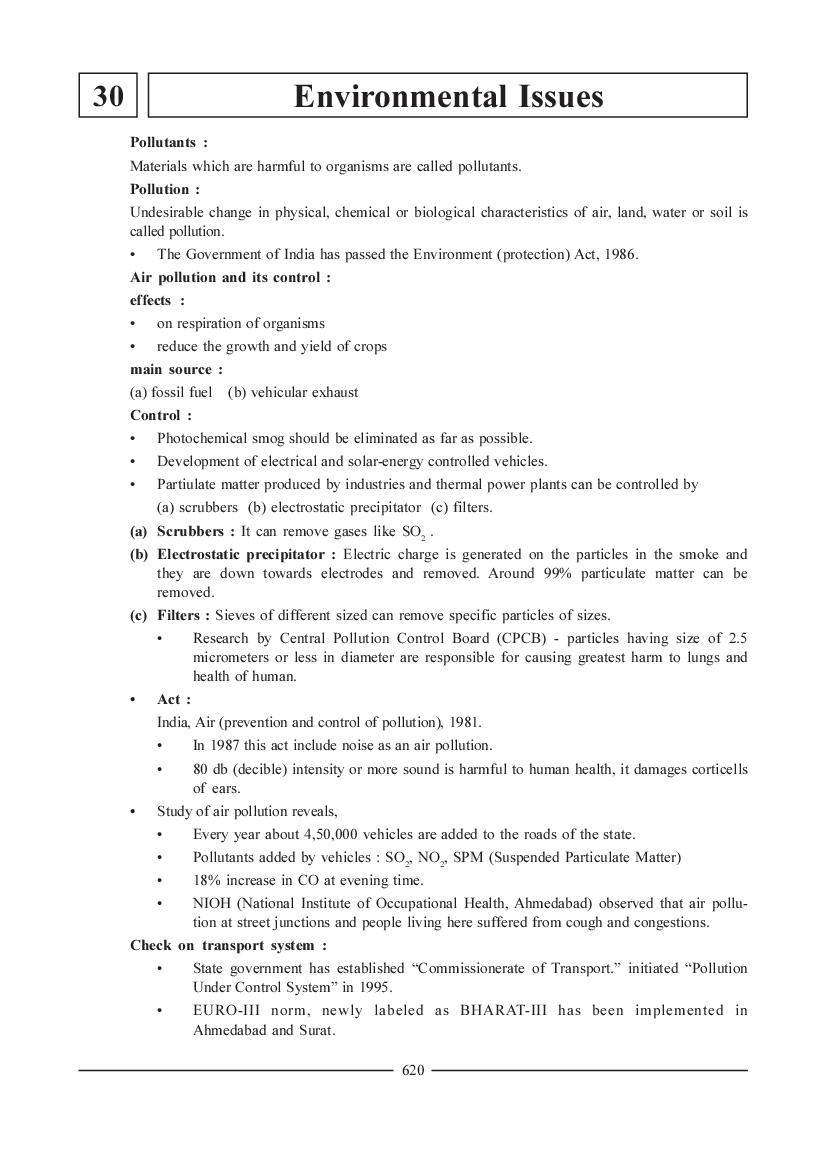
Pollutants :
Materials which are harmful to organisms are called pollutants.
Pollution :
Undesirable change in physical, chemical or biological characteristics of air, land, water or soil is
called pollution.
The Government of India has passed the Environment (protection) Act, 1986.
Air pollution and its control :
effects :
on respiration of organisms
reduce the growth and yield of crops
main source :
(a) fossil fuel (b) vehicular exhaust
Control :
Photochemical smog should be eliminated as far as possible.
Development of electrical and solar-energy controlled vehicles.
Partiulate matter produced by industries and thermal power plants can be controlled by
(a) scrubbers (b) electrostatic precipitator (c) filters.
(a) Scrubbers : It can remove gases like SO2 .
(b) Electrostatic precipitator : Electric charge is generated on the particles in the smoke and
they are down towards electrodes and removed. Around 99% particulate matter can be
removed.
(c) Filters : Sieves of different sized can remove specific particles of sizes.
Research by Central Pollution Control Board (CPCB) - particles having size of 2.5
micrometers or less in diameter are responsible for causing greatest harm to lungs and
health of human.
Act :
India, Air (prevention and control of pollution), 1981.
In 1987 this act include noise as an air pollution.
80 db (decible) intensity or more sound is harmful to human health, it damages corticells
of ears.
Study of air pollution reveals,
Every year about 4,50,000 vehicles are added to the roads of the state.
Pollutants added by vehicles : SO2, NO2, SPM (Suspended Particulate Matter)
18% increase in CO at evening time.
NIOH (National Institute of Occupational Health, Ahmedabad) observed that air pollu-
tion at street junctions and people living here suffered from cough and congestions.
Check on transport system :
State government has established Commissionerate of Transport. initiated Pollution
Under Control System in 1995.
EURO-III norm, newly labeled as BHARAT-III has been implemented in
Ahmedabad and Surat.
620
Page 2
CNG vehicle increase.
CNG is not carcinogenic (not cause for cancer).
Companies provide CNG to cities of Gujarat.
GGCL - Gujarat Gas Company Ltd; Surat-Ankleshwar
GAIL - Gas Authority of India Ltd; Vadodara
GAEL - Gujrat Adani Energy Ltd; Ahmedabad
(1) When did India pass the Environment Act ?
(A) 1995 (B) 1981 (C) 1986 (D) 1974
(2) Major sources of NO2 and SO2 pollutants.
(A) Vehicular exhaust (B) Fertilized factories
(C) Petroleum refineries (D) B and C both
(3) From which method of following electric charge is generated on particles in the smoke ?
(A) Scrubbers (B) Electrostatic precipitators
(C) Filters (D) All given
(4) Size of particles to human health, suggested by CPCB
(A) 2.5 micrometer or less in diameter
(B) 2.5 micrometer or more in diameter
(C) 2.5 milileter or more in diameter
(D) 2.5 milimeter or less in diameter
(5) To include noise as an air pollution, Indian government amended the Air act in which year ?
(A) 1981 (B) 1987 (C) 1995 (D) 2002
(6) How much amount of CO increases in evening in city ?
(A) 1.8% (B) 2.0% (C) 18% (D) 20%
(7) Company provides CNG to Ankleshwar - ......... .
(A) GAEL (B) GGCL (C) GAIL (D) GSRTC
(8) Which one is not appropriate for CNG : ......... .
(A) odourless smoke
(B) more efficient
(C) can not be adulterated easily
(D) heavier than air so no chances of fire-catching
(9) Which norm is newly added to register vehicles in Ahmedabad ?
(A) BHARAT - I (B) BHARAT - II (C) BHARAT - III (D) EURO - II
(10) Photochemical smog is formed due to pollution of ......... .
(A) vehicles (B) cement factories (C) plastic factories (D) steel factories
(11) GAIL provides CNG to ......... .
(A) Ahmedabad (B) Anklelshwar
(C) Surat (D) Rajkot
621
Page 3
(A) Smoke (B) Types of pollen
(C) Radiation (D) Mixture of fog and smoke.
(13) Which of the following is not carcinogenic ?
(A) CNG (B) Smoke by combustion of Nicotin.
(C) CO (D) All given
(14) Recently CPCB researched that ........ .
(A) particles of 2.5 micrometers or less in diameter cause premature death in human
(B) noise of 150 db or high intensity disturb the peaceful life of human
(C) India occupied 24 % area of biodiversity of total area of world
(D) None of the above
(15) Natural air pollutants are ........ .
(A) smoke of vehicles, pollens, SPM
(B) SPM, smoke from chimney, smoke spread during eruption of volcano
(C) pollen of plants, smoke from chimney, vehicular smoke
(D) pollen of plants, smoke spread during volcanic eruption, SPM
(16) Air protection and control act has established in ?
(A) 1990 (B) 1975 (C) 1981 (D) 1985
(17) Scrubbers reduces which pollution ?
(A) water (B) soil (C) air (D) radiative
(18) Which gas can be removed through scrubbers ?
(A) O 2 (B) CO2 (C) SO2 (D) NO2
(19) In Electrostatic precipitators electric charge is generated on the particles of .............. .
(A) soil (B) smoke
(C) photochemical smog (D) precipitation
(20) According to Gujarat Pollution Control Board, Gandhinagar has declared SPM in 2010-11.
(A) 27.5 (B) 257 (C) 155 (D) 275
Answers : (1-C), (2-D), (3-B), (4-A), (5-B), (6-C), (7-B), (8-D), (9-C), (10-A), (11-A), (12-D),
(13-A), (14-A), (15-D), (16-C), (17-C), (18-C), (19-B), (20-D)
Water pollution : When any undesirable substance mixes with water then water becomes
contaminated and becomes unfit for use.
Water born desease : typhoid, hepatitis jaundice, cholera, diarrhoea, dysentery.
Law : The Water (Prevention and Control of Pollution) Act, 1974, India.
622
Page 4
It has bio-degradable organic matter.
A mere 0.1% impurities make domestic sewage unfit for human use.
Bio-degradable organic matter : They are readily decomposed by microorganisms from
complex organic matter into simple organic and inorganic matter.
BOD (Biological Oxygen Demand)
The measurement of amount of O2 required for decomposition of biodegradable substances.
Higher the bio-degradable matter, more O2 utilise, more BOD.
More BOD makes water unfit to drink.
Drinking water has BOD value less than 1.
BOD is meausred by Oxymeter.
Eutrophication : Means easy availability of nutrients in an aquatic habitat.
That cause rapid growth in plants.
Results in population-blast and pollute the water.
Cultural or Accelerated Eutrophications : Pollutants from mans activities like effluents
from industries and homes can accelerate the aging process called .........
Source of pollutants : sewage, fertilizers, animal excreta, detergents.
That increases ammonia, nitrates, nitrites and phosphorous.
e.g. Water hyacinth Eicchornia crassipes (Terror of Bengal)
Side effect : Water body becomes shallow and finally converted into land.
Biological magnification :
Means increasing concentration of some toxic substances at various tropic levels
of a food chain of organisms.
some toxic substance can not degrade (non-biodegradable). They are accumulated by an
organism can not be metabolized or excreted and thus passed on to next higher trophic level.
eg : DDT (Dichloro Diphenyl Trichloro ethane)
Water ® zooplanktons ® small fishes ® Big fishes ® fish eating Birds
0.003 ppb 0.04 ppm 0.5 ppm 2 ppm 25 ppm
Waste water treatment :
Removes contaminants from waste water.
It includes physical, chemical and biological process to remove such contaminants.
Three phases :
Phase I : Large suspended substances are filtered out and made harmless and used as manure.
Phase II : Through bacterial activity organic waste is decomposed with airflow and water is
chlorinated.
Phase III : Nitrates, phosphates are removed from this water and pure water is obtained.
623
Page 5
recycled into natural fertilizer.
(21) To purify water reserviors and maintenance Indian Government has passed which law ?
(A) The water (protection) act, 1986
(B) The water (prevention and control of polution) act, 1974
(C) The water(prevention and control of polution) act, 1981
(D) The water (prevention and purification) act, 1974
(22) In decreases dissolved O2 in water ......... .
(A) higher concentration of non-biodegradeble materials
(B) lower concentration of biodegradeble materials
(C) high proportion of biodegradable materials
(D) lower concentration of non-biodegradable materials
(23) Dereacing O2 in water, ......... BOD.
(A) increases (B) some what decreases (C) no change (D) negligible
(24) It is known as terror of Bengal.
(A) Clarias genipius (B) Calotropic procera (C) Polyalthia longifolia (D) Eichornia crassipes
(25) Pollutants from mans activities like effluents from industries and homes can accelerate the ageing
process is called ......... .
(A) Cultural Eutrophication (B) Accelerated Eutrophication
(C) Inhibitory Eutrophication (D) A and B both
(26) If in water reserviors concentration of bio-non-degadable component is 0.003 ppb, then what will
be the concentration in small fishes ?
(A) 25 ppm (B) 0.04 ppm (C) 0.5 ppm (D) 2 ppm
(27) Which is correct option for activity done during second phase of waste water treatment ?
(A) Passes air flow
(B) Bacterial decomposition
(C) Chlorination of water
(D) All given
(28) The higher accumulation of DDT found in ......... .
(A) phytoplanktons (B) eel (C) crab (D) birds
(29) In sewage water, fishes die, because of ......... .
(A) more physical matters
(B) more silt enters the body along with water
(C) specific odour
(D) dissolved O2 is lower
(30) Drinking water sometimes passes through Chlorination because ......... .
(A) it lowers the salt amount (B) removes suspended particles
(C) kills micro organisms (D) increases O2 concentration
624
Page 6
(A) >1 (B) =1 (C) <1 (D) not certain
(32) What will affect the BOD value if we add organic materials in water ?
(A) no effect on BOD (B) no effect on COD
(C) decrease in BOD (D) increase in BOD
(33) Arrange them in ascending value of BOD ........ .
(i) high polluted lake water
(ii) non-polluted lake water
(iii) distil water
(A) i ® ii ® iii (B) ii ® iii ®i (C) iii ® ii ® i (D) i ® iii ® ii
(34) Arrange them in increasing BOD value.
(i) distil water
(ii) tape water
(iii) drainage debris in river water
(A) i ® ii ® iii (B) ii ® iii ®i (C) iii ® ii ® i (D) i ® iii ® ii
(35) Fish eating birds ®large fishes ® small fishes ® zooplanktons ® phytoplanktons
(A) Eutrophication (B) Biological magnification
(C) Aquatic food chain (D) Succession
(36) Herbicides which are accumulate at different trophic levels of an ecosystem as a part of green
revolution indicates ......... .
(A) Biological magnification (B) Succession
(C) Eutrophication (D) Organic farming
(37) What is Eutrophication ?
(A) Terror of Bengal, Water Hyacinth destroys
(B) Blue green algae destroys from aquatic habitat
(C) Decrease in NH3, NO3, NO2, PO4 in aquatic habitat
(D) Easy availability of nutrients
Answers : (21-B), (22-C), (23-A), (24-D), (25-D), (26-C), (27-D), (28-D), (29-D), (30-C), (31-C),
(32-D), (33-C), (34-A), (35-B), (26-A), (37-D)
*Solid Waste or Soil Pollution *
Commonly known as garbage that goes in trash.
Different types of wastes :
(I) Biodegradable waste : food, and kitchen waste, green waste, paper (Can also be
recycled)
(II) Recyclable material : paper, glass, bottles, cans, metals, certain plastics
(III) Inert waste : construction and demolition waste, dirt, rocks, debris
(IV) Composite waste : Waste clothing, tetra packs, waste plastics (toys etc...)
625
Page 7
hospital waste (Bio waste) (BMW-Bio Medical Waste)
products of paints, chemicals
e-waste (non-repairable electronics)
Recycling in developing countries involves manual participation thus exposing workers to toxic
substances present in e-waste.
Use of plastic waste :
Waste plastic can be mixed with polymers to build roads.
Such plastices cleaned, shredded in small pieces, passing through 4.35 mm sieve, heated to
170oC in Mini hot mix plant.
Then it gets softened and coated over the aggregate.
At 160oC Bitumen is added and blend is formed at surface of aggregate.
Then mixture is transferred to road.
This technique is extended to Central Mixing Plant also.
Benefits of Polymer - Tar :
Stronger roads, no potholes formed, less bleeding during summer, reduces consumption of bitumin,
not involve extra machinery.
Agrochemicals and their effects :
As a part of green revolution the use of herbicides, pesticides and fungicides has increased
tremendously in order to get more production.
They accumulate and generate harmful effects on various trophic levels.
causes bio-magnification in terrestrial ecosystem.
think about organic farming.
Organic farming
It excludes the use of manufactured fertilizers, pesticides, plant growth hormones etc.
Ramesh Chandra Dagar, a farmer in Hariyana is making use of organic farming.
He developed Haryana Kisan Welfare Club and introduced many techniques of bee
harvesting, dairy management, water harvesting, composting and agriculture.
Radioactive waste :
It is by-product of nuclear power generation, nuclear fission or nuclear technology.
Radiation waste - Radiation - mutation in organism - Cancer.
The first accidental event is leakage in Three Mile Island and Chernobyl incidents.
It should be given pretreatment, shielded in containers buried within rocks, about 500 mt deep
below the earths surface.
(38) Which is bio-degradable waste ?
(A) Green waste (B) Cans (C) Clothing waste (D) Metals
626
Page 8
(A) 1.35 mm (B) 3.54 mm (C) 4.35 mm (D) 5.34 mm
(40) Which in not suitable with polymer-waste-bitumen mix road ?
(A) Less bleeding during summer.
(B) Road strength is twice than normal roads.
(C) No resistants towards water stagnation.
(D) Not involve any extra machinery.
(41) Biomagnification of agrochemical occurs in which ecosystem ?
(A) Forest ecosystem (B) Pond ecosystem
(C) A and B both (D) Terrestrial ecosystem
(42) It is not include in organic farming.
(A) Crop rotation (B) Plant growth hormones
(C) Green manure (D) Bio-pest control
(43) Who established Haryana Kisan Welfare Club ?
(A) Ramesh Chandra Duble (B) E. Z. Pillai
(B) Ramesh Chandra Dagar (D) Rajeshchandra Dagar
(44) Which are the victims of incidents of nuclear energy ?
(A) Bhopal (B) Three mile island (C) Chernobyl (D) B and C both
(45) Glohal warming can be controlled by ......... .
(A) increase in forest cutting, decrease in use of energy
(B) decrease in forest cutting, decrease in use of fossil fuel
(C) decrease in re-forestation, increase in use of fossil fuel
(D) increase in forest cutting, decrease in human population
Answers : (38-A), (39-C), (40-C), (41-D), (42-B), (43-D), (44-D), (45-B)
Green house effects and Global warming :
Sunlight passes through atmosphere and reaches the surface of the earth.
The CO2 absorbs long wavelength infrared rays and reflects them back towards the earth.
That increases temperature of atmosphere is called Green House Effect.
Another green house gases : Methane, Nitrous, Oxide : Hydroflurocarbon (HFC)
Chloro-flurocarbon (CFC)
Global Warming :
The Earths average temperature is around 15°C.
By the year 2050 it can be reach upto 5°C more.
Results of Global warming :
increase in temperature
melting of polar ice of Himalayan snow caps, result in rise in sea level that can submerged
many costal areas.
627
Page 9
reduce the use of fossil fuel
alternative source of energy like natural gas, solar-energy, nuclear-energy, should
be encouraged.
reduction in deforestation
promote plantation
Ozone depletion in stratosphere :
Ozone column measures in Dobson Unit (DU).
O3 absorbs UV-rays and inhabit them to reach on the earth and protect us from its
harmful effects.
Main reason of O 3 depletion is sources of chlorine used as CFC and HFC in
Refrigerators and Freon.
Cl + O3 ® ClO + O2
Clo + ClO ® Cl2 + O2
Cl2 ® Cl + Cl ¯
Ozone depletion first observed in Antarctic Region
Formation of a large area of thinned ozone layer is called the ozone hole.
Depletion of 10% in ozone layer cause 26% increase in skin-cancer and cataract.
High dose of UV causes inflammation of cornea, called snow -blindness.
(46) Why it is not advisable to use CFC in cooling equipments (Regrigerators and A.C.) ?
(A) Swollen occurs on lungs (B) Deplete ozone layer
(C) More use of energy (D) Combines Cl2 with CO2
(47) Chernobyl incident concern with ......... .
(A) Ozone hole (B) Nuclear power Generation
(C) Bio magnification (D) Eutrophication
(48) Dobson Unit indicates measure of ......... .
(A) materials in bio-magnification (B) rate of ozone depletion
(C) thickness of ozone layer (D) to measure length of UV-rays
(49) One atom of Cl2 can decomposes ......... molecules of O3 .
(A) 10,000 (B) 1,00,000 (C) 10,00,000 (D) 1,000
(50) Ozone depletion occurs in which layer of atmosphere ?
(A) Trophosphere (B) Stratosphere (C) Mesosphere (D) Ionosphere
(51) Atmospheric CO2 absorbs this rays : ......... .
(A) IR of short wavelength (B) IR of long wavelength
(C) UV of short wavelength (D) UV of long wavelength
(52) An average temperature of the earth is ......... .
(A) 27°C (B) 28°C (C) 15°C (D) 37°C
628
Page 10
(A) atmospheric CO2 does not allow long wavelength UV-rays so temperature of atmosphere
remains hot.
(B) atmospheric CO2 absorbs long wavelength IR-rays and reflect them on the earth so
temperature of the earth increases.
(C) atmospheric CO2 absorbs short wavelength UV-rays and reflect them on the earth, so
temperature of the earth increases.
(D) atmospheric CO2 doesnt allow short wavelength IR-rays so temperature of the earth
remains hot.
54) Which is commonly used in both refrigerators and A.C.
(A) HFC (B) Freon (C) CFC (D) None of these
Answers : (46-B), (47-B), (48-C), (49-B), (50-B), (51-B), (52-C), (53-B), (54-B)
Degradation by improper resource utilization and maintenance :
It is important that degradation of natural resources not only due to the action of pollutants but
also due to improper resource utilization practices.
Soil erosion and desertification :
Over cultivation, unrestricated grazing, deforestation and poor irrigation practicies are main
causes.
Such large patches extend and meet over a time, a desert is created.
Deforestation :
At beginning of twentieth centuary, forest covered about 30% of the land of India.
By end of centuary, it shrunk to 19.4 %.
National Forest Policy (NFP), 1988 of India has recommended 33% forest cover for plains
and 67% for hills.
Reasons :
rapidly increasing population
more land demand for agriculture
use of timbers and fuel wood increases
increasing industrialization and urbanization
Jhum cultivation : It is slash and burn agriculture.
Farmers cut down the trees of forest and burn the plant remains.
The ash is used as fertilizer and land is used for farming or cattle grazing.
Serious effects :
atmospheric changes occur
rainfall decreases
increased soil erosion decreasing soil fertility
amount of increasing CO2, causing green house effect
ecosystem balance is disturbed
irregularities arise in bio-geochemical cycles.
629
Page 11
* Peoples participation in conservation of forest *
Seven billion inhitants found in forest all over the world.
1.6 billion directly depend on forest for their livelihood.
Declaration of state forests, national parks or wild-life reserves.
The states in India have a strategy of Joint Forest Management (JFM)
Forestry departments and communities jointly manage it.
JFM originated from the management of Sal (Shorea robusta) forests in West Bengal.
Sal forests increased from 11% to 20% in Midnapore district alone.
Under JFM, the ownership of land remains with the government.
Study of three beneficial environmental issues :
(I) In 1931, Palace of Jodhpur, Rajasthan required timber wood from Forest.
Bishnois failed them to do so.
A Bishnoi woman Shri Amrita Devi laid down her life to save the trees.
Along with her 363 lay dead.
The Government of India has recently instituted the Amrita Devi Wildlife Protection
Award.
(II) Chipko Movement :
Initiated in 1974 in Uttar Pradesh, Garhwal Himalayas.
It spread to Himachal Pradesh, Karnataka, Rajasthan, Bihar, Vindhyas.
Mrs. Indira Gandhi (Prime minister) given the leadership to Sunderlal Bahuguna, a
Gandhian activist and philosopher.
(III) In 1980, the Government of India has introduced the concept of Joint Management
Program (JFM), to protect and manage forests.
(55) What is responsible for destroy of fertile layer of soil ?
(A) deforestation and weak irrigation
(B) unrestricted grazing
(C) more crop cultivation
(D) all given
(56) According to National Forest Policy (NFP-1988) how many perantage the hills of forest should be expanded ?
(A) 33% (B) 67% (C) 76% (D) 30%
630
Page 12
(A) increasing agriculture
(B) increasing use of timber and fuel wood
(C) increasing industrialization and urbanization
(D) all given
(58) Slush and burn cultivation means ......... .
(A) harvesting (B) green manure (C) jhum cultivation (D) A and B both
(59) Which idea gave origin of JFM ?
(A) Sal management in Dhaka (B) Cutting of Sal trees in Assam
(C) Sal management in West Bengal (D) Artificial forestation surrounding large cities
(60) Who is owner of land as per JFM ?
(A) Government (B) Village Management Association
(C) Farmer (D) Sahkari Mandli
(61) Which award is declared by Government of India for Wildlife conservation ?
(A) Chipko Movement Wildlife Protection Award
(B) Amritadevi Bishnoi Wildlife Protection Award
(C) Amritadevi Bahuguna Wildlife Protection Award
(D) Sundarlal Bishnoi Wildlife Protection Award
(62) The leadership of Chipko-movement was given to ......... .
(A) Sundarlal Bahuguna (B) Mrs. Indira Gandhi
(C) Amritadevi Bishnoi (D) Shri Vinoba Bhave
(63) Aim of Joint Management Programme is ......... .
(A) involvement of people to conserve forests
(B) forest products are available to people
(C) manage the forests with communities
(D) all given
(64) Chipko- movement initiated in ......... .
(A) 1947 (B) 1980 (C) 1974 (D) 1731
(65) Jhum cultivation has harmful and beneficial effects both because ......... .
(A) decreases food production, increases forest area
(B) deforestation occurs, increases food production
(C) deforestation occurs, only to develop medicinal plants
(D) none of these
Answers : (55-D), (56-B), (57-D), (58-C), (59-C), (60-A), (61-B), (62-A), (63-D), (64-C), (65-B)
631
Page 13
(66) The measures taken for global warming.
(1) Alternative source of energy Natural gas should be increased.
(2) Solar-energy, geo-thermal energy utilization should be decreased so that Natural resources can
be saved.
(3) Inhibit reforestation and encourage plantation
(4) Rapid increase in price of fossil fuel.
(A) TFTF (B) TFFF (C) TTTF (D) TFTT
(67) (1) Sound more than 150 db couse noise pollution.
(2) Pollution can be decreased by use of unleaded petrol and diesel.
(3) 90% gaseous pollutants can remove through electrostatic precipitators.
(4) The Government of India introduced Joint Management programme to control environmental
pollution.
(A) TFTF (B) TTTF (C) TTTT (D) TTFF
(68) Choose correct option for water pollution.
(1) to clean water reserviors, Indian Government introduced The water (purification and control of
solution) Act, 1974.
(2) Chlorination of water is done in second phase of waste water management.
(3) Non-biodegradable components are bio magnified in food chain of aquatic habitat.
(4) Animal excreta, detergent when add to water causes exponential growth in aquatic plants.
(A) FFTT (B) TFTT (C) TFFT (D) FTTT
(69) Choose appropriate option for improper use of natural resources.
(1) 100 years pass to form fertile layer of soil.
(2) So many issues generate due to marshy soil and high salinity in industrial revolution.
(3) 63% land area should occupy by forests.
(4) Reforestation is not possible in deforest area.
(A) TTFF (B) TTFT (C) TFFF (D) TFTT
Answers : (66-B), (67-D), (68-A), (69-C)
A - Assertion R - Reason type MCQS
Read the assertion and reason carefully to mark the correct option out of the options given below :
(70) Assertion A : Available area for natural ecosystem decreases.
Reason R : Human population increases.
(A) (B) (C) (D)
632
Page 14
Reason R : To destroy mosquitoes DDT is spreaded in water.
(A) (B) (C) (D)
(72) Assertion A : Forest cutting is one of the reason for global warming.
Reason R : Forest cutting increases green house gas CO2.
(A) (B) (C) (D)
(73) Assertion A : DDT shows bio magnification.
Reason R : UV rays cause ozone depletion.
(A) (B) (C) (D)
(74) Assertion A : CNG is more beneficial than petrol and diesel.
Reason R : CNG is carcinogenic.
(A) (B) (C) (D)
(75) Assertion A : Smoke is precipitated in electrostatic precipitators.
Reason R : 90% particles remove in electrostatic precipitators.
(A) (B) (C) (D)
(76) Assertion A : BOD measurement decides fitness of water.
Reason R : BOD value of drinking water is always 1.
(A) (B) (C) (D)
(77) Assertion A : Shorea robusta forests expand in Midnapur District.
Reason R : Management of forest with the help of communities under JFM.
(A) (B) (C) (D)
(78) Assertion A : One atom of chlorine degrades 1,00,000 moleules of ozone and it returns
back as chloride.
Reason R : Use of freon in refrigerator and AC should be banned
(A) (B) (C) (D)
(79) Assertion A : Main reason for global warming is deforestation.
Reason R : Methane and CFC are also added to list of green house gases along with CO2.
(A) (B) (C) (D)
Answers : (70-A), (71-A), (72-A), (73-B), (74-C), (75-D), (76-C), (77-A), (78-A), (79-B)
(80) Column- I Column- II I II III IV
(I) paper (P) toxic waste (A) Q R P S
(II) plastic waste (Q) inert waste (B) Q P R S
(III) spray cans (R) recyclable material (C) R S P Q
(IV) construction waste (S) polymer tar (D) R P S Q
633
Page 15
(I) Rajasthan-Jodhpur (P) Chipko-movement (A) S P R Q
(II) Garhwal-Himalaya (Q) Ozone depletion (B) R S R Q
(III) Midnapur (R) Shorea robusta (C) S R P Q
(IV) Stratosphere (S) Bishnoi community (D) P S R Q
(82) Column- I Column- II I II III
(I) GAIL (P) Vadodara (A) P S R
(II) GGCL (Q) Ankleshwar (B) Q R S
(III) GAEL (R) Ahmedabad (C) P Q R
(S) Rajkot (D) Q P S
(83) Column- I Column- II I II III IV
(I) Water hyacinth (P) Kerala (A) R P Q S
(II) Ecoson (Q) Three mile island (B) P R S Q
(III) Shorea robusta (R) Terror of Bengal (C) S Q R P
(IV) Radiation incident (S) Natural resources (D) R P S Q
Answers : (80-C), (81-A), (82-A), (83-D)
Pollutants :
Non-degradable pollutants : prohibited through laws, use alternative sources.
Degradable polluntants :
Primary pollutants : They are found in the forms in which form they are added. eg. DDT
Secondary pollutants : They are formed due to chemical reactions between primary
pollutants.
eg. photochemical smog, PAN
They are more toxic than primary pollutants.
(PAN : Peroxy Acetyl Nitrate)
Quantitative pollutants : They are present in atmosphere, when their amount increases at
maximum level, they act as pollutants.
eg: CO2, N2O
Qualitative pollutants : They are not found in atmosphere. Human activities add them in
environment.
eg. : fungicides, weedicides, DDT, etc.
Natural pollutants : Natural resources like cattles, methane from paddy field, forest-fire etc.
634
Page 16
eg. over grazing, soil erosion, desirable matters are removed or absence makes loss of
productivity of soil.
Positive pollution : Undesirable matters are present at wrong places or adding of this
matters, decreases soil fertility.
eg.: biofertilizer compensate the land. (Landfilling)
Point source pollution : external source at definate places.
eg. exit of garbage of factories, drainage of Nagar-palika.
Primary pollutants :
CO, 3-4 Benzopyrine, Benzene, Ethylene
NO, NO2, SO2, SO3
Secondary pollutants : Smog = Smoke + fog
- Term given by Devoex,
- Smog is measured by Ringalman technique.
(a) Losangeles smog or photochemical smog first observed in Los Angeles.
(PAN + O3 + Nitrogen Oxide)- Brown Smog
(b) London Smog - Sulphar Smog
Coal, smoke, smog, sulphur oxide and low temperature is favourable.
H2SO4 is vaporised is called London fog.
Along with smog, vapour of H2SO4 is breathe in. As a result in 1952 4000 people died
in London.
Acid-rain :
H2SO4 + HNO3 fall with rain water. (70% H2SO4 + 30% HNO3)
Term was given by Robert August.
pH < 5.6
Green house gases :
CO2, CH4, CFC, N2O
CO2 level increases from 280 ppm to 368 ppm during 1956 to 2002.
Upto 2020 CO2 amount will be doubled.
Effect of CO2 fertilization :
Increase in CO2 concentration also increases rate of photosynthesis (upto some years).
Response against increasing CO2 concentration is called CO2 fertilization effect.
Maximum concentration of Ozone is found in stratosphere (16 km to 25 km from earths
surface).
First Ozone hole was found in Antarctica by Satellite Nimbus -7
Ozone hole generate after August and before october in Antarctica.
During spring season mostly seen during February to April.
July-October show less.
635
Page 17
5th June World Environment Day
16th September Ozone Day
22nd April Earth Day
2nd December National Environment Day
3rd December, 1984 Bhopal gas tragedy
(Methyl ISO Cynite)
ODS Ozone Depleting Substance
Water-blooms more nutrients in water
Jetropa plants to make bio-ethanol
Green muphlar to reduce noise-pollution plant shrubs and trees on two sides of roads
Pyrolysis burning of solid waste in absense of O2
Plume Smoke releases from chimneys
Anthracosis disease caused by coal particles
Syderosis disease caused by iron particles
Disease caused by presense of excess metals.
Arsenic Black foot disease
Mercury Minamata
Blue-baby syndrome more amount of Nitrate in drinking water, that reduces O2
carrying capacity called methamoglobinemia.
Plumbism Water polluted by lead
Itai-Itai or Ouch-Ouch - bone-joint discase caused by cadmium.
Questions for NEET
(84) Increase phospharus and nitrate fertilizer in water causes ........ .
(A) decrease in growth of algae (B) Eutrophication
(C) stability in growth of algae (D) Bio magnification
(85) Air pollutants produce photochemical oxidants ......... .
(A) CO2, CO, SO2
(B) Nitrous oxide, Nitric oxide, Nitric Acid
(C) O2, Cl, HNO3
(D) O3, Cl, SO2
(86) Presence of E-coli in water indicates pollution of ......... .
(A) pollens of aquatic plants (B) light metals
(C) faecal matter (D) polluted water of industries
(87) In 1984 Bhopal tragedy occured because methyl isocyanide reacted with ......... .
(A) DDT (B) NH3 (C) CO (D) H2O
636
Page 18
permitted for mixing in petrol ?
(A) 2.5% (B) 10-15% (C) 10% (D) 5%
(89) Prolonged liberal irrigation of agriculture field is likely to create the problem of ......... .
(A) acidity (B) aridity (C) Salinity (D) metal toxicity
(90) Which of the following is not used for disinfection of drinking water.
(A) chlorine (B) oxygen (C) phenyl (D) florine
(91) Limit of BOD prescribed by Central pollution control board for discharge of industrial and
municipal waste emptied into natural surface water is -
(A) < 10 ppm (B) < 100 ppm (C) < 30 ppm (D) < 3.0 ppm
(92) Photochemical smog pollution doesnt contain ......... .
(A) nitrogen dioxide (B) Carbon dioxide
(C) Oxygen (D) PAN (peroxy acetyl nitrate)
(93) In which one of the following BOD (Biochemical Oxygen Demand) of sewage, distillery effluent,
paper mill effluent and sugar mill effluent have been arranged in ascending order ?
(A) SE < PE < S < DE (B) PE < S < SE < DE
(C) S < DE < PE < SE (D) SE < S < PE < DE
(94) In a coal fired power plant electrostatic precipitators are installed to control emission of ......... .
(A) NO (B) SPM (C) CO (D) SO 2
(95) Which one of the following is not a bioindicator of water pollution ?
(A) Blood-worms (B) Stone flies (C) Sewage fungus (D) Sludge-worms
(96) Montreal protocol aims at ......... .
(A) biodiversity conservation (B) control of water pollution
(C) control of CO2 emission (D) reduction of ozone depleting substances
(97) BOD in river water ......... .
(A) not related with amount of O2 in water (B) indicates presense of salmonela in water
(C) when sewage adds to water, it increases (D) not affected by population-blast of algae
(98) Which of the following plant species you would select for the production of bioethanol ?
(A) Pongamia (B) Brassica (C) Zea mays (D) Jatropha
(99) A renewable exhaustible natural resource is ......... .
(A) coal (B) petroleum (C) minerals (D) forest
(100) Chipko-movement initiated to conserve ......... .
(A) wild animals (B) forests (C) cow (D) grasslands
(101) World Environment Day : ......... .
(A) 5th June (B) 5th August (C) 5th September (D) 5th December
637
Page 19
(A) 16th January (B) 16th May (C) 16th August (D) 16th September
(103) Green Muphlar is called the pollution of ......... .
(A) Air (B) Sound (C) Soil (D) Water
(104) Gas produces in Paddy field, causes global warming is ......... .
(A) Methane (B) Chlorine (C) H2S (D) Nitrate
(105) What does Water blooms indicate in lake ?
(A) Presence of more nutrients (B) Deficiency of nutrients
(C) Deficiency of oxygen (D) Absence of aquatic insects
(106) ODS means ......... .
(A) Ozone Developing Substances (B) Ozone Depleting Substances
(C) Ozone Doubling Substances (D) Ozone Deta Sources
(107) In Green Muphlar, trees and shrubs can be planted at ......... .
(A) unuseful land (B) on mountains
(C) on road-divider (D) on both side of road
Answers : (84-B), (85-B), (86-C), (87-B), (88-D), (89-C), (90-A), (91-A), (92-B), (93-B), (94-B),
(95-B), (96-D), (97-C), (98-D), (99-B), (100-A), (101-D), (102-B), (103-B), (104-A), (105-A),
(106-B), (107-D)
638
Page 20
Environmental Issues ® - It is undersirable change in physical, chemical and biological properties of
air, water and soil, which directly or indirectly affect human beings.
Air pollution
Primarily results from burning of fossil in Water pollution
industries and automobiles. It is deterioration of water quality that makes it unfit
Effects include reduction in growth and for consumption.
yield of crops and their premature death. Causes are domestic sewage, industrial discharge,
Affects respiratory system of humans surface run off containing pesticides, detergents,
and of animals. fertilizers, silt etc., oil spills.
Devices such as setting chamber,
® Consequences of water pollution are :
cyclonic separators, bag filters, - decreased DO
electrostatic precipitators etc. are used to ¬ - increased BOD
control air pollution. - eutrophication
Noise is also considered air pollutant. - biomagnification
- thermal pollution
- health hazards
Solid waste management Water pollution can be controlled sewage treatment.
Solid waste refers to everything that goes
out in trash. Agrochemicals and their effects (Soil pollution)
Sources of solid wastes are municipal Pesticides, fertilizers, chemicals and radioactive
wastes, industrial wastes, mining wastes, ® wastes are the main source.
hazardous wastes, defunct ships and Control measures include :
electronic wastes.
Disposal of wastes consists of recovery ® Organic farming
and recycling, source reduction, burning ¬
and dumping (landfills). ® Solid waste disposal
Radioactive pollution
Pollution of air, water and soil with radio- ® Soil conservation by terrace farming, growing
active materials. grazing fields, afforestation, reforestation
It is caused by atomic weapons and atomic
explosions, atomic reactors and nuclear
fuel, mining of radioactive materials. Greenhouse effect and global warming
These waste should be changed into harm- ¬ Greenhouse effect is a naturally occurring
less form and stored in safe place where phenomenon that is responsible for heating of
they may gradually decay in a harmless Earths surfce and atmosphere.
manner. Increased level of greenhouse gases (N2O, CFCs,
® methane, CO2) has led to considerable heating of
Ozone layer depletion earth leading to global warming. This is resulting in
Ozone layer (layer which protects life odd climatic changes, melting of ice caps etc.
on earth from harmful effects of UV Control measures include cutting down use of fossil
radiations) is being depleted by ozone fuels, improving efficiency of energy usage, reducing
depleting substances (ODS), such as deforestation, planting trees and slowing down the
chlorofluorocarbons, nitrogen oxides, growth of human population.
hydrocarbons etc.
Ozone depletion of thinned ozone layer
(ozone hole) is particularly marked Deforestation
over Antarctic region. ¬ It is the conversion of forested areas to non-forested
It causes aging of skin, damage to skin ones.
cells and various types of cancer, snow It results in enhanced CO2 concentration, loss of
blindness, cataract etc. ® biodiversity, disturbed hydrological cycle, soil erosion,
and desertification.
639
Document Details
| Board / Org | NTA |
| Exam | National Eligibility cum Entrance Test (Undergraduate) |
| Type | Question Bank |
| Pages | 20 |
| Updated | 22 Jul 2026 |