NEET Biology Question Bank - Excretory Products and their Elimination
Finished viewing? Save it for later —
Download NEET Biology Question Bank - Excretory Products and their Elimination (PDF · 25 pages)About NEET Biology Question Bank - Excretory Products and their Elimination
NEET Biology Question Bank - Excretory Products and their Elimination is available here for free download. Published by NTA for National Eligibility cum Entrance Test (Undergraduate), this question bank can be viewed online or downloaded as a PDF (25 pages). Candidates preparing for National Eligibility cum Entrance Test (Undergraduate) can use NEET Biology Question Bank - Excretory Products and their Elimination to understand the exam pattern, the type of questions asked, and the overall difficulty level.
Frequently Asked Questions
How can I download NEET Biology Question Bank - Excretory Products and their Elimination?
Open this page and click the Download button to save NEET Biology Question Bank - Excretory Products and their Elimination as a PDF. It is completely free on AglaSem Docs.
Is NEET Biology Question Bank - Excretory Products and their Elimination free to download?
Yes. NEET Biology Question Bank - Excretory Products and their Elimination can be viewed online and downloaded as a PDF free of cost on AglaSem Docs.
How many pages does NEET Biology Question Bank - Excretory Products and their Elimination have?
NEET Biology Question Bank - Excretory Products and their Elimination contains 25 pages, which you can read online or download together as a single PDF.
Where can I find more National Eligibility cum Entrance Test (Undergraduate) study material?
You can find more National Eligibility cum Entrance Test (Undergraduate) question papers, sample papers, syllabus, and answer keys on AglaSem Docs.
NEET Biology Question Bank - Excretory Products and their Elimination – Text
Read the full text of this question bank below — useful to quickly search, copy and reference the content online without downloading the PDF.
📄 View text version (25 pages)
Page 1
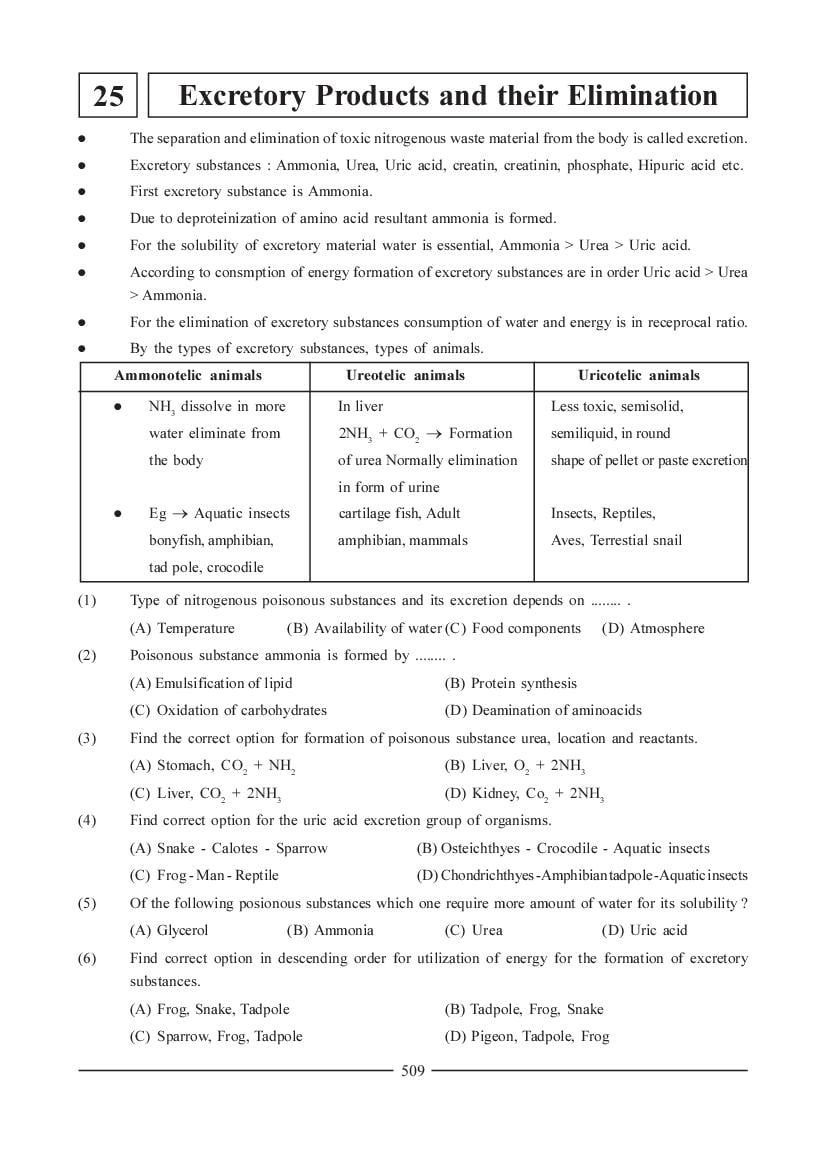
The separation and elimination of toxic nitrogenous waste material from the body is called excretion.
Excretory substances : Ammonia, Urea, Uric acid, creatin, creatinin, phosphate, Hipuric acid etc.
First excretory substance is Ammonia.
Due to deproteinization of amino acid resultant ammonia is formed.
For the solubility of excretory material water is essential, Ammonia > Urea > Uric acid.
According to consmption of energy formation of excretory substances are in order Uric acid > Urea
> Ammonia.
For the elimination of excretory substances consumption of water and energy is in receprocal ratio.
By the types of excretory substances, types of animals.
Ammonotelic animals Ureotelic animals Uricotelic animals
NH3 dissolve in more In liver Less toxic, semisolid,
water eliminate from 2NH3 + CO2 ® Formation semiliquid, in round
the body of urea Normally elimination shape of pellet or paste excretion
in form of urine
Eg ® Aquatic insects cartilage fish, Adult Insects, Reptiles,
bonyfish, amphibian, amphibian, mammals Aves, Terrestial snail
tad pole, crocodile
(1) Type of nitrogenous poisonous substances and its excretion depends on ........ .
(A) Temperature (B) Availability of water (C) Food components (D) Atmosphere
(2) Poisonous substance ammonia is formed by ........ .
(A) Emulsification of lipid (B) Protein synthesis
(C) Oxidation of carbohydrates (D) Deamination of aminoacids
(3) Find the correct option for formation of poisonous substance urea, location and reactants.
(A) Stomach, CO2 + NH2 (B) Liver, O2 + 2NH3
(C) Liver, CO2 + 2NH3 (D) Kidney, Co2 + 2NH3
(4) Find correct option for the uric acid excretion group of organisms.
(A) Snake - Calotes - Sparrow (B) Osteichthyes - Crocodile - Aquatic insects
(C) Frog - Man - Reptile (D) Chondrichthyes - Amphibian tadpole - Aquatic insects
(5) Of the following posionous substances which one require more amount of water for its solubility ?
(A) Glycerol (B) Ammonia (C) Urea (D) Uric acid
(6) Find correct option in descending order for utilization of energy for the formation of excretory
substances.
(A) Frog, Snake, Tadpole (B) Tadpole, Frog, Snake
(C) Sparrow, Frog, Tadpole (D) Pigeon, Tadpole, Frog
509
Page 2
(A) Osteichthyes (B) Chondrichthyes (C) Amphibia (D) A and B both
(8) Deamination is ........ .
(A) Reabsorption of amino acids by papillae of intestinal wall from digested food
(B) Release of CO2 and NH2 from dissociation of amino acids
(C) Formation of NHCO, for linking amino acid with amino acid
(D) Removal of CO2 from amino acids by kidney
(9) What is proper statement for amphibian class ?
(A) Urea in tadpole and ammonia in adult amphibian.
(B) Urea in total lifecycle of amphibian animals.
(C) Ammonia in tadpole and urea in adult frog.
(D) Uric acid in adult amphibia and ammonia in tadpole.
Answers : (1-B), (2-D), (3-C), (4-A), (5-B), (6-C), (7-C), (8-B), (9-C)
Human Excretory system : ytËvenacava
Post hLke {nkrþhk Ãk] c {nkÄ{Lke
Dorsal artery
yurzÙLk÷ økú
Adrenal trÚk
gland
Main excretory organ-kidney ®Colour: Reddish brown {qRenal
ºk®ÃkzÄ{Lke
artery
zkçkwt kidney
Left {qºk®Ãkz
Shape : Bean shape {qºk®Ãkzrþhk
Renal Vein
s{ýw
Right t kidney
{qºk®Ãkz
Weight : 125 to 170 gm zkçke
Left {q ºkðkrnLke
ureter
s{ýe
Right {qºkðkrnLke
ureter
Size : (l : 10 × b : 5 × h : 3) cm
Location : Both side of vertebral column, inlumber region {qºkkþÞ bladder
Urinary
12th thoracic vertebrate and first two lumber vertebrate, {q º kðkrnLkeLkw t
{qUrethra
ºk{køko
lateral side (T12L1L2)
Human Excretory System
Arrangement : The two kidney are not placed at the same level.
The right kidney is slightly on a lower level than the left. This
is due to fact that right side of the abdominal covity is occupied
by liver.
External structure :
Surface : Outer surface convex, inner surface concave.
Hilum : On concave surface one longitudinal slit like structure is there by which artery, nerve
enters inside the hilum, through this slit vein, ureter come out. Modullary
Pyramids
Internal structure : Calyces
Renal Pyramids
Cortex : Peripheral area of convex surface dark
red and somewhat granular. Renal artery
Meducle
Medulla : Pyrami shaped renal pyramid, area Renal pcivis
Renal vein
between the cortex and renal pyramid which spread
toward the cortex is called column of Bertini.
Kidney Ureter
(10) Spreading region of cortex ........ .
(A) Renal pyramid (B) Column of bertini L.S. of Kidney
(C) Calyces (D) Renal pelvis
510
Page 3
(A) diaphragm is slightly lowered towards right side
(B) right kidney is heavy in weight
(C) right ureter is very short
(D) above right kidney, beneath diaphragm largest accessory digestive gland is situated
(12) Hilum present on the concave surface of kidney ........ .
(A) pure blood by renal artery come out of kidney
(B) pure blood by renal artery enters into kidney
(C) pure blood by renal vein enters into kidney
(D) pure blood by renal vein come out of kidney
(Hint : pure blood - without nitrogenous poisonous substances)
(13) Location of kidney ........ .
(A) 11th and 12th thoracic vertebrae and on either side of 1st Sacral vertebrae.
(B) 12th thoracic vertebrae and either side of first two sacral vertebrae
(C) either side of first three sacral vertebrae
(D) either side of last three thoracic vertebrae
(14) Renal vein transport blood in which direction ?
(A) Inferior venacava to kidney
(B) Kidney to inferior venacava
(C) Inside kidney toward Afferenent renal arteriole
(D) From hind limb to kidney
(15) In which part of kidney glomerulus is situated ?
(A) Renal pelvis (B) Renal pyramid (C) Renal cortex (D) Calyces
(16) In terrestrial organism, excretory substances formed in liver reaches to kidney through which passage ?
(A) Hepatic vein - hepatic artery - post venacava - heart - renal artery
(B) Hepatic artery - heart - dorsal aorta -Renal artery
(C) Hepatic vein - Post venacava - aortic arch - heart - renal artery
(D) Hepatic vein - post venacava - heart - aortic arch - renal artery
Neephron : Excretory unit : Afferent arteniole Efferent arteniole
Structural and functional unit of kidney. Proximal
Glome rulos
Each kidney has approximately 10 lacs nephron. Bowmans
convoluted tubule
capsule
Lenght 3 cm
Distal
Diameter : 20 to 30 P m (Micrometer) convoluted tubule
Descending part
Excretory unit has two main part of Henles loop
(a) malpighian body Ascending part
of Henles loop
(b) Uriniferous tubule Vasarecta
Collecting tubule
(a) Malpighian body : Glomerulus + Bowmans capsule Duct of beuini
Ultraspructure of uriniforous tubule
Answers : (10-B), (11-D), (12-D), (13-B), (14-B), (15-C), (16-D)
511
Page 4
Afferent arteriole - Glomerulus - Efferent arteriole
Efferent arterniole
Diameter of afferent arteriole is more.
Diameter of efferent arteriole is less. Bowmans
capsule
Blood capillaries unilayered thickness micro vessel.
Bowman Capsule : Glomerelus
Double walled cup like structure
Towards outer side wall composed by squmousal
Proximal convoluted
epithelial cells tubule
Malpighian Body
Inner side wall some. specific type of epithelial cell are
situated which is called podocytes.
Specific arrangement of cells little bit space among
them, is called filtration slits.
Uriniferous tubules :
PCT - Proximal Convoluted tubule
Wall of this region, cells having mitochondria and micro villi are present. Tubular linning made
up of cuboidal epithelial cells.
Location : In cortex region.
Loops of Henle : U-shaped tubule
Descending loop : Linning made up by flat epithelial cells, permeable for water.
Asecending loop : Its linning made up by cuboidal epithelial cells impermeable for water.
Location : In medulla region.
DCT : Distal Convoluted tubule
It linning made up of cuboidal epithelial cells.
Location : It is situated in Cortex.
Transport pathway : Bowmans capsule - PCT - Loop of Henle - DCT
Collecting duct :
Location : tubule beneath the DCT which is located in pyramid of medulla region
Bellini duct : Many collecting ducts joint and open in large billini duct.
Bellini duct opens in renal pelvis.
Urine formation occur only in nephron. While urine transportation occur only in collecting duct.
Transporation pathway : Collecting duct - Bellini duct - Renal pelvis - uretar - urinary bladder.
Types of nephron :
Juxta medullary nephron Cortical nephron
15% of total nephron 85% of total nephron
length of Henles loop is more Length of Henles loop is less
vasa recta is present Vasarecta is absent or less developed
No or less developed peritubular capillaries Development of peritubulur
capillaries
Henles loop situated deep in medulla. Limited upto cortex, very less part
enlarge in medulla.
512
Page 5
Glomerulur
Proximal convoluted tubule
Malpighian Body
Renal cortex
Renal artery
Cortical excretory unit
Renal vein
Juxta renal excretry unit 15 %
Ascending region of
Henles loop
Renal medullary pyramid
Collecting tubule
Decending region of
Henles loop
Bellini duct
Henles loop
Vasarecta
Ultrasturcture and types of uriniferous tubule excretory unit
(17) State name of cells which by Specific arrangement forms filteration pore in inner wall of Bowmans
capsule.
(A) Squamous epithelium (B)Podocytes (C) ciliated cells (D) Stratified epithelium
(18) In healthy person, diameter of afferent and efferent arteriole ........ .
(A) Both equal (B) More and less
(C) Less and more (D) Depending on working capacity of nephron
(19) Improper, accordance with renal pyramid.
(A) Convoluted tubule (B) Henles loop (C) Vasa recta (D) Collecting tubule
(20) True sequence for transport of excretory substances ........ .
(A) uriniferous tubule - collecting tubule - renal pelvis - duct of bellini
(B) uriniferous tubule - renal pelvis - collecting tubule - bellinis duct
(C) uriniferous tubule - bellinis duct - collecting tubule - renal pelvis
(D) uriniferous tubule - collecting tubule - bellinis duct - renal pelvis
(21) Its layer is formed by columnar epithelial cells ........ .
(A) PCT (B) DCT
(C) Ascending region of Henles loop (D) All of above
(22) End portion of uriniferous tubule
(A) DCT (B) collecting tubule (C) duct of bellini (D) ureter
513
Page 6
(A) Concentration of intercellular fluid is more (B) More amount of Juxta-cortical nephron
(C) More amount of corical excretory unit (D) More amount of convoluted tubule
(24) What is true for external excretory unit ?
(A) It has peritubular capillaries (B) Henles loop is extended towards medulla
(C) convoluted tubules are less developed (D) collecting tubules are branched
(25) Columnar cells with brush border is characteristic of the following.
(A) PCT (B) Henles ascending narrow region
(C) Inner wall of Bowmans capsule (D) Henles descending narrow region
(26) Which structures are more in renal pyramid ?
(A) Malpighian body (B) PCT (C) Henles loop (D) DCT
Answers : (17-B), (18-C), (19-A), (20-D), (21-D), (22-A), (23-C), (24-A), (25-A), (26-C)
Function of Nephron :
PCT - PCT is lined by cuboidal brush border (having microvilli) epithelium which increases the
surface for re-absorption of fitrate.
The PCT also helps to maintain a constant balance in body fluid by the secretion of H+ and by
reabsorption of the buffer HCO3- from the filtrate.
The filtrate is isotonic blood plasma.
Absorption of essential nutrients.
Descending Henles loop : Permeable for water, impermeable for electrolytes, filtrate more
concentrated than blood plasma.
Ascending Henles loop
Impermeable for water, permeable for electrolytes (Diffusion and active transport)
When electrolytes enters from Henles loop to medulla filtrate becomes dilute.
DCT
Reabsorption of water, HCO3–
From efferent arteriole absorption of excretion secretion occur in lumens of DCT.
Na+ K+ balance is maintained.
Collecting duct :
From the DCT urine passes from here and reabsorption of water in huge amount, Urine
becomes concentrated.
pH and Ionic balance by secretion of H+ and K+ and elimination occurs.
End portion of collecting tubule is permeable for urea. So it diffuses in medulla. Therefore concentration
of Urine is maintained.
(27) Characteristic of endothelial cells of proximal convoluted tubule ........ .
(A) flat cells (B) cuboidal with brush border
(C) many layered (D) columnar
514
Page 7
(A) Secretion of H+ and HCO3–
(B) Reabsorption of H+ and secretion of HCO3-
(C) Reabsorption of H+ and HCO3–
(D) Secretion of H+ and reabsorption of HCO3-
(29) Descending region of Henles loop is mainly impermeable for ........ .
(A) electrolytes (B) water (C) both A and B (D) None
(30) Filterate is diluted in ascending region of Henles loop because ........ .
(A) electrolytes from interstitial medullary fluid enters ascending region
(B) more water from interstitial medullary fluid enters ascending region
(C) from ascending region only electrolytes diffuses or actively transported in interstitial fluid
(D) more secretion of ADH
(31) State correct option, with reference to X, Y , Z
Statements -
X - urine gets more concentrated in distal convoluted tubule
Y - urea come out of DCT
Z : uric acid and ammonia secreted from DCT
(A) X, Y, Z are true, Y and Z are explanation for X.
(B) X and Y are true, Z is False, Y is explanation for X.
(C) X and Z are true, Y is False Z is reason for X.
(D) X true, Y and Z wrong.
Answers : (27-B), (28-D), (29-A), (30-C), (31-C)
Urine formation :
Three phases :
(1) Glomerular filtration (2) Selective reabsorption and (3) Tubular secretion
(1) Glomerular filtration :
For the filtration process, kidney per minute average 1100 to 1200 ml blood gain.
Pressure filtration process occur in glomerulus.
Filtration of blood occur by micro membrane.
In filtrate water, essential substances and excretory substances etc. are present.
GFR : (Glomerular filtration rate)
Every minute from both kidney by all the excretory units forms amount of filtrate which enter
in PCT. or The quantity of fitrated formed per minute in all nephrons of both the kidneys is called
glomerular filtration rate.
125 ml/ minute is the GFR for healthy man.
515
Page 8
99% amount of filtrate reabsorption occur in PCT
= GFR : 1 minute ® 125 ml, 60 minute ® 7500 ml or 7.5 lit, 24 hour ® 180 lit
(24 × 7.5) l, per day filtrate ® 18 li.
Everyday amount of urine release average 1.5 li.
(180 l ® 1.5 l = 99%)
Reabsorptionable substances : Water, glucose, amino acid, vitamins, NaHCO3 etc.
(3) Tubular Secretion :
Substances which are not reabsorbed in PCT, passes towards the descending loop.
H+, K+, NH4+ like substances are secreted in the PCT.
Moreover in malpighian body the substances which are not filtered pass through efferent arteriole
and such substances are ammonia, urea, uric acid, antibodies like penicillin etc. secreted in DCT.
In PCT and Henles loop absorption of water can occur, so urine become concentrated.
When the filtrate passes through DCT and collecting duct, water is also reabsorbed and urine
becomes concentrated.
(32) State the volume of blood entering into both kidney for filteration.
(A) 0.125 liter (B) 180 liter (C) 1.5 liter (D) 1.1 to 1.2 liter
(33) In healthy person, volume of filterate per minute passes through neck of malphithian body ?
(A) 125 ml (B) 75 ml (C) 1250 ml (D) 1500 ml
(34) To maintain ionic balance of body fluid, tubular cells secretes ........ .
(A) uric acid (B) ammonia (C) penicillin (D) A and C both
(35) Organisms in which, Henles loop length is very less in excretory unit urine of such organism is ........ .
(A) isotonic (B) hypotonic (C) hypertonic (D) more concentrated
(36) In normal condition which of the following substance is absorbed totally in PCT ?
(A) Urea (B) Salts (C) Glucose (D) Uric acid
(37) In healthy person components present fiterate formed due to pressure filteration , find true group
from the following ........ .
(A) Water, glucose, vitamins, sodium bicarbonate (B)Water, glucose, urea, uric acid, penicilin
(C) Water, salt, uric acid, penicilin (D) Water, vitamins, vasopressin, uric acid
(38) Out going Blood flow is slow in malpighian tubule than blood entered because ........ .
(A) efferent arteriole is unilayered and has very narrow lumen
(B) afferent arteriole diameter is narrower than efferent arteriole
(C) afferent arteriole lumen is broader than efferent arteriole
(D) both afferent and efferent arteriole has same diameter but amount of blood capillaries are more
Answers : (32-D), (33-A), (34-B), (35-B), (36-C), (37-A), (38-C)
516
Page 9
For the concentration of urine the kindey has a mechanism that is known as concentration
mechanism.
Aves and mammals have ability for urine excretion (More concentrated than blood).
For this they have evolved a counter current mechanism, for conservation of water.
Henles loop and vasa recta (capillary in the form of loop) play a significant role in it.
The flow of filtrate in the two limbs of Henles loop is in opposite direction which forms a
counter current.
The flow of blood in the two limbs of vasa recta is also in opposite direction and thus forms
a counter current.
Thus these two counter current systems play an important role in concentrating urine.
The proximity between the vasa recta and loop of Henle and the counter current in them help
in maintaining an increasing Osmolarity towards the inner medullary interstitial fluid. ie from
300 mOsmoil1 the cortex to about 1200 m Osmol/L in the inner medulla.
Participant units of counter currrent :
(1) Henles loop :
When the filtrate passes through the ascending limbs of the Henles loop, it loses Na+, Cl by
diffusion in its narrow region to the interstitial fluid in the renal medulla and Na+ and Cl ions
by active transport in its wide region of the ascending limbs.
The water so drawn enters the vasa recta and is transported away.
The interstitial fluid in the medulla is nearly as concentrated as the urine leaving the collecting
duct.
(2) Vasa Recta :
The walls of the vasa recta is made up of endo thelial cells and are freely permeable to water,
urea and ions.
Blood flows from ascending capillary towards water is drawn out by the process of osmosis
from the blood and there will be an increase in the concentration of the interstitial fluid by
diffusion of urea and Na+ and Cl enters the blood plasma.
As the blood enters in the ascending capillary towards the renal cortex, the reverse condition
occurs.
It means water re-enters the blood plasma while urea and Na+ and Cl drawn out due to a
decrease in the concentration of interstitial fluid.
The counter current exchange in the vasa recta :
(A) Prevent the loss of Na+ and Cl ions, from the renal medulla and
(B) helps to maintain concentration gradient in the renal medulla.
Certain urea diffuses from the last part of the collecting duct into interstitial fluid, to increase
density which increased water re- absorption from the bottom of Henles loop as well as from
collecting duct.
The function of counter - current mechanism is to maintain high concentration surrounding
nephrons and collecting ducts.
517
Page 10
concentracted than the initial filtrate formed.
(300 mOsmoil1 ® 1200 mOsmoil1)
mOsmoil1 = Osmolarity in milli osmosmol per litre.
Chemical composition of urine :
Water 95% Creatinine 0.3%
Urea 2.6% Ammonia 0.3%
Electrolytes 2% Hipuric acid 0.3%
Uric acid 0.3%
Urochrome : By presence of this pigment Urine is pale yellow in colour.
Daily : 25-30 gm urea is excreted.
(39) Counter current mechanism means ........ .
(A) direction of blood flow in glomerulus
(B) in both regions of the loop, flow of filterate is in same direction
(C) flow of urine in collecting tubule
(D) in both regions of the loop, flow of filtrate is in opposite direction
(40) How is Osmosis of interstitial fluid present in renal medulla maintained ?
(A) With the help of counter current (B) Due to proximity of Henles loop and vasa recta
(C) Due to proximity of PCT and vasa recta (D) A and B Both
(41) Current of osmolarity is formed by which substance ?
(A) Urea (B) NaCl (C) A and B both (D) NH 3
(42) True sequence of blood (mOsmoil1) in descending capillary ........ .
(A) 900 ® 600 ® 400 (B) 400 ® 600 ® 900
(C) 200 ® 400 ® 600 (D) 600 ® 400 ® 200
(43) True sequence of urine (mOsmoil1) flowing in collecting tubule ........ .
(A) 300 ® 400 ® 600 ® 900 ® 1200 (B) 1200 ® 700 ® 400 ® 200 ® 100
(C) 1200 ® 900 ® 600 ® 400 ® 300 (D) None of above
(44) State the true sentence, related with uriniferous tubule
(A) Na+ and Cl flow from interstitial fluid into descending Henles loop
(B) Na+ and Cl flow from Henles descending region into interstitial fluid and than into vasa recta
(C) Na+ and Cl flow from Henles ascending region to interstitial fluid and than enters vasa recta
(D) Na+ and Cl flows from vasa recta to interstitial fluid and from than Henles ascending region
518
Page 11
(A) to prepare hypertonic urine
(B) to prepare isotonic ccompare to blood urine
(C) maintain more concentration of nearby excretory unit and collecting tubule
(D) maintain more concentration in adjoining excrectory unit and vasa recta
(46) To increase density of interstitial fluid of renal pyramid which substance diffuse from last portion of
collecting tubule ?
(A) NaCl (B) HCO3– (C) H 2 O (D) Urea
(47) mOsmoil of blood entering in vasa recta is ........ comparing interstitial fluid ?
1
(A) more (B) less (C) isotonic (D) A and B both
Answers : (39-D), (40-D), (41-C), (42-B), (43-A), (44-C), (45-C), (46-D), (47-B)
Regulation of kidney function :
The function of the kidney is efficiently monitored and regulated by hormonal feed back
mechanisms.
Regulated by hormonal feed back mechanisms mainly by hypothalamus, pituitary, JGA (Juxta
Glomerular Appartus) and heart at certain extent.
When water is abundant in the body tissue kidney excretes large quantity of dilute urine.
When body tissues are short of water small quantity of concentrated urine is excreted.
The regulation of water and solute content of the body fluid by kidney is known as osmoregulation.
Charge in ionic concentration, blood volume and volume of body fluid activate the Osmoreceptor
in the body.
Excessive loss of fluid from the body activates these receptors which stimulate the hypothalamus
to release antidiuretic hormone (ADH or vasopressin) from the posterior pituitary.
ADH facilities water absorption from posterior parts of the tubules and thus prevents diuresis.
An increase in volume of body fluid can switch off the osmoreceptors and suppress the ADH
release to complete the feed back.
Micturition
Urine formed and drained continuously by the nephrons is ultimately carried cut by the ureters
by peristaltic movement and then carried into urinary bladder.
The function of bladder is to store urine temporarily till a voluntary signal is given by central
nervous system (CNS). The signal initiates the stretching of the urinary bladder as it is filled with
urine.
In response, the strech receptors on the walls of the bladder send signals to the CNS.
The CNS passes messages to indicate the concentration of smooth muscle of the bladder and
relaxation of the urethral sphincter surrounding the opening of the bladder with causes release
of urine.
Thus the release of urine from bladder is called micturition or urination and the neural mechanisms
causing micturition is known as the micturation reflex.
contraction and relaxation of the bladder are caused by impulses from the sympathetic and
parasympethetic nerve fibres.
An adult man excretes on an average 1 to 1.5 litres of urine per day.
519
Page 12
odour; pH : 6.0 (slightly acidic)
ratio of substances
Urea : 30 gms Creatinine : 1.2 gms
Ammonia : 1.2 gm Uric acid : 1 gm
(48) Which of the following hormone increases permeability of collecting tubule ?
(A) GH (B) LH (C) ACTH (D) ADH
(49) In absence of ADH ........ .
(A) concentrated urine released (B) increase in dilute urine
(C) kidney is inactivated (D) more urea is formed
(50) Urine emptied in renal pelvis, first of all enters ........ .
(A) bellini tubule (B) urinogenital tract (C) ureter (D) urinary bladder
(51) Which of the following organ is not associated with formation or removal of nitrogenous poisonous
substance ?
(A) Lungs (B) Liver (C) Skin (D) Kidney
(52) Urine formation is continuous process but removal of urine is not continuous because ........ .
(A) restricition muscles around ureter.
(B) urine is stored temporarily in bellinis duct.
(C) wall of urinary bladder is formed of striated.
(D) aperture of urinary bladder, opening in urinogenital passage is closed by restriction muscle, which
relaxes under the effect of message by CNS.
(53) State pH of human urine.
(A) 7.35 (B) 4.5 (C) 5.2 (D) 6.0
(54) Contraction and relaxation of urinary bladder is by nerve impulses of which nerve fibre?
(A) Brain (B) Spinal cord
(C) Both A and B (D) Sympathetic and para sympathetic n. system
(55) Change in which of the following makes osmo - receptor centers of the body active?
(A) Change in the volume of bodyfluid (B) Amount of above
(C) Ionic concentration (D) All of above
(56) State the origin place for vassopressin hormone ........ .
(A) kidney (B) adrenal gland (C) hypothalamus (D) post pituitary gland
(57) When is ADH secretion is inhibited ?
(A) Decrease in volume of body fluid (B) Body fluid volume is normal
(C) More urea is synthesized (D) All of above
(58) State the hormone which make urine hypertonic and blood hypotonic.
(A) ADH (B) Adrenalin (C) Glucagon (D) Sterols
520
Page 13
opening into urinary bladder, muscles surrounding it shows ........ .
(A) relaxation, relaxation (B) relaxation, contraction
(C) contraction, contraction (D) contraction, relaxation
60. In the chart showing regulation of urine formation what is indicated by P, Q, R, S ?
Kxo :
P (A) P = Increases H2o in the body
â Q = Hypothalamus
R = Inhibits secretion of ADH
osmoreceptor center is activated
S = Inhibits reabsorption from post region of tubule
â
(B) P = Decreases H2o in body
Q Q = Hypothalamus
â R = ADH secreted
Posterior Pituitary S = H2o is reabsorbed from post part of tubule
â (C) P = Decreases H2o in body
Q = Hind brain
R
R = Starts secretion of ADH
â
S = Reabsorption of H2o from anterior region of tubule
S (D) None of the above
â
Inhibits urine input
Answers : (48-D), (49-B), (50-C), (51-A), (52-D), (53-D), (54-D), (55-D), (56-D), (57-B), (58-A),
(59-D), (60-B)
Role of other organs in excretion :
Other than kidneys, skin, lungs and liver help in the elimination of excretory wastes.
Skin :
Many aquatic animals like starfish and Hydra excrete ammonia into surrounding water through
skin by diffusion.
In Mammals :
Sebaceous glands discharge waxes, sterols, fatty acids and hydro carbon which is collectively
known as sebum. It lubricates the hair and preventing drying up of skin and wetting of hair.
While sweat gland secretion is watery and stimulated by increase in body temperature. The
secretion consists of water, salts mainly Nacl, urea, lactic acid, little amino acids, which are
discharged on the surface of skin.
Lungs : About 18 litres of CO2 and about 400 ml of water per day are removed by human
lungs.
521
Page 14
could be eliminated.
Disorders of the excretory system : An excessive amount of urea in the blood.
Due to bacterial infection (nephritis) or some mechanical obstraction excretion
of urea by kidney decreases.
Due to this disease kidney can fail.
Treatment : Haemodialysis
Method : In treatment of haemodialysis or artificial kidney dialyser unit of patient blood and dialysing
fluid are in contact to each other.
Patients blood and dialyzer fluid passes to both sides through semi permeable membrane.
By the process of osmosis from the blood of patient urea is filtered in dialiyzer fluid.
Keep Isotonic solution approximately as dialyzer fluid and blood plasma (which is maintained).
But percentage of urea in dialyzer fluid necessary to maintain.
From the patient body by the blood pump from any one artery, blood is pumped out and supplied
towards the dialyzer unit, in that added heparin and keep it at 0°C temperature for the cooling.
When passes through the cellophone duct. Excretion can occur from the blood, urea, uric acid,
creatinine and excessive salts come in dialyzer fluid by Osmosis and blood becomes pure.
Now in this blood added with anti heparine and then pumped back into vein of the patient enter
in patient.
A : Unit of thermoregulator,
B : Pump
C : Dialyzer unit
G
D: Bubble strip
E : Dializer fluid
F : Waste fluid E F
G : vein
Kidney failure :
Partial or total inability of kidney to carry excretory functions is known as kidney failure.
Causes: Infection tubular injury, bacterial toxin, drug reaction etc.
Treatment : Dialysis (Three times in a week)
Renal calculi :
It blocks the kidney tubules / nephron.
Causes : Stones or insoluble masses of crystalized salts formed by oxlate or uric acid precipitation
formed in the kidney stone.
Symptoms : Severe back pain. The stone may pass into urinary bladder and cause severe pain.
Treatment : Surgery may be done to remove stone.
522
Page 15
It is an inflammation of renal pelvis interstitial tissue and calyces. It is due to bacterial infection.
Bacteria reach kidney via urethra and ureter. Inflammation effects the counter current mechanism
disease. Back-pain and painful and frequent urination are its symptoms.
Glycosurea : Presence of sugar in urine.
Oligourea : less formation of urine
Haematuria : Blood cells presence in urine.
Anuria : Very less production of urine in urine formation, thus kidney failure can occur.
Dysuria: Painful micturition.
(61) Substances which required to be removed, what is their amount in Dialyzing fluid ?
(A) More (B) Less
(C) Zero (D) Same as that of blood plasma
(62) Find correct option for the structure of sebum.
(A) Wax, Hydrocarbon, Fatty Acid, Uric acid
(B) Urea, Lactic acid, some Amino acids, Salt
(C) Fatty acids, Sterols, Water, Salt
(D) Wax, Sterols, Fatty acid, Hydrocarbon
(63) State the components of sweat secreted from sweat gland.
(A) Lactic acid, Amino acid, H2O, Urea, NaCl
(B) H2O, Urea, Amino acid, Fatty acid
(C) NaCl, Sterols, Wax, Fatty acid, Hydrocarbon
(D) Amino acid, Lactic acid, Sterols, Wax, H2O
(64) State function of sebum ........ .
(A) hair becomes soft (B) prevents dryness of skin
(C) keeps hair moist (D) all of above
(65) State the amount of daily excreted CO2 by lungs.
(A) 1.8 litre (B) 18 litre (C) 180 ml (D) 0.18 litre
(66) Of the following, inactivation of which organ requires haemodialysis ?
(A) Kidney (B) Urinary bladder (C) Ureter (D) Renal pelvis
(67) Which of the following component is absent in liquid used in dialyzing unit ?
(A) Glucose (B) Urea (C) Salt (D) Water
(68) More amount of urea is found during laboratory test of blood, so doctor may diagnosed which
disease ?
(A) Nephritis (B) Uremia (C) Diahorrea (D) Aneuria
(69) Which crystals are responsible for stone formation in kidney ?
(A) Calcium chloride (B) NaCl (C) Calcium oxalate (D) Na 2CO 3
(70) In the last stage of haemodialysis process, before pumping blood into the body which substance is
added ?
(A) Heparin (B) Histamine (C) Antihistamine (D) Antineparin
523
Page 16
mechanism ?
(A) Uremia (B) Atherosclerosis (C) Nephritis (D) Hypertension
(72) Find improper pair.
(A) Stone - Acute pain, if enters in urinary bladder
(B) Nephritis - Frequent urine release/explusion
(C) Failure of kidney - Inability for total excretory function
(D) Uremia - Increase amount of urea in urine
(73) Presence of blood in urine is termed as ........ .
(A) ketoneuria (B) oligourea (C) haematuria (D) glycosurea
(74) What is correct for haemodialysis ?
(A) Liquid components of dialyzing fluids are similar to blood plasma but it has more amount of urea
(B) Antiheparin is mixed in pure blood.
(C) Filtered blood is allowed to enter in patients artery through pump.
(D) Haemodialysis is blessing for the patient of kidney stone.
Answers : (61-C), (62-D), (63-A), (64-D), (65-B), (66-A), (67-B), (68-B), (69-C), (70-D), (71-C),
(72-D), (73-C), (74-B)
True - False (T - F) type questions
Of the following sentences which true or false option is correct choose it.
(75) (1) Collecting tubules unite to form renal pyramids.
(2) Collecting tubules transports and synthesizes urine.
(3) Descending region of Henles loop is formed of cuboidal epithelial cells.
(4) Ascending region of Henles loop formed of flat epithelial cells.
(A) FTFF (B) FTTT (C) TFTT (D) FFTT
(76) Given Statement ........ .
(1) If length of Henles loop is less urine is more concenterated.
(2) Secretion in the tubule is in PCT of uriniferous tubule.
(3) Medicinal Substances and H+ are reabsorbed.
(4) PCT layer is formed of squamous epithelium.
(A) FFFF (B) FFTT (C) TFFT (D) TTTF
(77) Given Statement ........ .
(1) In human body ammonia from urea is formed in the liver.
(2) Aves, snail and osteichthyes are uricotelic organisms.
(3) Left kidney is slightly higher than right kidney.
(4) Layer of PCT is formed of squamous epithelium.
(A) FFFF (B) FFTT (C) TFFT (D) TTTF
524
Page 17
(1) Micturition is reflex action but partially controlled voluntary.
(2) Human can release hypertonic or hypotonic urine as per requirement of body.
(3) Skin helps in removal of nitrogenous excretory substances.
(4) H2O, Na+ and HCO3 reabsorbed in DCT.
(A) FTFF (B) FTTT (C) TTTT (D) FFTF
(79) Given Statement ........ .
(1) Liquid concentration 400 mosmoil1 in descending capillarys outer side.
(2) Ascending capillarys has liquid concentration 600 mosmoil1, present in the middle part of renal
medulla.
(3) Filterate concentration is 1200 mosmoil1 in Henles loop, towards curved region of medulla in
uriniferous tubule.
(4) Filteration concentration in DCT is 300 mosmoil1.
(A) FFTT (B) TFTT (C) TFFT (D) TTTT
A - Statement, R - Reason type questions
Select answer of following questions from the options given below.
(A) A and R true, R is explanation of A.
(B) A and R true, but R is not explanation of A.
(C) A is true, R is false.
(D) A is false, R is true.
(80) Statement A : NH3 Synthesized in the body, is to be removed in same or another form
Reason R : NH3 is not soluble in water.
(A) (B) (C) (D)
(81) Statement A : Vasopressin increases permeability of H2O in DCT.
Reason R : In absence of Vasopressin there is decrease in reabsorption of H2O and dilute
urine increases.
(A) (B) (C) (D)
(82) Statement A : Mammalian animals living in desert, has concenterated urine.
Reason R : Length of Henles loop is very less in these animals.
(A) (B) (C) (D)
(83) Statement A : In human of the excretory substances are soluble in H2O.
Reason R : Water is non-essential reactant.
(A) (B) (C) (D)
(84) Statement A : During physiological process of excretion, deamination process occurs in liver.
Reason R : Ammonia links with O2 and converted into urea in liver.
(A) (B) (C) (D)
(85) Statement A : Water utilized for the removal of excretory substances and energy, both are in
reciprocal proportion.
Reason R : Ammonia is less poisonous, its removal require less energy.
(A) (B) (C) (D)
(86) Statement A : Reabsorption is essential after microfilteration.
Reason R : Filteration through glomerulus has similar component as that of blood plasma.
(A) (B) (C) (D)
525
Page 18
ascending region urine is hypotonic.
Reason R : Ascending region is impermeable where as descending region is impermeable
for Na+.
(A) (B) (C) (D)
(88) Statement A : Blood pressure is very high in capillaries of glomerulus.
Reason R : Blood capillary is very narrow comparing to afferent arteriole.
(A) (B) (C) (D)
(89) Statement A : Increasing osmolarity of interstitial fluid of medulla is maintained.
Reason R : Both counter current sytem are closely linked.
(A) (B) (C) (D)
(90) Statement A : Presence of urea in urine increases in uremia.
Reason R : Dialysis is essential in the patient of uremia.
(A) (B) (C) (D)
(91) Statement A : Urea is less poisonous comparing uric acid.
Reason R : Synthesis of urea utilizes less energy than uric acid.
(A) (B) (C) (D)
Answers : (75-D), (76-A), (77-B), (78-C), (79-B), (80-C), (81-B), (82-C), (83-C), (84 - B),
(85 - C), (86 - A), (87 - A), (88 - A), (89 - A), (90-D), (91-D)
(92) Match a the proper pair.
Column - I Column - II I II III
(I) Aves (P) uricotelic (A) P Q R
(II) Adult amphibian (Q) ureacotelic (B) P R Q
(III) Aquatic insects (R) Ammonotelic (C) R P Q
(D) Q R P
(93) Match the proper pair.
Column - I Column - II
(I) PCT (P) Reabsorption of HCO3 and Na+
(II) Ascending region of Henles loop (Q) Secretion of Penicillin and NH3
(III)Descending region of Henles loop (R) Filtrate, is hypertonic than blood plasma
(IV)DCT (S) Filtrate, is hypertonic than blood plasma
I II III IV
(A) Q S R P
(B) Q R S P
(C) R Q S P
(D) P Q R S
526
Page 19
Column - I Column - II I II III IV V
(I) Uremia (P) more protein in urine (A) R T Q S P
(II) Haematuria (Q) more ketone in urine (B) S R Q T P
(III) Ketonuria (R) presence of blood cells in urine (C) Q S P T R
(IV) Glycosuria (S) presence of glucose in urine (D) T R Q S P
(V) Protinuria (T) presence of urea in blood
(95) Match the proper pair.
Column - I Column - II I II III IV V
(I) Osmoreceptors (P) microfilter aperture (A) S R T P Q
(II) Podocytes (Q) counter current structure (B) Q T S P R
(III) Vasarecta (R) dializer unit (C) T P Q S R
(IV) Peritubular blood capillary (S) external excretory unit (D) R S Q P T
(V) Cellophane tube (T) stimulates hypothalamus
Answers : 92-A), (93-B), (94-D), (95-C)
Give answers, in reterence to figure given below Question 96 to 98.
Figure 1
(96) In the given figure in part labelled as mention osmolarity L1 of enetered excretory fluid.
(A) 300 (B) 600 (C) 900 (D) 1200
(97) Mention amount of excretory substance in h region of given diagram.
(A) More (B) Less (C) Nil (D) Not sure
(98) In the given diagram I contraction of which region, stores excretory fluid in temporary storage
place ?
(A) e (B) f (C) g (D) h
Answers : (96-D), (97-C), (98-A)
527
Page 20
time of urine expulsion due to neurostimulation
sequentially show contraction and relaxation ?
(A) e, f
(B) f, g
(C) g, f Figure 2
(D) f, e
(100) In which labelled part of diagram-3 pressure filteration takes place ?
(A) p
(B) q
(C) r
(D) s Figure 3
For a 101 to 103 select proper option with reference to diagram show below.
(101) In the given diagram-4, d labelled part formed of which
of the following cells ?
(A) Columnar epithelium
(B) Brush border cells
(C) Squamous epithelium
(D) Cuboidal epithelium
(102) In the given diagram - 4, mention the concentration of
Figure 4
filterate mOsmoil1 passing through labelled part f.
(A) 400 (B) 200 (C) 600 (D) 900
(103) In the above shown diagram - 4, find the correct option for process occurring in labelled part e.
(A) Helps in concentration Nacl in filterate.
(B) Electrolytes spread from here into renal medulla.
(C) Filterate become isotonic to blood plasma.
(D) Here urine become hypertonic and removed in ureter.
Answers : (99-C), (100-A), (101-D), (102-B), (103-A)
528
Page 21
Water regulation:
Homeostatic situation : Maintenance of stable stage.
Homeostate process is important for normal life. Which maintain metabolic process at specific rate.
Loss of 12 part of body fluid causes man die. By drinking water and taking water content
diet water stress can be reduced or complementry.
Kangaroo-rat loss very little amount of water because their metabolic fluid covered the 90% of
water loss.
When camel do not get water, it can go for micturition but it stored urea on basis of metabolic
fluid in tissue when camel get water, approximately it drinks water in only 10 minute and do
rehydrosis.
Homeostasis word proposed by walter canon.
Elimination of excretory substances :
Urea is produce from liver by the ureacycle which take place in liver.
Shark, for the maintenance of osmolarity of the omolarity equilibrium in surrounding marine water,
body fluid, retains some of the urea which produced in it. So here urea act as a osmotic substances.
Ornithine Cycle :
It is also known as kreb -Henslet cycle. In this cycle two molecules of NH3 act with the 1 molecule
of CO2 as a result urea can form.
C.P. Synthetase
NH3 + CO2 ¬--------------® Carbomyl phosphate
2 ATP 2ADP + 2P
Ornithrin Ornithrin
carbomyl
transferase
Citrulin
Urea
Arginase Ornithine Cycle Aspartic acid
Arginosuccinic
synthetase
Arginosuccinic Acid
Arginine
Arginosuccinase
Fumaric Acid
Formation of urea in liver
529
Page 22
In several animals by the methylalous process ammonia is converted into tri-methyl amine and
oxidised and form trimethyl amine oxide which is eliminated. It is soluble in water and non-
poisonous. e.g. Some marine molluscan. Crustacean, marine animals which have tail.
Gaunine : In spiders ammonia is Converted in guanine. Its structure is like uric acid. It is not
soluble in water. Excretion is in the form of crystal.
Allantoin : Mostly mammals, converted purines and pyrimidines to allantoin. In man purines
converted into uric acid form for excretion and pyrimidine excreted in form of alaline and
isobutyric acid.
Hipuric acid : In mammal Benzoic acid + Glycine = Hipuric acid
In Aves Benzoic acid + Ornithin - ornituric acid
Creatine : Absence in normal urine.
New born body, pregnant woman, feeder woman, in their urine it present. In liver, amino acid
- creatine.
Regulation of kidney function by feedback pathways :
(1) Regulation by ADH
(2) Regulation by JGA
Regulation by JGA :
Multi hormone renin angiotensin alsosterone system is controlled by JGA.
When decreases in blood volume or blood pressure in arterioles of glomerulus of JGA blood
pressure and volume of blood can decrease due to release in blood stream of renin.
Renin induce chemical process.
Angiotensinogen is converted into Angiotensin-II protein in blood plasma which act as a hormone.
By the angiotensin - II increases the blood pressure by the contraction of arterioles. It increases
the blood pressure by two way.
(1) By the signals of PCT reabsorbs NaCl and water.
(2) Induce the adrenal grand to releases hormone aldosterone in which more Na+ and water
reabsorbs.
These processes increases blood pressure and blood volume.
ANF (Atrial Natriuretic Factor):
When blood volume and blood bressure increases after that wall of artery of heart release ANF
which keeps the enlargement of blood vessels and decreases pressure.
ANF also stop the renin secretion from kidney.
530
Page 23
(104) If liver is removed from person, which of the following component increases ?
(A) Uric acid (B) Urea (C) Ammonia (D) CO 2
(105) Uric acid is synthesized from where in human ?
(A) Pyrimidine (B) Purine (C) Protein (D) Pentosesugar
(106) Of the following organism, which shows green gland as excretory organ ?
(A) Spider (B) Cockroach (C) Honeybee (D) Lobster
(107) If person observe fasting for prolonged period urine has more amount of ........ .
(A) glucose (B) amino acids (C) lipid (D) katones
(108) State the net value of pressure in malpighian body during pressure filteration.
(A) 30 mm Hg (B) 20 mm Hg (C) 50 mm Hg (D) 75 mm Hg
(109) Urea is transported by ........ .
(A) RBC (B) WBC (C) Thrombocytes (D) Blood plasma
(110) In which direction excretory substances are transported from malpighian body ?
(A) Intestine (B) Rectum (C) PCT (D) DCT
(111) Who regulates secretion of Na+ by urine ?
(A) Ant. Pituitary (B) Post Pituitary (C) Adrenal cortex (D) Adrenal medulla
(Hint - Adrenal cortex is origin for aldosterone hormone)
(112) Yellow colour of urine in vertebrate animals is due to ........ .
(A) urea (B) uric acid (C) urochrome (D) ammonia
(113) Urea is synthesized by which of the following cycle ?
(A) Krebs cycle (B) Ornithine cycle (C) Citracin cycle (D) Arginine cycle
(114) In healthy person after transport of blood from kidney, amount of which substances remain
unchanged ?
(A) Amino acids and glucose (B) Urea and glucose
(C) Urea and uric acid (D) Uric acid and amino acid
(115) Reason for Diabetes insipidus ........ .
(A) less secretion of vasopressin (B) deficiency of insulin
(C) more secretion of Insulin (D) secretion of ADH
(116) How many NH3 molecules are required for synthesis of 1 mol. of urea ?
(A) 1 (B) 2 (C) 3 (D) 4
O
||
[ Hint : CO 2 + 2NH 3 o H 2 – C – NH 3 ]
(117) Which of the following is included in RAAS ?
(A) Angiotensin (B) Aldosterone (C) Renin (D) All of above
(118) Function of Renin hormone.
(A) Dissociation (B)Decreases blood pressure
(C) Causes relaxation of blood capillaries (D)Stimulates corpus luteum
531
Page 24
(A) Pancreas (B) Liver (C) JGA (D) Kidney
(120) For activation of angiotensinogen to angiotensin, responsible ........ .
(A) dil. HCl (B) Caesin (C) Renin (D) Hipuric acid
(121) State the synthesis of main excretory substance and its removal in human.
(A) Synthesized in kidney, removed by liver (B) Synthesized and removed in kidney
(C) Synthesized in liver and removed by kidney (D) Synthesized and removed by liver
(122) If GFR Decreases ........ .
(A) Renin is secreted from JGA (B) Aldosterone is secreted from adrenal cortex
(C) Adrenalin is secreted from adrenal medulla (D) ADH is secreted from post. pituitary
(123) Place of origin of renin hormone ........ .
(A) Renal medulla (B) Collecting tubule (C) JGA (D) Renal pelvis
(124) Which of the following is not observed in external excretory unit ?
(A) Bowmans capsule (B) DCT (C) Vasa recta (D) Renal pelvis
(125) Which of the excretory unit is affected by aldosterone ?
(A) PCT (B) DCT
(C) Bellinis tubule (D) Post part of collecting tubule
(126) Who regulates reabsorption of salts filtered from glomerulus ?
(A) Oxytocin (B) ADH (C) Glucocorticoid (D) Mineralocorticoid
(127) Marine tailed organisms, during degradation produces strong foul smell, it is due to ........ excretory
substance ?
(A) ammonia (B) trimethyl amine (C) lactic acid (D) hydrogen sulphide
(128) Osteichthyes of Fresh water, osmoregulates by ........ .
(A) excreting hypotonic urine
(B) chlorine cells present in gills, excrete salts
(C) drinks water frequently
(D) excrete excretory substance in the form of uric acid
(129) Which of the following sentence is true for regulation of kidney function ?
(A) Effect of cold climate stimulates ADH secretion.
(B) When some one drinks more water ADH is not released.
(C) Increase in blood flow in glomerulus stimulates synthesis of angiotensin II.
(D) During summer when due to transpiration body loses more amount of water. ADH is not
released.
(130) ........ hormone is secreted by kidney.
(A) Gastrin (B) Secretin (C) Erythropoietin (D) Aldosterone
(131) Blood capillaries entering in Bowmans capsule are called ........ .
(A) renal artery (B) renal vein (C) efferent arteriole (D) afferent arteriole
Answers : (104-C), (105-B), (106-D), (107-D), (108-B), (109-D), (110-D), (111-C), (112-C),
(113-B), (114-A), (115-A), (116-B), (117-D), (118-A), (119-B), (120-C), (121-C), (122-A),
(123-C), (124-C), (125-B), (126-D), (127-B), (128-A), (129-B), (130-C), (131-D)
532
Page 25
Depending upon the excretory Juxta Glomaruler Appartus (JGA) is special region formed
product, animals show the following by cellular modifications in the DCT and afferent arteriole
types of nitrogenous excretion. supplying Bowmans capsule.
JG cells contain granules of the proteolytic enzyme renin
which activates renin - angiotensin- aldosterone pathway
Ammonotelism
(RAAS) that loads to activation of angiotensin-II.
Excretion of ammonia. It is readily
Angiotensin-II increases the synthesis and release of
® soluble, excreted by diffusion. aldesterone.
Bony fishes, aquatic amphibians,
Aldosterone causes sodium and water reabsorption by the
aquatic insects.
distal part of the tubules.
Anti Diuretic Hormone (ADH) or vasopressin from posterior
Ureotelism
pituitary facilities water reabsorption from DCT and CT.
Excretion of Urea. It is less
® toxic.
Mammals, Terrestrial ® Nephron
amphibians and Marine fishes. It is the structural and functional unit of kidney. Each
nepharon is made up of Bowmans capsules and tubules.
Kidney
Paired, bean-shaped, dark red in Bowmans Capsule
colour Bowmans capsule enclose a tuff of a glomerular
® Two distinct Zones- (i) renal ® capillaries
cortex, outer and darker. (ii) renal Epithalial cells called podocytes from filtration slits
medulla, inner and lighter, it is through which ultrafiltration is carried out
made up of 8 to 10 conical renal Glemerular filtration occurs due to the pressure
Human Excretory System
pyramids. gradient between glomerular capillaries and Bowmans
capsule.
Ureters
Ureters are paired smooth muscle ® Tubules
® tubes.
They open into urinary bladder and ® Proximal Convoluted Tubules (PCT)
carry urine from the kidney. PCT is lined bycuboidal epithalial cells.
About 70-80% of electrolytes and water are
Urinary Bladder
reabsorbed in PCT.
® Urinary bladder is a chamber of
smooth muscles. It helps in maintaining pH and ionic balance
It stores Urine. Filtrate is isotonic.
Urethra
It is the duct that conveys Urine Henles loop
® from the bladder to be discharged Descending limb is permeable to water and
to the outside of the body. ® impermeable to electrolytes. Filtrate becomes
Muscular urethral sphincters keep hypertonic.
the Urethra closed Ascending limb is impermeable to water but
permeable to K+, C1 and Na+ Filtrate becomes
hypotonic.
Uricotelism
Excretion of uric acid, Its crystals are ® Distal Convoluted Tubule (DCT)
non-toxic and almost insoluble in water, DCT absorbs sodium chloride and other inorganic
® excreted as pellets.
salts while retaining water.
Reptiles, birds, land snails and insects.
® Collecting Tubule
Entire duct is permeable to water. Water is
reabsorbed.
533
Document Details
| Board / Org | NTA |
| Exam | National Eligibility cum Entrance Test (Undergraduate) |
| Type | Question Bank |
| Pages | 25 |
| Updated | 22 Jul 2026 |