NEET Biology Question Bank - Growth and Development in Plants
Finished viewing? Save it for later —
Download NEET Biology Question Bank - Growth and Development in Plants (PDF · 25 pages)About NEET Biology Question Bank - Growth and Development in Plants
NEET Biology Question Bank - Growth and Development in Plants is available here for free download. Published by NTA for NEET UG, this question bank can be viewed online or downloaded as a PDF (25 pages). Candidates preparing for NEET UG can use NEET Biology Question Bank - Growth and Development in Plants to understand the exam pattern, the type of questions asked, and the overall difficulty level.
Frequently Asked Questions
How can I download NEET Biology Question Bank - Growth and Development in Plants?
Open this page and click the Download button to save NEET Biology Question Bank - Growth and Development in Plants as a PDF. It is completely free on AglaSem Docs.
Is NEET Biology Question Bank - Growth and Development in Plants free to download?
Yes. NEET Biology Question Bank - Growth and Development in Plants can be viewed online and downloaded as a PDF free of cost on AglaSem Docs.
How many pages does NEET Biology Question Bank - Growth and Development in Plants have?
NEET Biology Question Bank - Growth and Development in Plants contains 25 pages, which you can read online or download together as a single PDF.
Where can I find more NEET UG study material?
You can find more NEET UG question papers, sample papers, syllabus, and answer keys on AglaSem Docs.
NEET Biology Question Bank - Growth and Development in Plants – Text
Read the full text of this question bank below — useful to quickly search, copy and reference the content online without downloading the PDF.
📄 View text version (25 pages)
Page 1
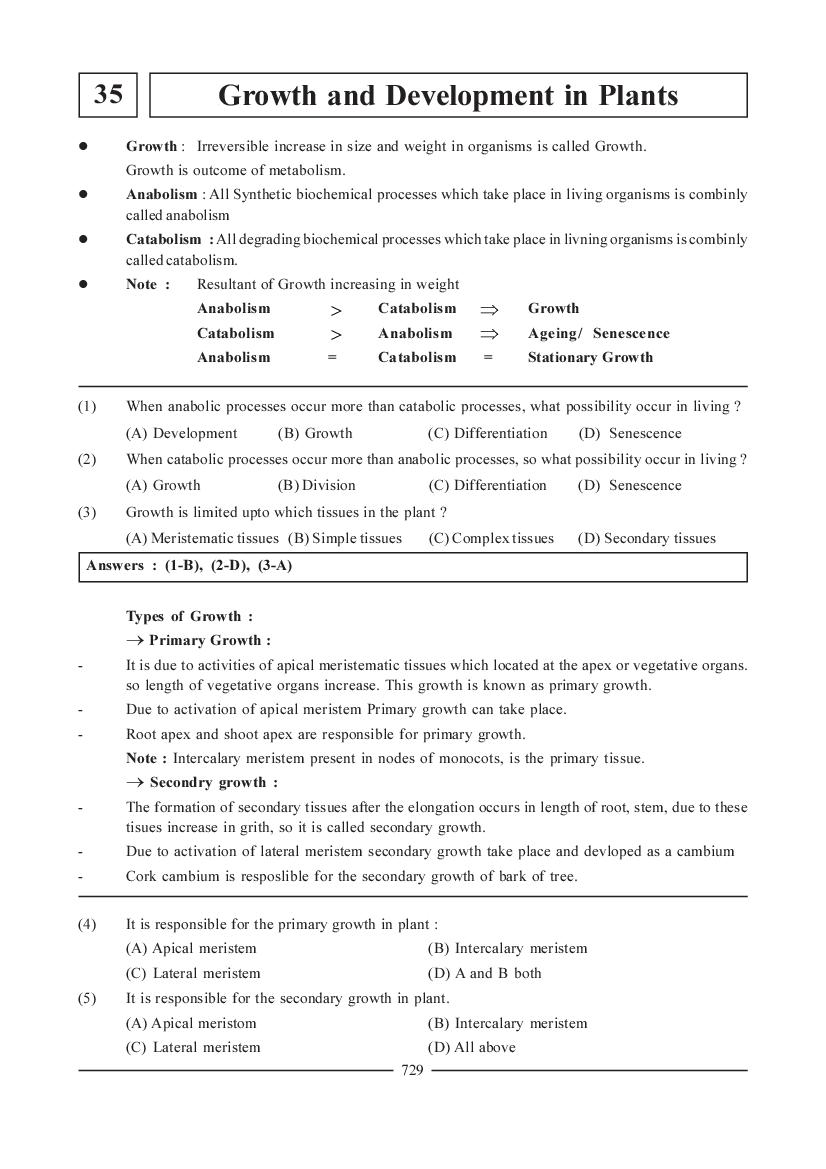
l Growth : Irreversible increase in size and weight in organisms is called Growth.
Growth is outcome of metabolism.
l Anabolism : All Synthetic biochemical processes which take place in living organisms is combinly
called anabolism
l Catabolism : All degrading biochemical processes which take place in livning organisms is combinly
called catabolism.
l Note : Resultant of Growth increasing in weight
Anabolism ! Catabolism Growth
Catabolism ! Anabolism Ageing/ Senescence
Anabolism = Catabolism = Stationary Growth
(1) When anabolic processes occur more than catabolic processes, what possibility occur in living ?
(A) Development (B) Growth (C) Differentiation (D) Senescence
(2) When catabolic processes occur more than anabolic processes, so what possibility occur in living ?
(A) Growth (B) Division (C) Differentiation (D) Senescence
(3) Growth is limited upto which tissues in the plant ?
(A) Meristematic tissues (B) Simple tissues (C) Complex tissues (D) Secondary tissues
Answers : (1-B), (2-D), (3-A)
Types of Growth :
® Primary Growth :
- It is due to activities of apical meristematic tissues which located at the apex or vegetative organs.
so length of vegetative organs increase. This growth is known as primary growth.
- Due to activation of apical meristem Primary growth can take place.
- Root apex and shoot apex are responsible for primary growth.
Note : Intercalary meristem present in nodes of monocots, is the primary tissue.
® Secondry growth :
- The formation of secondary tissues after the elongation occurs in length of root, stem, due to these
tisues increase in grith, so it is called secondary growth.
- Due to activation of lateral meristem secondary growth take place and devloped as a cambium
- Cork cambium is resposlible for the secondary growth of bark of tree.
(4) It is responsible for the primary growth in plant :
(A) Apical meristem (B) Intercalary meristem
(C) Lateral meristem (D) A and B both
(5) It is responsible for the secondary growth in plant.
(A) Apical meristom (B) Intercalary meristem
(C) Lateral meristem (D) All above
729
Page 2
(A) Apical meristem (B) Intercalary meristem
(C) Lateral meristem (D) All above
(7) It is responsible for secondary growth which located at .........
(A) Shoot apex (B) Root apex
(C) Internode (D) In form of cork cambium below the bark of tree.
Answers : (4-D), (5-C), (6-B), (7-D)
Growth rate:The increared growth per unit time is termed as growth rate
S - Shaped Growth curue:
- Initially, the rate of growth in plant is slow. Then it increases very rapidly. In course of time, it again
slows down.
- Suppose we draw a graph of growth rate raised on the increase in number of cells against time taken.
such a graph will be a typical s-shaped graph.
Stationary Phase
(CS = Sigmoid curve).
Size/Weight of the organism
- After an initial period of slow growth rate,
An exponential period of growth follows and
finally a stable state of growth occurs.
e
has
- Note : such a graph of growth is obtained
lP
tia
for growth of an organism and that of a
nen
population also parameters other than an po Lag phase
Ex
increase in the number of cells can also be used
in measurement of growth
Time
Growth Curve
(8) S-Shaped growth curve and grand period of growth is changed by which factor ?
(A) Suddenly change in intensity of light
(B) Change occur in temperature
(C) increase - decrease in relation to light and temperature
(D) No effects of given factors on it.
(9) It is correct order of stages of s-shaped growth curve ?
(A) Initial growth stage, stationary growth stage, Exponential growth stage.
(B) Stationary growth stage, Initial growth stage, Exponential growth stage.
(C) Initial growth stage, Exponential growth stage, stationary growth stage.
(D) Exponential growth stage, stationary growth stage, initial growth stage.
(10) What is the parameter for sigmaid curve graph ?
(A) Glowth of population (B) Numberof cell (C) Size of organism (D) All above
Answers : (8-D), (9-C), (10-D)
Phases of Growth :
® Phase of cell division (Formation of Meristematic) : The meristematic cells located in shoot
apex and rootapex divide repeatedly and continuously and add new cells.
730
Page 3
cellulose
- Faster rate of metabolism occurs in them.
® Phase of cell enlargement (Elongation) : In this phase, the new cells formed through cell
divisions increase in size.
- The volume of cells increases. The growth in cell wall is mainly responsible for such enlargement.
The size of vacuole in the cell also increases.
® Phases of cell differentiation (Maturation) : The cells assume forms based on their functions.
Their size and form become permanent
- They become associated with the constitution of various tissues
- The phase of becoming differentiated is called differentiation phase.
Grand period of growth: The entire period covering the period from cell division to cell
differentiation is called grand period of growth.
(11) What is characteristics of cells which is situated in divisional region ?
(A) Dense cytoplasm (B) Large nucleus (C) Rapid metabolic rate (D) All above
(12) In which stage of growth size of vacuole increases ?
(A) In stage of cell differentiation (B) In stage of cell division
(C) In stage of cell expantion (D) None of the above
(13) It is characteristic of cell which is situated in cell differentiation stage ?
(A) Growth of cell wall (B) Cells assume forms based on their functions
(C) Cells posses dense protoplasm (D) Cells possess large nucleus
(14) In which stage of growth cells obtain various tissue structure ?
(A) In stage of cell division (B) In stage of cell enlargement
(C) In stage of cell differentiation (D) All above
Answers : (11-D), (12-C), (13-B), (14-C)
Factors affecting Growth :
Water : It is essential for turgidity of cells undergoing growth. Water is also required as a medium
for various biochemical processes
Oxygen: Oxygen is inevitable for respiration
Temperature : proper temperature is required for germination. Normally the optimum range is
between 28 C and 30 C.
Light : Light is required for photosynthesis. Food is prepared in this way.
Nutrients : Availability of proper amount of nutrients is required for plant growth. The materials and
energy required for synthesis of Protoplasm are
obtained from the nutrients. Deficienty of various ìÞØåýÀ
Indicator
nutrients and various kinds of stresses hinder the
process of growth.
Measurement of Growth: Measurement by scale or
tape, number of branches, number of leaves, measured ÃßÃÍí
Pulley
by dry weight, measured by arial expansions.
- Specific Growth-measurement Method :
- Method of ArC - Auxanometer : Øùßí
Thread
±Ãþ ÀìáÀë
Apical bud
- One end of a thread is tied to the apical bud area of
ArchÇëÕ
the plant. The thread is then passed over a pulley äÉÞ
Weight
which is attached to the apparatus and suspended by VË"LÍ
Stand
a weight attached to the other end of the thread
731
Page 4
- As growth occurs, the weighed end of the thread is lowered.
- As this happens, the indicator also moves along the arch.
- The distance is measured at proper time-intervals and growth is calculated.
(15) What is an optimum temperature of germination ?
(A) 300C to 350C (B) 280C to 300C
(C) 250C to 300C (D) 200C to 250C
(16) Which of the following supplies material and energy for synthesis of cytoplasm ?
(A) Light (B) Oxygen (C) Nutrients (D) Water
(17) It is not correct option for Arc-Growth measurement.
(A) One end of thread tied with apical bud.
(B) Second end of thread passes on the indicator.
(C) Second end of thread hanging weights
(D) When growth occurs weight end moves downward.
Answers : (15-B), (16-C), (17-B)
Development: Development is a term that includes all changes that an orgamism goes through
during its life cycle from germination of seed to senescence.
- Growth, differentiation and development are very closely related events in the life of a
plant.
- Development in plants is under the control of two factors
- (i) Internal Factors (ii) Externel cellular factors
(i) Internal cellular Factors (Genetical control) or Intercellular plant growth regulators
(ii) External cellular factors"- Light, temperature, water, oxygen, nutrients etc.
(18) In plant genetic regulation of growth is which type of regulation ?
(A) Intercellular (B) Intracellular (C) External factor (D) A and B both.
(19) Regulation by growth regultors is known as .........
(A) Intercellular (B) Intracellular (C) External factor (D) None of above.
(20) It is affected to development of growth by means of external factor. ?
(A) Nutrients (B) Gene (C) Growth regulatory (D) All above
Answers : (18-B), (19-A), (20-A)
Plant - Growth Regulators :
- They are conducted to some specific regions and influence growth occurring there or influence some
activities from specific place such influence may be either stimulatory or inhibitory such chemicals
are called plant growth regulators
- Properties :
- They are specific types of organic chemicals which produce from specific regions.
- Origin and activation loci of such chemicals differ.
- Effects are stimulatory or inhibitory
- Their amount decreases after the functions are over.
Note : PGRs are divided in five groups. Auxin, Gibberrelin, cytokinin, Ethylene and Abscisic acid
732
Page 5
- Growth inhibitors group: Ethylene, Abscisic acid.
(21) PGRs is ....... .
(A) Small molecules of diverse chemical composition.
(B) Simple molecules of diverse chemical composition.
(C) Special Organic Chemicals
(D) All of the above
(22) It is not a characteristic of PGRs.
(A) They are formed in specific regions.
(B) Origination and funcations differ.
(C) They are stimulatory or inhibitory.
(D) They are complex molecules of derivatives of chemical substances.
(23) It is a group of growth regulators.
(A) ABA, Ethylene, Cytokinin (B) Auxin, Gibberrelin, Cytokinin
(C) ABA, Ethylene, (D) Ethylene, Cytokinin, Gibberrelins.
(24) It is group of growth inhibitiors.
(A) ABA, Ethylene, Cytokinin (B) Auxin, Gibberrelin, Cytokinin
(C) ABA, Ethylene, (D) Ethylene, Cytokinin, Gibberrlins.
Answers : (21-D), (22-D), (23-B), (24-C)
Auxins: It was first isolated from human urine.
Naturel Auxins: IAA (Indole - Acetic Acid), IBA (Indole- Butyric acid)
Synthetic Auxins: 2-4-D (2-4 Dichloro phenoxy acetic acid)
NAA (Napthalene Acetic Acid)
Effects of Auxins: Dominancy of adventitious roots and apical bud.
- Induce the formation of seedless fruit
- Stimulate the process of floweling
- Stimulate the respiration process
- Stops premature fall of leaves and fruits
- Regulates phototropic movement of plant organs.
- Acts as weed-controllers and weed - eradicators
- Are useful in stimulating cell division in tissue-culture also.
(25) It is natural auxins.
(A) IAA, NAA (B) IAA, IBA (C) IBA, 2-4-D (D) 2-4-D, NAA
(26) It is synthetic auxins.
(A) IAA, NAA (B) IAA, IBA (C) IBA, 2-4-D (D) 2-4-D, NAA
(27) Which is the use of synthetic auxin ?
(A) Regulation of cell enlargment (B) Weed - regulators
(C) Decrease the dominancy of axillary bud (D) Maintain chrophyll in leaves.
(28) It is used for stimulation for cell divison in tissue culture.
(A) 2-4-D (B) ABA (C) GA (D) IBA
733
Page 6
(A) NAA (B) IBA (C) 2-4-D (D) ABA
(30) Which growth regulator is used commonly for tea crop ?
(A) Ethylene (B) Gibberelin (C) Cytokinin (D) Indol-3-Acetic acid.
Answers : (25-B), (26-D), (27-B), (28-A), (29-C), (30-D)
Gibberrelins : This hormone was discovered during the investigation of disease in paddy for which
gibberrela fungus is responsible (Discovered In Japan)
- The disease was named 'bakane' which means 'foolish plant'
Characters of infected plant : Abnormally long, yellow, thin and normally sterile.
- This happens due to the disease induced by secretion of gibberrela fungus. Their secretion is called
gibberrelin.
Plant's Gibberrelin : From the Fungi and other higher plants more than hundred (100) different
kinds of gibberrelin have been discovered which are known as GA1, GA2, GA3....etc.
- All kinds of gibberrelins are acidic in nature.
- Their synthesis is higher in darkness.
Effects of Gibberrelins:
- Remove the expression of genetic dwarfism
- Induce elongation of stem. The internodes develop longer
- They also increase leaf area.
- Mobilization of storage compounds during germination that stimulates activation of embryo.
- Responsible for removal of dormancy of buds and seeds.
- They stimulate synthesis of various enzymes which activate the embryo.
- Induce flowering in some plants.
(31) Which of the following is responsible for cell Enlargement in inter nodes ?
(A) Gibberrelin (B) Ethylenc (C) Cytokinin (D) IAA.
(32) When gibberrelic acid gives stimulation for flowering ?
(A) In situation of long day in angisperms
(B) In situation of short day in long day plants
(C) In situation of long day in short day plants
(D) During night in dayneutral plant.
(33) It is discoverd from foolish plant of paddy.
(A) Indole-3-acetic acid (B) Ethylene (C) Gibberrelin (D) Kinetin.
(34) Which hormone is essential for change the genetic expression ?
(A) Cytokinin (B) Auxin (C) Gibberrelin (D) Ethylene
(35) It is an effect of gibberrelins.
(A) Induce germination by conduction of storage compound.
(B) Maintainance of chlorophyll in leaves.
(C) Induce respiration process.
(D) Produce adventitious root.
Answers : (31-A), (32-B), (33-C), (34-C), (35-A)
734
Page 7
- It was first discovered as kinetin (a modified form of adenine- purine) from the sperm of herring fish.
- A substance called zeatin, having effects similar to that of cytokinin was obtained from maize grain
as well as from coconut milk.
Effect of cytokinin :
- Stimulate the processes of cell division cell enlarglement and cell differentiation.
- Reduce apical dominance.
- Retain chlorophyll in leaves.
- Translocate nutrients and organic substances.
Note: Kinetin hormone gives remarkable effect of cell division.
(36) It is gained from water of coconut ?
(A) Kinetin (B) Zeatin (C) Auxin (D) Gibberrelin.
(37) Which hormone treatment is neccessary to keep picked flowers and cut vegetables for long time ?
(A) Gibberrelin (B) Auxin (C) Ethylene (D) Cytokinin.
(38) From which kinetin is first discovered ?
(A) From human urine (B) From herring fish
(C) From fruit of cotton (D) From plant of paddy
(39) What is Kinetin ?
(A) Active form of guanine Nitrogen base (B) Derivative form of cytosine Nitrogen base
(C) Derivative form of adenine Nitrogen base (D) Active form of thimine Nitrogen base
Answers : (36-B), (37-D), (38-B), (39-C)
Abscisic Acid (ABA) : Discovery: It was first discovered as a substance inducing fall of cotton
fruits.
Effects of Abscisic Acid: Preventing plant metabolism.
- Stimulate abcission process
- Inducing buds dormancy
- Under the condition of water stress, it stimulates the process of closing of stomata.
- It inhibits seed germination and the development of isolated embryo
- Resistance to stress conditions
Note : Abscisic acid act as a vegetative growth inhibitor hormone.
(40) If ABA is more given to plant, ............
(A) Increase the area of leaves (B) Increase in length of stem
(C) Closing of stomata (D) Increase in length of root.
(41) It stimulate the closure of stomata of leaf in water stress condition.
(A) ABA (B) IAA (C) GA (D) Ethylene.
735
Page 8
(A) IAA (B) 2-4-D (C) ABA (D) GA
Answers : (40-C), (41-A), (42-C)
Ethylene (Volatile hormone):
- It is a simple gaseous plant growth regulator, It is volatile in nature.
- Its concentration remains high in tissues undergoing senescence and in the ripening fruits.
Effects Ethylene:
- It inhibits the length wise growth in root, stems and leaves.
- It induces senescence in plants
- It induces leaf fall and fall of flowers.
- It stimulate the process of ripening of fruits.
- It induces drooping of leaves and flowers.
(43) In which amount / ratio of ethylene is higher ?
(A) In green banana (B) In green apple
(C) In ripen mango (D) In healthy patato.
(44) Plant growth regalator which gives triple response ?
(A) IAA (B) ABA (C) C2H4 (D) GA3
(45) In pea plant which growth regulator is responsible for stunted growth ?
(A) Gubberrelic acid (B) Auxin (C) cytokinin (D) Ethylene
Answers : (43-C), (44-C), (45-D)
Seed Dormancy:
- Seed dormancy is defined as a state in which seeds are prevented from germinating even under
favorable environmental condilions. For this various internal factors are responsible.
- During the period of dormancy, the growth of seed is arrested. Some seeds remain dormant for days,
while others remain dormant over month or even years.
Types of Seed dormancy : There are mainly four types :
(1) Exogenous dormancy (2) Endogenous dormancy
(3) Combinational dormancy (4) Secondary dormancy
(1) Exogenous Dormancy:
- It is caused by conditions outside the embryo and is often classified into three subgroups.
(a) Physical Dormancy: Which occurs when seeds are impermeable to water or to the exchange of
gases.
(b) Mechanical Dormancy: Mechanical dormancy occurs when seedcoats or other coverings are too
hard to allow the emtryo to expand during germination.
(c) Chemical Dormancy: Includes growth regulators that are present in the coverings around the
embryo.
(2) Endogenous Dormancy: Endogenous dormancy is caused by conditions within the embryo itself
and it is also often divided into the following subgroups.
(a) Physiological Dormancy: Physiological dormancy presents embryo growth and seed germination
until chemical changes occur.
(b) Morpholgical Dormancy: It Occurs when the embryos are not differentiated into different tissues
at the time of fruit ripening it means embryo is undeveloped or undifferentiated
736
Page 9
physilogical dormancy)
(3) Combinatonal Dormancy: This is both exogenous (Physical) and endogenous (Physiological)
conditions in some seeds
(4) Secondary Dormancy: The conditions that are not favorable for seed germination like high
temperatures causes secondary dormancy
(46) With the internal situation of embryo which type of dormancy occur ?
(A) Physical dormancy (B) Chemical dormancy
(C) Endogenous dormancy (D) Combinational Dormancy
(47) Which dormancy prevent the germination and embryo growth until the chemical changes ?
(A) Physiogical dormancy (B) Mechanical dormancy
(C) Chemical dormancy (D) Exogenous dormancy
(48) Which is responsible for the exogenous dormancy ?
(A) Presence of growth inhibitors surrounding coat of embryo.
(B) At time of fruit ripening. In various tissue differentiation does not take place
(C) Seed is impermeable for water or gaseous exchange.
(D) Internal situation of embryo is favourable.
(49) Mixed dormancy means .............
(A) Physiological, chemical (B) Chemical, combinational
(C) Physical, physiological (D) Physiological, Exogenous (physical)
Answers : (46-C), (47-A), (48-B), (49-D)
Various causes for seed dormancy:
- undeveloped embryo
- Seed coats impermeable to water
- Mechanically hard and strong seed coats which do not permit germination
- Physiologically immature embryo
- Presence of some germination inhibiting chemicals amongst them the main one is ABA
Note: GA is absent in dormant seeds. At this time ABA remains active, inhibits the transcription of
genes. As a result proper enzymes are not synthesized.
Removal of seed dormancy:
(1) Natural Method : When concentration of GA increases more tha ABA, effects of ABA
removed and embryo becomes active which results into removal of dormancy.
(2) Seed can scraped lightly with sandpaper. Thus, their seed coats become permeable to water
and germination is induced.
- A similar result can be achieved by using chemicals
- Soaked seeds in an O2 containing environment, can be provided with higher or lower temperature
for a definite period. Dormancy is removed is this way.
(50) It removes the effect of ABA.
(A) GA (B) IAA (C) CKN (D) 2 - 4 - D
(51) It is absent in dormant seed.
(A) C2H4 (B) ABA (C) GA (D) IAA
737
Page 10
(A) It inhibits translation (B) It obstract transcription
(C) It continues translation (D) It continues transcription.
(53) It is phenomenon which removes the effect of ABA.
(A) Continues process of trascription (B) Formation of specific enzynes occur
(C) Embryo can be activated (D) All of the above
Answers: (50-A), (51-C), (52-B), (53-D)
Seed Germination: The entire process from the sowing of the seed in the soil up to the emergence of a
young sapling from it is called seed germination.
Precondition: Available water, sufficent O2 and favourable temperature are preconditions for seed
germination
Sprouting: The seed, first of all, imbibes water. As the seed coats become loose, rapid absorption of water
occurs through the micropyle. Embryo becomes active. Digestion of food, either stored in endosperm
or with the help of proper enzymes. The developing embryo is nourished in this way. First or all, the
radicle of the embryo develops into a primary root which comes out from the micropyle This is
known as sprouting.
Stucture of rootsystems: This indicates initiation or germination of the primary root developed and forms
a root system.
Development of shootsystem: In the mean time, development of plumule also begins, shoot that is stem
and leaves, is formed through development of plumule.
- Growth related processes like cell division, cell enlargement and cell differntiation take place in
the formation of root system and shoot systems during germination.
- During the entire process a high respiratory rate is maintained.
- Some hormones are secreted and some enzymes become active.
Seed coat Pericarp
Plumule Endosperm
Hypocotyl radicle Cotyledon
Cotyledon
Calleoptile
Hypocotyl Plumule Stilt roots
W i t h r e d-
Seed coat hypocotyl Seed cotyledon Radicle Adventitious
Coat Hypocotyl Calearhiza First leaf
roots
Caleoptile
Primary root
Primary Secondary root Radicle
root Colerhiza Primary
Primary root root
Germination of bean seed
Germination of Maize Grain
Viviparous Germination: Mangrooves are a special type of
vegetation live in the bassein (creek) region around sea
Branch
shore. They exihibit a different kind of germination.
- The seed germinates while it is still in the fruit
Fruit
attaches to the parent plant.
- Later as the weight of sapling increases it drops
vertically straight into the mud and becomes anchored.
lateral roots. develop and proper establishment is Fruit
achieved. Such a germination is called - viviparous
Germination. eg. Rhizophora and Avicennia are the Radicle
examples.
Viviparous Germination
738
Page 11
(A) Avaibility of water (B) Sufficient O2
(C) Favourable temperature (D) All of the above
(55) By which process seed absorb water ?
(A) Osmosis (B) Imbibition (C) Diffusion (D) Absorption
(56) Sprouting means ...........
(A) Root formation from radicle
(B) Formation of primary root from radicle and it comes out from the micropyle.
(C) Formation / development of shoot system from plumule.
(D) Dormant seed becomes active.
(57) During the embryo development first leaf and coleoplile produce one sturucture is called .....
(A) Primary structure (B) Coleoptile (C) Prop root (D) Plumule axis
(58) (i) With this initiation of plant growth occurs
(ii) After the completion of this stage essential factors for growth are avalibable (iii) Removal of
seed coat first out growth / development of shoot apex can take place.
(A) (i) Seed coat, (ii) Seed germination (iii) First leaf
(B) (i) Dormancy, (ii) Seed germination (iii) Seed coat
(C) (i) Seed germination (ii) Dormancy period (iii) Seed coat
(D) (i) Seed germination (ii) Dormancy period (iii) First leaf
(59) In rhizophora which type of seed germination is seen ?
(A) Epigeal seed germination (B) Hypogeal seed germination
(C) Viviparous germination (D) Vernalization
Answers : (54-D), (55-B), (56-B), (57-B), (58-D), (59-C)
Senescence:
It is a period between complete maturation of an individual and the death of that individual and it
is also knownes 'aging'.
- Changes ocours during senescence:
- High rate of catabolism -There is depreciation in the organ and in the body.
- Efficiency decreases -It seems that hormones influences this proces
(i) Types of Senescence :
Senescence of entire body : It affects the individuals organs as well as the entire body. All organ
are involved eg. Annual plants like wheat and other cereals.
(ii) Sencescence of aerial Shoots: In this biennial plants, the aerial shoot experiences this. External
portion from above ground like flower and fruit, after formation they die and underground portion
devolops new shoot at next year. e.g. Banana, Ginger etc.
(iii) Sequencial senesence: This type of sencescence occurs in perennial plants, in which branches of
stem becomes meristematic and devolop and formation of new organs like flower, fruit, leaf occurs
when old organs such as the branches and leaves fall down. eg. mango, eucalyptus, Cassia etc.
Abcission: The phenomenon of dropping of leaf, flower and fruit is called abscisssion
- The amount of auxin is high in healthy leaf
- During the sencescence decreases the amount of auxin and ABA, ethylene like growth inhibitors are
increases.
- Under their influence, the middle lamella which is made up of pectin and which connects th cellulose cell
wall, become degraded with other accompanying degradatory activities, the abcission layer develops.
- The cells in this layer undergo degradatory process and become weak. As a result, at proper time
the leaf, flower or the fruit breaks.
739
Page 12
(A) Senescence of entire plant (B) Senescence of aerial shoot
(C) Sequential senescence (D) All of the above
(61) In which plant senescene of aerial shoot can be seen ?
(A) In annual plants (B) In biannula plants
(C) In perennial plant (D) A and B both
(62) In healthy leaf which hormone is present in more amount ?
(A) Cytokinin (B) Gibberrelin (C) Auxin (D) Ethylene
(63) In yellowing of leaf which hormone is in more amount ?
(A)ABA (B) C2H4 (C) GA (D) A and B both
Answers : (60-A), (61-B), (62-C), (63-D)
Photoperiodism: In the development of plants process of flowering response to the stimulus of
period of available light by plants is called photoperiodism.
- The period for which light is available has a remarkable influene on flowering.
- Classtication of plant on basis of sensention of light availbility.
(i) Long day plants: Some plants required a longer period of light to come into flowering, such plants
are called-long day plants eg : wheat, poppy, Oat, Beet are long day plants.
(ii) Short Day plants: Some plants require a shorter period of light to flower. Such plants are called
short day plants. Soyobean, xanthium etc are short day plants.
(iii) Day- Neutral plants: In some other plants the period of available light does not have any influence
on their flowering. Such plants are called - day neutral plants. Tomato, cucumber and Maize etc
are any day neutral plants.
Note: For a photoperiodic response, the continuity of the period of available light and its following
period of dark is inevitable. When mendatary period of dark breaks the continuity of light period in
the long day plants or such a period of light breaks the continuity of dark period in the short day
plants. The response of flowering to this stimulus is not observed.
- It is believed that some specific pigment (Phytochromes) as well as some specific hormone is
responsible for this process.
(64) Phytochrome pigment is related to ..... photonastism
(A) Photoperiodism (B) Photorespiration
(C) Photonastism (D) Geotropism
(65) In which plants phytochrome is found ?
(A) Algae (B) Fungi (C) Flowering plants (D) A and B both
(66) When a mendatary period of light is given in dark duration to short day plant ?
(A) Flowering response is not seen
(B) Spontaneous flowering take place
(C) In that season flowering is more
(D) It is converted from short day to long day plant.
(67) What is responsible for responsse of photoperiodism ?
(A) Leaf (B) Bud (C) Shoot apex (D) Flower
(68) Most of the plant produce flowering in season which situation is responsible for this ?
(A) Photonastism (B) Photoperiodism (C) Photosynthesis (D) Photorespiration.
Answers : (64-A), (65-C), (66-A), (67-D), (68-B)
740
Page 13
- Better and earlier germination is induced when seeds are provided with specific low
temperature for a definite period of time. Flowering is also earlier in the plants which develop
from them. This artificial treatment is called Vernalization.
- Seeds of Wheat, Paddy, Millet and Cotton are provided low temperature between 10C to 100C
and earlier end higher yield of crop is obtained.
- Plants growing under natural conditions must get low temperature for a specific period.
- Only then, they come into flowering. This natural uncertainty can be avoided by vernalization
and timely yield can be obtained.
(69) Low temperature treatment given to seed and get rapid germination that method known as ........
(A) Photoperiodism (B) Vernalization (C) Thermonasty D) Phototropisrm.
(70) How much temperature is given to cotton seed so it give yield in proper time ?
(A) 100C to 150C (B) 150C to 200C
(C) 10C to 100C (D) 250C to 300C
(71) By which process the natural uncertainity for flowering is removed ?
(A) Photoperiodism (B) Photorespiration
(C) Nutation D) Vernalization.
(72) Which hormone is responsible for vernalization ?
(A) Auxin (B) Gibberrelin
(C) Vernalin (D) ABA
Answers : (69-B), (70-C), (71-D), (72-C)
Plant Movements
¯
¯ ¯
Locomotory movement Curvature movement
¯ ¯
¯ ¯ ¯ ¯
Autonomous Induced Autonomous Induced
movement movement movement movement
¯ ¯
¯ ¯ ¯ ¯ ¯ ¯
Phototaxis Chemustaxis Thermotaxis Thigmotaxis
Tropism Nastism
¯ ¯ ¯ ¯
Amoeboid Ciliary Circulatory Rotational
movement movement movement movement
¯ ¯ ¯ ¯ ¯
Epinasty Hyponasty Nutation Circumnutation Variation
¯ ¯ ¯ ¯
Phototropism Geotropism Hydrotropism Thigmotropism
¯ ¯ ¯ ¯
Photonastay Thermonasty Hydronasty Thigmonasty
741
Page 14
- Such a movement can be that of the protoplasm, or an organ or the entire organism
- There are two main kinds of movements of locomotion
(1) Autonomous and (2) Induced locomotion
(1) Autonomous movement:
- No external factor is responsible for causing this type of movements.
(i) Amoeboid movement : Plosmodia of slimemold
(ii) Cillary movement: Chlamydomonas algae
(iii) Circulatory movement: Cytoplasm in Tradescantia anther
(iv) Rotational movement: Cytoplasm in Hydrilla leaves
(2) Induced Movement:
- The induced movements of locomotion are caused as a response to the external stimulus
- Such a locomotory movement inducing a change of place called Taxis.
(i) Phototaxis : Zoospore of Volvox.
(ii) Chemotuxis : Antherozoids of bryophytes and pteriodophytes.
(iii) Thermotaxis : Diatoms
(iv) Thigmotaxis : Zoospore in Oedogonium.
(B) Curvatuve Movements: Higher plants show the movements of curvatuve which help them to
orient their organ for their work efficiency. Uneven or unbalanced growth causes such a curvature.
These are two main kinds of movement of curvature
(1) Autonomous Movement:
- No external factor is responsible for causing such uneven growth.
(i) Epinasty: Growth ratio of upper surface is more then upper susface in leaves -open leaf blade.
(ii) Hyponasty: Growth ratio of lower surface is more then upper surface in leave closing of leaves.
(iii) Nutation: Zigzag movement in apicalbud of stem.
(iv) Circumnutation: Spiral and helical growth of shoot in climbers and tendrilar plants.
(v) Variation: Pulsation in leaflets of Indian telegraph plant (Desmodium gyrans)
(2) Induced Movement:
- The induced movement of curvature are caused as a response to the external stimulus. There are
two types (i) Tropism and (II) Nastism
(i) Tropism or Tropic movements: If the movement of curvatuve in a plant organ is induced by an
external and directional stimulus, it is called tropism The curuature induced by tropism is having a
directional relationship with the direction of the stimulus. Kinds of tropism are derived on the basis
of the directional stimulus.
742
Page 15
- Stem shows positive phototropism and root shows negative phototropism. Oat coleoptiles.
(b) Geotropism : (By gravitation)
- Stem shows negative geotropism and root shows positive geotropism- Radicle of maize seedling.
(c) Hydrotropism (By Water):
- Roots of higher plants.
(d) Thigmotropism: (By Touch) - Coccinia
(ii) Nastism or nastic Movements:
- This kind of movement depends on the presence and intensity of external stimulus It is not
neccessary that it should affect from any definite direction. Based on the external stimulus these
movements are called - Nastism
- Based on the external stimulus these movements are called
(a) Photonasty: The flowers in lotus and suflowers open in the morning.
(b) Thermonasty: Flowers of crocus and Tulip open at higher temperature.
(c) Hydronasty: Plants show nastism through heavy rain and water flow.
(d) Thigmonasty: The leaves of Drosera and Mimosa close and droop when they are touched.
(73) In which amoebiod movement is found ?
(A) Plasmodia of slime mold (B) Chlamydomonas algae
(C) Stamen of tradescantia (D) Leaf protoplasm of Hydrilla
(74) Which type of movement is found in cytoplasm of hydrilla leaf ?
(A) Amoebiod (B) Thigmotropism
(C) ciliary (D) Circumnutation.
(75) It is correct movemt for zoospore of oedogonium ?
(A) Photonasty (B) Thigmotropissm (C) Chemotaxis (D) Thigmonasty
(76) Where thermotaxis is found ?
(A) Diatoms (B) Slime mold
(C) Male gamete of bryophyte. (D) Coccinia
(77) Spiral and helical growth of shoot of climbers and tendrilar plants is the example for ..........
(A) Epinasty (B) Hyponasty
(C) Nutation (D) Circumnutation
(78) Variation movement is shown by
(A) Desmodium gyrans (B) Coccinia
(C) Coleoptile of oat (D) Radicle of maize seed germination
(79) Which plant leaflet show pulsation ?
(A) Desmodium gyrans (B) Tulip and crocus
(C) Sunflower and lotus (D) Coccinia
(80) Which type of tropism is found in coleoptile of oat.
(A) Phototropism (B) Hydrotropism
(C) Thigmotropism (D) Mimosa
743
Page 16
(A) Phototropism (B) Hydrotropism (C) Thigmotropism (D) Geotropism
(82) It shows thigmotropism.
(A) Coleoptile of oat (B) Coleorhiza of barley
(C) Coccinia (D) Mimosa
(83) It shows photonasty.
(A) Flowers of crocus and tulip
(B) Flowers of lotus and sun flower
(C) Drosera and mimosa
(D) Leaves of Desmodium gyrans
(84) Its flowers open at high temperature.
(A) Sunflower (B) Lotus (C) Tulip (D) Coccinia
(85) A phenomenon due to turgidity opening of stomata is ..........
(A) Photonasty (B) Hydronasty (C) Thigmonasty (D) Thermonasty
(86) Flowers of sunflower and lotus opens at morning.
(A) Photonasty (B) Thermonasty (C) Hydronasty (D) Phototaxis
Answers : (73-A), (74-D), (75-B), (76-A), (77-D), (78-A), (79-A), (80-A), (81-D), (82-C), (83-B),
(84-C), (85-B), (86-A)
· A - Assertion R - Reason types of questions
Choose the correct option which given below for following questions.
(A) A and R both are correct while R is a correct explanation of A.
(B) A and R both are correct but R is not correct explanation of A.
(C) A is correct but R is wrong
(D) A is wrong but R is correct.
(87) Assertion A : Gibberrelin is neccessary for flowering in long day plants.
Reason R : If GA treatment is given to tall plant, they can be converted into dwarf plant.
(A) (B) (C) (D)
(88) Assertion A : In presense of ABA seed gemination of seed can be prevented.
Reason R : ABA is inhibitor for transcription process.
(A) (B) (C) (D)
(89) Assertion A : Ethylene is sprinkled on green fruits.
Reason R : Ethylene is neccessary for fruit ripening.
(A) (B) (C) (D)
(90) Assertion A : 2-4-D is useful for tissue culture method.
Reason R : During gemination 2-4-D conducts the storage compounds.
(A) (B) (C) (D)
(91) Assertion A : Cytokinin slows down the senescence.
Reason R : Ethylene is stimulates senescence
(A) (B) (C) (D)
(92) Assertion A : In S-Shaped growth curve three / stages have been found.
Reason R : Initial growth stage is called grand period of growth.
(A) (B) (C) (D)
744
Page 17
available light and inevitable continuation of dark period is essential.
Reason R : In photoperiod of long day plant for mendatary duration of darkness, flowering
respone found on high rate.
(A) (B) (C) (D)
(94) Assertion A : Vernalization is artificial process.
Reason R : Vernalizaion is a process in which entire plant is affected.
(A) (B) (C) (D)
(95) Assertion A : Inshort day plants need less light than the specific time period for flowering.
Reason R : In dark period of shortday plant, introducing of light for moment, response of
flowering is not found.
(A) (B) (C) (D)
(96) Assertion A : Cells of short apex and root apex is continuously divides.
Reason R : At the tip of the root apex and shoot apex apical meristematic tissue is present.
(A) (B) (C) (D)
(97) Assertion A : Wheat and other cereals are annual plant
Reason R : In them senescence found in all organs of the plant.
(A) (B) (C) (D)
Answers : (87-C), (88-A), (89-A), (90-C), (91-B), (92-C), (93-C), (94-B), (95-B), (96-A), (97-A)
· True (T) - False (F) Types Questions
Given statements are true or false choose the correct option.
(98) (1) In reference of physiology growth is resultant of metabolism.
(2) Anabolic is process of degradation.
(3) Catabolic is process of synthesis.
(4) Dry weight inereases as a result of growth.
(A) TFFT (B) FTTF (C) FTTT (D) TFTF
(99) (1) Rapid metabolic rate of cells is found in meristamatic regions.
(2) Nucleus size of cell increase in enlargment region.
(3) In maturation region, shape and size of the cell become permanent.
(4) Meristematic cells divides repidly which are arranged in shoot apex.
(A) FTTF (B) FFTT (C) TFTT (D) TFTF
(100) (1) Gibberrelin removes genetical dwarfness.
(2) Cytokinin maintain chlorophyll of leaves.
(3) Ethylene prevents the situation of stress.
(A) TTT (B) TTF (C) FTT (D) FFT
745
Page 18
(2) Auxin stimulates respiration.
(3) ABA inhibits stress situation.
(A) FFF (B) TTF (C) TTT (D) TFT
(102) (1) Seed absorb water by imbibition firstly.
(2) Primary root develops from the radicle and it comes out from micropyle.
(3) Sprouting is indication of initiation of seed germination.
(A) TTF (B) TTT (C) FTT (D) FFF
(103) (1) Phyto chrome pigment is responsible for the photoperiodism.
(2) Florigen hormone is responsible for the photo periodism.
(A) FF (B) TF (C) FT (D) TT
Answers : (98-A), (99-C), (100-B), (101-C), (102-B), (103-D)
(104) Column - I Column - 2
(I) Auxin (p) It act as a weedicide and weed (A) : (I - p), (II - q), (III - r)
regulator.
(II) Gibberrlin (q) Maintain the chlorophyll in leaves (B) : (I - r), (II - q), (III - p)
(III) Cytokinin (r) It is more synthesized in absence of light (C) : (I - p), (II - r), (III - q
(D) : (I - r), (II - p), (III - q)
(105) Column - I Column - 2
(I) IAA (p) Synthetic auxin act as a weedicide. (A) : (I - r), (II - q), (III - p)
(II) ABA (q) Inhibit plant physiology. (B) : (I - r), (II - p), (III - q)
(III) NAA (r) Stimalate process of flowering (C) : (I - p), (II - q), (III - r)
(D) : (I - q), (II - p), (III - r)
(106) Column - I Column - 2
(I) Primary growth (p) Growth to increase work efficienty (A) : (I - r), (II - p), (III - q)
in higher plants of organs. (B): (I - r), (II - q), (III - p)
(II) Secondary growth (q) Activation of lateral meristem that (C) : (I - q), (II - p), (III - r)
growth.
(III) Annual growth (r) Activation of apical meristem that (D) : (I - p), (II - q), (III - r)
growth.
746
Page 19
(I) Phase of cell (p) Cells having a dense cytoplasm, (A) : (I - p), (II - q), (III - r)
enlargement large nucleus
(II) Phase of call (q) Cells included in structure of (B) : (I - r), (II - p), (III - q)
differentiation various tissues
(III) Phase of cell (r) Increases in size of cell and (C) : (I - q), (II - r), (III - p)
division increase in size of vacuole (D) : (I - r), (II - q), (III - p)
(108) Column - I Column - 2
(I) More synthesis of Auxin (p) In helthy leaf (A) : (I - q), (II - p), (III - r)
(II) Less synthesis of Auxin (q) In senescence leaf (B) : (I - r), (II - p), (III - q)
(III) More amount of (r) During seed germination (C) : (I - q), (II - r), (III - p)
gibberrelin (D) : (I - p), (II - q), (III - r)
(109) Column - I Column - 2
(I) Short days plant (p) Rice, soyabean, Xanthium (A) : (I - p), (II - q), (III - r)
(II) Long day plant (q) Wheat, Barley, poppy (B) : (I - p), (II - r), (III - q)
(III) Day neutral plant (r) Tomato, cucumber, maize (C) : (I - r), (II - p), (III - q)
(D) : (I - q), (II - p), (III - r)
(110) Column - I Column - 2
(I) Epigeal seed germination (p) Avicennia, Rhizophora (A) : (I - p), (II - q), (III - r)
(II) Hypogeal seed germination (q) Bean pea (B) : (I - r), (II - p), (III - q)
(III) Viviparous germination (r) Wheat, Maize (C) : (I - q), (II - r), (III - p)
(D) : (I - p), (II - r), (III - q)
(111) Column - I Column - 2
(I) Thigmotaxis (p) Drosera (A) : (I - p), (II - q), (III - r)
(II) Thigmotropism (q) Coccinia (B) : (I - r), (II - p), (III - q)
(III) Thigmonasty (r) Zoospore of oodogonium (C) : (I - q), (II - p), (III - r)
(D) : (I - r), (II - q), (III - p)
Answers : (104-C), (105-A), (106-B), (107-D), (108-D), (109-A), (110-C), (111-D)
(112) Diagram shows germination of which plant group ?
(A) Mangroove (B) Gymnosperm
(C) Pteridophyta (D) Bryophyta.
(113) True habitat of plant which shows germination in given diagram ....... .
(A) Grassland (B) Creek area of sea shore
(C) Mountain area (D) Wetland area
747
Page 20
(A) A = Radicle, B = Branch, C = Fruit (B) A = Fruit, B = Radicle, C = Branch,
(C) A = Fruit, B = Branch, C = Radicle, (D) A = Branch, B = Fruit, C = Radicle.
(115) Which is true plant group for given germination ?
(A) Bean, pea (B) Rhizophora, Bean (C) Wheat, maize (D) Rhizophora, Avicennia
Answers : (112-A), (113-B), (114-C), (115-D)
l Questions for PMT - NEET
(116) 2-4-D agent means.
(A) Insecticide (B) Weedicide (C) Pneumatocide (D) Pesticide
(117) 6-furfuryle aminopurine, 2-4- dichlorophenoxy acetic acid and Indole-3 acetic acid are examples of
........ respectively.
(A) Synthetic auxin, kinetin and natural auxin (B) Gibberrelin, natural auxin and kinetin
(C) Kinetin, synthetic auxin and natural auxin (D) Natural auxin, Gibberrelin and kinetin.
(118) Which process is not affected when amount of auxin decreases ?
(A) Hypopulsatory of leaves
(B) Entrance of root in ground
(C) Movement of sunflower in direction of sunlight
(D) Movment of shoot in direction of sun.
(119) Hormone is responsible for phototropism.
(A) Auxin (B) Gibberrelin (C) Cytokinin (D) ABA
(120) Treatment of which hormone induce parthehogenesis ?
(A) Ethylene (B) Auxin (C) Kinetin (D) Cytokinin
(121) Which hormone is not found in plants ?
(A) 2-4-D (B) GA2 (C) Gibberrelin (D) IAA
(122) Who discovered auxin ?
(A) Thiamann (B) Went (C) Butlar (D) Skoog.
(123) Mostly dormant seeds are found in Leguminous plant, because ......
(A) less developed embryo (B) hard seed coat
(C) Absence of cytokinin (D) Absence of GA3
(124) Rhizokalin is excess hormone, which is synthesied in .......
(A) Seed coat (B) Root (C) Leaf (D) Stem
(125) Climachteric effect means .............
(A) Ripening process of fruit (B) effect of environment of growth.
(C) Yellowing of leaves mostly in plant (D) Process of dropping of flowers of plant.
(126) A substane which regulate the other organs growth rate and originate from shoot apex and root apex
of plant, what is it ?
(A) Enzyme (B) Hormone (C) Vitamin (D) Nutritional substance.
(127) During the whole year for getting the fruit of pineapple which treatment is given to plant ?
(A) NAA, 2, 4-D (B) Phynyl acetic acid (C) Cytokinin (D) IAA, IBA
748
Page 21
(A) No leaf fall is there.
(B) Leaf fall occur at regular time interval.
(C) During year proper amount of atmospheric moisture is available
(D) effect of cold atmosphere.
(129) Where is active cell division found ?
(A) In medulla region (B) In cortex region
(C) In internode region (D) In shoot apex and root apex.
(130) It is a function of phytotron.
(A) Bombardment of electron (B) release protons.
(C) Plants grows in restrictive atmosphere (D) Mutation occur in plants.
(131) When itiolation is found in plants ?
(A) When plant grow in dark (B) When deficiency occur due to mineralnutrition
(C) When more intensity of light (D) When plant grow in green light
(132) Sowing of seed in ground at depth can not grow well because ........
(A) Lack of light (B) lack of water
(C) lack of oxygen (D) absence of nutrients.
(133) Dendrocronology means ......... .
(A) Secondary growth (B) Development of shoot
(C) Biological Phenology (D) To measure age of tree.
(134) Identity substance from given structure ? CH2 COOH
(A) IAA (B) ABA
(C) GA3 (D) CKN
N
(135) Which pair is not correct ? H
(A) ABA - closistomata (B) GA - Leaf fall
(C) CKN - cell division (D) IAA - cell wall growth.
(136) How seedless tomato can be produce ?
(A) Sowing seed which is vernalized
(B) Seed is treated by phenyl mercuric acetate and then sowing
(C) Removal of another before pollen releases
(D) Plant is treated by auxin and gibberrelin.
(137) Gibberrelin stimulate seed germination because ......... .
(A) It stimulates celldivision (B) It produces the hydrolase enzymes of.
(C) It produces ABA (D) From the hard seed coat water is also absorbed.
(138) During seed germination amylase enzyme is produced in response to ..........
(A) Auxin (B) Gibberrelin (C) Kinetin (D) Ethylene
(139) By the treatment of which hormone rosette pattern of cabbage is changed.
(A) Gibberrelin (B) 2-4-D (C) ABA (D) IAA.
(140) Who proposed the word cytokinin ?
(A) Yabuta (B) Brown (C) Latham (D) Fitting.
(141) Choose correct sentances from following.
(1) Senescence is removed by cytokinin.
(2) Auxin is responsible for the apical dominance.
(3) Ethylene is neccessary for seed germination.
(4) Gibberrelin induce immature leaf fall.
(A) 1 and 2 are correct (B) 1 and 3 are correct
(C) 1 and 4 are correct (D) 2 and 4 are correct
749
Page 22
decreases the yield. Thus, for the increase of crop yield which correct advice should be given to
farmer ?
(A) Remove all yellow leaves and spread 2-4-D on green leaves.
(B) Fe and Mg are given to plant thus synthesis of chlorophyll is increased.
(C) Frequently irrigation given to the farm
(D) Give treatment of N2 fertilizer with cytokinin.
(143) Who is proposed zeatin word ?
(A) Skoog (B) Letham (C) Miller (D) Yabota
(144) It is neccessary for flowering in short day plant.
(A) Gibberrelin (B) Cytokinin (C) Auxin (D) Ethylene
(145) For the ripening of fruits what is the suitable ratio of gases.
(A) 80% C2H4 and 20% CO2 (B) 80% CO2 and 20% CH2
(C) 80% CO2 and 20% O2 (D) 80% NO2 and 20% CO2
(146) Which acid is gained from carotenoids ?
(A) Indole butyric acid (B) Indole - acetic acid
(C) Abscisic acid (D) Gibberrelic acid
(147) What is morfectin ?
(A) Synthetic growth regulator (B) Synthetic auxin
(C) Synthetic gibberrelin. (D) Synthetic drugs.
(148) Which hormone is opposite for gibberrelin action ?
(A) Zeatin (B) Ethylene (C) IAA (D) ABA
(149) Which is mismatch pair ?
(A) Auxin : growth (B) Gibberrelin : Gibberrela fungi
(C) Cytokinin : DNA of sperm of herring fish (D) ABA : flowering.
(150) In plants biological clock is regulated by which ?
(A) Phytochrome (B) Cytochrome (C) Gibberrelin (D) A and B both.
(151) Some of plants are getting 12 hours light and 12 hours darkness so flowering can occur. Now in
these plants 12 hours of dark period is discontinued by introducing when light for mendetary period
that breaks flowering response. Thus these types of plants are called ..........
(A) Day neutral (B) Long day (C) Short day (D) Neutral darkness
(152) Some of the seedlings of tomato plants are kept in darkness for few days so most of the seedlings
show white colour this phenomenon is known as ......
(A) Etiolation (B) Defoliation (C) Mutation (D) Dehydration
(153) Soyabean gives flowering in winter season, because ............
(A) It is long day plant (B) It is short day plant
(C) It is day neutral plant (D) It is terresterial plant.
(154) One plant gives flowering three times in a year october, January, and July, so what you tell about this
situation ?
(A) It is photo sensible but not thermo sensible
(B) It is thermo sensible but not photo sensible
(C) It is not sensible for light and heat both.
(D) It is sensible for light and heat.
750
Page 23
reason is responsible for this phenemenon ?
(A) Buds of stem is attractive towards light.
(B) For the phototynthesis light is essential.
(C) Auxin is present in shoot apex due to that more cell elongation occur.
(D) More neccessity of photorespiration.
(156) In which plant, treatment is given by gibberelin so male flowers are converted into female flowers?
(A) Papaya (B) Banana (C) Cucumber (D) Coccinia
(157) One hormone is induced early seed germination in barley plant, second hormone respossible for
flowering in pineapple. and third hormone is inhibiting leaf senescence, give the name of hormones
respectively.
(A) Auxin, Gibberrelin and cytokinin (B) Gibberrelin, cytokinin and Auxin.
(C) Gibberrelin, Auxin and cytokinin (D) Auxin, cytokinin and Gibberrelin
(158) How fruit ripening process induced ?
(A) When fruit become ripen, water level should decrease in ground
(B) Surrounding the fruits increase the ratio of N2
(C) Surrounding atmosphere become warmly
(D) Artificial ethylene spread in atmosphere.
(159) Which pair is not related
(A) Adenine - Kinetin (B) Carotenoids - ABA
(C) Turpin - IAA (D) Gas - Ethylene.
(160) Which sentance is correct about phytochrome from following ?
(A) Phytochrome is plant growth regulator.
(B) Phytochrome is useful pigment in photosynthesis process.
(C) Phytochrome pigment stimulate growth process light based physiological.
and development.
(D) Phytochrome is restricted protein, which control dark-reaction.
(161) What is useful to check the viabillity capacity of seed ?
(A) 2, 6, dichloro phenol indo phenol (B) 2,3,5, triphenyl tetra sodium chloride
(C) DMSO (D) Safranin
(162) In internode of stem for the cell enlargement which hormone is responsible ?
(A) IAA (B) CKN (C) GA (D) Ethylene
(163) Process in which floral bud is converted into flower.
(A) Induced locomotion (B) Palatonic locomotion
(C) Autonomous movement (D) Induced movement.
(164) Which hormone is responsible for differntiation and organogenesis ?
(A) Auxin (B) Gibberrelin (C) Cytokinin (D) ABA
(165) Why coconut water is useful for tissue culture method ?
(A) Auxin (B) Ethylene (C) cytokinin (D) Gibberrelins.
(166) By which physical method, seed coat becomes permeable for the growth of embryo ?
(A) Bending (B) Degradation (C) Vernalization (D) through scrapping
(167) IAA is produced from derivatives of which amino acid ?
(A) Tryptophane (B) Tyrosine (C) Phenyl alanine (D) Serine
(168) Which hormonal treatment is given to plast to stop immature leat fall ?
(A) IAA (B) GA3 (C) CKN = Cytokinin (D) ABA
751
Page 24
(A) Phototropism (B) Photonasty (C) Phototaxis (D) Chemotaxis
(170) In which plant polyembryony of nucellus is found ?
(A) Citrus (B) Brassica (C) Malva (D) Yucca
(171) Which sentances are correct ?
(1) Gibbrerrelins is responsible for foolish plant.
(2) ABA is growth promotor hormone.
(3) Auxins and cytokinin are regulators of cell differentiation.
(4) Dormancy of axillary bud in cabbage is due to auxin.
(A) 1, 2 and 3 (B) 1 and 2 (C) 2 and 4 (D) 1 and 3
(172) Do mathes coulmns
Coulmn - 1 Coulmn - 2
(I) C-Darwin and F-Darwin (p) Cytokinin (A) : (I - s), (II - p), (III - r), (IV - t)
(II) Miller and Skoog (q) ABA (B) : (I - p), (II - r), (III - s), (IV - q)
(III) Letham (r) Zeatin (C) : (I - q), (II - p), (III - s), (IV - t)
(IV) Kurosuruva (s) Auxin (D) : (I - t), (II - r), (III - p), (IV - s)
(t) GA
(173) Mostly wax coating is done on apple, so that ....... .
(A) Colour can save against light
(B) Stop the aerobic respiration and O2 cannot enter in fruit
(C) Save from injury and stop the entry of ethylene
(D) Apple is seen bright and beautiful.
(174) In flowering plant senscence is active developmental process which indicate growth and functions
it is seen in ....... .
(A) Leaffall (B) Xylem vessel and vessel differntiated
(C) Annual plant (D) Floral parts
(175) In garden tendril of pea climb with support, this process is related to ....... .
(A) Thigmontasty (B) Thigmotaxis (C) Thermotaxis (D) Thigmotropism
(176) Flowering depending on cold, what is called ?
(A) Cryotherapy (B) Cryogenix (C) Cryoscopy (D) Vernalization
(177) What is the uses of clinostat instrument ?
(A) Osmosis measurement (B) Measure Velocity of growth
(C) Measure the rate of Photosynthesis (D) Measure the respiration rate
(178) What is useful for spinch vegetable to keep green for long period ?
(A) GA3 (B) CKN = Cytokinin (C) IAA (D) ABA
(179) Which hormone is used in place of vernalization ?
(A) Auxin (B) Cytokinin (C) Gibbrerelin (D) Ethylene
Answers : (116-B), (117-C), (118-A), (119-A), (120-B), (121-A), (122-B), (123-B), (124-C),
(125-A), (126-B), (127-A), (128-B), (129-D), (130-C), (131-A), (132-C), (133-D), (134-A),
(135-B), (136-D), (137-B), (138-B), (139-A), (140-C), (141-A), (142-D), (143-B), (144-A),
(145-A), (146-C), (147-A), (148-D), (149-D), (150-D), (151-C), (152-A), (153-B), (154-B),
(155-C), (156-B), (157-C), (158-D), (159-C), (160-C), (161-B), (162-A), (163-C), (164-D),
(165-C), (166-D), (167-A), (168-C), (169-B), (170-A), (171-D), (172-A), (173-B), (174-A),
(175-D), (176-D), (177-B), (178-B), (179-C)
752
Page 25
¯
¯ ¯ ¯ ¯
Growth Development Photoperiodism Vernalisation
l Irreversible permanent l Includes all changes that an It is the flowering Low temperature
increase in size of an organism goes through during response of plants to treatment of plants
organ or its parts or even its life cycle from seed periods of day/night to decrease the
of an individual call. germination to senescence. It phytochrome is the time period of
l Growth includes 3 phases involves differentitation, receptor pigment. vegetative phase
division, elongation and dedifferentitation and and to promote
maturation. redifferentitation of cells. early flowering.
¯ ¯
Growth Rate Growth Regulators
Increased growth per unit time is termed Chemical substances also called as phytohormones,
as growth rate. It is of two types. produced naturally in plants which regulate one or more
Arithemetic Growth physiological conditions.
®
After mitotic cell division only one Growth Promoters
daughter cell continues to divide ® Chemicals that increase growth of cells tissues or organs
while other differentates and
matures. ® Auxins : Weakly acidic hormone which induces
apical dominance, photoropism and geotropism
etc., Sequence of amino acids linked by peptide
® Both ofGeometric Growth
the daughter cells of
bonds.
mitotic cell division keep on ® Cytokinins : Basic hormone which promotes cell
dividing regularly division and differentitation along with many
other physiological effects.
Growth Curve ® Gibberellins : Weakly acidic hormones with
® Graphical representation of growth rate of gibbane ring structure. They mainly enhance
an organism or population. seed germination, overcome seed dormancy and
induce, bolting in rosette plants.
® Arithmetic growth curve linear
graph obtained by plotting ® Growth inhibitors
arithmetic growth. Phytohormones which perform growth inhibiting
activities like inducing dormancy and abscission.
® Exponential growth curve curved
graph showing initial slow growth
and later rapid increase in growth
® Abscisic acid - Mildly acidic stress hormone
which is obtained by plotting a that induces abscision and dormancy.
geometrical growh
® Ethylene - Gaseous hormone which enhances
® Sigmoid growth curve abscision and senesence induces fruit ripening.
S-shaped curve obtained in natural
condition where exponential
growth is limited or even ceased at
later stages. It occurs so because
in nature nutrient supply is limited.
l
753
Document Details
| Board / Org | NTA |
| Exam | NEET UG |
| Type | Question Bank |
| Pages | 25 |
| Updated | 22 Jul 2026 |