Karnataka 2nd PUC Biology Human Reproduction MCQ with Answers
Finished viewing? Save it for later —
Download Karnataka 2nd PUC Biology Human Reproduction MCQ with Answers (PDF · 24 pages)About Karnataka 2nd PUC Biology Human Reproduction MCQ with Answers
Karnataka 2nd PUC Biology Human Reproduction MCQ with Answers is available here for free download. Published by Karnataka Board for Class 12, this question bank can be viewed online or downloaded as a PDF (24 pages). Candidates preparing for Class 12 can use Karnataka 2nd PUC Biology Human Reproduction MCQ with Answers to understand the exam pattern, the type of questions asked, and the overall difficulty level.
Frequently Asked Questions
How can I download Karnataka 2nd PUC Biology Human Reproduction MCQ with Answers?
Open this page and click the Download button to save Karnataka 2nd PUC Biology Human Reproduction MCQ with Answers as a PDF. It is completely free on AglaSem Docs.
Is Karnataka 2nd PUC Biology Human Reproduction MCQ with Answers free to download?
Yes. Karnataka 2nd PUC Biology Human Reproduction MCQ with Answers can be viewed online and downloaded as a PDF free of cost on AglaSem Docs.
How many pages does Karnataka 2nd PUC Biology Human Reproduction MCQ with Answers have?
Karnataka 2nd PUC Biology Human Reproduction MCQ with Answers contains 24 pages, which you can read online or download together as a single PDF.
Where can I find more Class 12 study material?
You can find more Class 12 question papers, sample papers, syllabus, and answer keys on AglaSem Docs.
Karnataka 2nd PUC Biology Human Reproduction MCQ with Answers – Text
Read the full text of this question bank below — useful to quickly search, copy and reference the content online without downloading the PDF.
📄 View text version (24 pages)
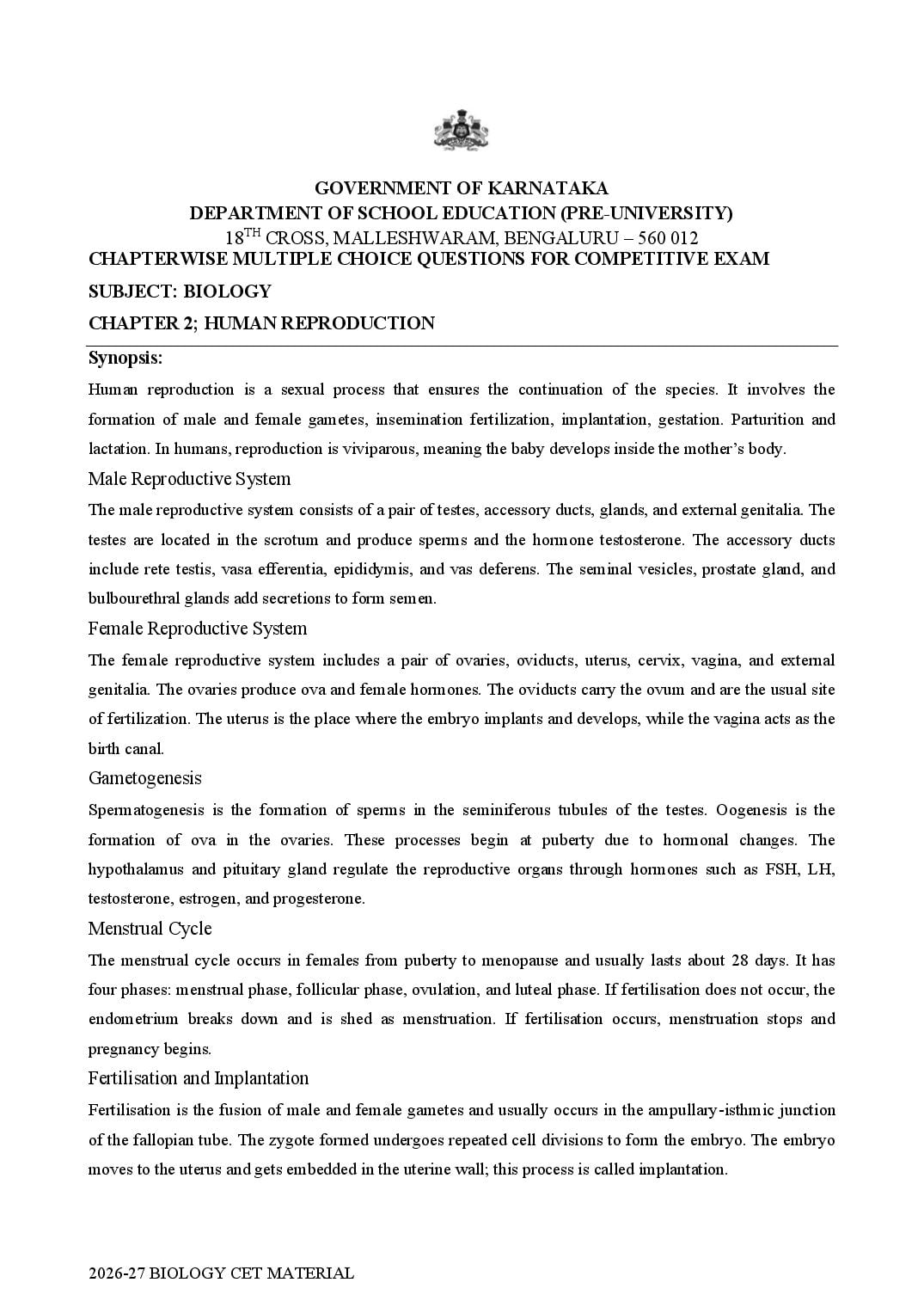
Page 1
DEPARTMENT OF SCHOOL EDUCATION (PRE-UNIVERSITY)
18TH CROSS, MALLESHWARAM, BENGALURU – 560 012
CHAPTERWISE MULTIPLE CHOICE QUESTIONS FOR COMPETITIVE EXAM
SUBJECT: BIOLOGY
CHAPTER 2; HUMAN REPRODUCTION
Synopsis:
Human reproduction is a sexual process that ensures the continuation of the species. It involves the
formation of male and female gametes, insemination fertilization, implantation, gestation. Parturition and
lactation. In humans, reproduction is viviparous, meaning the baby develops inside the mother’s body.
Male Reproductive System
The male reproductive system consists of a pair of testes, accessory ducts, glands, and external genitalia. The
testes are located in the scrotum and produce sperms and the hormone testosterone. The accessory ducts
include rete testis, vasa efferentia, epididymis, and vas deferens. The seminal vesicles, prostate gland, and
bulbourethral glands add secretions to form semen.
Female Reproductive System
The female reproductive system includes a pair of ovaries, oviducts, uterus, cervix, vagina, and external
genitalia. The ovaries produce ova and female hormones. The oviducts carry the ovum and are the usual site
of fertilization. The uterus is the place where the embryo implants and develops, while the vagina acts as the
birth canal.
Gametogenesis
Spermatogenesis is the formation of sperms in the seminiferous tubules of the testes. Oogenesis is the
formation of ova in the ovaries. These processes begin at puberty due to hormonal changes. The
hypothalamus and pituitary gland regulate the reproductive organs through hormones such as FSH, LH,
testosterone, estrogen, and progesterone.
Menstrual Cycle
The menstrual cycle occurs in females from puberty to menopause and usually lasts about 28 days. It has
four phases: menstrual phase, follicular phase, ovulation, and luteal phase. If fertilisation does not occur, the
endometrium breaks down and is shed as menstruation. If fertilisation occurs, menstruation stops and
pregnancy begins.
Fertilisation and Implantation
Fertilisation is the fusion of male and female gametes and usually occurs in the ampullary-isthmic junction
of the fallopian tube. The zygote formed undergoes repeated cell divisions to form the embryo. The embryo
moves to the uterus and gets embedded in the uterine wall; this process is called implantation.
Page 2
After implantation, the placenta develops and acts as an exchange organ between the mother and the foetus.
Human pregnancy lasts about 9 months. The baby is delivered by the process of parturition, which is aided
by hormones such as oxytocin. After birth, milk is secreted by the mammary glands to nourish the newborn.
Recap
• Testes and ovaries are the primary reproductive organs.
• Spermatogenesis and oogenesis produce male and female gametes.
• The menstrual cycle prepares the body for pregnancy.
• Fertilisation occurs in the ampulla of fallopian tube and implantation occurs in the uterus.
• Placenta, pregnancy, parturition, and lactation are important stages of human reproduction.
CLASS WORK MCQs
1. Match Column-I (terms) with Column-II (definitions) and select the correct option from the
codes given below.
Column-I Column-II
(a) Parturition (i) Attachment of zygote to endometrium.
(b) Gestation (ii) Release of egg from Graafian follicle.
(c) Ovulation (iii) Delivery of baby from uterus.
(d) Implantation (iv) Duration between pregnancy and birth.
(e) Conception (v) Formation of zygote by fusion of the egg and sperm.
(vi) Stoppage of ovulation and menstruation.
(A) (a) → (ii); (b) → (iv); (c) → (i); (d) → (v); (e) → (vi)
(B) (a) → (iv); (b) → (iii); (c) → (i); (d) → (v); (e) → (ii)
(C) (a) → (v); (b) → (vi); (c) → (ii); (d) → (iii); (e) → (iv)
(D) (a) → (iii); (b) → (iv); (c) → (ii); (d) → (i); (e) → (v)
2. In a normal pregnant woman, the amount of total gonadotropin activity was assessed. The result
expected was.
(A) High level of circulating FSH and LH in the uterus to stimulate implantation of the embryo.
(B) High level of circulating HCG to stimulate endometrial thickening.
(C) High level of FSH and LH in uterus to stimulate endometrial thickening.
(D) High level of circulating HCG to stimulate estrogen and progesterone synthesis.
3. Identify the human development stage shown as well as the related right place of its occurrence
in a normal pregnant woman, and select the right option of the two, together.
Page 3
(A) Late morula Middle part of Fallopian tube.
(B) Blastula End part of Fallopian tube.
(C) Blastocyst Uterine wall.
(D) 8-celled morula Starting point of Fallopian
tube.
4. Bartholin’s glands are situated
(A) On the either side of vagina in humans (B) on either side of vas deferens in humans
(C) On either side of penis in humans (D) on either side of fallopian tube in humans
5. The given figure is of human female reproductive system
A B C D
(A) Oviduct uterus Oviduct Ovary
(B) Cervix uterus Ovary Tumor
(C) Uterus Uterine Oviduct funnel Ovary
cavity
(D) Cervix Uterine Fallopian tube Ovary
cavity
6. Below is given the unorganized list of some important events in the human female reproductive
cycle. Identify the correct sequence of these events and select the correct option.
(i) Secretion of FSH (ii) Growth of corpus luteum
(iii) Growth of the follicle and oogenesis (iv) Ovulation
(v) Sudden increase in the levels of LH
(A) (i) → (iv) → (iii) → (v) → (ii) (B) (ii) → (i) → (iii) → (iv) → (v)
(C) (iii) → (i) → (iv) → (ii) → (v) (D) (i) → (iii) → (v) → (iv) → (ii)
7. Identify the correctly matched pair / pairs of the germ layers and their derivatives.
(i) Ectoderm – Epidermis (ii) Endoderm – Dermis
Page 4
(v) Endoderm Enamel of teeth
(A) (i) and (iv) (B) (i) and (ii) (C) (i), (iii) and (iv) (D) (i), (ii), (iii) and (v)
8. The given figure shows a diagrammatic sketch of a portion of human male reproductive system.
Identify the parts labelled as A, B, C and D and select the correct option.
(A) A-vas deferens, B-seminal vesicle, C-prostate, D-bulbourethral gland.
(B) A-vas deferens, B-Seminal vesicle, C-bulbourethral gland, D-prostate.
(C) A-ureter, B-seminal vesicle, C-prostate, D-bulbourethral gland.
(D) A-ureter, B-prostate, C-seminal vesicle, D-bulbourethral gland.
9. Which one of the following is the correct matching of the events occurring during menstrual
cycle?
(A) Proliferative phase: Rapid regeneration of myometrium and maturation of Graafian follicle.
(B) Secretory phase: Development of corpus luteum and increased secretion of progesterone.
(C) Menstruation: Breakdown of myometrium and ovum not fertilized.
(D) Ovulation: LH and FSH attain peak level and sharp fall in the secretion of progesterone.
10. Which one of the following events is correctly matched with the time period in a normal
menstrual cycle?
(A) Release of egg: 5th day.
(B) Endometrium regenerates: 5-10 days.
(C) Endometrium secretes nutrients for implantation: 11-18 days.
(D) Rise in progesterone level: 1-15 days.
11. Identify the parts labelled as A, B, C, D and E of the given diagram of a human sperm and select
the correct option.
Page 5
(B) A-Acrosome, B- Nucleus, C-Plasma membrane, D-Mitochondria, E- Plasma membrane.
(C) A-Nucleus, B-Mitochondria, C-Plasma membrane, D- Centriole, E-Neck.
(D) A-Acrosome, B-Centriole, C-Mitochondria, D-Plasma membrane, E-Tail
12. 2n = 16 is in a primary spermatocyte which is in metaphase of first meiotic division. What shall
be the total number of chromatids in each of the secondary spermatocyte?
(A) 16. (B) 24. (C) 32. (D) 8.
13. The second maturation division of the mammalian ovum occurs.
(A) Shortly after ovulation before the ovum makes entry into the Fallopian tube.
(B) Until after the ovum has been penetrated by a sperm.
(C) Until the nucleus of the sperm has fused with that of the ovum.
(D) In the Graafian follicle following the first maturation division.
14. The given figure depicts a diagrammatic sectional view of the human female reproductive
system. Which set of three parts out of I-VI have been correctly identified?
(A) (II) endometrium, (III) infundibulum, (IV) fimbriae.
(B) (III) infundibulum, (IV) fimbriae, (V) cervix.
(C) (IV) oviduct funnel, (V) Uterus, (VI) cervix.
(D) (I) perimetrium, (II) myometrium, (III) Fallopian tube.
15. Given below are four statements (i)-(iv) regarding embryonic development in humans.
(i) Cleavage divisions bring about considerable increase in the mass of protoplasm.
(ii) With more cleavage divisions, the resultant blastomeres become smaller and smaller.
(iii) The blastomeres in the blastocyst are arranged into two layers, trophoblast and
endometrium.
(iv) Cleavage divisions result in a solid ball of cells called morula.
Which of the above two statements ate correct?
(A) (i) and (iii). (B) (ii) and (iv). (C) (i) and (ii). (D) (iii) and (iv).
16. The following graph shows the levels of pituitary hormones during a menstrual cycle. What do
1 and 2 represent?
1 2
Page 6
(B) Estrogen Progesterone
(C) FSH LH
(D) Progesterone Estrogen
17. Given here is the figure of a section of Graffian follicle. Identify the labelled parts A to E and
select the correct option.
(A) A- Theca externa; B- Theca interna; C- Ovum; D- Antrum; E- Membran granulose.
(B) A-Membran granulose; B- Theca externa; C- Ovum; D- Antrum; E- Theca interna.
(C) A- Membran granulose; B- Theca interna; C- Ovum; D- Antrum; E- Theca externa.
(D) A- Theca externa; B- Theca interna; C- Ovum; D- Membran granulose; E- Antrum.
18. Which of the following hormones is not a secretion product of human placenta?
(A) Human chorionic gonadotropin. (B) Prolactin.
(C) Estrogen. (D) Progesterone
19. Sertoli cells are regulated by the pituitary hormone known as.
(A) LH. (B) FSH. (C) GH. (D) Prolactin.
20. Which part of ovary in mammals acts as endocrine gland after ovulation?
(A) Stroma. (B) Germinal epithelium.
(C) Vitelline membrane. (D) Graffian follicle.
21. In humans, at the following is the first meiotic division, the male germ cells differentiate into
the.
(A) Spermatids. (B) Spermatogonia.
(C) Primary spermatocytes. (D) Secondary spermato cytes.
22. Which one of the following is the most likely root cause why menstruation is not taking place in
regularly cycling human female?
(A) Maintenance of the hypertrophical endometrial lining.
(B) Maintenance of high concentration of sex-hormones in the blood stream.
(C) Retention of well-developed corpus luteum.
(D) Fertilization of the ovum.
23. The first movements of the foetus and appearance of hair on its head are usually observed
during which month of pregnancy?
Page 7
24. In the given figure, what do A, B, C and D represent?
D
A C
B
A B C D
(A) Infundibulum Fertilization Myometrium Morula.
(B) Infundibulum Fertilization Endometrium Blastocyst.
(C) Isthmus Fertilization Myometrium Blastocyst.
(D) Isthmus Fertilization Endometrium Morula.
25. If for some reason, the vasa efferentia in the human reproductive system get blocked, the
gametes will not be transported from.
(A) Testes to epididymis. (B) Epididymis to vas deferens.
(C) Ovary to uterus. (D) Vagina to uterus.
26. Given below are the three statements each with two blanks. Select the option which correctly
fills up the blank in any two statements.
(a) Each seminiferous tubule is lined on its inside by two types of cells called (i) and (ii).
(b) The seminiferous tubules open into the (i) through (ii).
(c) The enlarged end of penis called the (i) is covered by a loose fold of skin called the (ii).
(A) (a)-(i) vas deferens, (ii) urethral meatus, (a)-(i) spermatogonia, (ii) follicular cells.
(B) (c)-(i) glans penis, (ii) foreskin (b)-(i) vasa efferentia, (ii) rete testis.
(C) (a)-(i) spermatogonia, (ii) Sertoli cells (c)-(i) urethral meatus, (ii) scrotum.
(D) (a)-(i) spermatocytes, (ii) oogonia (b)-(i) rete testis, (ii) vasa efferentia.
27. Match Column-I with Column-II and select the correct option from the codes given below.
Column-I Column-II
(a) Hypothalamus (i) Sperm lysins.
(b) Acrosome (ii) Estrogen.
(c) Graffian follicle (iii) Relaxin.
(d) Leydig’s cells (iv) GnRH.
(e) Parturition (v) Testosterone.
(A) (a) → (iv); (b) → (i); (c) → (ii); (d) → (iii); (e) → (v)
(B) (a) → (ii); (b) → (i); (c) → (iv); (d) → (iii); (e) → (v)
Page 8
(D) (a) → (iv); (b) → (i); (c) → (ii); (d) → (v); (e) → (iii)
28. A human female is born with a million of eggs (primary oocyte) at the time of birth, only some
500 eggs get a chance of maturity. What is the destiny of rest of the eggs?
(A) Rest of the eggs differentiates back to theca and granulose cells.
(B) Rest of the eggs nurture the dominant follicular cell.
(C) Rest of the eggs move out of the ovary and are destroyed by leucocytes.
(D) Rest of the eggs break down and are absorbed i.e. Degenerated follicular atresia.
29. Read the following statements about menstrual cycle and select two correct statements.
(i) Lack of menstruation may be indicative of pregnancy.
(ii) The changes in the ovary and the uterus are induced by changes in the levels of ovarian
hormones only.
(iii) LH surge induces ovulation.
(iv) If fertilization occurs, corpus luteum degenerates immediately.
(A) (i) and (ii). (B) (ii) and (iii). (C) (i) and (iii). (D) (ii) and (iv).
30. The following graph shows the levels of ovarian hormones during a menstrual cycle. What do 1
and 2 represent?
1 2
(A) Progesterone Estrogen.
(B) FSH LH
(C) LH FSH
(D) Estrogen. Progesterone
31. Which of the following options is correct?
Haploid Diploid
(A) Secondary Oocyte Primary spermatocyte
(B) Secondary Secondary oocyte
spermatocyte
(C) Primary oocyte Secondary
spermatocyte
(D) Ovum Spermatid
Page 9
fills up the blanks in any two statements.
(A) The embryo with 8 to 16 blastomeres is called a (i)
(B) Embedding of the (i) in the endometrium of the uterus is called implantation and it leads to
(ii)
(C) After implantation, finger-like projections appear on the trophoblast called (i) which are
surrounded by the (ii) and maternal blood.
(D) Inner cell mass contains certain cells called (i) cells which have the potency to give rise to
all the tissues and organs.
(A) A – (i) blastula, C – (i) Chorionic villi, (ii) uterine tissue
(B) B – (i) blastocyst, (ii) pregnancy, D – (i) stem
(C) A – (i) morula, D (i) Sertoli
(D) B – (i) morula, (ii) parturition, C – (i) fimbriae, (ii) embryonic tissue
33. A sex gland which contributes fluid containing sugar fructose that provides spermatozoa energy
for swimming and hormone prostaglandins that stimulate contractions in the female
reproductive tract to aid sperm ovum interaction is
(A) Cowper’s gland (B) Prostate gland (C) Seminal vesicles (D) Preputial gland
34. Match Column-I with Column-II and select the correct option from the codes given below.
Column-I Column-II
(a) Trophoblast (i) Embedding of blastocyst in the endometrium.
(b) Cleavage (ii) Group of cells that would differentiate as embryo.
(c) Inner cell (iii) Outer layer of blastocyst attached to the
mass endometrium.
(d) Implantation (iv) Mitotic divisions of zygote.
(A) (a) → (ii); (b) → (i); (c) → (iii); (d) → (iv) (B) (a) → (iii); (b) → (iv); (c) → (ii); (d) → (i)
(C) (a) → (iii); (b) → (i); (c) → (ii); (d) → (iv) (D) (a) → (ii); (b) → (iv); (c) → (iii); (d) → (i)
35. During bleeding phase of menstrual cycle unfertilized secondary oocyte undergoes autolysis.
The interplay of hormones then is.
(A) Progesterone and estrogen continue the hypertrophy of endometrial lining.
(B) Prolactin and progesterone reduce LH level causing regression of corpus luteum.
(C) Progesterone inhibits the release of LH from pituitary causing regression of corpus luteum.
(D) Prolactin and estrogen inhibit progesterone secretion leading to sloughing off of uterine
lining.
Page 10
(T) and which ones are false (F).
(i) The scrotum acts as a thermo regulator, maintaining the testes at a temperature 2C lower
than that of the body.
(ii) Corona radiata layer of the ovum prevents polyspermy.
(iii) Middle part of ear is derived from the endoderm layer.
(iv) The hormone, human chorionic gonadotropin facilitates parturition by connective tissue of
the pubic symphysis.
(i) (ii) (iii) (iv)
(A) T T F F
(B) F T F T
(C) T F T F
(D) F F T T
37. Given below are three statements each with one or two blanks. Select the option which correctly
fills up the blanks in any two statements.
(a) In human beings, menstrual cycle ceases around 50 years of age; this is termed as (i).
(b) The milk produced during the initial few days of lactation is called (i) which contains
several (ii) absolutely essential to develop resistance for the newborn babies.
(c) At the completion of the (i) division the primary oocyte divides into secondary oocyte and
(ii).
(A) (a)-(i) menarche; (b)-(i) lactation, (ii) minerals.
(B) (b)-(i) colostrum, (ii) antibodies; (c)-(i) First meiotic, (ii) first polar body.
(C) (a)-(i) menopause; (c)-(i) second meiotic, (ii) second polar body.
(D) (a)-(i) menopause; (b)-(i) corpus luteum, (ii) antibodies.
38. Consider the following three statements related to the human male reproductive system, and
select the correct option stating which ones are true (T) and which ones are false (F).
(i) Middle piece of spermatozoon is also termed as power house of spermatozoon.
(ii) Vas deferens joins a duct from seminal vesicle and form vasa efferentia.
(iii) Semen is a collection of secretions from the seminal vesicles, prostate gland and Cowper’s
glands and sperms from testes.
(i) (ii) (iii)
(A) T F T
(B) F F T
Page 11
(D) F T T
39. Match Column-I with Column-II and select the correct option from the codes given below.
Column-I Column-II
(a) Cleavage (i) Fertilization.
(b) Morula (ii) Mitotic divisions.
(c) Polyspermy (iii) Endometrial.
(d) Implantation (iv) Little mulberry.
(A) (a) → (ii); (b) → (iv); (c) → (i); (d) → (iii) (B) (a) → (i); (b) → (iv); (c) → (ii); (d) → (iii)
(C) (a) → (iv); (b) → (ii); (c) → (i); (d) → (iii) (D) (a) → (ii); (b) → (iv); (c) → (iii); (d) → (i)
40. Mark the wrong item in each series and select the correct option.
(i) Spermatocyte; polar body; spermatid; Spermatogonium.
(ii) Endometrium; corpus luteum; acrosome; Graffian follicle.
(iii) Vas deferens; fallopian tube; epididymis; Cowper’s gland.
(iv) Testes; prostate; seminal vesicles; Cowper’s gland.
(i) (ii) (iii) (iv)
(A) Spermatid Endometrium Epididymis Prostate.
(B) Polar body Acrosome Fallopian tube Testes.
(C) Spermatocyte Corpus luteum Vas deferens Seminal
Vesicles.
(D) Spermatogonium Graafian follicle Cowper’s gland Seminal
Vesicles.
41. Name the hormone that has no role in menstruation.
(A) LH. (B) FSH. (C) Estradiol. (D) TSH.
42. Consider the following statements each with two blanks.
(a) Seminiferous tubules produce (i) while Leydig’s cells produce (ii).
(b) In females, urethra is small and conducts (iii) While in males it conducts urine and (iv).
(c) The process of formation of spermatozoa from spermatogonia is called (v) and the process of
maturation of spermatids into spermatozoa is called (vi).
Which one of the following options, gives the correct fill ups for the respective blank numbers
from (i) to (vi) in the statements?
(A) (v)-spermatogenesis, (vi)-spermiogenesis, (i)-spermatozoa, (ii)-testosterone.
(B) (i)-testosterone, (ii)-spermatozoa, (iii)-urine, (iv) semen.
Page 12
(D) (iii)-urine, (iv)-semen, (v)-spermiogenesis, (vi)-spermatogenesis.
43. Study the graph carefully and correlate the hormone levels on.
(i) 1-5 days. (ii) 12-14 days. (iii) 25-28 days (if the ovum is not fertilized).
(A) (i) LH decreases and FSH increases, (ii) LH increases and FSH decreases, (iii) LH level
maintained and FSH level increases.
(B) (i) LH increases and FSH decreases, (ii) LH decreases and FSH increases. (iii) LH level
increases and FSH level maintained.
(C) (i) LH increases and FSH decreases, (ii) LH peaks and FSH peaks. (iii) LH level decreases
and FSH level maintained.
(D) (i) LH peaks and FSH peaks, (ii) LH increases and FSH decreases. (iii) LH level decreases
and FSH level maintained.
44. Fill the blanks in the given statements and select the correct option.
(a) The developmental stage of an animal passed in the mother’s womb is called (i).
(b) The outer layer of blastula is called (ii). If does not take part in the formation of (iii).
(c) (iv) is the first germ layer formed from the inner cell mass by differentiation.
(A) (ii)-mesoderm, (iii) embryo proper, (iv)-ectoderm.
(B) (i)-embryo, (ii)-trophoblast, (iii)-embryo proper.
(C) (i)-egg, (iv)-endoderm.
(D) (i)-embryo, (iv) ectoderm.
45. Given below is an incomplete flowchart showing influence of Hormones on gametogenesis in
human females. Study it carefully and identify A, B, C and D.
Page 13
(A) FSH LH Ovary Progesterone
(B) GnRH FSH and LH Ovary Estrogen and
Progesterone
(C) GnRH FSH Testis Testosterone
(D) LH FSH Testis Testosterone
46. Pick the odd one out from each series given below and select the correct option.
(i) Scrotum, rete testis, Fallopian tube, vas deferens.
(ii) Ovary, uterus, vagina, ejaculatory duct.
(iii) Acrosome, Graffian follicle, corpus luteum, cervix.
(iv) Prostate, testis, seminal vesicles, Cowper’s gland.
(i) (ii) (iii) (iv)
(A) Vas deferens Vagina Cervix Cowper’s
gland.
(B) Rete testis Ovary Graafian Prostate.
follicle
(C) Scrotum Uterus Corpus luteum Seminal
Vesicles.
(D) Fallopian Ejaculatory Acrosome Testis.
tube duct
47. The principal tail piece of human sperm shows the micro tubular arrangement of.
(A) 7 + 2. (B) 9 + 2. (C) 11 + 2. (D) 13 + 2.
48. The time for optimum chances of conception in a woman is ______________ starting from the
day of menstruation.
(A) 1st day. (B) 4th day.
(C) 14th day. (D) 26th day.
49. In spermatogenesis, reduction division of chromosomes occurs during conversion of.
(A) Spermatogonia to primary spermatocytes.
(B) Primary spermatocytes to secondary spermatocytes.
(C) Secondary spermatocytes to spermatids.
(D) Spermatids to sperms.
50. HCG, hPL and relaxin are produced in women.
(A) At the time of puberty. (B) Only during
pregnancy.
Page 14
51. Read the following statements carefully and select the correct statements.
(i) hPL plays a major role in parturition.
(ii) Foetus shows movements for the first time in the 7th month of pregnancy.
(iii) Signal for parturition comes from fully developed foetus and placenta.
(iv) Embryo’s heart is formed by the 2nd month of pregnancy.
(A) (ii) and (iii). (B) (iii) only. (C) (ii) and (iv). (D) (i) and (iv).
52. The sperms undergo physiological maturation, acquiring increased motility and fertilizing
capacity in.
(A) Seminiferous tubules. (B) Vasa efferentia. (C) Epididymis. (D) Vagina.
53. The third stage of parturition is called “after-birth”. In this stage.
(A) Excessive bleeding occurs.
(B) Foetus is born and cervix and vagina contraction to normal condition happens.
(C) Foetus is born and contraction of uterine wall prevents excessive bleeding.
(D) Placenta is expelled out.
54. Which one is released from the ovary?
(A) Primary oocyte. (B) Secondary oocyte
(C) Ovum. (D) Oogonium.
Practice Questions
1. Choose the incorrect statement from the following:
(A) In birds and mammals internal fertilization takes place
(B) Colostrum contains antibodies and nutrients
(C) Polyspermy is prevented by the chemical changes in the egg surface
(D) In the human female implantation occurs almost seven days after fertilization
2. Identify the wrong statement from the following:
(A) High levels of estrogen triggers the ovulatory surge.
(B) Original cells start to proliferate and give rise to functional ova in regular cycles from
puberty onwards.
(C) Sperms released from seminiferous tubules are poorly motile/ non-motile.
(D) Progesterone level is high during the post ovulatory phase of menstrual cycle.
3. Spot the odd one out from the following structures with reference to the male reproductive
system:
(A) Rete testis (B) Epididymis (C) Vasa efferentia (D) Isthmus
Page 15
(A) Seminal vesicle (B) Prostate (C) Urethra (D) bulbourethral gland
5. Spermiation is the process of the release of sperms from:
(A) Seminiferous tubules (B) Vas deferens (C) Epididymis (D) Prostate gland
6. Mature Graffian follicle is generally present in the ovary of a healthy human female around
(A) 5 − 8 day of menstrual cycle (B) 11− 17 day of menstrual cycle
(C) 18 −23 day of menstrual cycle (D) 24 − 28 day of menstrual cycle
7. Acrosomal reaction of the sperm occurs due to:
(A) Its contact with zona pellucida of the ova
(B) Reactions within the uterine environment of the female
(C) Reactions within the epididymal environment of the male
(D) Androgens produced in the uterus
8. Which one of the following is not a male accessory gland?
(A)Seminal vesicle (B) Ampulla (C) Prostate (D)Bulbourethral gland
9. The immature male germ cell undergo division to produce sperms by the process of
spermatogenesis. Choose the correct one with reference to above.
(A) Spermatogonia have 46 chromosomes and always undergo meiotic cell division
(B) Primary spermatocytes divide by mitotic cell division
(C) Secondary spermatocytes have 23 chromosomes and undergo second meiotic division
(D) Spermatozoa are transformed into spermatids
10. Match between the following representing parts of the sperm and their functions and choose the
correct option.
Column-A Column-B
(a) Head (i) Enzymes
(b) Middle piece (ii) Sperm motility
(c) Acrosome (iii) Energy
(d) Tail (iv) Genetic material
(A) (a) → (ii); (b) → (iv); (c) → (i); (d) → (iii) (B) (a) → (iv); (b) → (iii); (c) → (i); (d) → (ii)
(C) (a) → (iv); (b) → (i); (c) → (ii); (d) → (iii) (D) (a) → (ii); (b) → (i); (c) → (iii); (d) → (iv)
11. Which among the following has 23 chromosomes?
(A) Spermatogonia (B) Zygote (C) Secondary oocyte (D) Oogonia
12. Match the following and choose the correct options
Column-I Column-II
Page 16
(b) Cleavage (ii) Group of cells that would differentiate as embryo
(c) Inner cell (iii) Outer layer of blastocyst attached to the
mass endometrium
(d) Implantation (iv) Mitotic division of zygote
(A) (a) → (ii); (b) → (i); (c) → (iii); (d) → (iv) (B) (a) → (iii); (b) → (iv); (c) → (ii); (d) → (i)
(C) (a) → (iii); (b) → (i); (c) → (ii); (d) → (iv) (D) (a) → (ii); (b) → (iv); (c) → (iii); (d) → (i)
13. Which of the following hormones s not secreted by human placenta?
(A) hCG (B) Estrogens (C) Progesterone (D) LH
14. The vas deferens receives duct from the seminal vesicle and opens into urethra as:
(A) Epididymis (B) Ejaculatory duct
(C) Efferent ductile (D) Ureter
15. Urethral meatus refers to the:
(A) Urinogenital duct (B) Opening of vas deferens into urethra
(C) External opening of the urinogenital duct (D) Muscles surrounding the urinogenital duct
16. Morula is a developmental stage:
(A) Between the zygote and blastocyst (B) Between the blastocyst and gastrula
(C)After the implantation (D) Between implantation and parturition
17. The membranous cover of the ovum at ovulation is:
(A) Corona radiate (B) Zona radiate (C) Zona pellucida (D) Chorion
18. Identify the odd one from the following:
(A) Labia minora (B) Fimbriae (C) Infundibulum (D) Isthmus
19. Male reproductive system comprises of
(A) Testes, rate testis and glands
(B) testes, accessory ducts, glands and external genitalia
(C) testes, rete testis, vasa efferentia
(D) testis, external genitalia, prostate gland
20. Which of the accessory sex glands is also called as ‘bulbourethral glands’?
(A) Seminal vesicle (B) Cowper’s gland (C) Prostate gland (D) Bartholin’s gland
21. The hormone that promotes the descent of testis into scrotal sacs is
(A) FSH (B) ICSH (C) HCG (D) Testosterone
22. Testes descend into scrotum in mammals for
(A) Spermatogenesis (B) Fertilization
Page 17
23. Which structure transports the sperms to the vas deferens?
(A) Seminal vesicles (B) Prostate gland (C) Epididymis (D) Urethra
24. Seminal fluid has sperms and secretions of
(A) Prostate, Cowper’s and Bartholin’s gland
(B) Seminal vesicle, prostate and Cowper’s gland
(C) Seminal vesicle, ureter and prostate gland
(D) Follicles, ureters and prostate gland
25. The sertoli cells secrete the hormone
(A) Relaxin (B) Inhibin (C) Testosterone (D) Androgen
26. The sperm acquires motility in
(A) Seminiferous tubules (B) Ejaculatory duct
(C) Epididymis (D) Vasa efferentia
27. In female genitalia, the tiny finger-like projections found at the upper junction of two labia
minora above urethral opening is known as
(A) clitoris (B) hymen (C) isthmus (D) fimbriae
28. Pick the odd one out
(A) Ampulla (B) Infundibulum (C) Isthmus (D) Labia minora
29. The given illustration represents the human female reproductive system in the given illustration,
the structure labeled ‘I’ is the site for
(A) sperm maturation (B) egg production (C) implantation (D) fertilization
30. Mammary glands are accessory reproductive gland in females which produce milk to nourish
the young ones. Mammary glands are modified
(A) sweat gland (B) serous glands (C) salivary glands (D) sebaceous glands
31. Which is the correct sequence in spermatogenesis?
(A) Spermatogonia → Spermatids → Secondary spermatocytes → Primary spermatocytes →
Sperms
(B) Spermatogonia → Spermatids → Primary spermatocytes → Secondary spermatocytes →
sperms
Page 18
sperms
(D) Spermatogonia → primary spermatocytes → Secondary speramtocytes → Spermatids →
Sperms
32. The haploid cells are produced in the following phase of gametogenesis
(A) phase of maturation (B) phase of growth
(C) phase of multiplication (D) Phase of spermatogenesis
33. How many sperms and ova are produced from 25 secondary spermetocytes and 25 primary
oocytes respectively?
(A) 50 and 50 (B) 50 and 25 (C) 100 and 25 (D) 100 and 100
34. In spermatogenesis, the genetic recombination takes place during
(A) Formation of spermatogonia (B) formation of primary spermatocytes
(C) formation of secondary spermatocytes (D) formation of spermatids
35. The given figure illustrates a sperm cell. Which part of sperm cell helps in the production of
ATP?
(A) I (B) II (C) III (D) IV
36. The part of the sperm called manchette is
(A) Nucleus (B) Cytoplasm (C) Mitochondria (D) Axoneme
37. The role of proximal centriole of the sperm is to
(A) help the sperm penetration into the egg (B) cause the dissolution of egg membrane
(C) initiate cell division in the zygote (D) provide energy for sperm mobility
38. Which of the following statements is correct regarding maturation phase of oogenesis?
(A) The primary oocyte undergoes reductional division to produce two equal haploid cells.
(B) The primary oocyte undergoes reductional division to produce two unequal haploid cells.
(C) The primary oocyte undergoes equational division to produce two equal haploid cells.
(D) The primary oocyte undergoes equational division to produce two unequal haploid cells.
39. The formation of the development of both Graffian follicles and seminiferous tubules?
(A) Luteinizing hormone (B) Somatotropic hormone
(C) Follicle stimulating hormone (D) Thyroid stimulating hormone
40. Onset of menstrual cycle in female is termed as
(A) Menopause (B) Menarch (C) Mesarch (D) Gynarch
Page 19
(A) stratum basalis (B) stratum functionalis
(C) endometrium (D) Placenta
42. The given figure illustrates a cross- section of the human ovary. Which of the following events
will occur when the level of hormone secreted by structure X decreases?
(A) The endometrium will become secretory (B) The endometrium will disintegrate
(C) Uterine contractions will occur (D) Ovulation will occur
43. After menstruation, the uterine wall is healed by
(A) FSH (B) LH (C) Semen (D) Estrogen
44. Correct sequence of hormone secretion from beginning of menstruation is
(A) FSH, Progesterone, estrogen (B) Estrogen, FSH, progesterone
(C) FSH, estrogen, progesterone (D) Estrogen, progesterone, FSH
45. Which of the following hormone induces ovulation?
(A) FSH (B) LH (C) Estrogen (D) Progesterone
46. FSH and LH are
(A) Sex hormones (B) Gonadotropins
(C) Aldosterones (D) Gynogamones
47. The mature ovum lies at which site in the female reproductive tract after ovulation?
(A) Cervix (B) Vagina (C) Uterus (D) Oviduct
48. i Phase is characterized by the conversion of ruptured Graffian follicle into corpus luteum. The
luteum. The high level of ii hormone inhibits ovulation. The information in which alternative
completes the given statements?
i ii
(A) Luteal Estrogen
(B) Luteal Progesterone
(C) Proliferative Estrogen
(D) Proliferative Progesterone
49. On the 13th day of the uterine cycle, the level of the follicle stimulating hormone is i . The level
of the luteinizing hormone which stimulates ovulation is ii on the 13th day of the uterine cycle.
Which alternative completes the given statement?
Page 20
(A) High Low
(B) Low High
(C) High high
(D) Low low
50. Which of the following structure degenerates during the menstrual cycle, if there is no
conception?
(A) Secondary oocyte (B) Graafian follicle
(C) Corpus luteum (D) Corpus albicans
51. Which of the following statements is correct regarding the luteal phase of menstrual cycle
(A) The levels of both progesterone and estrogen increase
(B) The levels of both progesterone and estrogen decrease
(C) The level of progesterone increases while the level of estrogen increases
(D) The level of progesterone decreases while the level of estrogen increases.
52. The female reproductive system undergoes a series of cyclic changes during the entire
reproductive period of the female’s life. This cycle of changes is termed as the menstrual cycle.
In which period of the menstrual cycle does its proliferative phase extend?
(A) 5th to 13th day (B) 26th to 28th day
(C) 15th to 28th day (D) 1st to 5th day
53. In the absence of any conception, the inner lining of the uterus breaks down. This leads to the
onset of menstruation. Menstruation results during the absence of
(A) oestrogen and progesterone (B) progesterone and prolactin
(C) oxytocin and oestrogen (D) prolactin membrane
54. Immediately after ovulation, the mammalian egg is covered by a cellular
(A) Chorion (B) Zona pellucida
(C) Corona radiate (D) Vitelline membrane
55. Correct sequence in development is
(A) Fertilisation Zygote Cleavage Morula Blastula Gastrula
(B) Fertilisation Zygote Blastula Morula Cleavage Gastrula
(C) Fertilisaiton Cleavage Morula Zygote Blastula Gastrula
(D) Cleavage Zygote Fertilisation Morula Blastula Gastrula
56. The formation of Oosperm or Synkaryon is called
(A) Amphimixis (B) Syngamy (C) Fertilization (D) Amplexus
57. Fertilizins are present over
Page 21
58. Fertilizing is a
(A) Glycoproteinic gynogamone (B) acid proteinic gynogamone
(C) Glycoproteinic androgamone (D) acid proteinic androgamone
59. Fallopian tubes area pair of muscular and ciliated tubes that lie near the ovary and open into the
uterus. Fertilization in the fallopian tubes occurs in the
(A) Junction of fimbriae- infundibulum (B) Junction of infundibulum – ampulla
(C) Junction of ampulla- isthmus (D) Junction of isthmus-fimbriae
60. The sperm nucleus moves towards egg nucleus. This path is called
(A) Penetration path (B) Copulation path
(C) Cleavage path (D) Amphimixis
61. What happens during fertilization in humans after many sperms reach close to the ovum?
(A) Secretion of acrosome help one sperm enters cytoplasm of ovum through zone pellucida.
(B) All sperms except the one nearest to the ovum lose their tails
(C) Cell of corona radiate trap all the sperms except one.
(D) Only two sperms nearest the ovum penetrate zone pellucida.
62. The given image is that of the female reproductive system. In which labelled part of the given
figure does the implantation of the embryo take place?
(A) I (B) II (C) III (D) IV
63. In human female, the blastocyst
(A) forms placenta even before implantation
(B) gets implanted into uterus 3 days after ovulation.
(C) gets nutrition from uterine endometrial secretion only after implantation.
(D) gets implanted in endometrium by the trophoblast cells.
64. The sign of pregnancy is
(A) Vomiting (B) Absence of menses
(C) Enlargement of abdomen (D) Enlargement of breasts
65. The term parturition refers to
(A) The act of expelling urine from the urinary bladder
(B) The act of giving birth to young people once
Page 22
(D) The period of pregnancy
66. Umbilical cord is a connection between
(A) Foetus and Amnion (B) Foetus and placenta
(C) Foetus and yolk (D) Foetus and uterus of mother
These questions consist of two statements each, printed as Assertion and Reason. While answering
these questions you are required to choose one of the following four responses.
(A) If both Assertion and Reason are true and the Reason is a correct explanation of the Assertion.
(B) If both Assertion and Reason are true but Reason is not a correct explanation of the Assertion.
(C) If Assertion is true but the Reason is false.
(D) If both Assertion and Reason are false.
67. Assertion: Parthenogenesis is a kind or variation of sexual reproduction.
Reason: In parthenogenesis, a young one develops from an ovum but without fertilization.
68. Assertion: In the testes, spermatogenesis occurs in the seminiferous tubules and testosterone
secretion takes in the interstitial cells.
Reason: Testosterone brings about growth and maturation of secondary sex organs and also
development of accessory sex characters.
69. Assertion: In a Graafian follicles, the primary oocyte and the follicle cells may be regarded
sibling cells.
Reason: Both arise from the same parent cell, the oogonium, by mitotic divisions.
70. Assertion: Testes originate in the abdomen but later descend into the scrotum under the
influence of testosterone.
Reason: The interstitial (Leydig's) cells of the testes secrete male sex hormone, the testosterone.
71. Assertion: Testes are located in the scrotum outside the coelom.
Reason: A vaginal coelom partly surrounds the testis in the scrotum.
72. Assertion : Infection of urethra is more common in the males than in the females :
Reason: Urethra is shorter in the males than in the females.
73. Assertion: Cervix contains the largest and the most powerful sphincter muscle in the body.
Reason: Cervix opens into the vagina by external os.
74. Assertion: Ovum retains most of the contents of the primary oocyte and is much larger than a
spermatozoon.
Reason: Ovum needs energy to go about in search of a spermatozoon for fertilization.
75. Assertion: A woman passes out hCG in the urine during pregnancy.
Page 23
pregnancy tests.
76. Assertion: Failure of testes to descend into the scrotum causes sterility in man.
Reason: Higher temperature in the abdomen than in the scrotum is not suitable for sperm
development.
77. Assertion: In humans, the gamete contributed by the male determines whether the child
produced will be male or female.
Reason: Sex in humans is a polygenic trait depending upon a cumulative effect of some genes
on X-chromosome and some on Y- chromosome.
78. Assertion: Up to morula stage, the cells divide without any increase in size.
Reason: Zona pellucida remains intact till cleavage is complete.
79. Assertion: The third cleavage in frog is latitudinal (horizontal).
Reason: The mitotic spindle orients parallel to the polar axis in each blastomere.
80. Assertion: Sperm entry causes a rearrangement of materials in the ooplasm.
Reason: Path of the male pronucleus toward the female pronucleus is marked in the ovum as a
copulation path.
81. Assertion: Placenta is connected to the foetus by an umbilical cord.
Reason: Foetal components of the placenta are derived from the chondroblast.
82. Assertion: A sperm sticks to an egg for fertilization.
Reason: Interaction of surface receptors, fertilizin on the egg and antifertilizin on the sperm
head, makes adhere together.
83. Assertion: Cleavage in human zygote is holoblastic.
Reason: Human egg contains abundant yolk in ooplasm.
84. Assertion: Zona pellucida disappears when blastocyst reaches the uterus.
Reason: Role of zona pellucida is to check the implantation of the blastocyst at an improper
site.
85. Assertion: Human embryo develops a yolk sac beneath it.
Reason: Yolk sac stores yolk for nourishing the embryo.
86. Assertion: Twins may arise from a single egg or from two eggs.
Reason: One egg gives rise to identical twins by separation of blastomeres, and two eggs
produce non identical twins
87. Assertion: Human body is pigment less at the time of birth.
Reason: Pigment disappears before the birth of a body.
88. Assertion: All members of bee society are diploid except the drones.
Page 24
89. Assertion: Holoblastic cleavage with almost equal sized blastomeres is characteristic of
placental mammal.
Reason: Eggs of most mammals including humans are centrolecithal.
90. Assertion: Only a single functional female gamete is formed from each primary oocyte cell.
Reason: Meiosis in each primary and secondary oocyte gives rise to only one cell, which
functions as ovum
91. Assertion: Generally, a woman does not conceive during lactation period.
Reason: The hormone prolactin initiates and maintain lactation in a woman.
92. Assertion: Holoblastic cleavage with almost equal sized blastomeres is a characteristic feature
of placental mammals.
Reason: Eggs of most mammals including human are of centrolecithal type.
CLASS WORK Keys
1 (D) 7 (C) 13 (B) 19 (B) 25 (A) 31 (A) 37 (B) 43 (C) 49 (B)
2 (D) 8 (A) 14 (B) 20 (D) 26 (B) 32 (B) 38 (A) 44 (B) 50 (B)
3 (C) 9 (B) 15 (B) 21 (D) 27 (D) 33 (C) 39 (A) 45 (B) 51 (B)
4 (A) 10 (B) 16 (C) 22 (B) 28 (D) 34 (B) 40 (B) 46 (D) 52 (C)
5 (D) 11 (B) 17 (D) 23 (B) 29 (C) 35 (C) 41 (D) 47 (B) 53 (D)
6 (D) 12 (A) 18 (B) 24 (B) 30 (D) 36 (C) 42 (A) 48 (C) 54 (B)
Practice Keys
1 (C) 11 (C) 21 (B) 31 (D) 41 (B) 51 (C) 61 (C) 71 (A) 81 (C) 91 (B)
2 (B) 12 (B) 22 (C) 32 (A) 42 (A) 52 (A) 62 (D) 72 (D) 82 (A) 92 (C)
3 (D) 13 (D) 23 (C) 33 (B) 43 (D) 53 (B) 63 (D) 73 (B) 83 (C)
4 (B) 14 (B) 24 (B) 34 (C) 44 (C) 54 (B) 64 (B) 74 (C) 84 (A)
5 (A) 15 (C) 25 (A) 35 (B) 45 (B) 55 (A) 65 (B) 75 (A) 85 (C)
6 (B) 16 (A) 26 (C) 36 (D) 46 (B) 56 (A) 66 (B) 76 (A) 86 (A)
7 (A) 17 (A) 27 (A) 37 (C) 47 (D) 57 (A) 67 (A) 77 (C) 87 (D)
8 (B) 18 (A) 28 (D) 38 (B) 48 (B) 58 (A) 68 (B) 78 (B) 88 (A)
9 (C) 19 (B) 29 (B) 39 (C) 49 (B) 59 (C) 69 (A) 79 (A) 89 (D)
10 (B) 20 (B) 30 (A) 40 (A) 50 (C) 60 (D) 70 (B) 80 (B) 90 (A)
Document Details
| Board / Org | Karnataka Board |
| Exam | Class 12 |
| Type | Question Bank |
| Pages | 24 |
| Updated | 24 Sep 2026 |