SEBA Class 9 Class 10 Syllabus 2025 Yoga & Physical Education
Finished viewing? Save it for later —
Download SEBA Class 9 Class 10 Syllabus 2025 Yoga & Physical Education (PDF · 8 pages)About SEBA Class 9 Class 10 Syllabus 2025 Yoga & Physical Education
SEBA Class 9 Class 10 Syllabus 2025 Yoga & Physical Education is available here for free download. Published by Assam Board for Class 10, this syllabus can be viewed online or downloaded as a PDF (8 pages). Candidates preparing for Class 10 can use SEBA Class 9 Class 10 Syllabus 2025 Yoga & Physical Education to understand the exam pattern, the type of questions asked, and the overall difficulty level.
Frequently Asked Questions
How can I download SEBA Class 9 Class 10 Syllabus 2025 Yoga & Physical Education?
Open this page and click the Download button to save SEBA Class 9 Class 10 Syllabus 2025 Yoga & Physical Education as a PDF. It is completely free on AglaSem Docs.
Is SEBA Class 9 Class 10 Syllabus 2025 Yoga & Physical Education free to download?
Yes. SEBA Class 9 Class 10 Syllabus 2025 Yoga & Physical Education can be viewed online and downloaded as a PDF free of cost on AglaSem Docs.
How many pages does SEBA Class 9 Class 10 Syllabus 2025 Yoga & Physical Education have?
SEBA Class 9 Class 10 Syllabus 2025 Yoga & Physical Education contains 8 pages, which you can read online or download together as a single PDF.
Where can I find more Class 10 study material?
You can find more Class 10 question papers, sample papers, syllabus, and answer keys on AglaSem Docs.
SEBA Class 9 Class 10 Syllabus 2025 Yoga & Physical Education – Text
Read the full text of this syllabus below — useful to quickly search, copy and reference the content online without downloading the PDF.
📄 View text version (8 pages)
Page 1
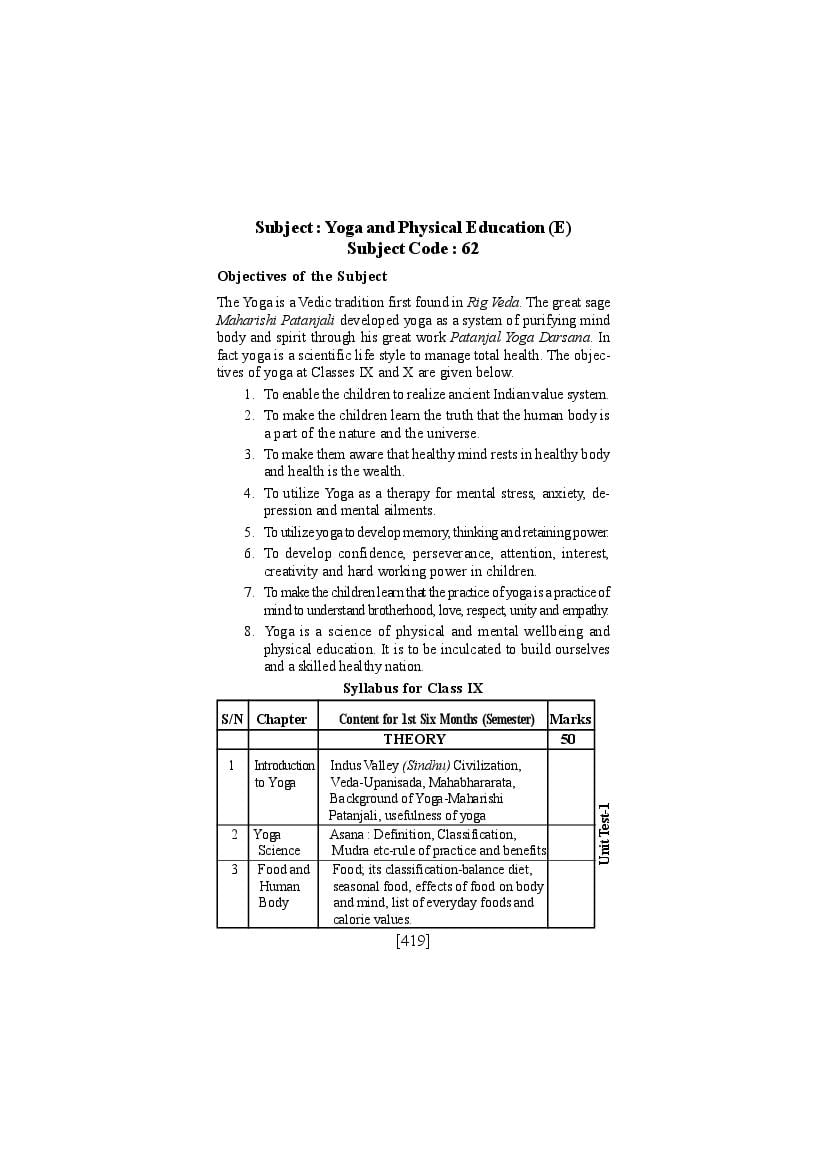
Subject Code : 62
Objectives of the Subject
The Yoga is a Vedic tradition first found in Rig Veda. The great sage
Maharishi Patanjali developed yoga as a system of purifying mind
body and spirit through his great work Patanjal Yoga Darsana. In
fact yoga is a scientific life style to manage total health. The objec-
tives of yoga at Classes IX and X are given below.
1. To enable the children to realize ancient Indian value system.
2. To make the children learn the truth that the human body is
a part of the nature and the universe.
3. To make them aware that healthy mind rests in healthy body
and health is the wealth.
4. To utilize Yoga as a therapy for mental stress, anxiety, de-
pression and mental ailments.
5. To utilize yoga to develop memory, thinking and retaining power.
6. To develop confidence, perseverance, attention, interest,
creativity and hard working power in children.
7. To make the children learn that the practice of yoga is a practice of
mind to understand brotherhood, love, respect, unity and empathy.
8. Yoga is a science of physical and mental wellbeing and
physical education. It is to be inculcated to build ourselves
and a skilled healthy nation.
Syllabus for Class IX
S/N Chapter Content for 1st Six Months (Semester) Marks
THEORY 50
1 Introduction Indus Valley (Sindhu) Civilization,
to Yoga Veda-Upanisada, Mahabhararata,
Background of Yoga-Maharishi
Unit Test-1
Patanjali, usefulness of yoga
2 Yoga Asana : Definition, Classification,
Science Mudra etc-rule of practice and benefits
3 Food and Food; its classification-balance diet,
Human seasonal food, effects of food on body
Body and mind, list of everyday foods and
calorie values.
[419]
Page 2
PRACTICAL 50
1 Joint (Sandhi) Pasini, Janu, Uru, Kati, Skandha, Kilakuti,
Exercise Moni, Anguli, Greeva, Meru sandhi
2 Preparation First to Eighth (Action 1 to 8) action
for Asana
3 Asana Tarasana, Ardhakatichakrasana, Brikshasana,
Sasakasana, Ustrasana, Janusirasana,
Padmasana, Bhujangasana, Halasana
4 Mudra and Yoga and Biparit karani mudra
Bandha
5 Dhyana Mouna dhyana, bhramari dhvani
Total 100
Sl. No. Chapter Content for 2nd Six Months (Semester) Marks
T HE ORY 50
1 Introduction Concept of yoga-Jnana yoga, Bhakti yoga
to Yoga Karma yoga, Introduction to Patanjali’s
Yogasutra etc.
2 Yoga Aerobics (Bayu), Pranayam and its
Science benefits
3 Food and Health and wellbeing, Body-mass
Human index, blood pressure, body
Unit Test-2
body temperature, respiration etc.
PRACTICAL
1 Yoga Yoga exercises from Yogabyayam-1 to
Exercise Yogabyayam-9
2 Preparation Agnisar, Udghat, Bhastrika, Batsar
for Kapalbhati, Udariya swasan, Bakshiya
Pranayama swasan, Greeva and Yougik swasan
(respiration)
3 Asana Padahastasana, Trikonasana,
Sasangasana, Supta brajasana, Simhasana,
Ardhamatchyendrasana, Sirsasana,
Pavanmuktasana, Uttan padasana,
Salabhasana, Dhanurasana
[420]
Page 3
4 Mudra and Maha, Aswini and Mahabandha mudra
Bandha
5 Dhyana Sthula dhyana, Preksha dhyana
Total 100
[421]
Page 4
Subject Code : 62
Objective of the Subject
The Yoga is Vedic tradition first found in Rig Veda. The great
sage Maharishi Patanjali developed yoga as a system of
purifying mind body sprit Through his great work Patanjali
Yoga Darsana. In fact yoga is a scientific life style to manage
total health. The objective of yoga at Classes IX and X are given
below.
1. To enable the children to realize ancient Indian value systemm.
2. To make the children learn the truth that the human body is a
part of the nature and the universe.
3. To make them aware that healthy mind rests in healthy body
and health is wealth.
4. To utilize Yoga as a therapy for mental stress. anxiety, depression
and mental ailments.
5. To utilize Yoga to develope memory, thinking and retaining
power.
6. To develope confidence, perseverance, attention, interest,
creativity and hard working power in children.
7. To make the children learn that the practice of yoga is a practice
of mind to understand brotherhood, love, respect, unity and
empathy.
8. Yoga is science of physical and mental wellbeing and physical
education. It is to be inculcated to build ourselves and a skilled
healthy nation.
[422]
Page 5
THEORY 50
1 Introduction : Relieving measure of Chitta Vritti
to Yoga : Astanga Yoga : Tama, Niyama, Asana,
Pranayana, Pratyahara, Dharana,
Dhyana and Samadhi.
: Yama: Ahimsa, Satya, Asteya,
Brahmacharya, Aparigraha.
: Niyama : Shauca, Santosha, Tapah,
Swadhyaya, Ishwarapranidhara
2 Yoga : Difference between Yoga Modelities
Science and Exercises,
: Dhyana: Sthuladhyana, Jyotirdhyana,
Nadanusandhana
: Satkarma and their classifications.
3 Food and : Ayurveda; Saptadhatu
Human Body
: Exclaratory System : Sweda, Mala,
Mutra and their deseases
: Muscular system; Bones, Joints and
Their functions
: Digestive System : Liver, Gall bladder,
pencreas and their deseases.
[423]
Page 6
PRACTICAL 50
1 Surya : Surya Namaskar - 12 times
Namaskar
2 Asana : Paribritta Trikunasana, Sankatasana,
Utthita Padmasana
Ankarnadhanurasana-1,
Pachimuttanasana, Bhadrasana,
Naukasana, Dhanurasana,
Hansasana, Setubandhasana
3 Pranayama : Nadishuddhi, Vedic Pranayama
4 Mudra and : Mahabandha Mudra, Mahabedha
Bandha Mudra, Uddiyanbandha Mudra
5 Trataka : Nasikagra Trataka, Angustha Trataka,
Dakshinayatru Trataka, Bamayatru
Trataka.
6 Dhyana : Jyotidhyana, Sakshibhavadhyana
[424]
Page 7
THEORY 50
1 Introduction : Gheranda Samhita : Ghata,
to Yoga Saptasadhana
: Sudhana, Drirhata, Sthairya, Dhairya,
Laghava, Pratyaksha and Nirlipta.
: Hathayaga Pradipika : Place of
Practices, Obtacles of Yoga, Assistance
of Yoga, Criteria and Symptoms of
Hathayoga Siddhi.
: Nadi Chakra : Ida, Pingala and
Sushumna Nadi, Muldhara,
Swadhisthana, Manipura, Anarata
Vishuddha, Ajna, Sahasrara
2 Yoga : Dhyana : 1. Prekshadhyana
Science 2. Sakshibhavadhyana
: Activities of every division of satkarma
and their benefits.
: Jalneti, Bamanadhouti, Sahaj Bastikriya.
3 Food and : Respiratary system : Lungs
Human Body
: Blood circulatory system : Heart
: Endrocrine Gland : Pineal, Pituitary,
Thyroid, Parathyroid, Thymus, Adrinal.
: Naturopathy
[425]
Page 8
PRACTICAL 50
1 Surya : Surya Namaskar - 12 times
Namaskar with Mantra
2 Asana : Parshakonasana, Birabhadrasana,
Garudasana, Aakarnadhanurasana-2,
Matsyasana, Ardha-Matsyendrasana,
Ardha-Chakrasana, Hastanabhiasana,
Mayurasana, Sarbangasana
Pranayama : Suryaveda Pranayama,
3 Shitali Pranayama, Sitkari Pranayama.
4 Mudra and : MahaMudra
Bandha
5 Dhyana : Shabda Dhyana, Nadanusandhana
6 Satkarma : Jalneti
[426]
Document Details
| Board / Org | Assam Board |
| Exam | Class 10 |
| Type | Syllabus |
| Pages | 8 |
| Updated | 30 Apr 2026 |